From the free course Introductory Biology on Lykke
Enzyme Kinetics and Thermodynamics
Key concepts: Activation Energy · Free Energy (ΔG) · Enzyme Inhibition · Allosteric Regulation · Metabolic Pathways
The study of biological catalysts, reaction energetics, and metabolic regulation.
Enzyme Kinetics and Thermodynamics
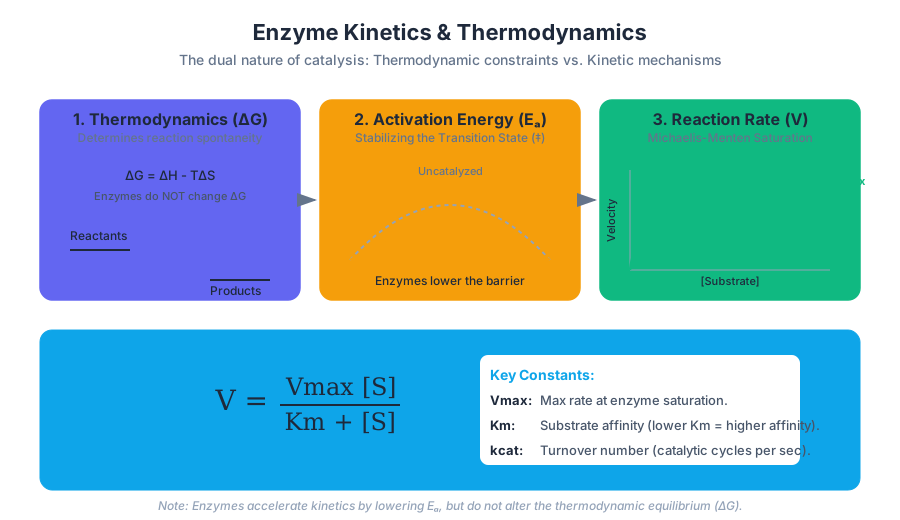
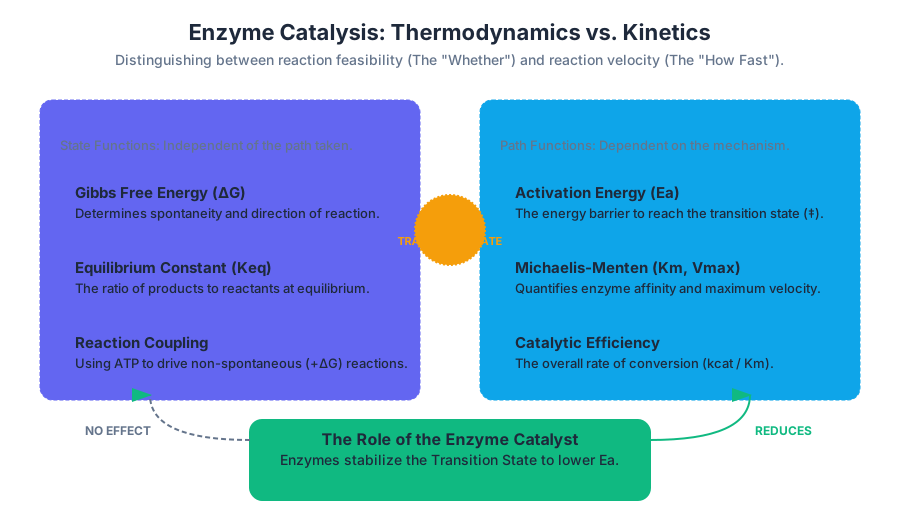
Enzymes are the sophisticated molecular machines that underpin all biological life. While a simple chemical reaction might take centuries to occur spontaneously, an enzyme can accelerate that same process by factors of $10^6$ to $10^{12}$. This section explores the dual nature of enzymatic catalysis: the thermodynamic constraints that dictate whether a reaction can happen, and the kinetic mechanisms that determine how fast it actually occurs.
The Thermodynamic Landscape: Free Energy (ΔG)
In biological systems, the "possibility" of a reaction is governed by the laws of thermodynamics. Specifically, we look at the Gibbs Free Energy (ΔG), which represents the energy available to do work at constant temperature and pressure.
The First Law of Bio-Thermodynamics: Enzymes do not, and cannot, alter the equilibrium constant ($K_{eq}$) or the total free energy change ($\Delta G$) of a reaction. They only change the path taken to reach that equilibrium.
Gibbs Free Energy and Spontaneity
The relationship between enthalpy ($\Delta H$), entropy ($\Delta S$), and temperature ($T$) is defined by the equation: $$\Delta G = \Delta H - T\Delta S$$
A reaction is exergonic (spontaneous) if $\Delta G < 0$ and endergonic (non-spontaneous) if $\Delta G > 0$. In the context of metabolic pathways, cells often perform endergonic reactions by reaction coupling—linking a non-spontaneous reaction to a highly spontaneous one, such as the hydrolysis of ATP.
| Parameter | Symbol | Definition | Impact on Spontaneity |
|---|---|---|---|
| Gibbs Free Energy | $\Delta G$ | Total energy available for work | Negative value indicates spontaneity. |
| Enthalpy | $\Delta H$ | Total heat content of the system | Exothermic ($\Delta H < 0$) favors spontaneity. |
| Entropy | $\Delta S$ | Degree of disorder/randomness | Increase ($\Delta S > 0$) favors spontaneity. |
| Standard Free Energy | $\Delta G^{\circ'}$ | $\Delta G$ at pH 7, 25°C, 1M concentration | Benchmarking constant for biochemical reactions. |
Reaction Coupling and Flux
In a metabolic pathway, the overall $\Delta G$ is the sum of the individual steps. This allows a cell to "pull" a reaction forward even if a specific intermediate step is slightly unfavorable, provided the subsequent step is highly favorable (a concept known as metabolic flux).
Activation Energy and the Transition State
If a reaction is exergonic, why doesn't it happen instantly? The answer lies in the Activation Energy ($E_a$). Even if the products are at a lower energy state than the reactants, the system must first pass through a high-energy, unstable configuration known as the Transition State (‡).
How Enzymes Lower $E_a$
Enzymes function by stabilizing this transition state. By providing an environment (the active site) that is chemically complementary to the transition state, the enzyme reduces the energy "hump" the reactants must climb.
- Proximity and Orientation: The enzyme holds substrates in the exact geometry required for the reaction to occur.
- Microenvironment: The active site may exclude water, change local pH, or provide metal ion cofactors to facilitate electron transfer.
- Induced Fit: As the substrate binds, the enzyme undergoes a conformational change that strains the substrate’s bonds, pushing it toward the transition state.
Mathematical Representation of Reaction Rates
The relationship between the rate constant ($k$) and activation energy is described by the Arrhenius Equation: $$k = Ae^{-E_a / RT}$$ Where $A$ is the frequency factor, $R$ is the gas constant, and $T$ is temperature. Because $E_a$ is in the exponent, even a small reduction in activation energy results in a massive increase in the reaction rate.
Michaelis-Menten Kinetics
To quantify how well an enzyme works, we use the Michaelis-Menten model. This model assumes a simple two-step process: the formation of an Enzyme-Substrate (ES) complex, followed by the catalytic step that releases the product (P).
$$E + S \xrightarrow{k_1, k_{-1}} ES \xrightarrow{k_{cat}} E + P$$
The Michaelis-Menten Equation
The fundamental equation relating reaction velocity ($V$) to substrate concentration $[S]$ is: $$V = \frac{V_{max}[S]}{K_m + [S]}$$
| Constant | Name | Meaning |
|---|---|---|
| $V_{max}$ | Maximum Velocity | The rate when the enzyme is fully saturated with substrate. |
| $K_m$ | Michaelis Constant | The $[S]$ at which $V = 1/2 V_{max}$; inversely related to substrate affinity. |
| $k_{cat}$ | Turnover Number | Number of substrate molecules converted to product per unit time per enzyme. |
| $k_{cat}/K_m$ | Catalytic Efficiency | The "perfection" of the enzyme; limited by the rate of diffusion. |
Enzyme Inhibition: Modulating Activity
Inhibition is the primary mechanism for drug action and cellular regulation. Inhibitors are molecules that decrease the rate of an enzymatic reaction. They are classified based on where they bind and how they affect the kinetic parameters $V_{max}$ and $K_m$.
Types of Inhibition
- Competitive Inhibition: The inhibitor resembles the substrate and competes for the active site. Increasing $[S]$ can overcome this inhibition.
- Effect: $V_{max}$ stays the same; $K_m$ increases.
- Uncompetitive Inhibition: The inhibitor binds only to the Enzyme-Substrate (ES) complex. It "locks" the substrate in, preventing the reaction.
- Effect: Both $V_{max}$ and $K_m$ decrease.
- Non-competitive (Mixed) Inhibition: The inhibitor binds to an allosteric site (not the active site), regardless of whether the substrate is bound.
- Effect: $V_{max}$ decreases; $K_m$ usually stays the same (in pure non-competitive).
The Lineweaver-Burk Plot
To distinguish between these types of inhibition, scientists use the double-reciprocal plot. By taking the reciprocal of the Michaelis-Menten equation, we get a linear form: $$\frac{1}{V} = \frac{K_m}{V_{max}} \cdot \frac{1}{[S]} + \frac{1}{V_{max}}$$
\begin{aligned}
&\text{Lineweaver-Burk Analysis:} \\
&\text{y-intercept} = 1/V_{max} \\
&\text{x-intercept} = -1/K_m \\
&\text{slope} = K_m/V_{max}
\end{aligned}
| Inhibition Type | $V_{max}$ Change | $K_m$ Change | Lineweaver-Burk Intersection |
|---|---|---|---|
| Competitive | Unchanged | Increases | Intersect at Y-axis ($1/V_{max}$) |
| Uncompetitive | Decreases | Decreases | Parallel lines (Slope unchanged) |
| Non-competitive | Decreases | Unchanged | Intersect at X-axis ($-1/K_m$) |
Allosteric Regulation and Cooperativity
Not all enzymes follow Michaelis-Menten kinetics. Many regulatory enzymes exhibit allosteric regulation, where the binding of a molecule at one site affects the binding of a molecule at a distant site.
Sigmoidal Kinetics
Allosteric enzymes often show a sigmoidal (S-shaped) curve rather than a hyperbolic one. This indicates cooperativity. In positive cooperativity, the binding of the first substrate molecule makes it easier for subsequent molecules to bind. This allows the enzyme to act as a "switch," being highly sensitive to small changes in substrate concentration within a narrow range.
The Hill Equation
Cooperativity is quantified using the Hill coefficient ($n$): $$V = \frac{V_{max}[S]^n}{K_{0.5}^n + [S]^n}$$
- $n > 1$: Positive cooperativity (e.g., Hemoglobin binding Oxygen).
- $n = 1$: Non-cooperative (Michaelis-Menten).
- $n < 1$: Negative cooperativity.
Key Insight: Allosteric effectors can be activators or inhibitors. They shift the sigmoidal curve to the left (activation, lower $K_{0.5}$) or to the right (inhibition, higher $K_{0.5}$), allowing for precise "fine-tuning" of metabolic flux.
Metabolic Pathways and Feedback Loops
Enzymes rarely act in isolation. They are organized into metabolic pathways where the product of one enzyme becomes the substrate for the next.
Feedback Inhibition (End-Product Inhibition)
To maintain homeostasis, the final product of a pathway often acts as an allosteric inhibitor of the first "committed step" in that pathway. This prevents the wasteful overproduction of metabolites.
Example: Phenylketonuria (PKU)
A classic example of metabolic failure is Phenylketonuria. The enzyme phenylalanine hydroxylase (PAH) is responsible for converting the amino acid phenylalanine into tyrosine.
- The Defect: A mutation in the PAH gene leads to a non-functional enzyme.
- The Consequence: Phenylalanine builds up to toxic levels (hyperphenylalaninemia), leading to intellectual disability if not managed by diet.
- The Lesson: This illustrates the importance of enzyme "throughput." If one "pipe" in the metabolic plumbing is blocked, the entire system backs up, leading to pathological states.
Common Pitfalls in Kinetic Analysis
Even experienced researchers can stumble when interpreting enzyme data. Here are the most common traps:
- Ignoring pH and Temperature: Enzymes have narrow optima. A $V_{max}$ measured at pH 7.4 might be zero at pH 5.0 due to the protonation of critical active-site residues (like Histidine).
- Assuming $K_m$ is a Dissociation Constant ($K_d$): $K_m = (k_{-1} + k_{cat}) / k_1$. It only equals $K_d$ if $k_{cat}$ is much smaller than $k_{-1}$. In many efficient enzymes, this is not the case.
- Substrate Depletion: Michaelis-Menten assumes the "Initial Velocity" ($V_0$). If you let the reaction run too long, the substrate concentration drops, and the rate slows down naturally, leading to an underestimation of $V_{max}$.
- Non-Specific Inhibition: Some compounds inhibit enzymes by simply denaturing them or forming aggregates (detergent-like effects) rather than binding the active site.
Source Materials
Study Introductory Biology on Lykke
This course page is free to open: signed out, you can read its first two sections, and signing in, on any plan, opens the rest. The free Lykke Chrome extension syncs your own Canvas courses, so ChatGPT, Claude and Muse can answer from your classes and deadlines. It only reads Canvas.
Add the free extensionSign in to open every sectionAll sections of Introductory Biology · Browse more course pages