Introduction Philosophy
Institution: MIT
1 study materials · 4 sections
OpenStax's Introduction to Philosophy provides a comprehensive, thematic exploration of the fundamental branches of philosophical thought. The course is designed to build critical thinking and analytical skills by engaging with diverse global perspectives and primary sources. Students move through the core pillars of the discipline, including logic, epistemology, metaphysics, and value theory, to develop a well-rounded understanding of how to evaluate complex ideas and arguments.
Course Sections
Logic and Critical Thinking
Key concepts: Deductive Reasoning · Inductive Reasoning · Logical Fallacies · Syllogisms
An introduction to the formal and informal tools of philosophical inquiry, focusing on the structure of arguments and the methods of reasoning.
Logic and Critical Thinking
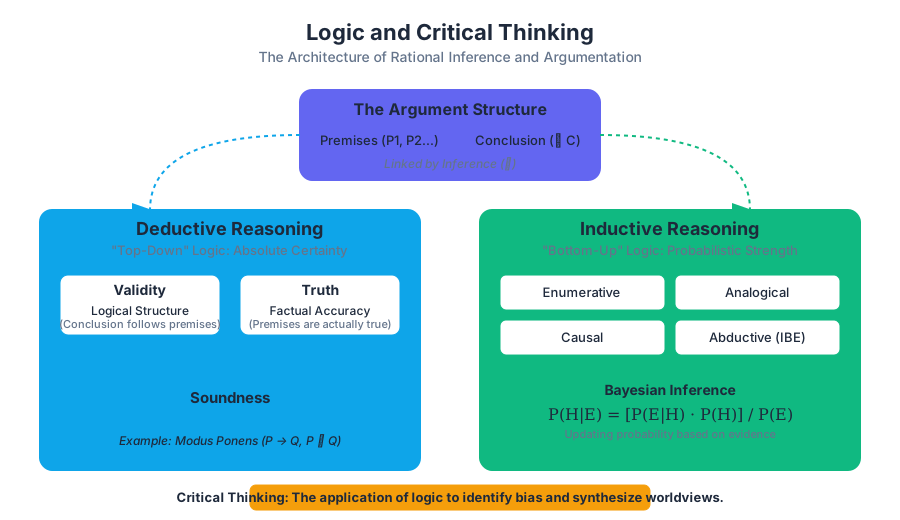
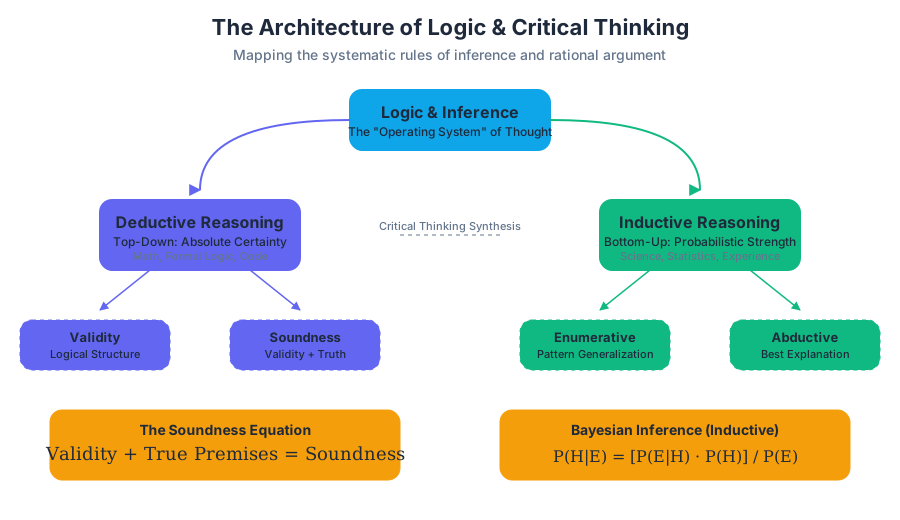
Logic is the systematic study of the rules of inference—the process by which we derive new information from existing data. In the context of philosophy and cognitive science, logic serves as the "operating system" for rational thought. It provides the formal structures necessary to evaluate whether a conclusion follows from its premises, regardless of the specific subject matter. Critical thinking is the application of these logical structures to real-world scenarios, enabling the identification of biases, the deconstruction of complex arguments, and the synthesis of coherent worldviews.
The Architecture of Arguments
At its core, an argument is a set of statements (the premises) intended to provide support or evidence for another statement (the conclusion). The relationship between these components determines the argument's quality.
Definition: Inferential Strength The degree to which the premises of an argument provide support for the conclusion. In formal systems, this is a binary (valid/invalid); in informal systems, it exists on a spectrum (weak to strong).
Structural Components of Logic
| Component | Description | Formal Symbol |
|---|---|---|
| Premise | A proposition supporting a conclusion. | $P_1, P_2, ... P_n$ |
| Conclusion | The statement being argued for. | $C$ or $\therefore$ |
| Inference | The move from premises to conclusion. | $\vdash$ (Syntactic) or $\vDash$ (Semantic) |
| Logical Operator | Connectives like "and," "or," "not," and "if...then." | $\land, \lor, \neg, \rightarrow$ |
Deductive Reasoning
Deductive reasoning is a "top-down" logic where the conclusion is claimed to follow with absolute necessity from the premises. If the structure is correct and the premises are true, the conclusion cannot be false. This is the domain of mathematics, formal geometry, and computer science.
Validity vs. Soundness
A common point of confusion in deductive logic is the distinction between validity and soundness.
- Validity: Refers strictly to the structure of the argument. An argument is valid if, assuming the premises are true, the conclusion must follow.
- Soundness: Refers to a valid argument that also possesses actually true premises.
The Soundness Equation:
Validity + True Premises = Soundness
Syllogisms
The most famous form of deductive reasoning is the syllogism, pioneered by Aristotle. A categorical syllogism consists of exactly three categorical propositions (two premises and a conclusion) and three terms, each of which appears twice.
Classic Example (Modus Ponens):
- If it is raining, the ground is wet. ($P \rightarrow Q$)
- It is raining. ($P$)
- Therefore, the ground is wet. ($\therefore Q$)
Implementation: Propositional Logic Evaluator
In computational logic, we can represent these structures using Boolean algebra. The following Python snippet demonstrates a simple engine to evaluate the truth value of a deductive argument based on premise states.
class DeductiveEngine:
    """
    A basic engine to evaluate propositional logic structures.
    Supports Modus Ponens and Modus Tollens.
    """
    def __init__(self, p_state: bool, q_state: bool, implication: bool):
        self.p = p_state
        self.q = q_state
        self.p_implies_q = implication

    def evaluate_modus_ponens(self):
        # Rule: If (P -> Q) is True AND P is True, then Q must be True.
        if self.p_implies_q and self.p:
            return f"Inference Valid: Q is {self.q} (Expected: True)"
        return "Modus Ponens conditions not met."

    def evaluate_modus_tollens(self):
        # Rule: If (P -> Q) is True AND Q is False, then P must be False.
        if self.p_implies_q and not self.q:
            return f"Inference Valid: P is {self.p} (Expected: False)"
        return "Modus Tollens conditions not met."

# Example Usage:
# Premise 1: If it's a square (P), it's a rectangle (Q). (True)
# Premise 2: It is a square (P = True).
engine = DeductiveEngine(p_state=True, q_state=True, implication=True)
print(engine.evaluate_modus_ponens())
Inductive Reasoning
Unlike deduction, inductive reasoning is "bottom-up." It involves using specific observations to reach a general conclusion. Induction does not deal in certainty; it deals in probability and strength.
The Problem of Induction
David Hume famously argued that induction cannot be rationally justified because it relies on the "Uniformity of Nature"—the assumption that the future will resemble the past. Since this assumption itself is based on induction, the reasoning is circular. However, induction remains the backbone of the scientific method.
Types of Inductive Arguments
| Type | Mechanism | Example |
|---|---|---|
| Enumerative | Generalizing from a sample to a population. | "Every swan I've seen is white; therefore, all swans are white." |
| Analogical | Comparing two similar things and inferring a shared trait. | "Drug A worked in mice; mice are mammals; Drug A will work in humans." |
| Causal | Inferring a cause-and-effect relationship based on correlation. | "The light turns on every time I flip this switch." |
| Abductive | Inference to the best explanation (IBE). | "The grass is wet; it most likely rained (rather than a giant sprayer passing by)." |
Mathematical Representation: Bayesian Inference
In modern logic, induction is often modeled using Bayes' Theorem, which updates the probability of a hypothesis ($H$) as more evidence ($E$) becomes available.
P(H|E) = \frac{P(E|H) \cdot P(H)}{P(E)}
- $P(H|E)$: Posterior probability (Probability of hypothesis given evidence).
- $P(E|H)$: Likelihood (Probability of evidence given hypothesis).
- $P(H)$: Prior probability (Initial probability of hypothesis).
- $P(E)$: Marginal likelihood (Total probability of evidence).
Logical Fallacies
A fallacy is a flaw in reasoning that renders an argument invalid (deductive) or weak (inductive). Fallacies are categorized into Formal and Informal.
Formal Fallacies
These occur when the very structure of the argument is flawed.
- Affirming the Consequent: If $P$ then $Q$; $Q$; therefore $P$. (Invalid because $Q$ could happen for other reasons).
- Denying the Antecedent: If $P$ then $Q$; not $P$; therefore not $Q$.
Informal Fallacies
These relate to the content and context of the argument.
| Fallacy | Description | Example |
|---|---|---|
| Ad Hominem | Attacking the person instead of the argument. | "You're wrong because you're a jerk." |
| Straw Man | Misrepresenting an opponent's position to make it easier to attack. | "You want to reduce military spending? Why do you want our country to be defenseless?" |
| False Dilemma | Presenting only two options when more exist. | "Either we go to war, or we are cowards." |
| Begging the Question | Circular reasoning where the conclusion is in the premise. | "The Bible is true because God wrote it, and we know God exists because the Bible says so." |
| Slippery Slope | Claiming a small step will lead to a chain of disastrous events. | "If we let students use calculators, eventually they won't be able to do basic addition." |
Real-World Logic: Logic Programming (Prolog)
To see how logic is used in "Expert Systems," we look at Prolog, a language where you define facts and rules, and the engine uses backtracking to find truths.
% Facts
mortal(X) :- man(X).
man(socrates).
man(plato).
man(aristotle).

% Rules
philosopher(socrates).
philosopher(plato).
philosopher(aristotle).

% A query to find all mortal philosophers
% Usage: ?- philosopher(Who), mortal(Who).
% Output: Who = socrates ; Who = plato ; Who = aristotle.
Critical Thinking and Cognitive Biases
Logic provides the rules, but critical thinking is the discipline of applying them while being aware of human cognitive limitations. Even with perfect logic, human brains are prone to heuristics—mental shortcuts that lead to systematic errors.
The Dual-Process Theory
Psychologists (notably Daniel Kahneman) suggest two systems of thought:
- System 1: Fast, instinctive, and emotional. (Prone to fallacies).
- System 2: Slower, more deliberative, and logical. (Where formal logic resides).
Key Biases to Mitigate
- Confirmation Bias: The tendency to search for, interpret, and recall information in a way that confirms one's pre-existing beliefs.
- Dunning-Kruger Effect: A cognitive bias where people with low ability at a task overestimate their ability.
- Availability Heuristic: Overestimating the importance of information that is easy to recall (e.g., fearing shark attacks more than heart disease).
Advanced Logic: Modal and Predicate Logic
While basic logic deals with simple propositions, advanced logic expands the scope to include "possibility" and "quantification."
Predicate Logic (First-Order Logic)
Introduces quantifiers:
- Universal Quantifier ($\forall$): "For all..."
- Existential Quantifier ($\exists$): "There exists at least one..."
Example: $\forall x (Human(x) \rightarrow Mortal(x))$ — For all $x$, if $x$ is human, then $x$ is mortal.
Modal Logic
Introduces operators for necessity and possibility:
- $\Box P$: It is necessary that $P$.
- $\Diamond P$: It is possible that $P$.
Real-World Usage: Database Constraints (SQL)
Relational databases are built on Predicate Logic and Set Theory. A WHERE clause is essentially a logical predicate.
-- Using logic to filter a set of entities
SELECT name, age
FROM citizens
WHERE (status = 'active' AND age >= 18) -- Logical Conjunction
   OR (status = 'exempt');              -- Logical Disjunction

-- Using Existential Quantifiers
SELECT *
FROM orders o
WHERE EXISTS (
    SELECT 1 FROM items i
    WHERE i.order_id = o.id AND i.price > 1000
);
Summary of Logical Systems
| Feature | Deductive Logic | Inductive Logic | Abductive Logic |
|---|---|---|---|
| Goal | Certainty / Necessity | Probability / Strength | Plausibility / Best Fit |
| Information | Conclusion is "contained" in premises. | Conclusion goes beyond premises. | Conclusion explains premises. |
| Evaluation | Valid / Invalid | Strong / Weak | Cogent / Non-cogent |
| Primary Use | Math, Code, Formal Proofs | Science, Statistics | Diagnosis, Detectives |
Epistemology: The Study of Knowledge
Key concepts: Skepticism · Empiricism · Rationalism · Justified True Belief
This section explores the nature, sources, and limits of human knowledge, asking how we know what we claim to know.
Epistemology: The Study of Knowledge
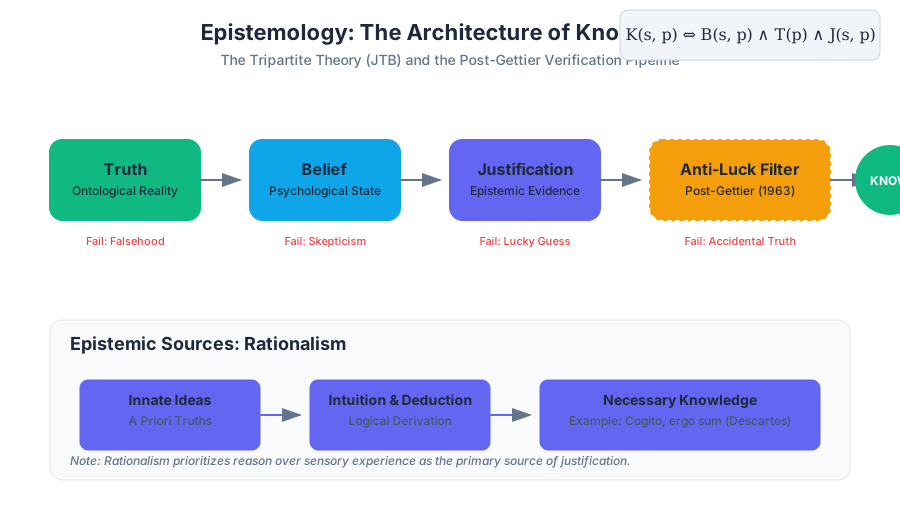
Epistemology is the branch of philosophy concerned with the nature, origin, scope, and limits of human knowledge. Derived from the Greek words episteme (knowledge) and logos (reason/study), it functions as the "operating system" of intellectual inquiry. While metaphysics asks what exists, epistemology asks how we can justify our claims about what exists. In the context of modern information theory and cognitive science, epistemology provides the formal framework for distinguishing between raw data, information, and actionable intelligence.
The Architecture of Knowledge: Justified True Belief (JTB)
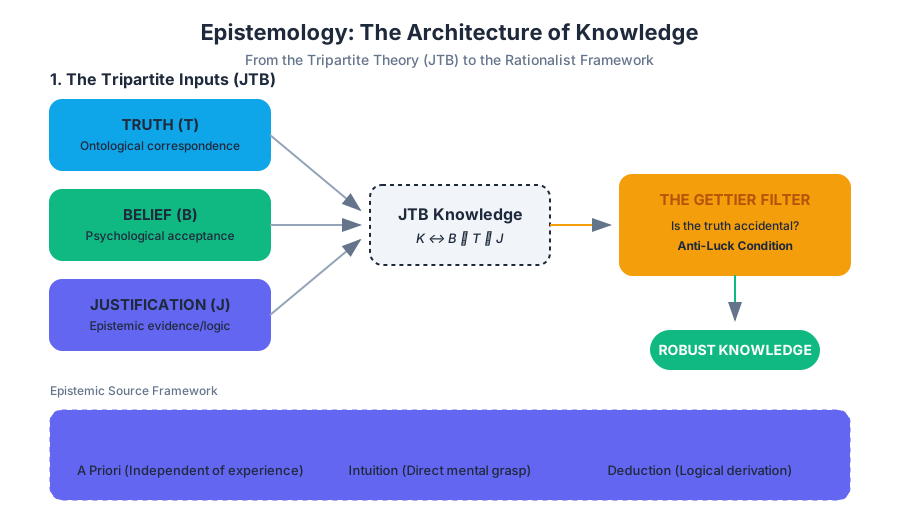
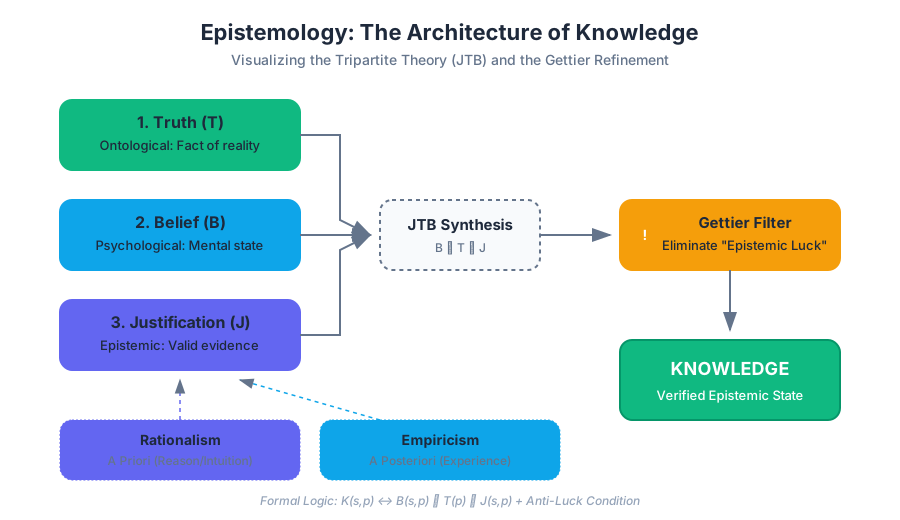
The traditional account of knowledge, originating in Plato’s Theaetetus, is the Tripartite Theory, which defines knowledge as Justified True Belief (JTB). Under this framework, for a subject $S$ to know a proposition $P$, three necessary and sufficient conditions must be met:
- Truth: $P$ must actually be the case. One cannot "know" that the moon is made of cheese if it is not.
- Belief: $S$ must actually believe that $P$ is true. One cannot "know" something they are skeptical of or indifferent toward.
- Justification: $S$ must have a valid reason or evidence for believing $P$. A lucky guess does not constitute knowledge.
Formalizing JTB
In formal logic, we can represent the JTB criteria as a conjunction of predicates. If $K(s, p)$ represents "$s$ knows $p$," then:
$$K(s, p) \iff B(s, p) \land T(p) \land J(s, p)$$
Where:
- $B(s, p)$: Subject $s$ believes $p$.
- $T(p)$: Proposition $p$ is true.
- $J(s, p)$: Subject $s$ is justified in believing $p$.
The JTB Component Matrix
| Component | Domain | Requirement | Failure Mode |
|---|---|---|---|
| Belief | Psychological | Internal mental state of acceptance. | Cognitive dissonance or doubt. |
| Truth | Ontological | Correspondence with objective reality. | Falsehood or delusion. |
| Justification | Epistemic | Sufficient evidence, logic, or testimony. | Lucky guess or "Gettier case." |
The Gettier Problem: The Collapse of JTB
In 1963, Edmund Gettier published a three-page paper that fundamentally disrupted 2,000 years of consensus. He provided counterexamples—now called Gettier Cases—where a subject has a justified true belief that is clearly not knowledge because the truth of the belief relies on a "stroke of luck" that bypasses the justification.
Definition: Gettier Case A scenario where a person has a belief that is both true and justified, but the justification is not connected to the truth in the right way, usually due to an intervening element of luck.
Implementation: A Logic-Based Knowledge Verifier
The following Python implementation demonstrates a simplified epistemic engine that evaluates whether a "belief" qualifies as "knowledge" under the JTB framework, including a check for "Gettier-style" environmental luck.
class EpistemicState:
    def __init__(self, subject_belief, objective_truth, justification_strength, environmental_luck=False):
        self.belief = subject_belief          # Boolean: Does the agent believe it?
        self.truth = objective_truth          # Boolean: Is it actually true?
        self.justification = justification_strength  # Float: 0.0 to 1.0
        self.luck_factor = environmental_luck # Boolean: Is the truth accidental?

    def is_knowledge(self, threshold=0.8):
        """
        Evaluates knowledge based on JTB + Anti-Luck condition.
        """
        # 1. Belief Condition
        if not self.belief:
            return False, "Condition Failed: Subject does not believe the proposition."

        # 2. Truth Condition
        if not self.truth:
            return False, "Condition Failed: The proposition is false."

        # 3. Justification Condition
        if self.justification < threshold:
            return False, f"Condition Failed: Justification ({self.justification}) is below threshold."

        # 4. Anti-Luck Condition (Post-Gettier refinement)
        if self.luck_factor:
            return False, "Condition Failed: Gettier Case detected. Truth is accidental."

        return True, "Success: Proposition qualifies as Knowledge."

# Example: The 'Clock on the Wall' Gettier Case
# A man looks at a clock that says 12:00. He believes it is 12:00.
# It IS 12:00, but the clock is actually broken.
clock_case = EpistemicState(
    subject_belief=True,
    objective_truth=True,
    justification_strength=0.9, # Looking at a clock is usually great justification
    environmental_luck=True      # The clock is broken; he just happened to look at the right time
)

status, message = clock_case.is_knowledge()
print(f"Result: {status} | Reason: {message}")
Rationalism: Knowledge through Reason
Rationalism is the epistemic position that reason is the primary source of knowledge, independent of sensory experience. Rationalists argue that the human mind possesses innate ideas or the capacity to derive complex truths from self-evident axioms.
Core Tenets of Rationalism
- A Priori Knowledge: Knowledge that is independent of experience (e.g., $2 + 2 = 4$).
- Intuition and Deduction: The mind "sees" basic truths (intuition) and moves to new truths via logical steps (deduction).
- Innatism: The belief that we are born with certain structures or concepts (e.g., God, infinity, substance).
Key Figures
- René Descartes: Famous for his "Method of Doubt." He sought a foundation that could not be shaken, leading to the Cogito, ergo sum ("I think, therefore I am").
- Baruch Spinoza: Proposed a geometric model of ethics and reality, deriving everything from the concept of a single "Substance."
- Gottfried Wilhelm Leibniz: Argued for "necessary truths" that are true in all possible worlds.
Mathematical Derivation: The Rationalist Proof
Rationalists often use the structure of a mathematical proof to demonstrate how knowledge can be built without sensory input.
\text{Axiom 1: } P \implies Q \quad \text{(If it is raining, the ground is wet)}
\text{Axiom 2: } P \quad \text{(It is raining)}
\text{------------------------------------------------}
\text{Conclusion: } \therefore Q \quad \text{(The ground is wet)}
This syllogism provides certainty regardless of whether one actually looks outside, provided the axioms are true.
Empiricism: Knowledge through Experience
Empiricism stands in direct opposition to Rationalism, asserting that all knowledge originates in sensory experience. For the empiricist, the mind at birth is a tabula rasa (blank slate).
Core Tenets of Empiricism
- A Posteriori Knowledge: Knowledge derived from sensory observation and data.
- Induction: The process of drawing general conclusions from specific instances (e.g., "Every swan I have seen is white, therefore all swans are white").
- Sensory Perception: The only reliable interface between the subject and reality.
Key Figures
- John Locke: Distinguished between Primary Qualities (objective properties like extension and motion) and Secondary Qualities (subjective properties like color and taste).
- George Berkeley: Took empiricism to its extreme with Idealism, arguing that "to be is to be perceived" (esse est percipi).
- David Hume: A radical empiricist who questioned the validity of induction and the concept of causality itself.
Comparison: Rationalism vs. Empiricism
| Feature | Rationalism | Empiricism |
|---|---|---|
| Primary Source | Reason / Intellect | Sensory Perception |
| Innate Ideas | Yes (Born with concepts) | No (Tabula Rasa) |
| Model Discipline | Mathematics / Logic | Natural Sciences / Biology |
| Methodology | Deduction (Top-Down) | Induction (Bottom-Up) |
| Certainty | Possible for abstract truths | Always probabilistic/tentative |
Data Representation: Querying the Empirical World
In an empirical framework, knowledge is treated like a database query where the "truth" is only as good as the "data" collected.
-- An empirical query to determine the 'truth' of a property based on observation
SELECT
    observation_value,
    COUNT(*) as frequency,
    AVG(confidence_score) as reliability
FROM sensory_input_log
WHERE object_type = 'Swan'
GROUP BY observation_value
ORDER BY frequency DESC;

/*
Result might show:
observation_value | frequency | reliability
------------------|-----------|------------
'White'           | 10000     | 0.99
'Black'           | 1         | 1.00
*/
Skepticism: The Limits of Certainty
Skepticism is the philosophical position that we should suspend judgment or that certain knowledge is impossible. It is not merely "cynicism," but a rigorous methodological challenge to the foundations of our beliefs.
Varieties of Skepticism
- Global Skepticism: The claim that we cannot know anything at all about the world.
- Local Skepticism: Doubt directed at specific domains (e.g., religious skepticism, moral skepticism).
- Methodological Skepticism: Using doubt as a tool to find certainty (e.g., Descartes’ "Evil Demon" or the modern "Simulation Theory").
The Regress Argument (Münchhausen Trilemma)
To justify a belief $A$, one must provide evidence $B$. But $B$ itself requires justification $C$. This leads to three unsatisfactory outcomes:
- Infinite Regress: The chain of justification never ends.
- Circular Reasoning: $A$ is justified by $B$, and $B$ is justified by $A$.
- Dogmatic Foundation: The chain stops at an arbitrary point that is accepted without further proof (Foundationalism).
Common Pitfalls in Epistemic Reasoning
- Confirmation Bias: Only seeking evidence that supports existing beliefs.
- Solipsism: The extreme skeptical position that only one's own mind is sure to exist.
- Dunning-Kruger Effect: A meta-epistemic failure where a subject lacks the knowledge to recognize their own lack of knowledge.
The Synthesis: Kantian Epistemology
Immanuel Kant attempted to bridge the gap between Rationalism and Empiricism with his Transcendental Idealism. He argued that while all our knowledge begins with experience, it does not all arise out of experience.
Key Insight: The Copernican Revolution in Philosophy Instead of the mind conforming to the world, the world (as we experience it) conforms to the structures of the mind.
Kant proposed that the human mind uses "Categories of Understanding" (like Space, Time, and Causality) to process raw sensory data. We can never know the Noumena (the thing-in-itself), only the Phenomena (the thing-as-it-appears to us).
System Architecture: The Kantian Processor
Think of the mind as a low-level system driver that formats raw hardware interrupts (sensory data) into a high-level UI (perception).
// A Rust-style metaphor for Kantian 'Categories of Understanding'
struct SensoryData {
    raw_signal: Vec<u8>,
}

struct Phenomenon {
    spatial_coordinates: (f64, f64, f64),
    timestamp: u64,
    causal_link: Option<Box<Phenomenon>>,
    object_identity: String,
}

trait Mind {
    // The 'Transcendental Schema' that processes raw data into experience
    fn synthesize(&self, data: SensoryData) -> Phenomenon;
}

impl Mind for HumanCognition {
    fn synthesize(&self, data: SensoryData) -> Phenomenon {
        // The mind 'imposes' space and time onto the raw signal
        Phenomenon {
            spatial_coordinates: (0.0, 0.0, 0.0), // Imposed category
            timestamp: 1625097600,               // Imposed category
            causal_link: None,                   // Imposed category
            object_identity: String::from("External Object"),
        }
    }
}
Modern Formal Epistemology: Bayesianism
In contemporary settings, epistemology often moves away from binary "Knowledge vs. Ignorance" and toward Bayesian Epistemology, which deals with degrees of belief (credences).
Bayes' Theorem in Epistemology
Bayes' Theorem provides a mathematical way to update our beliefs based on new evidence:
$$P(H|E) = \frac{P(E|H) \cdot P(H)}{P(E)}$$
Where:
- $P(H|E)$: The Posterior probability (belief in hypothesis $H$ after seeing evidence $E$).
- $P(E|H)$: The Likelihood (probability of seeing $E$ if $H$ is true).
- $P(H)$: The Prior (initial belief in $H$).
- $P(E)$: The Evidence (total probability of seeing $E$).
Probability vs. Certainty Matrix
| Feature | Traditional JTB | Bayesian Epistemology |
|---|---|---|
| Output | Binary (Known / Unknown) | Continuous (0.0 to 1.0) |
| Justification | Logical proof or strong evidence | Statistical updating |
| Handling Error | Knowledge is lost if truth is false | Credence is adjusted downward |
| Primary Goal | Finding absolute truth | Minimizing "Surprise" (Entropy) |
Summary of Epistemic Schools
| School | Key Proponent | Source of Knowledge | View on Innate Ideas |
|---|---|---|---|
| Rationalism | Descartes | Reason / Logic | Yes |
| Empiricism | Locke / Hume | Senses / Observation | No (Tabula Rasa) |
| Skepticism | Sextus Empiricus | None (Doubt) | N/A |
| Constructivism | Piaget / Kant | Social/Mental Construction | Structural only |
| Reliabilism | Alvin Goldman | Reliable Processes | N/A |
Metaphysics: The Nature of Reality
Key concepts: Ontology · Dualism · Materialism · Free Will vs. Determinism
An investigation into the fundamental nature of existence, reality, and the relationship between mind and matter.
Metaphysics: The Nature of Reality
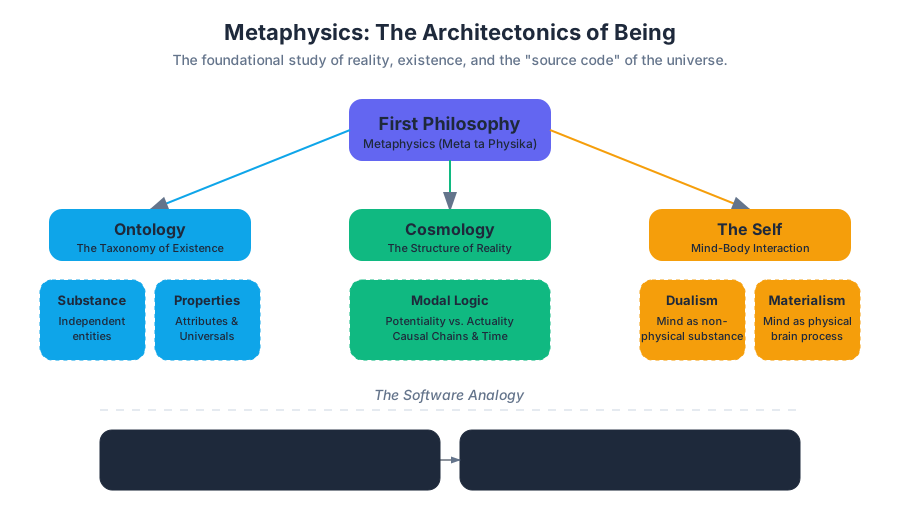
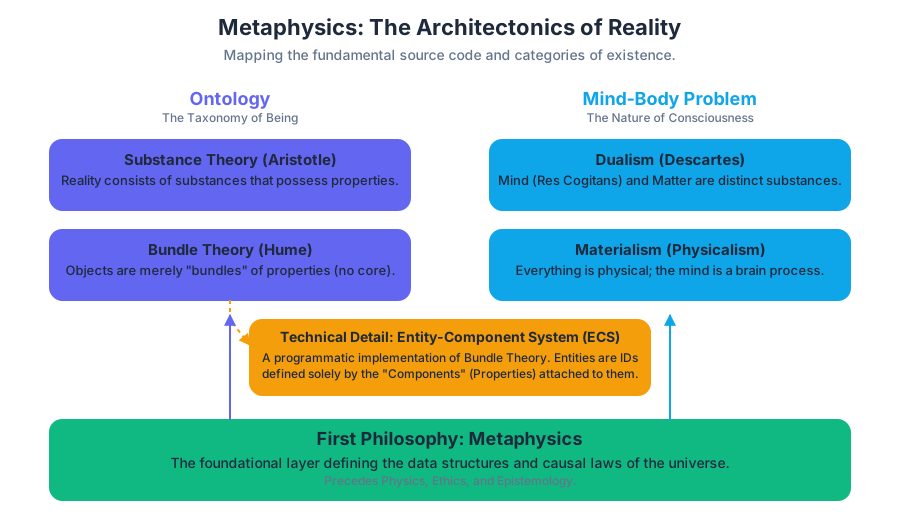
Metaphysics is the branch of philosophy concerned with the fundamental nature of reality, including the relationship between mind and matter, between substance and attribute, and between potentiality and actuality. Often termed "First Philosophy" by Aristotle, it functions as the foundational layer upon which all other inquiries—scientific, ethical, and epistemological—are built. While physics investigates the laws governing the behavior of matter within the universe, metaphysics investigates the very nature of "being" and the categories of existence that make such a universe possible.
Overview: The Architectonics of Being
At its core, metaphysics addresses the "Why" and "What" of existence that precede empirical observation. If we view the universe as a complex software system, physics describes the runtime behavior and API calls, while metaphysics describes the underlying source code, the data structures, and the hardware architecture that define what can and cannot happen.
Definition: Metaphysics Derived from the Greek meta ta physika ("after the things of nature"), metaphysics is the systematic study of the fundamental principles of reality. It seeks to define the nature of existence (Ontology), the structure of the universe (Cosmology), and the nature of the self and consciousness.
Metaphysical inquiry is not merely speculative; it is a rigorous analytical process. It utilizes modal logic to explore "possible worlds," mereology to understand parts and wholes, and causal theory to map the chain of events that constitute history.
### Ontology: The Taxonomy of Existence
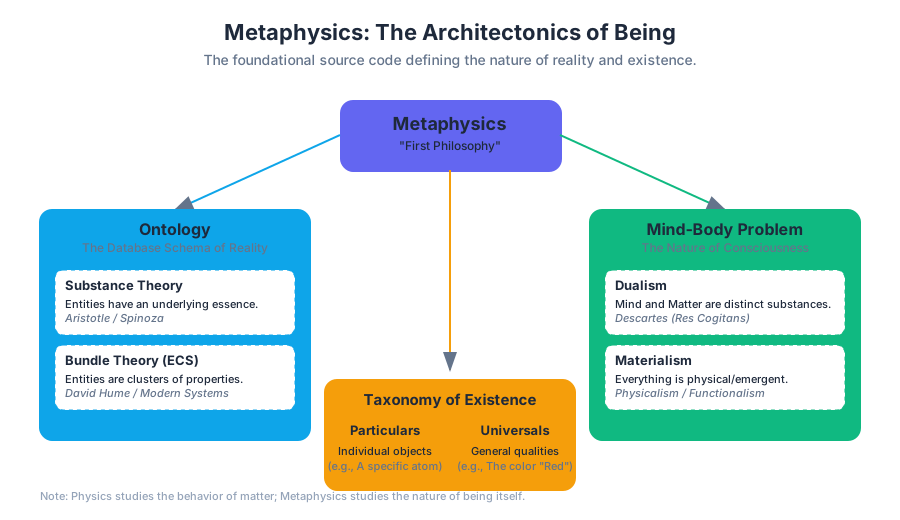
Ontology is the formal study of what exists. It is the "database schema" of reality. In ontology, we ask: What are the fundamental categories of things? Do numbers exist in the same way that rocks do? Are properties (like the color "red") real entities, or just linguistic shortcuts?
1. What it is
Ontology seeks to establish a "Complete Inventory of the Universe." It distinguishes between Particulars (individual things like a specific chair) and Universals (general qualities like "chairness" or "redness").
2. Why it matters
Without an ontological framework, we cannot perform coherent science or mathematics. For instance, if a scientist claims a "force" exists, they are making an ontological commitment. In computer science, an "ontology" is a formal naming and definition of the types, properties, and interrelationships of the entities that exist for a particular domain of discourse.
3. How it works: Substance vs. Properties
The most common ontological distinction is between Substance (that which exists in itself) and Properties (qualities that belong to a substance).
| Theory | Description | Key Proponent |
|---|---|---|
| Substance Theory | Reality consists of substances that possess properties. | Aristotle / Spinoza |
| Bundle Theory | Objects are merely "bundles" of properties with no underlying substance. | David Hume |
| Process Ontology | Change and dynamic processes are the fundamental elements of reality. | A.N. Whitehead |
| Nominalism | Universals (like "redness") do not exist; only individual particulars exist. | William of Ockham |
4. Concrete Example: The Entity-Component System (ECS)
In systems programming, we often model ontology through an Entity-Component System. This mirrors the metaphysical debate between Substance and Bundle theory.
/*
 * A Low-Level Ontological Implementation: Entity-Component System (ECS)
 * This mimics 'Bundle Theory' where an entity is defined solely by its components.
 */

#include <stdint.h>
#include <stdbool.h>

#define MAX_ENTITIES 1024

// Components represent 'Properties' in Metaphysics
typedef struct {
    float x, y, z;
} Position;

typedef struct {
    float mass;
    float velocity;
} Physics;

// The 'Entity' is just an ID—a placeholder for a bundle of properties
typedef uint32_t Entity;

// The 'World' represents the Ontological Space
typedef struct {
    bool active[MAX_ENTITIES];
    Position positions[MAX_ENTITIES];
    Physics physics_data[MAX_ENTITIES];
} World;

void update_system(World* world) {
    for (Entity i = 0; i < MAX_ENTITIES; i++) {
        if (world->active[i]) {
            // Logic defining the 'Causal Laws' of this reality
            world->positions[i].x += world->physics_data[i].velocity;
        }
    }
}
5. Common Pitfalls: The Reification Fallacy
A common error in ontology is Reification—treating an abstract concept (like "The Economy" or "Justice") as if it were a concrete physical substance. Metaphysicians must be careful to distinguish between linguistic constructs and ontological primitives.
### Dualism vs. Materialism: The Mind-Body Problem
The most contentious debate in metaphysics concerns the nature of the "Self." Is the mind a physical process of the brain, or is it a non-physical substance?
1. What it is
- Dualism: The view that reality consists of two distinct substances: the Res Extensa (extended material things) and the Res Cogitans (thinking, non-extended things).
- Materialism (Physicalism): The view that everything that exists is physical or is dependent on physical processes. There is no "soul" or "mind" separate from the brain.
2. Why it matters
This debate defines the limits of Artificial Intelligence, the ethics of medical brain death, and the possibility of "uploading" consciousness. If Materialism is true, a perfect simulation of a brain is a mind. If Dualism is true, the simulation lacks the "mental substance."
3. How it works: The Interaction Problem
The primary challenge for Dualism is the Interaction Problem: How can a non-physical mind cause a physical arm to move? Conversely, the challenge for Materialism is the Hard Problem of Consciousness: How do physical neurons produce the subjective "feel" (Qualia) of the color red?
| Perspective | Core Thesis | Primary Challenge |
|---|---|---|
| Substance Dualism | Mind and Body are different "stuff." | How do they interact? |
| Property Dualism | One substance (brain) has two types of properties (physical/mental). | Epiphenomenalism (Mind has no power). |
| Reductive Physicalism | Mental states are brain states. | Explanatory Gap (Qualia). |
| Functionalism | Mind is what the brain does (software/hardware). | The Chinese Room Argument. |
4. Concrete Example: Functionalism in Logic
Functionalism suggests that a mental state is defined by its causal role (inputs, outputs, and transitions) rather than its physical makeup. We can represent this using a Finite State Machine (FSM).
\begin{aligned}
& \text{Let } M \text{ be a mental state (e.g., Pain).} \\
& \text{Functionalist Definition of } M: \\
& M(i, s) \rightarrow (o, s') \\
& \text{where: } \\
& i = \text{Input (e.g., Tissue damage)} \\
& s = \text{Current internal state} \\
& o = \text{Output (e.g., "Ouch!", withdrawal reflex)} \\
& s' = \text{Next state (e.g., Anxiety, Caution)}
\end{aligned}
5. Variations: Panpsychism
An emerging alternative is Panpsychism, which suggests that consciousness is a fundamental property of all matter, much like mass or charge. This attempts to bridge the gap between Materialism and Dualism by making "mind" a universal primitive.
### Free Will vs. Determinism: The Causal Chain
If every event in the universe is caused by a preceding event according to the laws of physics, do humans have the power to choose their actions?
1. What it is
- Determinism: Every event, including human action, is necessitated by antecedent events and the laws of nature.
- Libertarianism: The belief that humans have free will and that some actions are not determined by prior causes.
- Compatibilism: The view that free will and determinism are not mutually exclusive. We are "free" if we act according to our desires, even if those desires are determined.
2. Why it matters
This is the foundation of the legal system and moral responsibility. If a murderer was "programmed" by their biology and environment to kill, can we justify punishment?
3. How it works: Laplace’s Demon
In 1814, Pierre-Simon Laplace proposed a thought experiment: If an intellect (a "Demon") knew the precise position and momentum of every atom in the universe at one moment, it could calculate the entire past and future.
4. Concrete Example: Deterministic vs. Stochastic Systems
In computing, we can simulate a deterministic "universe" vs. one with "free" (stochastic) elements.
import numpy as np

# Deterministic System: The outcome is fixed by initial conditions
def deterministic_universe(initial_state, steps):
    state = initial_state
    history = [state]
    for _ in range(steps):
        # A simple linear congruential generator (fixed law)
        state = (state * 1103515245 + 12345) % 2**31
        history.append(state)
    return history

# Stochastic System: Includes 'Indeterminism' (Quantum or Libertarian)
def stochastic_universe(initial_state, steps):
    state = initial_state
    history = [state]
    for _ in range(steps):
        # Law + Randomness (representing 'Free Choice' or Quantum jitter)
        noise = np.random.normal(0, 1)
        state = (state * 0.5) + noise
        history.append(state)
    return history

# Usage
print(f"Deterministic Path: {deterministic_universe(42, 5)}")
print(f"Stochastic Path: {stochastic_universe(42, 5)}")
5. Common Pitfalls: Confusing Determinism with Fatalism
Fatalism is the idea that "whatever will happen, will happen," regardless of your actions. Determinism is different: it says your actions do matter, but your actions themselves are caused. If you decide to study, you will pass; but your decision to study was determined by your personality and history.
### The Problem of Universals: Realism vs. Nominalism
Do general concepts like "The Circle" exist in a transcendent realm, or are they just names we give to groups of similar things?
1. What it is
- Platonic Realism: Universals exist as "Forms" in a non-physical realm. A physical circle is just an imperfect shadow of the "Ideal Circle."
- Nominalism: Only individuals exist. "Circle" is just a word (a nomen) used to categorize objects that look similar.
2. Why it matters
This affects how we view mathematics and logic. Are mathematical truths "discovered" (Realism) or "invented" (Nominalism)?
| Feature | Realism | Nominalism | Conceptualism |
|---|---|---|---|
| Status of "Red" | Exists independently of red things. | Just a label for a set of objects. | Exists as a mental construct. |
| Math | Numbers are real entities. | Math is a useful language. | Math is a structure of the mind. |
| Discovery | We discover objective truths. | We create useful frameworks. | We map our cognitive limits. |
3. How it works: The Schema Mapping
In database design, we deal with this daily. Is a Table a real entity, or just a collection of Rows?
-- A Nominalist Schema: Focus on the concrete instances
CREATE TABLE concrete_circles (
    id SERIAL PRIMARY KEY,
    radius FLOAT NOT NULL,
    color VARCHAR(20)
);

-- A Realist Schema: The 'Universal' (Form) is defined separately
CREATE TABLE universal_forms (
    form_id SERIAL PRIMARY KEY,
    form_name VARCHAR(50), -- e.g., 'Circle'
    ideal_properties JSONB -- e.g., '{"ratio": "pi"}'
);

CREATE TABLE instances (
    instance_id SERIAL PRIMARY KEY,
    form_id INTEGER REFERENCES universal_forms(form_id),
    deviation_from_ideal FLOAT
);
### Summary of Metaphysical Frameworks
To navigate the landscape of reality, one must choose a "stack." Most modern scientists operate on a stack of Physicalism + Determinism + Nominalism, while many religious or spiritual frameworks operate on Dualism + Libertarianism + Realism.
| Concept | Materialist Stack | Idealist/Dualist Stack |
|---|---|---|
| Ontology | Monism (Matter only) | Dualism (Mind & Matter) |
| Mind | Emergent Property | Independent Substance |
| Agency | Determinism / Compatibilism | Libertarian Free Will |
| Abstracts | Nominalism (Labels) | Realism (Forms/Ideas) |
Metaphysics remains the "final frontier" of human knowledge. As we move closer to creating sentient machines and understanding the quantum foundations of the universe, these ancient questions about substance, cause, and being become more than just academic exercises—they become the design specifications for the future of intelligence.
Value Theory: Ethics and Aesthetics
Key concepts: Normative Ethics · Metaethics · Social Contract · Aesthetics
An examination of how humans assign value to actions, objects, and social structures, covering ethics, political philosophy, and aesthetics.
Value Theory: Ethics and Aesthetics
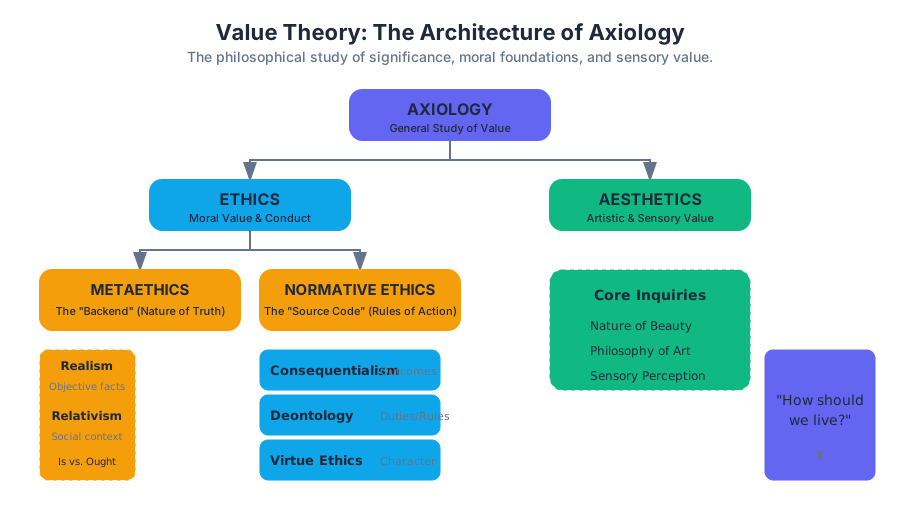
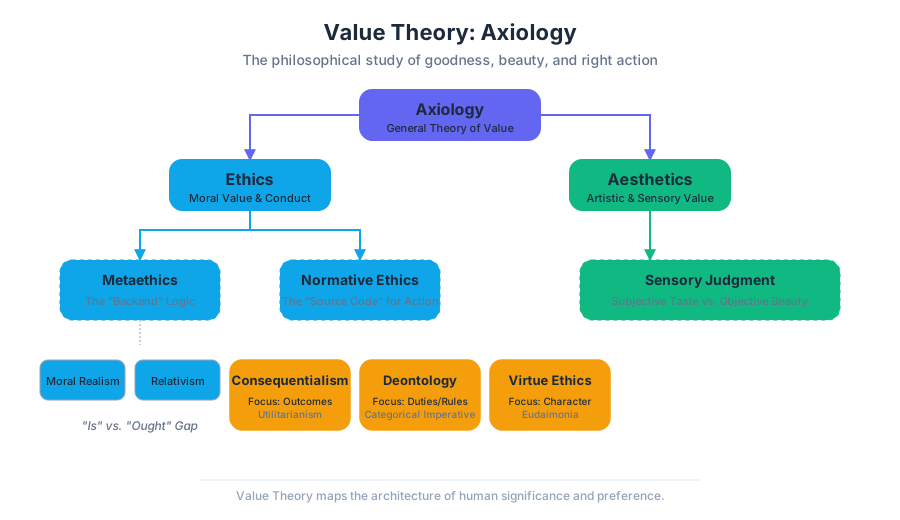
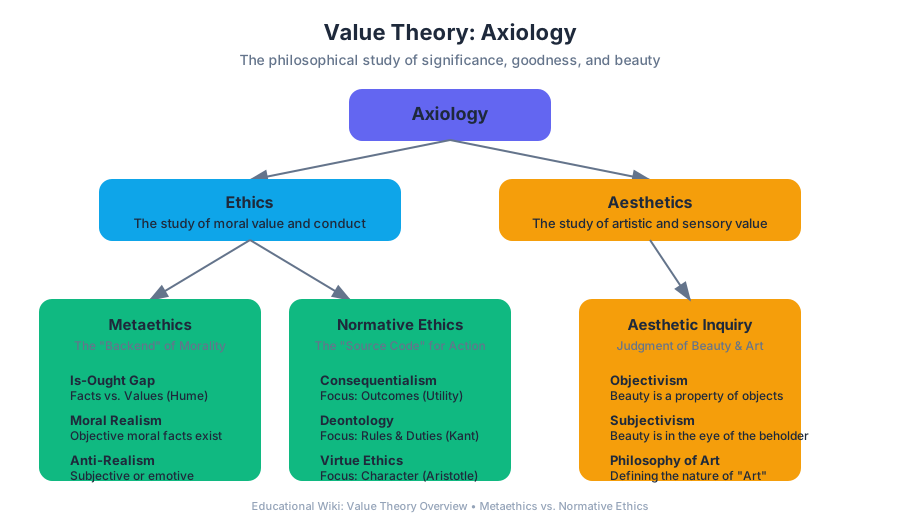
Value Theory, or Axiology, is the philosophical study of value. It encompasses a broad range of inquiries into what humans find significant, how we determine the "goodness" or "badness" of actions, and how we define beauty. While epistemology asks "What do we know?" and metaphysics asks "What is real?", value theory asks "What should we care about?" and "How should we live?"
In the modern analytical tradition, value theory is bifurcated into two primary domains: Ethics (the study of moral value) and Aesthetics (the study of artistic or sensory value). These are not merely matters of opinion; they involve rigorous logical frameworks, ontological commitments, and social architectures.
Metaethics: The Foundations of Moral Reality
Before we can determine if an action is "right," we must understand what "rightness" actually is. Metaethics is the "backend" of moral philosophy. It does not ask "Should I lie?"; instead, it asks "What does the word 'should' mean?" and "Are moral facts as real as physical facts?"
The Fact-Value Distinction
A central problem in metaethics is the Is-Ought Gap, famously articulated by David Hume. Hume argued that one cannot logically derive a statement of value (what ought to be) from a statement of fact (what is).
Hume’s Law: "In every system of morality, which I have hitherto met with, I have always remarked, that the author proceeds for some time in the ordinary way of reasoning... when of a sudden I am surprised to find, that instead of the usual copulations of propositions, is, and is not, I meet with no proposition that is not connected with an ought, or an ought not."
Metaethical Taxonomies
Metaethical positions are generally categorized based on their stance on moral truth and the nature of moral language.
| Position | Category | Core Tenet | Key Implication |
|---|---|---|---|
| Moral Realism | Objectivism | Moral facts exist independently of human opinion. | "Murder is wrong" is as true as "2+2=4." |
| Ethical Subjectivism | Anti-Realism | Moral statements describe individual feelings or attitudes. | Morality is a matter of personal preference. |
| Moral Relativism | Anti-Realism | Moral truths are relative to cultural or social contexts. | No culture's ethics are superior to another's. |
| Emotivism | Non-Cognitivism | Moral statements are expressions of emotion, not facts. | "Stealing is bad" means "Boo stealing!" |
| Error Theory | Anti-Realism | All moral claims are false because moral properties don't exist. | We are systematically mistaken about morality. |
Modeling Metaethical Logic
In a computational sense, metaethics can be viewed as the "type system" for moral propositions. If we were to implement a moral evaluator, we would first need to define the return type of a moral judgment.
# A Metaethical Evaluator Framework
from enum import Enum, auto

class MoralTruthValue(Enum):
    OBJECTIVE_TRUE = auto()
    OBJECTIVE_FALSE = auto()
    SUBJECTIVE_PREFERENCE = auto()
    EMOTIVE_EXPRESSION = auto()
    ERROR_NULL = auto()

def evaluate_proposition(statement: str, framework: str) -> MoralTruthValue:
    """
    Evaluates a moral statement based on the chosen metaethical framework.
    """
    if framework == "Realism":
        # Assumes a lookup in a 'universal moral law' database
        return MoralTruthValue.OBJECTIVE_TRUE
    elif framework == "Emotivism":
        # Statements are just signals of approval/disapproval
        return MoralTruthValue.EMOTIVE_EXPRESSION
    elif framework == "ErrorTheory":
        # All moral assertions fail to map to reality
        return MoralTruthValue.ERROR_NULL
    else:
        return MoralTruthValue.SUBJECTIVE_PREFERENCE

# Example: "Lying is wrong"
print(evaluate_proposition("Lying is wrong", "Realism"))
Normative Ethics: Frameworks for Conduct
While metaethics deals with the nature of morality, Normative Ethics provides the actual "source code" for behavior. It attempts to establish a set of rules or principles that guide us in determining right from wrong.
Consequentialism (Utilitarianism)
Consequentialism argues that the morality of an action is determined solely by its outcomes. The most prominent form is Utilitarianism, championed by Jeremy Bentham and John Stuart Mill. The core metric is the Greatest Happiness Principle.
The Greatest Happiness Principle: Actions are right in proportion as they tend to promote happiness, wrong as they tend to produce the reverse of happiness.
In mathematical terms, Utilitarianism functions as an optimization problem:
$$U(a) = \sum_{i=1}^{n} (H_i - S_i)$$
Where $U(a)$ is the total utility of action $a$, $H$ is the happiness produced for individual $i$, and $S$ is the suffering produced.
Deontology (Duty-Based Ethics)
Deontology, most famously associated with Immanuel Kant, rejects the idea that consequences matter. Instead, morality is about following universal rules. Kant proposed the Categorical Imperative, a test for whether an action is permissible.
- Universalizability: Act only according to that maxim whereby you can, at the same time, will that it should become a universal law.
- Humanity as an End: Act in such a way that you treat humanity, whether in your own person or in the person of any other, never merely as a means to an end, but always at the same time as an end.
Virtue Ethics
Derived from Aristotle’s Nicomachean Ethics, Virtue Ethics shifts the focus from what to do to who to be. It emphasizes the cultivation of character traits (virtues) like courage, temperance, and wisdom. The goal is Eudaimonia (often translated as "flourishing" or "living well").
| Feature | Utilitarianism | Deontology | Virtue Ethics |
|---|---|---|---|
| Focus | Consequences/Outcomes | Rules/Duties | Character/Habit |
| Primary Question | What produces the most good? | What is my duty? | What would a virtuous person do? |
| Core Proponent | J.S. Mill | Immanuel Kant | Aristotle |
| Weakness | Can justify harming minorities. | Can be too rigid (no lying to save a life). | Vague on specific actions. |
Formalizing the Categorical Imperative
We can represent Kant's Universalizability test as a logic check in pseudocode.
FUNCTION IsActionMoral(Action, Maxim):
    // Step 1: Universalize the maxim
    UniversalMaxim = "Everyone does " + Action + " whenever " + Maxim

    // Step 2: Check for logical contradiction
    IF UniversalMaxim.CreatesLogicalContradiction() THEN
        RETURN False // Perfect Duty violation (e.g., Lying)

    // Step 3: Check for contradiction in will
    IF UniversalMaxim.IsUnreasonableToWill() THEN
        RETURN False // Imperfect Duty violation (e.g., Not helping others)

    RETURN True
END FUNCTION
Social Contract Theory: The Ethics of Statehood
Social Contract Theory bridges the gap between individual ethics and political philosophy. It asks: Why do we have governments, and what gives them the right to tell us what to do? The theory posits that individuals consent, either explicitly or tacitly, to surrender some freedoms to an authority in exchange for the protection of their remaining rights.
The State of Nature
To understand the social contract, philosophers imagine a State of Nature—a hypothetical condition before organized society.
- Thomas Hobbes: Described the state of nature as a "war of all against all" where life is "solitary, poor, nasty, brutish, and short." For Hobbes, the social contract is a survival pact, requiring an absolute sovereign (The Leviathan) to maintain order.
- John Locke: Argued that the state of nature is governed by natural law, where individuals have rights to "Life, Liberty, and Property." The contract is a limited agreement to protect these rights. If the state fails, the people have a right to revolution.
- Jean-Jacques Rousseau: Believed humans were "noble savages" corrupted by society. His contract emphasizes the General Will—the collective interest of the citizens.
Modern Social Contract: John Rawls
John Rawls updated the theory with the Veil of Ignorance. He argued that a just society is one we would design if we didn't know our place in it (our race, gender, wealth, or talents). This leads to the Difference Principle: inequalities are only permitted if they benefit the least advantaged members of society.
Simulating Resource Contention in the State of Nature
In a system with no rules, agents compete for resources. This Rust snippet demonstrates a basic "State of Nature" where lack of coordination leads to suboptimal outcomes (The Prisoner's Dilemma).
struct Agent {
    id: u32,
    resources: i32,
}

impl Agent {
    fn interact(&mut self, other: &mut Agent, strategy: &str) {
        match strategy {
            "defect" => {
                // Hobbesian approach: Take what you can
                self.resources += 10;
                other.resources -= 10;
            }
            "cooperate" => {
                // Lockean/Social Contract approach: Mutual benefit
                self.resources += 5;
                other.resources += 5;
            }
            _ => (),
        }
    }
}

fn main() {
    let mut alice = Agent { id: 1, resources: 100 };
    let mut bob = Agent { id: 2, resources: 100 };

    // In a state of nature without a contract,
    // the dominant strategy is often defection.
    alice.interact(&mut bob, "defect");

    println!("Alice: {}, Bob: {}", alice.resources, bob.resources);
}
Aesthetics: The Nature of Beauty and Art
Aesthetics is often dismissed as "subjective," but in value theory, it is treated with the same analytical rigor as ethics. It explores the nature of aesthetic judgments and the definition of art.
The Standard of Taste
David Hume addressed the subjectivity of beauty in "Of the Standard of Taste." He acknowledged that beauty is in the eye of the beholder, but argued that some "eyes" are better than others. A True Critic possesses:
- Delicacy of imagination.
- Practice in viewing art.
- Comparison between different works.
- Freedom from prejudice.
- Good sense.
Theories of Art
What makes something a "work of art"? Philosophers have proposed several definitions:
| Theory | Definition | Example |
|---|---|---|
| Mimetic Theory | Art is an imitation of reality (Mimesis). | A realistic landscape painting. |
| Expressionism | Art is the communication of the artist's emotions. | Van Gogh’s Starry Night. |
| Formalism | Art is defined by its formal qualities (line, color, shape). | Jackson Pollock’s drip paintings. |
| Institutional Theory | Art is whatever the "Artworld" (galleries, critics) says it is. | Marcel Duchamp’s Fountain (a urinal). |
Aesthetic Properties as Metadata
In modern digital design, aesthetics are often codified into "Design Systems." We can think of an aesthetic judgment as a set of parameters applied to an object.
{
  "artwork": "The Great Wave off Kanagawa",
  "aesthetic_parameters": {
    "composition": "Golden Ratio / Rule of Thirds",
    "color_palette": ["#000080", "#FFFFFF", "#F5DEB3"],
    "balance": "Asymmetrical",
    "rhythm": "Repeating wave patterns",
    "emotional_impact": "Sublime / Awe"
  },
  "evaluations": {
    "formalist_score": 0.95,
    "mimetic_score": 0.40,
    "institutional_status": "Masterpiece"
  }
}
The Sublime vs. The Beautiful
Edmund Burke and Immanuel Kant distinguished between the Beautiful (which is small, smooth, and pleasing) and the Sublime (which is vast, powerful, and potentially terrifying). The Sublime reminds us of our own insignificance and the greatness of nature or the divine.
Synthesis: The Intersection of Values
Value theory is not a collection of isolated silos. Ethics, politics, and aesthetics constantly overlap.
- Ethical Aesthetics: Can a "bad" person create "good" art? (The "Cancel Culture" debate).
- Political Aesthetics: How is art used for propaganda or social change? (Socialist Realism vs. Street Art).
- The Ethics of Beauty: Does the pursuit of aesthetic perfection (e.g., in architecture or plastic surgery) lead to ethical harms?
As we move into an era of Artificial Intelligence, value theory becomes a technical requirement. We must encode "values" into alignment algorithms, determine the "aesthetic" of AI-generated content, and decide the "social contract" between humans and autonomous systems.
Source Materials
Study Introduction Philosophy with AI — Free on Lykke
Sign up for free to generate personalized flashcards, quizzes, and study guides from this course. Chat with an AI tutor that knows the material.
Get Started FreeView this course wiki on Lykke · Browse all public course wikis