Introduction Business
Institution: MIT
2 study materials · 4 sections
OpenStax's Introduction to Business course provides a comprehensive foundation in contemporary business principles, balancing theoretical frameworks with real-world applications. The curriculum emphasizes critical themes such as ethics, entrepreneurship, and global operations to prepare students for the complexities of the modern professional landscape. By integrating emerging trends like artificial intelligence and evolving workplace dynamics, the course ensures learners are equipped for success in a rapidly changing economic environment.
Course Sections
Foundations of Business and Decision Making
Key concepts: Decision making · Customer satisfaction
This section introduces the fundamental principles of business operations, focusing on how organizations create value and make strategic decisions to ensure customer satisfaction.
Foundations of Business and Decision Making
Every successful business begins with a clear understanding of how to create value for its stakeholders. This section explores the core functions of business and the systematic approach required to make effective decisions in a competitive marketplace. In the modern era, business is no longer a static exercise in resource management; it is a dynamic process of navigating uncertainty, leveraging data, and aligning organizational goals with human psychology.
Decision Making: The Architecture of Choice
Decision making is the cognitive process of identifying problems and opportunities and selecting a specific course of action from among several alternatives. In a business context, this is rarely a solitary event but rather a continuous cycle of data ingestion, risk assessment, and strategic execution.
The Rational Decision-Making Model
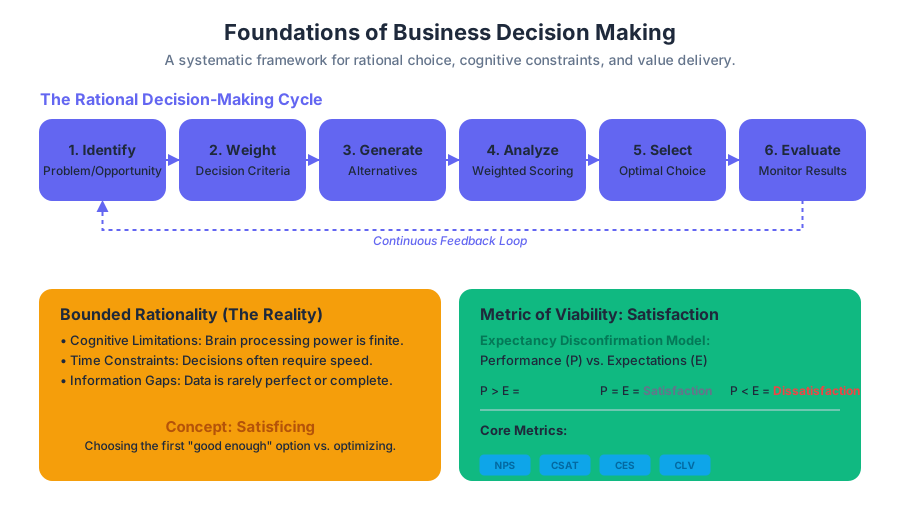
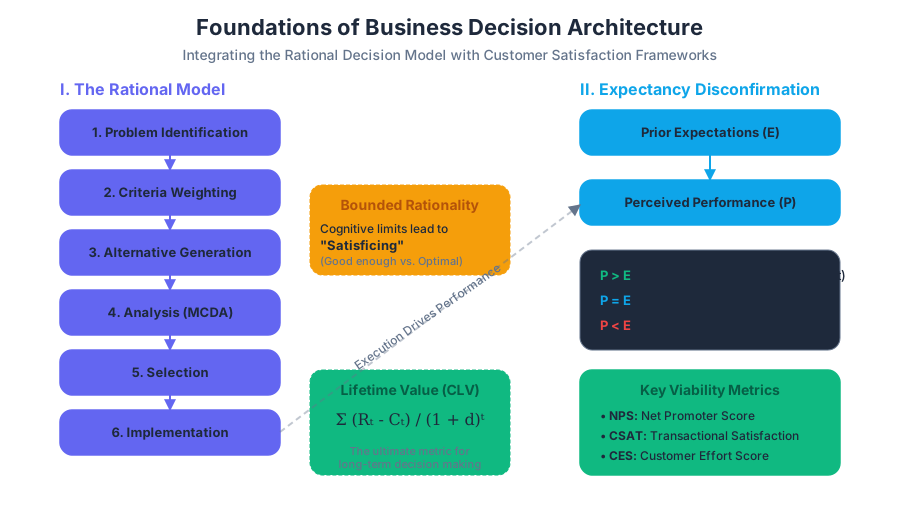
The classical view of decision-making assumes that managers act as "rational actors" who maximize utility through a structured sequence. This model is foundational for understanding how organizations should behave, even if human limitations often interfere.
- Problem Identification: Recognizing a discrepancy between the current state and the desired state.
- Criteria Weighting: Determining which factors (cost, speed, quality) are most important.
- Alternative Generation: Developing a comprehensive list of potential solutions.
- Analysis: Evaluating each alternative against the weighted criteria.
- Selection: Choosing the alternative with the highest calculated value.
- Implementation and Evaluation: Executing the choice and monitoring results to close the feedback loop.
The Principle of Bounded Rationality: Proposed by Herbert Simon, this concept suggests that human decision-making is limited by the information available, the cognitive limitations of the mind, and the finite amount of time. Instead of "optimizing," managers often "satisfice"—choosing the first solution that meets the minimum threshold of acceptability.
Comparative Decision Frameworks
| Feature | Rational Model | Bounded Rationality | Intuitive Model |
|---|---|---|---|
| Information | Perfect/Complete | Incomplete/Fragmented | Experience-based/Pattern recognition |
| Goal | Optimization (Best) | Satisficing (Good enough) | Speed and "Gut feel" |
| Context | Stable, predictable | Complex, time-constrained | High-pressure, expert domain |
| Risk | Quantified and mitigated | Accepted as a constraint | Managed through heuristic |
Implementation: Multi-Criteria Decision Analysis (MCDA)
To move beyond intuition, businesses use weighted scoring models. The following Python implementation demonstrates a simple MCDA engine used to evaluate potential vendors or projects.
import numpy as np

def evaluate_decision(alternatives, criteria_weights):
    """
    Calculates the weighted score for business alternatives.
    :param alternatives: Dictionary of {name: [scores_for_each_criterion]}
    :param criteria_weights: List of weights summing to 1.0
    :return: Sorted list of (alternative, final_score)
    """
    results = {}
    weights = np.array(criteria_weights)

    for name, scores in alternatives.items():
        score_array = np.array(scores)
        # Weighted sum calculation: Σ (score_i * weight_i)
        final_score = np.dot(score_array, weights)
        results[name] = round(final_score, 2)

    # Sort by highest score
    return sorted(results.items(), key=lambda x: x[1], reverse=True)

# Example: Choosing a Cloud Provider
# Criteria: [Cost (lower is better), Reliability, Scalability, Security]
# Note: Cost is inverted so higher score = better (cheaper)
criteria = [0.3, 0.3, 0.2, 0.2]
vendors = {
    "Provider_Alpha": [8, 9, 7, 9],
    "Provider_Beta":  [6, 9, 10, 8],
    "Provider_Gamma": [9, 7, 6, 7]
}

rankings = evaluate_decision(vendors, criteria)
for rank, (name, score) in enumerate(rankings, 1):
    print(f"{rank}. {name}: {score}")
Customer Satisfaction: The Metric of Viability
Customer Satisfaction (CSAT) is a measure of how products and services supplied by a company meet or surpass customer expectations. It is not merely a "feel-good" metric; it is a leading indicator of customer retention, lifetime value, and brand equity.
Expectancy Disconfirmation Theory
The most widely accepted psychological model for satisfaction is Expectancy Disconfirmation. It posits that satisfaction is the result of a comparison between prior expectations ($E$) and perceived performance ($P$).
- Positive Disconfirmation: $P > E$ (Delight)
- Confirmation: $P = E$ (Satisfaction)
- Negative Disconfirmation: $P < E$ (Dissatisfaction)
Key Satisfaction Metrics
Businesses quantify satisfaction through several standardized instruments. Choosing the right metric depends on whether the goal is to measure a specific transaction or the overall relationship.
| Metric | Definition | Calculation | Use Case |
|---|---|---|---|
| NPS | Net Promoter Score | % Promoters - % Detractors | Brand loyalty and word-of-mouth |
| CSAT | Customer Satisfaction Score | Average score on a 1-5 or 1-10 scale | Post-transaction feedback |
| CES | Customer Effort Score | "How easy was it to solve your problem?" | Support and service optimization |
| Churn Rate | Rate of attrition | (Lost Customers / Total Customers) | Long-term viability |
Mathematical Foundation: Customer Lifetime Value (CLV)
Decision-making regarding customer satisfaction often centers on the Customer Lifetime Value (CLV). This formula helps businesses decide how much they can afford to spend on customer acquisition (CAC) and retention.
CLV = \sum_{t=1}^{n} \frac{(R_t - C_t)}{(1 + d)^t}
Where:
- $R_t$: Revenue from the customer at time $t$
- $C_t$: Cost to serve the customer at time $t$
- $d$: Discount rate (cost of capital)
- $n$: Expected duration of the relationship
Analyzing Satisfaction Data with SQL
In a production environment, satisfaction data is often cross-referenced with purchasing behavior. The following SQL snippet identifies "At-Risk" high-value customers by joining satisfaction surveys with transaction logs.
-- Identify high-value customers with low satisfaction scores (NPS < 7)
-- to prioritize for retention outreach.

WITH Customer_Value AS (
    SELECT
        customer_id,
        SUM(order_total) as total_spent,
        COUNT(order_id) as order_count
    FROM transactions
    WHERE transaction_date > CURRENT_DATE - INTERVAL '1 year'
    GROUP BY customer_id
),
Recent_Surveys AS (
    SELECT
        customer_id,
        nps_score,
        survey_date,
        ROW_NUMBER() OVER(PARTITION BY customer_id ORDER BY survey_date DESC) as latest_rank
    FROM satisfaction_surveys
)
SELECT
    cv.customer_id,
    cv.total_spent,
    rs.nps_score
FROM Customer_Value cv
JOIN Recent_Surveys rs ON cv.customer_id = rs.customer_id
WHERE rs.latest_rank = 1
  AND rs.nps_score < 7
  AND cv.total_spent > 5000
ORDER BY cv.total_spent DESC;
The Intersection: Ethics and Decision Making
Modern business theory emphasizes that decision-making does not occur in a moral vacuum. The Triple Bottom Line (People, Planet, Profit) framework suggests that customer satisfaction is inextricably linked to corporate social responsibility (CSR) and ethical conduct.
Ethical Frameworks for Managers
When faced with a "wicked problem"—a decision with no clear right answer—managers apply different ethical lenses:
- Utilitarianism: Seeking the greatest good for the greatest number of people.
- Deontology: Following a set of moral rules or duties (e.g., "never lie to customers").
- Virtue Ethics: Focusing on the character of the decision-maker and what a "virtuous" person would do.
- Justice Approach: Ensuring that the benefits and burdens of a decision are distributed fairly.
Ethical Decision Matrix
| Framework | Focus | Business Application |
|---|---|---|
| Utilitarian | Outcomes/Consequences | Cost-benefit analysis for product safety |
| Rights-Based | Individual Protections | Data privacy and GDPR compliance |
| Fairness | Equity/Justice | Pay transparency and equitable hiring |
| Common Good | Community Well-being | Environmental sustainability initiatives |
Managing Change and Uncertainty
Business environments are characterized by VUCA (Volatility, Uncertainty, Complexity, and Ambiguity). Effective decision-making requires frameworks to manage change, particularly when technological shifts (like Artificial Intelligence) disrupt existing models.
Lewin’s Three-Step Change Model
- Unfreezing: Preparing the organization to accept that change is necessary; breaking down existing status quo.
- Changing: The transition period where new behaviors, processes, or ways of thinking are implemented.
- Refreezing: Stabilizing the organization after the change to ensure the new state becomes the norm.
Common Pitfalls in Business Decisions
- Confirmation Bias: Seeking out information that supports our pre-existing beliefs while ignoring contradictory evidence.
- Sunk Cost Fallacy: Continuing to invest in a failing project or customer segment because of the resources already committed.
- Groupthink: The tendency of highly cohesive groups to suppress dissenting opinions to reach a consensus, often leading to disastrous outcomes.
- Over-reliance on Data: Ignoring qualitative "human" factors (like employee morale or brand sentiment) because they are harder to quantify than spreadsheet metrics.
Advanced Application: AI-Augmented Decision Making
The integration of Artificial Intelligence into the decision-making pipeline represents the most significant shift in business theory in decades. AI moves from Descriptive Analytics (what happened?) to Prescriptive Analytics (what should we do?).
The AI Decision Pipeline
- Ingestion: Aggregating customer touchpoints, market trends, and internal logs.
- Inference: Using machine learning models to predict customer churn or demand spikes.
- Optimization: Running simulations (Monte Carlo) to find the most efficient resource allocation.
- Human-in-the-loop: The manager reviews AI-generated recommendations, applying ethical and contextual judgment that the machine lacks.
Key Insight: AI does not replace the manager; it replaces the drudgery of data processing, allowing the manager to focus on high-level strategy and human-centric customer satisfaction.
Business Ethics and Social Responsibility
Key concepts: Business ethics
An exploration of the moral frameworks that guide business conduct and the importance of maintaining ethical standards in a global economy.
Business Ethics and Social Responsibility
Modern business is no longer a vacuum of pure profit maximization. The contemporary landscape demands a sophisticated synthesis of economic performance, legal compliance, and moral integrity. This section examines the ethical frameworks that guide corporate behavior, the evolution of Corporate Social Responsibility (CSR), and the technical mechanisms used to implement these values in a globalized, tech-driven economy.
The Foundations of Business Ethics
Business Ethics is the systematic study of how moral standards apply to the complexities of organizational life. It is not merely a "feel-good" initiative; it is a critical governance framework designed to mitigate risk, ensure long-term sustainability, and maintain the "social license to operate."
Ethical Frameworks in Practice
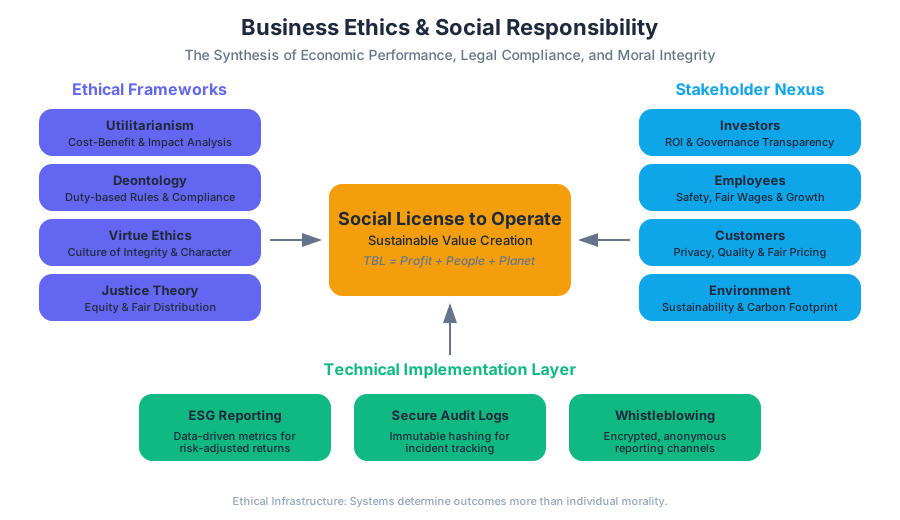
To navigate ethical dilemmas, managers rely on established normative theories. These are not just philosophical abstractions; they serve as the "logic gates" for corporate decision-making.
| Theory | Core Principle | Business Application | Potential Flaw |
|---|---|---|---|
| Utilitarianism | The greatest good for the greatest number. | Cost-Benefit Analysis (CBA) and impact assessments. | May sacrifice the rights of a minority for the majority. |
| Deontology | Duty-based ethics; follow universal rules regardless of outcome. | Strict compliance with law and "Code of Conduct" policies. | Can be too rigid in complex, "gray area" scenarios. |
| Virtue Ethics | Focus on the character of the actor rather than the act. | Building a "Culture of Integrity" and leadership development. | Subjective; depends on what a "virtuous" person is defined as. |
| Justice Theory | Fairness and equity in the distribution of benefits/burdens. | Equitable pay scales and diversity, equity, and inclusion (DEI). | Defining "fairness" is politically and socially contested. |
The Slippery Slope and Moral Decoupling
In a technical sense, ethical failure often begins with incrementalism—the "slippery slope" where small, questionable decisions normalize deviant behavior. This is often facilitated by moral decoupling, a psychological process where an individual separates a person's moral character from their professional performance (e.g., "He's a shark in business, but a great family man").
Key Insight: Ethical behavior is a systemic property, not just an individual one. An organization's "Ethical Infrastructure" (communication, surveillance, and sanctioning systems) determines the probability of ethical outcomes more than the personal morality of any single employee.
Corporate Social Responsibility (CSR) and Stakeholder Theory
While ethics focuses on the individual or managerial level, Corporate Social Responsibility (CSR) refers to the organizational level of obligation.
From Shareholder Primacy to Stakeholder Theory
For decades, the "Friedman Doctrine" (Shareholder Primacy) argued that the only social responsibility of business is to increase profits. Modern theory has shifted toward Stakeholder Theory, which posits that a corporation is a nexus of contracts between various groups, all of whom have a "stake" in the firm's operations.
| Stakeholder Group | Primary Interest | Risk of Neglect |
|---|---|---|
| Investors | ROI, Transparency, Governance | Short-termism, financial fraud. |
| Employees | Safety, Fair Wages, Growth | High turnover, labor strikes, burnout. |
| Customers | Quality, Privacy, Fair Pricing | Brand boycott, litigation, regulatory fines. |
| Environment | Sustainability, Carbon Footprint | Ecological collapse, "Greenwashing" backlash. |
| Community | Jobs, Infrastructure, Philanthropy | Loss of "Social License," local opposition. |
The Triple Bottom Line (TBL)
The technical implementation of CSR often follows the Triple Bottom Line framework, which expands the traditional reporting framework to include social and environmental performance.
$$TBL = \sum (Profit + People + Planet)$$
In practice, this is quantified through ESG (Environmental, Social, and Governance) metrics. These metrics allow investors to treat "responsibility" as a data point in a risk-adjusted return calculation.
Implementing Ethics: The Technical Layer
To move from "values on a wall" to "values in the workflow," organizations must implement technical controls. This involves creating systems for whistleblowing, auditing, and algorithmic fairness.
Whistleblowing and Anonymity Systems
A robust ethical culture requires a "fail-safe" for reporting misconduct. This is often implemented via encrypted, third-party managed reporting channels.
/*
 * A low-level conceptual example of an "Ethical Audit Log"
 * ensuring immutability of reported incidents via a simple
 * linked-list structure with basic hashing for integrity.
 */

#include <stdio.h>
#include <string.h>
#include <stdlib.h>

typedef struct IncidentNode {
    int incident_id;
    char timestamp[20];
    char report_hash[64]; // Simplified SHA-256 placeholder
    struct IncidentNode* next;
} IncidentNode;

void log_incident(IncidentNode** head, int id, const char* hash) {
    IncidentNode* new_node = (IncidentNode*)malloc(sizeof(IncidentNode));
    new_node->incident_id = id;
    strncpy(new_node->report_hash, hash, 64);
    new_node->next = *head;
    *head = new_node;

    // In a real system, this would be written to a WORM (Write Once Read Many) drive.
    printf("SECURE_LOG: Incident %d recorded with hash %s\n", id, hash);
}

int main() {
    IncidentNode* audit_trail = NULL;
    log_incident(&audit_trail, 101, "a3f2b1...");
    log_incident(&audit_trail, 102, "e99c1d...");
    return 0;
}
Ethical Decision-Making Algorithms
When faced with a dilemma, managers can use a structured heuristic. This "Ethical Filter" ensures that decisions are vetted through multiple lenses before execution.
ALGORITHM Ethical_Filter(Decision D):
    1. LEGAL_CHECK: Does D violate any local or international laws?
       IF True -> REJECT(D, "Illegal")
    2. POLICY_CHECK: Does D violate the Corporate Code of Conduct?
       IF True -> REJECT(D, "Policy Violation")
    3. STAKEHOLDER_IMPACT:
       Calculate Impact(D) for {Employees, Customers, Environment, Shareholders}
       IF Impact(D).Environment < Threshold -> FLAG(D, "Environmental Risk")
    4. THE_NEWSPAPER_TEST: If this decision were on the front page tomorrow,
       would the CEO be comfortable?
       IF False -> REJECT(D, "Reputational Risk")
    5. RETURN APPROVE(D)
Global Business Ethics
In a globalized economy, ethics becomes exponentially more complex due to Cultural Relativism—the idea that no culture's ethics are superior to another's. However, businesses must often balance this against Ethical Imperialism, which is the attempt to impose one's own ethical standards on a host country.
The Foreign Corrupt Practices Act (FCPA)
The FCPA is a landmark piece of U.S. legislation that prohibits companies from bribing foreign officials. It creates a "level playing field" but also presents significant compliance challenges in regions where "facilitation payments" (grease payments) are culturally normalized.
Global CSR Standards
To standardize behavior, several international frameworks have emerged:
- UN Global Compact: A voluntary initiative based on CEO commitments to implement universal sustainability principles.
- ISO 26000: Provides guidance on how businesses and organizations can operate in a socially responsible way.
- GRI (Global Reporting Initiative): The most widely used standards for sustainability reporting.
Modern Challenges: AI, Data, and ESG
As we move into the "Fourth Industrial Revolution," the ethical landscape is shifting toward data and automation.
Algorithmic Bias and AI Ethics
When businesses use AI for hiring, lending, or pricing, they risk automating human bias. Algorithmic Accountability requires that these models be transparent and auditable.
import pandas as pd
from sklearn.metrics import confusion_matrix

def check_algorithmic_bias(data, sensitive_attr, target, predictions):
    """
    Analyzes a model's predictions for disparate impact across
    sensitive attributes (e.g., gender, race).
    """
    groups = data[sensitive_attr].unique()
    results = {}

    for group in groups:
        subset = data[data[sensitive_attr] == group]
        y_true = subset[target]
        y_pred = predictions[data[sensitive_attr] == group]

        # Calculate False Positive Rate (FPR)
        tn, fp, fn, tp = confusion_matrix(y_true, y_pred).ravel()
        fpr = fp / (fp + tn)
        results[group] = fpr

    return results

# Example Usage:
# bias_report = check_algorithmic_bias(loan_data, 'gender', 'loan_default', model_preds)
# print(f"Bias Report (FPR by Gender): {bias_report}")
The Rise of ESG Investing
Environmental, Social, and Governance (ESG) criteria are a set of standards for a company’s operations that socially conscious investors use to screen potential investments.
| Pillar | Key Metrics | Technical Implementation |
|---|---|---|
| Environmental | Carbon Intensity, Water Usage, Waste Management | IoT sensors for real-time emission tracking. |
| Social | Employee Turnover, Safety Incidents, Pay Gap | HRIS (Human Resource Information Systems) auditing. |
| Governance | Board Diversity, Executive Compensation, Audit Quality | Proxy voting records and blockchain-based cap tables. |
Common Pitfalls in Business Ethics
- Greenwashing: Spending more time and money on marketing being "green" than on actually implementing environmentally sound practices.
- Compliance vs. Integrity: Treating ethics as a "checkbox" (Compliance) rather than a core value (Integrity). Compliance-only systems often fail because they don't address the spirit of the law.
- The "Ethics Premium" Myth: The belief that being ethical always costs more. In reality, ethical companies often have lower costs of capital and higher employee retention.
- Diffusion of Responsibility: In large hierarchies, individuals may feel that "someone else" is responsible for the ethical outcome, leading to systemic failure (e.g., the Wells Fargo cross-selling scandal).
Policy as Code (PaC)
In modern DevOps and cloud environments, ethical and regulatory compliance is increasingly handled via "Policy as Code." This ensures that infrastructure cannot be deployed unless it meets specific ethical or security constraints.
# Open Policy Agent (Rego) example
# Ensure that no cloud resource is deployed in a region
# with known human rights violations (hypothetical policy).

package ethics.compliance

default allow = false

forbidden_regions := ["region-x", "region-y"]

allow {
    input.resource_type == "cloud_instance"
    not is_forbidden(input.region)
}

is_forbidden(region) {
    region == forbidden_regions[_]
}
Summary of the Ethical Evolution
The trajectory of business ethics has moved from simple legal compliance to a strategic imperative. Organizations that fail to integrate social responsibility into their core "operating system" face existential risks in an era of radical transparency and stakeholder empowerment.
Theorem of Ethical Resilience: The long-term stability of a firm ($S$) is directly proportional to the alignment between its stated values ($V_s$) and its operationalized actions ($A_o$), divided by the friction of its compliance overhead ($C$). $$S \propto \frac{V_s \cap A_o}{C}$$
Study Guide: Business Ethics and Social Responsibility
1. Core Definitions
- Business Ethics: The application of moral standards to business behavior.
- Corporate Social Responsibility (CSR): The obligation of a business to contribute to the well-being of society.
- Stakeholders: Any individual or group that can affect or be affected by an organization’s actions.
- ESG: Environmental, Social, and Governance metrics used to measure sustainability.
2. Key Frameworks
- Utilitarianism: Focus on outcomes (greatest good).
- Deontology: Focus on rules and duties.
- Triple Bottom Line: Measuring success via Profit, People, and Planet.
- Stakeholder Theory: Moving beyond just shareholders to include employees, customers, and the community.
3. Critical Legislation & Standards
- FCPA (1977): Prohibits U.S. firms from bribing foreign officials.
- Sarbanes-Oxley Act (2002): Mandates strict financial reporting and internal controls.
- ISO 26000: International standard for social responsibility.
4. Modern Ethical Dilemmas
- AI Bias: Ensuring algorithms don't discriminate.
- Data Privacy: Balancing personalization with consumer rights.
- Climate Change: Decarbonizing supply chains and operations.
5. Implementation Strategies
- Code of Ethics: A formal document outlining an organization's values.
- Whistleblower Protection: Systems to allow safe reporting of misconduct.
- Ethical Audits: Systematic evaluation of an organization's ethical performance.
Entrepreneurship and Technological Innovation
Key concepts: Entrepreneurship · Artificial intelligence
This section covers the entrepreneurial mindset and the impact of emerging technologies, such as artificial intelligence, on business models.
Entrepreneurship and Technological Innovation
The intersection of entrepreneurship and artificial intelligence (AI) represents the most significant shift in the global economic landscape since the Industrial Revolution. While entrepreneurship provides the framework for identifying market inefficiencies and mobilizing resources, AI offers a new "general-purpose technology" (GPT) that drastically reduces the cost of prediction, automation, and personalization. This synergy allows for the creation of scalable business models that were previously impossible due to human cognitive limitations or labor costs.
The Entrepreneurial Framework
At its core, entrepreneurship is the process of creating value by bringing together a unique package of resources to exploit an opportunity. It is not merely "starting a business" but a specific mindset oriented toward innovation, risk-taking, and proactive growth.
Definitions and Typologies
Entrepreneurship: The pursuit of opportunity beyond resources controlled. This involves the identification, evaluation, and exploitation of opportunities to create future goods and services.
Entrepreneurs are often categorized by their growth intent and the nature of the innovation they bring to the market.
| Dimension | Small Business Entrepreneurship | Scalable Startup Entrepreneurship | Corporate Entrepreneurship (Intrapreneurship) |
|---|---|---|---|
| Primary Goal | Stability and local market service | Rapid growth and market disruption | Innovation within an existing firm |
| Funding | Personal savings, small bank loans | Venture Capital (VC), Angel investors | Internal corporate budget |
| Risk Profile | Moderate; based on proven models | High; based on unproven innovations | Moderate to High; protected by corporate assets |
| Exit Strategy | Longevity or family succession | IPO or Acquisition | Integration into core business |
Artificial Intelligence: The New Factor of Production
In the modern entrepreneurial context, Artificial Intelligence is defined as the simulation of human intelligence processes by machines. For a founder, AI is less about "robots" and more about probabilistic logic—moving away from hard-coded "if-then" business rules toward systems that learn patterns from data.
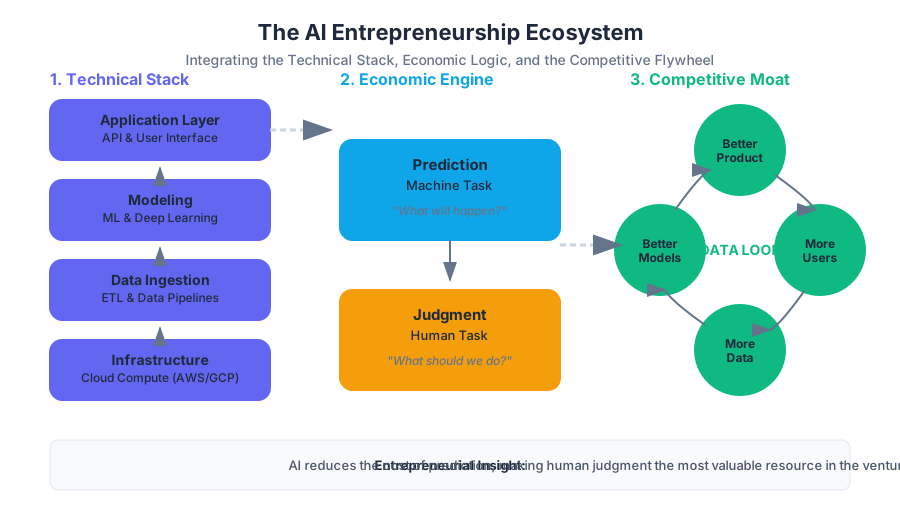
The AI Hierarchy of Needs for Startups
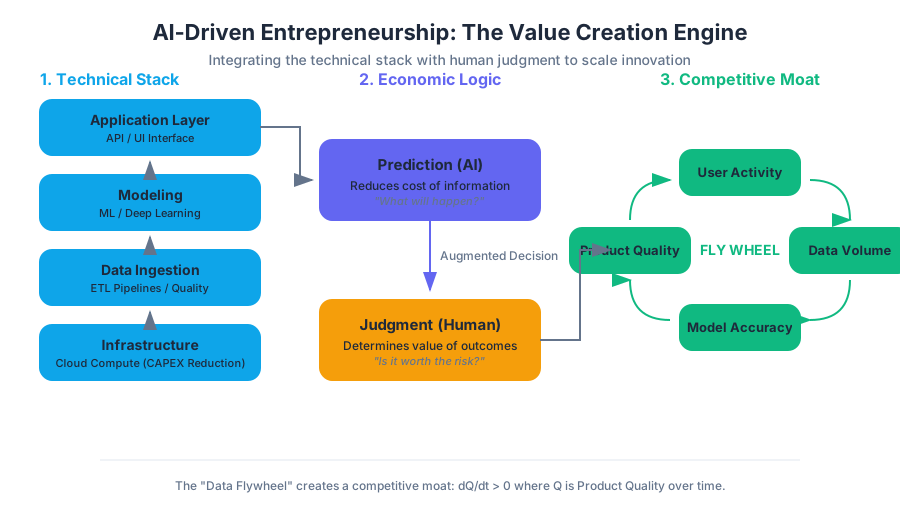
Before an entrepreneur can leverage AI, they must navigate a technical stack that ensures data integrity and model relevance.
| Layer | Component | Entrepreneurial Significance |
|---|---|---|
| Infrastructure | Cloud Compute (AWS/GCP/Azure) | Eliminates high upfront CAPEX for hardware. |
| Data Ingestion | ETL Pipelines (Extract, Transform, Load) | The "fuel" for AI; determines the quality of insights. |
| Modeling | Machine Learning (ML) / Deep Learning | The engine that generates predictions or content. |
| Application | API / UI Layer | How the end-user interacts with the AI's output. |
Low-Level Implementation: Predictive Demand Modeling
A common entrepreneurial challenge is inventory management. Using Python and scikit-learn, an entrepreneur can move from "gut feeling" to data-driven forecasting.
import numpy as np
import pandas as pd
from sklearn.ensemble import RandomForestRegressor
from sklearn.model_selection import train_test_split
from sklearn.metrics import mean_absolute_error

# Load historical sales data
# Features: [Price, Promotion_Active, Day_of_Week, Competitor_Price]
data = pd.read_csv("historical_sales.csv")

X = data[['price', 'promo', 'dow', 'comp_price']]
y = data['units_sold']

# Split for validation
X_train, X_test, y_train, y_test = train_test_split(X, y, test_size=0.2, random_state=42)

# Initialize a Random Forest Regressor
# This models non-linear relationships between price and demand
model = RandomForestRegressor(n_estimators=100, max_depth=10)
model.fit(X_train, y_train)

# Predict and evaluate
predictions = model.predict(X_test)
error = mean_absolute_error(y_test, predictions)

print(f"Mean Absolute Error: {error:.2f} units")
# An entrepreneur uses this 'error' to determine safety stock levels.
The Economics of AI in Entrepreneurship
The primary economic impact of AI is the reduction in the cost of prediction. As prediction becomes cheap, it is used more frequently, and the value of its complements—human judgment and data—increases.
The Prediction-Judgment Decomposition
Entrepreneurs must decompose business problems into prediction tasks and judgment tasks.
- Prediction: Using data to generate information about the unknown (e.g., "Will this customer churn?").
- Judgment: Determining the value or utility of a specific outcome (e.g., "Is it worth offering a 20% discount to prevent that churn?").
Mathematical Representation of the AI Flywheel
The "Data Flywheel" is a core concept in AI entrepreneurship. More users lead to more data, which improves the AI model, which leads to a better product, which attracts more users.
\text{Product Quality} (Q) \propto \text{Model Accuracy} (A)
\text{Model Accuracy} (A) = f(\text{Data Volume } D, \text{Compute } C)
\text{Data Volume} (D) = \int_{0}^{t} \text{User Activity}(u) \, dt
\therefore \frac{dQ}{dt} > 0 \implies \text{Competitive Moat}
This relationship suggests that the first-mover advantage in AI is not just about the code, but about the proprietary data loop established early in the venture's lifecycle.
Decision Making and Managing Change
Entrepreneurship requires constant decision-making under uncertainty. AI enhances this by providing Augmented Intelligence, where the machine handles the data-heavy computation and the human handles the strategic "pivot."
The Pivot vs. Persevere Decision
In the Lean Startup methodology, entrepreneurs use a Build-Measure-Learn loop. AI accelerates the "Measure" and "Learn" phases.
| Phase | Traditional Approach | AI-Enhanced Approach |
|---|---|---|
| Build | Manual MVP development | Low-code/Generative AI prototyping |
| Measure | Lagging financial indicators | Real-time sentiment and behavioral analytics |
| Learn | Qualitative interviews (slow) | Automated A/B testing and cohort analysis |
Real-World Usage: Deploying an AI Microservice
Modern entrepreneurs use containerization to scale their AI innovations globally. The following docker-compose.yml demonstrates how a startup might deploy a model inference engine alongside a database.
version: '3.8'

services:
  inference_api:
    image: startup/ai-model-api:v1.2
    build: ./api
    ports:
      - "8000:8000"
    environment:
      - MODEL_PATH=/models/production_v1.pkl
      - DB_URL=postgres://user:pass@db:5432/app
    depends_on:
      - db
    deploy:
      resources:
        reservations:
          devices:
            - driver: nvidia
              count: 1
              capabilities: [gpu]

  db:
    image: postgres:15-alpine
    volumes:
      - postgres_data:/var/lib/postgresql/data
    environment:
      POSTGRES_PASSWORD: example_password

volumes:
  postgres_data:
Ethical Considerations and Global Business
As AI-driven startups scale globally, they encounter diverse regulatory and ethical landscapes. Business ethics in AI is no longer a peripheral concern but a core component of risk management.
Key Ethical Dimensions
- Algorithmic Bias: If the training data contains historical prejudices, the AI will amplify them (e.g., biased hiring algorithms).
- Transparency (The Black Box Problem): The inability to explain why an AI made a specific decision, which is problematic in regulated industries like finance or healthcare.
- Labor Displacement: The entrepreneurial drive for efficiency through AI can lead to significant shifts in the workforce, requiring a focus on "upskilling" as part of corporate social responsibility.
Comparative Global AI Regulations
| Region | Regulatory Approach | Primary Focus |
|---|---|---|
| European Union (AI Act) | Risk-based classification | Human rights and safety |
| United States | Sector-specific / Decentralized | Innovation and market competition |
| China | State-aligned / Algorithmic governance | Social stability and national priority |
Common Pitfalls in AI Entrepreneurship
Even with advanced technology, many ventures fail due to common misconceptions:
- The "Hammer Looking for a Nail": Developing a complex AI solution for a problem that could be solved with a simple spreadsheet or better customer service.
- Underestimating Data Cleaning: Spending 90% of resources on model architecture while the underlying data is noisy or biased.
- Ignoring Technical Debt: Building "quick and dirty" AI integrations that become impossible to maintain as the startup scales.
- The Overfitting Trap: A model that performs perfectly on historical data but fails in the "wild" because it hasn't captured the true underlying market dynamics.
SQL Example: Identifying Model Drift
An entrepreneur must monitor if their AI's performance is degrading over time (Model Drift).
-- Query to compare predicted vs actual outcomes over time
-- to detect if the model needs retraining.
SELECT
    DATE_TRUNC('week', created_at) AS observation_week,
    AVG(ABS(predicted_value - actual_value)) AS mean_absolute_error,
    COUNT(*) AS total_predictions
FROM
    ai_predictions_log
GROUP BY
    1
ORDER BY
    1 DESC;
-- If mean_absolute_error increases significantly over 3 weeks,
-- the entrepreneur triggers a 'retrain' event.
Managing Technological Change
For established businesses, the challenge is Managing Change. This involves transitioning from legacy systems to AI-integrated workflows without disrupting current revenue streams.
Ambidextrous Organization: A firm that is capable of simultaneously exploiting existing competencies (efficiency) and exploring new opportunities (innovation).
Entrepreneurs within large firms (intrapreneurs) must balance these two forces. Success requires a culture that views failure not as a setback, but as a data point in the learning process.
Summary of the AI-Entrepreneurship Nexus
The modern entrepreneur is a "systems orchestrator." They do not need to be the best coder or the best salesperson, but they must understand how to leverage AI to automate the mundane, predict the future, and provide hyper-personalized value to a global audience. The barriers to entry have never been lower, but the requirements for ethical clarity and strategic judgment have never been higher.
Global Business and Managing Change
Key concepts: Global business · Managing change
A look at the complexities of operating in a globalized market and the strategies required to manage organizational change effectively.
Global Business and Managing Change
In the modern era, the distinction between "domestic" and "international" business has become increasingly blurred. Global Business refers to the production, distribution, and sale of goods and services across national borders, a process driven by the liberalization of trade and the rapid advancement of communication technologies. However, operating on a global scale introduces a layer of stochastic complexity: varying legal frameworks, fluctuating exchange rates, and divergent cultural norms.
To survive this complexity, organizations must master Managing Change—the systematic approach to transitioning individuals, teams, and entire architectures from a current state to a desired future state. Change is no longer a discrete event but a continuous requirement for survival in a globalized market.
1. The Mechanics of Global Business
Global business is predicated on the economic principle that nations and firms should specialize where they possess a relative efficiency. This is codified in the theories of Absolute Advantage and Comparative Advantage.
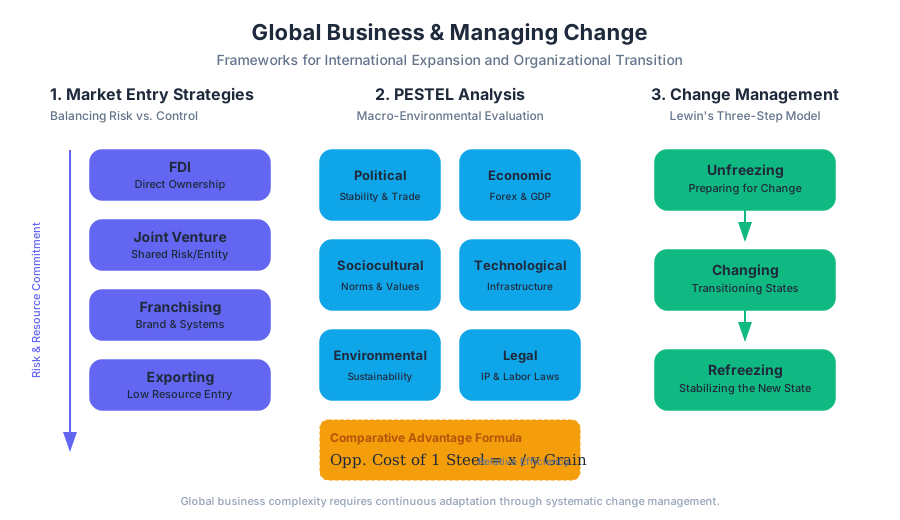
Definition: Comparative Advantage A condition where a country can produce a particular good or service at a lower opportunity cost than its trading partners. Mathematically, if Country A produces $x$ units of grain or $y$ units of steel, its opportunity cost for 1 unit of steel is $x/y$ units of grain.
1.1 Strategies for Global Market Entry
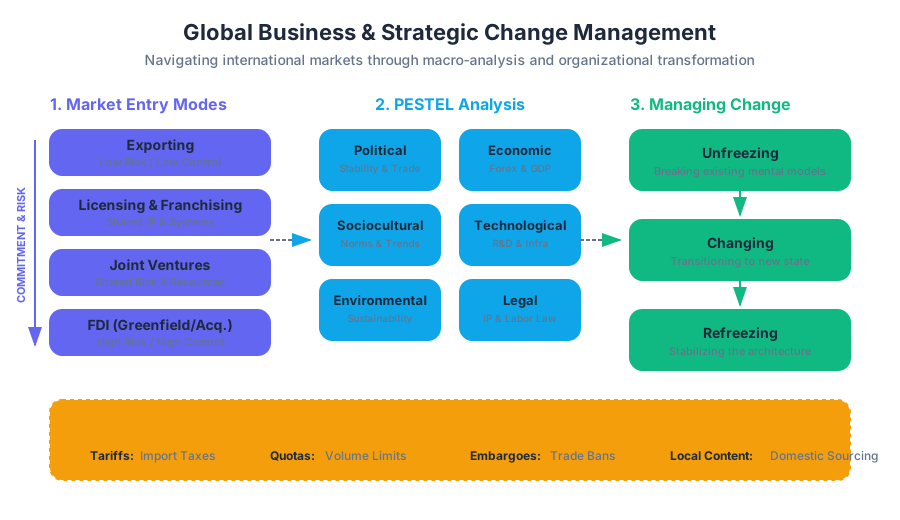
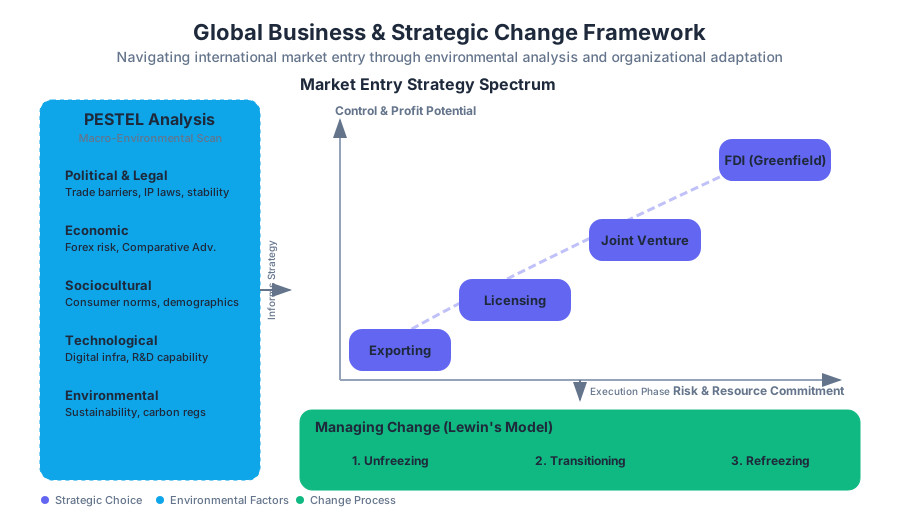
When a firm decides to expand internationally, it must choose an entry strategy that balances risk, control, and resource commitment. The selection of a mode is often a function of the firm's "closeness" to the target market (geographically and culturally) and its internal capabilities.
| Entry Strategy | Resource Commitment | Risk Level | Control | Description |
|---|---|---|---|---|
| Exporting | Low | Low | Low | Selling domestically produced products in foreign markets. |
| Licensing | Low | Medium | Low | Granting a foreign firm the right to use intellectual property for a fee. |
| Franchising | Medium | Medium | Medium | A specialized form of licensing involving brand identity and operational systems. |
| Joint Venture | High | High | Shared | Two or more firms create a new entity to share costs and risks. |
| Foreign Direct Investment (FDI) | Very High | Very High | High | Direct ownership of facilities in a foreign country (Greenfield or Acquisition). |
1.2 The PESTEL Framework for Global Analysis
To navigate foreign environments, managers utilize the PESTEL framework to evaluate macro-environmental factors. This is a prerequisite for any global change initiative.
- Political: Stability of the government, trade restrictions, and tax policies.
- Economic: Inflation rates,
Forex(Foreign Exchange) stability, and GDP growth. - Sociocultural: Demographics, consumer behavior, and cultural taboos.
- Technological: R&D activity, automation, and digital infrastructure.
- Environmental: Climate change policies and carbon footprint regulations.
- Legal: Employment laws, anti-trust laws, and intellectual property rights.
2. Financial and Regulatory Barriers
Global business is not a frictionless environment. It is constrained by Protectionism—government policies that restrict international trade to help domestic industries.
2.1 Trade Barriers and Their Impact
Governments employ several mechanisms to regulate the flow of goods:
- Tariffs: Taxes imposed on imported goods, increasing their cost to consumers.
- Quotas: Quantitative limits on the amount of a specific good that can be imported.
- Embargoes: A complete ban on trade with a specific country, often for political reasons.
- Local Content Requirements: Mandates that a certain percentage of a product's value must be produced locally.
2.2 Currency Risk and Exchange Rates
Operating in multiple currencies introduces Exchange Rate Risk. A firm's profitability can be erased by a sudden devaluation of a foreign currency against its home currency.
# Example: Calculating Transaction Exposure for a Global Transaction
# This script calculates the impact of currency fluctuation on a future payment.

def calculate_forex_exposure(invoice_amount_foreign, current_spot_rate, projected_future_rate):
    """
    invoice_amount_foreign: Amount in foreign currency (e.g., EUR)
    current_spot_rate: Current rate (e.g., 1 EUR = 1.10 USD)
    projected_future_rate: Rate at time of payment (e.g., 1 EUR = 1.05 USD)
    """
    current_value_usd = invoice_amount_foreign * current_spot_rate
    future_value_usd = invoice_amount_foreign * projected_future_rate

    exposure_loss_gain = future_value_usd - current_value_usd
    percent_change = ((projected_future_rate - current_spot_rate) / current_spot_rate) * 100

    return {
        "initial_usd": current_value_usd,
        "final_usd": future_value_usd,
        "variance": exposure_loss_gain,
        "pct_change": percent_change
    }

# Scenario: A US company owes 1,000,000 EUR.
# The Euro weakens from 1.10 to 1.05 USD/EUR.
result = calculate_forex_exposure(1000000, 1.10, 1.05)

print(f"Initial Liability: ${result['initial_usd']:,.2f}")
print(f"Final Liability: ${result['final_usd']:,.2f}")
print(f"Net Gain/Loss: ${result['variance']:,.2f}") # A gain in this case, as debt is cheaper
3. Managing Organizational Change
Change management is the "soft" side of business strategy that yields "hard" results. In a global context, change often involves restructuring, digital transformation, or merging disparate corporate cultures.
3.1 Lewin’s Three-Step Model
Psychologist Kurt Lewin proposed a foundational model for understanding change as a process of breaking down existing mental models and establishing new ones.
- Unfreezing: Creating the motivation to change. This involves identifying the Force Field Analysis—the balance of "driving forces" (incentives for change) vs. "restraining forces" (barriers to change).
- Moving (Transitioning): The actual implementation of the change. This is the period of highest uncertainty and requires intense communication.
- Refreezing: Stabilizing the organization at a new state of equilibrium so that the change becomes the new norm.
3.2 Kotter’s 8-Step Process for Leading Change
John Kotter expanded on Lewin’s model to provide a more granular, action-oriented roadmap for leaders.
| Step | Action | Objective |
|---|---|---|
| 1 | Establish Urgency | Identify potential crises or untapped opportunities. |
| 2 | Form a Guiding Coalition | Assemble a team with enough power to lead the change. |
| 3 | Create a Vision | Define the "why" and the "where" of the transition. |
| 4 | Communicate the Vision | Use every vehicle possible to broadcast the new direction. |
| 5 | Empower Action | Remove obstacles and change systems that undermine the vision. |
| 6 | Generate Short-term Wins | Create visible, unambiguous successes as soon as possible. |
| 7 | Consolidate Gains | Use increased credibility to change all systems that don't fit. |
| 8 | Anchor in Culture | Articulate the connection between new behaviors and success. |
4. The ADKAR Model: A Bottom-Up Approach
While Kotter focuses on the organization, the ADKAR model focuses on the individual. It posits that organizational change only happens when each individual goes through five distinct stages.
% Representation of the ADKAR logic flow
\text{Change Success} = \int (A \cdot D \cdot K \cdot A_b \cdot R) \, dt

\text{Where:}
A = \text{Awareness of the need for change}
D = \text{Desire to support the change}
K = \text{Knowledge of how to change}
A_b = \text{Ability to demonstrate skills/behaviors}
R = \text{Reinforcement to make the change stick}
4.1 Common Pitfalls in Change Management
- Change Fatigue: Overwhelming employees with too many initiatives simultaneously, leading to burnout and apathy.
- Lack of Executive Sponsorship: Change initiatives often fail if the "C-Suite" does not visibly and consistently support the effort.
- Underestimating Culture: In global business, a change strategy that works in New York may fail in Tokyo due to different power distances or attitudes toward risk.
5. Technological Change and AI Integration
The most significant driver of change in the current global landscape is Artificial Intelligence (AI). AI is not just a tool but a paradigm shift that forces organizations to rethink their global supply chains and decision-making processes.
5.1 AI-Driven Decision Making
Global firms are moving from "gut-feel" decisions to data-driven models. This requires a fundamental change in organizational structure—moving from hierarchical silos to cross-functional data teams.
# Example: Infrastructure as Code (IaC) for a Global Change Deployment
# This YAML snippet defines a multi-region deployment for a new business logic service.
# This represents the "Technological Change" aspect of global expansion.

version: '3.8'
services:
  global-analytics-api:
    image: company/analytics-engine:v2.1-stable
    deploy:
      replicas: 5
      placement:
        constraints:
          - node.labels.region == us-east-1
          - node.labels.region == eu-central-1
          - node.labels.region == ap-southeast-1
    environment:
      - NODE_ENV=production
      - LOCAL_COMPLIANCE_MODE=GDPR_ENABLED # Managing legal change via config
      - CURRENCY_SERVICE_URL=https://api.forex-sync.internal
    networks:
      - global-mesh
    healthcheck:
      test: ["CMD", "curl", "-f", "http://localhost/health"]
      interval: 30s
      timeout: 10s
      retries: 3

networks:
  global-mesh:
    driver: overlay
6. Ethics and Entrepreneurship in a Global Context
Managing change globally involves navigating the ethical minefield of different labor standards, environmental regulations, and corruption levels.
6.1 The "Glocal" Paradox
The term Glocal (Global + Local) refers to the strategy of "thinking globally but acting locally." An entrepreneur must maintain a consistent brand identity while adapting the product or service to local tastes and ethical expectations.
6.2 Ethical Frameworks for Global Managers
Managers often face a conflict between Ethical Relativism (doing what the local culture does) and Ethical Universalism (applying the same standards everywhere).
| Framework | Core Principle | Application in Global Change |
|---|---|---|
| Utilitarianism | The greatest good for the greatest number. | Used to justify layoffs during a restructuring for the company's survival. |
| Deontology | Adherence to moral duties and rules. | Refusing to pay bribes even if it is the local "norm" for business. |
| Virtue Ethics | Focus on the character of the individual. | Developing leaders who act with integrity regardless of the region. |
7. Summary of Global Business Dynamics
The intersection of global expansion and change management is where modern corporate strategy is won or lost. Success requires a dual competency: the analytical rigor to understand global markets and the psychological intelligence to lead people through the resulting transitions.
Key Insight: In a globalized economy, the only sustainable competitive advantage is an organization's Adaptive Capacity—its ability to sense environmental shifts and reconfigure its resources faster than its competitors.
Source Materials
Study Introduction Business with AI — Free on Lykke
Sign up for free to generate personalized flashcards, quizzes, and study guides from this course. Chat with an AI tutor that knows the material.
Get Started FreeView this course wiki on Lykke · Browse all public course wikis