Criminology and Criminal Justice
Institution: MIT
85 study materials · 13 sections
This course provides a comprehensive exploration of Criminology and Criminal Justice, blending theoretical frameworks with the practical operations of the American legal system. Students will examine the causes of criminal behavior, the methodologies used to measure crime, and the historical evolution of law enforcement, courts, and corrections. The curriculum places a significant emphasis on contemporary challenges, including urban inequality, systemic disparities, juvenile justice, and the management of mental health within the legal framework.
Course Sections
Foundations of Crime and Criminology
Key concepts: Deviance · Consensus vs. Conflict View · Wedding Cake Model · Dark Figure of Crime · Uniform Crime Reports (UCR)
Introduction to the definitions of crime and deviance, the structure of the criminal justice system, and the methodologies used to track criminal activity.
Foundations of Crime and Criminology
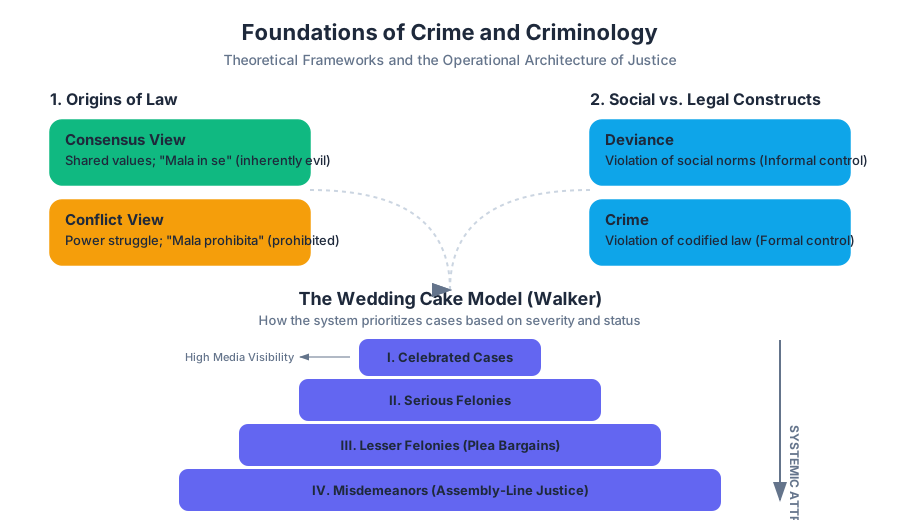
The study of crime and criminology is not merely a cataloging of illegal acts, but a rigorous analysis of the intersection between human behavior, social norms, and institutional power. To understand the American criminal justice system, one must first master the distinction between deviance (a sociological concept) and crime (a legal construct), and then examine the competing philosophical frameworks—Consensus versus Conflict—that dictate how laws are written and enforced.
This section provides a high-level architectural overview of the system’s foundations, moving from abstract definitions of rule-breaking to the concrete metrics used to track societal health, such as the Uniform Crime Reports (UCR) and the National Incident-Based Reporting System (NIBRS). We will also analyze the systemic "leakage" of cases through the Crime Funnel and the hierarchical prioritization of justice via the Wedding Cake Model.
Deviance, Norms, and the Social Construction of Crime
At its core, deviance is any behavior, belief, or condition that violates significant social norms in the society or group in which it occurs. While often conflated with crime, deviance is a much broader category. A person may be deviant without being a criminal (e.g., having extreme facial tattoos in a corporate environment), or a criminal without being perceived as deviant (e.g., speeding on a highway where everyone else is doing the same).
Definition: The Four Conditions of Deviance (Goode) According to sociologist Erich Goode, for a behavior to be considered deviant, four conditions must be met:
- A norm must exist.
- Someone must violate that norm.
- An audience must be present to witness or learn of the violation.
- The violation must elicit a negative reaction from that audience.
The Spectrum of Social Control
Societies maintain order through social control, which functions on two levels:
- Informal Social Control: The use of "nods, smiles, and frowns" to encourage conformity. This is the primary regulator of deviance.
- Formal Social Control: The legal system, police, and courts. This is reserved for behaviors categorized as crimes.
| Feature | Deviance | Crime |
|---|---|---|
| Definition | Violation of social norms | Violation of codified law |
| Sanction | Social stigma, ostracization | Fines, imprisonment, death |
| Enforcement | Peers, family, community | State-authorized agents (Police) |
| Documentation | Anecdotal/Sociological | Official records (UCR/NIBRS) |
| Scope | Broad (includes fashion, speech) | Narrow (defined by statute) |
Competing Perspectives: Consensus vs. Conflict
How does a behavior move from being "merely deviant" to being "criminal"? Criminologists generally subscribe to one of two competing views on the origins of law.
The Consensus View
The Consensus View posits that the law is a reflection of the shared values and beliefs of the majority of society. In this model, the legal system functions as a social glue, protecting the common good. It assumes a "social contract" where citizens give up certain freedoms in exchange for the state's protection.
- Key Logic: Laws are created to prohibit behaviors that the vast majority of people find repugnant (e.g., murder, theft).
- Mala in se: Crimes that are "evil in themselves" (inherently wrong).
The Conflict View
The Conflict View, heavily influenced by Marxist and Weberian sociology, argues that the law is a tool used by the ruling class to maintain their position of power and control the "have-nots." In this perspective, the criminal justice system is not a neutral arbiter but an instrument of oppression.
- Key Logic: Laws are created to protect the property and interests of the elite, while criminalizing the survival behaviors of the poor.
- Mala prohibita: Crimes that are "wrong because they are prohibited" (e.g., gambling, drug use, loitering).
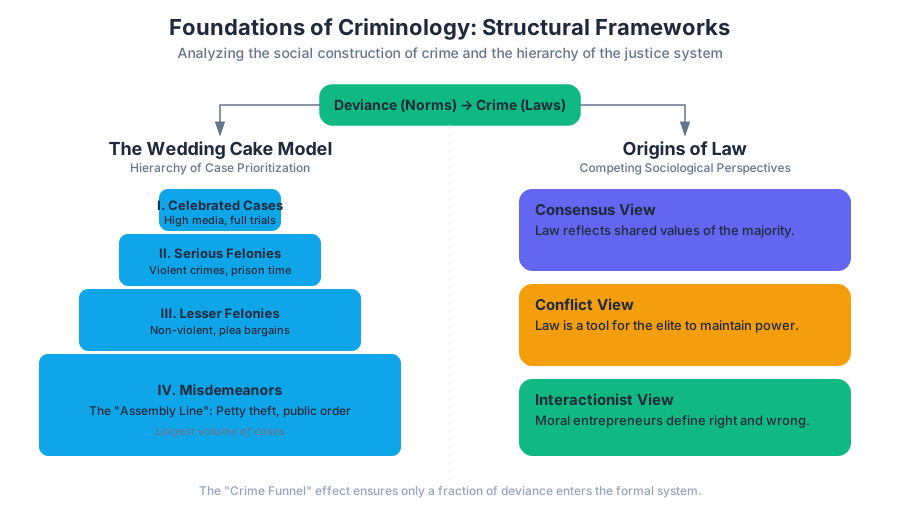
The Interactionist View
A third, middle-ground perspective suggests that "moral entrepreneurs" (individuals or groups with social power) define what is right and wrong based on their own subjective perceptions, which then become codified into law through political influence.
The Operational Architecture: The Wedding Cake Model
Developed by Samuel Walker, the Wedding Cake Model provides a realistic alternative to the "assembly line" view of justice. It explains why the system treats different cases with vastly different levels of resources and scrutiny.
Layer 1: Celebrated Cases
The smallest, top layer consists of cases that garner intense media attention (e.g., O.J. Simpson, high-profile white-collar crimes). These cases involve full-blown jury trials, expensive defense teams, and complex forensic analysis. They distort public perception because they are the least representative of how the system actually functions.
Layer 2: Serious Felonies
These are "heavy" crimes: violent acts (rape, robbery, aggravated assault) committed by experienced offenders. Prosecutors are unlikely to offer lenient plea bargains here, and these cases often result in significant prison time.
Layer 3: Lesser Felonies
These are often non-violent crimes or felonies committed by first-time offenders. They are frequently filtered out of the system via plea bargaining, where the charge is reduced to a misdemeanor in exchange for a guilty plea.
Layer 4: Misdemeanors
The massive base of the cake. This layer represents the high volume of "garbage" cases: public intoxication, petty theft, shoplifting, and disorderly conduct. These are handled with "assembly-line justice," often resolved in minutes with fines or probation.
The Crime Funnel and Systemic Attrition
The Crime Funnel (or Funnel of Justice) illustrates the process of attrition. For every 1,000 serious crimes committed, only a tiny fraction results in an individual being incarcerated. This "leakage" occurs at every stage: detection, reporting, investigation, arrest, charging, and sentencing.
Mathematical Representation of Attrition
We can model the probability of a crime resulting in a prison sentence ($P_s$) as a product of conditional probabilities at each gate of the funnel.
P_s = P(Reported | Committed) \times P(Arrest | Reported) \times P(Charged | Arrest) \times P(Convicted | Charged) \times P(Sentenced | Convicted)
If each stage has a 50% success rate (which is generous for many crime types), the final probability of a committed crime resulting in a sentence is $0.5^5$, or roughly 3.1%.
Implementation: Analyzing Attrition with Python
In a real-world criminological study, we might use Python to analyze the "drop-off" rates across different jurisdictions to identify bottlenecks in the justice pipeline.
import pandas as pd

def analyze_crime_attrition(data):
    """
    Calculates the retention rate at each stage of the criminal justice funnel.
    Input: DataFrame with columns ['Committed', 'Reported', 'Arrested', 'Charged', 'Convicted', 'Sentenced']
    """
    stages = ['Committed', 'Reported', 'Arrested', 'Charged', 'Convicted', 'Sentenced']
    results = {}

    for i in range(len(stages) - 1):
        current_stage = stages[i]
        next_stage = stages[i+1]

        # Calculate retention rate between stages
        rate = (data[next_stage].sum() / data[current_stage].sum()) * 100
        results[f"{current_stage} -> {next_stage}"] = f"{rate:.2f}%"

    # Calculate overall system efficiency
    total_efficiency = (data['Sentenced'].sum() / data['Committed'].sum()) * 100
    results["Overall System Efficiency"] = f"{total_efficiency:.2f}%"

    return results

# Example Data: 10,000 hypothetical burglaries
crime_stats = pd.DataFrame([{
    'Committed': 10000,
    'Reported': 5000,
    'Arrested': 1200,
    'Charged': 800,
    'Convicted': 400,
    'Sentenced': 200
}])

print(analyze_crime_attrition(crime_stats))
Measuring Crime: UCR vs. NIBRS
To manage the system, we must measure it. However, crime data is notoriously difficult to collect accurately. The two primary tools used by the FBI are the Uniform Crime Reports (UCR) and the National Incident-Based Reporting System (NIBRS).
The Uniform Crime Reports (UCR)
Established in 1930, the UCR is a summary-based reporting system. It tracks "Part I Index Crimes" (Murder, Rape, Robbery, Aggravated Assault, Burglary, Larceny, Motor Vehicle Theft, and Arson).
- The Hierarchy Rule: A major flaw of the UCR. If multiple crimes occur in a single incident (e.g., a robbery that turns into a murder), only the most serious crime is reported.
- Data Granularity: Low. It provides counts but lacks detail on the relationship between victim and offender.
National Incident-Based Reporting System (NIBRS)
NIBRS is the modern successor to the UCR. It was designed to provide a more "high-fidelity" view of crime.
- No Hierarchy Rule: Every offense within an incident is recorded.
- Detailed Parameters: It captures data on victims, offenders, property, and arrests for 52 specific offenses.
| Feature | UCR (Summary Reporting) | NIBRS (Incident-Based) |
|---|---|---|
| Unit of Analysis | Aggregate counts per agency | Individual crime incidents |
| Hierarchy Rule | Yes (only most serious crime) | No (all crimes recorded) |
| Victim/Offender Data | Limited | Extensive (age, sex, race, relationship) |
| Offense Categories | 8 Part I Index Crimes | 52 Group A Offenses |
| Complexity | Low (easier for small agencies) | High (requires robust IT infrastructure) |
The Dark Figure of Crime
Regardless of the reporting system used, all official statistics suffer from the Dark Figure of Crime. This refers to the volume of crime that is never reported to the police and, therefore, never enters the official record.
Why Crime Goes Unreported:
- Fear of Reprisal: The victim fears the offender will retaliate.
- Distrust of Police: The victim believes the police cannot or will not help.
- Self-Incrimination: The victim was engaged in illegal activity when the crime occurred.
- Private Matter: The victim views the incident as a personal or family issue.
To estimate this "Dark Figure," researchers use the National Crime Victimization Survey (NCVS), which asks a representative sample of U.S. households about their experiences with crime, regardless of whether they reported it.
Data Modeling: The NIBRS Schema
To understand how NIBRS handles the complexity of modern crime reporting, we can look at a simplified SQL schema representing the relationships between incidents, offenses, and victims. Unlike the UCR, which is a flat file of numbers, NIBRS is a relational database.
-- Simplified NIBRS Relational Schema
CREATE TABLE Incidents (
    IncidentID INT PRIMARY KEY,
    IncidentDate DATETIME,
    ReportDate DATETIME,
    LocationType VARCHAR(50),
    AgencyID INT
);

CREATE TABLE Offenses (
    OffenseID INT PRIMARY KEY,
    IncidentID INT,
    OffenseCode VARCHAR(10), -- e.g., '13A' for Aggravated Assault
    AttemptedCompleted CHAR(1),
    WeaponUsed VARCHAR(50),
    FOREIGN KEY (IncidentID) REFERENCES Incidents(IncidentID)
);

CREATE TABLE Victims (
    VictimID INT PRIMARY KEY,
    IncidentID INT,
    VictimType VARCHAR(20), -- Individual, Business, Government
    Age INT,
    Sex CHAR(1),
    Race CHAR(1),
    InjuryType VARCHAR(50),
    FOREIGN KEY (IncidentID) REFERENCES Incidents(IncidentID)
);

-- Query to find incidents with multiple offenses (Impossible in UCR)
SELECT i.IncidentID, COUNT(o.OffenseID) as OffenseCount
FROM Incidents i
JOIN Offenses o ON i.IncidentID = o.IncidentID
GROUP BY i.IncidentID
HAVING COUNT(o.OffenseID) > 1;
Victimology and Typologies
Modern criminology has shifted from a pure focus on the offender to an inclusion of Victimology. Understanding who is victimized and why is crucial for policy development.
Benjamin Mendelsohn’s Victim Typology
Mendelsohn, the "father of victimology," categorized victims based on their level of "guilt" or responsibility for the incident.
| Typology | Description | Example |
|---|---|---|
| Completely Innocent | No provocative behavior; victimized by chance. | A child or someone unconscious. |
| Victim with Minor Guilt | Victimized due to ignorance or inadvertent risk. | Walking alone in a high-crime area at 3 AM. |
| Voluntary Victim | Equally guilty as the offender. | Participating in a suicide pact or a "fair fight." |
| Victim More Guilty | Provokes the offender into committing the crime. | A person who starts a bar fight and loses. |
| Most Guilty Victim | Initially the offender, but becomes the victim. | A burglar shot by a homeowner in self-defense. |
| Simulating Victim | Fakes a crime to frame someone or collect insurance. | Filing a false police report for a stolen car. |
Summary of Theoretical Frameworks
To conclude this foundational overview, we must recognize that the "facts" of crime are always filtered through theoretical lenses.
- Rational Choice Theory: Crime is a calculated decision. To stop it, we must increase the costs (punishment) and decrease the benefits.
- Positivism: Crime is caused by internal or external factors (biology, psychology, sociology) rather than free will.
- Social Disorganization: Crime is a product of the environment (poverty, broken homes, lack of social cohesion) rather than individual pathology.
- Labeling Theory: The system creates "criminals" by applying labels to deviant behavior, which then becomes a self-fulfilling prophecy.
Criminal Law and Policy
Key concepts: Actus Reus · Mens Rea · Stare Decisis · Moral Panics · Evidence-Based Practices
Exploration of the legal frameworks that define crimes and the processes through which public policy is developed and evaluated.
Criminal Law and Policy
Criminal law and policy represent the dual-engine system of social control in modern society. While Criminal Law provides the static framework of rules, definitions, and punishments, Criminal Policy acts as the dynamic application of those rules, shaped by political pressure, empirical data, and sociological shifts. This intersection determines not just what is "illegal," but how the state prioritizes enforcement, manages resources, and responds to the evolving definition of deviance.
The Foundational Elements of Criminal Liability
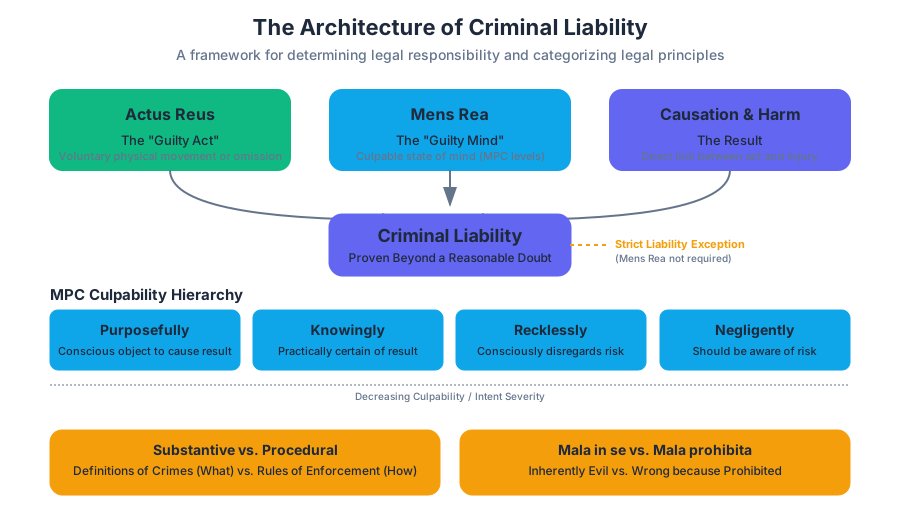
At the core of the American legal system is the requirement that a crime consists of specific, provable elements. The state bears the burden of proving these elements "beyond a reasonable doubt" to overcome the presumption of innocence.
Actus Reus: The Physical Component
Actus Reus (the "guilty act") refers to the physical act or unlawful omission that comprises the physical elements of a crime. It must be a voluntary movement.
Definition: Actus Reus A voluntary physical act, or a failure to act when a legal duty exists (omission), that causes a specific harm prohibited by law.
Mens Rea: The Mental Component
Mens Rea (the "guilty mind") refers to the state of mind of the defendant at the time the crime was committed. Modern American law, following the Model Penal Code (MPC), categorizes mental states into four distinct levels of culpability.
| Culpability Level | Definition | Example Scenario |
|---|---|---|
| Purposefully | The actor has the conscious object to engage in conduct or cause a specific result. | Shooting someone with the specific intent to kill them. |
| Knowingly | The actor is practically certain that their conduct will cause a specific result. | Bombing a building to claim insurance, knowing people are inside. |
| Recklessly | The actor consciously disregards a substantial and unjustifiable risk. | Drag racing on a crowded city street. |
| Negligently | The actor should be aware of a substantial and unjustifiable risk. | Leaving a loaded firearm on a coffee table with toddlers present. |
Strict Liability: The Exception
In certain cases, the law dispenses with the requirement of Mens Rea. These are known as Strict Liability crimes. Examples include traffic violations and statutory rape, where the state only needs to prove the Actus Reus occurred, regardless of the defendant's intent or knowledge.
# Low-level Implementation: A Liability Logic Engine
# This script simulates the determination of criminal liability based on
# the intersection of Actus Reus and Mens Rea.

class CriminalLiabilityEngine:
    def __init__(self, act_voluntary, mental_state, causation_proven):
        self.act_voluntary = act_voluntary  # Boolean
        self.mental_state = mental_state    # String: 'purposeful', 'knowing', 'reckless', 'negligent', 'none'
        self.causation_proven = causation_proven # Boolean

    def evaluate_liability(self, is_strict_liability=False):
        if not self.act_voluntary:
            return "No Liability: Act must be voluntary."

        if not self.causation_proven:
            return "No Liability: Causation not established."

        if is_strict_liability:
            return "Liable: Strict Liability offense (Mens Rea irrelevant)."

        culpability_weights = {
            'purposeful': 4,
            'knowing': 3,
            'reckless': 2,
            'negligent': 1,
            'none': 0
        }

        score = culpability_weights.get(self.mental_state, 0)

        if score > 0:
            return f"Liable: Conviction possible at {self.mental_state} level."
        else:
            return "No Liability: Lacks Mens Rea for non-strict liability offense."

# Example: Reckless Endangerment
case = CriminalLiabilityEngine(act_voluntary=True, mental_state='reckless', causation_proven=True)
print(case.evaluate_liability())
The Architecture of Law: Classifications and Sources
The legal landscape is divided into two primary domains: Substantive Law, which defines the "what" (crimes and punishments), and Procedural Law, which defines the "how" (the rules the government must follow to enforce substantive law).
Stare Decisis and the Common Law
The American legal system is rooted in the English Common Law tradition, governed by the principle of Stare Decisis ("to stand by things decided"). This principle ensures that judicial decisions are consistent and predictable by requiring lower courts to follow the precedents set by higher courts.
Mala in se vs. Mala prohibita
Societies distinguish between acts that are inherently wrong and acts that are wrong because the legislature says so.
- Mala in se: Acts that are "evil in themselves." These are universally recognized as immoral and harmful, such as murder, rape, and robbery.
- Mala prohibita: Acts that are "wrong because they are prohibited." These are often regulatory or victimless crimes that vary by jurisdiction, such as gambling, public intoxication, or drug possession.
| Feature | Substantive Law | Procedural Law |
|---|---|---|
| Focus | Definitions of crimes and defenses. | Rights of the accused and state obligations. |
| Source | Statutes, Penal Codes. | Bill of Rights, Court Rules, Case Law. |
| Goal | To specify what conduct is prohibited. | To ensure fairness and prevent government overreach. |
| Example | The definition of First Degree Murder. | The requirement for a Miranda warning. |
Measuring Crime: The "Dark Figure" and Data Systems
To create effective policy, the state must measure crime. However, official statistics often fail to capture the true volume of criminal activity.
The Dark Figure of Crime
The Dark Figure of Crime represents the gap between the actual amount of crime committed and the amount reported to and recorded by the police. This gap exists due to victim fear, lack of trust in police, or the "victimless" nature of certain crimes.
Major Reporting Systems
- Uniform Crime Reports (UCR): Managed by the FBI, this system collects data from local law enforcement. It historically used the "Hierarchy Rule," only recording the most serious crime in a single incident.
- National Incident-Based Reporting System (NIBRS): A more granular successor to the UCR that records every offense within an incident, providing richer context (e.g., relationship between victim and offender).
- National Crime Victimization Survey (NCVS): A self-report survey that asks citizens about their experiences as victims, bypassing police reports to uncover the "Dark Figure."
\text{Dark Figure} = \text{Total Actual Crimes} - \text{Crimes Recorded in UCR/NIBRS}
The Crime Funnel
The Crime Funnel is a conceptual model illustrating how the number of cases decreases as they move through the justice system. For every 1,000 crimes committed, only a fraction result in arrest, and an even smaller fraction result in incarceration.
Sociological Perspectives: Consensus vs. Conflict
How does a behavior become a "crime"? Criminologists offer two primary competing views:
- Consensus View: This perspective assumes that the majority of citizens share similar values and agree on what behaviors should be criminalized. Law is seen as a tool to protect the common good.
- Conflict View: This perspective argues that law is a tool used by those in power (the "ruling class") to control the marginalized. Crises and crimes are defined in ways that protect the interests of the wealthy while criminalizing the survival behaviors of the poor.
The Dynamics of Criminal Justice Policy
Policy is the operational layer of the justice system. It is often reactive, driven by public sentiment or high-profile events.
Moral Panics and Folk Devils
A Moral Panic is a widespread, disproportionate fear that a particular group or behavior threatens the well-being of society. Sociologist Stanley Cohen identified the role of Folk Devils—individuals or groups (e.g., "super-predators," "hackers," "drug dealers") who are scapegoated by the media and politicians.
The Moral Panic Lifecycle:
- An event occurs.
- Media simplifies and exaggerates the threat.
- "Folk Devils" are identified.
- Public anxiety rises.
- Politicians pass "tough on crime" legislation (often with unintended consequences).
Evidence-Based Practices (EBP)
In contrast to reactive policy, Evidence-Based Practices rely on empirical research and rigorous evaluation to determine "what works." EBP seeks to move away from "gut-feeling" legislation toward interventions that reduce recidivism and maximize cost-benefit ratios.
# CLI Example: Accessing Open Crime Data for Policy Analysis
# A researcher might use a tool like 'curl' to pull NIBRS-compliant data
# from a city's Open Data API for evaluation.

curl -X GET "https://api.citydata.gov/v1/crime_stats?year=2023&type=violent" \
     -H "Authorization: Bearer YOUR_API_TOKEN" \
     -o crime_data_2023.json

# Post-processing to find the 'Dark Figure' estimate
grep -c "unreported" crime_data_2023.json
Criminological Theory: Why Do People Commit Crime?
Policy is ultimately built on theories of human behavior. If we believe people are rational, we use deterrence; if we believe they are products of their environment, we use social reform.
Rational Choice and Deterrence
Rooted in the Social Contract, this theory posits that humans are hedonistic and rational. To prevent crime, the punishment must outweigh the gain.
- Specific Deterrence: Aimed at the individual offender.
- General Deterrence: Aimed at the public to set an example.
Social Disorganization and Strain Theory
- Social Disorganization: Crime is a product of broken social institutions (schools, families) in specific geographic areas.
- Strain Theory: Crime occurs when there is a gap between societal goals (e.g., the American Dream) and the legitimate means to achieve them.
The Wedding Cake Model
The Wedding Cake Model explains how the system handles cases differently based on their "celebrity" or seriousness:
- Layer 1: Celebrated Cases: High-media attention, full jury trials (e.g., O.J. Simpson).
- Layer 2: Serious Felonies: Violent crimes by experienced offenders.
- Layer 3: Lesser Felonies: First-time offenders or less violent acts, often plea-bargained.
- Layer 4: Misdemeanors: The "assembly line" of the system (public intoxication, shoplifting).
Common Pitfalls in Law and Policy
- Conflating Deviance and Crime: Not all deviant behavior (violating social norms) is criminal, and not all criminal behavior is viewed as deviant by all subcultures.
- The "CSI Effect": Jurors often have unrealistic expectations of forensic evidence due to media portrayals, leading to wrongful acquittals or convictions.
- Ignoring Police Discretion: While laws are written in black and white, their enforcement is highly discretionary. A "meat-eater" (corrupt officer) and a "grass-eater" (passive officer) apply the law differently.
- Correlation vs. Causation in Policy: Just because crime dropped after a "Three Strikes" law was passed doesn't mean the law caused the drop; economic shifts or demographic changes may be the actual drivers.
-- SQL: Analyzing the 'Crime Funnel' via Database Queries
-- This query calculates the attrition rate from Arrest to Conviction
-- to identify bottlenecks in the justice system.

SELECT
    arrest_year,
    COUNT(arrest_id) AS total_arrests,
    COUNT(case when disposition = 'Convicted' then 1 end) AS total_convictions,
    ROUND(CAST(COUNT(case when disposition = 'Convicted' then 1 end) AS FLOAT) /
          COUNT(arrest_id) * 100, 2) AS conviction_rate_percentage
FROM
    court_records
WHERE
    offense_category = 'Felony'
GROUP BY
    arrest_year
ORDER BY
    arrest_year DESC;
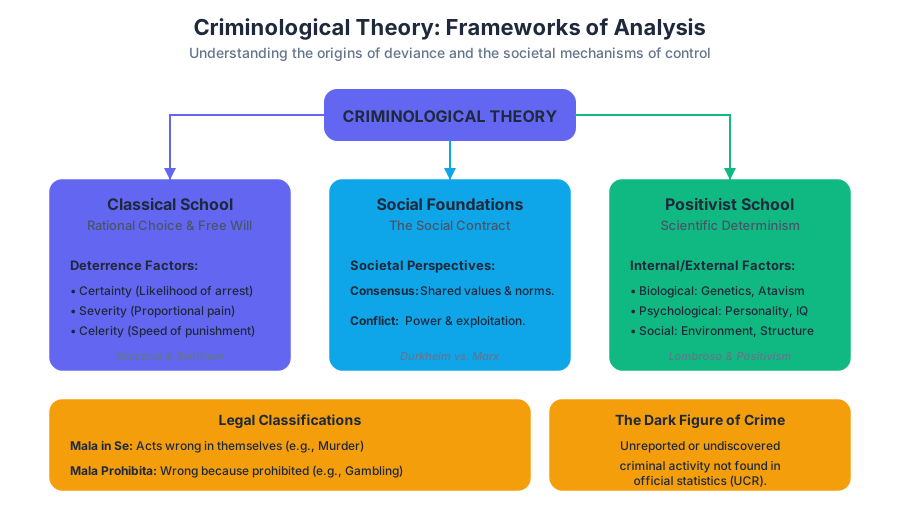
Criminological Theory
Key concepts: Rational Choice Theory · Positivism · Social Disorganization · Deterrence · Social Contract
A deep dive into the various schools of thought that attempt to explain why individuals commit crimes.
Criminological Theory
Criminological theory serves as the analytical backbone of the criminal justice system, providing the frameworks necessary to understand why individuals violate social norms and how society should respond. Rather than a monolithic explanation, the field is a synthesis of sociology, psychology, biology, and economics. It moves beyond the simple "good vs. evil" dichotomy to examine the structural, situational, and individual variables that precipitate criminal behavior.
Foundations: The Social Contract and the Nature of Law
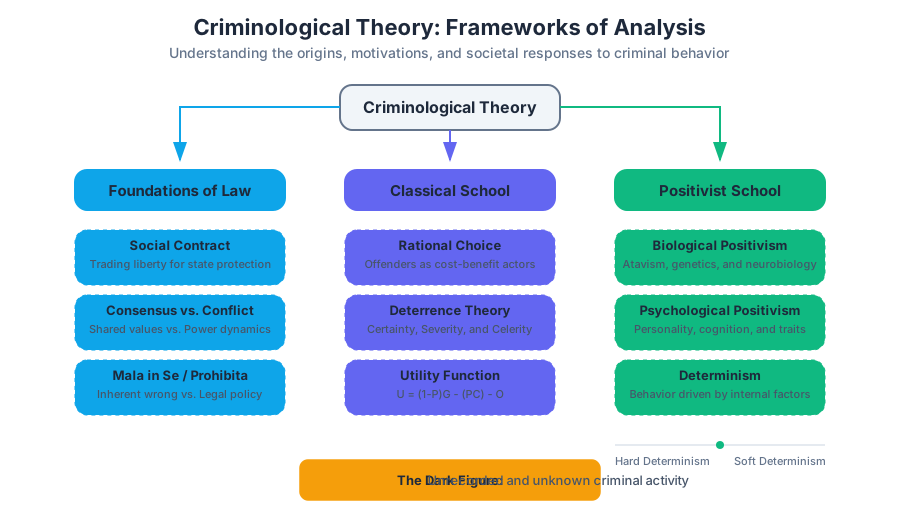
Before analyzing specific theories of crime, one must understand the legal and social environment in which crime is defined. The Social Contract is the foundational political philosophy suggesting that individuals surrender a portion of their natural liberty to a central authority in exchange for the protection of their remaining rights and the maintenance of social order.
Consensus vs. Conflict Perspectives
The definition of what constitutes a "crime" depends heavily on one's theoretical lens regarding the nature of society.
| Feature | Consensus View | Conflict View |
|---|---|---|
| Origin of Law | Reflects the shared values and norms of the majority. | Created by those in power to protect their interests. |
| Social Order | Maintained through cooperation and shared morality. | Maintained through coercion and exploitation. |
| Function of Crime | Deviance defines the boundaries of acceptable behavior. | Crime is a label used to suppress marginalized groups. |
| Key Proponents | Durkheim, Parsons | Marx, Dahrendorf, Quinney |
Legal Classifications: Mala in Se and Mala Prohibita
Laws are generally categorized by their perceived inherent wrongness:
- Mala in se: Acts that are "wrong in themselves" (e.g., murder, theft). These are universally condemned across cultures and eras.
- Mala prohibita: Acts that are "wrong because they are prohibited" (e.g., drug possession, gambling, public intoxication). these reflect current social policy rather than universal morality.
Definition: The Dark Figure of Crime The Dark Figure of Crime refers to the volume of criminal activity that remains unknown to law enforcement and is never recorded in official statistics like the Uniform Crime Reports (UCR).
The Classical School: Rational Choice and Deterrence
The Classical School of criminology emerged during the Enlightenment, spearheaded by Cesare Beccaria and Jeremy Bentham. It rejected theological explanations for crime (e.g., demonic possession) in favor of a model based on Rational Choice.
Rational Choice Theory (RCT)
RCT posits that offenders are rational actors who conduct a cost-benefit analysis before committing a crime. If the perceived utility of the crime outweighs the potential costs, the individual will proceed.
Deterrence Theory
Deterrence is the practical application of RCT. It suggests that crime can be prevented if the legal system ensures that the "pain" of punishment exceeds the "gain" of the offense.
| Variable | Definition | Impact on Deterrence |
|---|---|---|
| Certainty | The probability of being caught and punished. | High impact; considered the most critical factor. |
| Severity | The harshness of the punishment. | Moderate impact; must be proportional to the crime. |
| Celerity | The speed with which the punishment is applied. | High impact; strengthens the mental link between act and consequence. |
Implementation: The Utility Function
In a formal sense, the decision to commit a crime can be modeled as an expected utility calculation.
# A low-level simulation of the Rational Choice Utility Function
# This script calculates the 'Expected Utility' of a criminal act
# based on probability of arrest and severity of punishment.

def calculate_criminal_utility(gain, prob_arrest, punishment_cost, opportunity_cost):
    """
    Calculates the net utility of a criminal decision.
    U = (1 - P) * G - (P * C) - O
    """
    # Expected gain if not caught
    expected_gain = (1 - prob_arrest) * gain

    # Expected loss if caught
    expected_loss = prob_arrest * punishment_cost

    # Net utility after accounting for what the individual loses by not working (opportunity cost)
    net_utility = expected_gain - expected_loss - opportunity_cost

    return net_utility

# Example: Shoplifting a $500 item
# 10% chance of arrest, $2000 fine/legal fees, $50 opportunity cost (time spent)
utility = calculate_criminal_utility(500, 0.10, 2000, 50)

if utility > 0:
    print(f"Decision: Proceed. Net Utility: {utility}")
else:
    print(f"Decision: Abstain. Net Utility: {utility}")
Positivism: The Scientific Study of the Offender
As the 19th century progressed, the Positivist School emerged, challenging the Classical School's assumption of "free will." Positivists argue that behavior is determined by internal or external factors.
Biological Positivism
Cesare Lombroso, the "father of modern criminology," suggested that criminals were atavistic—evolutionary throwbacks who could be identified by physical "stigmata" (e.g., large jaws, asymmetrical faces). While his specific findings were debunked, modern biological positivism lives on in the study of neurobiology, genetics (e.g., the MAOA gene), and biochemistry (e.g., testosterone levels).
Psychological Positivism
This branch focuses on personality disorders, cognitive development, and intelligence. It explores how traits like impulsivity or lack of empathy (psychopathy) contribute to criminal trajectories.
The Determinism Spectrum
- Hard Determinism: The belief that humans have no free will; every action is a result of prior causes.
- Soft Determinism: The belief that while environment and biology constrain choices, individuals still retain a degree of agency.
Social Disorganization Theory: The Ecology of Crime
Developed by the Chicago School (Shaw and McKay), Social Disorganization Theory shifted the focus from the individual to the environment. It posits that crime is a product of the neighborhood's structural characteristics rather than the people living there.
The Concentric Zone Model
Researchers observed that crime rates remained high in specific areas of Chicago (the "Zone in Transition") regardless of which ethnic group lived there. This suggested that the environment itself was "criminogenic."
| Zone | Description | Crime Level |
|---|---|---|
| Zone I | Central Business District (CBD). | Low (commercial focus). |
| Zone II | Zone in Transition. High poverty, dilapidated housing, high turnover. | Highest. |
| Zone III | Workingmen's Homes. Modest apartments. | Moderate. |
| Zone IV | Residential Zone. Single-family homes, yards. | Low. |
| Zone V | Commuter Zone. Suburbs. | Lowest. |
Mechanics of Disorganization
Social disorganization occurs when a community cannot realize the common values of its residents or maintain effective social controls. This is driven by:
- Residential Instability: People move in and out too quickly to form bonds.
- Racial/Ethnic Heterogeneity: Diverse languages and cultures may hinder communication (in the context of early 20th-century urban theory).
- Poverty: Lack of resources to fund community programs or local surveillance.
Social Process and Reaction Theories
These theories examine how individuals interact with society and how those interactions shape criminal identity.
Differential Association Theory
Edwin Sutherland argued that criminal behavior is learned through interaction with others. Individuals learn the techniques of committing crime and the "definitions" (motives/rationalizations) favorable to violating the law.
Social Reaction (Labeling) Theory
Labeling theory focuses on how the criminal justice system itself can create more crime. When an individual is "labeled" a criminal, they may adopt that label as their master status, leading to a self-fulfilling prophecy known as secondary deviance.
Strain Theory
Robert Merton proposed that crime occurs when there is a gap between societal goals (e.g., the American Dream) and the legitimate means to achieve them.
\text{Strain} = \text{Societal Goals} - \text{Institutionalized Means}
Merton identified five adaptations to strain:
- Conformity: Accepting goals and means.
- Innovation: Accepting goals but using illegitimate means (the primary source of crime).
- Ritualism: Rejecting goals but sticking to means.
- Retreatism: Rejecting both (e.g., chronic drug use).
- Rebellion: Replacing both with new goals/means.
Measuring Crime: Data and the Funnel
To test these theories, criminologists rely on data. However, the data is often filtered through the Crime Funnel, where the number of actual crimes is far greater than the number of people who end up in prison.
Data Sources Comparison
| Feature | Uniform Crime Reports (UCR) | NIBRS | NCVS (Victimization) |
|---|---|---|---|
| Source | Police reports to FBI. | Detailed police reports. | Household surveys. |
| Hierarchy Rule | Only the most serious crime in an incident is counted. | No hierarchy rule; counts all offenses. | N/A. |
| Scope | Part I and Part II offenses. | 52 categories of crime. | Crimes not reported to police. |
| Weakness | Underreports due to police discretion. | High administrative burden for police. | Relies on victim memory/honesty. |
The Wedding Cake Model
The Wedding Cake Model explains how the system handles different types of cases:
- Layer 1: Celebrated Cases: High-profile trials (e.g., O.J. Simpson) that receive massive media attention but are unrepresentative.
- Layer 2: Serious Felonies: Violent crimes committed by experienced offenders.
- Layer 3: Lesser Felonies: Non-violent crimes, often involving people who know each other.
- Layer 4: Misdemeanors: The "bulk" of the system; public intoxication, shoplifting, traffic violations.
Operationalizing Theory in Policy
Theoretical frameworks are not merely academic; they dictate the "Three C's" of the criminal justice system: Cops, Courts, and Corrections.
Example: The "Broken Windows" Policy
Rooted in Social Disorganization and Deterrence, the Broken Windows theory suggests that ignoring minor physical decay (like a broken window) signals that "no one cares," leading to a breakdown in social control and an increase in serious crime.
# A conceptual CLI workflow for a "Data-Driven Policing" unit
# implementing a Broken Windows / Hotspot strategy.

# 1. Identify "Hotspots" using spatial analysis of NIBRS data
cjis-analyzer --input nibrs_2023_q3.csv --analyze hotspots --threshold 0.85

# 2. Correlate hotspots with physical disorder (311 reports)
cjis-correlate --crime-data hotspots.json --city-data 311_reports.csv --target "vandalism"

# 3. Deploy "Quality of Life" enforcement to specific sectors
cjis-deploy --sector "Zone_J_Transition" --strategy "zero_tolerance" --duration 30d
Common Pitfalls and Misconceptions
- The Ecological Fallacy: Assuming that because a neighborhood has a high crime rate, every individual in that neighborhood is a criminal. This is a common error in interpreting Social Disorganization Theory.
- Correlation vs. Causation: Finding that criminals often have low heart rates (a biological positivist finding) does not mean low heart rates cause crime. It may be a symptom of a third variable, like lack of fear.
- Over-reliance on Official Statistics: Using only UCR data ignores the "Dark Figure of Crime," leading to skewed theories that only explain why people get caught, not why they commit crime.
- The Rationality Myth: Rational Choice Theory often assumes a level of "perfect information" that offenders rarely have. Most crimes are committed under the influence of substances or high emotional arousal, limiting "rational" calculus.
Summary of Legal Elements: Actus Reus and Mens Rea
For a crime to occur under substantive law, two elements must generally be proven:
- Actus Reus: The "guilty act." A voluntary physical movement or an omission where there was a legal duty to act.
- Mens Rea: The "guilty mind." The intent or state of mind at the time of the act.
Levels of Mens Rea (Model Penal Code)
- Purposeful: Acting with the conscious object to engage in the conduct or cause the result.
- Knowing: Being aware that the result is practically certain to occur.
- Reckless: Consciously disregarding a substantial and unjustifiable risk.
- Negligent: Should be aware of a substantial and unjustifiable risk.
-- Querying a legal database to find cases where Mens Rea was 'Reckless'
-- but Actus Reus resulted in a 'Mala in se' felony.

SELECT
    case_id,
    defendant_name,
    offense_type,
    intent_level,
    sentencing_outcome
FROM
    criminal_cases
WHERE
    intent_level = 'Reckless'
    AND offense_category = 'Mala_in_se'
    AND conviction_status = 'Guilty'
ORDER BY
    sentencing_outcome DESC;
Policing and Law Enforcement
Key concepts: Peelian Principles · Policing Eras · Police Discretion · Community Policing · Accountability
The history, evolution, and modern challenges of policing in the United States.
Policing and Law Enforcement
Policing serves as the primary interface between the state’s legal apparatus and the citizenry. Often described as the "front door" of the criminal justice system, law enforcement agencies are tasked with the dual, often conflicting, mandates of maintaining social order and protecting individual constitutional rights. This tension is governed by a complex framework of historical precedents, evolving operational philosophies, and the exercise of high-level administrative and individual discretion.
The Foundations of Modern Policing
The evolution of policing is a transition from informal, communal self-policing to highly structured, professionalized state bureaucracies. This transition was not merely organizational but philosophical, moving from the concept of "might makes right" to the "rule of law."
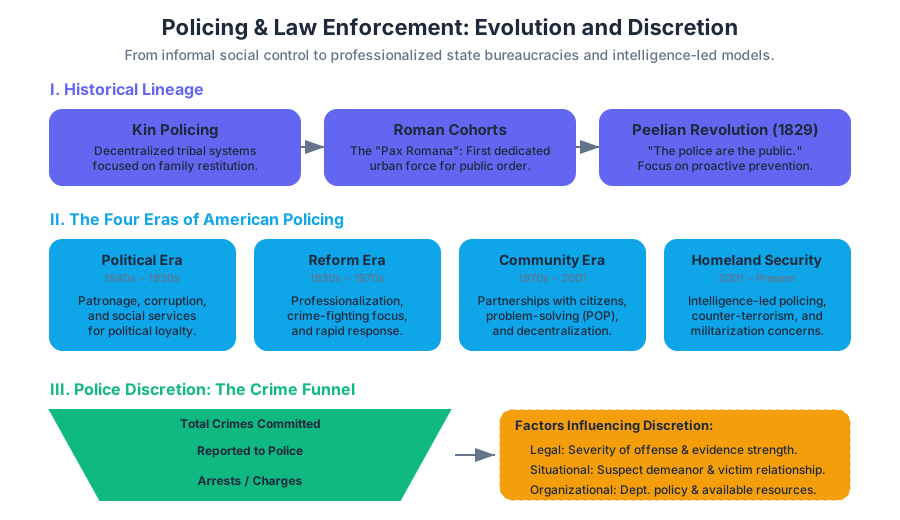
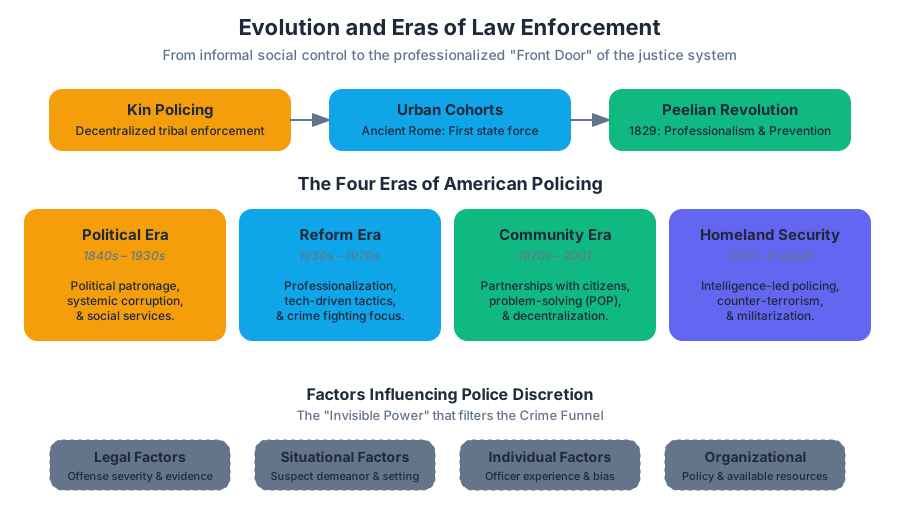
Historical Lineage: From Kin to Cohorts
Before formal departments existed, societies relied on Kin Policing, a decentralized system where families or tribes were responsible for enforcing norms. This often resulted in "blood feuds," where the "justice" was as much about vengeance as it was about restitution.
The first move toward professionalization occurred in ancient Rome with the Urban Cohorts and Vigiles, established by Augustus. These were the first instances of a dedicated force tasked with maintaining the Pax Romana (Roman Peace) within city limits, focusing on fire prevention and petty crime.
The Peelian Revolution
The watershed moment for modern law enforcement was the Metropolitan Police Act of 1829, championed by Sir Robert Peel. Peel is widely regarded as the "Father of Modern Policing" for establishing the first organized, professional police force in London. His "Peelian Principles" shifted the focus from reactive punishment to proactive prevention.
The Peelian Principle of Legitimacy: "The police are the public and the public are the police; the police being only members of the public who are paid to give full-time attention to duties which are incumbent on every citizen in the interests of community welfare and existence."
| Principle Category | Core Mandate | Modern Application |
|---|---|---|
| Prevention | To prevent crime and disorder as an alternative to their repression by military force. | Proactive patrolling and crime prevention programs. |
| Approval | To recognize always that the power of the police to fulfill their functions is dependent on public approval. | Community policing and public relations. |
| Cooperation | To recognize always that to secure and maintain the respect and approval of the public means also the securing of the willing cooperation of the public. | Witness participation and tip lines. |
| Proportionality | To use physical force only when the exercise of persuasion, advice, and warning is found to be insufficient. | Use of Force continuums and de-escalation. |
The Four Eras of American Policing
American policing did not evolve in a vacuum; it was shaped by the unique socio-political landscape of the United States, moving through four distinct developmental stages.
1. The Political Era (1840s–1930s)
During this era, police departments were extensions of local political "machines." Officers were appointed based on political loyalty rather than merit. Corruption was systemic, with the police providing social services (housing, food) to voters while engaging in "graft" (bribery) and protecting illegal vice operations for political patrons.
2. The Reform (Professional) Era (1930s–1970s)
Driven by the desire to eliminate political influence, this era focused on professionalization. August Vollmer and O.W. Wilson advocated for civil service exams, specialized units, and the use of technology (radios, cars). The police mission narrowed to "crime fighting," and the relationship with the public became distant and reactive.
3. The Community Era (1970s–2001)
Following the civil unrest of the 1960s, it became clear that the "professional" model had alienated the public. The Community Era emphasized building ties with citizens to solve the underlying causes of crime. This era introduced Community-Oriented Policing (COP) and Problem-Oriented Policing (POP).
4. The Homeland Security Era (2001–Present)
Triggered by the 9/11 attacks, this era is characterized by the integration of local policing with national intelligence. It emphasizes "intelligence-led policing," terrorism prevention, and the acquisition of military-grade equipment, leading to ongoing debates regarding the "militarization" of domestic law enforcement.
Police Discretion: The Invisible Power
Police Discretion is the authority of an officer to choose between various courses of action (or inaction) based on their professional judgment. While laws are written as absolute (e.g., "thou shalt not speed"), their enforcement is highly selective.
Factors Influencing Discretion
Discretion is not arbitrary; it is influenced by a hierarchy of variables:
- Legal Factors: The severity of the offense and the strength of the evidence (e.g., Actus Reus and Mens Rea).
- Situational Factors: The demeanor of the suspect, the presence of witnesses, and the relationship between the victim and the offender.
- Individual Factors: The officer's experience, education, and personal biases.
- Organizational Factors: Departmental policy, quotas (official or unofficial), and available resources.
The "Crime Funnel" and Discretion
Discretion acts as the primary filter in the Crime Funnel. For every 1,000 crimes committed, only a fraction result in arrest, and even fewer in conviction. The police decide which cases enter the "funnel" and which are diverted through warnings or informal resolutions.
P(Arrest) = \frac{C_{reported} \times E_{sufficiency} \times D_{officer}}{C_{total}}
Where $C$ represents crime volume, $E$ represents evidence, and $D$ represents the discretion coefficient.
Operational Models and Problem Solving
Modern policing relies on structured frameworks to move beyond "random patrol" toward targeted intervention.
The SARA Model
The SARA Model is the gold standard for Problem-Oriented Policing. It provides a recursive loop for identifying and neutralizing recurring crime patterns.
| Phase | Action | Objective |
|---|---|---|
| Scanning | Identifying recurring problems and their consequences. | Problem identification. |
| Analysis | Identifying the conditions that precede and accompany the problem. | Understanding the "Why." |
| Response | Developing and implementing a tailored intervention. | Execution of strategy. |
| Assessment | Evaluating the effectiveness of the response. | Quality control and iteration. |
Technical Implementation: Use of Force Decision Logic
In modern training and body-camera analysis, the "Use of Force Continuum" is often modeled as a state machine. Below is a C++ representation of how a simplified decision-support system might evaluate a threat level versus a response.
#include <iostream>
#include <string>

enum class SubjectBehavior { COMPLIANT, PASSIVE_RESISTANT, ACTIVE_RESISTANT, AGGRESSIVE, DEADLY };
enum class ForceLevel { VERBAL_COMMANDS, PHYSICAL_CONTROL, NON_LETHAL_WEAPON, LETHAL_FORCE };

struct IncidentState {
    SubjectBehavior behavior;
    bool officer_at_risk;
    bool public_at_risk;
};

ForceLevel determineResponse(IncidentState state) {
    switch (state.behavior) {
        case SubjectBehavior::COMPLIANT:
            return ForceLevel::VERBAL_COMMANDS;
        case SubjectBehavior::PASSIVE_RESISTANT:
            return ForceLevel::PHYSICAL_CONTROL; // Low-level joint locks
        case SubjectBehavior::ACTIVE_RESISTANT:
            return ForceLevel::NON_LETHAL_WEAPON; // Taser / OC Spray
        case SubjectBehavior::AGGRESSIVE:
            return ForceLevel::NON_LETHAL_WEAPON; // Impact tools
        case SubjectBehavior::DEADLY:
            if (state.officer_at_risk || state.public_at_risk) {
                return ForceLevel::LETHAL_FORCE;
            }
            return ForceLevel::NON_LETHAL_WEAPON;
        default:
            return ForceLevel::VERBAL_COMMANDS;
    }
}

int main() {
    IncidentState current = {SubjectBehavior::AGGRESSIVE, true, false};
    ForceLevel response = determineResponse(current);
    std::cout << "Recommended Response Level: " << static_cast<int>(response) << std::endl;
    return 0;
}
Accountability and Misconduct
As the state’s agents of force, police are subject to intense scrutiny. Misconduct is generally categorized by the motivation and the level of activity.
Meat Eaters vs. Grass Eaters
The Knapp Commission (1972) famously distinguished between two types of corrupt officers:
- Grass Eaters: Officers who do not actively seek out bribes but will accept them if offered (e.g., a free meal or a small "tip" to overlook a traffic violation). They are more numerous and create a culture of "quiet" corruption.
- Meat Eaters: Officers who aggressively misuse their power for personal gain (e.g., shaking down drug dealers, stealing evidence, or orchestrating protection rackets).
Mechanisms of Accountability
- Internal Affairs (IA): A specialized unit within the department that investigates allegations of officer misconduct.
- Civilian Oversight Boards: External bodies that review police actions to ensure transparency.
- Body-Worn Cameras (BWC): Technology designed to provide an objective record of encounters, though its effectiveness depends on strict activation policies.
Policy Configuration Example
The effectiveness of accountability technology is often dictated by the underlying configuration. Below is a YAML snippet representing a standardized policy for Body-Worn Camera (BWC) auto-activation.
# BWC Activation Policy v2.1
activation_triggers:
  emergency_lights: true
  siren_active: true
  weapon_rack_release: true
  accelerometer_threshold: 4.5G # Triggers on foot pursuit or collision
  manual_override: true

retention_policy:
  non_evidentiary: 90_days
  misdemeanor_arrest: 3_years
  felony_arrest: 7_years
  use_of_force_incident: permanent

access_control:
  officer_review_before_report: false # Prevents "statement tailoring"
  internal_affairs_bypass: true
  public_request_redaction: automatic_pii_blur
Measuring Police Performance
How do we know if policing is "working"? Traditionally, departments relied on Official Statistics like the Uniform Crime Reports (UCR). However, these metrics are flawed.
The Dark Figure of Crime
The Dark Figure of Crime represents the volume of crime that is never reported to the police and thus never appears in official statistics. To bridge this gap, criminologists use Victimization Studies (like the NCVS) and Self-Report Statistics.
SQL Analysis of Misconduct Patterns
Data scientists in Internal Affairs use SQL to identify "red flag" officers—those whose metrics deviate significantly from their peers.
-- Identify officers with Use of Force incidents 2 standard deviations above the precinct mean
WITH PrecinctStats AS (
    SELECT
        precinct_id,
        AVG(force_incidents) as avg_incidents,
        STDDEV(force_incidents) as stddev_incidents
    FROM officer_metrics
    GROUP BY precinct_id
)
SELECT
    m.officer_id,
    m.precinct_id,
    m.force_incidents,
    p.avg_incidents,
    ((m.force_incidents - p.avg_incidents) / p.stddev_incidents) as z_score
FROM officer_metrics m
JOIN PrecinctStats p ON m.precinct_id = p.precinct_id
WHERE ((m.force_incidents - p.avg_incidents) / p.stddev_incidents) > 2.0
ORDER BY z_score DESC;
Common Pitfalls and Misconceptions
- The "CSI Effect": The public often believes that policing is primarily about high-tech forensics. In reality, the vast majority of police work is administrative, social service-oriented, or involves routine patrol.
- The "Bad Apple" Fallacy: Focusing solely on individual "meat eaters" often ignores systemic organizational issues (the "rotten orchard") that allow misconduct to flourish.
- Correlation vs. Causation in Crime Rates: Falling crime rates are often credited to specific police policies (e.g., "Broken Windows"), but they may actually be driven by broader demographic shifts, economic changes, or even environmental factors (like the removal of lead from gasoline).
The Judicial System
Key concepts: Dual Court System · Jurisdiction · Courtroom Workgroup · Principle of Orality · Writ of Certiorari
An examination of the dual court system, the roles of courtroom actors, and the stages of a criminal trial.
The Judicial System
The judicial system serves as the critical "middle pillar" of the American criminal justice apparatus, situated between the initial contact of law enforcement and the eventual implementation of correctional mandates. It is a complex, multi-layered architecture designed to balance the state's interest in public safety with the individual's right to due process. Unlike the executive branch (police) or the legislative branch (lawmakers), the judiciary operates through a reactive and adjudicative framework, interpreting law and applying it to specific controversies.
The Dual Court System: Federalism in Practice
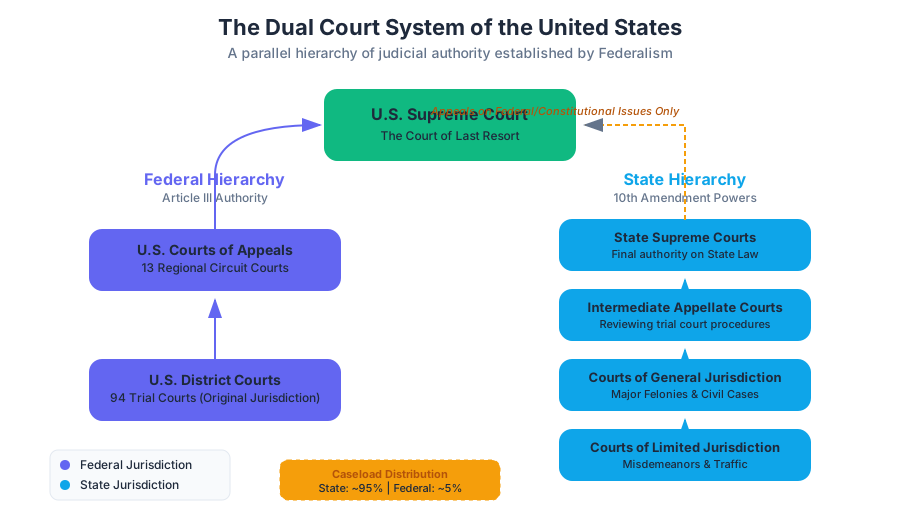
The United States utilizes a Dual Court System, a structural manifestation of federalism where two independent judicial hierarchies—state and federal—operate simultaneously. This division is rooted in the 10th Amendment, which reserves powers not delegated to the federal government to the states.
The State Hierarchy
The vast majority of criminal cases (approximately 90-95%) are handled at the state level. While structures vary by state, they generally follow a four-tier model:
- Courts of Limited Jurisdiction: Handle minor offenses, traffic violations, and initial appearances (e.g., Municipal or Justice of the Peace courts).
- Courts of General Jurisdiction: Trial courts for serious crimes (felonies) and major civil disputes (e.g., Superior or District courts).
- Intermediate Appellate Courts: Review decisions from trial courts to ensure legal procedures were followed.
- State Supreme Courts: The court of last resort for state law issues.
The Federal Hierarchy
Established by Article III of the Constitution, the federal system addresses crimes involving federal laws, constitutional issues, or disputes between states.
- U.S. District Courts: The primary trial courts of the federal system (94 districts).
- U.S. Courts of Appeals: Organized into 13 circuits, these courts review district court decisions.
- U.S. Supreme Court (SCOTUS): The ultimate arbiter of federal law and the Constitution.
| Feature | State Court System | Federal Court System |
|---|---|---|
| Source of Authority | State Constitution / Statutes | U.S. Constitution / Federal Law |
| Caseload Volume | High (Millions of cases annually) | Low (Thousands of cases annually) |
| Subject Matter | Crimes against state law (Robbery, Murder, Theft) | Crimes against federal law (Drug trafficking across borders, Tax evasion) |
| Judicial Selection | Election or Appointment (varies by state) | Presidential Appointment / Senate Confirmation |
| Final Authority | State Supreme Court (unless federal issue) | U.S. Supreme Court |
The Mechanics of Jurisdiction
Jurisdiction is the legal authority of a court to hear and decide a case. Without proper jurisdiction, a court’s judgment is void. It is not a singular concept but a multi-dimensional requirement.
Dimensions of Jurisdiction
- Geographic Jurisdiction: The court's authority over a specific physical area (e.g., a county or a federal district).
- Subject Matter Jurisdiction: The authority to hear specific types of cases (e.g., Family Court vs. Criminal Court).
- Personal Jurisdiction: The court’s power over the individuals involved in the lawsuit.
- Hierarchical Jurisdiction: Distinguishes between Original Jurisdiction (the power to hear a case for the first time) and Appellate Jurisdiction (the power to review a lower court's decision).
Key Insight: Jurisdiction is often concurrent, meaning both state and federal courts might have the authority to prosecute the same act (e.g., a bank robbery). Under the Dual Sovereignty Doctrine, this does not violate the Double Jeopardy clause of the 5th Amendment.
/*
 * Low-level Logic: Case Routing Algorithm
 * This pseudocode represents the logic used to determine
 * if a case belongs in Federal or State jurisdiction.
 */

#include <stdio.h>
#include <stdbool.h>

typedef struct {
    bool involves_federal_law;
    bool cross_state_lines;
    bool constitutional_challenge;
    char* crime_location;
} CaseContext;

int determine_jurisdiction(CaseContext c) {
    // Priority 1: Federal Mandates
    if (c.involves_federal_law || c.constitutional_challenge) {
        return 0; // U.S. DISTRICT COURT
    }

    // Priority 2: Interstate Commerce / Activity
    if (c.cross_state_lines) {
        return 0; // U.S. DISTRICT COURT
    }

    // Default: State Jurisdiction
    return 1; // STATE SUPERIOR COURT
}

int main() {
    CaseContext current_case = {true, false, false, "California"};
    int venue = determine_jurisdiction(current_case);
    printf("Case routed to: %s\n", venue == 0 ? "Federal" : "State");
    return 0;
}
The Courtroom Workgroup: A Sociological Perspective
While the public perceives the courtroom as a site of pure adversarial combat, sociologists and legal scholars identify it as a Courtroom Workgroup. This concept suggests that the judge, prosecutor, and defense attorney are not merely opponents but colleagues who must interact daily to process cases efficiently.
Core Members and Their Dynamics
- The Prosecutor: Arguably the most powerful actor due to Prosecutorial Discretion. They decide which charges to file and whether to offer a plea bargain.
- The Defense Attorney: Tasked with protecting the defendant's rights. In reality, they often negotiate with the prosecutor to reach "the going rate"—the standard sentence for a specific crime in that jurisdiction.
- The Judge: Acts as the "referee" and ultimate legal authority. While they oversee the trial, their role in the workgroup is often to facilitate settlements (plea bargains) to prevent docket congestion.
| Actor | Primary Goal | Source of Power | Conflict Point |
|---|---|---|---|
| Prosecutor | Secure conviction / Justice | Discretionary charging | Due process requirements |
| Defense | Protect rights / Minimize penalty | 6th Amendment mandate | Lack of resources (Public Defenders) |
| Judge | Ensure legal procedure / Efficiency | Statutory authority | Mandatory minimum sentences |
The Principle of Orality and Trial Dynamics
The American trial system is governed by the Principle of Orality. This principle dictates that all evidence must be presented "live" and in open court. It is a rejection of the "inquisitorial" systems where judges might decide cases based solely on written dossiers.
Why Orality Matters
- Confrontation Clause: The 6th Amendment grants the defendant the right to confront their accusers.
- Demeanor Evidence: Juries and judges can assess the credibility of a witness by observing their body language and tone.
- Public Scrutiny: Oral proceedings ensure the public can witness the administration of justice, preventing "star chamber" secrecy.
The Adversarial vs. Consensus Reality
The system is designed as an Adversarial System, where the truth emerges from the clash of two opposing sides. However, the Wedding Cake Model of justice shows that most cases do not reach this stage.
- Layer 1 (Celebrated Cases): Receive full adversarial trials.
- Layer 4 (Misdemeanors): Handled like an assembly line with little formal procedure.
P(Conviction) = \frac{\sum (E_{physical} \cdot w_1) + \sum (E_{testimonial} \cdot w_2)}{R_{procedural}}
Where $E$ represents evidence types, $w$ represents their weighted impact on a jury, and $R$ represents the procedural "friction" (defense motions, suppressed evidence).
The Appellate Process and the Writ of Certiorari
The right to appeal is a fundamental safeguard, but it is not a "retrial." Appeals focus exclusively on Legal Error (e.g., a judge allowed inadmissible evidence) rather than Factual Error (e.g., the jury was wrong about who committed the crime).
The U.S. Supreme Court Gatekeeping
The SCOTUS is a court of discretionary jurisdiction. It does not have to hear every case appealed to it. The mechanism for requesting a review is the Writ of Certiorari.
- Petition: The losing party files a petition for cert.
- The Rule of Four: If four of the nine justices agree the case has significant constitutional merit, the writ is granted.
- The Docket: Out of ~7,000 petitions annually, only about 70-80 are granted cert.
Sentencing: The Bridge to Corrections
Once guilt is established—either through trial or the more common plea bargain—the system moves to the sentencing phase. This is where the theoretical goals of the justice system (Retribution, Deterrence, Incapacitation, Rehabilitation) are put into practice.
Sentencing Models
- Indeterminate Sentencing: A range of time (e.g., 5-10 years). This gives the parole board discretion based on the inmate's rehabilitation.
- Determinate Sentencing: A fixed term (e.g., 8 years). This reduces disparity but limits the incentive for rehabilitation.
- Mandatory Minimums: Statutes that require a specific minimum sentence for certain crimes (often drug-related), significantly stripping judges of their discretion.
Common Pitfalls in Sentencing
- Sentencing Disparity: Similar crimes committed by similar defendants resulting in vastly different sentences due to judicial bias or jurisdictional differences.
- The Trial Penalty: Defendants who exercise their right to a trial often receive significantly harsher sentences than those who accept a plea bargain.
# Example: Sentencing Guideline Configuration (Simplified)
offense_levels:
  - level: 1
    description: "Minor theft, no weapon"
    base_points: 4
  - level: 10
    description: "Armed robbery, bodily injury"
    base_points: 26

criminal_history_category:
  - category: I
    points: 0-1
  - category: VI
    points: 13+

sentencing_matrix:
  lookup: "base_points + history_points"
  output: "months_incarceration"
  discretionary_range: "15%"
Synthesis: The Crime Funnel and Judicial Reality
The judicial system is often described as a Crime Funnel. While thousands of crimes are committed, only a fraction result in arrest, fewer in charging, and a tiny percentage in a full trial. The "workgroup" ensures the funnel flows, but this efficiency often comes at the cost of the adversarial ideal.
Summary of Key Definitions
- Stare Decisis: "To stand by things decided." The principle of following legal precedent.
- Mala in se: Acts that are inherently evil (e.g., murder).
- Mala prohibita: Acts that are wrong only because they are prohibited (e.g., gambling laws).
- Writ of Certiorari: An order by a higher court directing a lower court to send the record of a case for review.
Conclusion
The American judicial system is a masterpiece of procedural complexity. It functions not as a single machine, but as a collection of local bureaucracies (workgroups) operating within a rigid constitutional framework. Understanding the tension between the Principle of Orality (the ideal) and the Courtroom Workgroup (the reality) is essential for any deep-dive into criminology. Whether through the granting of a Writ of Certiorari at the highest level or a plea bargain in a municipal court, the judiciary remains the definitive site where the abstract power of the law meets the concrete reality of human behavior.

Institutional Corrections
Key concepts: Retribution · Rehabilitation · Walnut Street Jail · Prison Security Levels · Incarceration Trends
The history and management of jails and prisons, focusing on the philosophies of punishment.
Institutional Corrections
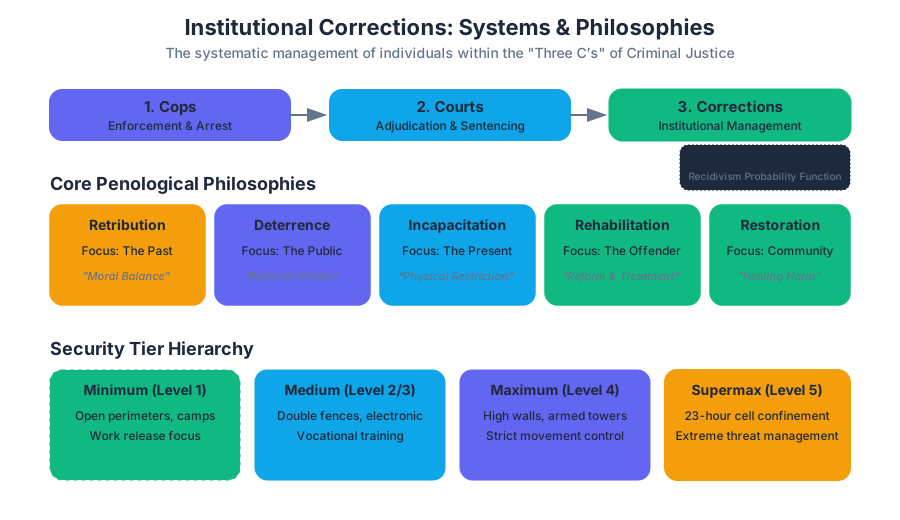
Institutional corrections refers to the systematic management and confinement of individuals who have been accused or convicted of criminal offenses within state-sanctioned facilities. As the final stage of the "Three C’s" (Cops, Courts, and Corrections), it represents the most intensive form of social control. The evolution of institutional corrections reflects a transition from corporal and capital punishment to a "penitentiary" model focused on the mind and soul, and eventually to a modern bureaucratic system balancing security with varying degrees of rehabilitation.
The Philosophical Foundations of Punishment
The operation of any correctional facility is governed by a specific penal philosophy. These philosophies are not mutually exclusive; modern systems often represent a "hybrid" approach where different goals are prioritized based on the offense type (e.g., mala in se vs. mala prohibita) or the offender's history.
Penological Philosophy: The theoretical framework that justifies the state's right to punish and defines the intended outcome of that punishment, ranging from moral retribution to social utility.
Core Perspectives
| Philosophy | Primary Goal | Focus | Justification |
|---|---|---|---|
| Retribution | Deserved punishment | Past (The Act) | "Eye for an eye"; moral balance must be restored. |
| Deterrence | Prevention of future crime | Future (The Public/Individual) | Rational Choice Theory; the pain of punishment must outweigh the gain of crime. |
| Incapacitation | Physical restriction | Present (The Community) | Removing the ability to commit crime by removing the offender from society. |
| Rehabilitation | Reform and treatment | Future (The Offender) | Addressing the root causes of behavior (e.g., addiction, lack of education). |
| Restoration | Healing the community | Future (The Victim/Community) | Repairing the harm caused by the criminal act through mediation and restitution. |
Implementation: The Recidivism Function
In a technical sense, the success of a correctional system is often measured by the reduction of recidivism. We can model the probability of an individual re-offending ($P_r$) as a function of various correctional inputs.
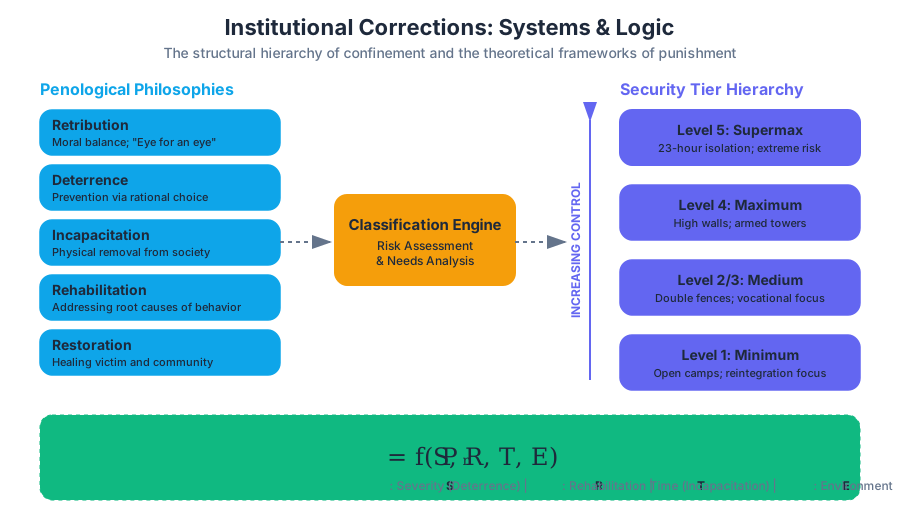
P_r = f(S, R, T, E)
Where:
- $S$: Severity of the initial sentence (Deterrence factor)
- $R$: Quality of rehabilitative programming (Reform factor)
- $T$: Time served (Incapacitation factor)
- $E$: Post-release environment/social capital
Historical Evolution: From Walnut Street to the Modern Era
The American correctional system is rooted in the "Great Law" of William Penn and the subsequent reforms of the Philadelphia Society for Alleviating the Miseries of Public Prisons.
The Walnut Street Jail (1790)
The Walnut Street Jail is widely considered the first true penitentiary. It introduced the concept of the "penitent"—a prisoner who reflects on their crimes in silence. This marked a departure from the chaotic, congregate holding pens of the colonial era where men, women, and children were housed together regardless of their offense.
Competing Systems: Pennsylvania vs. Auburn
In the 19th century, two distinct models of institutionalization emerged, setting the stage for modern prison architecture and management.
| Feature | Pennsylvania System (Separate) | Auburn System (Congregate) |
|---|---|---|
| Primary Facility | Eastern State Penitentiary | Auburn Prison (New York) |
| Method | Total isolation; 24/7 solitary confinement. | Work together during the day; solitary at night. |
| Philosophy | Reflection and repentance without "criminal contagion." | Discipline and economic productivity through contract labor. |
| Communication | Absolute silence; hoods worn when moving. | Absolute silence; lockstep marching. |
| Outcome | High rates of mental illness; expensive to run. | More cost-effective; became the dominant U.S. model. |
Facility Classification and Security Levels
Modern institutional corrections is a highly stratified system. Classification is the process of matching an offender's risk and needs with the appropriate security level. This is a critical safety function: placing a low-risk offender in a high-security environment can lead to "prisonization" (adoption of criminal values), while the reverse poses a threat to public safety.
Security Tier Hierarchy
- Minimum Security (Level 1): Often "camps" with no fences. Inmates are low-risk, often white-collar or nearing release. Focus is on work release and reintegration.
- Medium Security (Level 2/3): Double-fenced perimeters, often with electronic detection. More internal freedom than maximum security, with a heavy emphasis on vocational training.
- Maximum Security (Level 4): High walls, armed guard towers, and high staff-to-inmate ratios. Movement is strictly controlled.
- Supermax (Level 5): Facilities like ADX Florence. Inmates are in their cells 23 hours a day. Reserved for the "worst of the worst" or those posing extreme threats to national security.
The Classification Algorithm
In modern practice, classification is handled by algorithmic scoring systems that evaluate static and dynamic risk factors.
/*
 * Low-level implementation of an Inmate Security Classification Scoring Engine.
 * This simulates the logic used to assign a security level based on
 * historical and behavioral variables.
 */

#include <stdio.h>

typedef struct {
    int violent_offense_history; // 0-10 scale
    int escape_risk;             // 0-10 scale
    int gang_affiliation;        // Boolean
    int sentence_length_years;   // Raw years
    int age;                     // Inverse correlation with risk
} InmateProfile;

const char* calculate_security_level(InmateProfile inmate) {
    int score = 0;

    // Weighting factors
    score += (inmate.violent_offense_history * 3);
    score += (inmate.escape_risk * 5);
    if (inmate.gang_affiliation) score += 15;

    // Sentence length adjustment
    if (inmate.sentence_length_years > 20) score += 10;

    // Aging out of crime (Positivist theory)
    if (inmate.age > 50) score -= 5;

    // Classification Logic
    if (score >= 40) return "SUPERMAX / LEVEL 5";
    if (score >= 25) return "MAXIMUM / LEVEL 4";
    if (score >= 15) return "MEDIUM / LEVEL 2-3";
    return "MINIMUM / LEVEL 1";
}

int main() {
    InmateProfile subject_A = {8, 2, 1, 25, 34};
    printf("Assigned Tier: %s\n", calculate_security_level(subject_A));
    return 0;
}
Architectural Paradigms: Linear vs. Podular
The physical layout of a prison dictates the "style" of supervision. Architecture is not merely aesthetic; it is a tool of social control.
1. Linear Design (First Generation)
Characterized by long hallways and cells arranged in rows. Guards walk "rounds" to peer into cells.
- Pitfall: "Intermittent surveillance." Inmates can predict when a guard will pass, creating "blind spots" for illicit activity.
2. Podular Remote (Second Generation)
Cells are arranged around a central common area (dayroom). The guard station is encased in glass (the "bubble") overlooking the pod.
- Pitfall: The physical barrier between staff and inmates creates an "us vs. them" mentality and limits the guard's ability to sense tension.
3. Podular Direct (Third Generation)
The guard station is located inside the pod with no physical barrier. This is known as Direct Supervision.
- Benefit: Guards interact constantly with inmates, allowing for proactive conflict resolution and better intelligence gathering.
Incarceration Trends and the "Crime Funnel"
The United States has experienced a massive expansion in its correctional population since the 1970s, a phenomenon often termed "Mass Incarceration." To understand why the prison population looks the way it does, we must look at the Crime Funnel.
The Crime Funnel: The phenomenon where the number of crimes committed far exceeds the number of people who are eventually incarcerated.
Funnel Attrition Points
- The Dark Figure of Crime: Crimes committed but never reported to the police.
- Police Discretion: Decisions to arrest or warn.
- Prosecutorial Discretion: Decisions to charge, dismiss, or plea bargain.
- Sentencing: Judicial decisions based on guidelines or mandatory minimums.
Data Representation: The System State
We can represent the flow of individuals through the correctional system using a configuration-style schema, highlighting the transition from "Arrested" to "Institutionalized."
# Institutional Flow Configuration
system_parameters:
  jurisdiction: "Federal"
  policy_framework: "Mandatory Minimums"

occupancy_thresholds:
  maximum_capacity: 120% # Overcrowding indicator
  critical_alert: true

inmate_lifecycle:
  entry_point: "Booking/Intake"
  processing:
    - step: "Initial Classification"
      method: "Static Risk Assessment"
    - step: "Medical Screening"
      focus: "Contagious Disease & Mental Health"
    - step: "Housing Assignment"
      logic: "Security Level Matching"
  exit_strategies:
    - type: "Parole"
      eligibility: "65% of sentence served"
    - type: "Expiration of Sentence"
      status: "Max out"
    - type: "Commutation"
      authority: "Executive Branch"
Jails vs. Prisons: A Technical Distinction
While often used interchangeably in common parlance, jails and prisons serve distinct functions within the institutional corrections framework.
| Feature | Jail | Prison |
|---|---|---|
| Administration | Local (County Sheriff/City) | State or Federal (DOC/BOP) |
| Population | Pre-trial detainees & short-term sentences. | Convicted felons. |
| Duration | Typically < 1 year. | Typically > 1 year. |
| Programming | Limited (due to high turnover). | Extensive (Education, Vocational, Therapy). |
| Stability | High churn; "revolving door." | Stable population; long-term social structures. |
Contemporary Challenges and Policy Shifts
The Cost-Benefit Paradox
Institutional corrections is one of the largest expenditures for state governments. The shift toward Evidence-Based Practices (EBP) is driven by the need to ensure that the high cost of incarceration actually produces a "public safety dividend."
Common Pitfalls in Correctional Management
- Net Widening: Implementing "intermediate" sanctions (like GPS monitoring) that end up increasing the number of people under correctional supervision rather than diverting them from prison.
- Prisonization: The process by which inmates adapt to the "inmate code," making reintegration into the "consensus view" of society difficult.
- Over-classification: Placing low-risk offenders in high-security settings, which statistically increases their likelihood of re-offending due to the influence of high-risk peers.
The Role of Technology
Modern institutions are increasingly reliant on technology for management. This includes biometric scanning for movement, AI-driven sentiment analysis of inmate communications to predict riots, and "Tele-health" to provide psychiatric care in remote facilities.
# Example: Querying a Correctional Database for Overcrowding Metrics
# This CLI command simulates an administrative check on facility density.

curl -X GET "https://api.corrections.gov/v1/facilities/stats?region=northeast" \
     -H "Authorization: Bearer $CORRECTIONS_API_KEY" \
     -d "include_overcrowding_index=true" \
     -d "min_security_level=4"

# Expected Output:
# {
#   "facility_id": "MAX-REACH-01",
#   "design_capacity": 1200,
#   "current_population": 1450,
#   "overcrowding_index": 1.21,
#   "status": "CRITICAL_OVER_CAPACITY"
# }
Summary of Institutional Dynamics
Institutional corrections is a reactive system. It does not control its "input" (the courts do), but it is held accountable for its "output" (recidivism). The tension between the Conflict View (prisons as tools of class/racial oppression) and the Consensus View (prisons as necessary for social order) continues to shape policy. Whether the system leans toward the punitive "Retribution" model or the "Rehabilitative" model depends largely on the prevailing political climate and the "Wedding Cake Model" of justice, where high-profile cases drive policy changes that affect the "lower layers" of ordinary felonies and misdemeanors.
Community Corrections and Reentry
Key concepts: Probation · Parole · Intermediate Sanctions · Diversion · Restorative Justice
Alternatives to incarceration, including probation, parole, and restorative justice programs.
Community Corrections and Reentry
Community corrections represents the most significant component of the American criminal justice system by volume, encompassing all non-incarcerative sanctions and supervision strategies. While the "Mass Incarceration" era often dominates public discourse, the reality of the system is one of Mass Supervision. At any given time, the number of individuals under community-based supervision—primarily probation and parole—dramatically outpaces the population held in jails and prisons.
This domain operates at the intersection of public safety, rehabilitative science, and fiscal pragmatism. It seeks to solve the "Incarceration Paradox": while prison removes a threat from the community, it often degrades the individual's social capital, making them more likely to offend upon release. Community corrections attempts to maintain or rebuild those social ties while managing risk through surveillance and intervention.
The Mechanics of Supervision: Probation and Parole
Though often used interchangeably in lay conversation, Probation and Parole are distinct legal mechanisms with different origins, jurisdictional oversight, and placement within the "Crime Funnel."
Probation: The Front-End Alternative
Probation is a court-ordered sanction that allows a person to remain in the community under the supervision of a probation officer, typically in lieu of a prison or jail sentence. It is a "suspended sentence," meaning the threat of incarceration remains a latent motivator for compliance.
Definition: Probation A judicial requirement that a defendant fulfill certain conditions of behavior in exchange for remaining in the community, rather than being incarcerated. It is governed by the principle of conditional liberty.
Parole: The Back-End Release
Parole is the conditional release of an inmate from a correctional institution after they have served a portion of their sentence. Unlike probation, which is a judicial function, parole is an administrative function of the executive branch (specifically, a Parole Board or Department of Corrections).
| Feature | Probation | Parole |
|---|---|---|
| Timing | Sentenced at the "front end" (pre-prison) | Granted at the "back end" (post-prison) |
| Authority | Judicial Branch (Judge) | Executive Branch (Parole Board) |
| Legal Status | Alternative to incarceration | Extension of a prison sentence |
| Population | Generally lower-risk or first-time offenders | Individuals who have served time for more serious crimes |
| Revocation Consequence | Imposition of the original suspended sentence | Return to prison to serve the remainder of the term |
Risk Assessment and Actuarial Supervision
Modern community corrections has moved away from "gut-feeling" supervision toward Evidence-Based Practices (EBP). Central to this is the use of actuarial risk assessment tools, such as the COMPAS (Correctional Offender Management Profiling for Alternative Sanctions) or the LSI-R (Level of Service Inventory-Revised). These tools calculate the probability of Recidivism—the tendency of a convicted criminal to re-offend.
The Risk-Need-Responsivity (RNR) Model
The RNR model is the "gold standard" for effective community supervision:
- Risk Principle: Match the level of service to the offender's risk to re-offend (high-risk individuals need more intensive supervision).
- Need Principle: Target Criminogenic Needs—factors directly linked to criminal behavior (e.g., anti-social personality, substance abuse, pro-criminal attitudes).
- Responsivity Principle: Tailor the intervention to the individual's learning style, motivation, and abilities.
Implementation: Risk Scoring Algorithm
The following Python snippet demonstrates a simplified logic for a risk-scoring engine that might be used to categorize probationers into supervision tiers.
import numpy as np

class RiskAssessmentEngine:
    """
    A simplified actuarial tool for determining supervision intensity.
    Factors are weighted based on longitudinal recidivism data.
    """
    def __init__(self):
        # Weights derived from historical correlation coefficients
        self.weights = {
            "prior_convictions": 0.35,
            "age_at_first_arrest": -0.20, # Inverse correlation
            "employment_status": -0.15,   # Protective factor
            "substance_abuse_history": 0.20,
            "social_support_score": -0.10  # Protective factor
        }

    def calculate_risk_score(self, offender_data):
        raw_score = 0
        for factor, value in offender_data.items():
            if factor in self.weights:
                raw_score += value * self.weights[factor]

        # Normalize score to a 0-100 scale using a sigmoid function
        normalized_score = 100 / (1 + np.exp(-raw_score))
        return round(normalized_score, 2)

    def get_supervision_tier(self, score):
        if score < 30: return "Low (Administrative)"
        if score < 60: return "Medium (Standard)"
        return "High (Intensive/ISP)"

# Example usage
offender_a = {
    "prior_convictions": 5,
    "age_at_first_arrest": 16,
    "employment_status": 0, # Unemployed
    "substance_abuse_history": 1,
    "social_support_score": 2
}

engine = RiskAssessmentEngine()
score = engine.calculate_risk_score(offender_a)
print(f"Offender Risk Score: {score} | Tier: {engine.get_supervision_tier(score)}")
Intermediate Sanctions: The "In-Between"
Intermediate sanctions are a spectrum of punishments that are more restrictive than traditional probation but less severe than total incarceration. They are designed to provide "proportionality" in sentencing and to reduce the "Net Widening" effect—where new programs intended to divert people from prison actually end up capturing lower-level offenders who would have previously received simple probation.
Common Intermediate Sanctions
- Intensive Supervision Probation (ISP): Probation with frequent check-ins, unannounced home visits, and strict curfews.
- Electronic Monitoring (EM): The use of GPS or Radio Frequency (RF) technology to track an individual's location.
- Day Reporting Centers (DRC): Non-residential hubs where offenders must report daily for drug testing, counseling, and job training.
- House Arrest (Home Confinement): Restricting an individual to their residence except for pre-approved activities (work, medical, religious).
- Split Sentences/Shock Probation: A short period of incarceration followed by a term of probation, intended to "shock" the offender into compliance.
| Sanction Type | Primary Goal | Cost (Per Day) | Tech Dependency |
|---|---|---|---|
| Traditional Probation | Rehabilitation | $3 - $5 | Low |
| Electronic Monitoring | Surveillance | $10 - $25 | High (GPS/Cellular) |
| Day Reporting Center | Treatment/Skills | $40 - $80 | Medium |
| Residential Reentry | Reintegration | $70 - $100 | Medium |
| Prison | Incapacitation | $100 - $150+ | N/A |
Diversion and Specialty Courts
Diversion programs seek to move individuals out of the formal criminal justice process before a conviction is even recorded. This is often achieved through Specialty Courts (or Problem-Solving Courts).
Drug Courts and Mental Health Courts
These courts operate on a non-adversarial model. Instead of a prosecutor and defense attorney fighting over guilt, the "court team" (including a judge, social workers, and treatment providers) works to address the underlying cause of the criminal behavior. If the participant successfully completes the program, the charges are often dismissed.
The Logic of Diversion (Pseudocode)
The following logic represents the decision-making pipeline for a pre-trial diversion program.
PROCEDURE EvaluateDiversionEligibility(Offender, CurrentCharge):
    IF CurrentCharge.IsViolent() OR CurrentCharge.IsSexOffense():
        RETURN "Ineligible: Statutory Exclusion"

    IF Offender.PriorFelonies > 1:
        RETURN "Ineligible: Criminal History Threshold"

    NeedsProfile = AssessCriminogenicNeeds(Offender)

    IF NeedsProfile.PrimaryIssue == "SubstanceAbuse":
        ASSIGN TO "Drug Court Pipeline"
        SET Conditions = [RandomScreening, GroupTherapy, BiWeeklyHearing]
    ELSE IF NeedsProfile.PrimaryIssue == "MentalHealth":
        ASSIGN TO "Mental Health Court Pipeline"
        SET Conditions = [MedicationCompliance, CaseManagement]
    ELSE:
        RETURN "Ineligible: No Applicable Treatment Track"

    RETURN "Eligible: Diversion Offered"
END PROCEDURE
Restorative Justice: A Paradigm Shift
While traditional community corrections focus on the offender and the state, Restorative Justice (RJ) focuses on the Victim, the Community, and the Offender. It views crime not just as a violation of the law, but as a violation of people and relationships.
Core Components of RJ
- Encounter: Creating opportunities for victims, offenders, and community members to meet and discuss the crime and its aftermath.
- Amends: Expecting offenders to take steps to repair the harm they have caused (restitution, community service).
- Reintegration: Seeking to restore victims and offenders to whole, contributing members of society.
- Inclusion: Providing opportunities for all parties with a stake in a specific crime to participate in its resolution.
| Perspective | Retributive Justice | Restorative Justice |
|---|---|---|
| Question | What laws were broken? | Who was harmed? |
| Focus | Offender's guilt and punishment | Victim's needs and offender's responsibility |
| Method | Adversarial process | Collaborative dialogue |
| Outcome | Pain/Deprivation (Incarceration) | Healing/Repair (Restitution/Mediation) |
Reentry: The Transition from Cell to Community
Reentry is the process of leaving prison and returning to society. It is not a single event but a complex transition fraught with Collateral Consequences—legal and social restrictions that persist long after a sentence is served.
Challenges to Successful Reentry
- Employment Barriers: Many states allow employers to deny jobs based on criminal records; professional licenses (barbering, nursing, etc.) are often revoked.
- Housing Instability: Public housing authorities often exclude those with drug convictions or violent histories.
- The "Digital Divide": Long-term inmates may return to a world where basic tasks (applying for jobs, banking) require technological literacy they do not possess.
- Social Capital Erosion: Prison often severs ties with family and prosocial friends, leaving the individual dependent on "anti-social" networks.
Technical Implementation: Monitoring and Alerting
In modern reentry, parole officers use automated systems to monitor compliance. Below is a conceptual example of a configuration for a GPS-based geofencing alert system used for an individual on house arrest.
# Reentry Monitoring Configuration: Case_ID_88291
offender_profile:
  id: "88291"
  risk_level: "High"
  supervision_type: "GPS_Active"

geofences:
  - name: "Home_Residence"
    type: "Inclusion" # Offender must be here during curfew
    coordinates: [34.0522, -118.2437]
    radius_meters: 50
    active_hours: "22:00-06:00"

  - name: "Workplace_Site"
    type: "Inclusion"
    coordinates: [34.0580, -118.2480]
    radius_meters: 100
    active_hours: "08:00-17:00"
    days: ["Mon", "Tue", "Wed", "Thu", "Fri"]

  - name: "Victim_Exclusion_Zone"
    type: "Exclusion" # Offender must NEVER enter
    coordinates: [34.0700, -118.2600]
    radius_meters: 500
    active_hours: "00:00-23:59"

alert_pipeline:
  violation_severity:
    exclusion_entry: "CRITICAL"
    curfew_violation: "MAJOR"
    low_battery: "MINOR"
  notification_targets:
    CRITICAL: ["PO_Mobile_SMS", "Local_PD_Dispatch"]
    MAJOR: ["PO_Email", "PO_Dashboard"]
Common Pitfalls and Controversies
- Technical Violations: A significant portion of prison admissions are not for new crimes, but for Technical Violations of supervision (e.g., missing a meeting, failing a drug test, or failing to pay fees). Critics argue this creates a "revolving door" that penalizes poverty rather than criminality.
- Net Widening: As mentioned, the availability of intermediate sanctions can lead judges to impose more restrictive conditions on people who would have otherwise been low-risk, increasing their chance of failing due to a technicality.
- Algorithmic Bias: Risk assessment tools have been criticized for potentially baking in racial and socioeconomic biases, as factors like "employment history" or "neighborhood crime rate" correlate with race in the United States.
- Privatization: Many community corrections functions (drug testing, electronic monitoring, even probation supervision) are outsourced to private companies that charge the offenders "user fees." This can lead to a "debtor's prison" scenario.
Conclusion
Community corrections and reentry represent the "living" part of the criminal justice system. While the walls of a prison provide a clear, if expensive, boundary for social control, the community-based approach requires a delicate balance of surveillance and support. The success of these programs is measured not just by the absence of new crimes (recidivism), but by the successful reintegration of individuals into the social and economic fabric of their communities.
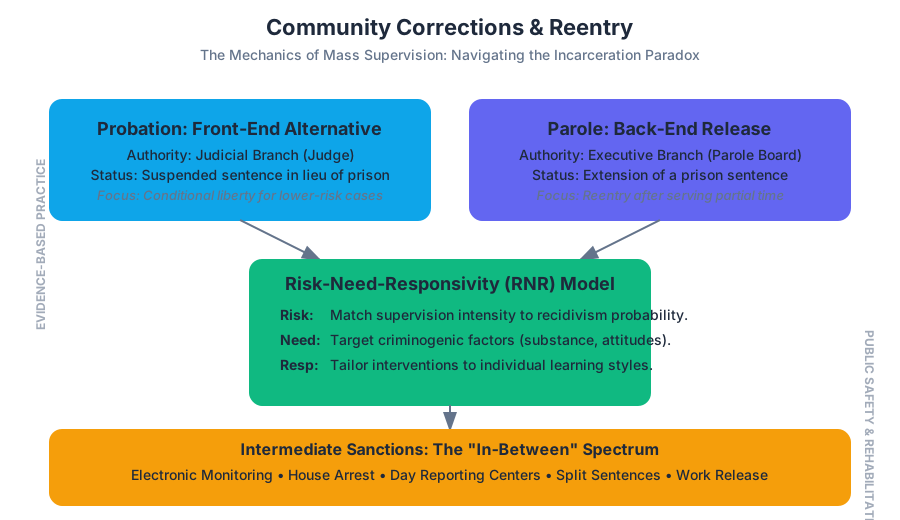
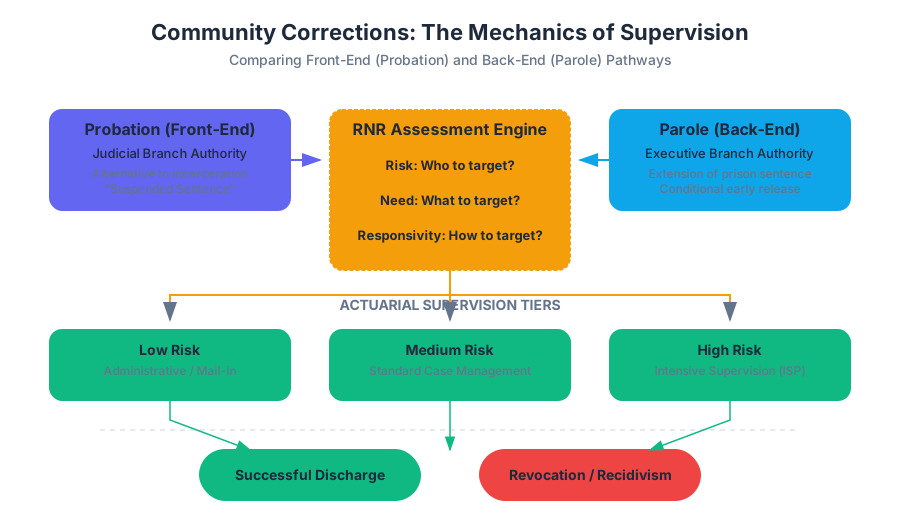
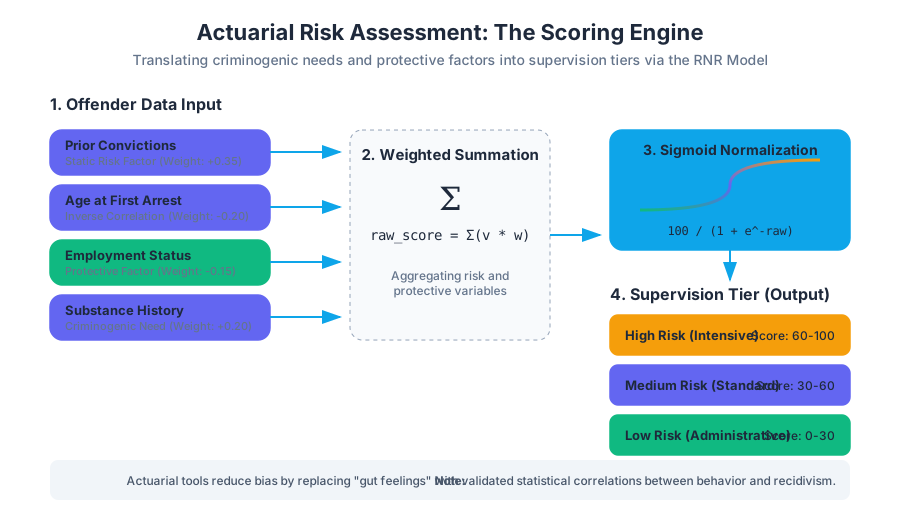
Juvenile Justice
Key concepts: Parens Patriae · Waiver Mechanisms · Superpredator Narrative · School-to-Prison Pipeline · In re Gault
The specialized system for handling minor offenders, its history, and the shift between rehabilitative and punitive models.
Juvenile Justice: The Architecture of Rehabilitation and Retribution
The juvenile justice system represents a specialized branch of the American legal framework designed to address the unique legal and developmental status of minors. Unlike the adult criminal system, which focuses heavily on retribution and public safety, the juvenile system was historically founded on the principle of rehabilitation—the idea that youth are more malleable and capable of reform than adults. However, this system has undergone significant shifts, oscillating between a protective, paternalistic model and a more punitive "get tough" approach driven by political narratives and social panics.
The Philosophical Foundation: Parens Patriae
The bedrock of the juvenile court is the Latin doctrine of Parens Patriae, which translates to "the state as parent." This concept grants the government the legal authority to intervene in the lives of children when their parents are unable or unwilling to provide proper care or supervision.
Definition: Parens Patriae A legal doctrine that gives the state the power to act as a guardian for those who are unable to care for themselves, such as children or the disabled. In juvenile justice, this shifts the court's focus from "guilt vs. innocence" to "the best interests of the child."
Evolution of the Doctrine
In the late 19th century, the "Child Savers" movement argued that children should not be housed in adult jails or subjected to the harshness of adult criminal proceedings. This led to the creation of the first juvenile court in Cook County, Illinois, in 1899. The original system was intentionally informal:
- Non-adversarial: Judges acted as counselors rather than arbiters of law.
- Private: Proceedings were closed to the public to prevent stigmatization.
- Indeterminate Sentencing: Youth were held until they were "rehabilitated," not for a fixed term.
The Constitutional Pivot: In re Gault (1967)
For the first half of the 20th century, the informality of the juvenile court meant that youth had almost no constitutional rights. Because the court was "helping" the child, the Supreme Court initially ruled that due process was unnecessary. This changed with the landmark case In re Gault.
The Case of Gerald Gault
Fifteen-year-old Gerald Gault was committed to a state industrial school for six years after allegedly making a lewd phone call. An adult would have received a maximum fine of $50 or two months in jail. Gault was denied a lawyer, was not informed of his rights, and the complaining witness never appeared.
The Ruling and Its Impact
The Supreme Court ruled that "under our Constitution, the condition of being a boy does not justify a [denial of rights]." The decision established that in any proceeding where incarceration is a possibility, juveniles are entitled to:
- Notice of charges.
- Right to counsel.
- Right to confront and cross-examine witnesses.
- Privilege against self-incrimination.
| Right | Adult Court | Juvenile Court (Post-Gault) |
|---|---|---|
| Notice of Charges | Required (6th Amendment) | Required |
| Right to Counsel | Required (Gideon v. Wainwright) | Required |
| Trial by Jury | Required | Not Required (McKeiver v. Pennsylvania) |
| Standard of Proof | Beyond a Reasonable Doubt | Beyond a Reasonable Doubt (In re Winship) |
| Double Jeopardy | Protection Applies | Protection Applies (Breed v. Jones) |
Waiver Mechanisms: The Bridge to Adult Court
While the juvenile system is the default for minors, certain circumstances allow or require a youth to be "waived" or transferred to adult criminal court. This process effectively strips the youth of their juvenile status and subjects them to adult penalties, including life without parole (though restricted by later rulings).
Types of Waivers
Waiver mechanisms vary by state and represent a critical point of police and prosecutorial discretion.
- Judicial Waiver: The most common form. A juvenile court judge holds a hearing to determine if the youth is "amenable to treatment" within the juvenile system. Factors include the seriousness of the offense and the youth's prior record.
- Statutory Exclusion (Legislative Waiver): State laws automatically require certain serious crimes (e.g., murder, armed robbery) to be tried in adult court, bypassing the juvenile judge entirely.
- Concurrent Jurisdiction (Prosecutorial Waiver): The prosecutor has the discretion to file the case in either juvenile or adult court.
# Low-level logic simulation for a Waiver Decision Engine
# This represents the heuristic used in many jurisdictions to determine
# if a 'Transfer Hearing' is triggered.

class JuvenileCase:
    def __init__(self, age, offense_severity, prior_records, amenability_score):
        self.age = age
        self.offense_severity = offense_severity  # Scale 1-10
        self.prior_records = prior_records        # Integer count
        self.amenability_score = amenability_score # Scale 1-10 (lower is less amenable)

    def determine_jurisdiction(self):
        # Statutory Exclusion Logic
        if self.age >= 16 and self.offense_severity >= 9:
            return "AUTOMATIC_ADULT_TRANSFER (Statutory Exclusion)"

        # Judicial Waiver Heuristic
        waiver_threshold = (self.offense_severity * 0.5) + (self.prior_records * 0.3) + ((10 - self.amenability_score) * 0.2)

        if waiver_threshold > 7.5:
            return "JUDICIAL_WAIVER_HEARING_RECOMMENDED"
        elif self.age < 12:
            return "JUVENILE_COURT_MANDATORY"
        else:
            return "JUVENILE_COURT_DEFAULT"

# Example Usage
case_a = JuvenileCase(age=17, offense_severity=10, prior_records=2, amenability_score=3)
print(f"Case A: {case_a.determine_jurisdiction()}")
The Superpredator Narrative and the "Get Tough" Era
In the 1990s, a moral panic gripped the United States, fueled by the Superpredator Narrative. Coined by political scientist John DiIulio, the term described a supposed new generation of "radically impulsive, ruthlessly amoral" youth who would cause a bloodbath of violent crime.
The Myth vs. Reality
The narrative was based on flawed demographic projections. While the youth population was increasing, the predicted crime wave never materialized. Instead, juvenile crime rates began a precipitous decline that continues today. However, the political response was swift and punitive:
- States lowered the age for adult transfers.
- Mandatory minimum sentences were applied to youth.
- The focus shifted from "best interests of the child" to "public safety and accountability."
The School-to-Prison Pipeline
The School-to-Prison Pipeline refers to the systemic trend where children are funneled out of public schools and into the juvenile and adult criminal justice systems. This is often the result of "Zero Tolerance" policies and an increased police presence in schools.
Key Drivers of the Pipeline
- Zero Tolerance Policies: Mandating harsh punishments (suspension/expulsion) for minor infractions, which disproportionately affect students of color and those with disabilities.
- School Resource Officers (SROs): The presence of police in hallways leads to the criminalization of behavior that was previously handled by school administrators (e.g., "disturbing a school assembly" becoming a misdemeanor arrest).
- Disproportionate Minority Contact (DMC): Statistics consistently show that youth of color are more likely to be arrested, detained, and waived to adult court than white youth for the same offenses.
Measuring the Pipeline
We can quantify the "Relative Rate Index" (RRI) to identify disparities at various stages of the justice funnel.
\text{RRI} = \frac{\text{Rate of Minority Youth (at stage } X\text{)}}{\text{Rate of White Youth (at stage } X\text{)}}
- An RRI > 1.0 indicates that minority youth are overrepresented at that stage.
- An RRI < 1.0 indicates underrepresentation.
Developmental Neuroscience and Legal Culpability
Modern juvenile justice is currently shifting back toward a rehabilitative model, driven by breakthroughs in Developmental Neuroscience. Research using fMRI technology has demonstrated that the adolescent brain is fundamentally different from the adult brain.
The Prefrontal Cortex vs. The Amygdala
- The Amygdala: Responsible for immediate emotional responses (fear, aggression). It is fully developed in adolescence.
- The Prefrontal Cortex: Responsible for impulse control, weighing consequences, and long-term planning. This part of the brain does not fully mature until the mid-20s.
Key Insight: Diminished Culpability Because their brains are not fully developed, juveniles are more susceptible to peer pressure, more impulsive, and less able to appreciate the long-term consequences of their actions. This makes them "less blameworthy" than adults.
Supreme Court Realignment
This scientific consensus led to a series of landmark rulings that curtailed the harshest punishments for youth:
- Roper v. Simmons (2005): Outlawed the death penalty for crimes committed under age 18.
- Graham v. Florida (2010): Outlawed Life Without Parole (LWOP) for non-homicide offenses.
- Miller v. Alabama (2012): Outlawed mandatory LWOP for homicide offenses; the judge must consider the "hallmarks of youth."
The Juvenile Justice Process: A Comparison
The terminology in juvenile court is intentionally different from adult court to reduce the "stigma of criminality."
| Process Stage | Adult Term | Juvenile Term |
|---|---|---|
| Initiation | Arrest | Taken into Custody |
| Charging Document | Indictment / Information | Petition |
| Pre-trial Detention | Jail | Detention Center |
| Trial | Trial | Adjudicatory Hearing |
| Verdict | Conviction | Adjudication |
| Sentencing | Sentencing | Disposition |
| Incarceration | Prison | Commitment / Placement |
The Juvenile Justice Funnel
Similar to the "Crime Funnel" in the adult system, the juvenile system filters out cases at various stages through diversion.
-- Real-world usage: Querying a Case Management System to analyze
-- the 'Funnel' effect of Diversion programs.

SELECT
    offense_category,
    COUNT(case_id) AS total_petitions,
    SUM(CASE WHEN disposition_type = 'Diversion' THEN 1 ELSE 0 END) AS diverted_cases,
    ROUND(AVG(youth_age), 1) AS avg_age,
    (SUM(CASE WHEN disposition_type = 'Diversion' THEN 1 ELSE 0 END) * 100.0 / COUNT(case_id)) AS diversion_rate
FROM
    juvenile_court_records
WHERE
    filing_year = 2023
GROUP BY
    offense_category
ORDER BY
    diversion_rate DESC;
Common Pitfalls and Misconceptions
- The "Adult Crime, Adult Time" Fallacy: This slogan ignores the constitutional and neurobiological differences between youth and adults. Research shows that youth transferred to adult prisons have higher recidivism rates than those kept in the juvenile system.
- Confusing Status Offenses with Delinquency:
- Delinquent Acts: Crimes that would be illegal regardless of age (e.g., theft, assault).
- Status Offenses: Acts that are only illegal because of the person's age (e.g., truancy, running away, curfew violations).
- The Privacy Myth: While juvenile records are "sealed," they are not "expunged" automatically. They can still be seen by law enforcement, the military, and some employers, and can be used to enhance sentences if the person offends as an adult.
Summary of Competing Perspectives
The tension in juvenile justice arises from three competing goals:
- Retribution: Holding the youth accountable for the harm caused.
- Rehabilitation: Addressing the underlying causes of the behavior (trauma, substance abuse, education).
- Incapacitation: Protecting the public from dangerous individuals.
Modern policy is increasingly moving toward Restorative Justice, which focuses on repairing the harm to the victim and the community through mediation and restitution, rather than purely punitive measures.
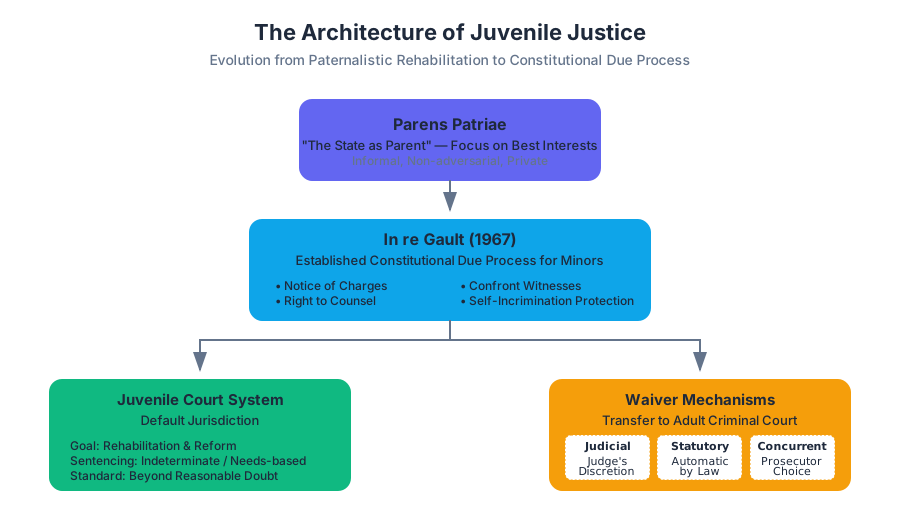
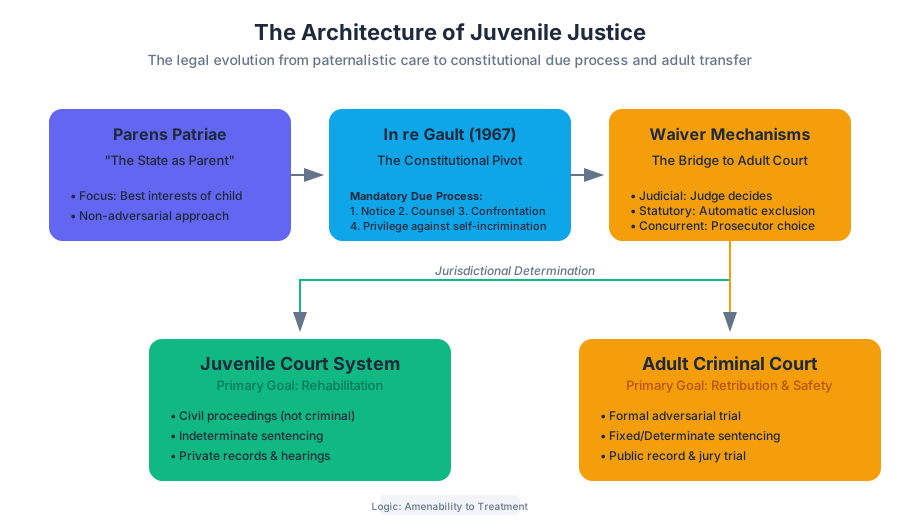
Urban Inequality and Social Disparities
Key concepts: Broken Windows Theory · Housing Discrimination · Urban Jails · Banishment of the Indigent · Systemic Disparities
Analysis of how race, class, and geography intersect with the criminal justice system, particularly in urban environments.
Urban Inequality and Social Disparities
Urban inequality is not merely a byproduct of economic variance; it is a structural feature of the modern metropolitan landscape, reinforced by decades of policy, policing strategies, and judicial architecture. In the study of criminology and criminal justice, the spatial distribution of crime is rarely random. Instead, it follows patterns of concentrated disadvantage, where historical housing discrimination, aggressive order-maintenance policing, and the criminalization of poverty converge to create a "feedback loop" of systemic disparity.
The Theoretical Framework: Social Disorganization and Broken Windows
To understand why certain urban sectors experience higher rates of police intervention and incarceration, we must first examine the transition from Social Disorganization Theory to the Broken Windows Theory.
Social Disorganization Theory
Originating from the Chicago School of sociology, this theory posits that crime is a function of a neighborhood's ecological characteristics rather than the inherent qualities of the individuals living there. High rates of residential mobility, ethnic heterogeneity, and low socioeconomic status weaken the Social Contract and informal social controls (like neighbors watching out for one another), leading to increased deviance.
Broken Windows Theory
Introduced by James Q. Wilson and George L. Kelling in 1982, Broken Windows Theory suggests that visible signs of disorder—such as literal broken windows, graffiti, and public intoxication—signal that a neighborhood is "unmonitored." This perceived lack of control encourages more serious criminal activity.
Key Insight: Broken Windows shifted the focus of law enforcement from responding to serious crimes (Part I offenses in the UCR) to aggressively policing minor "quality of life" infractions (Mala Prohibita), under the assumption that preventing small crimes prevents large ones.
| Feature | Social Disorganization | Broken Windows |
|---|---|---|
| Primary Driver | Structural decay and lack of social cohesion. | Visible disorder and "signal" crimes. |
| Locus of Control | Informal (community, family, peers). | Formal (police intervention, citations). |
| Policy Outcome | Urban renewal and economic investment. | "Zero-Tolerance" policing and order maintenance. |
| Criticism | Can lead to "victim-blaming" of poor areas. | Often results in racial profiling and over-policing. |
Implementation of Spatial Analysis in Criminology
Modern criminology uses spatial data to map these disparities. Below is a Python implementation of a simplified Crime Propensity Model that factors in "Disorder Signals" (Broken Windows) and "Economic Stability" (Social Disorganization).
import numpy as np

class UrbanCrimeModel:
    """
    Simulates the relationship between neighborhood disorder,
    economic stability, and the resulting 'Crime Pressure'.
    """
    def __init__(self, grid_size=(10, 10)):
        self.grid_size = grid_size
        # Economic stability: 0.0 (poor) to 1.0 (wealthy)
        self.stability = np.random.uniform(0.2, 0.8, grid_size)
        # Disorder signals: 0.0 (clean) to 1.0 (high disorder)
        self.disorder = np.random.uniform(0.1, 0.5, grid_size)

    def calculate_crime_pressure(self, alpha=0.6, beta=0.4):
        """
        Pressure = alpha * (1 - Stability) + beta * Disorder
        alpha: Weight of social disorganization
        beta: Weight of broken windows signals
        """
        pressure = alpha * (1 - self.stability) + beta * self.disorder
        return np.clip(pressure, 0, 1)

    def simulate_police_intervention(self, threshold=0.7):
        pressure = self.calculate_crime_pressure()
        # High pressure areas receive 'Zero-Tolerance' policing
        interventions = pressure > threshold
        return interventions

# Initialize a city sector
sector_a = UrbanCrimeModel(grid_size=(5, 5))
pressure_map = sector_a.calculate_crime_pressure()
print(f"Mean Sector Crime Pressure: {np.mean(pressure_map):.2f}")
Housing Discrimination and the Architecture of Segregation
Systemic disparities in the American criminal justice system cannot be decoupled from Housing Discrimination. Historical practices like Redlining—the systematic denial of mortgages and investment in minority neighborhoods—created "islands" of poverty.
The Legacy of Redlining
The Home Owners' Loan Corporation (HOLC) maps of the 1930s categorized neighborhoods by "risk." Areas with high minority populations were colored red ("Hazardous"), leading to a lack of capital. This lack of investment directly correlates with the "Social Disorganization" discussed earlier.
Concentrated Disadvantage
When poverty is geographically concentrated, the "Dark Figure of Crime" (unreported crime) often fluctuates wildly. In highly policed "redlined" areas, police presence is high, meaning more crimes are discovered and recorded in the Uniform Crime Reports (UCR). Conversely, in affluent areas, the same behaviors might be handled through informal social controls or private security, never entering official statistics.
| Historical Policy | Mechanism of Inequality | Modern Criminal Justice Impact |
|---|---|---|
| Redlining | Denial of capital/mortgages. | Concentrated poverty; lack of tax base for schools. |
| Restrictive Covenants | Legal bans on selling to minorities. | Forced segregation into high-density urban cores. |
| Urban Renewal | Destruction of "slums" for highways. | Displacement and destruction of informal social networks. |
| Exclusionary Zoning | Minimum lot sizes/ban on multi-family. | Prevents low-income mobility to low-crime areas. |
Banishment of the Indigent and the "War on the Poor"
A critical component of urban inequality is the Banishment of the Indigent. This refers to legal and architectural strategies designed to remove homeless or extremely poor individuals from public view.
Criminalizing Status
While the Supreme Court has ruled that one cannot be punished for a "status" (like being an addict), cities circumvent this by criminalizing actions that are inseparable from that status.
- Anti-Camping Ordinances: Prohibiting sleeping in public.
- Sit-Lie Laws: Prohibiting sitting on sidewalks.
- Aggressive Panhandling Bans: Restricting the solicitation of funds.
These are examples of Mala Prohibita (crimes because they are prohibited by law) rather than Mala in Se (crimes that are inherently evil).
The Mathematical Representation of the Poverty Trap
The "Poverty Trap" in the legal system can be modeled as a recursive function where the cost of a minor infraction $C_i$ grows over time due to an inability to pay, eventually leading to incarceration $I$.
\begin{aligned}
& \text{Let } F_0 \text{ be the initial fine.} \\
& \text{Let } r \text{ be the interest/late fee rate.} \\
& \text{Let } P \text{ be the probability of a "Failure to Appear" (FTA) warrant.} \\
& \text{Total Debt } D_t = F_0(1+r)^t + \text{Legal Fees} \\
& \text{Incarceration Risk } R = \int_{0}^{t} P(D_t) dt
\end{aligned}
Urban Jails: The Revolving Door
Unlike prisons, which house those convicted of felonies, Urban Jails serve as the intake point for the entire system. They are the "front door" of the Crime Funnel. In many cities, jails have become the largest mental health providers and homeless shelters by default.
The "Million Dollar Blocks" Phenomenon
Researchers have identified specific city blocks where the state spends over $1 million annually to incarcerate residents of that single block. This concentration of "justice spending" highlights the inefficiency of the current model: the money is spent on the back end (punishment) rather than the front end (prevention/housing).
Systemic Disparities in Pre-Trial Detention
Urban inequality is most visible in the bail system. Those with financial means can "buy" their freedom while awaiting trial (Consensus View of justice as a fair process), while the indigent remain in jail (Conflict View of justice as a tool for class control).
Data and Measurement: The UCR vs. NIBRS in Urban Contexts
How we measure crime in cities changes our perception of inequality. The FBI's Uniform Crime Reports (UCR) traditionally used the "Hierarchy Rule," only recording the most serious crime in an incident. This often masked the complexity of urban crime.
The transition to the National Incident-Based Reporting System (NIBRS) provides a more granular look:
- No Hierarchy Rule: All offenses in an incident are recorded.
- Contextual Data: Includes information on the relationship between victim and offender.
- Expanded Categories: Better tracking of white-collar crime vs. street crime.
-- Example: Querying NIBRS-style data to find
-- correlations between 'Quality of Life' citations
-- and subsequent felony arrests in a specific ZIP code.

SELECT
    neighborhood_id,
    COUNT(CASE WHEN offense_type = 'Vagrancy' THEN 1 END) AS qol_citations,
    COUNT(CASE WHEN offense_type = 'Robbery' THEN 1 END) AS felony_arrests,
    (COUNT(CASE WHEN offense_type = 'Robbery' THEN 1 END) * 1.0 /
     NULLIF(COUNT(CASE WHEN offense_type = 'Vagrancy' THEN 1 END), 0)) AS escalation_ratio
FROM
    city_crime_stats
WHERE
    report_year = 2023
GROUP BY
    neighborhood_id
HAVING
    qol_citations > 100
ORDER BY
    escalation_ratio DESC;
Synthesis: The Wedding Cake Model of Urban Justice
The Wedding Cake Model of criminal justice, developed by Samuel Walker, explains why public perception of urban crime is often skewed:
- Top Layer (Celebrated Cases): Rare, high-profile cases that get media attention.
- Second Layer (Serious Felonies): Violent crimes that receive full judicial attention.
- Third Layer (Lesser Felonies): Cases often settled through plea bargains.
- Bottom Layer (Misdemeanors): The vast majority of urban cases—public intoxication, minor theft, "Broken Windows" infractions.
In the bottom layer, the "process is the punishment." For a resident of a disadvantaged urban area, the time spent in jail, the lost wages, and the accumulated fines for a misdemeanor can be more devastating than the actual legal sentence.
Common Pitfalls and Misconceptions
- Misconception: Broken Windows "Fixed" New York. While crime dropped in NYC during the 1990s, it dropped in almost every major American city during that time, including those that did not adopt Broken Windows policing.
- Pitfall: Confusing Correlation with Causation. High crime in a poor neighborhood does not mean poverty causes crime directly; rather, the lack of social cohesion and formal over-policing create the statistical profile of a high-crime area.
- The "Dark Figure" Bias: Assuming that low-crime suburbs are actually low-crime. Often, it is simply a matter of Police Discretion—officers in affluent areas are more likely to give "warnings" or "escort someone home," whereas officers in urban cores are incentivized to make arrests.
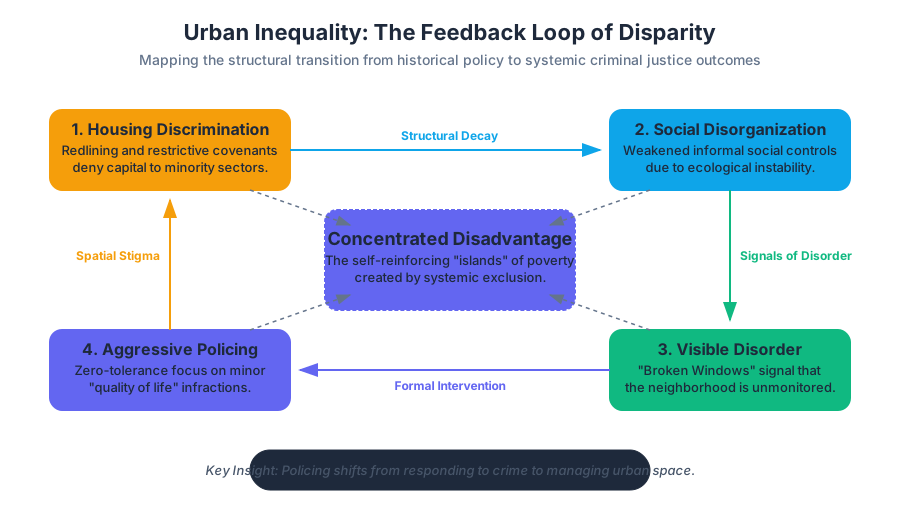
Sociological Imagination and Research Methods
Key concepts: Sociological Imagination · Social Status · Empirical Data · Research Methods · Social Forces
The application of sociological perspectives and empirical research methods to the study of crime.
Sociological Imagination and Research Methods
The study of criminology and criminal justice is often misconstrued as a simple investigation into "why individuals break the law." However, a rigorous analysis requires moving beyond the individual to examine the systemic architecture of society. To understand crime, one must apply the Sociological Imagination, utilizing empirical research methods to decode the complex interplay between social forces, legal frameworks, and human behavior.
The Sociological Imagination: The Macro-Micro Interface
At the core of modern criminological inquiry is the Sociological Imagination, a concept pioneered by C. Wright Mills. It is defined as the vivid awareness of the relationship between personal experience and the wider society.
Definition: The Sociological Imagination is the analytical capacity to shift from one perspective to another—from the political to the psychological; from the examination of a single family to the critical assessment of the national budgets of the world; from the theological school to the military establishment.
In the context of criminal justice, this means distinguishing between Personal Troubles and Public Issues. If one person commits a robbery, it may be a personal trouble (a lapse in character or a specific desperate need). However, if robbery rates spike across an entire urban corridor following a factory closure, it becomes a public issue rooted in the social structure.
Social Status and Social Forces
An individual’s Social Status—their position within the social hierarchy based on race, class, gender, and age—functions as a set of variables that influence their interaction with the law. Social Forces are the external pressures (economic shifts, cultural norms, institutional biases) that shape individual behavior.
| Concept | Level of Analysis | Focus |
|---|---|---|
| Personal Trouble | Micro | Individual biography, character, immediate milieu. |
| Public Issue | Macro | Social structure, historical context, institutional failure. |
| Social Status | Individual/Group | Intersectionality of race, class, gender, and power. |
| Social Forces | Environmental | Economic trends, legislative shifts, technological change. |
Competing Perspectives: Consensus vs. Conflict
How a society defines "crime" is not a neutral process. Criminologists generally operate under one of two competing frameworks: the Consensus View or the Conflict View.
- Consensus View: This perspective assumes that the majority of citizens share similar values and agree on what behaviors should be prohibited. Law is seen as a mechanism to codify these shared norms and maintain social order.
- Conflict View: This perspective argues that society is a collection of diverse groups in constant conflict. The law is not a reflection of shared values, but a tool used by those in power (the "ruling class") to protect their interests and control subordinate groups.
Empirical Research and Data Collection
To move beyond philosophical debate, criminology relies on Empirical Data—information acquired by observation or experimentation. In the United States, the "data stack" for measuring crime consists of three primary pillars, each with distinct strengths and weaknesses.
The "Dark Figure of Crime"
A critical concept in research methodology is the Dark Figure of Crime. This refers to the volume of crime that is never reported to the police and, consequently, never appears in official statistics.
Theorem of the Dark Figure: $C_{total} = C_{reported} + C_{hidden}$, where $C_{hidden}$ represents the "Dark Figure" influenced by police discretion, victim fear, and social stigma.
Primary Data Sources
| Source | Method | Strengths | Weaknesses |
|---|---|---|---|
| Uniform Crime Reports (UCR) | Official police data (FBI) | Long-term trends, national scope. | Only includes reported crimes; "Hierarchy Rule" (only most serious crime in an incident is recorded). |
| NIBRS | Incident-based reporting | Detailed context (weapon, location, victim-offender relationship). | Not yet universally adopted by all precincts; complex data entry. |
| NCVS | Victimization surveys | Captures the "Dark Figure"; bypasses police reporting. | Relies on victim memory; excludes "victimless" crimes (drug use, gambling). |
| Self-Report Surveys | Offender surveys | Captures "victimless" crimes and minor deviance. | Honesty concerns; usually limited to adolescent populations. |
Implementation: Analyzing Crime Data
In a technical environment, analyzing these datasets requires robust data pipelines. Below is a low-level implementation using Python and the Pandas library to process a hypothetical NIBRS-style dataset to identify patterns in the "Dark Figure" by comparing reported incidents against survey-estimated frequencies.
import pandas as pd
import numpy as np

def analyze_crime_gap(reported_csv, survey_csv):
    """
    Calculates the 'Dark Figure' coefficient across different crime categories.
    """
    # Load official UCR/NIBRS data
    df_reported = pd.read_csv(reported_csv)
    # Load National Crime Victimization Survey (NCVS) proxy data
    df_survey = pd.read_csv(survey_csv)

    # Aggregate by crime type
    reported_counts = df_reported.groupby('crime_type').size()
    survey_estimates = df_survey.groupby('crime_type')['estimated_occurrence'].sum()

    # Join datasets for comparison
    comparison_df = pd.DataFrame({
        'Reported': reported_counts,
        'Estimated': survey_estimates
    }).fillna(0)

    # Calculate the Dark Figure Ratio (DFR)
    # DFR = (Estimated - Reported) / Estimated
    comparison_df['dark_figure_ratio'] = (
        (comparison_df['Estimated'] - comparison_df['Reported']) / comparison_df['Estimated']
    ).replace([np.inf, -np.inf], np.nan)

    return comparison_df.sort_values(by='dark_figure_ratio', ascending=False)

# Example Usage
# gap_report = analyze_crime_gap('fbi_2023_data.csv', 'ncvs_2023_estimates.csv')
# print(gap_report)
The Legal Framework: Actus Reus and Mens Rea
Research methods often focus on the occurrence of crime, but the legal system focuses on the elements of a crime. For an act to be prosecuted, the state must generally prove two components:
- Actus Reus (The Guilty Act): A voluntary physical act or a failure to act when a legal duty exists.
- Mens Rea (The Guilty Mind): The mental state or intent at the time of the act.
Classifications of Offenses
- Mala in se: Acts that are inherently evil (e.g., murder, rape).
- Mala prohibita: Acts that are crimes only because they are prohibited by statute (e.g., public intoxication, speeding).
Modeling the System: The Wedding Cake and the Funnel
The American criminal justice system does not treat all cases equally. Two models describe this disparity:
1. The Wedding Cake Model
Developed by Samuel Walker, this model illustrates how the system prioritizes cases:
- Layer 1: Celebrated Cases (Media-heavy, full process).
- Layer 2: Serious Felonies (Violent crimes, experienced offenders).
- Layer 3: Lesser Felonies (Non-violent, first-time offenders).
- Layer 4: Misdemeanors (The vast majority of cases, handled via assembly-line justice).
2. The Crime Funnel
The Crime Funnel represents the attrition of cases as they move through the system. For every 1,000 serious crimes committed, only a fraction result in an arrest, and an even smaller fraction result in a prison sentence.
-- Schema for a Crime Funnel Tracking System
CREATE TABLE Case_Lifecycle (
    incident_id UUID PRIMARY KEY,
    crime_type VARCHAR(50),
    is_reported BOOLEAN DEFAULT FALSE,
    is_arrest_made BOOLEAN DEFAULT FALSE,
    is_charged BOOLEAN DEFAULT FALSE,
    is_convicted BOOLEAN DEFAULT FALSE,
    sentence_type VARCHAR(50)
);

-- Query to calculate the Attrition Rate at the 'Arrest' stage
SELECT
    crime_type,
    COUNT(*) AS total_incidents,
    SUM(CASE WHEN is_arrest_made THEN 1 ELSE 0 END) AS total_arrests,
    (CAST(SUM(CASE WHEN is_arrest_made THEN 1 ELSE 0 END) AS FLOAT) / COUNT(*)) * 100 AS clearance_rate
FROM Case_Lifecycle
WHERE is_reported = TRUE
GROUP BY crime_type;
Criminological Theory as Analytical Frameworks
Theories are the "logic" of criminology. They provide the "why" that links empirical data to social forces.
Rational Choice Theory
Rooted in Classical Criminology, this theory posits that offenders weigh the costs and benefits of a crime. If the Certainty, Severity, and Celerity (Swiftness) of punishment outweigh the gain, the individual will be deterred.
Social Disorganization Theory
Developed by the Chicago School, this theory argues that crime is a product of environmental factors (poverty, residential mobility, ethnic heterogeneity) rather than individual pathology.
Strain Theory
Robert Merton’s theory suggests that crime occurs when there is a "disconnect" between societal goals (e.g., financial success) and the legitimate means to achieve them.
Policy Evaluation and Evidence-Based Practices
The ultimate goal of research methods is to inform Criminal Justice Policy. Modern policy-making has shifted toward Evidence-Based Practices (EBP), which require that interventions be backed by rigorous scientific evaluation rather than political intuition or Moral Panics.
Moral Panics and Folk Devils
A Moral Panic is a feeling of fear spread among a large number of people that some evil threatens the well-being of society. The "threat" is often personified as a Folk Devil.
- Example: The "Superpredator" myth of the 1990s led to harsh sentencing laws for juveniles that were later found to be based on flawed data.
Policy Evaluation Workflow
- Agenda Setting: Identifying a problem (e.g., rising retail theft).
- Policy Formulation: Designing an intervention (e.g., increased patrol).
- Implementation: Executing the plan.
- Evaluation: Using empirical data to see if the policy worked.
# Example: Using a CLI tool to query a policy evaluation database
# This hypothetical tool 'cj-eval' checks the efficacy of 'Three Strikes' laws
cj-eval query --policy "three-strikes" --metric "recidivism" --region "California" --period "1994-2014"

# Output:
# [INFO] Policy: Three Strikes
# [INFO] Result: No significant correlation with violent crime reduction.
# [INFO] Side Effect: 300% increase in geriatric prison population.
# [INFO] Recommendation: Re-evaluate mandatory minimums.
Common Pitfalls in Criminological Research
- Correlation vs. Causation: Just because ice cream sales and murder rates both rise in the summer does not mean ice cream causes murder (the confounding variable is heat).
- Ecological Fallacy: Applying group-level data to an individual (e.g., assuming a person from a "high-crime neighborhood" is a criminal).
- Sampling Bias: Relying only on prison populations to study "criminals," which ignores those who were never caught or those who committed white-collar crimes.
Summary of Key Interconnections
The Sociological Imagination allows us to see that Social Status and Social Forces are the hidden drivers behind the Empirical Data we collect. By using Research Methods like the UCR or NCVS, we can test Criminological Theories (like Strain or Rational Choice). These tests inform Criminal Justice Policy, which must be balanced against the legal requirements of Actus Reus and Mens Rea. Without this integrated approach, the justice system risks operating on bias rather than evidence, failing to address the root causes of deviance in society.
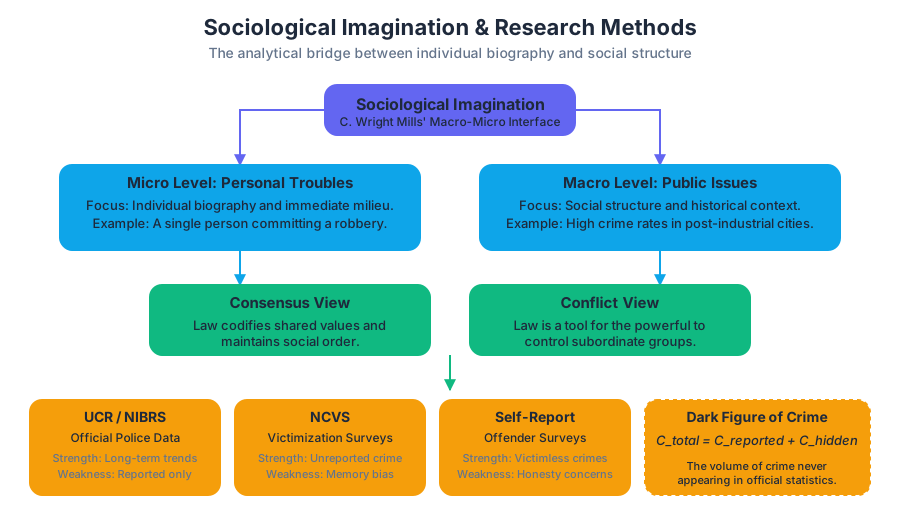
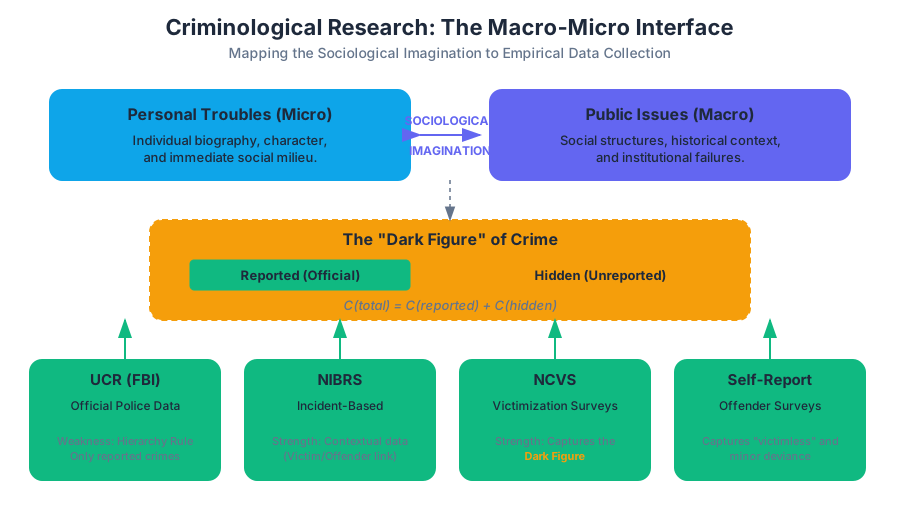
Systemic Wars: Drugs and Poverty
Key concepts: War on Drugs · War on Poverty · Mass Incarceration · Black Youth · Social Control
The impact of the 'War on Drugs' and the 'War on Poverty' on the American criminal justice landscape.
Systemic Wars: Drugs and Poverty
The late 20th century in the United States was defined by two competing state-led "wars": the War on Poverty, launched in the 1960s, and the War on Drugs, which gained aggressive momentum in the 1970s and 80s. While the former sought to address the root causes of social deviance through economic uplift, the latter shifted the state's apparatus toward punitive social control. This transition represents a fundamental pivot in American governance—from a social welfare model to a carceral state model.
The "Systemic Wars" are not merely historical periods but represent a structural transformation of the criminal justice system. By analyzing these through the lens of Conflict Theory, Social Disorganization, and the Wedding Cake Model, we can see how policy decisions created a feedback loop that disproportionately targeted Black youth and institutionalized mass incarceration.
The Great Pivot: From Welfare to Warfare
The mid-1960s "Great Society" programs aimed to eliminate poverty by addressing structural inequalities. However, as civil unrest grew and economic conditions shifted, the political consensus moved toward a Conflict View of society. In this view, the law is not a product of social agreement (the Consensus View) but a tool used by those in power to control subordinate groups.
Comparing the "Wars"
The following table contrasts the ideological and operational differences between the two systemic approaches to social stability.
| Feature | War on Poverty (1964) | War on Drugs (1971/1982) |
|---|---|---|
| Primary Mechanism | Social Welfare / Economic Integration | Criminal Justice / Incarceration |
| Target Population | The "Underclass" (Economic focus) | Drug Users/Sellers (Legal focus) |
| Core Philosophy | Strain Theory: Reduce crime by providing legitimate means to success. | Deterrence Theory: Increase the "cost" of crime through severe punishment. |
| Key Legislation | Economic Opportunity Act of 1964 | Comprehensive Crime Control Act of 1984 |
| Systemic Output | Job Corps, Head Start, Community Action | Mandatory Minimums, Civil Asset Forfeiture |
| Role of State | Provider of services and opportunities. | Enforcer of social norms and order. |
Key Insight: The transition from the War on Poverty to the War on Drugs represents a shift from addressing Substantive Law (the "why" of behavior) to a hyper-focus on Procedural Law and enforcement of Mala Prohibita offenses (acts that are crimes only because they are prohibited by statute).
The Mechanics of Mass Incarceration
Mass incarceration is the systemic result of policy choices that increased both the "inflow" of individuals into the justice system and the "duration" of their stay. This can be visualized through the Crime Funnel, where the wide mouth represents the "Dark Figure of Crime" (unreported acts) and the narrow end represents those actually serving time.
The Wedding Cake Model and Drug Offenses
Criminologist Samuel Walker’s Wedding Cake Model explains how the system treats cases differently based on their perceived importance.
- Layer 1: Celebrated Cases — High-profile trials that receive immense media attention.
- Layer 2: Serious Felonies — Violent crimes committed by experienced offenders.
- Layer 3: Lesser Felonies — Non-violent crimes, often involving plea bargains.
- Layer 4: Misdemeanors — The "assembly line" of the system, where the vast majority of drug-related arrests occur.
The War on Drugs effectively flooded Layer 4 and Layer 3, turning the criminal justice system into a high-throughput processing plant. Because drug offenses are often Mala Prohibita, police discretion plays a massive role in who enters the funnel.
Implementation: Simulating Systemic Bias in the Crime Funnel
The following Python script simulates how small increases in "Police Discretion" and "Enforcement Bias" can lead to massive disparities in incarceration rates over time, reflecting the "feedback loop" of systemic wars.
import numpy as np

def simulate_carceral_throughput(population_size, bias_factor, iterations=10):
    """
    Simulates the 'Crime Funnel' effect over time.
    bias_factor: Multiplier for enforcement in specific demographics.
    """
    # Initialize populations (Group A: Targeted, Group B: Baseline)
    pop_a = population_size // 2
    pop_b = population_size // 2

    records = []

    for i in range(iterations):
        # Base crime rate is identical for both groups (Consensus view)
        base_rate = 0.05

        # Arrests are influenced by the bias_factor (Conflict view)
        arrests_a = int(pop_a * base_rate * bias_factor)
        arrests_b = int(pop_b * base_rate)

        # Incarceration leads to 'Social Disorganization' (Feedback loop)
        # Higher incarceration in Group A increases future crime rate slightly
        pop_a_impact = (arrests_a / pop_a) * 0.1
        base_rate_a = base_rate + pop_a_impact

        records.append({
            "year": i + 1,
            "group_a_arrests": arrests_a,
            "group_b_arrests": arrests_b,
            "disparity_ratio": arrests_a / (arrests_b if arrests_b > 0 else 1)
        })

    return records

# Example: 2.5x bias in enforcement (common in historical drug policy)
results = simulate_carceral_throughput(100000, 2.5)
for r in results[:5]:
    print(f"Year {r['year']}: Disparity Ratio = {r['disparity_ratio']:.2f}")
The War on Drugs: A Policy of Social Control
The War on Drugs was fueled by Moral Panics—intense public fear often stoked by media portrayals of "folk devils" (e.g., the "crack mother" or the "superpredator"). These panics led to the adoption of policies that bypassed Evidence-Based Practices in favor of political expediency.
Sentencing Disparities: Crack vs. Powder Cocaine
One of the most cited examples of systemic inequality is the 100-to-1 sentencing ratio established by the Anti-Drug Abuse Act of 1986.
| Substance | Amount for 5-Year Mandatory Minimum | Demographic Association (Historical) |
|---|---|---|
| Powder Cocaine | 500 grams | Affluent, White |
| Crack Cocaine | 5 grams | Lower-income, Black |
| Ratio | 100 : 1 | Systemic Bias |
This disparity is a classic example of Conflict Theory in action: the law was structured to penalize the form of the drug most common in marginalized communities while remaining relatively lenient toward the form used by the powerful.
Impact on Black Youth and the School-to-Prison Pipeline
The intersection of poverty and drug policy has had a devastating impact on Black Youth. This is often explained through Social Reaction Theory (Labeling Theory). When the state labels a young person as a "delinquent" or "criminal" early on—often for minor drug offenses—it creates a self-fulfilling prophecy.
Theoretical Frameworks of Impact
- Social Disorganization Theory: High rates of incarceration remove adult males from the community, weakening informal social controls (family, church, neighborhood) and leading to more crime.
- Differential Association: Youth in high-incarceration areas are more likely to be exposed to criminal definitions and techniques, as the "criminal" label becomes a normalized status.
- Strain Theory: As legitimate economic opportunities vanish (the failure of the War on Poverty), the "drug economy" becomes a rational choice for survival.
Theorem of Systemic Exclusion: As the density of criminal labeling increases within a demographic, the utility of the "criminal" label as a social deterrent decreases, while its utility as a barrier to legal employment increases.
Mathematical Representation of Deterrence
The War on Drugs relied on the Rational Choice Theory of deterrence. The effectiveness of a legal sanction ($D$) is traditionally defined as a function of Certainty ($C$), Severity ($S$), and Celerity (speed, $W$).
D = f(C, S, W)
In the context of systemic wars, the state maximized $S$ (Severity) via mandatory minimums but failed to maintain $C$ (Certainty) due to the "Dark Figure of Crime," leading to an inefficient system that incarcerated many for long periods without actually deterring the behavior.
Measuring the "Dark Figure": UCR vs. NIBRS
To understand the scope of these systemic wars, we must look at how crime is measured. The Uniform Crime Reports (UCR) and the National Incident-Based Reporting System (NIBRS) provide the "official" statistics, but they often miss the Dark Figure of Crime.
| Feature | UCR (Summary Reporting) | NIBRS (Incident-Based) |
|---|---|---|
| Hierarchy Rule | Only the most serious crime in an incident is reported. | All crimes in an incident are reported. |
| Detail Level | Low (Aggregated totals). | High (Context, victim-offender relationship). |
| Drug Data | Limited to arrests. | Includes drug types, quantities, and locations. |
| Bias Potential | High (Police discretion in reporting). | Moderate (More granular, but still police-dependent). |
SQL Schema for Analyzing Sentencing Disparity
A senior data analyst in a Department of Justice role might use a schema like this to identify systemic outliers in sentencing.
-- Schema to track sentencing outcomes by demographic and offense type
CREATE TABLE sentencing_data (
    case_id UUID PRIMARY KEY,
    offender_race VARCHAR(50),
    offender_age INT,
    offense_type VARCHAR(100), -- e.g., 'Drug Possession', 'Drug Distribution'
    substance_type VARCHAR(50), -- e.g., 'Crack', 'Powder', 'Cannabis'
    quantity_grams DECIMAL(10, 2),
    sentence_months INT,
    mandatory_minimum_applied BOOLEAN,
    judge_id INT,
    jurisdiction_zip VARCHAR(10)
);

-- Query to find average sentence length for Crack vs Powder Cocaine
SELECT
    substance_type,
    AVG(sentence_months) as avg_sentence,
    COUNT(*) as total_cases
FROM sentencing_data
WHERE offense_type = 'Drug Possession'
GROUP BY substance_type;
Policy Evaluation and Evidence-Based Reform
The failure of the War on Drugs to "win" (i.e., eliminate drug use) has led to a shift toward Evidence-Based Practices. Policy evaluation now focuses on Cost-Benefit Analysis and reducing Recidivism rather than just increasing "toughness."
Common Pitfalls in Drug Policy
- Displacement: Cracking down on one drug (e.g., heroin) often leads to the rise of a more dangerous substitute (e.g., fentanyl).
- Net Widening: Increasing police presence in schools to stop drugs often results in more youth being arrested for minor behavioral issues.
- The Prohibition Effect: Like the 1920s Alcohol Prohibition, drug prohibition creates high-profit margins for organized crime, leading to increased systemic violence.
Conclusion: The Legacy of Systemic Warfare
The War on Drugs and the retreat from the War on Poverty created a "perfect storm" for mass incarceration. By redefining social problems (poverty, addiction) as criminal problems, the United States built a system that prioritizes Social Control over social health. Understanding this history is crucial for any student of criminology or practitioner in the justice system, as the "path dependency" of these 20th-century policies continues to shape the 21st-century legal landscape.
Administrative Evaluation via CLI
In a modern policy environment, tools are used to simulate the impact of legislative changes (e.g., the FIRST STEP Act).
# Hypothetical CLI tool for Criminal Justice Policy Impact Analysis
$ cj-impact-sim --policy "Repeal Mandatory Minimums" --target "Non-Violent Drug"
> Loading UCR/NIBRS data for 2020-2024...
> Simulating sentencing shifts...
> [RESULT]: Projected 15% reduction in prison population over 5 years.
> [RESULT]: Projected $2.4B savings in state expenditures.
> [WARNING]: Potential increase in demand for community-based reentry programs.
- War on Drugs: A policy initiative aimed at reducing the illegal drug trade through increased enforcement and mandatory sentencing.
- War on Poverty: A set of 1960s social welfare programs intended to address the root causes of crime through economic support.
- Conflict View: The perspective that the law is a tool used by the ruling class to maintain power and control the "have-nots."
- Mala Prohibita: Acts that are considered crimes because they are prohibited by law, not necessarily because they are inherently evil.
- Dark Figure of Crime: The volume of crime that goes unreported to the police and is never captured in official statistics.
- Labeling Theory: The theory that being labeled a "criminal" by the state leads to further deviance and social exclusion.
- Social Disorganization: The breakdown of communal institutions (family, school) that leads to a loss of social control and higher crime rates.
- How does the Conflict View differ from the Consensus View in the context of drug laws?
- Answer: The Consensus View suggests drug laws reflect a shared social agreement that drugs are harmful. The Conflict View argues drug laws are used by those in power to target and control specific marginalized populations.
- What is the "Hierarchy Rule" in UCR reporting, and how does it affect drug crime statistics?
- Answer: The Hierarchy Rule only records the most serious offense in an incident. If a robbery and a drug possession occur together, only the robbery is counted, potentially undercounting the prevalence of drug-related activity.
- Describe the feedback loop between Social Disorganization and Mass Incarceration.
- Answer: Mass incarceration removes individuals (mostly men) from a community, which weakens family structures and informal social controls. This "disorganization" then leads to higher crime rates, which triggers more policing and incarceration.
- Why are drug offenses often categorized as "Layer 4" in the Wedding Cake Model?
- Answer: Because they are high-volume, often involve minor possession, and are typically handled through routine processing or plea bargains rather than full trials.
- What was the primary criminological theory behind the War on Poverty?
- Answer: Strain Theory—the idea that if you provide people with the means to achieve the "American Dream" (jobs, education), they will not feel the "strain" that leads to criminal behavior.
Systemic Wars: Drugs and Poverty - Summary Guide
- Historical Context: Understand the shift from 1960s social welfare (Johnson) to 1970s/80s punitive control (Nixon/Reagan).
- Key Theoretical Lens: Conflict Theory is the primary framework for explaining why drug laws disproportionately affect the poor and minorities.
- Data Sources: Be able to distinguish between UCR (official summary), NIBRS (incident-based), and Victimization Surveys (capturing the "Dark Figure").
- The Carceral State: Recognize that mandatory minimums and the 100:1 crack/powder ratio were specific policy "levers" that drove mass incarceration.
- Impact on Youth: Focus on the "School-to-Prison Pipeline" and how Labeling Theory explains the long-term recidivism of youth arrested for drug crimes.
- Modern Reform: Note the shift toward Evidence-Based Practices and the use of cost-benefit analysis to justify decriminalization or sentencing reform.
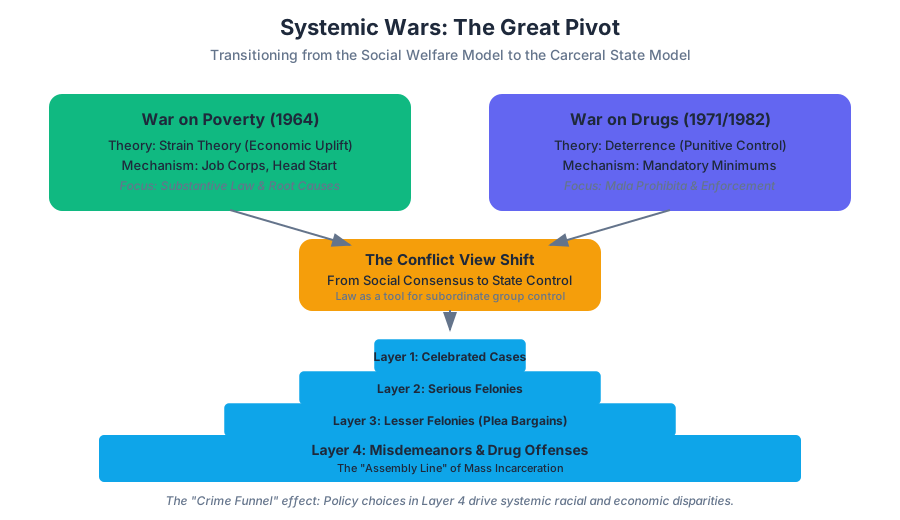
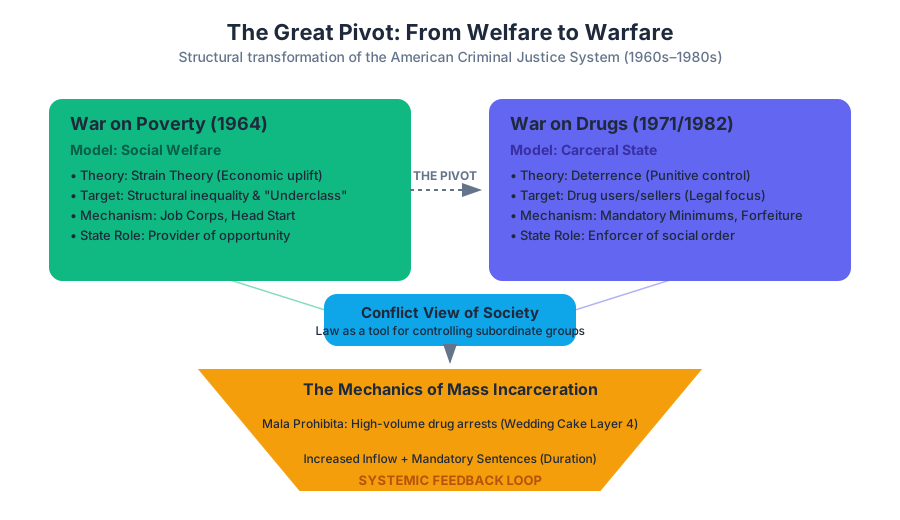
Mental Health in the Justice System
Key concepts: Deinstitutionalization · Competency to Stand Trial · Mental Health Courts · Dual Diagnosis · Crisis Intervention
The history of mental health treatment and the challenges of managing mental disorders within the legal framework.
Mental Health in the Justice System
The intersection of mental health and the criminal justice system represents one of the most complex "wicked problems" in modern governance. Over the last half-century, the United States has undergone a structural shift where the primary locus of mental health care has migrated from clinical settings to correctional facilities. This phenomenon, often termed transinstitutionalization, has forced law enforcement, the judiciary, and corrections officers to become the de facto front-line providers of psychiatric intervention.
Deinstitutionalization and the "New Asylums"
Deinstitutionalization refers to the policy of moving severely mentally ill people out of large state institutions and then closing part or all of those institutions. While intended as a humanitarian reform to replace "warehousing" with community-based care, the failure to adequately fund community resources led to a vacuum.
What it is
Historically, the United States relied on large, state-run psychiatric hospitals. In 1955, there were approximately 558,000 beds in state psychiatric hospitals; by 2016, that number plummeted to fewer than 38,000. This 93% reduction was driven by three primary factors:
- Pharmacological Advancements: The introduction of antipsychotics like chlorpromazine (Thorazine) in the 1950s.
- Legal Shifts: Supreme Court rulings (e.g., O'Connor v. Donaldson) that restricted the state's ability to confine non-dangerous individuals.
- Fiscal Policy: The creation of Medicaid and Medicare, which incentivized states to move patients out of state-funded hospitals and into community settings where federal matching funds were available.
Why it matters
The "Dark Figure of Crime" for the mentally ill is often a reflection of survival strategies. Without stable housing or treatment, many individuals with Serious Mental Illness (SMI) engage in "nuisance crimes" (vagrancy, public intoxication, trespassing). This has led to the Criminalization of Mental Illness, where the justice system is used to manage social problems that the healthcare system has failed to address.
| Metric | 1955 (Peak Institutionalization) | 2020s (Post-Deinstitutionalization) |
|---|---|---|
| Primary Care Site | State Psychiatric Hospitals | County Jails and State Prisons |
| Patient/Inmate Count | ~558,000 in hospitals | ~2,000,000 in jails/prisons (with SMI) |
| Legal Framework | Parens Patriae (State as Parent) | Due Process and Public Safety |
| Funding Source | State General Funds | Medicaid, Local Tax, Corrections Budgets |
Common Pitfalls
A common misconception is that deinstitutionalization caused mental illness. It did not; it changed the geography of mental illness. The "revolving door" phenomenon—where individuals are repeatedly arrested for minor offenses, released, and re-arrested—is a direct result of the lack of "step-down" facilities between the jail and the street.
Competency to Stand Trial (CST)
Competency to Stand Trial is a constitutional requirement rooted in the Due Process Clause of the 14th Amendment. It ensures that a defendant has the "sufficient present ability to consult with his lawyer with a reasonable degree of rational understanding."
How it works: The Dusky Standard
The landmark case Dusky v. United States (1960) established the two-pronged test for competency:
- Factual Understanding: Does the defendant understand the charges, the roles of the court participants (judge, jury, prosecutor), and the possible penalties?
- Rational Understanding: Can the defendant assist their counsel in their own defense?
"The test must be whether he has sufficient present ability to consult with his lawyer with a reasonable degree of rational understanding—and whether he has a rational as well as factual understanding of the proceedings against him." — Dusky v. United States
Implementation and Restoration
If a defendant is found Incompetent to Stand Trial (IST), the criminal proceedings are paused. The state then attempts Competency Restoration, usually through medication and legal education. If a defendant cannot be restored in a reasonable timeframe (Jackson v. Indiana), the state must either release them or initiate civil commitment proceedings.
# Low-level logic for a Competency Assessment Simulation
# This represents the decision tree for a forensic evaluator

class CompetencyEvaluator:
    def __init__(self, defendant_data):
        self.data = defendant_data
        self.is_competent = False

    def assess_factual_understanding(self):
        # Checks for knowledge of court roles and charges
        criteria = ['knows_judge_role', 'knows_prosecutor_role', 'understands_charges']
        return all(self.data.get(c) for c in criteria)

    def assess_rational_ability(self):
        # Checks for ability to assist counsel without delusional interference
        if self.data.get('active_hallucinations') or self.data.get('paranoia_re_lawyer'):
            return False
        return True

    def evaluate(self):
        factual = self.assess_factual_understanding()
        rational = self.assess_rational_ability()

        if factual and rational:
            self.is_competent = True
            return "COMPETENT: Proceed to trial."
        elif not factual and rational:
            return "IST: Recommend Legal Education Restoration."
        else:
            return "IST: Recommend Clinical Stabilization/Medication."

# Example usage
defendant = {
    'knows_judge_role': True,
    'knows_prosecutor_role': True,
    'understands_charges': True,
    'active_hallucinations': True,
    'paranoia_re_lawyer': False
}
evaluator = CompetencyEvaluator(defendant)
print(evaluator.evaluate())
Mental Health Courts (MHCs)
Mental Health Courts are specialized dockets that use a therapeutic jurisprudence model. Rather than focusing solely on punishment, these courts aim to address the underlying mental health issues that contribute to criminal behavior.
The Four Pillars of MHCs
- Voluntary Participation: Defendants must agree to participate, often in exchange for a suspended sentence or dismissed charges.
- Multidisciplinary Team: Includes a judge, prosecutor, defense counsel, and mental health clinicians.
- Judicial Supervision: Frequent status hearings where the judge interacts directly with the participant.
- Graduated Sanctions and Incentives: Positive reinforcement for compliance (e.g., reduced reporting) and therapeutic adjustments for non-compliance.
| Feature | Traditional Criminal Court | Mental Health Court |
|---|---|---|
| Goal | Adjudication and Punishment | Rehabilitation and Stability |
| Process | Adversarial | Collaborative |
| Outcome | Sentence (Jail/Probation) | Treatment Plan and Supervision |
| Judge's Role | Neutral Arbiter | "Coach" and Monitor |
| Success Metric | Recidivism (New Arrests) | Treatment Adherence and Quality of Life |
Dual Diagnosis (Comorbidity)
In the context of the justice system, Dual Diagnosis (or Co-occurring Disorders) refers to the presence of both a mental health disorder and a substance use disorder (SUD). This is the rule rather than the exception among justice-involved individuals.
Why it matters
Individuals with dual diagnoses are significantly more difficult to treat and have higher rates of recidivism. The "self-medication hypothesis" suggests that many individuals use illicit substances to manage the symptoms of untreated SMI (e.g., using stimulants to counter the lethargy of depression or alcohol to quiet auditory hallucinations).
The Feedback Loop
The interaction between SMI and SUD creates a "multiplier effect" on criminal risk:
- SMI impairs judgment and impulse control.
- SUD increases the likelihood of engaging in illegal markets and brings the individual into contact with law enforcement.
- Incarceration often interrupts treatment for both, leading to acute withdrawal and psychiatric crisis upon release.
-- Schema for a Mental Health Court Participant Tracking System
-- Demonstrating the relationship between diagnosis, treatment, and legal status

CREATE TABLE Participants (
    participant_id INT PRIMARY KEY,
    name VARCHAR(100),
    primary_diagnosis VARCHAR(50), -- e.g., Schizophrenia, Bipolar I
    secondary_diagnosis VARCHAR(50), -- e.g., Opioid Use Disorder
    risk_score INT CHECK (risk_score BETWEEN 1 AND 10)
);

CREATE TABLE Treatment_Adherence (
    log_id SERIAL PRIMARY KEY,
    participant_id INT REFERENCES Participants(participant_id),
    check_in_date DATE,
    medication_compliant BOOLEAN,
    drug_screen_result VARCHAR(20), -- 'Negative', 'Positive', 'Diluted'
    clinician_notes TEXT
);

-- Query to identify high-risk participants failing treatment
SELECT p.name, p.primary_diagnosis, t.drug_screen_result
FROM Participants p
JOIN Treatment_Adherence t ON p.participant_id = t.participant_id
WHERE t.medication_compliant = FALSE
  OR t.drug_screen_result = 'Positive';
Crisis Intervention Teams (CIT)
The Crisis Intervention Team (CIT) model, often called the "Memphis Model," is a police-based first responder program that has become the gold standard for law enforcement's handling of mental health crises.
How it works
CIT involves a specialized 40-hour training program for a subset of patrol officers. The training covers:
- Signs and Symptoms: Recognizing psychiatric disorders.
- De-escalation Techniques: Verbal strategies to lower the emotional temperature of an encounter.
- Lived Experience: Hearing from individuals who have experienced psychiatric crises.
- System Navigation: Understanding where to take an individual for help (Diversion Centers) rather than jail.
The De-escalation Pipeline
- Engagement: Approach with a non-threatening posture; use a calm voice.
- Assessment: Determine if the behavior is driven by psychosis, intoxication, or medical emergency (e.g., diabetic shock).
- Stabilization: Use active listening to validate the person's feelings without necessarily validating their delusions.
- Resolution: Direct the individual to a crisis center or hospital rather than a correctional facility.
The "Officer's Dilemma": Before CIT, officers often had only two choices when encountering a mentally ill person in crisis: "Arrest" or "Walk Away." CIT provides a third path: "Referral to Treatment."
Legal Defenses: Insanity vs. Competency
A frequent point of confusion in both public discourse and legal practice is the distinction between Competency and the Insanity Defense (Not Guilty by Reason of Insanity - NGRI).
Comparison of Legal Standards
| Dimension | Competency (CST) | Insanity (NGRI) |
|---|---|---|
| Timing | State of mind during the trial. | State of mind at the time of the crime. |
| Legal Basis | Due Process (14th Amendment). | Criminal Responsibility (Mens Rea). |
| Outcome of Finding | Postponement of trial; treatment. | Acquittal (usually followed by commitment). |
| Frequency | Very Common (thousands per year). | Very Rare (less than 1% of cases). |
| Burden of Proof | Usually the defense (preponderance). | Usually the defense (clear and convincing). |
Variations of the Insanity Defense
- M'Naghten Rule: Focuses on cognitive capacity—did the defendant know the "nature and quality" of the act or that it was wrong?
- Irresistible Impulse: Focuses on volitional capacity—could the defendant control their actions even if they knew they were wrong?
- Model Penal Code (MPC): A combination—did the defendant lack "substantial capacity" to appreciate the wrongfulness or conform their conduct to the law?
Common Pitfalls
The "Insanity Defense" is not a "get out of jail free" card. In reality, individuals found NGRI often spend more time confined in secure psychiatric hospitals than they would have spent in prison for the same offense.
Operational Challenges in Corrections
Once an individual with SMI is incarcerated, the challenges shift from the street to the cell block. Prisons are inherently anti-therapeutic environments: they are loud, brightly lit, crowded, and characterized by a rigid hierarchy.
The Solitary Confinement Paradox
Inmates with mental illness often struggle to follow complex prison rules. This leads to disciplinary infractions, which frequently result in Administrative Segregation (solitary confinement). However, solitary confinement is known to exacerbate psychiatric symptoms, leading to a "decompensation spiral."
Medication Management
Ensuring "continuity of care" is a massive logistical hurdle. When an individual is arrested, their community prescriptions are often not transferred.
- Formulary Restrictions: Jails may not carry the specific (and expensive) second-generation antipsychotics the inmate was taking.
- Refusal of Treatment: Inmates have a limited right to refuse medication (Washington v. Harper), unless they are a danger to themselves or others.
# Example of a Data Exchange Format (YAML)
# Used for "Continuity of Care" between a County Jail and a Community Health Provider

patient_transfer:
  inmate_id: "J-992834"
  status: "Booking"
  clinical_data:
    diagnosis:
      - code: "F20.9"
        description: "Schizophrenia, unspecified"
    current_medications:
      - drug: "Clozapine"
        dosage: "300mg"
        frequency: "Daily"
        last_administered: "2023-10-24T08:00:00Z"
    risk_factors:
      suicide_risk: "High"
      violent_tendencies: "Low"
      withdrawal_risk: "Moderate (Alcohol)"
  community_provider:
    agency_name: "Central Health Services"
    case_manager: "Sarah Jenkins, LCSW"
    contact: "555-0199"
Future Directions: The Sequential Intercept Model (SIM)
The Sequential Intercept Model provides a framework for communities to organize their response to mental illness in the justice system. It identifies six "intercept" points where an individual can be diverted from the system into treatment.
- Intercept 0 (Community Services): Crisis lines, mobile crisis teams, and "warm lines."
- Intercept 1 (Law Enforcement): CIT training and co-responder models (police + clinicians).
- Intercept 2 (Initial Detention/Court): Jail screening and post-arrest diversion.
- Intercept 3 (Jails/Courts): Mental Health Courts and specialty dockets.
- Intercept 4 (Reentry): Transition planning from jail/prison back to the community.
- Intercept 5 (Community Corrections): Specialized probation and parole caseloads.
By visualizing the justice system as a series of filters, the SIM allows policymakers to identify where the "leaks" are—where individuals are falling through the cracks and into deeper levels of involvement.
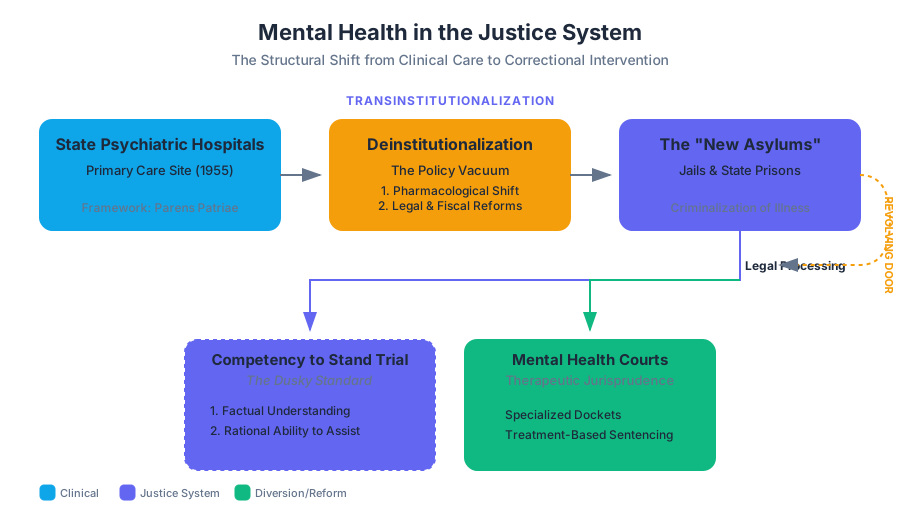
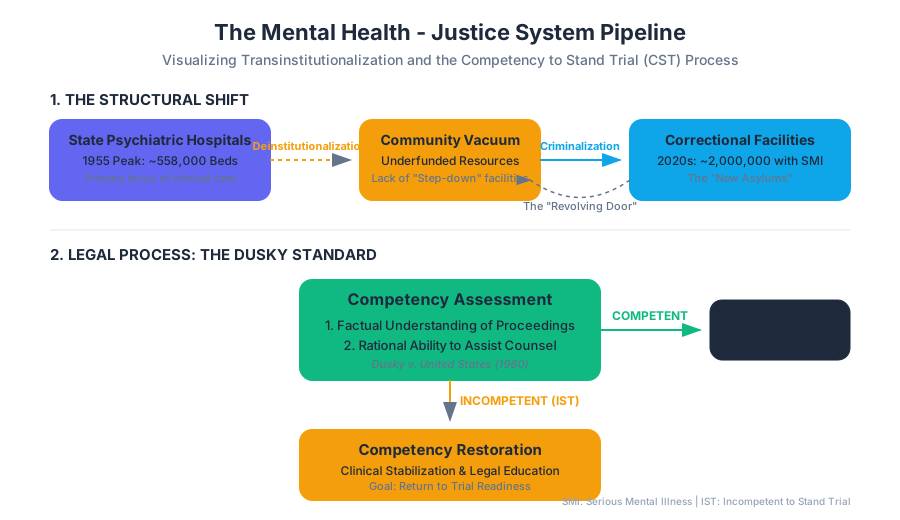
Reform and Alternatives
Key concepts: Urban Unrest · Systemic Reform · Alternatives to Incarceration · Policy Implementation · Public Safety
Evaluating efforts for systemic reform and exploring alternatives to the traditional criminal justice model.
Reform and Alternatives
The modern American Criminal Justice System (ACJS) exists in a state of perpetual tension between the traditional "tough on crime" mandates of the late 20th century and an emerging paradigm of Systemic Reform. This evolution is driven by the recognition that the "Crime Funnel"—the process by which the vast number of crimes committed is whittled down to a small number of incarcerated individuals—often fails to address the root causes of deviance or ensure equitable public safety.
Reform is not merely a policy adjustment; it is a fundamental re-evaluation of how society defines Social Control, handles Urban Unrest, and implements Alternatives to Incarceration. By synthesizing criminological theory with empirical data from the Uniform Crime Reports (UCR) and National Incident-Based Reporting System (NIBRS), policymakers are increasingly moving toward Evidence-Based Practices (EBP) to mitigate the "Dark Figure of Crime" while ensuring constitutional protections.
The Theoretical Impetus for Reform
To understand reform, one must first understand the competing sociological perspectives that define the purpose of the law. The ACJS operates under two primary frameworks: the Consensus View and the Conflict View.
- Consensus View: Assumes that the majority of citizens in a society share common values and agree on what behaviors should be defined as criminal. Laws are seen as a mechanism to protect the common good.
- Conflict View: Posits that the law is a tool used by the ruling class to maintain their position of power and control the "have-nots." In this view, reform is often a response to systemic inequalities highlighted by Urban Unrest.
The Wedding Cake Model of Justice
The "Wedding Cake" model, developed by Samuel Walker, illustrates why public perception of the justice system is often skewed, leading to misinformed reform efforts.
| Layer | Type of Case | Characteristics | Impact on Policy |
|---|---|---|---|
| Layer 1 | Celebrated Cases | Famous defendants, high media coverage, full jury trials. | Creates "Moral Panics" and reactionary legislation. |
| Layer 2 | Serious Felonies | Violent crimes, repeat offenders, heavy sentences. | Focus of traditional "get tough" policies. |
| Layer 3 | Lesser Felonies | Non-violent crimes, first-time offenders, often plea-bargained. | Where "Police Discretion" and diversion are most applicable. |
| Layer 4 | Misdemeanors | Traffic violations, public intoxication, shoplifting. | Represents the bulk of the system; site of most "Alternatives." |
Key Insight: Most reform efforts target Layer 4 and Layer 3, attempting to divert individuals from the system before they reach the "Serious Felony" stage, thereby reducing the "Crime Funnel" pressure.
Urban Unrest and the Catalyst for Change
Urban Unrest typically occurs when a specific incident (often involving police use of force) acts as a flashpoint for long-standing grievances regarding systemic injustice. Historically, these events have forced the transition between different Policing Eras.
Evolution of Policing Models
The history of policing shows a clear trajectory from informal control to professionalized, and eventually, community-oriented models.
- Political Era (1840s–1930s): Close ties between police and politicians; high levels of corruption.
- Reform Era (1930s–1970s): Focus on professionalization, rapid response, and "crime fighting." This era saw the rise of the UCR but also increased alienation from minority communities.
- Community Era (1970s–Present): Focus on partnership between police and citizens to solve underlying problems.
- Homeland Security Era (2001–Present): Integration of intelligence-led policing and counter-terrorism.
Systemic Reform: Mechanisms and Implementation
Systemic reform requires moving beyond "Moral Panics"—where "Folk Devils" (groups targeted as threats to societal values) are used to justify harsh legislation—toward Evidence-Based Practices.
Rational Choice and Deterrence
Reformers often utilize Rational Choice Theory, which suggests that individuals weigh the costs and benefits of a crime. If the system can increase the certainty and celerity (speed) of punishment rather than just the severity, it may achieve better deterrence.
$$U = pB - qC$$
Where:
- $U$ = Utility of the criminal act
- $p$ = Probability of success
- $B$ = Benefit/Gain from the crime
- $q$ = Probability of capture/punishment
- $C$ = Cost of the punishment
Implementation Challenges: The "Dark Figure of Crime"
A major hurdle in reform is the Dark Figure of Crime—the volume of crime that goes unreported to the police. If policy is based only on Official Statistics (UCR/NIBRS), it ignores the reality of victimization captured by the National Crime Victimization Survey (NCVS).
# Example: A simplified Python model to estimate the 'Dark Figure'
# by comparing Official Statistics (UCR) with Victimization Surveys (NCVS)

def calculate_reporting_gap(reported_crimes, survey_estimated_total):
    """
    Calculates the percentage of crimes not captured in official stats.
    """
    if survey_estimated_total == 0:
        return 0.0

    dark_figure = survey_estimated_total - reported_crimes
    gap_percentage = (dark_figure / survey_estimated_total) * 100

    return {
        "unreported_count": dark_figure,
        "reporting_rate": (reported_crimes / survey_estimated_total) * 100,
        "gap_percentage": gap_percentage
    }

# Realistic Data: Suppose 500,000 aggravated assaults are in UCR,
# but NCVS estimates 1,200,000.
stats = calculate_reporting_gap(500000, 1200000)

print(f"Dark Figure: {stats['unreported_count']} crimes")
print(f"Gap: {stats['gap_percentage']:.2f}% of crimes are hidden from official view.")
Alternatives to Incarceration
Alternatives focus on addressing the Mala Prohibita (acts that are crimes because they are prohibited, like drug possession) differently than Mala in se (acts that are inherently evil, like murder).
Diversion and Specialized Courts
Diversion programs move offenders out of the traditional criminal justice track and into treatment-based pathways. This is often implemented through:
- Drug Courts: Focusing on rehabilitation for substance abuse.
- Mental Health Courts: Addressing the intersection of psychological health and criminal behavior.
- Restorative Justice: Focusing on repairing the harm caused to the victim and the community.
Policy Evaluation: Cost-Benefit Analysis
Effective reform requires rigorous Policy Evaluation. This involves determining if a policy achieved its goals without creating unintended consequences (e.g., the "Net Widening" effect where more people are brought under state supervision than before).
| Method | Focus | Metric |
|---|---|---|
| Recidivism Analysis | Long-term impact | Rate of re-arrest within 3–5 years. |
| Cost-Benefit | Economic efficiency | Dollars saved in prison costs vs. program costs. |
| Public Safety | Community impact | Reduction in specific crime rates (NIBRS data). |
| Equity Audit | Social Justice | Disproportionality in sentencing across demographics. |
Legislative and Legal Frameworks for Reform
Reform must navigate the complexities of Substantive Law (which defines what is a crime) and Procedural Law (which defines how the law is enforced).
Actus Reus and Mens Rea in Reform
A key area of reform involves the definition of criminal intent. Many "Alternatives" look at Mens Rea (the guilty mind) to determine if an individual is better served by a hospital than a prison.
\text{Criminal Liability} = \text{Actus Reus} + \text{Mens Rea} + \text{Concurrence} + \text{Causation}
The Role of Stare Decisis
Reform is often slowed by Stare Decisis ("to stand by things decided"). Courts rely on precedent to ensure stability. However, when social norms change (e.g., the decriminalization of certain behaviors), the legal system must adapt its interpretation of Social Norms and Deviance.
-- SQL Example: Querying a database to identify candidates for
-- a "Lesser Felony Diversion Program" based on specific criteria.

SELECT
    offender_id,
    offense_code,
    prior_convictions,
    mental_health_flag
FROM
    criminal_records
WHERE
    offense_type = 'Non-Violent'
    AND prior_convictions < 2
    AND (substance_abuse_history = TRUE OR mental_health_flag = TRUE)
    AND status = 'Pre-Trial';
Common Pitfalls in Reform Implementation
- Net Widening: Implementing an alternative that ends up supervising people who would have previously been released with a warning.
- Technological Bias: Using "Risk Assessment Algorithms" that may inadvertently bake in historical racial or socioeconomic biases.
- Lack of Sustainable Funding: Many reform initiatives are "grant-funded" and collapse once the initial pilot period ends.
- The "Meat Eater" vs. "Grass Eater" Problem: In policing reform, focusing only on "Meat Eaters" (actively corrupt officers) while ignoring "Grass Eaters" (those who accept small favors and allow a culture of silence) can lead to incomplete systemic change.
The Future of Public Safety
The shift toward Evidence-Based Practices suggests a future where the ACJS is more surgical and less "blunt force." By integrating data from Self-Report Statistics and victimization studies, the system can move toward a model of Social Control that prioritizes community health over mere punishment.
Key Policy Implementation Steps:
- Agenda Setting: Identifying the problem (e.g., high recidivism).
- Policy Formulation: Developing the alternative (e.g., a vocational training program).
- Policy Implementation: Rolling out the program in specific jurisdictions.
- Policy Evaluation: Using NIBRS and recidivism data to check for success.
# CLI Example: Using a hypothetical tool to pull NIBRS data for policy evaluation
# This simulates how an analyst might check crime trends post-reform.

nibrs-tool fetch --state "OR" --city "Portland" --year 2023 --category "Property Crime" \
  | jq '.trends | select(.percent_change < 0)' \
  | mail -s "Monthly Reform Impact Report" policy_office@state.gov
Summary of Key Terms for Review
- Dark Figure of Crime: The gap between actual crime and reported crime.
- Mala in se: Crimes that are inherently wrong (e.g., murder).
- Mala prohibita: Crimes created by legislative decree (e.g., drug laws).
- Stare Decisis: The legal principle of determining points in litigation according to precedent.
- Actus Reus: The physical "guilty act."
- Mens Rea: The mental "guilty mind."
- Social Disorganization Theory: The theory that crime is a product of communal breakdown rather than individual pathology.
- Evidence-Based Practices (EBP): Policies developed through rigorous scientific research and data analysis.
Source Materials
- Chapter 1: Crime, Criminal Justice, and Criminology
- Chapter 2: Defining and Measuring Crime and Criminal Justice
- Criminology (Lumen)
- Save as PDF
- Save as PDF
- Save as PDF
- Save as PDF
- Save as PDF
- Chapter 3: Criminal Law
- Chapter 4: Criminal Justice Policy
- Introduction to the American Criminal Justice System (Burke et al.)
- Chapter 5: Criminological Theory
Study Criminology and Criminal Justice with AI — Free on Lykke
Sign up for free to generate personalized flashcards, quizzes, and study guides from this course. Chat with an AI tutor that knows the material.
Get Started FreeView this course wiki on Lykke · Browse all public course wikis