Calculus III
Institution: MIT
42 study materials · 6 sections
Calculus III extends the concepts of single-variable calculus into three-dimensional space and beyond. This course covers the geometry of vectors, lines, and planes, as well as the calculus of functions of multiple variables, including partial differentiation and multiple integration. The final portion of the course focuses on vector calculus, exploring the relationship between line, surface, and volume integrals through fundamental theorems like Green's, Stokes', and the Divergence Theorem.
Course Sections
Three-Dimensional Space and Vectors
Key concepts: Dot Product · Cross Product · Equations of Lines · Equations of Planes · Quadric Surfaces
An introduction to the coordinate systems and algebraic tools used to describe objects in 3D space.
Three-Dimensional Space and Vectors
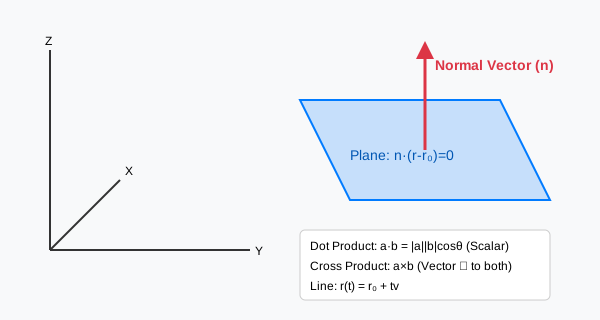
AI_SVGI_SVG## Overview Before performing calculus in higher dimensions, we must establish a geometric framework. This section introduces the 3D Cartesian coordinate system and the vectors used to navigate it.
Key Concepts
- Vectors: Quantities with both magnitude and direction. Operations include addition, scalar multiplication, and finding magnitudes.
- Dot Product: A scalar operation used to find the angle between vectors and determine if they are orthogonal (perpendicular).
- Cross Product: A vector operation resulting in a vector orthogonal to two given vectors, essential for finding the area of parallelograms and equations of planes.
- Lines and Planes: Describing linear paths and flat surfaces using vector equations and normal vectors.
- Quadric Surfaces: 3D analogues of conic sections, such as spheres, ellipsoids, and paraboloids.
Why This Matters
Understanding 3D geometry is the foundation for visualizing multivariable functions and the physical paths of objects in space.
Partial Derivatives
Key concepts: Limits and Continuity · Partial Derivatives · Chain Rule · Directional Derivatives · Gradient Vector
Extending the concept of the derivative to functions of multiple variables.
Partial Derivatives
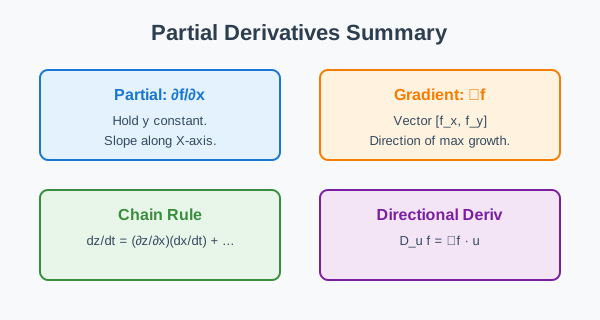
AI_SVGI_SVG## Overview In multivariable calculus, we often want to know how a function changes as we vary only one input at a time. This leads to the concept of the partial derivative.
Key Concepts
- Limits and Continuity: Evaluating limits in 2D or 3D space requires checking all possible paths of approach.
- Partial Derivatives: Taking the derivative with respect to one variable while holding others constant.
- The Chain Rule: Calculating derivatives for composite functions where variables depend on other parameters (e.g., $z = f(x,y)$ where $x=g(t)$ and $y=h(t)$).
- Directional Derivatives: Finding the rate of change of a function in any arbitrary direction.
- The Gradient Vector: A vector of partial derivatives ($ abla f$) that points in the direction of steepest ascent.
Why This Matters
Partial derivatives are used in physics and engineering to describe heat flow, wave propagation, and optimization problems.
Applications of Partial Derivatives
Key concepts: Tangent Planes · Linear Approximations · Relative Extrema · Absolute Extrema · Lagrange Multipliers
Using derivatives to find tangent planes and optimize multivariable functions.
Applications of Partial Derivatives
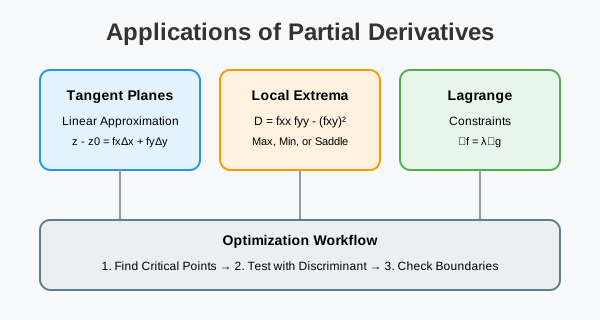
AI_SVGI_SVG## Overview This section focuses on finding the maximum and minimum values of multivariable functions, both with and without constraints.
Key Concepts
- Tangent Planes: The 3D equivalent of a tangent line; the best linear approximation of a surface at a point.
- Relative Extrema: Using the Second Derivative Test (the Discriminant) to identify local maxima, minima, and saddle points.
- Absolute Extrema: Finding the highest and lowest points of a function over a closed, bounded region.
- Lagrange Multipliers: A powerful method for finding the extrema of a function subject to a constraint (e.g., maximizing volume given a fixed surface area).
Why This Matters
Optimization is a core component of economics, data science, and structural engineering.
Multiple Integrals
Key concepts: Double Integrals · Polar Coordinates · Triple Integrals · Cylindrical Coordinates · Spherical Coordinates · Change of Variables
Calculating volumes and masses using double and triple integration in various coordinate systems.
Multiple Integrals
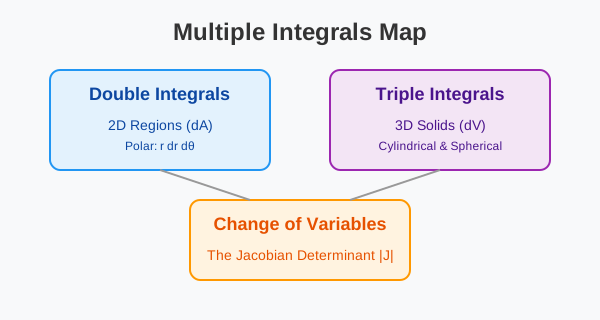
AI_SVGI_SVG## Overview Just as single integrals find the area under a curve, multiple integrals find the volume under a surface or the mass of a 3D solid.
Key Concepts
- Double Integrals: Integrating over a 2D region in the $xy$-plane. Often simplified by switching to Polar Coordinates.
- Triple Integrals: Integrating over a 3D solid.
- Cylindrical and Spherical Coordinates: Specialized coordinate systems that make integrating over cylinders or spheres much easier.
- Change of Variables (The Jacobian): A method to transform complex integration regions into simpler ones.
Why This Matters
Multiple integrals allow us to calculate physical properties like center of mass, moments of inertia, and total charge distribution.
Line Integrals and Vector Fields
Key concepts: Vector Fields · Line Integrals · Conservative Vector Fields · Fundamental Theorem of Line Integrals · Green's Theorem
Integrating functions along paths and exploring the properties of vector fields.
Line Integrals and Vector Fields
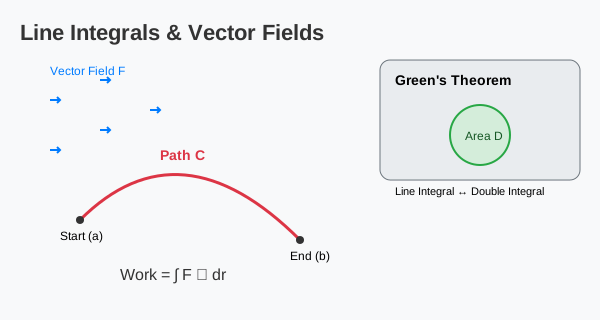
AI_SVGI_SVG## Overview This section introduces vector fields (like wind or gravity) and how to integrate along a curve within those fields.
Key Concepts
- Vector Fields: A function that assigns a vector to every point in space.
- Line Integrals: Calculating the work done by a force field along a path or the mass of a wire.
- Conservative Fields: Fields where the line integral depends only on the endpoints, not the path taken. These fields have a Potential Function.
- Green's Theorem: Relates a line integral around a simple closed curve to a double integral over the plane region it encloses.
Why This Matters
Line integrals are fundamental to understanding work, energy, and circulation in fluid dynamics.
Surface Integrals and Integral Theorems
Key concepts: Parametric Surfaces · Surface Integrals · Stokes' Theorem · Divergence Theorem
The culmination of the course: integrating over surfaces and the major theorems of vector calculus.
Surface Integrals and Integral Theorems
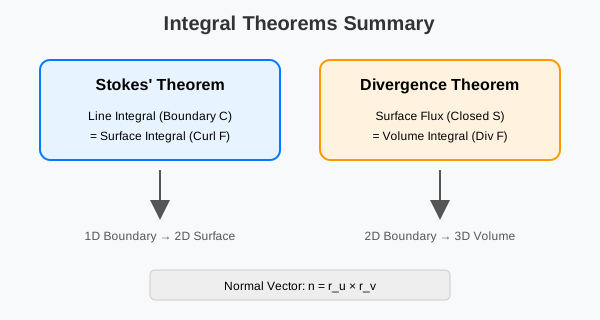
AI_SVGI_SVG## Overview This final section covers integration over 2D surfaces in 3D space and the powerful theorems that link different types of integrals.
Key Concepts
- Parametric Surfaces: Describing surfaces using two parameters (e.g., $u$ and $v$).
- Surface Integrals: Calculating the flux of a vector field through a surface.
- Stokes' Theorem: A higher-dimensional version of Green's Theorem that relates a surface integral of the curl of a vector field to a line integral around its boundary.
- Divergence Theorem: Relates the flux of a vector field through a closed surface to the triple integral of the divergence over the volume enclosed.
Why This Matters
These theorems are the language of electromagnetism (Maxwell's Equations) and fluid mechanics.
Source Materials
Study Calculus III with AI — Free on Lykke
Sign up for free to generate personalized flashcards, quizzes, and study guides from this course. Chat with an AI tutor that knows the material.
Get Started FreeView this course wiki on Lykke · Browse all public course wikis