Business Law I Essentials
Institution: MIT
1 study materials · 4 sections
OpenStax Business Law I Essentials provides a foundational introduction to the legal environment of business, designed for students seeking to understand the intersection of law and commerce. The course follows a traditional pedagogical approach, covering essential topics from the US legal system to complex contract negotiations and business structures. As a peer-reviewed, open-access resource, it aims to provide high-quality legal education that is both accessible and affordable for all learners.
Course Sections
Foundations of the Legal Environment
Key concepts: Constitutional Law · Statutory Law · Judicial Review · Business Ethics
An introduction to the sources of law, the American court system, and the ethical frameworks that guide business decisions.
Foundations of the Legal Environment
The legal environment of business is not merely a collection of restrictive rules; it is the fundamental operating system upon which modern commerce is built. Just as a software application requires a stable kernel and well-defined APIs to function, a market economy requires a predictable legal framework to enforce contracts, protect property rights, and resolve disputes. This article explores the architectural layers of the U.S. legal system, from the "root" level of Constitutional Law to the "application" layer of Business Ethics.
Constitutional Law: The System Kernel
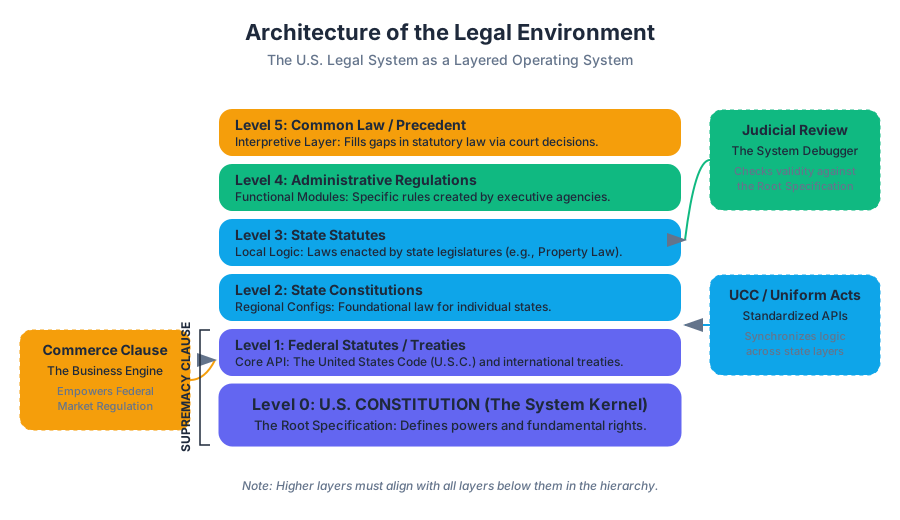
Constitutional Law is the supreme source of law in the United States. It functions as the foundational architecture that defines the scope of governmental power and the boundaries of individual and corporate liberty. In technical terms, the Constitution acts as the "Root Specification" for all other legal sub-systems.
Definition: Constitutional Law is the body of law derived from a formal written constitution, defining the powers of the executive, legislative, and judicial branches, and establishing the fundamental rights of citizens.
The Hierarchy of Authority
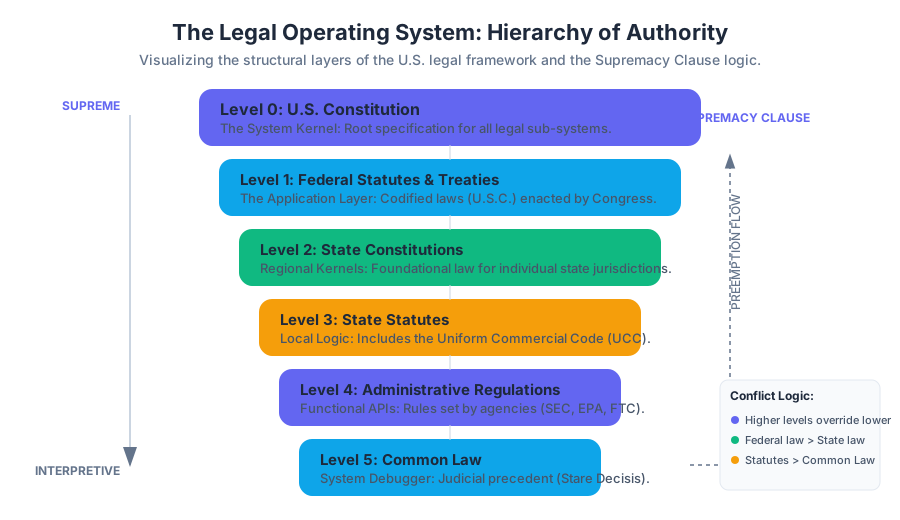
The Supremacy Clause (Article VI, Clause 2) establishes that the Constitution, federal laws made pursuant to it, and treaties made under its authority, constitute the "supreme Law of the Land." This creates a strict hierarchy where any state or local law in conflict with federal law is preempted.
| Layer | Source | Authority Level | Conflict Resolution |
|---|---|---|---|
| Level 0 | U.S. Constitution | Supreme | Overrides all other laws |
| Level 1 | Federal Statutes / Treaties | High | Overrides State Constitutions/Laws |
| Level 2 | State Constitutions | Medium-High | Overrides State Statutes |
| Level 3 | State Statutes | Medium | Overrides Local Ordinances |
| Level 4 | Administrative Regulations | Functional | Must align with enabling statutes |
| Level 5 | Common Law / Precedent | Interpretive | Fills gaps in statutory law |
The Commerce Clause: The Business Engine
For business entities, the most critical constitutional provision is the Commerce Clause (Article I, Section 8, Clause 3). It grants Congress the power "to regulate Commerce with foreign Nations, and among the several States." This has been interpreted broadly to allow federal regulation of any activity that has a "substantial economic effect" on interstate commerce.
Common Pitfalls: The State Action Doctrine
A frequent misconception is that the Bill of Rights applies to private corporations. In reality, the State Action Doctrine dictates that constitutional protections (like Free Speech or Due Process) generally protect individuals from government interference, not from private entities. A private employer can restrict speech in the workplace in ways the government cannot.
Statutory Law: The Application Layer
While the Constitution provides the framework, Statutory Law provides the specific rules of the road. These are laws enacted by legislative bodies (Congress or state legislatures).
The Lifecycle of a Statute
Statutes begin as bills. Once passed and signed into law, they are codified. At the federal level, they are organized into the United States Code (U.S.C.). For example, intellectual property laws are found in Title 17 (Copyrights) and Title 35 (Patents).
Uniform Acts and the UCC
Because the U.S. operates under a system of Federalism, each state has the power to create its own business laws. To prevent a "fragmentation" of the market, the Uniform Commercial Code (UCC) was developed. The UCC is a standardized set of laws governing commercial transactions (sales, leases, negotiable instruments) that has been adopted in some form by all 50 states.
Implementation Logic
In legal engineering, we can think of a statute as a conditional logic gate. If a set of facts matches the statutory criteria, a specific legal consequence follows.
# A conceptual representation of a Statutory Compliance Checker
# Domain: Contract Law / UCC Article 2 (Sales)

class UCCStatute:
    def __init__(self, state_adoption=True):
        self.active = state_adoption

    def check_contract_validity(self, contract):
        """
        Validates if a contract for the sale of goods over $500
        satisfies the Statute of Frauds (UCC 2-201).
        """
        results = {
            "is_enforceable": False,
            "error_code": None
        }

        # Logic Gate: Goods vs Services
        if contract['type'] != "goods":
            results["error_code"] = "NON_UCC_SUBJECT_MATTER"
            return results

        # Logic Gate: Price Threshold
        if contract['price'] >= 500:
            # Requirement: Must be in writing and signed
            if contract['is_written'] and contract['is_signed']:
                results["is_enforceable"] = True
            else:
                results["error_code"] = "STATUTE_OF_FRAUDS_VIOLATION"
        else:
            # Oral contracts under $500 are generally enforceable
            results["is_enforceable"] = True

        return results

# Example Usage
sample_contract = {
    "type": "goods",
    "price": 1200,
    "is_written": True,
    "is_signed": False
}

checker = UCCStatute()
print(checker.check_contract_validity(sample_contract))
# Output: {'is_enforceable': False, 'error_code': 'STATUTE_OF_FRAUDS_VIOLATION'}
Judicial Review: The System Debugger
Judicial Review is the power of the judiciary to examine the actions of the legislative and executive branches and determine their constitutionality. This power was famously established in the landmark case Marbury v. Madison (1803).
The Mechanics of Precedent (Stare Decisis)
The U.S. legal system relies on Common Law, where court decisions create binding precedents for future cases. This principle is known as Stare Decisis ("to stand by things decided").
- Vertical Stare Decisis: Lower courts must follow the decisions of higher courts within the same jurisdiction.
- Horizontal Stare Decisis: A court will generally follow its own previous decisions to ensure stability.
Standards of Review
When a court reviews a law, it doesn't use the same "magnification" for every case. It applies different levels of scrutiny based on the rights involved:
| Standard | Application | Requirement |
|---|---|---|
| Rational Basis | Economic regulations, age, wealth | Law must be "rationally related" to a "legitimate" government interest. (Easy to pass) |
| Intermediate Scrutiny | Gender, legitimacy | Law must be "substantially related" to an "important" government interest. |
| Strict Scrutiny | Fundamental rights (speech, religion) or suspect classifications (race) | Law must be "narrowly tailored" to achieve a "compelling" government interest. (Hard to pass) |
Formal Logic of Judicial Review
We can express the process of Judicial Review as a formal logical derivation. If a statute $S$ conflicts with a Constitutional provision $C$, and the Constitution is the supreme law ($C > S$), then $S$ must be declared null ($S \rightarrow \emptyset$).
\begin{aligned}
& \text{Let } \mathcal{C} \text{ be the set of Constitutional requirements.} \\
& \text{Let } f(x) \text{ be a legislative act (Statute).} \\
& \text{Judicial Review } \mathcal{J} \text{ is a function such that:} \\
& \mathcal{J}(f(x)) =
\begin{cases}
\text{Valid} & \text{if } f(x) \subseteq \mathcal{C} \\
\text{Void (Unconstitutional)} & \text{if } f(x) \cap \mathcal{C}^c \neq \emptyset
\end{cases} \\
& \text{where } \mathcal{C}^c \text{ represents the set of prohibited government actions.}
\end{aligned}
Business Ethics: The Governance Layer
While law defines what is required, Business Ethics defines what is right. Ethics often serves as a "leading indicator" for future laws; practices that are considered unethical today often become illegal tomorrow (e.g., environmental dumping, insider trading).
Competing Ethical Frameworks
Business leaders must navigate different philosophical approaches to decision-making.
| Framework | Core Principle | Business Application |
|---|---|---|
| Utilitarianism | Greatest good for the greatest number. | Cost-Benefit Analysis; prioritizing majority stakeholder interests. |
| Deontology (Kant) | Duty-based; follow universal rules regardless of outcome. | Strict adherence to codes of conduct and "Categorical Imperatives." |
| Virtue Ethics | Focus on the character of the decision-maker. | Developing corporate culture and leadership integrity. |
| Social Contract | Business exists by permission of society. | Corporate Social Responsibility (CSR) and "License to Operate." |
The Stakeholder vs. Shareholder Debate
A central tension in business ethics is the conflict between Shareholder Primacy (the duty to maximize profits for owners) and Stakeholder Theory (the duty to consider employees, customers, the environment, and the community).
Corporate Social Responsibility (CSR) Pipeline
Modern firms integrate ethics into their operations through a CSR pipeline, ensuring that values are not just "marketing" but are hard-coded into the supply chain.
# A CLI-style representation of a Corporate Compliance Audit
# This simulates checking a company's "Ethical Configuration"

$ compliance-check --target "Global Logistics Corp" --framework "ESG"

[INFO] Scanning Corporate Governance...
[PASS] Board Diversity Ratio: 40% (Target: >30%)
[PASS] Executive Compensation Cap: 20x Median (Target: <25x)

[INFO] Scanning Environmental Impact...
[WARN] Carbon Footprint: 1.2M tons (Threshold: 1.0M tons)
[FAIL] Waste Management: Non-compliant with ISO 14001 in Sector 7

[INFO] Scanning Social Responsibility...
[PASS] Supply Chain Transparency: Verified (Blockchain Audit)
[PASS] Fair Wage Compliance: 100% of regions

[RESULT] Ethical Health Score: 82/100
[ACTION] Immediate remediation required for Waste Management.
Connecting the Dots: The Legal-Ethical Matrix
The relationship between law and ethics can be visualized as a four-quadrant matrix. The goal of a sustainable business is to operate primarily in the "Legal and Ethical" quadrant.
- Legal and Ethical: Paying a living wage, producing safe products.
- Legal but Unethical: Tax avoidance through aggressive (but legal) loopholes, "planned obsolescence."
- Illegal but Ethical: Civil disobedience, whistleblowing in some jurisdictions where protections are weak.
- Illegal and Unethical: Fraud, embezzlement, human rights violations in the supply chain.
Case Study: Data Privacy
Consider the evolution of data privacy. Historically, collecting and selling user data was largely unregulated (Legal but Unethical in the eyes of many). Public outcry led to ethical shifts, which eventually codified into Statutory Law like the GDPR in Europe and the CCPA in California. This demonstrates the "Legal Environment" as a dynamic system that responds to ethical pressures.
Summary of Foundational Concepts
The foundations of the legal environment provide the stability necessary for complex economic interactions. Constitutional law sets the boundaries, statutory law provides the rules, judicial review ensures system integrity, and business ethics provides the normative guidance that keeps the system aligned with societal values.
Tort Law and Criminal Liability
Key concepts: Negligence · Intentional Torts · Strict Liability · White-Collar Crime
Exploration of civil wrongs (torts) and criminal acts that occur within a business context, focusing on liability and prevention.
Tort Law and Criminal Liability
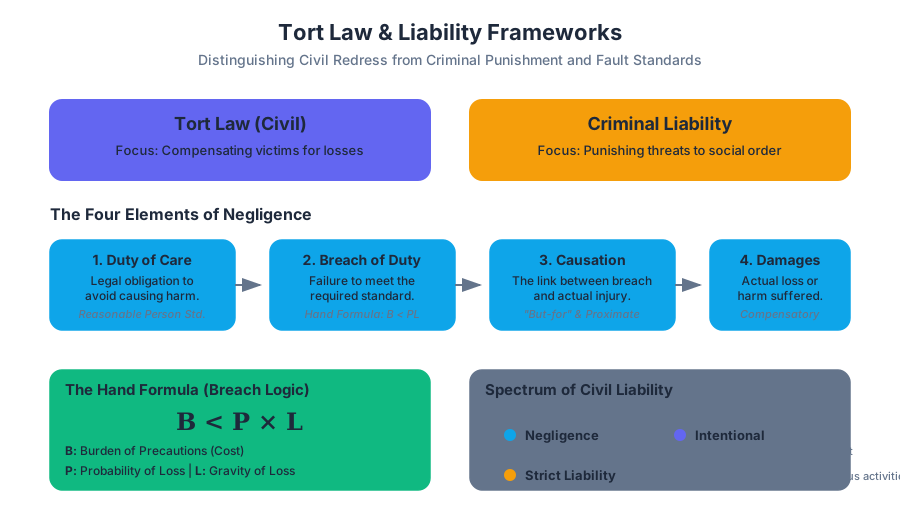
In the modern commercial landscape, the boundary between a "bad business decision" and a "legal violation" is defined by the frameworks of Tort Law and Criminal Liability. While both systems aim to regulate conduct and discourage harm, they operate on different planes of the legal system. Tort law is a civil mechanism designed to compensate victims for losses, shifting the cost of injuries from the "innocent" party to the "at-fault" party. Criminal liability, conversely, represents the state’s interest in punishing conduct that threatens the social order itself.
For business professionals, understanding these frameworks is not merely an academic exercise but a core component of risk management. A single product defect or a lapse in financial oversight can trigger a cascade of litigation, regulatory fines, and potential incarceration.
Negligence: The Standard of Care
Negligence is the most common basis for tort liability in the business world. It is defined not by the intent to do harm, but by the failure to exercise the degree of care that a "reasonably prudent person" would have exercised under similar circumstances.
Definition: Negligence A failure to behave with the level of care that someone of ordinary prudence would have exercised under the same circumstances. The behavior usually consists of actions, but can also consist of omissions when there is some duty to act.
The Four-Element Framework
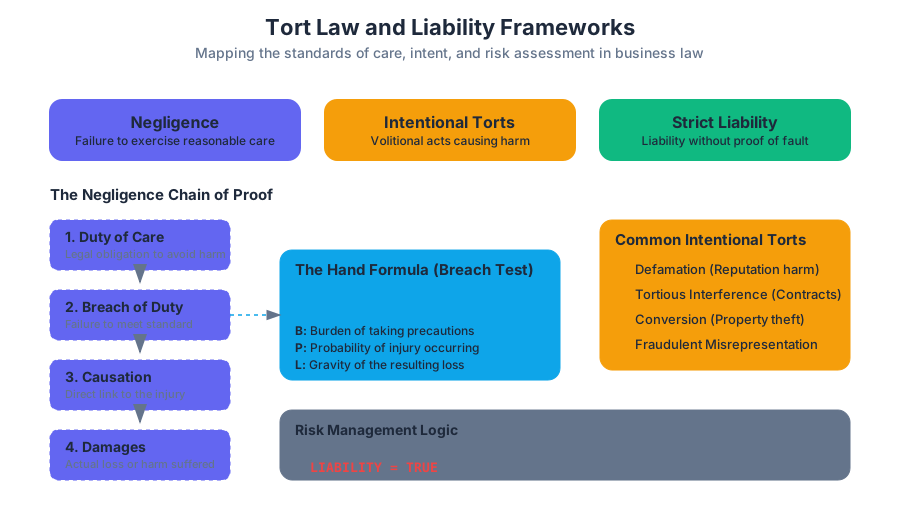
To prevail in a negligence claim, a plaintiff must prove four distinct elements by a preponderance of the evidence. If any single element is missing, the claim fails.
| Element | Description | Legal Test/Standard |
|---|---|---|
| Duty of Care | The legal obligation to avoid causing harm to others. | The "Reasonable Person" standard; Foreseeability. |
| Breach of Duty | The failure to meet the required standard of care. | The Hand Formula ($B < PL$); Industry standards. |
| Causation | The link between the breach and the actual injury. | "But-for" test (Actual) and "Proximate Cause" (Legal). |
| Damages | Actual loss or harm suffered by the plaintiff. | Compensatory, Punitive (rare), or Nominal damages. |
The Mechanics of Breach: The Hand Formula
In a technical sense, determining a breach of duty often involves an implicit or explicit cost-benefit analysis. Judge Learned Hand famously formulated this as a mathematical relationship:
B < PL
Where:
B= The Burden of taking precautions (cost of prevention).P= The Probability of loss/injury occurring.L= The gravity of the Loss (magnitude of the injury).
If the cost of prevention (B) is less than the expected loss (P * L), the failure to take that precaution constitutes a breach of duty.
Implementation: Risk Assessment Logic
In a software-driven compliance environment, we can model negligence risk using a logical gate system.
def evaluate_negligence_liability(duty_exists, precaution_cost, prob_of_harm, loss_magnitude, actual_harm_occurred):
    """
    Evaluates potential negligence liability based on the Hand Formula and
    standard tort elements.
    """
    # 1. Check Duty
    if not duty_exists:
        return "No Liability: No legal duty of care established."

    # 2. Check Breach (Hand Formula: B < PL)
    expected_loss = prob_of_harm * loss_magnitude
    breach = precaution_cost < expected_loss

    # 3. Check Causation and Damages
    if breach and actual_harm_occurred:
        liability_score = (expected_loss - precaution_cost) / loss_magnitude
        return {
            "status": "Potential Liability",
            "breach_confirmed": True,
            "risk_factor": round(liability_score, 4),
            "recommendation": "Immediate settlement or mitigation required."
        }

    return "No Liability: Standard of care met or no damages occurred."

# Example: A retail store fails to clean a spill (Cost: $10)
# Probability of slip: 0.2, Potential Injury Cost: $5000
print(evaluate_negligence_liability(True, 10, 0.2, 5000, True))
Intentional Torts: Volitional Harm
Unlike negligence, Intentional Torts require a volitional act. The defendant must have intended the physical act that caused the harm, though they need not have intended the specific resulting injury. In a business context, intentional torts often involve interference with property, reputation, or contractual relationships.
Key Categories of Intentional Torts
- Defamation: A false statement of fact communicated to a third party that harms a person's or business's reputation.
- Tortious Interference: Intentionally inducing a party to breach a contract with a third party.
- Conversion: The civil equivalent of theft; exercising dominion over another's personal property without consent.
- Fraudulent Misrepresentation: A material misrepresentation made with the intent to deceive, which the victim reasonably relies upon to their detriment.
Comparison: Negligence vs. Intentional Torts
| Feature | Negligence | Intentional Tort |
|---|---|---|
| State of Mind | Carelessness / Inadvertence | Volitional Act / Specific Intent |
| Standard | Reasonable Person | Subjective Intent to Act |
| Punitive Damages | Rarely awarded | Frequently awarded to deter conduct |
| Insurance Coverage | Usually covered | Often excluded (Public Policy) |
Common Pitfall: The "Transferred Intent" Doctrine
A common misconception is that if you intend to hit Person A but accidentally hit Person B, you are only liable for negligence. Under the doctrine of Transferred Intent, the intent to commit a tort against one person is transferred to the actual victim.
Strict Liability: Liability Without Fault
In certain scenarios, the law abandons the requirement of "fault" (negligence or intent) altogether. Under Strict Liability, a defendant is held responsible for damages even if they took every possible precaution.
Applications in Business
Strict liability is typically reserved for three specific areas:
- Ultra-hazardous Activities: Activities that involve a high risk of serious harm that cannot be eliminated by reasonable care (e.g., blasting, keeping wild animals).
- Product Liability: Manufacturers and sellers are held liable if a product is sold in a "defective condition unreasonably dangerous" to the user.
- Vicarious Liability (Respondeat Superior): Employers are strictly liable for the torts committed by employees acting within the "scope of employment."
Product Liability Logic
For a product liability claim to succeed, the plaintiff must prove the product was defective in one of three ways:
- Manufacturing Defect: The unit that caused injury differs from the intended design.
- Design Defect: The entire product line is inherently dangerous, and a safer alternative design was feasible.
- Failure to Warn: Inadequate instructions or warnings regarding foreseeable risks.
\text{Strict Liability Condition: } \exists \text{ Product } P \in \text{ Market} \mid \text{Defect}(P) \land \text{ProximateCause}(P, \text{Injury}) \implies \text{Liability}
White-Collar Crime: The Criminal Dimension
While torts are disputes between private parties, White-Collar Crimes are offenses against the state. These are non-violent crimes committed by business professionals for financial gain.
The Anatomy of a Crime
Criminal liability requires the concurrence of two elements:
- Actus Reus: The "guilty act" (the physical commission of the crime).
- Mens Rea: The "guilty mind" (the mental state or intent).
Common White-Collar Offenses
- Embezzlement: The fraudulent conversion of property by someone to whom it was entrusted (e.g., an accountant siphoning funds).
- Money Laundering: Engaging in financial transactions to conceal the identity, source, or destination of illegally gained money.
- Insider Trading: Trading stock based on material, non-public information in breach of a fiduciary duty.
- RICO Violations: The Racketeer Influenced and Corrupt Organizations Act, used to prosecute ongoing criminal enterprises.
Corporate Criminal Liability
Under the doctrine of Corporate Personhood, a corporation can be criminally prosecuted. Since a corporation cannot be imprisoned, penalties usually involve massive fines, debarment from government contracts, or "corporate death" (dissolution).
| Crime Type | Primary Actor | Typical Mens Rea | Key Statute/Rule |
|---|---|---|---|
| Fraud | Individual/Org | Intent to Deceive | 18 U.S.C. § 1341 (Mail/Wire) |
| Embezzlement | Fiduciary | Intent to Deprive | State Penal Codes |
| Bribery | Public/Private Official | Corrupt Intent | FCPA (Foreign Corrupt Practices) |
| Tax Evasion | Taxpayer | Willfulness | 26 U.S.C. § 7201 |
Technical Implementation: Audit Trail for Fraud Detection
To prevent white-collar crime, modern ERP (Enterprise Resource Planning) systems implement immutable logs. Below is a SQL schema designed to detect "lapping" (a form of embezzlement where credits are shifted to cover stolen cash).
-- Schema for detecting suspicious transaction patterns
CREATE TABLE financial_ledger (
    transaction_id UUID PRIMARY KEY,
    account_id INT NOT NULL,
    employee_id INT NOT NULL,
    amount DECIMAL(19, 4),
    entry_timestamp TIMESTAMP DEFAULT CURRENT_TIMESTAMP,
    is_reversal BOOLEAN DEFAULT FALSE,
    checksum VARCHAR(64) -- Hash of transaction data for immutability
);

-- Query to identify accounts with high frequency of manual reversals (Potential Fraud)
SELECT
    employee_id,
    COUNT(*) AS reversal_count,
    SUM(amount) AS total_reversed_volume
FROM
    financial_ledger
WHERE
    is_reversal = TRUE
GROUP BY
    employee_id
HAVING
    COUNT(*) > 10 -- Threshold for investigation
ORDER BY
    reversal_count DESC;
Comparative Analysis: Civil vs. Criminal Liability
A single act can trigger both civil and criminal proceedings. For example, a CFO who steals company funds can be sued by the company for the tort of conversion (Civil) and prosecuted by the District Attorney for embezzlement (Criminal).
| Feature | Civil (Tort) | Criminal |
|---|---|---|
| Parties | Plaintiff vs. Defendant | State/Government vs. Defendant |
| Burden of Proof | Preponderance of the Evidence (>50%) | Beyond a Reasonable Doubt (~99%) |
| Purpose | Compensation / Restitution | Punishment / Deterrence / Rehabilitation |
| Verdict | Liable / Not Liable | Guilty / Not Guilty |
| Remedy | Monetary Damages / Injunctions | Fines / Probation / Imprisonment |
The Burden of Proof Gap
The difference in the burden of proof is critical. This is why a defendant might be acquitted in a criminal trial (where the state failed to prove guilt "beyond a reasonable doubt") but found liable in a subsequent civil trial (where the plaintiff only had to show it was "more likely than not" that the defendant committed the act). The most famous historical example of this is the O.J. Simpson trials.
Common Pitfalls in Liability Management
- The "Independent Contractor" Fallacy: Many businesses believe they are immune from liability if they hire contractors. However, if the business retains "control" over the methods of work, or if the task is "inherently dangerous," the business remains liable under strict liability or agency principles.
- Assuming Compliance Equals Safety: Meeting federal safety regulations (like OSHA or FDA standards) is often considered the "floor," not the "ceiling." A company can be in full regulatory compliance and still be found negligent if a reasonable person would have taken additional precautions.
- Ignoring "Soft" Intent: In intentional torts, you don't have to hate the victim. If you play a "prank" on a coworker that involves unconsented touching (Battery), your "good intentions" are irrelevant to liability.
Contract Law Fundamentals
Key concepts: Offer and Acceptance · Consideration · Contractual Capacity · Statute of Frauds · Remedies
A deep dive into the formation, performance, and breach of contracts, which serve as the backbone of all commercial transactions.
Contract Law Fundamentals
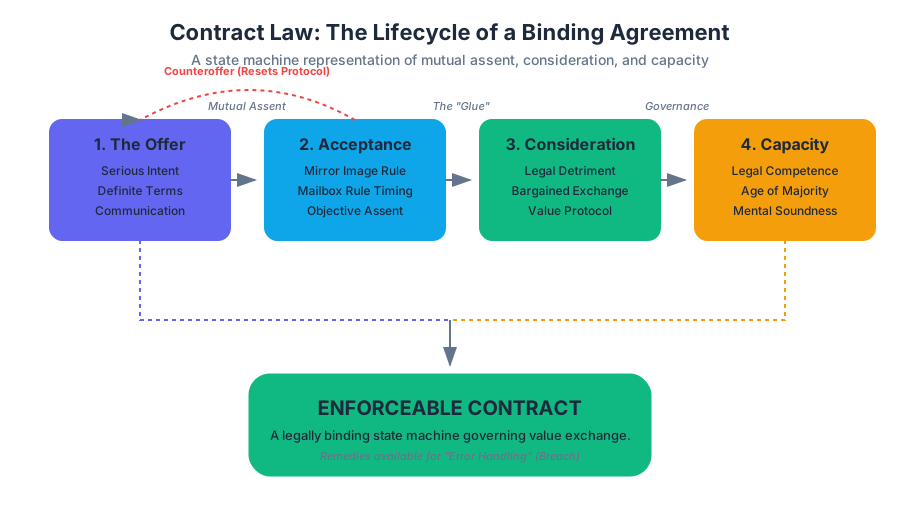
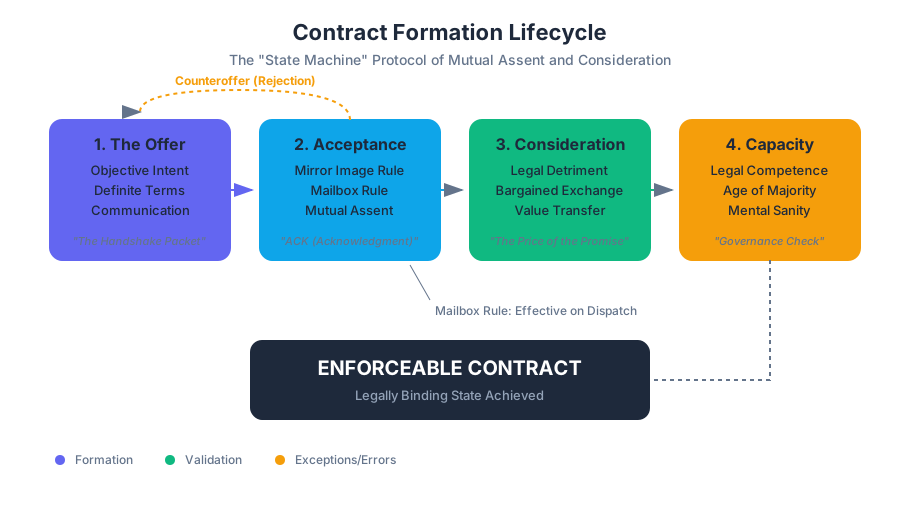
In the architecture of modern commerce, a contract is more than a mere agreement; it is a legally binding state machine that governs the exchange of value. At its core, contract law provides the "protocol" for private ordering, allowing individuals and entities to create their own enforceable rules. This section explores the lifecycle of a contract, from the initial "handshake" protocol of offer and acceptance to the "error handling" mechanisms of legal remedies.
1. Offer and Acceptance: The Mutual Assent Protocol
The formation of a contract begins with Mutual Assent, often described as a "meeting of the minds." However, modern jurisprudence relies on the Objective Theory of Contracts. This theory dictates that a party’s intent is determined by outward, objective facts—what they said, how they acted, and the circumstances—rather than their subjective, secret intentions.
1.1 The Offer
An Offer is a manifestation of willingness to enter into a bargain, made in a way that justifies another person in understanding that their assent to that bargain is invited and will conclude it.
| Element | Requirement | Description |
|---|---|---|
| Intent | Serious & Objective | Must not be made in jest, anger, or undue excitement (e.g., Lucy v. Zehmer). |
| Definiteness | Essential Terms | Must include parties, subject matter, price, and time of performance. |
| Communication | Direct or Indirect | The offeree must actually know the offer exists to accept it. |
1.2 The Acceptance
Acceptance is the offeree's expression of assent to the terms of the offer. Under the common law Mirror Image Rule, the acceptance must exactly match the offer. Any deviation or additional term converts the "acceptance" into a Counteroffer, which effectively terminates the original offer.
"The Mirror Image Rule ensures that the 'protocol' of the contract is identical on both sides. If Node A sends a packet with Parameter X, Node B must acknowledge Parameter X exactly; acknowledging Parameter X+1 is a protocol mismatch."
1.3 The Mailbox Rule
A critical timing mechanism in contract law is the Mailbox Rule. It states that an acceptance is generally effective upon dispatch (when it is placed in the control of the postal service), whereas revocations and rejections are only effective upon receipt.
// First code block: Low-level implementation (Solidity)
// Representing a basic Contract State Machine for Offer and Acceptance

pragma solidity ^0.8.0;

contract LegalAgreement {
    enum State { Pending, Accepted, Terminated, Fulfilled }
    State public currentState;

    address public offeror;
    address public offeree;
    string public terms;
    uint256 public considerationAmount;

    modifier onlyOfferee() {
        require(msg.sender == offeree, "Only the designated offeree can accept.");
        _;
    }

    constructor(address _offeree, string memory _terms, uint256 _amount) {
        offeror = msg.sender;
        offeree = _offeree;
        terms = _terms;
        considerationAmount = _amount;
        currentState = State.Pending;
    }

    function acceptOffer() external payable onlyOfferee {
        require(currentState == State.Pending, "Offer is no longer active.");
        require(msg.value == considerationAmount, "Incorrect consideration provided.");

        currentState = State.Accepted;
    }

    function revokeOffer() external {
        require(msg.sender == offeror, "Only offeror can revoke.");
        require(currentState == State.Pending, "Cannot revoke after acceptance.");

        currentState = State.Terminated;
    }
}
2. Consideration: The Price of the Promise
Consideration is the "glue" that makes a promise legally enforceable. It distinguishes a contract from a gift. It requires a Bargained-for Exchange of something of Legal Value.
2.1 Elements of Consideration
- Legal Sufficiency: The promisee must either incur a legal detriment (doing something they aren't obligated to do) or the promisor must receive a legal benefit.
- Bargained-for Exchange: The item of value must be given by the promisor in exchange for the promisee's promise, performance, or promise of performance.
2.2 Common Pitfalls in Consideration
- Past Consideration: An act done before the contract is made is not consideration. You cannot "pay" for a new promise with an old deed.
- Pre-existing Duty: A promise to do what one already has a legal duty to do does not constitute legally sufficient consideration.
- Illusory Promises: If the terms of the contract express such uncertainty of performance that the promisor has not actually promised to do anything, the promise is illusory (e.g., "I will buy all the grain I want from you").
| Concept | Status | Reason |
|---|---|---|
| Gift | Unenforceable | No bargained-for exchange; no detriment to the donor. |
| Promissory Estoppel | Enforceable (Exception) | Reliance on a promise leads to injustice; used when consideration is missing. |
| Adequacy of Consideration | Generally Irrelevant | Courts don't care if you made a "bad deal," only that a deal was made. |
3. Contractual Capacity: The Governance of Competence
Not every entity has the legal power to bind themselves to a contract. Capacity refers to the legal qualification of a person to enter into a binding agreement.
3.1 Minors
Contracts entered into by minors (typically under 18) are Voidable at the option of the minor. This is known as the power of Disaffirmance. However, if a minor contracts for "necessaries" (food, shelter, medical care), they may be held liable for the reasonable value of the goods under a theory of quasi-contract.
3.2 Mental Incompetence and Intoxication
- Void: If a person has been adjudged mentally incompetent by a court, any contract they sign is void ab initio (from the beginning).
- Voidable: If the person lacked the mental capacity to understand the nature and consequences of the transaction at the time of signing, the contract is voidable.
- Intoxication: This is a high bar. A contract is voidable only if the person was so intoxicated that they lacked the ability to comprehend the legal consequences of their actions, and the other party had reason to know of the intoxication.
4. Statute of Frauds: The Requirement of Writing
The Statute of Frauds is a legal doctrine that requires certain types of contracts to be in writing and signed by the party against whom enforcement is sought. The purpose is to prevent fraud and perjury in the testimony of oral contracts.
4.1 The "MYLEGS" Acronym
The types of contracts typically falling under the Statute of Frauds can be remembered by the acronym MYLEGS:
- Marriage: Contracts made in consideration of marriage (e.g., prenuptial agreements).
- Year: Contracts that cannot be performed within one year from the day after the date of formation.
- Land: Contracts for the sale of an interest in land (including leases and mortgages).
- Executor: Promises by an executor to pay estate debts out of their own pocket.
- Goods: Sale of goods priced at $500 or more (under the UCC).
- Suretyship: Promises to pay the debt of another person.
4.2 Sufficiency of the Writing
The "writing" does not need to be a formal contract. It can be a memo, an invoice, or even a series of emails, provided it contains:
- The essential terms (parties, subject matter, consideration).
- The signature of the party to be charged (the defendant).
# Second code block: Logic Flow / Pseudocode
# Validating a contract against the Statute of Frauds and Capacity

def is_contract_enforceable(contract):
    # 1. Check Capacity
    if not contract.party_a.has_capacity() or not contract.party_b.has_capacity():
        return "VOIDABLE: Lack of Capacity"

    # 2. Check Statute of Frauds (MYLEGS)
    requires_writing = False
    if contract.subject == "Real Estate": requires_writing = True
    if contract.duration_days > 365: requires_writing = True
    if contract.type == "Sale of Goods" and contract.value >= 500: requires_writing = True

    if requires_writing and not contract.has_written_record:
        return "UNENFORCEABLE: Statute of Frauds violation"

    # 3. Check Mutual Assent & Consideration
    if not (contract.offer and contract.acceptance):
        return "VOID: No Mutual Assent"
    if contract.consideration <= 0:
        return "VOID: No Consideration"

    return "ENFORCEABLE"
5. Remedies: Error Handling in Contract Law
When a party fails to perform their duties under a contract, a Breach occurs. The law provides Remedies to compensate the non-breaching party. The goal of contract remedies is generally Compensatory, not punitive—to put the non-breaching party in the position they would have been in had the contract been performed.
5.1 Legal Remedies (Damages)
Legal remedies consist of monetary awards.
| Type of Damage | Purpose | Calculation |
|---|---|---|
| Compensatory | Cover direct losses. | (Contract Price) - (Market Price) or (Cost of Substitute). |
| Consequential | Cover indirect, foreseeable losses. | Lost profits resulting from the breach (must be foreseeable). |
| Liquidated | Pre-determined amount. | Fixed in the contract itself if actual damages are hard to estimate. |
| Nominal | Recognize a technical breach. | Usually $1; awarded when no actual financial loss occurred. |
5.2 Equitable Remedies
When money is an inadequate remedy, courts may grant equitable relief.
- Specific Performance: A court order requiring the breaching party to perform their contractual duty. This is common in real estate transactions (because land is unique) but rare in personal service contracts (to avoid "involuntary servitude").
- Rescission: The contract is canceled, and the parties are returned to their pre-contractual positions.
- Reformation: The court rewrites the contract to reflect the parties' true intentions (often used in cases of mutual mistake).
5.3 Mitigation of Damages
The non-breaching party has a legal duty to Mitigate their damages. They must take reasonable steps to minimize the loss resulting from the breach. For example, if a tenant breaks a lease, the landlord must make reasonable efforts to find a new tenant rather than simply suing for the remaining months of rent without acting.
# Third code block: Real-world usage / CLI simulation
# Using a hypothetical 'contract-validator' tool to check for breach and damages

$ contract-tool analyze --file agreement.json --market-price 1200

[ANALYSIS START]
> Contract ID: 8829-X
> Subject: 100 units of Component_A
> Contract Price: $10.00/unit (Total: $1,000)
> Market Price: $12.00/unit (Total: $1,200)
> Status: BREACHED by Seller

[CALCULATING REMEDIES]
> Compensatory Damages: $200.00 (Market - Contract)
> Mitigation Check: Buyer found substitute at $11.50/unit.
> Adjusted Damages: $150.00

[VERDICT]
> Recommended Action: File for $150.00 in compensatory damages.
[ANALYSIS COMPLETE]
6. Summary of Contractual Lifecycle
The lifecycle of a contract can be viewed as a pipeline:
- Formation: Offer, Acceptance, and Consideration create the binding obligation.
- Validation: Capacity and the Statute of Frauds act as filters to ensure the obligation is enforceable.
- Performance: The parties fulfill their promises, terminating the contract naturally.
- Breach/Remedy: If performance fails, the "exception handling" of remedies triggers to restore balance.
Understanding these fundamentals allows business professionals to mitigate risk and ensure that their strategic agreements have the full force of the law behind them.
Agency and Business Organizations
Key concepts: Principal-Agent Relationship · Fiduciary Duty · Sole Proprietorship · Corporations · LLCs
An examination of how businesses are structured and the legal relationships between employers, employees, and third parties.
Agency and Business Organizations
In the modern economic landscape, the "firm" is rarely a single individual acting in isolation. Instead, businesses operate through a complex web of delegated authority and structured legal entities. The intersection of Agency Law and Business Organizations provides the framework for how these entities function, how they interact with third parties, and how risk is distributed among participants.
At its core, agency law governs the relationship where one person (the agent) acts on behalf of another (the principal). Business organization law then applies these principles to specific structures—ranging from the informal Sole Proprietorship to the highly regulated Corporation—to define liability, taxation, and governance.
The Principal-Agent Relationship
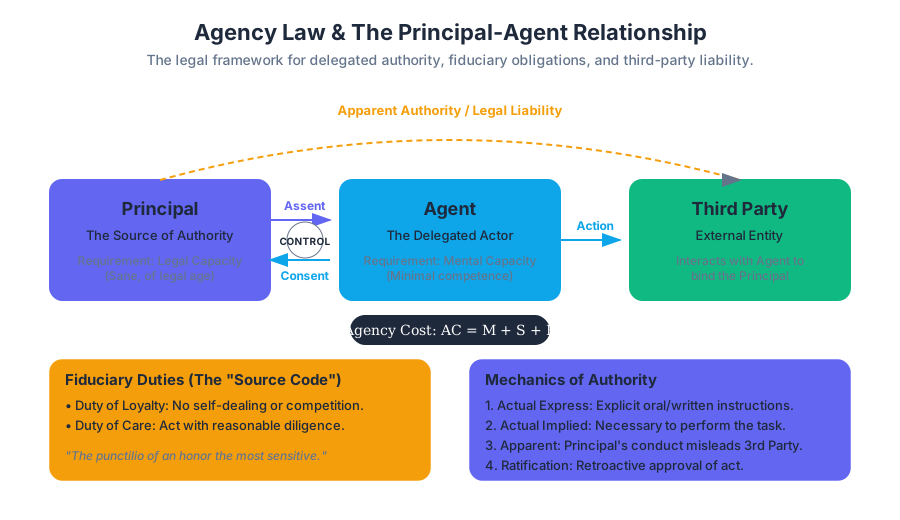
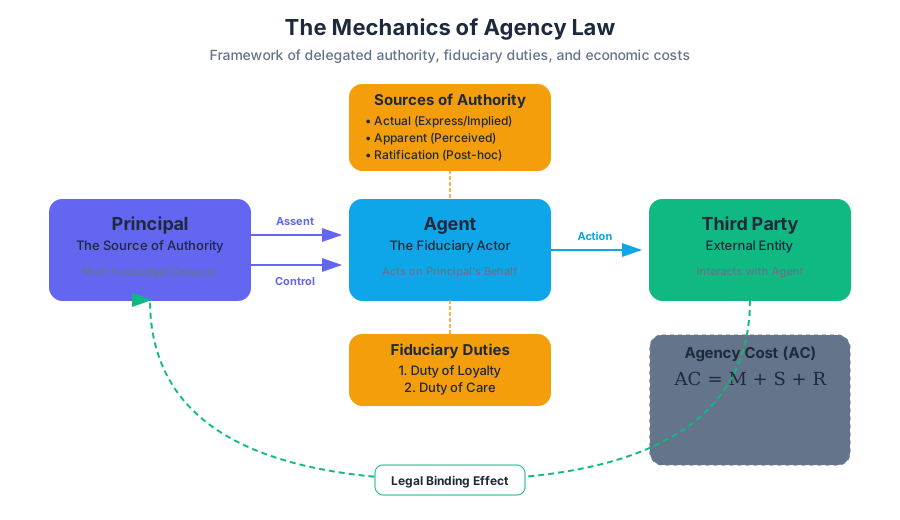
The Principal-Agent Relationship is a fiduciary relationship that arises when one person (the principal) manifests assent to another person (the agent) that the agent shall act on the principal's behalf and subject to the principal's control, and the agent consents so to act.
Mechanics of Agency
Agency is not defined by a contract alone; it is defined by the conduct of the parties. Even if a contract explicitly states "no agency relationship exists," a court may find one if the functional elements of consent and control are present.
| Component | Description | Legal Requirement |
|---|---|---|
| Principal | The entity with the original authority. | Must have legal capacity (sane, of age). |
| Agent | The entity acting on behalf of the principal. | Must have minimal mental capacity. |
| Consent | Both parties must agree to the relationship. | Can be express (written/oral) or implied. |
| Control | The principal has the right to control the agent's objectives. | The "right to control" is the hallmark of agency. |
Types of Authority
An agent's power to bind a principal to a third party depends on the type of Authority granted:
- Actual Express Authority: Explicit instructions given via written or oral communication (e.g., "I authorize you to sign this lease").
- Actual Implied Authority: Authority to do what is reasonably necessary to carry out the express mandate (e.g., authority to manage a store implies authority to hire staff).
- Apparent Authority: Created when a principal’s conduct leads a third party to reasonably believe the agent has authority, even if they do not.
- Ratification: Occurs when a principal accepts the benefits of an unauthorized act after the fact, thereby retroactively creating authority.
Implementation: Agency Logic in Systems
In software engineering, the "Agent Pattern" mirrors this legal structure. Below is a Python implementation demonstrating a delegated authority system where an Agent executes tasks on behalf of a Principal, subject to specific permissions.
import uuid

class Principal:
    def __init__(self, name):
        self.name = name
        self.id = uuid.uuid4()
        self.permissions = {"READ", "WRITE", "EXECUTE"}

    def manifest_assent(self, agent, scope):
        """Formally delegates a subset of permissions to an agent."""
        delegated_perms = {p for p in scope if p in self.permissions}
        agent.set_authority(self, delegated_perms)
        print(f"Principal {self.name} delegated {delegated_perms} to Agent {agent.name}")

class Agent:
    def __init__(self, name):
        self.name = name
        self.principal = None
        self.authority_scope = set()

    def set_authority(self, principal, scope):
        self.principal = principal
        self.authority_scope = scope

    def execute_action(self, action, target):
        if action in self.authority_scope:
            print(f"Agent {self.name} performing {action} on {target} for {self.principal.name}")
            return True
        else:
            print(f"Action {action} DENIED: Outside scope of authority.")
            return False

# Usage Example
ceo = Principal("Alice")
manager = Agent("Bob")

# Alice delegates READ and WRITE, but NOT EXECUTE
ceo.manifest_assent(manager, {"READ", "WRITE"})

manager.execute_action("WRITE", "Financial_Report.csv")  # Success
manager.execute_action("EXECUTE", "System_Shutdown")    # Failure
Fiduciary Duty: The "Source Code" of Trust
The most critical aspect of the agency relationship is the Fiduciary Duty. This is a high standard of care and loyalty that prevents the agent from exploiting the principal's trust for personal gain.
"A fiduciary is held to something stricter than the morals of the market place. Not honesty alone, but the punctilio of an honor the most sensitive, is then the standard of behavior." — Justice Benjamin Cardozo, Meinhard v. Salmon
The Two Pillars of Fiduciary Duty
- Duty of Loyalty: The agent must act solely for the benefit of the principal. This includes:
- No self-dealing (buying from or selling to oneself).
- No usurping business opportunities that belong to the principal.
- No competing with the principal while the relationship exists.
- Maintaining confidentiality.
- Duty of Care: The agent must act with the same care, competence, and diligence as a normally prudent person in similar circumstances.
Formalizing Fiduciary Obligations
We can represent the "Agency Cost" ($AC$)—the loss incurred by the principal due to the divergence of interests—mathematically:
AC = M + S + R
Where:
- $M$ = Monitoring Costs: Expenses paid by the principal to limit the agent's aberrant activities (e.g., audits).
- $S$ = Bonding Costs: Expenses paid by the agent to guarantee they will not take certain actions (e.g., contractual penalties).
- $R$ = Residual Loss: The remaining reduction in the principal's welfare despite monitoring and bonding.
Business Organizations: The Spectrum of Structure
When individuals decide to conduct business, they must choose a legal "container." This choice determines the Liability (who pays if things go wrong), Taxation (how the government takes its cut), and Governance (who makes the decisions).
1. Sole Proprietorship
The simplest and most common form of business. There is no legal distinction between the owner and the business.
- Formation: No formal filing required (except local DBAs or licenses).
- Liability: Unlimited Personal Liability. If the business is sued or goes bankrupt, the owner's personal assets (house, car, savings) are at risk.
- Taxation: Pass-through; income is reported on the owner's personal tax return.
2. Partnerships
A partnership is an association of two or more persons to carry on as co-owners of a business for profit.
| Feature | General Partnership (GP) | Limited Partnership (LP) |
|---|---|---|
| Liability | All partners have unlimited personal liability. | General partners have unlimited liability; Limited partners have limited liability. |
| Management | All partners share equal management rights. | Limited partners usually cannot participate in management. |
| Taxation | Pass-through. | Pass-through. |
| Creation | Can be created by conduct (informal). | Requires formal filing with the state. |
3. Corporations (C-Corps and S-Corps)
A corporation is a legal entity that is separate and distinct from its owners. It is a "legal person" that can enter contracts, sue, and be sued.
- Limited Liability: Shareholders are generally not personally liable for the corporation's debts. Their risk is limited to the amount of their investment.
- Double Taxation: C-Corps are taxed at the entity level on profits, and shareholders are taxed again on dividends.
- Governance Hierarchy: Shareholders elect Directors, who appoint Officers (CEO, CFO) to manage daily operations.
Corporate Governance Schema
In a database-driven view of a corporation, the hierarchy is strictly enforced. Below is a SQL schema representing the relationship between stakeholders.
-- Schema for Corporate Governance Tracking
CREATE TABLE Shareholders (
    shareholder_id INT PRIMARY KEY,
    name VARCHAR(255),
    shares_owned INT
);

CREATE TABLE Board_of_Directors (
    director_id INT PRIMARY KEY,
    name VARCHAR(255),
    term_expiry DATE,
    is_independent BOOLEAN
);

CREATE TABLE Officers (
    officer_id INT PRIMARY KEY,
    title VARCHAR(50), -- CEO, CTO, CFO
    name VARCHAR(255),
    appointed_by_director_id INT,
    FOREIGN KEY (appointed_by_director_id) REFERENCES Board_of_Directors(director_id)
);

-- The "Corporate Veil" is the logical barrier separating these
-- tables from the personal assets of the individuals involved.
4. Limited Liability Company (LLC)
The LLC is a hybrid structure designed to provide the limited liability of a corporation with the tax flexibility of a partnership.
- Members: Owners are called "members" (not shareholders).
- Operating Agreement: The "source code" of the LLC, defining how it is run.
- Taxation: Default is pass-through, but can elect to be taxed as a corporation.
Comparative Decision Matrix
Choosing a structure involves balancing competing priorities. The following table provides a technical comparison for founders.
| Metric | Sole Prop | Partnership | LLC | C-Corp |
|---|---|---|---|---|
| Entity Status | None | Separate (mostly) | Separate | Separate |
| Liability | Unlimited | Unlimited (General) | Limited | Limited |
| Taxation | Single (Personal) | Single (Pass-through) | Single (Default) | Double |
| Capital Raising | Difficult | Moderate | Moderate | High (VC/IPO) |
| Continuity | Ends with owner | Ends with partner | Perpetual | Perpetual |
| Complexity | Low | Low to Moderate | Moderate | High |
Common Pitfalls and Edge Cases
1. Piercing the Corporate Veil
The "Corporate Veil" is the legal shield protecting owners from personal liability. However, courts may "pierce" this veil if:
- The business is the Alter Ego of the owner (mixing personal and business funds).
- The corporation was Under-capitalized at formation to defraud creditors.
- The owner failed to follow Corporate Formalities (e.g., not holding annual meetings or keeping minutes).
2. Apparent Authority in the Digital Age
In modern systems, apparent authority often arises through automated systems. If a company provides an employee with an @company.com email and a "VP" signature, and that employee signs a contract they weren't authorized to sign, the company may still be bound under the doctrine of apparent authority.
3. The "Self-Dealing" Trap
A director of a corporation finds a piece of real estate perfect for the company's expansion. Instead of telling the board, they buy it personally and lease it back to the company. This is a classic breach of the Duty of Loyalty (Usurpation of Corporate Opportunity).
Example: Setting up a Tech Startup
To illustrate the lifecycle, consider a founder, "Devin," launching a SaaS product.
- Phase 1 (Sole Prop): Devin writes code in his garage. He is a sole proprietor. If his code accidentally deletes a client's database, the client can sue Devin and take his house.
- Phase 2 (LLC): Devin brings on a co-founder. They file an LLC. They now have limited liability. If the same error occurs, only the LLC's assets are at risk.
- Phase 3 (C-Corp): They want to raise Venture Capital. VCs require a Delaware C-Corp for its predictable legal environment and ease of issuing stock options. They "convert" the LLC to a C-Corp.
Infrastructure as Code: The "Legal" CLI
While legal filings are done via state portals, we can conceptualize the "deployment" of a business entity as a configuration script.
# Conceptual CLI for Business Deployment
# Usage: ./legal-deploy.sh [entity_type] [name]

ENTITY_TYPE=$1
NAME=$2

case $ENTITY_TYPE in
  "sole_prop")
    echo "Deploying $NAME: No isolation layer. Direct binding to owner_assets."
    ;;
  "llc")
    echo "Deploying $NAME: Initializing Operating Agreement... Setting up Pass-through Tax..."
    echo "Isolation Layer: ENABLED (Limited Liability)."
    ;;
  "corp")
    echo "Deploying $NAME: Filing Articles of Incorporation... Issuing 10M Shares..."
    echo "Isolation Layer: ENABLED (Corporate Veil)."
    echo "Tax Layer: DOUBLE_TAXATION enabled."
    ;;
  *)
    echo "Unknown entity type."
    exit 1
    ;;
esac
Summary of Key Terms
- Principal: The party who authorizes another to act on their behalf.
- Agent: The party authorized to act for the principal.
- Fiduciary: A person in a position of trust who owes duties of loyalty and care.
- Limited Liability: A legal protection where owners are not personally responsible for business debts.
- Pass-through Taxation: A system where business income is only taxed once at the individual level.
- Articles of Incorporation: The formal document filed with the state to create a corporation.
Study Guide: Agency and Business Organizations
I. Agency Law Fundamentals
- Definition: A consensual relationship where an Agent acts for a Principal.
- Creation: Requires Manifestation of Consent and Control.
- Authority Types:
- Actual: Principal tells Agent what to do.
- Apparent: Principal makes Third Party think Agent has authority.
- Ratification: Principal says "I'll allow it" after the fact.
- Fiduciary Duties: Duty of Loyalty (no self-dealing) and Duty of Care (prudence).
II. Business Entities Comparison
- Sole Proprietorship: 1 owner, unlimited liability, easy to start.
- Partnership: 2+ owners, unlimited liability (usually), pass-through tax.
- Corporation: Separate legal person, limited liability, double taxation, formal governance.
- LLC: Hybrid, limited liability, flexible taxation, "Members" instead of "Shareholders."
III. Key Legal Risks
- Vicarious Liability (Respondeat Superior): Principals are liable for torts committed by agents within the scope of employment.
- Piercing the Veil: Losing limited liability by failing to keep the business separate from personal affairs.
- Agency Costs: The inherent conflict of interest between owners and managers.
IV. Practical Application
- When to choose an LLC: For small to medium businesses wanting protection without the complexity of a corporation.
- When to choose a C-Corp: When planning to go public or raise significant Venture Capital.
- When to stay a Sole Prop: Almost never, once the business has any significant revenue or risk.
Source Materials
Study Business Law I Essentials with AI — Free on Lykke
Sign up for free to generate personalized flashcards, quizzes, and study guides from this course. Chat with an AI tutor that knows the material.
Get Started FreeView this course wiki on Lykke · Browse all public course wikis