AP United States Government and Politics
Institution: MIT
120 study materials · 67 sections
AP United States Government and Politics students working the current College Board Course and Exam Description, including first-time students with no prior background, plus teachers reviewing the page for CED alignment.; Teach every official CED unit and every numbered topic at topic granularity.; Develop every AP skill / science-practice code explicitly and by name.; Replace description with teaching: worked contextual examples, named misconceptions, and in-flow retrieval checks.; Build an exam-practice unit covering every task type on the current exam.
Course Sections
Course Framework, Skills and Reasoning Processes
Key concepts: AP course framework · Course skills and reasoning processes · College-level course alignment · Instructional model · AP Course Audit · Maintaining political balance · AP Classroom resources · Progress monitoring and formative feedback · Question Bank practice · Teacher-directed curriculum design
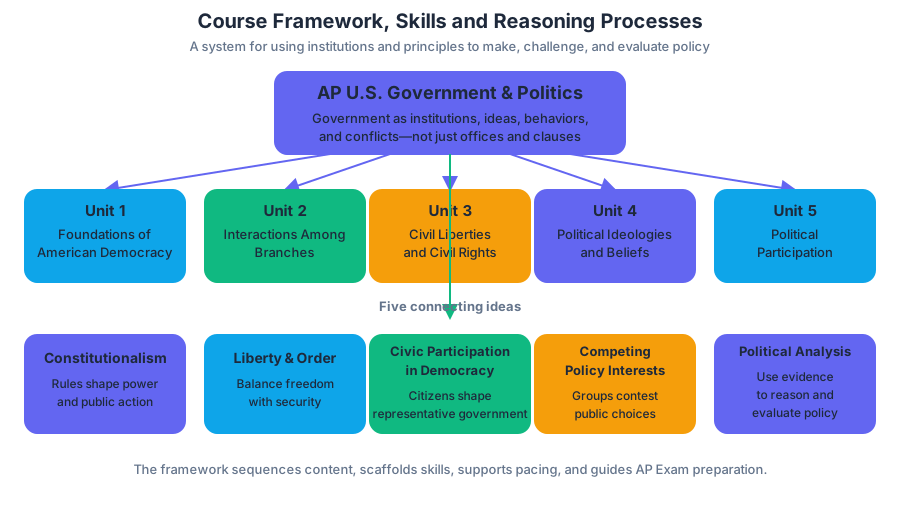
The AP U.S. Government and Politics course treats government as a system of institutions, ideas, behaviors, and conflicts—not merely as a list of offices and constitutional clauses.
Course Framework, Skills and Reasoning Processes
The AP U.S. Government and Politics course treats government as a system of institutions, ideas, behaviors, and conflicts—not merely as a list of offices and constitutional clauses. Its central question is practical: How do Americans use political institutions and constitutional principles to make, challenge, and evaluate public policy?
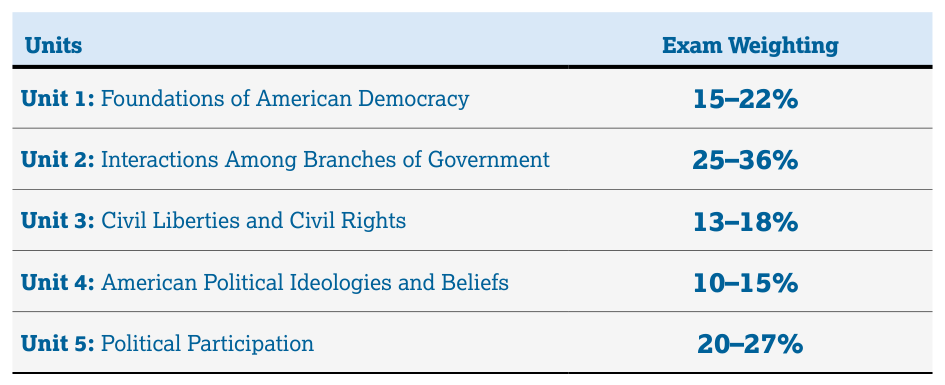
The course framework organizes that investigation into five units commonly found in introductory college courses:
- Unit 1: Foundations of American Democracy
- Unit 2: Interactions Among Branches of Government
- Unit 3: Civil Liberties and Civil Rights
- Unit 4: American Political Ideologies and Beliefs
- Unit 5: Political Participation
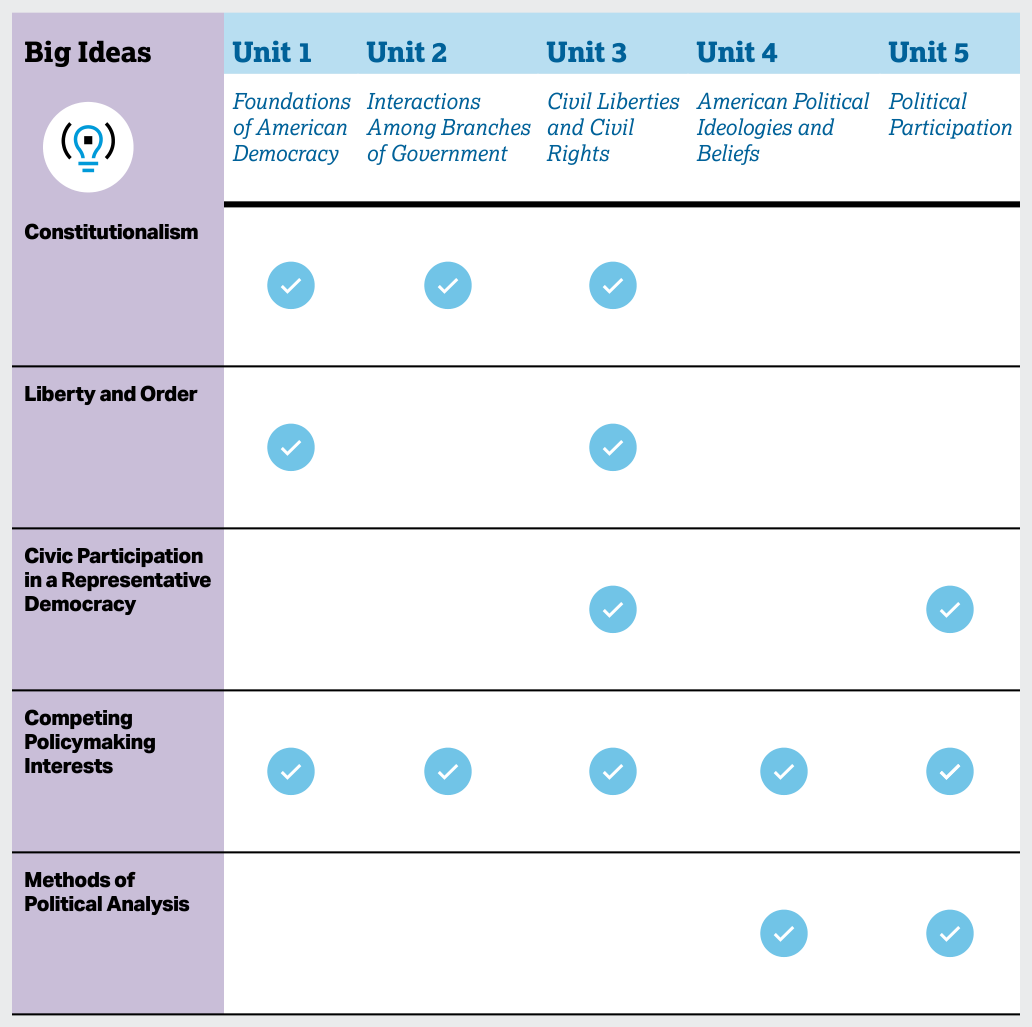
These units are connected by five broad ideas: Constitutionalism, Liberty and Order, Civic Participation in a Representative Democracy, Competing Policymaking Interests, and Methods of Political Analysis. The framework also organizes required content into numbered topics, sequences instruction, suggests pacing, scaffolds skills across units, and provides guidance for the AP Exam.
The framework is a map, not a script
A course framework is an organized outline of required understandings and skills. It identifies what students should be able to analyze, but it does not dictate every classroom activity, reading, simulation, or discussion. Knowledgeable teachers make instructional decisions based on their students, available time, current events, and the constitutional and political questions being studied.
Key distinction: The framework defines the destination and the analytical tools; teachers choose the most effective route.
Schools develop their own curricula, but those curricula must enable students to develop the content understandings and skills described in the framework. A strong course therefore combines foundational documents, Supreme Court decisions, data, visuals, multiple-perspective news sources, and applied political problems rather than treating government as memorization alone.
Five course skills and their reasoning processes
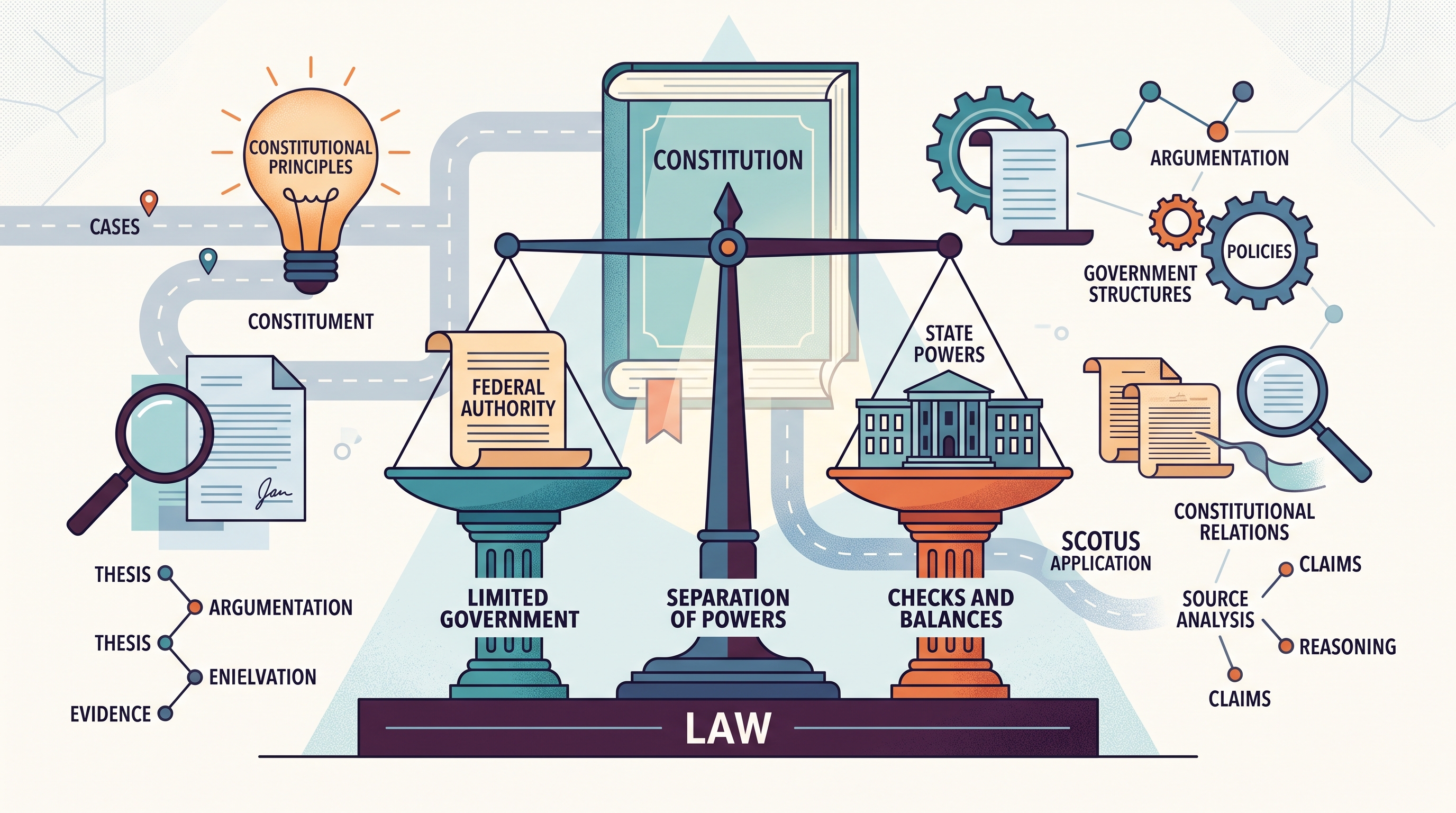
The five official course skills spiral through every unit. A student may first use Concept Application to explain federalism, then use Data Analysis to interpret public opinion about federalism, Source Analysis to examine a constitutional argument, SCOTUS Application to compare relevant Supreme Court reasoning, and Argumentation to defend a conclusion about national power.
| Official skill | What the reasoning requires | Typical evidence |
|---|---|---|
| Skill 1: Concept Application | Apply a political concept, institution, process, or behavior to a contextual situation | A scenario involving congressional procedure or federalism |
| Skill 2: SCOTUS Application | Apply and compare constitutional principles and Supreme Court decisions | A comparison of how two cases interpret individual rights |
| Skill 3: Data Analysis | Read quantitative, qualitative, and visual data; identify patterns; draw defensible conclusions | A graph of turnout, ideology, or approval ratings |
| Skill 4: Source Analysis | Analyze the argument, reasoning, perspective, and implications of a foundational or political text | A constitutional provision, court opinion, or political speech |
| Skill 5: Argumentation | Develop a defensible claim, support it with evidence, explain the reasoning, and address an opposing perspective | An essay evaluating a policy or constitutional controversy |
The exam assesses these skills through both sections. Multiple-choice questions may ask students to interpret a passage, graph, image, or political scenario. Free-response questions require students to apply concepts, analyze quantitative information, compare Supreme Court cases, and construct an argument using evidence and reasoning.
A useful reasoning sequence is:
Identify → Describe → Explain → Apply or Compare → Draw a conclusion → Support an argument.
For example, recognizing a filibuster is identification. Explaining that it can delay a vote is description. Connecting it to Senate rules and the difficulty of achieving cloture is explanation and application. Evaluating whether the procedure increases minority influence becomes argumentation.
College-level alignment and political balance
AP courses and exams emphasize challenging, research-based curricula aligned with college-level learning. In government and politics, that means analyzing institutions and political behavior with evidence, distinguishing constitutional principles from partisan claims, and recognizing that reasonable people may interpret the same policy problem differently.
The AP Course Audit is the review process through which AP teachers document that their courses meet required curricular expectations. College faculty review AP teachers’ course materials. For AP U.S. Government and Politics, the course must address the required framework, foundational documents, Supreme Court cases, analytical skills, and a political science research or applied civics project.
Political balance does not mean pretending every claim has equal factual support. It means presenting constitutional arguments, political perspectives, and relevant evidence fairly and allowing students to evaluate them using disciplined analysis rather than teacher advocacy. Multiple-perspective textbooks, primary sources, news sources, and research data help separate partisan position from evidence-based reasoning.
The instructional model: Plan → Teach → Assess
Effective instruction operates as a cycle rather than a one-way march through topics:
During Plan, teachers use the framework and unit guides to identify required content, skills, sequence, and pacing. During Teach, they build conceptual understanding through explanation, discussion, document analysis, cases, simulations, data work, and current political examples. During Assess, they use targeted evidence to decide what should be retaught, extended, or practiced next.
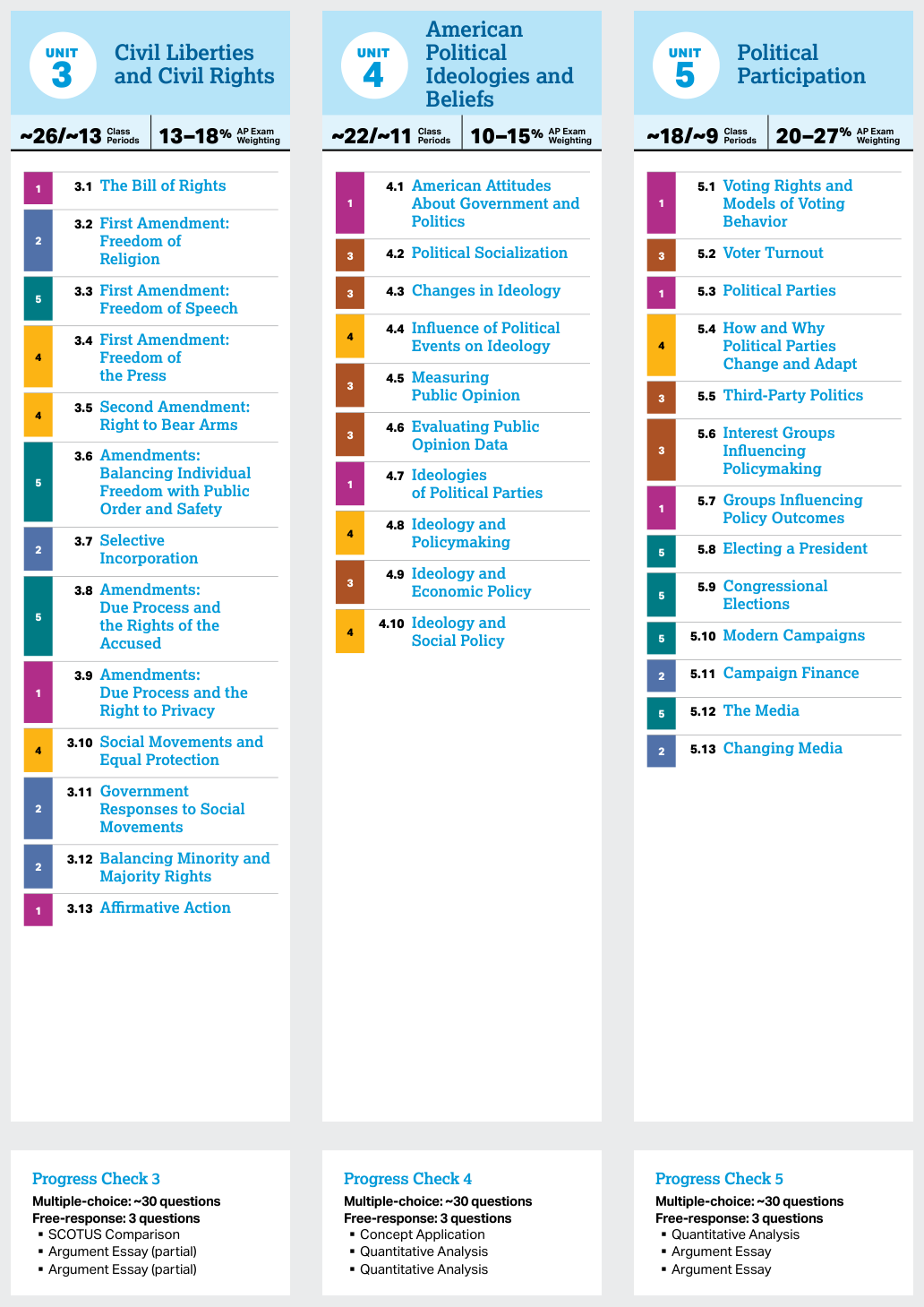
Topic Questions provide frequent checks while a topic is being taught. Progress Checks, assigned as homework or in-class work, help students and teachers evaluate performance at the end of a unit. Their purpose is diagnostic: students can see progress over time and identify content or skills needing improvement before the AP Exam.
Answer rationales provide question-level feedback by explaining why an answer is correct or incorrect. My Reports provide unit- and skill-level formative feedback, revealing patterns such as strong content knowledge but weak data interpretation. Teachers can then use the Question Bank, a searchable library of AP questions, to create custom practice assignments targeting those needs.
Retrieval check
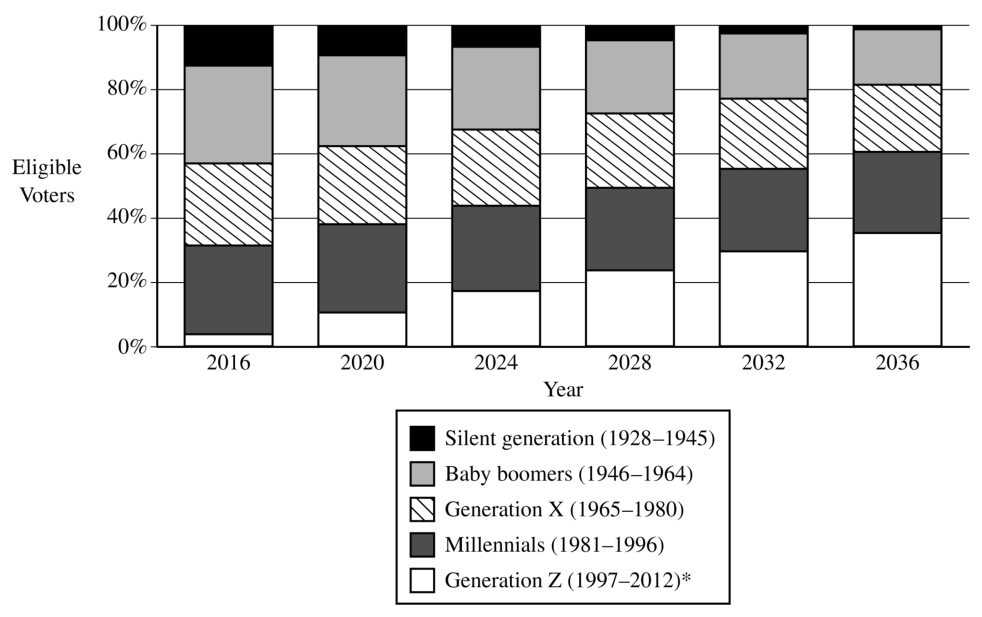
A teacher notices that students can define political socialization but cannot interpret a graph showing generational differences in ideology. Which skill needs direct reinforcement: Concept Application, Data Analysis, Source Analysis, SCOTUS Application, or Argumentation? The best answer is Skill 3: Data Analysis, although a later argument may combine it with Argumentation. AP course and exam descriptions are updated periodically, so teachers and students should check AP Central for the most recent version.


1.1 Ideals of Democracy
Key concepts: Ideals of democracy · Republicanism · Social movements · Constitutional principles · Supreme Court decisions · Refutation or rebuttal · Argumentation: claim, evidence, and reasoning · Democratic representation
A democracy rests on the idea that government is legitimate only when it reflects the rights, consent, and political will of the people.
1.1 Ideals of Democracy
A democracy rests on the idea that government is legitimate only when it reflects the rights, consent, and political will of the people.
Investigative question: How can a government claim to represent “the people” while still acting unconstitutionally or excluding some people from meaningful representation?
Democratic ideals as standards for government
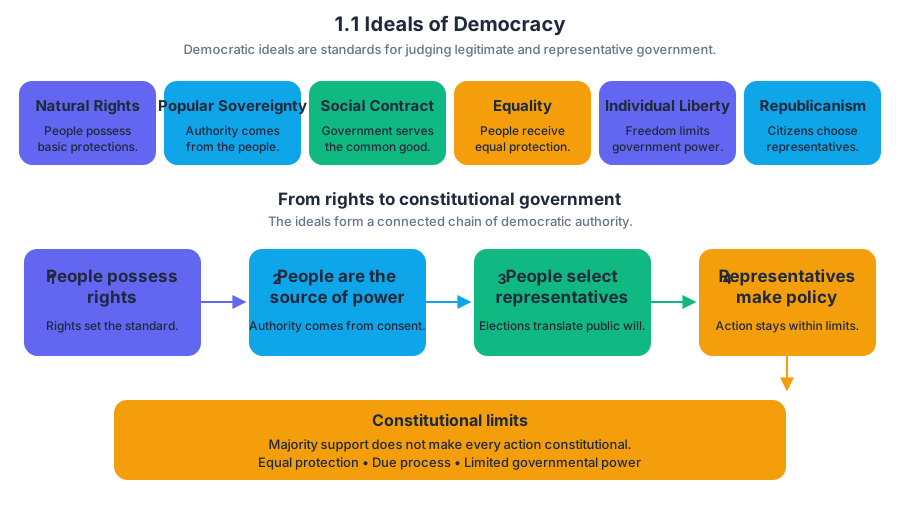
Democratic ideals are principles used to judge whether government is legitimate and representative. Important ideals include natural rights, popular sovereignty, social contract, equality, individual liberty, and republicanism. These ideals do not merely describe how government operates; they establish standards against which government action can be evaluated.
Republicanism means that citizens have a fair opportunity to select representatives who express their will in government. In a republic, citizens usually govern indirectly through elected officials rather than voting personally on every policy. Republicanism therefore requires more than holding elections: districts, voting rules, and governmental institutions must allow citizens’ preferences to be translated fairly into representation.
The connection among ideals can be pictured as a chain:
People possess rights → people are the source of governmental authority → people select representatives → representatives make policy within constitutional limits
The final step matters. Popular support does not automatically make an action constitutional. A majority may favor a policy, but government officials must still follow constitutional protections such as equal protection, due process, and limits on governmental power.
Bush v. Vera: republicanism and constitutional limits
In Bush v. Vera (1996), the Supreme Court considered Texas congressional districts drawn with race as the predominant factor. The Court held that the districts violated the Equal Protection Clause of the Fourteenth Amendment because racial classification had controlled the design of the districts without satisfying the demanding constitutional standard required for such classifications.
The case demonstrates a two-part relationship between constitutional principles and democratic ideals:
| Question | Constitutional principle | Democratic meaning |
|---|---|---|
| May government classify voters primarily by race when drawing districts? | Equal protection limits racial classifications | Government cannot treat citizens as political categories in a way that undermines equal citizenship |
| What should redistricting pursue? | Constituency-based representation rather than racial categorization | Citizens should have a fair opportunity to choose representatives who express their political will |
The decision connects to republicanism because representative government depends on fair opportunities for citizens to choose officials. A district designed primarily around racial categories may appear to increase representation for a racial group, but the Court’s reasoning insisted that representation must remain constitutionally equal and connected to constituencies and the people’s political will.
Named misconception — “A policy is democratic if it helps a historically disadvantaged group.”
Not necessarily. A policy may pursue a democratic goal yet use unconstitutional means. In Bush v. Vera, the relevant question was not simply whether minority representation mattered; it was whether the government’s use of race as the predominant districting factor complied with the Constitution.
Social movements and national policy
Social movements are organized efforts by citizens to change public attitudes, laws, or government institutions. They can begin locally but produce national policies that apply across all states. Protest, speech, litigation, organizing, voting, and public persuasion can transform a movement’s demands into constitutional amendments, federal statutes, or Supreme Court decisions.
For example, civil rights activists used demonstrations, legal challenges, public arguments, and organizing to pressure the national government to address racial inequality. The broader democratic connection is that participation allows citizens to influence the definition and enforcement of political ideals. A movement does not need to win every immediate election to change national policy; sustained collective action can alter what government institutions consider legitimate and necessary.
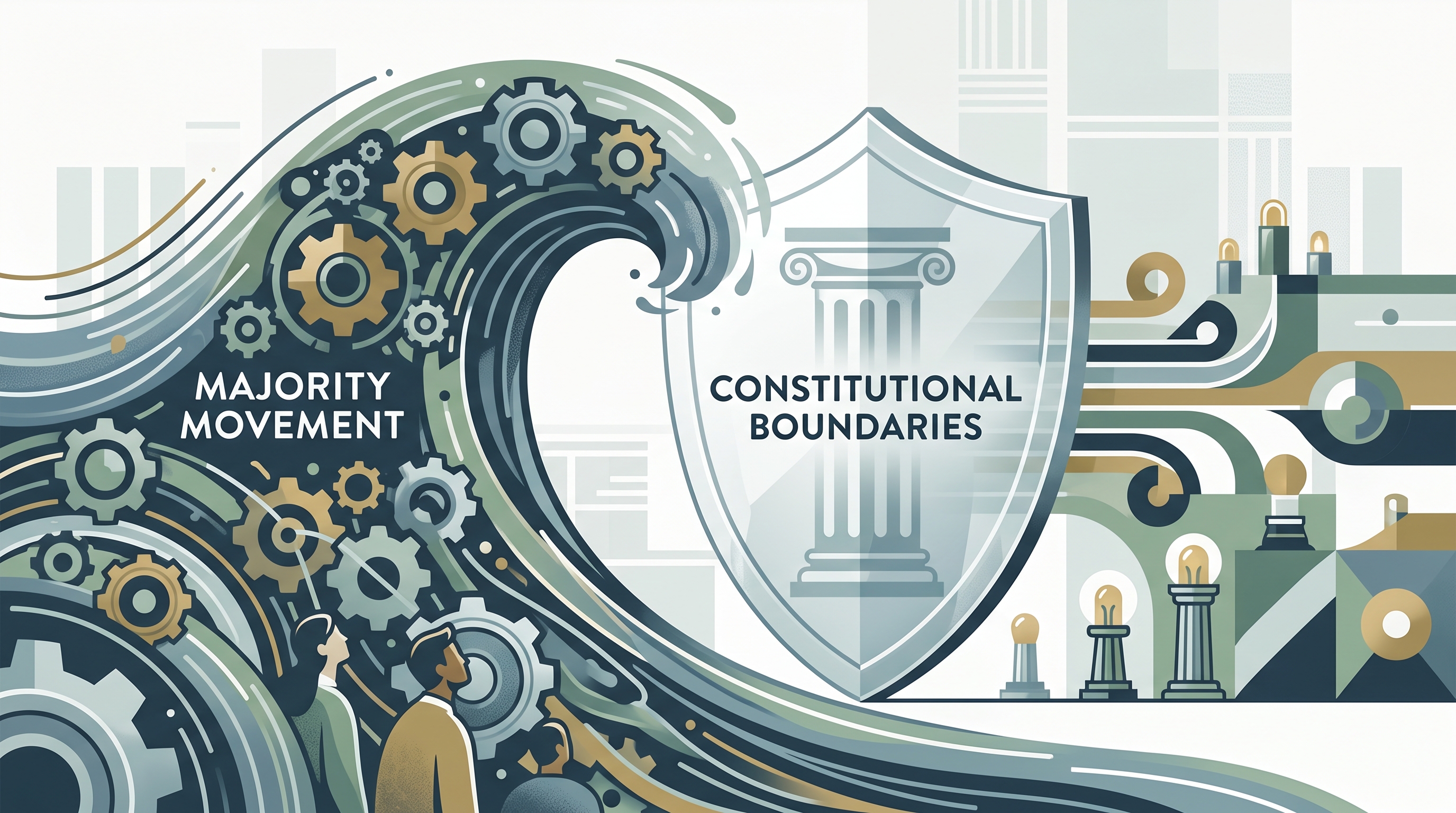
At the same time, social movements operate within constitutional boundaries. Some actions may violate the Constitution even when supporters believe the goal is beneficial. The constitutional question concerns both the objective and the government’s method: who acted, what power was used, which constitutional provision applies, and whether the action unjustifiably burdens protected rights or equal citizenship.
AP reasoning: turning ideals into an argument
This topic is assessed through SP1: Concept Application, SP2: SCOTUS Application, SP4: Source Analysis, and SP5: Argumentation. These skills require more than naming republicanism or Bush v. Vera; they require explaining how a specific fact produces a constitutional or democratic consequence.
A strong argument follows this structure:
- Thesis/claim: State a defensible position that answers the question.
- Evidence: Use specific facts, constitutional provisions, cases, documents, or examples.
- Reasoning: Explain why each piece of evidence supports the claim.
- Alternative perspective: Identify a competing view and refute or rebut it.
Worked example: Claim: Bush v. Vera supports republicanism because the Court protected the principle that citizens should receive fair opportunities for representation rather than being assigned political identities solely through racial classifications. Evidence: Texas used race as the predominant factor in drawing congressional districts, and the Court found that practice unconstitutional under equal protection. Reasoning: If district boundaries classify citizens primarily by race, the design of representation may replace citizens’ political will with a government-imposed category. Rebuttal: Although race-conscious districting may seek to improve minority representation, that purpose does not eliminate the constitutional requirement that racial classifications satisfy equal protection.
Retrieval check: A social movement persuades Congress to pass a law applying nationwide, but the law restricts a constitutional right. Which democratic ideal explains the movement’s influence, and what additional question must be asked? Answer: Civic participation explains how the movement influenced national policy; the additional question is whether the law itself complies with the Constitution.
1.2 Types of Democracy
A democracy can ask citizens to govern in different ways: directly, through organized groups, or mainly through elected and influential leaders. The United States uses a representative democracy, but its institutions and political debates reflect three competing models: participatory democracy, pluralist democracy,…
1.2 Types of Democracy
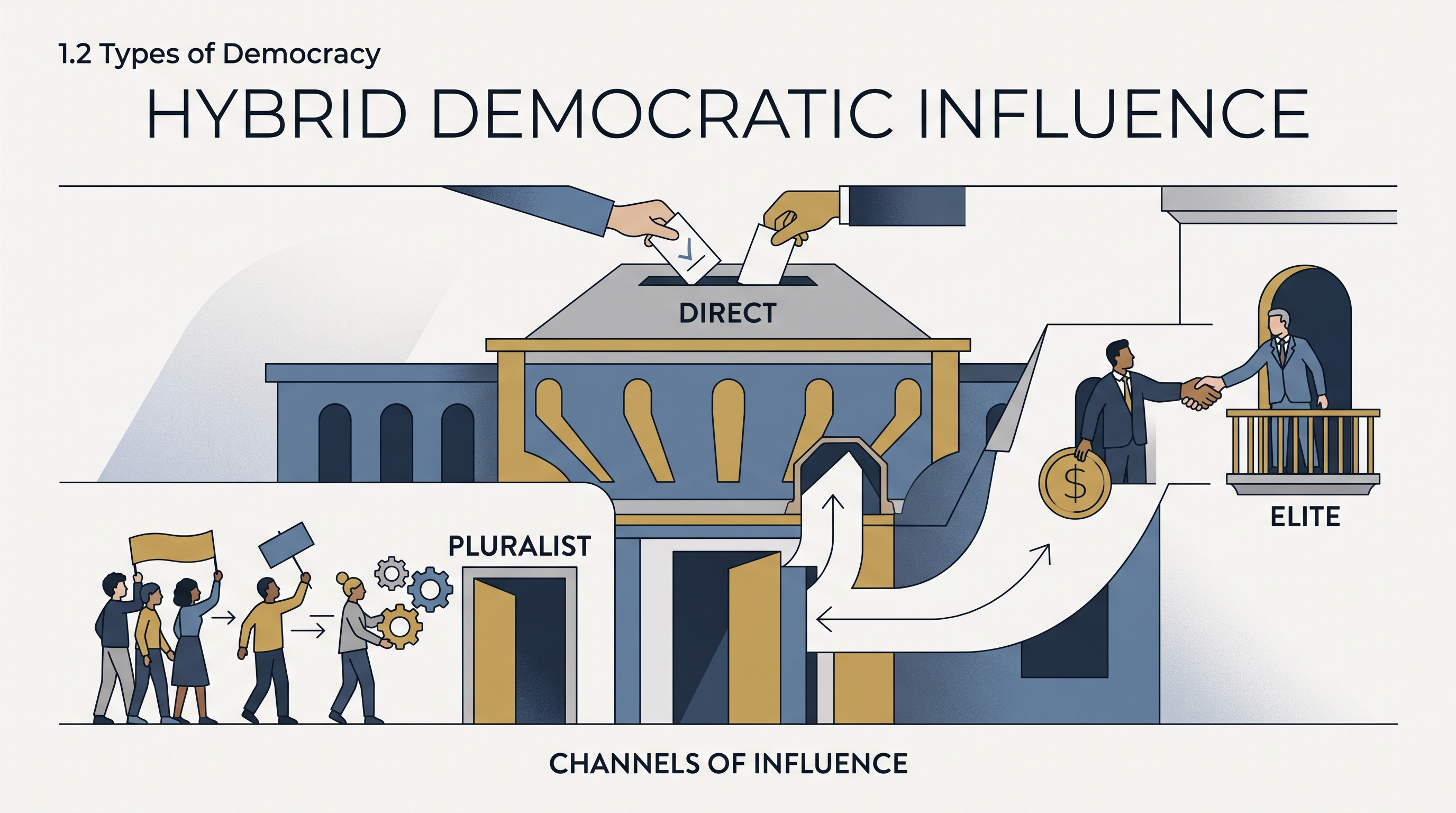
A democracy can ask citizens to govern in different ways: directly, through organized groups, or mainly through elected and influential leaders. The United States uses a representative democracy, but its institutions and political debates reflect three competing models: participatory democracy, pluralist democracy, and elite democracy.
Investigative question: When citizens do not vote on every policy themselves, how can the government still be democratic?
The basic distinction: direct and representative democracy
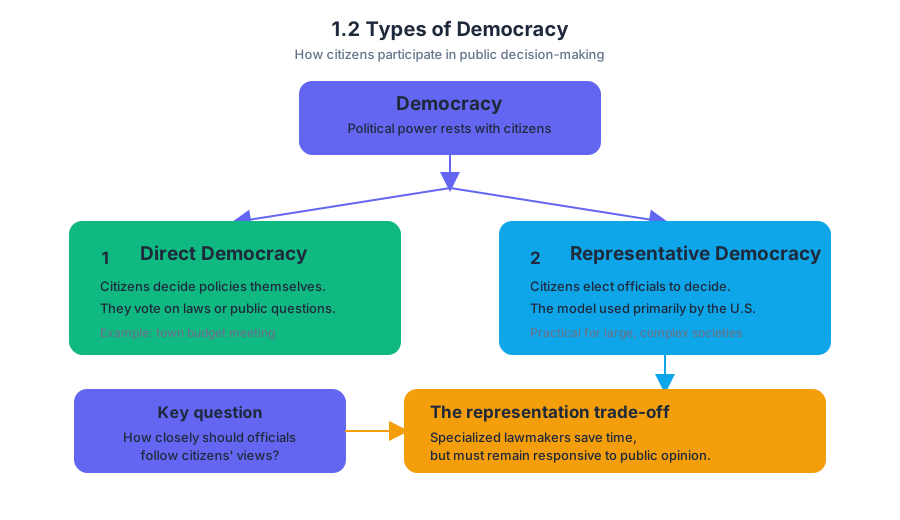
In a direct democracy, citizens make policy decisions themselves, usually by voting on laws or public questions. A small town using a meeting in which residents vote directly on a local budget is a limited example.
In a representative democracy, citizens choose officials who make public decisions on their behalf. The United States relies primarily on this model because its large population, geographic size, and complex policy agenda make direct decision-making on every issue impractical.
Representation creates a useful trade-off. Citizens gain officials with the time and specialized knowledge to write laws, but citizens must also decide how closely representatives should follow public opinion. That tension produces different models of representative democracy.
Three models of representative democracy
The models are not three separate constitutional systems. They are perspectives for explaining who participates, whose preferences receive attention, and how political decisions are made.
| Model | Central idea | Political activity it emphasizes | Illustrative example |
|---|---|---|---|
| Participatory democracy | Broad citizen involvement strengthens democratic government. | Voting, town halls, public meetings, petitions, protests, and civic organizing. | Residents organize and testify at a city meeting about a proposed development. |
| Pluralist democracy | Policy results from competition among many organized interests. | Interest-group advocacy, coalition building, lobbying, and bargaining. | Environmental, business, labor, and neighborhood groups compete to shape a regulation. |
| Elite democracy | A relatively small group of leaders and economically or politically powerful actors exercises disproportionate influence. | Leadership by elected officials, experts, major donors, executives, and other influential actors. | A policy debate is formally open to the public, but well-funded organizations have far greater access and policy expertise. |
Participatory democracy
Participatory democracy treats citizen involvement as valuable beyond simply selecting leaders. Participation can include voting, contacting representatives, attending public meetings, joining campaigns, organizing demonstrations, and discussing public issues with other citizens.
Its strength is political engagement: participation can make government more responsive and help citizens develop the knowledge and confidence needed for self-government. Its limitation is unequal participation. Public meetings and campaigns may attract citizens with more time, money, transportation, or specialized knowledge than the broader population.
Pluralist democracy
Pluralist democracy emphasizes organized groups rather than isolated individuals. Interest groups allow people with shared concerns—such as workers, businesses, patients, gun owners, environmental advocates, or professional associations—to combine resources and present their preferences to policymakers.
Pluralism can prevent one viewpoint from controlling every decision. However, groups do not possess equal resources. A large organization with professional lobbyists may communicate with policymakers more frequently than a loosely organized group whose members lack funding or access.
Elite democracy
Elite democracy focuses on the disproportionate influence of a small number of actors. “Elite” does not necessarily mean a secret conspiracy; it can refer to elected leaders, government officials, wealthy donors, corporate executives, policy experts, or organized interests with unusual access and resources.
This model draws attention to a central question: Does formal political equality produce equal political influence? Every citizen may have one vote, while some actors may have far greater ability to fund campaigns, hire experts, shape media attention, or obtain meetings with decision-makers.
Worked contextual example: a proposed transit policy
Imagine that a city is considering a new rail line. Under the participatory model, the key evidence would be residents attending hearings, submitting comments, voting in a referendum, and organizing neighborhood support or opposition.
Under the pluralist model, the analysis would track competition among groups: transit advocates, automobile associations, construction firms, neighborhood organizations, environmental groups, and taxpayers’ associations. The final policy would reflect bargaining among these organized interests.
Under the elite model, the analysis would ask whether major developers, wealthy donors, transportation consultants, or senior officials shaped the proposal more strongly than ordinary residents. The same event can therefore support different interpretations depending on which model is being applied.
Named misconception check
Misconception: “The United States is either participatory, pluralist, or elite.”
Correction: The models describe different ways of analyzing democratic politics. The United States is a representative democracy that contains participatory practices, pluralist competition, and unequal influence associated with elite democracy.
AP skill connection: Skill 4.A — Source Analysis
Topic 1.2 Types of Democracy is associated with Skill 4.A — Source Analysis. This skill requires identifying and interpreting an argument in a source rather than merely locating a familiar word.
For example, if a source argues that democracy works best when citizens organize in associations, connect that claim to pluralist democracy. If it argues that ordinary citizens must participate directly in public decisions, connect it to participatory democracy. If it emphasizes the power of wealthy or highly connected actors, connect it to elite democracy. The strongest response names the model and explains the source’s reasoning.
Retrieval check
A state allows voters to approve laws directly, several advocacy organizations lobby the legislature, and major donors receive frequent meetings with policymakers. Which model is illustrated by each feature, and why can all three exist within one representative democracy?
1.3 Government Power and Individual Rights
Key concepts: Government power and individual rights · Individual liberty · Balance between individual freedom, social order, and equality of opportunity · Unenumerated rights · Right to privacy · First Amendment establishment and free exercise clauses · Religious liberty · Constitutional compromises and unresolved debates · Racial discrimination in voting · Pluralism and elitism
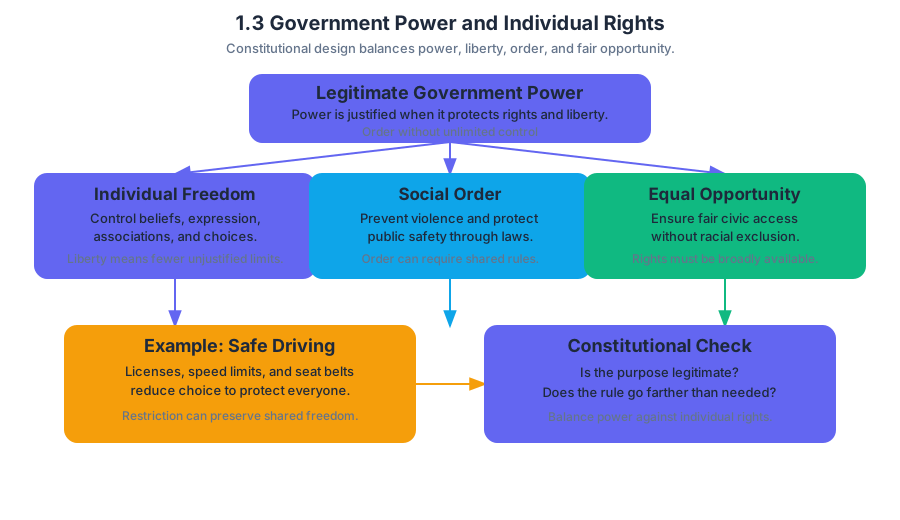
Government is legitimate only when its power is connected to the protection of individual rights and liberty. The central constitutional problem is not whether government should have power, but how a political system can use power to preserve order without giving officials unlimited control over people’s lives.
1.3 Government Power and Individual Rights
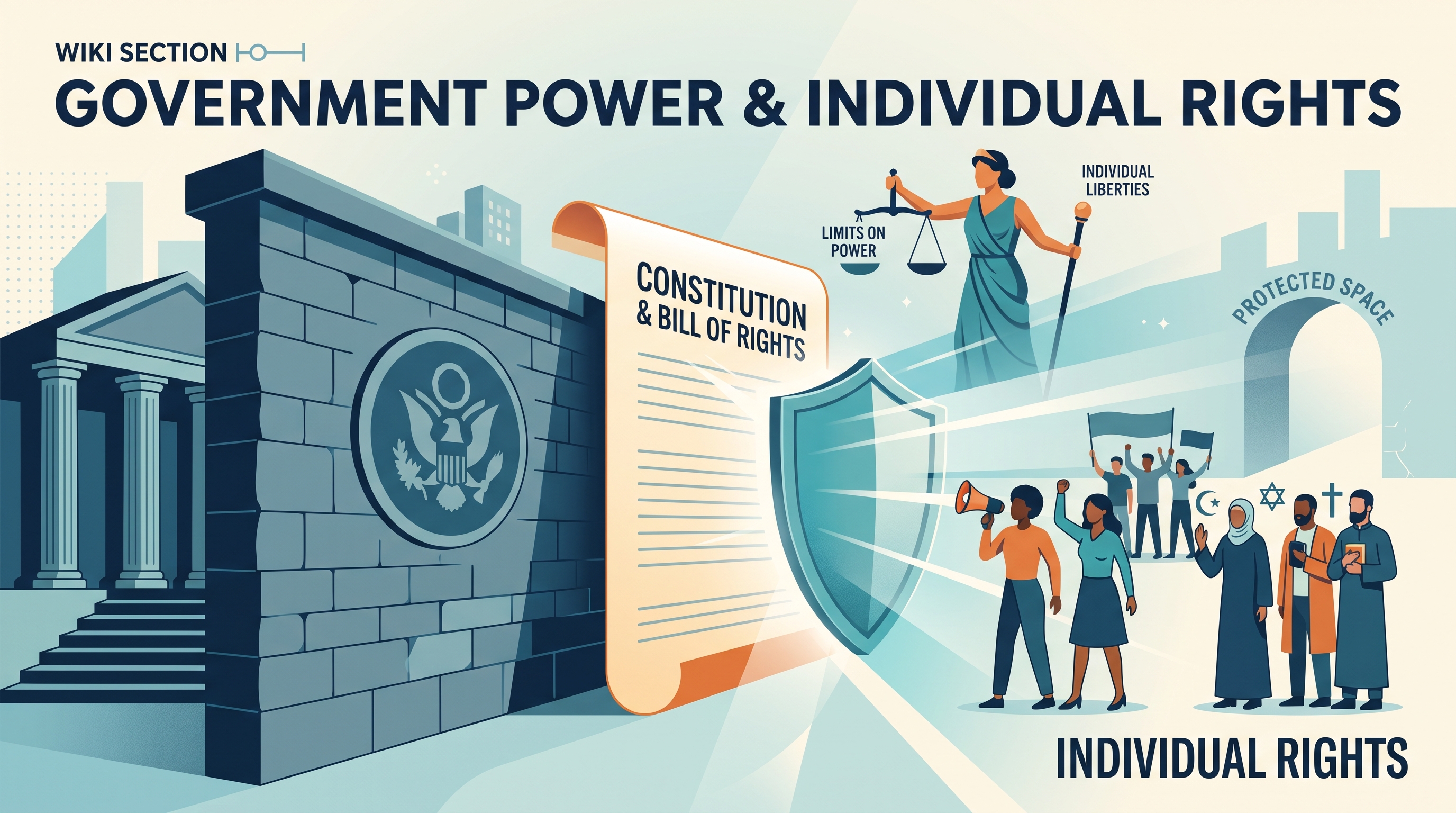
Government is legitimate only when its power is connected to the protection of individual rights and liberty. The central constitutional problem is not whether government should have power, but how a political system can use power to preserve order without giving officials unlimited control over people’s lives.
Individual liberty is the ability of people to make choices about their lives without unjustified government interference.
The Constitution reflects an ongoing effort to balance three values that can point in different directions:
- Individual freedom: people should control their beliefs, expression, associations, and personal choices.
- Social order: government must prevent violence, protect public safety, and enforce laws.
- Equality of opportunity: government should not deny people fair access to political participation or other civic opportunities because of characteristics such as race.
A law requiring safe driving illustrates the tension. The government limits individual behavior by requiring licenses, speed limits, and seat belts. Those rules reduce personal choice, but they can also protect everyone’s life and freedom to use public roads. The constitutional question is whether the government’s restriction is sufficiently connected to a legitimate public purpose and whether it goes farther than necessary.
Constitutional limits on government power
The constitutional system limits government through written rights, divided authority, and principles that prevent officials from treating power as unlimited. A government may claim that a policy promotes public order, but that claim does not automatically defeat an individual right. Constitutional conflicts arise when the state’s lawmaking authority collides with a protected sphere of personal freedom.
Unenumerated rights are rights not explicitly listed in the Constitution. The right to privacy is one example. The Constitution does not use the exact phrase “right to privacy,” yet constitutional interpretation has recognized privacy interests through protections found in several amendments and in the broader principle that government power has boundaries.
Key distinction: An unenumerated right is not necessarily an invented right. It is a right inferred from constitutional principles, structure, or specific guarantees rather than stated in one precise sentence.
Consider a government policy that requires officials to obtain legal authorization before entering a person’s home. The Fourth Amendment’s protection against unreasonable searches supports a zone of personal privacy even though the amendment does not create a general, single-sentence “privacy clause.” The dispute then becomes one of constitutional interpretation: how far does the protection extend, and what government interests can justify an intrusion?
Religious liberty: two First Amendment protections
The First Amendment demonstrates the tension between government power to make law and individual religious freedom through two related protections:
- The establishment clause limits government action that establishes, sponsors, or improperly favors religion.
- The free exercise clause protects an individual’s ability to practice religion.
These clauses can pull government in opposite directions. A government that officially promotes one faith may violate the establishment clause. A government that applies a neutral law may still burden religious conduct, raising a free exercise question. The constitutional challenge is to protect religious liberty without allowing either government or a religious majority to control everyone’s beliefs.
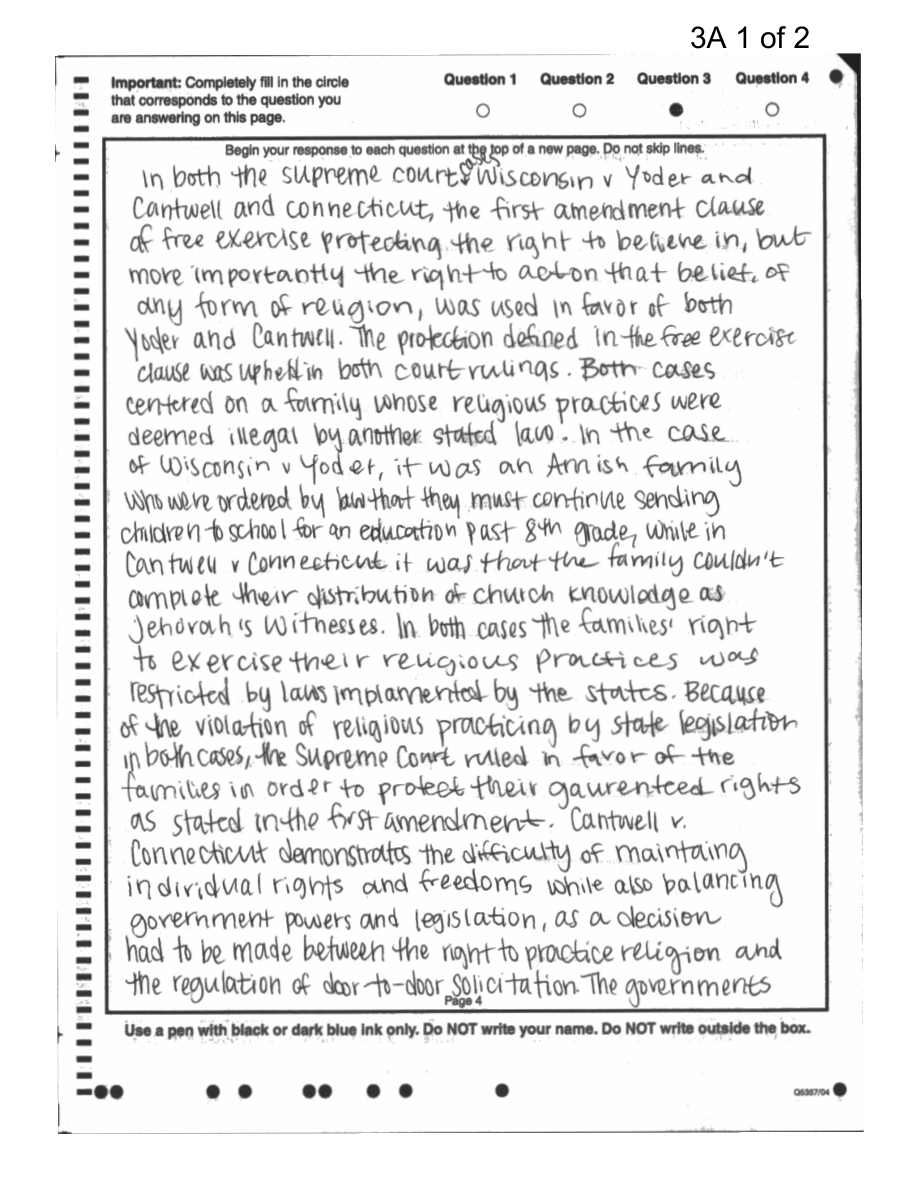
For example, imagine a city ordinance that restricts door-to-door distribution of religious pamphlets. The city may defend the rule as a way to prevent harassment or protect public order. A religious group may respond that the ordinance interferes with its ability to communicate and practice its faith. In Cantwell v. Connecticut, the Supreme Court treated this kind of conflict as involving the government’s regulatory power and the individual’s right to freely exercise religion.
Rights, political conflict, and unresolved compromises
The Constitutional Convention and ratification debates produced compromises, but they did not resolve every disagreement about liberty, order, and equality. Those unresolved questions continue to generate debate because constitutional rights must be applied to changing political circumstances. A policy affecting voting, for instance, may be defended as an administrative regulation while critics argue that it burdens equal political participation.
Racial discrimination in voting is a clear example of government action affecting individual rights. If officials use government power to prevent a racial group from registering, voting, or receiving equal access to the political process, the issue is not merely administrative efficiency. It concerns whether government is honoring equality of opportunity and protecting citizens’ political liberty.
Misconception check
Misconception: “Individual rights mean government can never restrict individual behavior.”
Correction: Rights are powerful limits on government, but constitutional government may regulate conduct to protect public safety and social order. The question is whether the restriction is constitutionally justified, fairly applied, and consistent with the protected liberty at stake.
CED traceability and skill application
Learning Objective LO 1.3.A: Explain how constitutional principles protect individual rights and limit government power.
Essential Knowledge EK 1.3.A.1: The Constitution contains provisions that limit the power of government and protect individual rights.
Essential Knowledge EK 1.3.A.2: The Bill of Rights protects individual liberties and rights from government action.
This topic is assessed through Concept Application 1.A: Describe political concepts and processes, Concept Application 1.B: Explain political concepts and processes, and Argumentation 5.A: Develop a defensible claim or thesis. A strong response identifies the constitutional principle, applies it to the specific government action, and explains the resulting conflict rather than merely naming a right.
Retrieval check: A state bans a religious practice because officials believe it is unpopular, even though the practice causes no identifiable harm. Which constitutional tension is most directly involved, and which First Amendment protection should be examined first? A strong answer would identify the conflict between government power and religious liberty and begin with the free exercise clause, while also asking whether the law improperly favors or targets religion.
1.4 Challenges of the Articles of Confederation
Key concepts: Challenges of the Articles of Confederation · Weak central government · Power reserved to state governments · Anti-Federalist perspectives · Brutus No. 1 · Popular democratic theory · Required foundational documents · Source analysis · Political principles, institutions, processes, policies, and behaviors
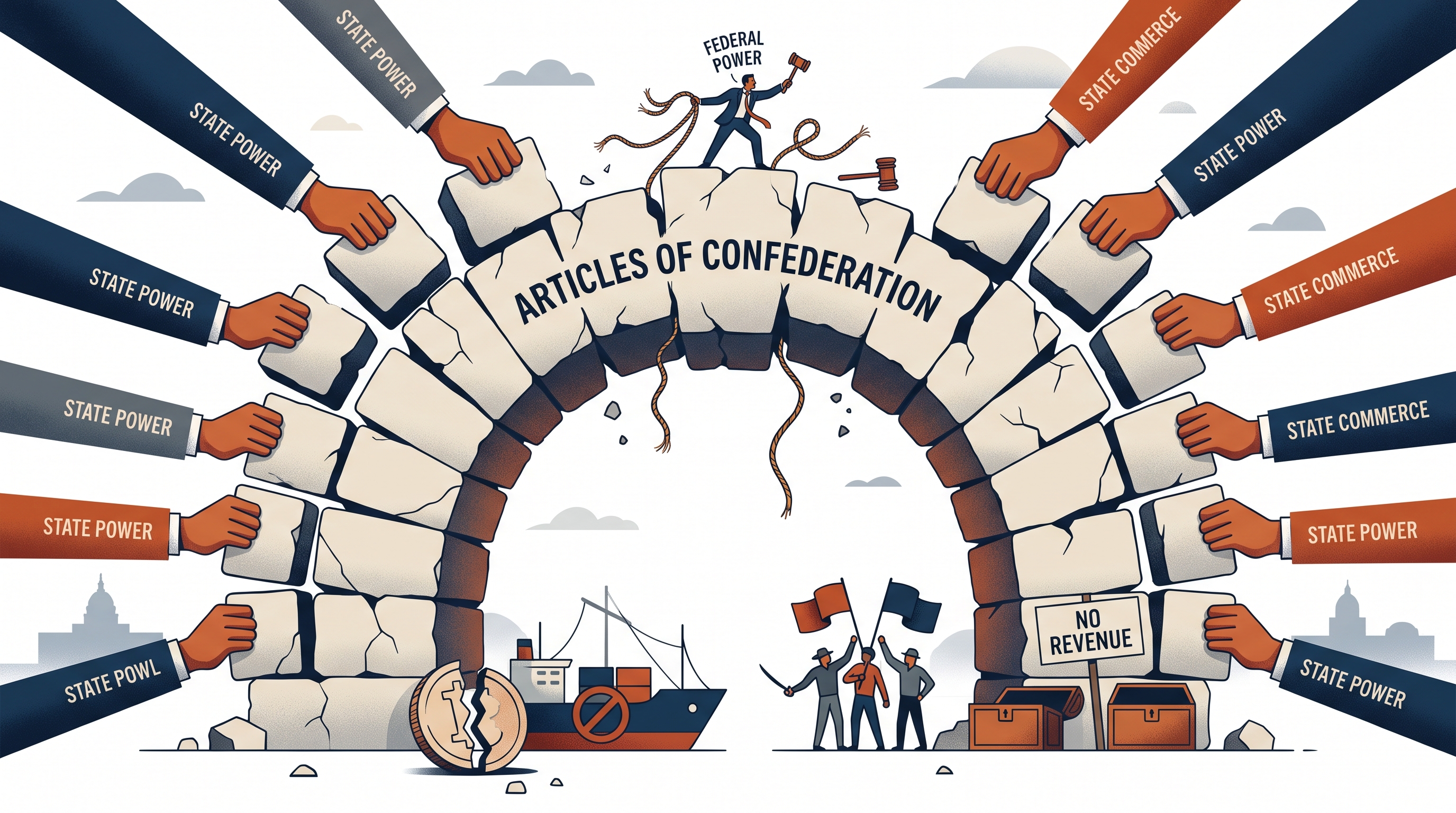
The Articles of Confederation created a national government that depended heavily on the states. Instead of concentrating authority in a strong central government, the Articles reserved more power to state governments—a design intended to protect local self-rule but one that made coordinated national action difficult.
1.4 Challenges of the Articles of Confederation
The Articles of Confederation created a national government that depended heavily on the states. Instead of concentrating authority in a strong central government, the Articles reserved more power to state governments—a design intended to protect local self-rule but one that made coordinated national action difficult.
Investigative question: How can a government protect the people from centralized power without becoming too weak to govern effectively?
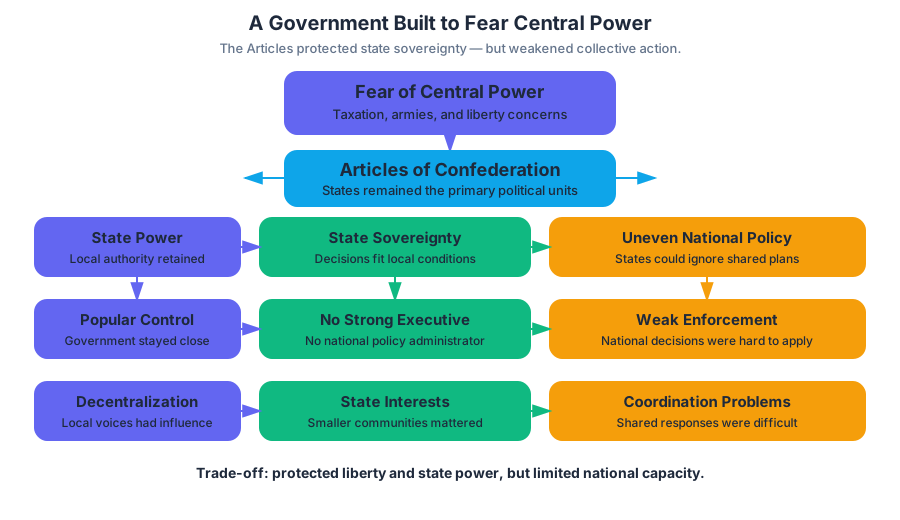
A government built to fear central power
The Articles emerged from a political climate shaped by resistance to British rule. Many Americans associated centralized authority with taxation without representation, standing armies, and threats to personal liberty. The resulting system treated the states as the primary political units and made the national government comparatively weak.
Under the Articles, the national government lacked several powers commonly associated with effective central authority. It could request money from the states but had difficulty compelling them to provide it; it could conduct diplomacy but struggled to enforce national decisions; and it had no strong executive structure to administer policy. The arrangement therefore protected state sovereignty, but it also made national problems harder to solve collectively.
The basic trade-off can be visualized as a balance:
| Political priority | Advantage under the Articles | Resulting difficulty |
|---|---|---|
| State power | Local governments retained substantial authority | National policies could be uneven or ignored |
| Fear of centralized power | No powerful national executive dominated the states | National enforcement was weak |
| Popular control | Government remained close to local communities | Smaller state interests could conflict with national interests |
| Decentralization | Political decisions could reflect local conditions | Coordinated responses were difficult |
The Anti-Federalist perspective
Anti-Federalists opposed ratification of the Constitution because they believed it would transfer too much authority from the states to a large central government. Their position was not simply opposition to government; it was an argument about which level of government could best protect liberty and preserve meaningful popular control.
Anti-Federalist writings favored a small, decentralized republic. In this context, decentralized means that political power is distributed among state and local governments rather than concentrated nationally. Supporters believed smaller political communities would make representatives more accountable and allow citizens to recognize and influence their government more directly.
This perspective rested on popular democratic theory, the idea that legitimate government depends on the active political role of the people. If representatives governed close to their communities, Anti-Federalists reasoned, citizens would be better able to monitor them, replace them, and resist abuses of power.
Brutus No. 1: liberty versus national scale
Brutus No. 1 is a required foundational document associated with the Anti-Federalist argument. Its perspective warned that a large, centralized republic could endanger personal liberty because national officials would be geographically distant from ordinary citizens and might accumulate authority beyond effective popular control.
Brutus’s reasoning follows a clear chain:
Large territory
      ↓
Citizens are distant from national representatives
      ↓
Representatives understand local concerns less directly
      ↓
Public oversight becomes harder
      ↓
Central officials may gain power at the expense of liberty
The argument therefore connects a constitutional design choice—centralization—to a political principle—liberty—and to political behavior: whether citizens can effectively monitor, influence, and hold representatives accountable. This is the essential move in Source Analysis 4.B: “Explain how the argument or perspective in the source relates to political principles, institutions, processes, policies, and behaviors.”
Worked source-analysis example
Suppose a passage from Brutus No. 1 argues that representatives in a vast republic will become too distant from the people to reflect their interests. A strong analysis should not merely label the passage “Anti-Federalist.” It should explain the connection:
- Perspective: Brutus favors stronger state power and distrusts a large national republic.
- Political principle: The argument appeals to popular control and protection of personal liberty.
- Institutional implication: It prefers a decentralized structure in which state governments remain powerful.
- Predicted behavior: Citizens are more likely to monitor and influence representatives who govern closer to home.
- Constitutional conflict: A stronger national government might coordinate policy more effectively, but it could also appear less accountable to local communities.
This analysis shows how philosophical debate shaped the architecture of government. The question was not merely whether government should exist; it was whether liberty was safer when power was concentrated enough to act or dispersed enough to remain closely controlled by the people.
Misconception check
Common misconception: “The Anti-Federalists wanted no national government.”
Correction: Anti-Federalists criticized the proposed expansion of national power and favored greater authority for the states. Their central concern was that a large, centralized government could threaten liberty and weaken popular control.
Key distinction: The Articles’ weakness was a structural consequence of reserving power to the states. Anti-Federalist arguments defended that decentralization as a protection for liberty, even though critics believed it limited effective national action.
Retrieval check
Why would an Anti-Federalist use popular democratic theory to defend state power? In two sentences, identify the connection between a decentralized republic, citizen oversight, and the fear of a large centralized government. A complete answer should name Brutus No. 1 and explain how its perspective relates to liberty, institutions, and political behavior.
1.5 Ratification of the U.S. Constitution
Key concepts: Ratification of the U.S. Constitution · Constitutional Convention compromises · Ratification debates · Federalists and Anti-Federalists · Agreement to add a Bill of Rights · Concerns of the Anti-Federalists · Debates about self-government · Balance between federal and state governments · Unresolved issues left by the ratification compromises · Federalist No. 10 and Brutus No. 1
The Constitution became effective only after a political bargain convinced enough states to accept a stronger national government while preserving meaningful state influence and individual protections.
1.5 Ratification of the U.S. Constitution
The Constitution became effective only after a political bargain convinced enough states to accept a stronger national government while preserving meaningful state influence and individual protections.
LO 1.5.A: Explain the impact of political negotiation and compromise at the Constitutional Convention on the development of the constitutional system.
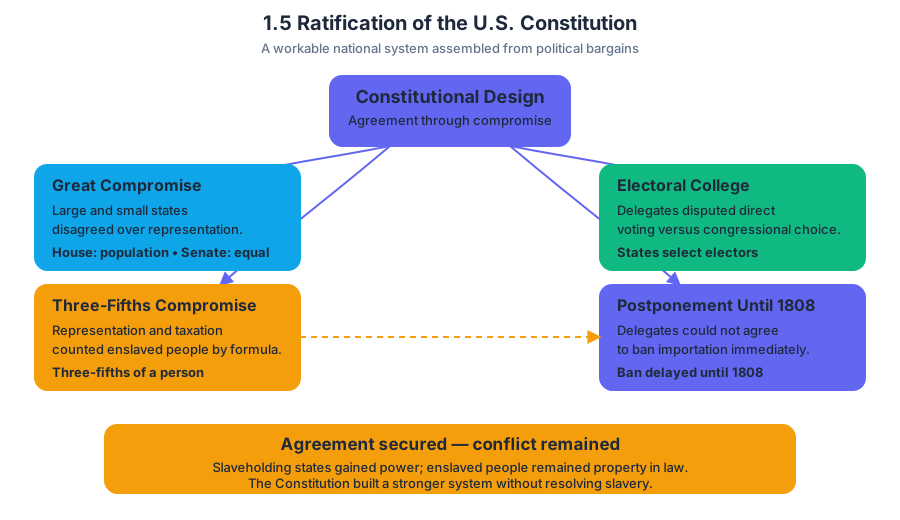
Convention compromises: designing a government states could accept
Delegates at the Constitutional Convention disagreed over representation, executive selection, slavery, and the distribution of power. The final document was not a perfect expression of one political theory; it was an architecture assembled from bargains.
| Compromise | Problem it addressed | Constitutional result |
|---|---|---|
| Great (Connecticut) Compromise | Large and small states disagreed over representation | A bicameral Congress: the House represents population, while the Senate gives each state equal representation |
| Electoral College | Delegates disputed whether the president should be chosen directly by voters or by Congress | Each state selects electors who formally choose the president |
| Three-Fifths Compromise | Delegates disputed how enslaved people would count for representation and taxation | A formula counted enslaved people as three-fifths of a person for those purposes |
| Postponement until 1808 | Delegates could not agree on banning the importation of enslaved persons | Congress could not prohibit the importation of enslaved persons until 1808 |
These arrangements secured agreement, but they also embedded unresolved conflicts. The Three-Fifths Compromise and the postponement of the importation ban protected the political power of slaveholding states while treating enslaved people as property in law. The Constitution therefore created a more workable national system without resolving the fundamental conflict over slavery.
Ratification: Federalists versus Anti-Federalists
After the Convention, the Constitution still required ratification by the states. Federalists supported ratification because they believed the proposed government needed enough authority to govern effectively. Anti-Federalists opposed or criticized ratification because they feared that a distant national government would threaten state authority, individual liberty, and self-government.
The dispute was not simply “strong government versus weak government.” It concerned who would control government and how citizens could protect themselves when government acted improperly. Federalists emphasized the need for an energetic national government and argued that a large republic could control factional conflict. Anti-Federalists worried that national officials would become detached from local communities and that the Constitution’s national powers were too broad.
Contrasting texts: Federalist No. 10 and Brutus No. 1
| Perspective | Central concern | Reasoning |
|---|---|---|
| Federalist No. 10 | Factions—organized groups pursuing their interests—are unavoidable | A large republic containing many competing interests makes it harder for one faction to dominate |
| Brutus No. 1 | A large republic may become too distant to remain genuinely self-governing | National officials could accumulate power, weaken the states, and govern a country too large for representatives to understand local concerns |
Read together, these documents reveal the central ratification question: does a larger republic protect liberty by multiplying competing interests, or endanger liberty by separating rulers from the people? A strong source-analysis response should identify each author’s claim, explain the reasoning supporting it, and connect the disagreement to federalism and self-government.
The Bill of Rights as a ratification bargain
The Bill of Rights was not a compromise made at the Constitutional Convention. The Constitution was signed without one. During ratification, Anti-Federalists objected that the new government lacked explicit protections for freedoms such as speech, religion, and fair legal procedures.
Federalists initially argued that listing specific rights was unnecessary because the national government possessed only the powers granted to it. Anti-Federalists responded that a government with broad powers might interpret its authority expansively unless individual rights were written down. The agreement to pursue amendments addressing these concerns helped secure ratification.
The first ten amendments were ultimately adopted in 1791. The sequence matters:
$$ \text{Constitution signed in 1787} \rightarrow \text{ratification debates} \rightarrow \text{promise to add protections} \rightarrow \text{Bill of Rights adopted in 1791} $$
Misconception check: The Bill of Rights did not appear in the original Constitution and was not one of the Convention’s structural compromises. It was a later response to Anti-Federalist concerns and part of the political bargain surrounding ratification.
Article V: self-government built into constitutional change
The ratification debates also influenced the amendment process. If self-government means that the people and states must be able to correct their governing system, the Constitution could not be permanently frozen. Article V therefore created a demanding but possible method of amendment.
An amendment may be proposed by either:
- a two-thirds vote in both houses of Congress; or
- a convention called after applications from two-thirds of the state legislatures.
It becomes part of the Constitution only after ratification by three-fourths of the states. This design balances national and state authority: change cannot occur through one branch or one state, but neither can a small minority permanently block an amendment supported across the country.
What ratification did not settle
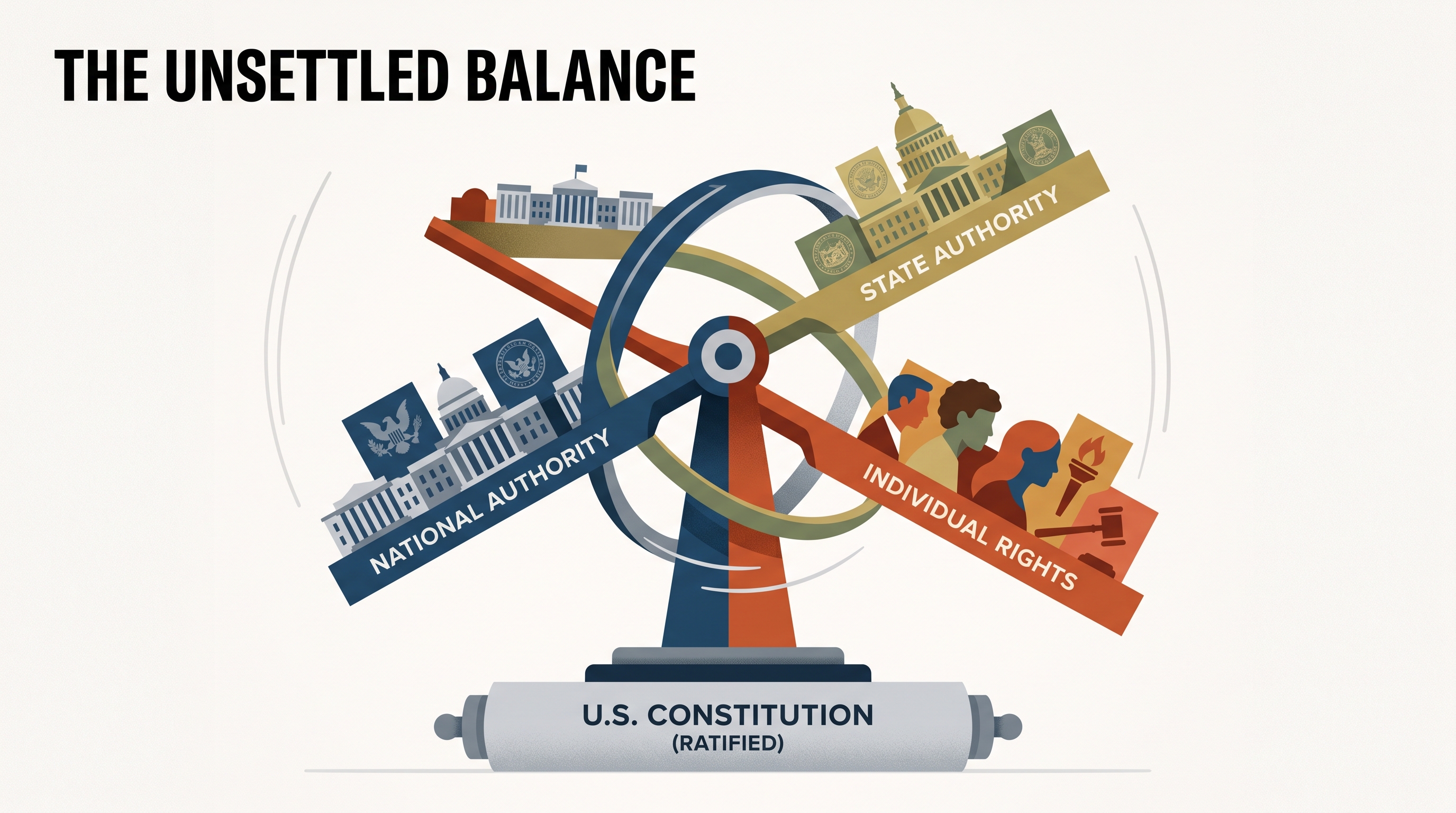
EK 1.5.A.3 emphasizes that the compromises necessary to secure ratification left matters unresolved. The role of the national government, the powers of state governments, and the rights of individuals remain subjects of constitutional debate. Modern disputes over federal surveillance following the 9/11 attacks and the government’s role in public-school education illustrate the continuing question of where governmental power should end.
EK 1.5.A.4 connects these disputes to the enduring balance among national authority, state authority, and individual rights. EK 1.5.A.2 identifies Article V as the constitutional mechanism created by debates about self-government.
Retrieval check: Why is the Bill of Rights best described as a ratification negotiation rather than a Convention compromise? In two sentences, contrast the reasoning of Federalist No. 10 with Brutus No. 1, then explain how Article V reflects both national and state participation in constitutional change.

1.6 Principles of American Government
Key concepts: Principles of American government · Political principles, institutions, processes, policies, and behaviors · Defensible claims and theses · Arguments and perspectives in sources · Text-based and visual sources · Political parties and party platforms · The Constitution · Checks on the presidency · Supreme Court decision-making · Federalism and limits of federal power
American government rests on a design problem: How can a government be powerful enough to protect rights and solve collective problems without becoming powerful enough to destroy liberty?
1.6 Principles of American Government
American government rests on a design problem: How can a government be powerful enough to protect rights and solve collective problems without becoming powerful enough to destroy liberty? The Constitution answers through a network of political principles, institutions, processes, policies, and behaviors rather than through a single governing rule.
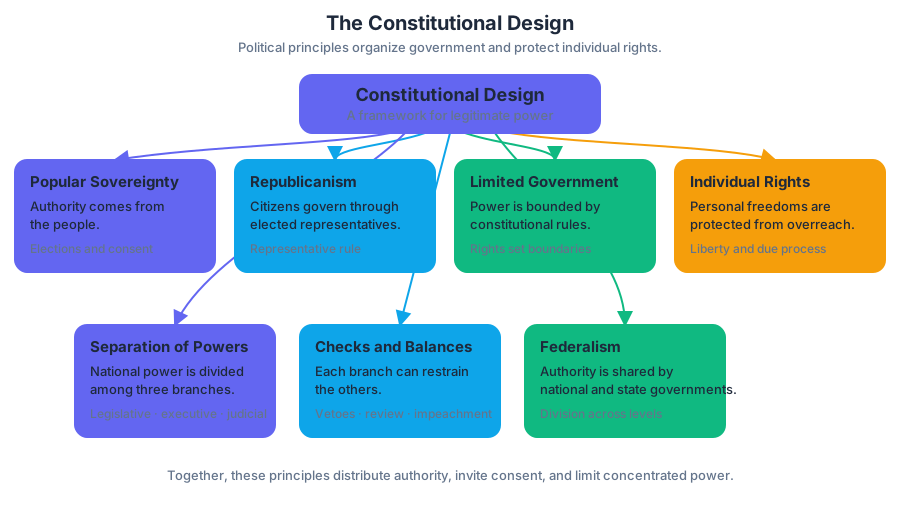
The constitutional design
Political principles are ideas about how government should be organized and what it should protect. The central principles of American government include popular sovereignty, republicanism, limited government, separation of powers, checks and balances, federalism, and protection of individual rights.
A useful way to visualize the system is:
| Principle | Core question | Constitutional expression |
|---|---|---|
| Popular sovereignty | Who gives government its authority? | The people, through elections and consent |
| Republicanism | How do citizens govern in a large country? | Elected representatives make policy |
| Limited government | What may government not do? | Constitutional boundaries and protected rights |
| Separation of powers | How is power divided within the national government? | Legislative, executive, and judicial branches |
| Checks and balances | How is concentrated power restrained? | Vetoes, confirmations, judicial review, impeachment |
| Federalism | How is authority divided geographically? | National and state governments share power |
These principles become concrete through institutions such as Congress, the presidency, and the Supreme Court; processes such as elections, lawmaking, and judicial review; policies such as civil-rights protections or campaign-finance rules; and behaviors such as voting, lobbying, protesting, and party organizing. A strong explanation connects the abstract principle to the specific political activity.
Checks on presidential power
The president is not an elected monarch. The presidency has important powers—including directing the executive branch, vetoing legislation, appointing officials, and serving as commander in chief—but other institutions can constrain those powers.
For example, if a president vetoes a bill, Congress may override the veto with a two-thirds vote in both chambers. The Senate confirms many presidential appointments, Congress controls appropriations, courts can review executive actions, and the House may impeach while the Senate conducts the trial. These mechanisms illustrate checks and balances: each branch has tools that limit the others.
Misconception check — “Checks and balances require every branch to have equal power in every situation.” They do not. Different branches possess different constitutional tools. The point is not identical power; it is preventing one branch from exercising unchecked power.
Supreme Court comparison: Heart of Atlanta Motel and United States v. Lopez
Both cases asked whether Congress had acted within its power under the Commerce Clause, but the Court reached opposite results because the connection between the regulated conduct and interstate commerce differed.
| Case | Congressional action | Majority reasoning | Result |
|---|---|---|---|
| Heart of Atlanta Motel v. United States (1964) | Applied the Civil Rights Act of 1964 to a motel that refused service based on race | Racial discrimination in lodging burdened interstate travel and commerce | Law upheld |
| United States v. Lopez (1995) | Applied a federal law banning guns near schools | Possessing a gun near a school was too weakly connected to interstate commerce | Law struck down |
In Heart of Atlanta Motel, the motel served interstate travelers, and racial exclusion could obstruct movement across state lines. The Court therefore accepted Congress’s conclusion that regulating the motel was a permissible use of commerce power. In Lopez, the government argued that gun possession could indirectly affect education, employment, and the economy, but the Court rejected that remote chain of reasoning.
Why did the United States prevail in both cases? The phrase “the United States won” must be handled carefully. In Heart of Atlanta Motel, the United States won because the Court upheld federal authority. In Lopez, the United States was the party defending the federal law but lost because the Court found Congress had exceeded its Commerce Clause authority.
The strongest reason supporting the Lopez majority was constitutional limiting: if every local activity could be regulated merely because it might eventually affect the national economy, Congress’s enumerated powers would have no meaningful boundary. The strongest reason supporting Heart of Atlanta Motel was the direct commercial and interstate connection between the motel’s conduct and travel.
Parties, platforms, and constitutional consequences
Political parties convert principles into choices. A party platform is a formal statement of a party’s policy goals and political priorities. Comparing platforms requires more than labeling a party “liberal” or “conservative”: identify the policy, the underlying principle, the institution responsible, and the likely effect on political behavior.
Consider a hypothetical Supreme Court decision overturning Citizens United v. Federal Election Commission. Supporters might argue that restricting corporate independent expenditures would reduce the political influence of wealthy organizations and strengthen political equality. Opponents might argue that such restrictions suppress political speech and give government excessive control over participation in elections. The political implications would include changes in campaign strategy, party messaging, interest-group activity, and the constitutional balance between free expression and democratic equality.
Skills: turning analysis into an argument
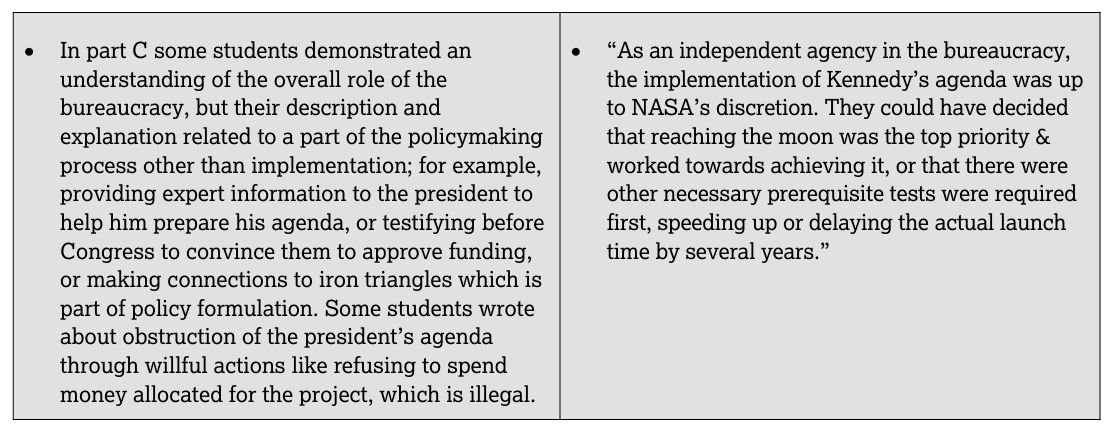
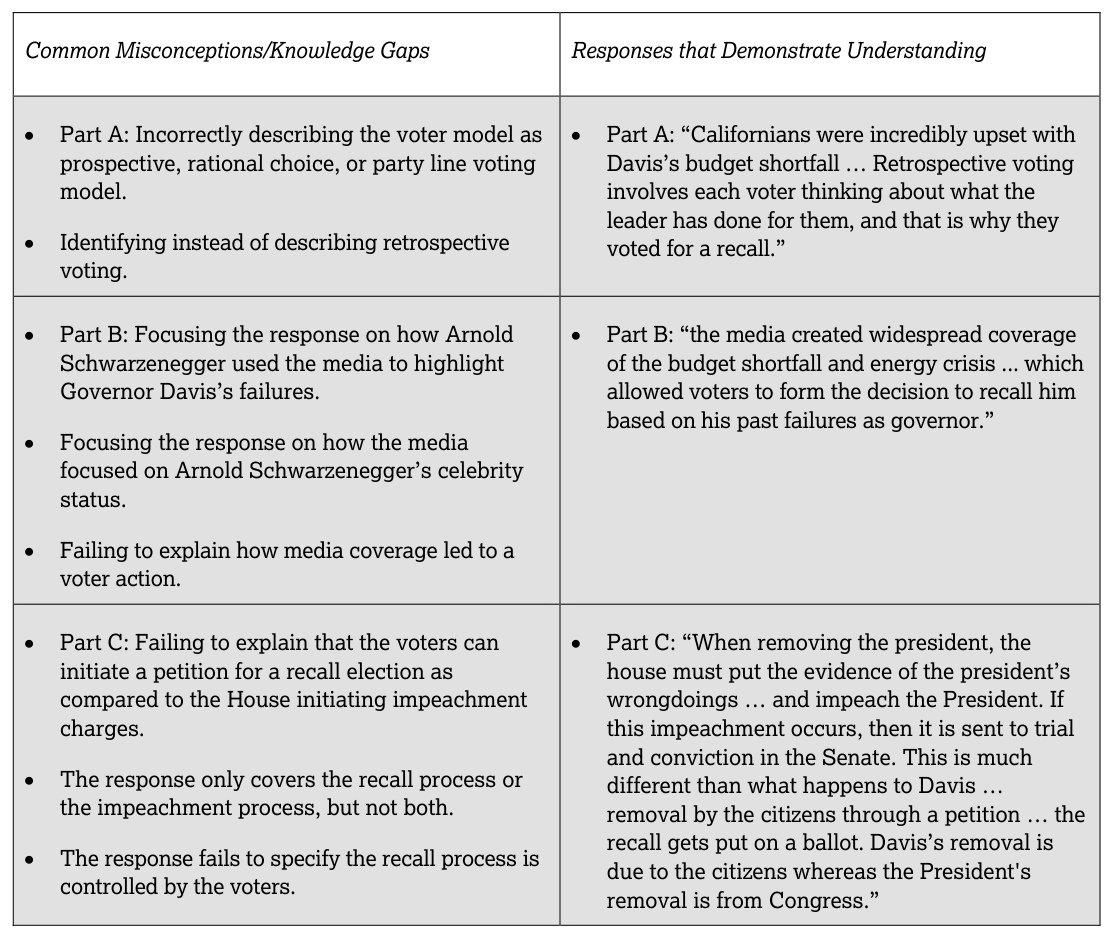
This topic develops Skill Category 1: Concept Application: 1.A Describe political principles, institutions, processes, policies, and behaviors; 1.B Explain them; 1.C Compare them; 1.D Describe how they appear in different contextual scenarios; and 1.E Explain how they apply in context.
It also develops Skill Category 2: SCOTUS Application: 2.A Describe the facts, issue, holding, reasoning, decision, and majority opinion; 2.B Explain how a required Supreme Court case relates to a foundational document or other source; 2.C Explain how required and non-required cases compare; and 2.D Explain how a required case relates to a political principle, institution, process, policy, or behavior.
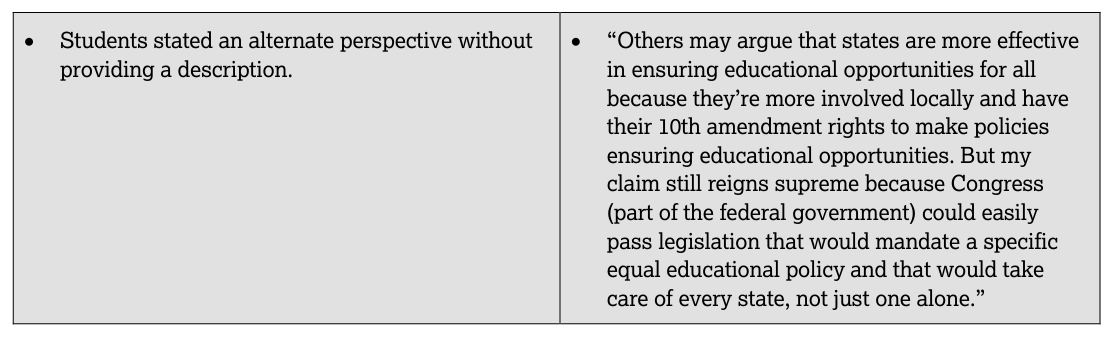
For sources, Skill Category 4: Source Analysis requires explaining claims, reasoning, evidence, and perspectives in text-based and visual sources. Skill Category 5: Argumentation requires 5.A Develop a defensible claim or thesis, 5.B Support it with specific evidence, 5.C Use reasoning to connect evidence to the claim, and 5.D Respond to an alternate perspective through concession, refutation, or rebuttal.
Retrieval check: A court upholds federal regulation of an interstate motel but rejects federal regulation of a local school-zone activity. Which constitutional principle is most directly illustrated, and what distinction between the two cases supplies the strongest evidence?
1.7 Relationship Between the States and National Government
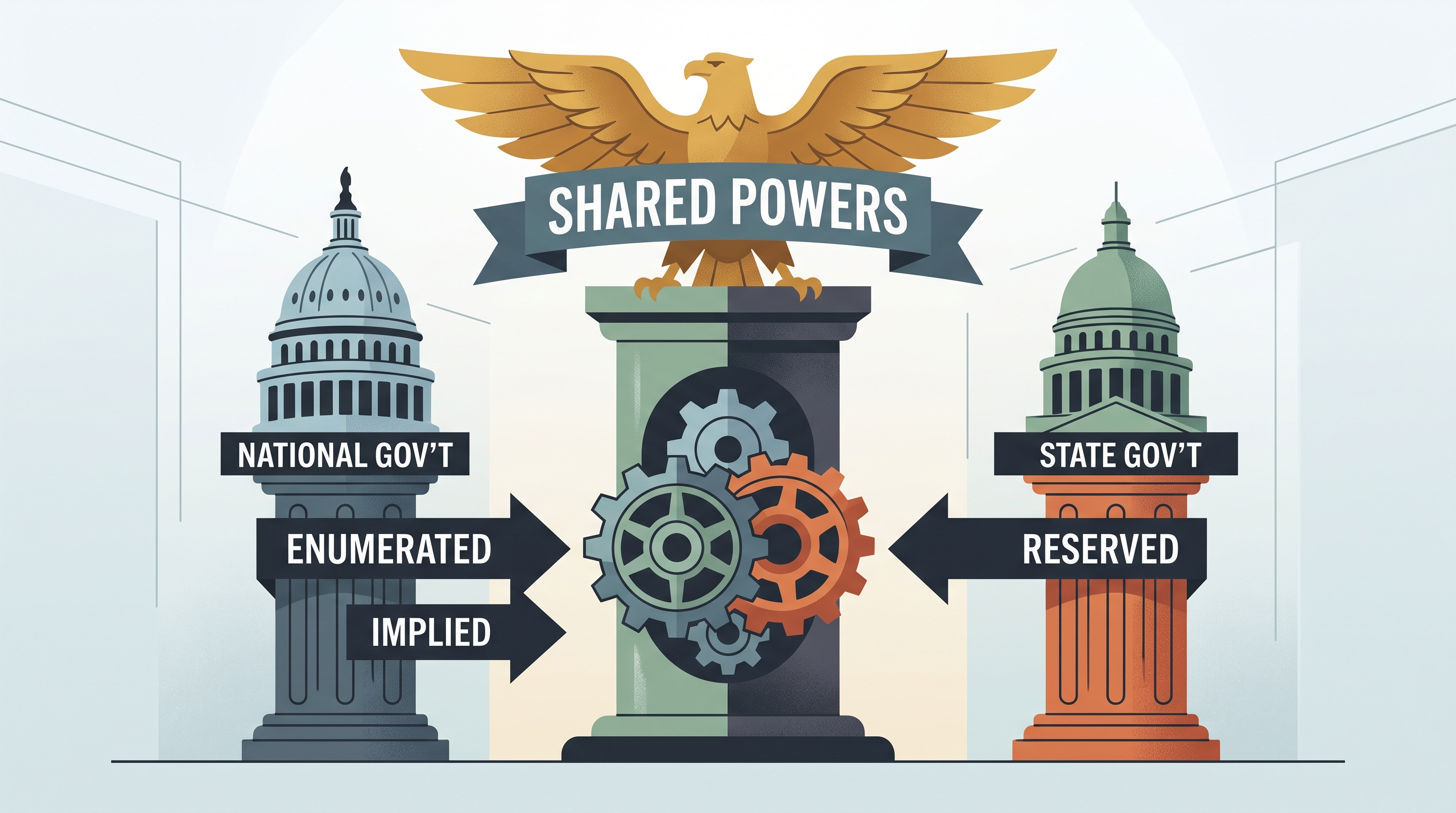
Key concepts: Federalism and the relationship between the national and state governments · Exclusive powers of the national government · Exclusive powers of state governments · Concurrent powers shared by national and state governments · Implied powers inferred from the Constitution · Reserved powers granted to the states by the Tenth Amendment · The ongoing debate over the balance of power between national and state governments · Federal intervention in response to natural disasters · Federalist No. 39 and republican principles · Federalist No. 51 and checks and balances
When a hurricane destroys highways, who should rebuild them: the state where the damage occurred, the national government, or both? Federalism answers that power is divided between the national government and the states rather than placed entirely in one level of government.
1.7 Relationship Between the States and National Government
When a hurricane destroys highways, who should rebuild them: the state where the damage occurred, the national government, or both? Federalism answers that power is divided between the national government and the states rather than placed entirely in one level of government. The difficult question is not whether both levels possess authority, but where the boundary lies.
L.O. 1.7.A — Explain how the constitutional allocation of power between the national and state governments affects society.
Federalism: one country, two levels of government
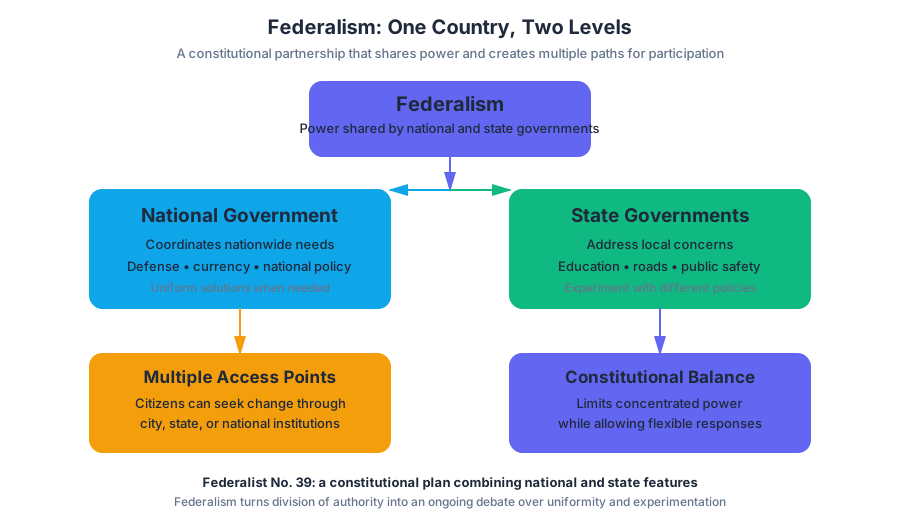
Federalism creates a constitutional partnership. The national government handles matters requiring national coordination, while state governments retain authority over many local concerns. Because the Constitution divides authority instead of assigning every responsibility to one government, federalism creates multiple access points for political participation: citizens can seek change in a city, state, or national institution.
EK 1.7.A.1 — Federalism is the system in which power is shared between the national and state governments. Federalist No. 39 describes the constitutional plan as combining national and state features. This arrangement limits the concentration of power in one part of government while permitting government to respond at different levels.
The division also creates an enduring political debate. One side may argue that a national problem requires a uniform national solution; another may argue that states should experiment with different policies. Federalism therefore affects practical questions about roads, public safety, education, health, environmental regulation, and disaster response—not merely abstract constitutional theory.
Four categories of governmental power
The most useful way to analyze federalism is to classify powers by who possesses them.
| Power category | Meaning | Example |
|---|---|---|
| Exclusive national powers | Held only by the national government | Conducting foreign policy or coining money |
| Exclusive state powers | Held only by the states through reserved authority | Establishing state and local governments |
| Concurrent powers | Shared by national and state governments | Taxing, enforcing laws, and building roads |
| Implied powers | Not specifically written but inferred from constitutional authority | Actions reasonably connected to an enumerated power |
EK 1.7.A.2 — Exclusive power is held by only one level of government. National exclusive powers include enumerated powers, which are written in the Constitution, and implied powers, which are inferred from the Necessary and Proper Clause. Implied does not mean unlimited: the power must connect logically to an authority granted to the national government.
For example, the Constitution gives Congress enumerated authority to raise and support armies. It does not list every administrative action needed to maintain a modern military. The authority to create military offices, procedures, and support systems can be understood as implied powers because those actions help execute an enumerated power.
EK 1.7.A.3 — Reserved powers are powers not delegated or enumerated to the national government but reserved to the states by the Tenth Amendment. State authority over many laws governing daily life reflects this principle. Reserved powers are not simply “whatever states want”; they remain subject to constitutional limits and other valid national authority.
EK 1.7.A.4 — Concurrent powers are shared by both levels of government. Taxation illustrates this clearly: the national government can collect federal taxes, while states can impose state taxes. Both levels can also enforce laws and build roads, although the scale, purpose, and legal basis of those actions may differ.
Worked example: Hurricane Katrina
Hurricane Katrina exposed the practical difficulty of divided authority. State and local officials possessed important responsibilities for emergency response, but the scale of the disaster created a need for national resources, coordination, and assistance. The central issue was therefore not whether one level of government mattered; it was how effectively multiple governments could act together.
Suppose a damaged road connects several communities inside one state. The state may plan and repair it using state authority. If the disaster also disrupts interstate transportation, housing, communications, and national emergency programs, national involvement becomes more significant. The example shows why concurrent powers can produce cooperation—but also delay, disagreement, and arguments over accountability.
Constitutional design and competing controls
Federalism works alongside the broader constitutional structure. Federalist No. 39 emphasizes that the government plan conforms to republican principles while combining national and state characteristics. Federalist No. 51 adds that checks and balances among government departments help prevent any one department from dominating the political system. Together, these ideas support a system in which power is divided both vertically between governments and horizontally among branches.
Named misconception — “The Tenth Amendment makes states completely sovereign.” Correction: the Tenth Amendment reserves powers not delegated to the national government, but state action can still be limited by the Constitution and by valid national laws. Named misconception — “Concurrent powers belong mainly to the national government.” Correction: concurrent powers are genuinely shared; taxing, enforcing laws, and building roads can be performed by both levels.
AP skill in action
This topic most directly develops Concept Application (1.A) by classifying a governmental action as exclusive, reserved, concurrent, enumerated, or implied. It develops Source Analysis (4.A) when interpreting Federalist No. 39 or Federalist No. 51, and Argumentation (5.A), Articulate a defensible claim/thesis, when arguing whether a problem should be addressed nationally, by the states, or cooperatively.
A strong argument does more than announce “the national government should act.” It identifies the constitutional allocation of power, applies a specific category—such as concurrent or implied power—and explains the social consequence, such as faster disaster relief or greater state policy independence.
Retrieval check: A state and the national government both impose taxes and repair roads after a disaster. What category of power is involved, and why might the response still generate debate over the proper balance of power?
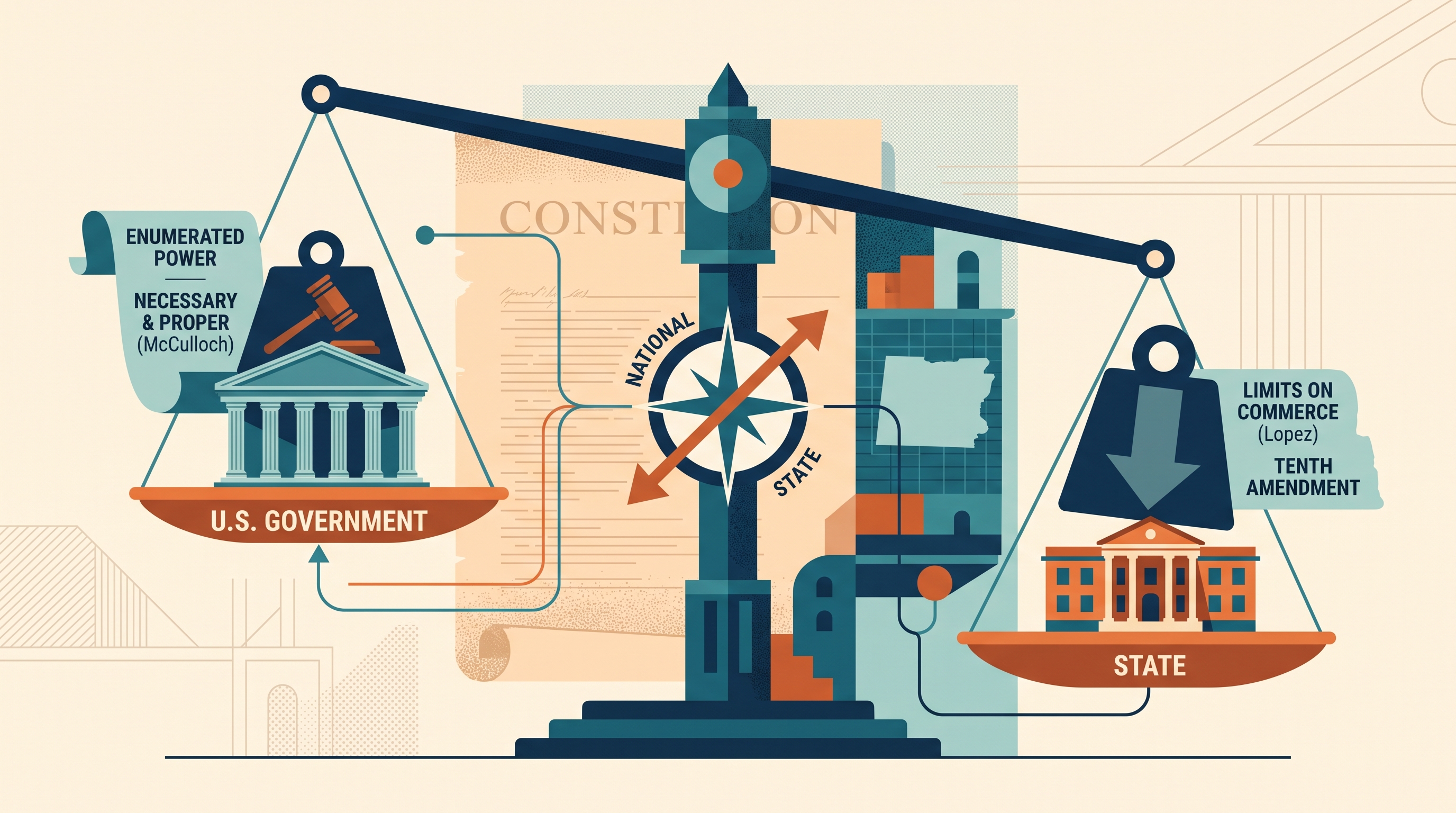
1.8 Constitutional Interpretations of Federalism
Federalism is not a fixed boundary between “national” and “state” government; it is a constitutional relationship whose meaning has been shaped by interpretation, especially by the Supreme Court.
1.8 Constitutional Interpretations of Federalism
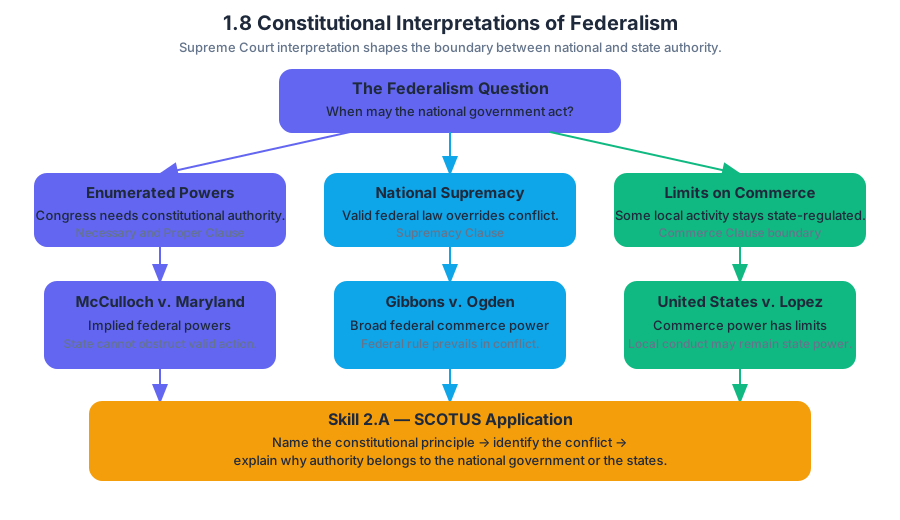
Federalism is not a fixed boundary between “national” and “state” government; it is a constitutional relationship whose meaning has been shaped by interpretation, especially by the Supreme Court. The central question is practical and powerful: When may the national government act, and when must power remain with the states?
Learning Objective 1.8.A: Explain how the Supreme Court has interpreted the Constitution’s provisions regarding federalism.
Skill 2.A — SCOTUS Application is the essential reasoning tool for this topic: use a Supreme Court decision to explain how constitutional principles apply to a specific governmental conflict. A strong response does not merely name McCulloch v. Maryland or United States v. Lopez; it identifies the constitutional principle in the case and connects that principle to the distribution of governmental authority.
The constitutional tension: national power versus state power
The Constitution gives Congress enumerated powers, meaning powers listed directly in the constitutional text. Article I, Section 8 includes powers such as taxing, spending, regulating interstate commerce, and establishing a national currency. But Congress also receives authority through the Necessary and Proper Clause, which permits it to make laws needed to carry out its listed responsibilities.
The Tenth Amendment supplies the opposing presumption: powers not delegated to the national government, and not prohibited to the states, are reserved to the states or the people. The result is a constitutional design with both an expanding mechanism—national powers that may be implied from enumerated powers—and a limiting principle—authority that remains outside the national government’s lawful reach.
Essential Knowledge 1.8.A: The Constitution establishes a federal system by dividing power between the national government and the states, while constitutional clauses and judicial interpretation determine how that division operates.
McCulloch v. Maryland (1819): implied powers and national supremacy
In McCulloch v. Maryland, Maryland attempted to tax the Second Bank of the United States. The dispute created two constitutional questions: Could Congress establish a national bank even though the Constitution does not expressly say “create a bank”? And could a state tax a legitimate institution of the national government?
The Supreme Court, led by Chief Justice John Marshall, answered both questions in favor of national authority. Congress could establish the bank under the Necessary and Proper Clause because the bank was a useful means of carrying out enumerated powers such as taxing, borrowing, and managing national finances. The Court also held that Maryland could not tax the bank because “the power to tax involves the power to destroy,” and state taxation could undermine constitutional national functions.
The decision established two linked principles:
- Implied powers: Congress may use reasonable means not expressly listed when those means help execute an enumerated power.
- Federal supremacy: Valid national laws and institutions take priority over conflicting state action, reflecting the Supremacy Clause.
Worked application: Suppose Congress creates a federal agency to administer a national borrowing program. A state argues that the agency is unconstitutional because no clause expressly names that agency. Under McCulloch, the question is not whether the agency is named word-for-word. The question is whether it is a reasonable instrument for carrying out an enumerated national power. If it is, the state may not obstruct it through taxation or similar measures.
United States v. Lopez (1995): a limit on the Commerce Clause
More than a century later, United States v. Lopez demonstrated that federalism can also restrict national power. Congress had enacted the Gun-Free School Zones Act, making it a federal crime to possess a gun near a school. The Supreme Court struck down the law because possessing a gun near a school was not sufficiently connected to interstate commerce.
The Commerce Clause allows Congress to regulate interstate economic activity and activities substantially related to it. The Court reasoned that accepting an unlimited chain of effects—guns near schools might affect education, education might affect the economy, and therefore Congress may regulate gun possession—would allow Congress to control nearly anything. Lopez therefore preserved a constitutional sphere for state authority.
Reading the two cases together
These cases are not contradictory. McCulloch asks whether Congress may select an appropriate means for implementing an enumerated power; Lopez asks whether Congress has identified a sufficient constitutional connection to an enumerated power in the first place.
| Case | Constitutional issue | Holding | Federalism effect |
|---|---|---|---|
| McCulloch v. Maryland | Necessary and Proper Clause; state interference | Congress may use implied powers, and states may not obstruct valid national action | Expanded national authority |
| United States v. Lopez | Commerce Clause | Congress may not regulate an activity with only a remote connection to interstate commerce | Limited national authority and protected state power |
Named misconception — “The Necessary and Proper Clause lets Congress do anything useful.” It does not. The implied power must connect to an enumerated power, and the chosen means must be appropriate for carrying out that power. Conversely, “the Tenth Amendment makes states sovereign whenever they disagree with Congress” is also incorrect: valid federal law remains supreme under the Constitution.
Retrieval check
A state challenges a federal regulation of an activity occurring entirely within one state. Which case provides the stronger analogy, McCulloch or Lopez, and what constitutional question should be asked first? A defensible answer should identify the relevant enumerated power, explain the constitutional connection, and use the case to show why national authority is either supported or limited.
1.9 Federalism in Action
Key concepts: legitimacy · the accused · policy
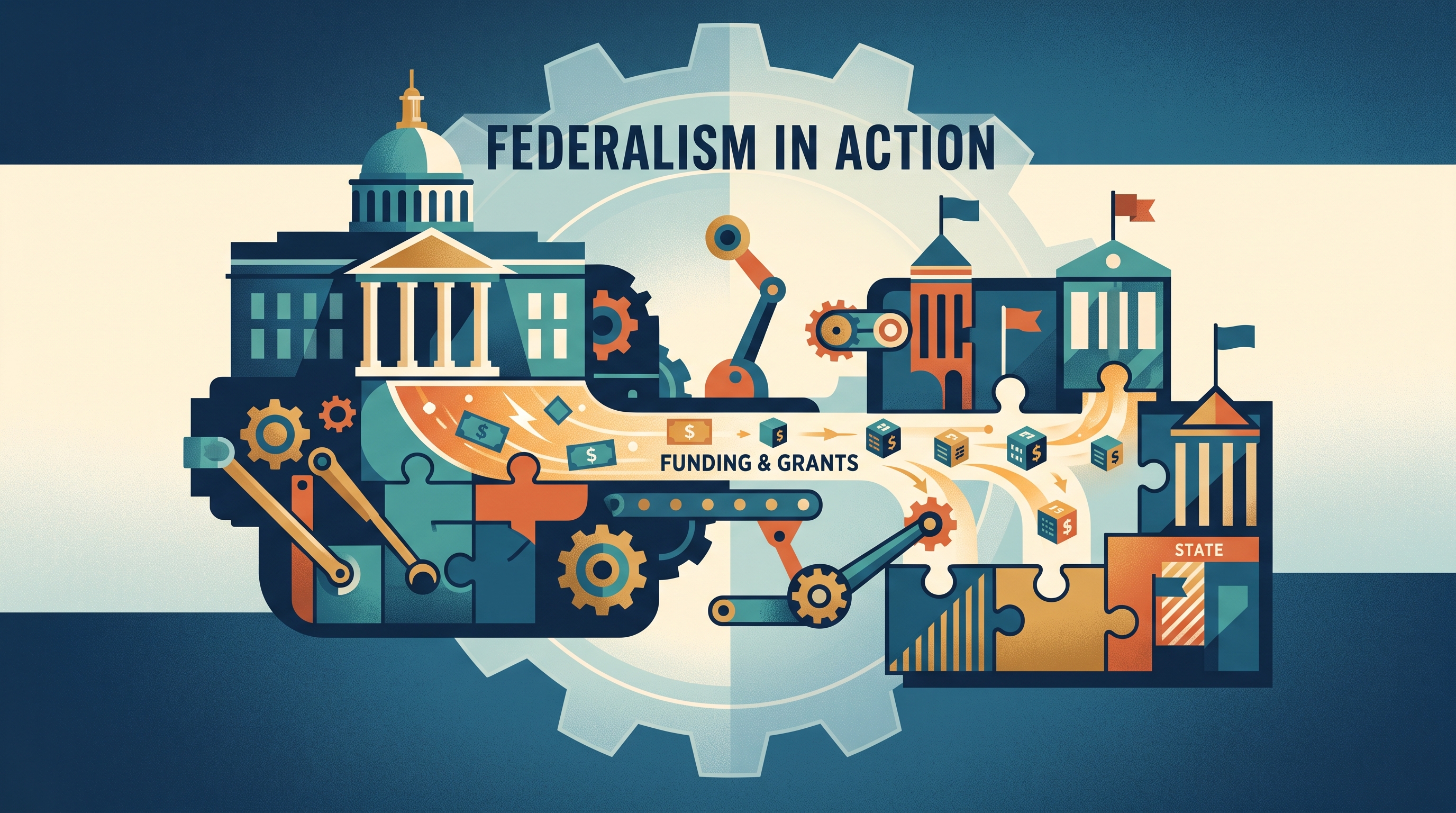
Federalism turns public policy into a shared job: the national government may set broad goals, while state and local governments often decide how those goals operate in daily life.
1.9 Federalism in Action
Federalism turns public policy into a shared job: the national government may set broad goals, while state and local governments often decide how those goals operate in daily life. That arrangement can make policy more responsive—but it can also produce unequal results, political conflict, and questions about legitimacy, meaning whether people view governmental authority and its decisions as rightful, lawful, and worthy of acceptance.
Learning Objective 1.9.A — Explain how federalism affects public policy.
Essential Knowledge 1.9.A.1: Federalism divides governmental authority among the national, state, and local governments, allowing each level to participate in policymaking and implementation.
Essential Knowledge 1.9.A.2: The national government influences state policy through tools such as grants, mandates, and conditions attached to federal funding.
Essential Knowledge 1.9.A.3: States can act as policy laboratories by testing different approaches to shared problems.
From constitutional structure to actual policy
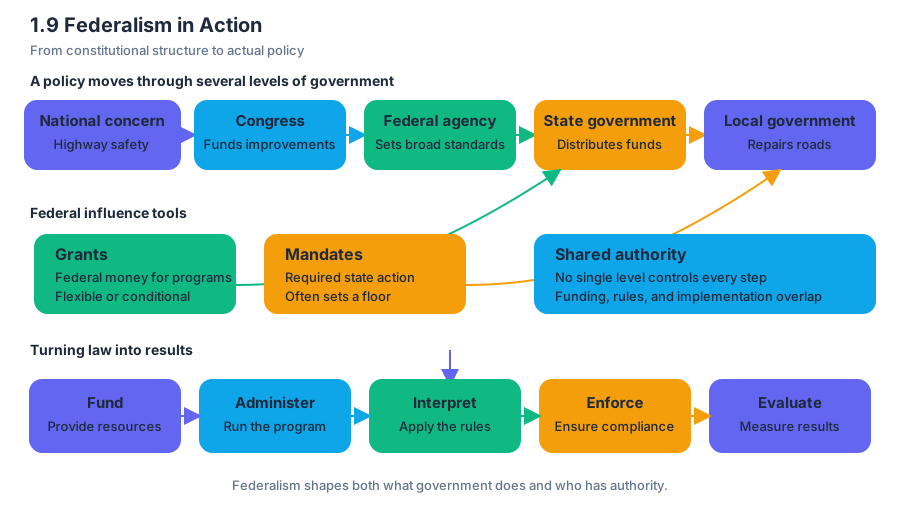
A policy is not simply an idea written into law. It must be funded, administered, interpreted, enforced, and evaluated. In a federal system, those tasks may be distributed across several levels of government.
For example, Congress might identify a national concern such as highway safety and provide money for improvements. A federal agency could establish broad standards, a state transportation department could distribute funds, and counties or cities could repair roads or redesign dangerous intersections. Federalism therefore affects both what government does and who has authority over each step.
The national government can influence state policy in several ways:
- Grants provide federal money for state or local programs. A grant may be relatively flexible, or it may require recipients to meet specific conditions.
- Mandates require state or local governments to take an action. An unfunded mandate can create tension when the national government orders a policy but supplies little or no money to carry it out.
- Preemption occurs when valid federal law displaces conflicting state law. In that situation, a state cannot use its own policy to override national authority within the federal government’s constitutional power.
Worked example: a coordinated safety policy
Imagine that Congress creates a program to reduce pedestrian deaths. The federal government offers transportation grants to states that adopt minimum road-design standards, collect crash data, and publish annual safety reports. State governments choose which roads receive priority, while local governments carry out construction and enforcement.
The arrangement may produce different results. State A uses the money to install raised crosswalks near schools; State B expands lighting and traffic-calming measures downtown; State C spends most of the grant on data collection before construction begins. These differences illustrate state experimentation, but they may also create unequal safety protections for residents in different states.
Now apply legitimacy. The policy is more likely to be viewed as legitimate when authority is transparent—people understand which government made which decision; implementation is accountable—officials can be questioned about delays or spending; treatment is reasonably equal—similar communities are not arbitrarily denied protection; and the policy is publicly accepted because residents see a lawful process and credible evidence behind it. Legitimacy weakens if federal officials impose unclear conditions, state agencies distribute funds secretly, or local leaders enforce standards selectively.
Policy laboratories: innovation with a trade-off
Federalism allows states to function as policy laboratories: governments can test different solutions before a broader adoption. One state may expand a public-health service, another may rely on tax incentives, and a third may combine private and public providers. Policymakers can compare outcomes and revise ineffective approaches.
The laboratory metaphor has a limit. Residents are not experimental subjects who can freely relocate whenever a policy fails. State-by-state variation may encourage innovation, but it can also mean that access to safety, education, health care, or legal protections depends heavily on geography. Federal standards and funding can reduce those disparities; state autonomy can preserve local choice.
Skill connection: reasoning from a policy dispute
This topic is especially suited to Concept Application (SP1): identify the federalism principle in a new policy scenario and connect it to a concrete governmental action. It also uses Source Analysis (SP4) when a passage describes a grant, mandate, or conflict among governments, and Argumentation (SP5) when evaluating whether federal involvement improves policy outcomes or legitimacy. If a prompt presents a relevant Supreme Court dispute, SCOTUS Application (SP2) requires connecting the case’s constitutional principle to the new facts rather than merely naming the case.
Misconception check — “Federalism means the national government and states must work separately.” Federalism does not require isolation. Much modern policy uses cooperative federalism, in which national, state, and local officials share responsibility. The important question is not whether governments cooperate, but how constitutional authority, funding, implementation, and accountability are distributed.
Retrieval check: A federal safety grant requires every state to publish spending records, but states may choose different road-safety projects. Identify one way the grant influences state policy, one federalism benefit, and one possible legitimacy concern. A strong answer identifies the funding condition, explains experimentation or local responsiveness, and notes that opaque spending or unequal implementation could reduce public acceptance.
2.1 Congress: The Senate and the House of Representatives
Key concepts: Bicameral structure of Congress · Equal state representation in the Senate · Popular representation in the House of Representatives · Chamber size and formality of debate · Interactions among members of Congress during the legislative process · House discharge petitions · Representative decision-making based on constituents’ long-term interests
Why does the United States use two legislative chambers instead of one? The answer is representation: Congress is bicameral, meaning that it has two houses—the Senate and the House of Representatives—designed to represent different political communities.
2.1 Congress: The Senate and the House of Representatives
Why does the United States use two legislative chambers instead of one? The answer is representation: Congress is bicameral, meaning that it has two houses—the Senate and the House of Representatives—designed to represent different political communities.
Two chambers, two representational principles
The Senate represents the states equally: every state has two senators, regardless of population. The House of Representatives represents the people through membership based largely on state population, so more populous states have more representatives.
This arrangement expresses republicanism, the democratic principle that the people’s will enters government through elected representatives who debate and make decisions. Bicameralism does not mean that both chambers represent the same constituency in the same way; it creates two routes through which public preferences can influence national law.
| Feature | Senate | House of Representatives |
|---|---|---|
| Representational basis | Equal representation of states | Representation of the people by population |
| Membership | 100 members | 435 members |
| Election cycle | One-third elected every two years | All members elected every two years |
| Legislative character | Smaller, less formal debate | Larger, more formal debate |
Retrieval check: A bill concerns a policy supported by voters in a large state but opposed by several small states. Which chamber’s representational design is more likely to reflect the large state’s population, and which chamber gives each state equal weight? The answer is the House for population-based representation and the Senate for equal state representation.
Size changes how debate works
The House has 435 members, while the Senate has 100 members. That numerical difference shapes legislative interaction: debate in the House is generally more formal because hundreds of members cannot all participate freely in an extended, spontaneous discussion.
The smaller Senate can operate with greater individual participation and a less formal debating culture. This does not mean that Senate debate is unstructured or that House members never negotiate; it means that chamber size creates different procedural conditions for speaking, amending, and coordinating.
The two-party system also affects interaction inside both chambers. Members must often cooperate with colleagues in their own party, bargain across party lines, and respond to constituents whose preferences may not match the party’s position.
Election cycles and continuity
All House members face election every two years. The Senate is different: one-third of its members are elected every two years. Because the entire Senate is never replaced at once, the Senate functions as a continuous legislative body, retaining institutional experience while still responding regularly to voters.
These different term structures influence congressional behavior. A House representative may face immediate electoral pressure from district opinion, while a senator represents an entire state and serves in a chamber where membership changes gradually.
Members, constituents, and legislative choices
A member of Congress represents constituents, meaning the people who live in the member’s district or state. Representation does not always require voting for whatever position appears most popular at a particular moment. A representative may support a bill because they believe it serves constituents’ long-term interests, even if some constituents currently oppose it.
For example, suppose a representative supports a costly infrastructure bill. The bill may impose short-term financial burdens, but the representative may judge that improved transportation, employment, and public safety will benefit the district over time. The decision reflects a judgment about representation rather than simple obedience to the latest opinion poll.
Key distinction: Representation involves making political judgments on behalf of constituents; it is not identical to acting as a mechanical messenger for every immediate preference.
House discharge petitions
The House’s formal structure can give party leaders and committees substantial control over which bills receive floor consideration. A discharge petition is a procedure through which an individual House representative can seek to bring a bill out of committee and onto the House floor for a vote.
The petition matters because it gives rank-and-file representatives a possible route around committee inaction or leadership resistance. Filing the petition alone does not guarantee passage of the bill: the measure still must be considered and voted on, and representatives may disagree about its merits.
Misconception check
Misconception: “The Senate and House are simply duplicate chambers.” They are not. Their different representational bases, membership sizes, and election cycles produce different incentives and debating environments. Another misconception is that a discharge petition automatically makes a bill law; it can bring a bill toward a floor vote, but it does not determine the vote’s outcome.
AP skill connection
This topic most directly develops Concept Application (CON-1): apply bicameralism, equal state representation, popular representation, chamber size, election cycles, and discharge petitions to a new congressional scenario. A strong response identifies the relevant chamber feature and explains its political consequence—for example, connecting the House’s larger membership to more formal debate or connecting staggered Senate elections to institutional continuity.
It also supports Argumentation (ARG-1) when evaluating whether a member’s vote represents constituents effectively. The reasoning must link a claim—such as “the vote reflects long-term representation”—to evidence in the scenario and explain why the representative’s judgment could serve constituents beyond their immediate preferences.
Final retrieval check: A bill remains stalled in a House committee, but several representatives believe it deserves a floor vote. What mechanism can one representative initiate, and what does that mechanism accomplish? An individual representative can file a discharge petition; if the petition receives the required support, it can move the bill toward consideration by the full House, but it does not guarantee passage.
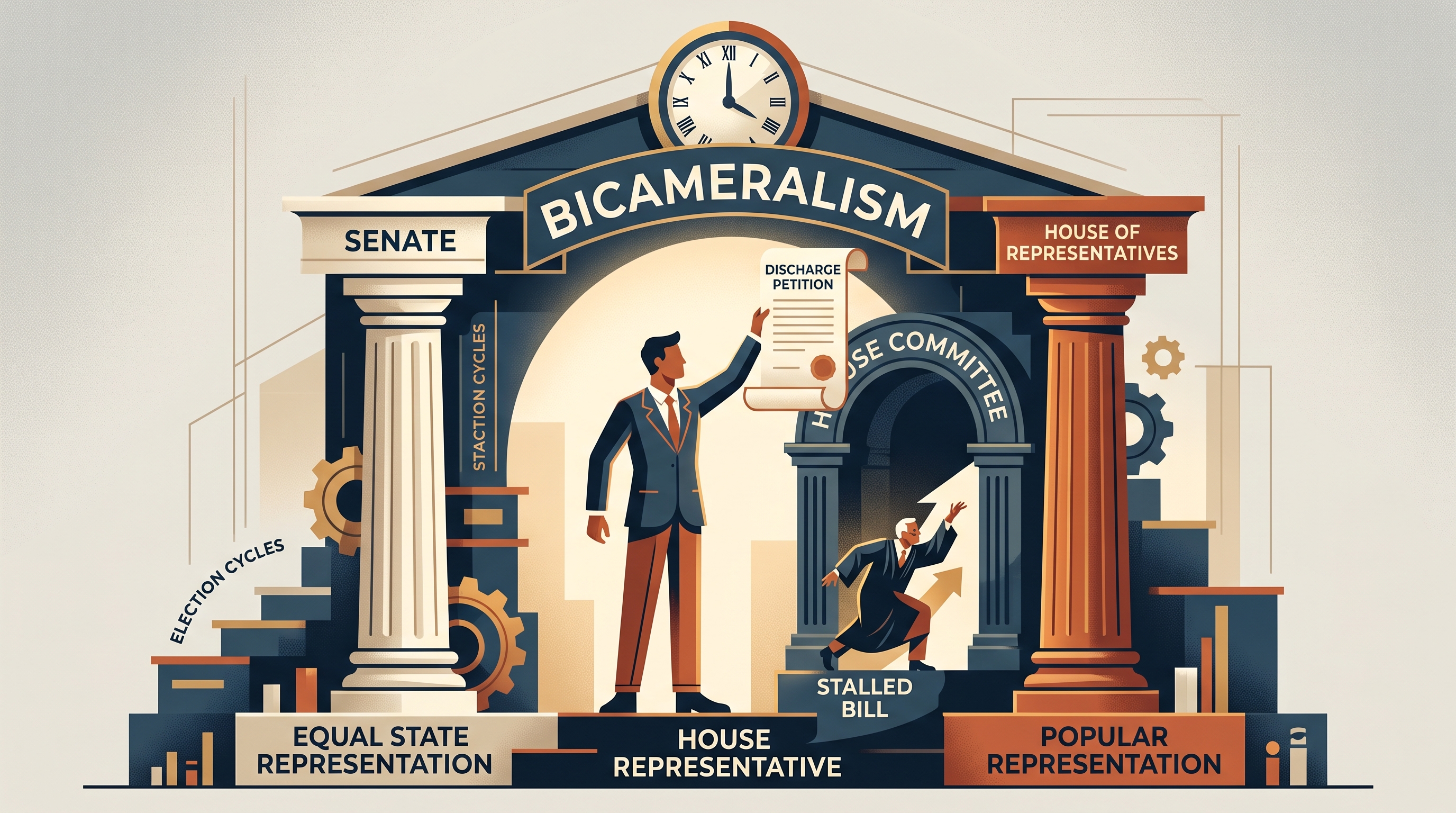
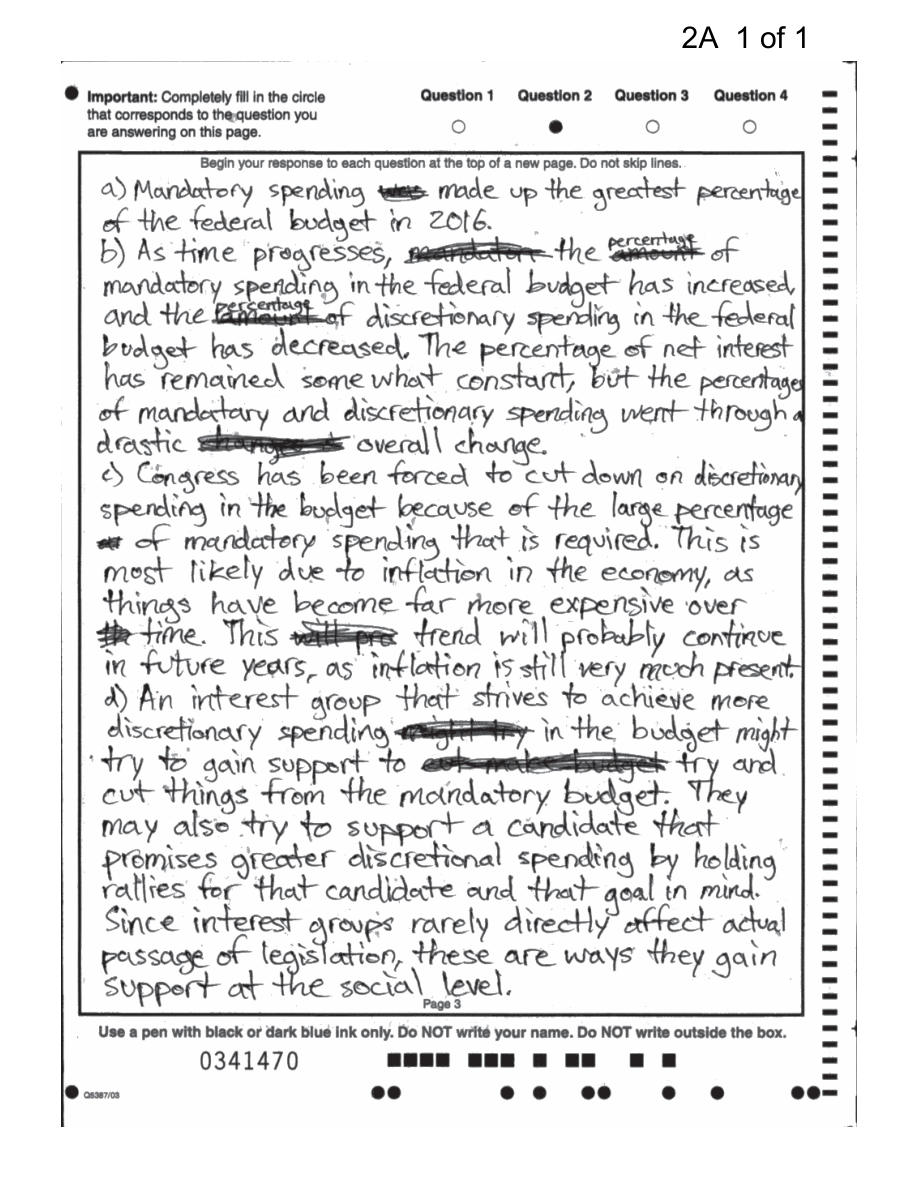
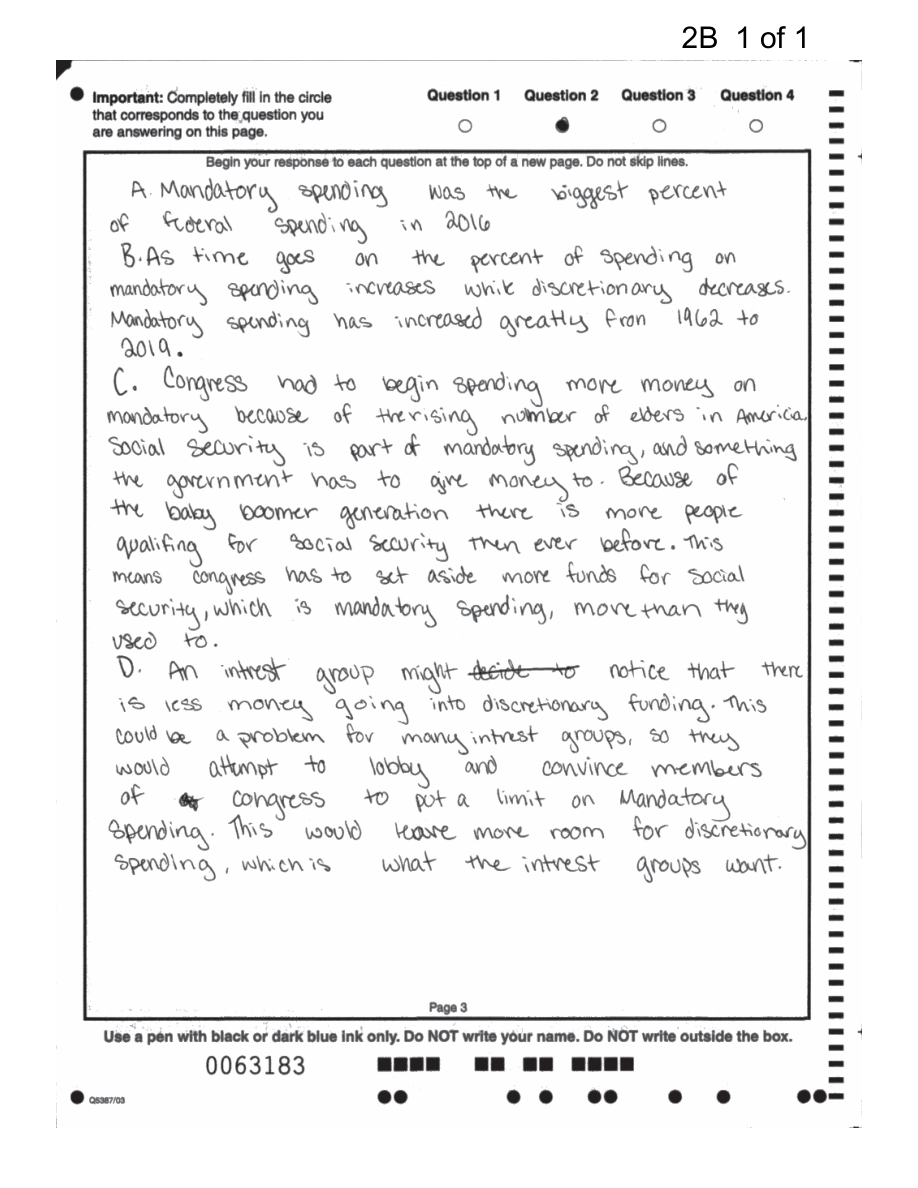
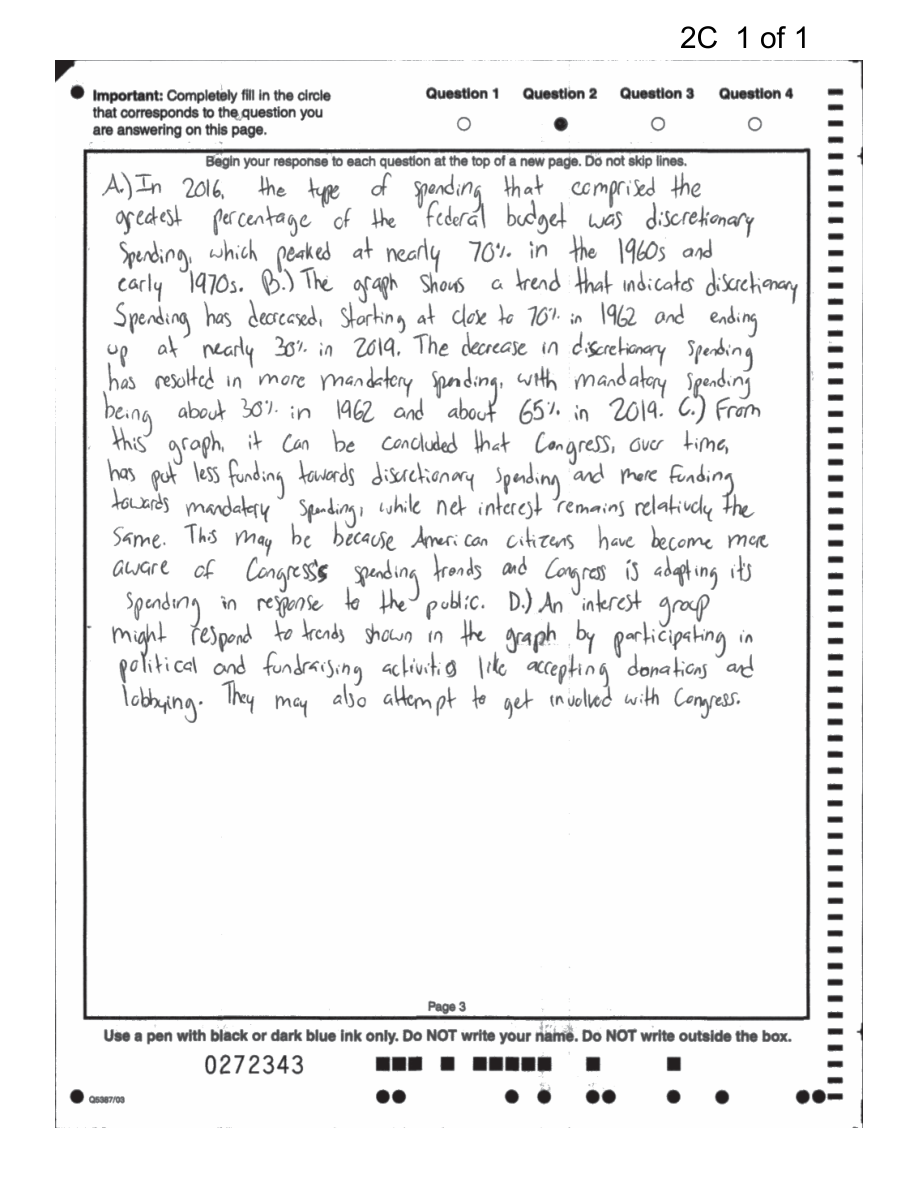
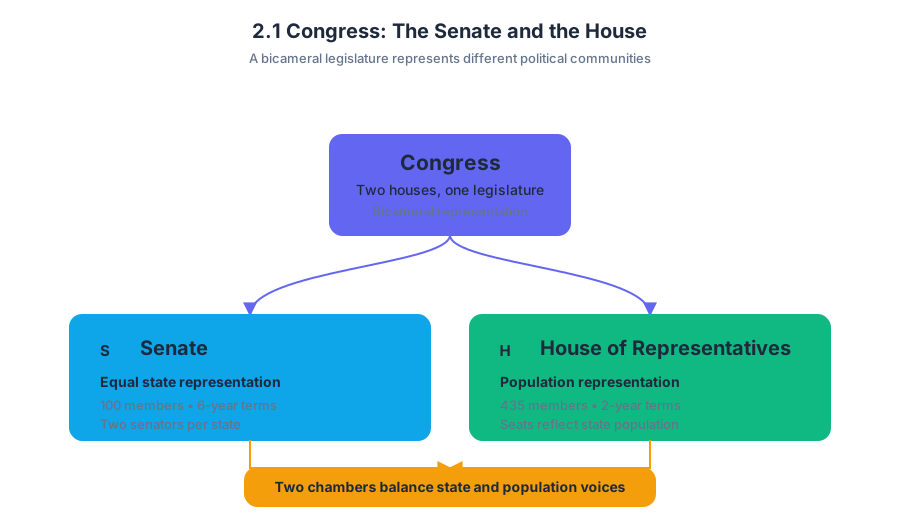
2.2 Structures, Powers, and Functions of Congress
Key concepts: Bicameral structure of Congress · Senate · House of Representatives · Differences in the structures, powers, and functions of the two houses · Design-based differences between the Senate and House · Filibuster · Cloture · Congressional behavior and partisanship · Entitlement spending · Discretionary spending and tax revenues
Congress is bicameral by design: the House of Representatives and the Senate share lawmaking power, but their different rules force legislation through two different political environments.
2.2 Structures, Powers, and Functions of Congress
Congress is bicameral by design: the House of Representatives and the Senate share lawmaking power, but their different rules force legislation through two different political environments.
One legislature, two institutional designs
The House of Representatives is larger and more tightly organized. Its members serve two-year terms and represent smaller districts, so the chamber is built for speed, party coordination, and responsiveness to shifting public opinion. The Senate is smaller and more individualistic: each state has two senators serving six-year terms, regardless of population. Longer terms and statewide constituencies encourage a broader time horizon and give individual senators greater procedural influence.
| Feature | House of Representatives | Senate |
|---|---|---|
| Membership | 435 voting representatives, apportioned by state population | 100 senators, two per state |
| Term length | Two years | Six years, staggered |
| Constituency | Smaller geographic district | Entire state |
| Presiding officer | Speaker of the House | Vice president; president pro tempore when the vice president is absent |
| Debate | More structured and time-limited | More open-ended |
| Agenda control | Majority party strongly controls scheduling and debate rules | Leaders must negotiate with individual senators and often the minority |
| Special constitutional powers | Revenue bills originate here; impeaches federal officials | Confirms appointments, ratifies treaties, and conducts impeachment trials |
Structure becomes procedure
The House’s size makes unlimited debate impractical. House leaders and the Rules Committee therefore help determine when a bill reaches the floor, how long members may debate it, and whether amendments may be offered. A majority-controlled House can often move its party’s priorities forward if its members remain sufficiently united.
The Senate’s smaller membership permits extended debate and greater individual influence. Senators may use unanimous-consent agreements, holds, amendments, and negotiations to shape or delay legislation. Because the Senate’s rules give the minority more opportunities to slow action, major legislation often requires broader support than a simple majority of the majority party.
Powers and functions
Both chambers legislate by introducing, debating, amending, and voting on bills. They also represent constituents, conduct oversight of executive agencies, authorize programs, appropriate funds, and investigate public problems. These shared functions create a system of checks within Congress itself: neither chamber can ordinarily send a bill to the president without the other chamber passing identical wording.
The Constitution assigns distinct powers to each house. The House must originate bills raising revenue and has the sole power to impeach federal officials. The Senate confirms presidential appointments, approves treaties by a supermajority, and conducts impeachment trials. These differences reflect competing constitutional goals: the House is closely tied to popular representation, while the Senate provides state-based representation and continuity.
When the chambers pass bills on the same subject with different wording, a conference committee may meet to reconcile the differences. The House and Senate must then approve the identical compromise before it can go to the president. This procedure illustrates how bicameralism can slow policymaking but also require broader agreement.
Filibuster and cloture
A filibuster is a Senate tactic in which debate is prolonged to delay or prevent a final vote. Under modern Senate practice, ending debate on most legislation generally requires cloture, a motion supported by at least 60 senators. Cloture does not pass the bill; it limits further debate so the Senate can proceed toward a vote.
Worked example: Suppose 52 senators support a bill and 48 oppose it. In the House, the majority party might schedule the bill, restrict debate, and pass it with 218 votes. In the Senate, however, the 48 opponents could use extended debate or threaten a filibuster. Unless at least 60 senators support cloture, the bill may never reach a final vote—even though a majority favors it.
The filibuster therefore makes Senate legislation more difficult to pass than House legislation. The House generally imposes stricter limits on debate time and relevance, while the Senate permits more delay and individual bargaining.
Procedure shapes congressional behavior
Institutional design does not determine every vote, but it changes the strategies legislators use. In the House, the majority party controls much of the agenda, party leaders organize members, and representatives often vote along party lines when leadership links a bill to the party’s program. In the Senate, party leaders still coordinate action, but they frequently need coalition-building, bipartisan bargaining, or agreements with individual senators to obtain enough support for debate and passage.
This is the key boundary with Topic 2.3 Congressional Behavior: Topic 2.2 explains how chamber rules and powers create incentives for party-line voting, coalition-building, and bargaining; Topic 2.3 examines legislators’ behavior and motivations in greater depth.
Congress and the budget
Under EK 2.2.A.4, Congress must produce a budget addressing both mandatory spending and discretionary spending. Mandatory spending is required by law for entitlement programs such as Social Security, Medicare, and Medicaid. Discretionary spending is approved annually for areas such as defense, education, and infrastructure.
As entitlement costs grow, fewer budget dollars remain available for discretionary priorities unless tax revenues increase or the budget deficit increases. Congress’s spending choices therefore involve trade-offs rather than an unlimited pool of money.
$$\text{Available discretionary room} \approx \text{Tax revenues} - \text{Mandatory spending}$$
Under EK 2.2.A.5, pork-barrel legislation places funding for a local project inside a larger appropriation bill. Logrolling is the exchange of political support—such as trading votes—to build enough support for legislation. Both practices can help legislators assemble coalitions in either chamber.
Misconception check
Misconception: “A Senate majority can always pass a bill.”
Correction: A majority may be enough for a final vote in many circumstances, but opponents can use Senate debate rules to block that vote unless cloture receives the required supermajority support.
AP skill and retrieval check
LO 2.2.A asks you to explain how the structures, powers, and functions of both houses affect policymaking. The relevant Concept Application, 1.C: Compare political principles, institutions, processes, policies, and behaviors, is demonstrated by identifying a specific House–Senate difference and explaining its policymaking consequence.
A bill has House support from a unified majority party but only 55 Senate supporters. Which institutional feature most directly explains why the bill may stall, and what procedural action could address the obstacle? Answer: Senate extended debate or a filibuster may prevent a final vote; a cloture motion supported by at least 60 senators could end debate and allow the Senate to proceed.
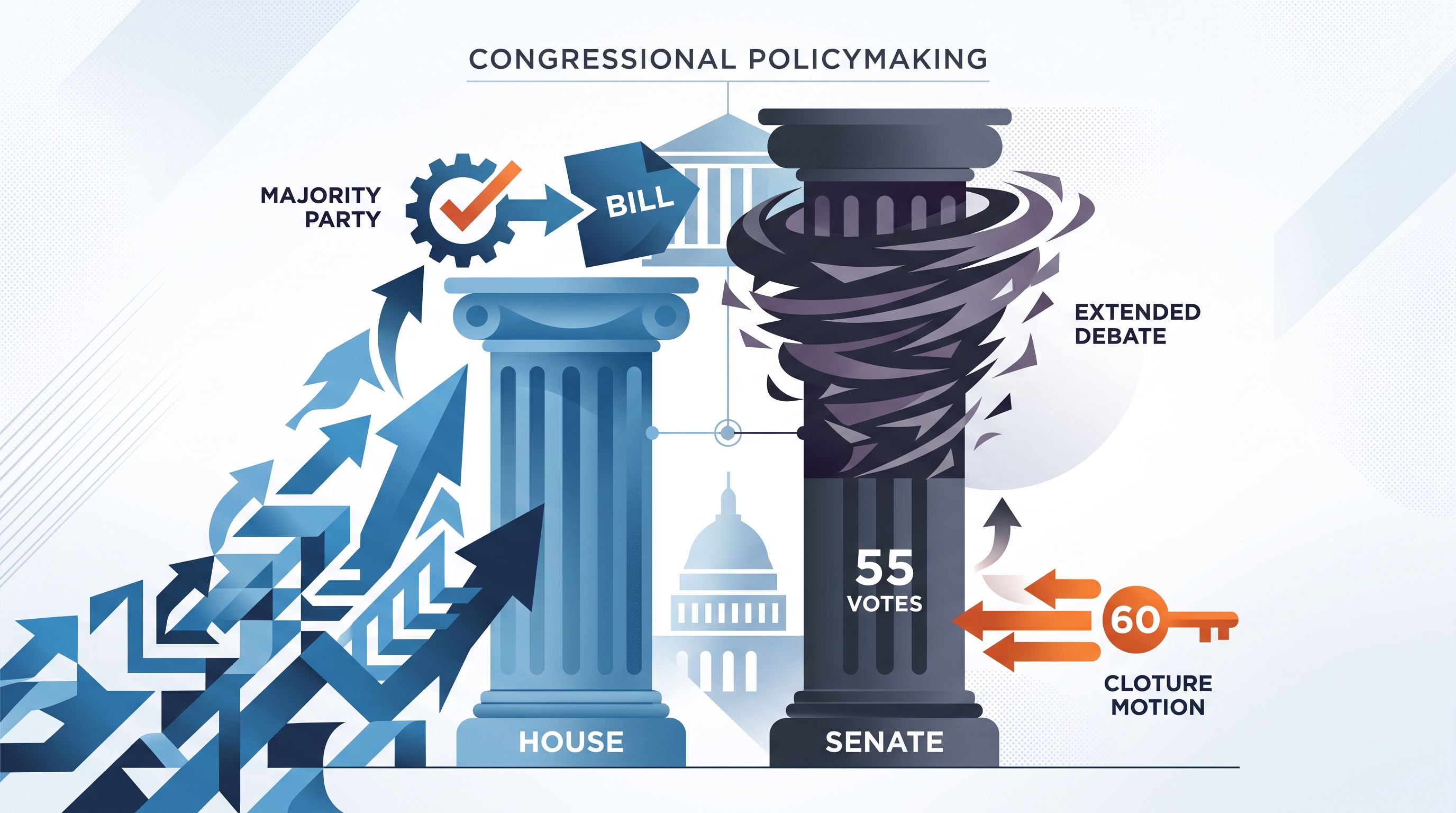
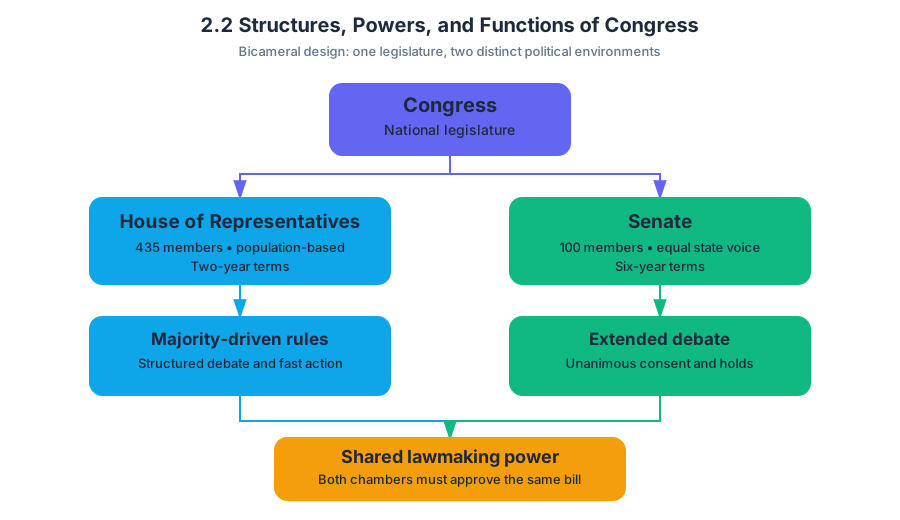
2.3 Congressional Behavior
Key concepts: retrospective voting · voter approval of congressional actions · electoral accountability · chairperson decision-making · voting in the next election
A voter can judge a member of Congress not by campaign promises, but by what that official actually did in office. Retrospective voting is a model of electoral decision-making in which voters look backward at an incumbent’s performance and then decide whether to support that official—or the official’s party—in the…
2.3 Congressional Behavior
A voter can judge a member of Congress not by campaign promises, but by what that official actually did in office. Retrospective voting is a model of electoral decision-making in which voters look backward at an incumbent’s performance and then decide whether to support that official—or the official’s party—in the next election.
The model is simple: approval creates electoral support; disapproval creates electoral risk. Congressional behavior therefore matters beyond the Capitol because a representative’s decisions can become evidence that voters use to assign responsibility.
The retrospective voter model
Under retrospective voting, citizens ask a practical question: “How did this official perform?” They may evaluate a vote, a public decision, a committee action, or the results of a policy. The voter does not need to agree with every position; the key is whether the official’s observed behavior produces approval or disapproval.
Retrospective voting: Voting based primarily on an official’s past performance rather than on promises about future action.
The basic causal chain is:
| Congressional behavior | Voter evaluation | Electoral consequence |
|---|---|---|
| The member takes an action the voter supports | Approval | The voter is more likely to support the member in the next election |
| The member takes an action the voter opposes | Disapproval | The voter may vote against the member or withhold support |
| The member’s party is associated with the action | Party-level evaluation | The voter may support or oppose the party’s candidate |
This model produces electoral accountability, the idea that elections allow citizens to reward or punish public officials for their performance. Accountability is not automatic: voters must notice the action, connect it to the correct official, and care enough to change their vote.
Worked example: Chairperson Maloney
Imagine that Chairperson Maloney leads a congressional committee considering a proposal affecting local manufacturers. She schedules public hearings, rejects a rushed amendment, and supports a compromise that protects some workers while limiting costs for employers.
A voter who believes Maloney’s decision protected the community may approve of her actions. Applying the retrospective voter model, that voter is more likely to vote for Maloney in the next election. The voter may also support Maloney’s party if the party is seen as responsible for the committee’s position.
A different voter may believe Maloney ignored consumer concerns or favored business interests. That voter may evaluate her performance negatively and become less likely to vote for her in the next election. The disagreement does not need to involve a constitutional argument; the voter’s judgment about her conduct is enough to create electoral pressure.
Responsibility can also be attributed at several levels:
- Individual level: “Maloney made the decision, so I will reward or punish her.”
- Committee level: “The chairperson controlled the hearing or agenda, so the committee’s outcome reflects her leadership.”
- Party level: “Maloney’s party supported this position, so I will reward or punish the party’s candidates.”
The chairperson’s actions can therefore influence electoral support by shaping voters’ evaluations of her performance. Even when a chairperson does not act alone, visibility and agenda-setting can make that official appear especially responsible for the result.
Misconception check: voters do not punish every official equally
Common misconception: Retrospective voting means voters always know exactly who caused a policy outcome and punish that person.
In reality, voters may have incomplete information. They may attribute a committee’s decision to the chairperson, the full chamber, the majority party, or Congress as a whole. Party identification can also influence the judgment: a strong partisan may defend an official from the preferred party or blame the opposing party even when responsibility is shared.
A second misconception is that retrospective voting concerns only the individual representative. Voters can use congressional behavior to evaluate the member, the committee leadership, or the party. The crucial reasoning step is to identify which political actor the voter holds responsible.
AP skill connection
This topic most directly develops Skill 1: Concept Application, especially 1.A Describe political concepts and processes and 1.B Explain political concepts and processes. A strong response does more than define retrospective voting: it connects Maloney’s specific action to approval or disapproval and then to the likelihood of voting for or against her.
It also supports Skill 5: Argumentation, particularly when a response makes a defensible claim about electoral accountability and supports it with the scenario’s evidence. The high-value structure is: identify the action → state the voter’s evaluation → explain the likely vote in the next election.
Retrieval check
If a voter approves of Chairperson Maloney’s committee decision, what does the retrospective voter model predict?
Answer: The voter is more likely to vote for Maloney in the next election, or possibly for candidates from her party, because the voter is rewarding an action viewed as good performance.
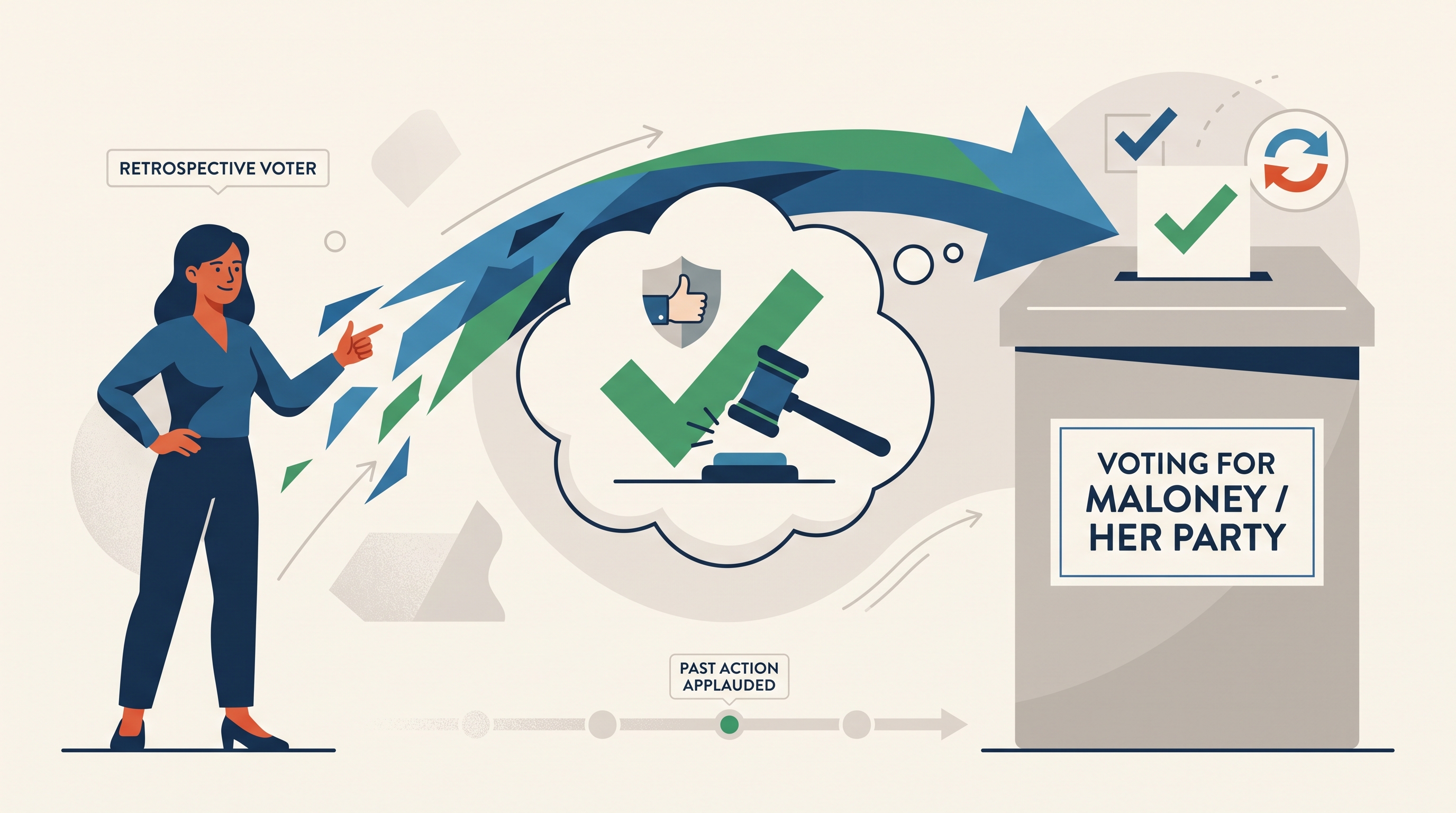
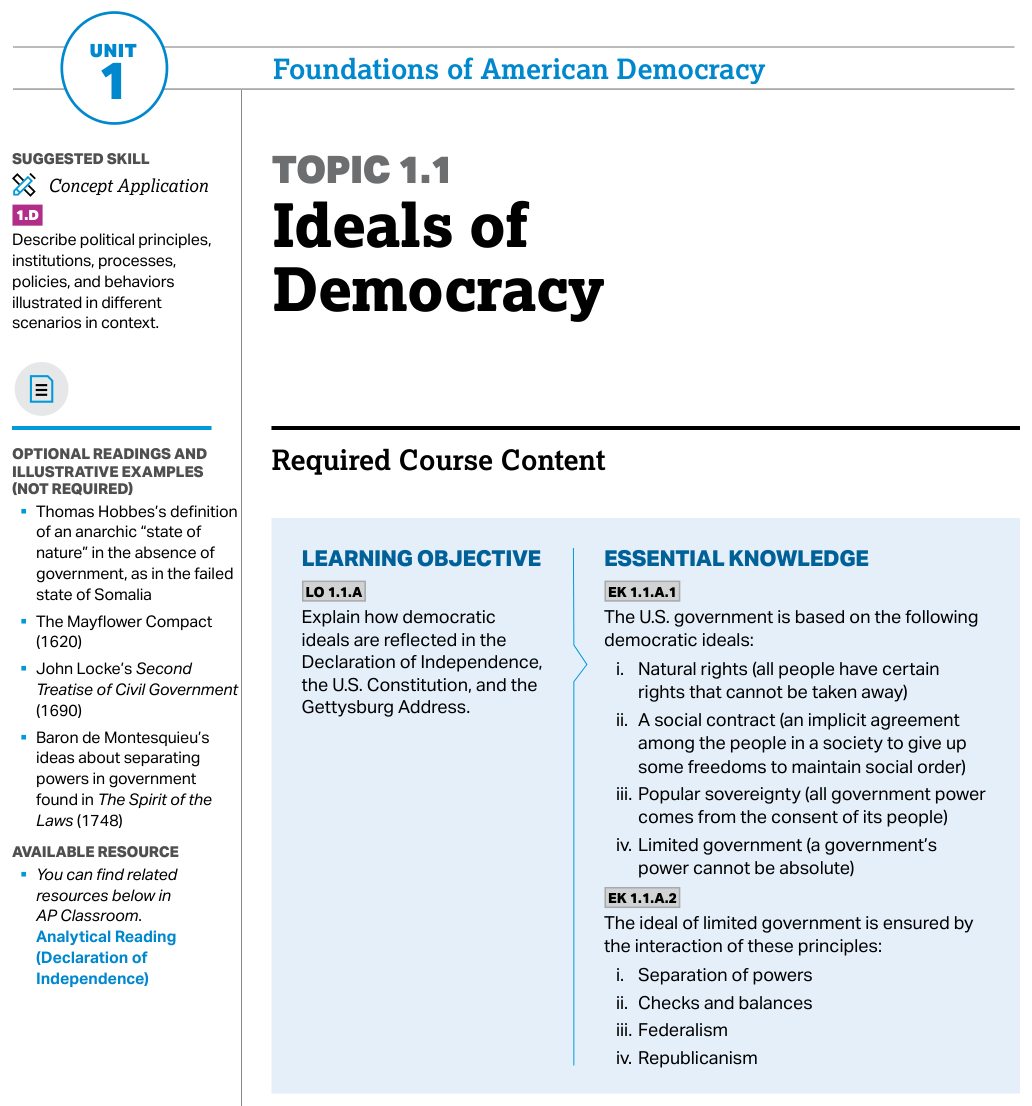
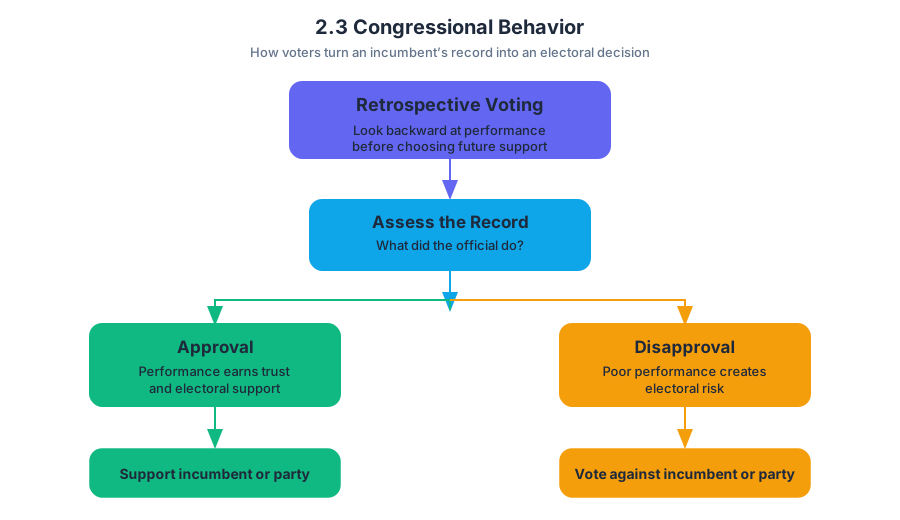
2.4 Roles and Powers of the President
A president can reject a bill, direct federal agencies, negotiate with foreign governments, command the armed forces, and persuade Congress—but these actions do not all come from the same constitutional source.
2.4 Roles and Powers of the President
A president can reject a bill, direct federal agencies, negotiate with foreign governments, command the armed forces, and persuade Congress—but these actions do not all come from the same constitutional source. The central question is: How does the president turn the office’s powers and institutional support into a policy agenda?
The presidency as an agenda-building institution
LO 2.4.A — Explain how presidents use powers and perform functions of the office to accomplish a policy agenda. A policy agenda is the set of goals a president seeks to advance, such as expanding health coverage, changing immigration enforcement, or revising foreign-policy priorities. Presidents rarely accomplish those goals through personal action alone; they rely on the Vice President, Cabinet, and Executive Office of the President.
The Cabinet consists of the leaders of executive departments, such as the secretary of state or secretary of defense. The Executive Office of the President (EOP) is a collection of specialized offices and advisers that help the president manage information, budgeting, communications, national security, and policy coordination. Together, these institutions give the president expertise and administrative capacity—but they do not erase the constitutional division between the branches.
EK 2.4.A.1 — Presidents use powers and perform functions of the office, with support from the Vice President, Cabinet, and Executive Office of the President, to accomplish a policy agenda.
Formal and informal presidential powers
EK 2.4.A.2 — The powers of the president include both formal and informal powers. Formal powers are powers explicitly granted by the Constitution or by federal law. Informal powers are tools that presidents use because of political influence, executive practice, or authority implied by the constitutional structure.
| Presidential tool | Type | What it does |
|---|---|---|
| Veto | Formal | Rejects a bill passed by Congress |
| Pocket veto | Formal | Prevents a bill from becoming law when Congress adjourns during the review period |
| Commander-in-chief authority | Formal | Directs the armed forces |
| Treaties | Formal, with Senate role | Establishes international agreements subject to Senate ratification |
| Executive agreements | Informal | Make international commitments without the treaty-ratification process |
| Bargaining and persuasion | Informal | Encourages Congress or other political actors to support presidential goals |
| Executive orders | Implied or delegated authority | Directs the operation of the federal government |
| Signing statements | Informal | Announces the president’s interpretation of a law being signed |
Worked example: stopping a bill
Imagine Congress passes a bill requiring every federal agency to use a new environmental reporting system. The president believes the bill is harmful and issues a veto, a formal power that prevents the bill from becoming law. Congress can still enact it, but only by overriding the veto with a two-thirds vote in both the House and Senate.
A pocket veto works differently. If Congress adjourns during the period in which the president may consider the bill, and the president does not sign it, the bill fails without the president returning it to Congress. Unlike an ordinary veto, a pocket veto cannot be overridden by a two-thirds congressional vote.
The reasoning chain is therefore:
- Congress passes legislation.
- The president chooses to sign, veto, or—under the conditions for a pocket veto—allow the bill to die.
- An ordinary veto preserves a congressional override option.
- A pocket veto ends the bill without that override route.
Foreign policy and executive influence
Presidential foreign-policy power combines formal and informal authority. The president acts as commander in chief, a formal constitutional role, and participates in treaty-making. At the same time, presidents use executive agreements, which are international commitments made without obtaining the Senate’s treaty-ratification vote.
For example, a president seeking an international climate commitment might negotiate an executive agreement with another government. This can be faster than pursuing a treaty, but it is not identical to a treaty and may be more vulnerable to later political or legal change.
Managing government and shaping interpretation
An executive order is a presidential directive used to manage the federal government. Its authority may rest on the president’s constitutionally vested executive power or on authority Congress has delegated through legislation. An executive order can organize agency action, establish administrative priorities, or instruct officials about enforcement—but it cannot validly create unlimited power where the Constitution or statutes provide none.
A signing statement is an informal power through which the president explains how the administration understands a law being signed. It informs Congress, federal officials, and the public about the president’s interpretation. It is not the same as a veto: the law has already been signed.
Key distinction: A veto prevents a bill from becoming law; a signing statement accompanies a law that the president has accepted.
Misconception check
Misconception: “The president can simply order any policy into existence.” Correction: presidential power is substantial but structured. Some tools are formal, some informal, and many depend on congressional authorization, administrative implementation, public support, or cooperation from other political actors. Presidential action can advance an agenda, but it does not eliminate separation of powers.
AP skill connection
This topic most directly develops Concept Application—especially 1.C, “Explain the impact of political concepts and processes on political systems”—by connecting presidential tools to policy outcomes. It also supports the suggested Source Analysis skill, “Explain how the argument,” when a source claims that executive action strengthens presidential leadership or creates tension with Congress. A strong explanation identifies the power, classifies it as formal or informal, and then explains its likely effect.
Retrieval check: A president signs a law but issues a public document explaining that the executive branch will interpret one provision narrowly. Which tool is being used, and why is it not a veto?

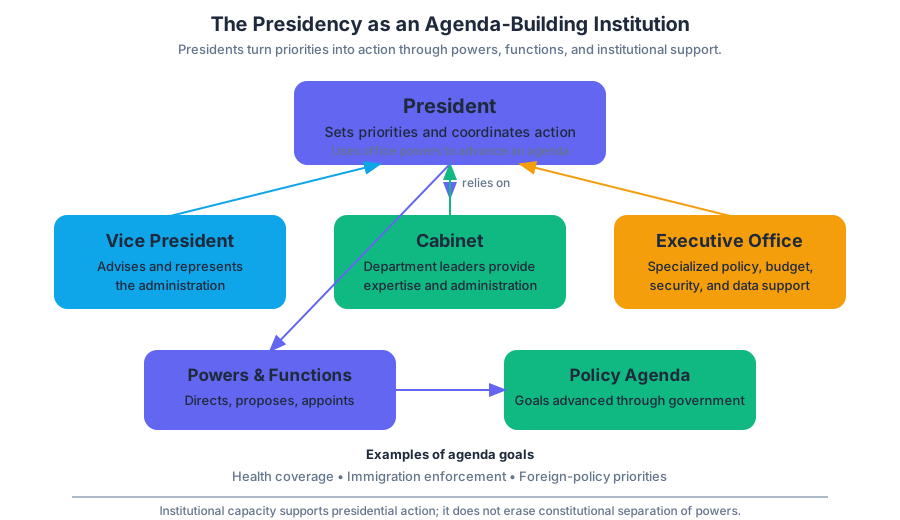
2.5 Checks on the Presidency
A president may act quickly, but cannot lawfully govern alone. The constitutional design places presidential power inside a system of checks and balances, in which Congress, the courts, and sometimes public and state resistance can limit, redirect, or review presidential action.
2.5 Checks on the Presidency
A president may act quickly, but cannot lawfully govern alone. The constitutional design places presidential power inside a system of checks and balances, in which Congress, the courts, and sometimes public and state resistance can limit, redirect, or review presidential action.
Learning Objective CON-5.B: Explain how other branches in the government can check the powers of the presidency.
The central tension is straightforward: energetic leadership can make government effective, but unchecked executive power can threaten liberty and states’ rights. Federalist No. 70 defends an energetic executive because one president can respond more quickly and decisively than a large legislature. The constitutional system answers with a second principle: speed does not eliminate accountability.
The constitutional “brakes” on presidential power
Congressional checks operate through several powers granted primarily in Article I. Congress can pass laws that shape or restrict executive action, refuse to fund an initiative through its control of appropriations, investigate executive agencies through oversight, approve or reject major appointments, and impeach and remove officials under the constitutional process.
The Senate’s confirmation power is especially important for presidential appointments. A president may nominate a justice, cabinet secretary, or agency leader, but the Senate must consent before many of those officials take office. Sandra Day O’Connor and Thurgood Marshall illustrate successful judicial appointments; Robert Bork illustrates a nomination that failed to receive Senate confirmation. The president selects the nominee, but the Senate controls the second constitutional step.
Congress also checks the president through legislation. Suppose a president proposes a nationwide education program. The president may recommend the policy and direct executive officials to administer it, but Congress must authorize the program and provide funding. The No Child Left Behind Act illustrates how national policy can emerge through legislation rather than presidential command alone.
Worked example: a military action
Imagine that a president orders a long military operation without a clear, continuing authorization from Congress. The president can act as commander in chief, but Congress retains powers connected to declaring war, appropriating funds, and conducting oversight. Congress could hold hearings, limit or refuse funding, require reports, or pass legislation governing the operation.
The Vietnam and Iraq conflicts demonstrate why this check matters. Presidential control over military operations can produce rapid decisions, while congressional involvement supplies deliberation, representation, and a possible limit on executive action. The conflict is not simply “president versus Congress”; it is a constitutional disagreement over which branch has authority at a particular stage of policymaking.
Judicial checks
The federal courts can check the presidency through judicial review, the power to determine whether government action violates the Constitution. If a presidential action conflicts with a statute, exceeds constitutional authority, or violates individual rights, a court may block or invalidate that action.
Judicial review does not mean that courts manage the executive branch day by day. Courts generally decide concrete cases brought by parties with a legal injury. Their check is therefore usually indirect: a dispute reaches court, the court interprets the relevant constitutional or statutory rule, and the resulting decision constrains presidential officials.
A visual decision path
When analyzing a presidential-checks scenario, trace the policy through this sequence:
- Presidential action: What did the president order, nominate, veto, or direct?
- Congressional response: Can Congress legislate, control funding, investigate, confirm, or impeach?
- Judicial response: Is there a justiciable dispute involving constitutional or statutory limits?
- Institutional consequence: Which branch gains authority, and which presidential action is limited?
Misconception check
Misconception: “Checks and balances mean the president has no real power.”
The opposite is closer to the constitutional design. The president possesses substantial independent authority, especially in execution, administration, foreign affairs, and military command. Checks do not erase presidential power; they require that power to operate within a structure where another institution can resist or review it.
Misconception: “The president can avoid checks by claiming that quick action is necessary.”
Urgency may strengthen the argument for executive action, but it does not automatically cancel congressional or judicial authority. A strong AP response distinguishes between an argument for energetic leadership and the constitutional question of whether the action remains subject to proper checks.
AP skills and reasoning processes
This topic is most directly assessed through Skill 1.B: Explain political concepts and processes, especially by explaining how oversight, appropriations, confirmation, impeachment, legislation, and judicial review constrain presidential action. It also develops Skill 2.B: Explain how a Supreme Court decision relates to a political issue, when a court’s interpretation limits executive authority.
For source-based questions, use Skill 4.B: Explain the author’s argument, perspective, or reasoning. For example, Federalist No. 70 supports energetic executive leadership, while an opposing argument warns that access to federal resources can threaten liberty without proper checks. Argument questions draw on Skill 5.A: Develop a claim or thesis, and Skill 5.C: Use refutation, concession, or rebuttal, by acknowledging the value of quick presidential action and then explaining why institutional limits remain necessary.
Retrieval check
A president nominates a Supreme Court justice, orders a new domestic program, and requests funding for it. Name one congressional check and one judicial check that could limit presidential power. Then explain why Federalist No. 70’s defense of an energetic executive does not eliminate checks and balances.
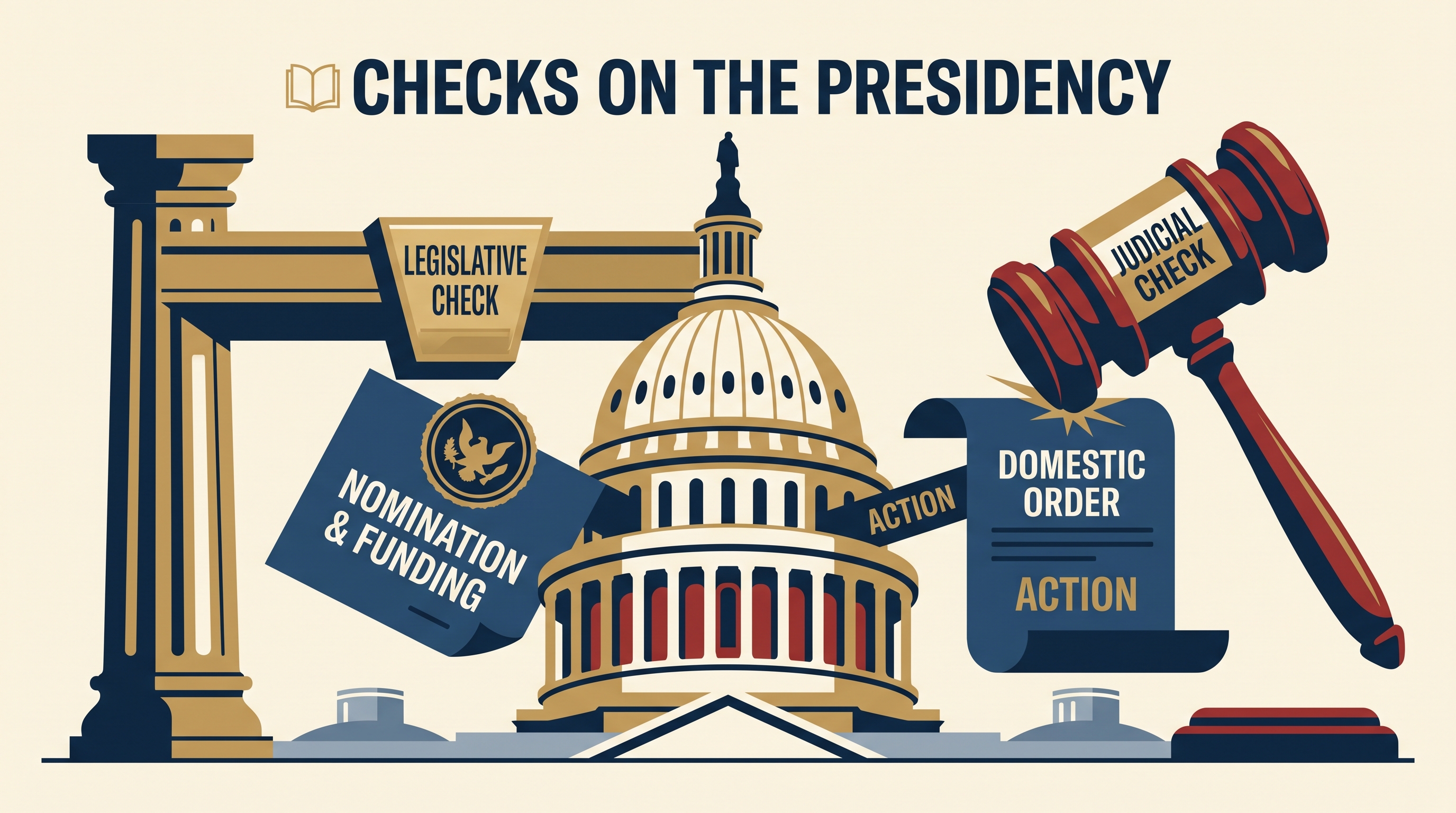
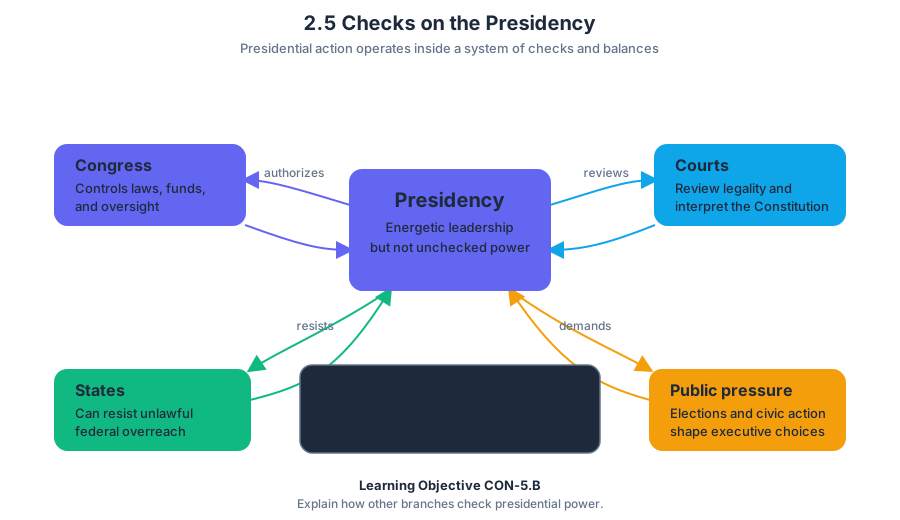
2.6 Expansion of Presidential Power
A president can expand the practical reach of the office without changing the constitutional text: the central question is whether presidential leadership is a necessary tool for effective government or a threat to limited government.
2.6 Expansion of Presidential Power
A president can expand the practical reach of the office without changing the constitutional text: the central question is whether presidential leadership is a necessary tool for effective government or a threat to limited government. Expansion of presidential power refers to the broader interpretation and use of presidential authority through both formal powers, which come from the Constitution or laws, and informal powers, which arise from political practice, public expectations, persuasion, and claims of executive responsibility.
LO 2.6.A: Explain how presidents have interpreted and justified their use of formal and informal powers.
The argument for a strong executive
The classic justification for an energetic presidency appears in Federalist No. 70. Alexander Hamilton argues that a single executive is valuable because a unified leader can provide energy, decisiveness, accountability, and protection in moments of danger. The argument is not simply that presidents should be powerful; it is that a sufficiently strong executive is “essential to the protection of the country against foreign attacks, to the steady administration of the laws, to the protection of property, and to the security of liberty” (EK 2.6.A.1).
This reasoning treats executive power like a command center during an emergency: one person can act more quickly than a large legislature, and voters can identify who is responsible for the decision. Presidents may therefore justify executive action by pointing to national security, enforcement of the laws, or the need to respond rapidly when Congress has not acted.
A president might use a formal power, such as directing executive agencies or serving as commander in chief, while also relying on informal powers, such as negotiating privately with legislators, appealing directly to the public, or interpreting broad statutory language. The legal source of the action and the political method used to carry it out are different questions.
Why expansion creates constitutional tension
The same flexibility that allows a president to respond quickly can weaken the principle of limited government. If presidents increasingly claim that broad national interests authorize unilateral action, Congress may have less influence over policymaking, and the separation of powers may shift toward the executive branch. The constitutional debate is therefore not simply “strong president versus weak president”; it is a disagreement about how much initiative the office requires and where legitimate authority ends.
The Twenty-Second Amendment, which established presidential term limits, demonstrates concern about the expansion of presidential power (EK 2.6.A.2). Its adoption reflected anxiety that a president who remains in office for too long could accumulate excessive influence over agencies, public opinion, appointments, and national policy. Term limits constrain the office even when a president remains popular and politically effective.
Competing presidential perspectives
Different presidents and political thinkers have defended different versions of the presidential role. William Howard Taft’s Our Chief Magistrate and His Powers represents a more limited interpretation: the president should exercise authority grounded in the Constitution or in legislation. Theodore Roosevelt’s An Autobiography is associated with a more expansive view, in which the president may take action for the national interest unless the Constitution or law clearly forbids it. Franklin Delano Roosevelt’s 1941 State of the Union Address provides another context for examining how national crisis can support a broader understanding of presidential responsibility.
These perspectives remain relevant when presidents respond to contemporary events. A president who orders an action during an international crisis may argue that speed and national security require executive initiative. Critics may answer that congressional authorization is necessary, especially when the action creates long-term obligations or affects individual rights. The disagreement illustrates EK 2.6.A.3: perspectives on the presidential role range from limited to expansive interpretations and continue to be debated.
Worked contextual example: analyzing a presidential action
Imagine that a president directs executive agencies to begin a national emergency program after Congress has delayed legislation. The president claims that existing law gives the executive branch discretion to act; opponents argue that the president is creating new policy without legislative authorization.
Apply Suggested Skill 4.A, Source Analysis: Describe the argument, perspective, evidence, and reasoning presented in the source. First identify the president’s argument: immediate executive action is necessary to address the emergency. Next identify the perspective: an expansive view of presidential responsibility. Then locate the evidence: the president points to existing statutory language and the urgency of the crisis. Finally explain the reasoning: because the law grants administrative discretion and delay threatens the public interest, executive action is presented as legitimate.
A complete analysis must also identify the opposing perspective. Critics may argue that the president is using informal initiative to accomplish what requires new legislation. The key issue is not whether the president acted decisively, but whether the action is justified by an existing formal power or represents an unsupported expansion of executive authority.
Misconception check
Misconception: “Expansion of presidential power means the president has unlimited power.” Expansion means that presidents interpret or use existing formal and informal powers more broadly; it does not erase constitutional limits. Congress, the courts, laws, elections, term limits, and public scrutiny can still constrain presidential action, even though the balance among branches may change over time.
Retrieval check: Why does Federalist No. 70 support a strong executive, and why does the Twenty-Second Amendment suggest concern about executive power? In one sentence, connect each document or constitutional provision to the competing debate between energetic leadership and limited government.
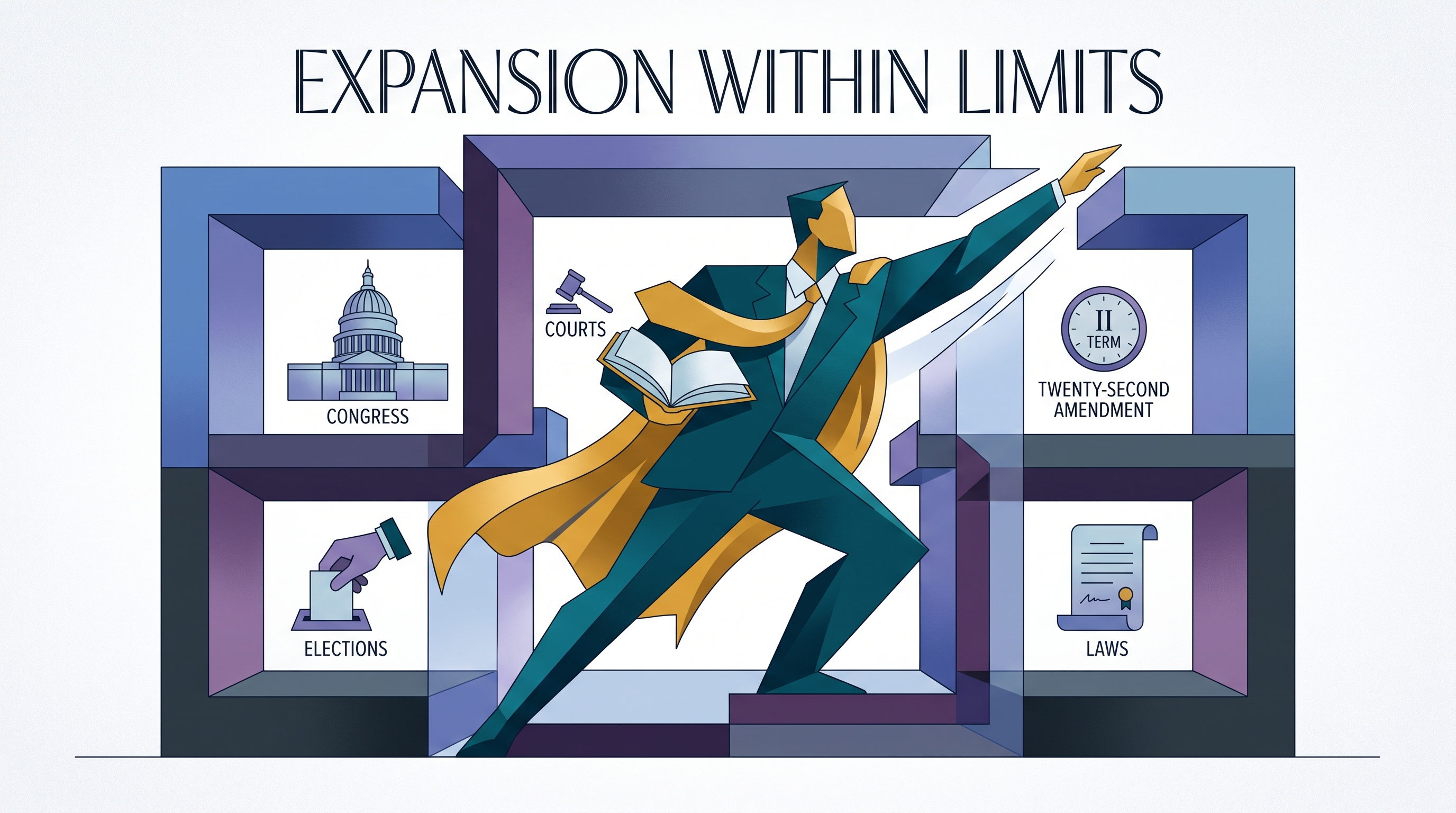
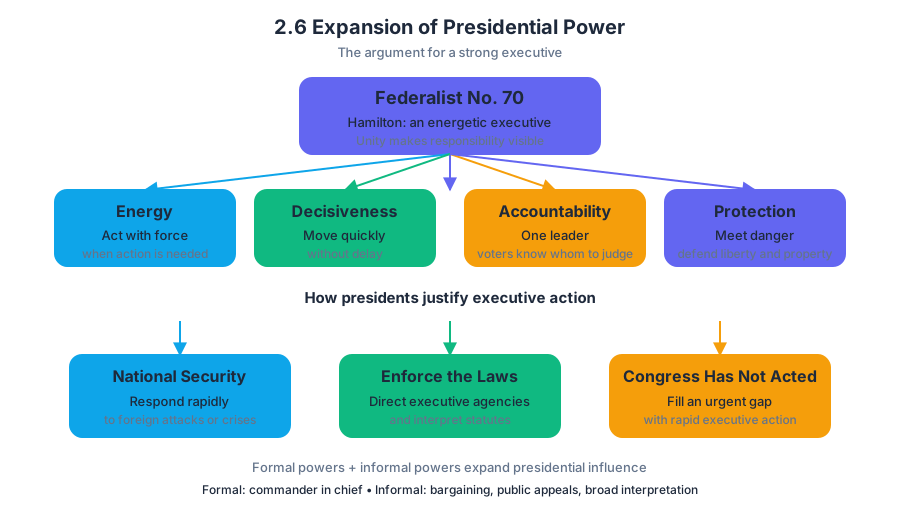
2.7 Presidential Communication
A president may possess formal constitutional powers, but those powers become politically effective only when the president can explain, defend, and build support for proposed action.
2.7 Presidential Communication
A president may possess formal constitutional powers, but those powers become politically effective only when the president can explain, defend, and build support for proposed action. Presidential communication is the use of speeches, news conferences, interviews, social media, public ceremonies, and other channels to shape public opinion, influence Congress, and establish a policy agenda.
CED Topic 2.7 — Presidential Communication
Learning Objective 2.7.A: Explain how the president’s use of media affects public opinion and policy.
Essential Knowledge 2.7.A.1: Presidents use various forms of communication to influence public opinion and policymaking.
The president as a national messenger
The president is unusually visible in American politics. A single presidential speech can reach citizens across the country, attract immediate news coverage, and pressure other political actors to respond. This communication advantage is often called the bully pulpit: the president’s ability to use the visibility and prestige of the office to promote ideas and mobilize support.
The bully pulpit is persuasive, not legally coercive. A president cannot make Congress pass a bill simply by delivering a speech, but public attention can change the political costs of opposing or supporting that bill.
Presidential communication commonly serves four connected purposes:
- Agenda setting: directing public and governmental attention toward an issue.
- Policy explanation: presenting a proposal in language ordinary citizens can understand.
- Coalition building: encouraging supporters, legislators, interest groups, and party organizations to act together.
- Political accountability: claiming credit for favorable outcomes or assigning blame for failures.
The same event can perform several functions at once. A president discussing disaster relief may reassure affected citizens, demonstrate command of the situation, pressure Congress to approve funding, and signal competence to voters.
Communication channels and audience effects
Presidents choose communication channels strategically. A formal address can create a sense of national importance; a news conference allows journalists to press for answers; a campaign-style rally energizes partisan supporters; and a social-media post can bypass traditional news organizations and reach followers directly.
| Communication channel | Likely audience | Political advantage | Limitation |
|---|---|---|---|
| National address | Broad national public | Creates shared attention | Citizens may interpret it through partisan preferences |
| News conference | Journalists and politically attentive citizens | Allows direct questioning | Unscripted answers can create political risks |
| Rally | Party supporters and activists | Builds enthusiasm and mobilization | May deepen partisan division |
| Social media | Targeted followers and rapid-response audiences | Speed and direct access | Encourages selective exposure and short, simplified messages |
| State of the Union address | Congress, citizens, and media | Publicly presents an agenda | Congress is not required to adopt the proposals |
Why communication does not guarantee persuasion
Presidential messages compete with partisan identity, prior beliefs, interest-group messaging, and media interpretation. Citizens frequently process the same statement through motivated reasoning, meaning they accept information that supports their existing views more readily than information that challenges them.
Modern presidents also communicate in a fragmented media environment. Instead of one shared national audience, citizens may receive different clips, headlines, commentary, and algorithmically selected posts. The president can reach supporters more directly, but direct access does not ensure broad agreement.
Key distinction: A president may successfully control what issue receives attention without successfully controlling what the public believes about that issue.
Worked contextual example: a climate-policy proposal
Imagine that a president proposes a national program to reduce carbon emissions. The president gives a televised address describing the plan as an effort to protect public health and create clean-energy jobs. The administration then releases short online videos aimed at younger voters, meets with business groups, and urges members of Congress to support legislation.
The communication strategy can be analyzed step by step:
- The televised address performs agenda setting by making climate policy a nationally visible issue.
- The explanation of health and employment benefits frames the proposal in terms likely to appeal beyond environmental activists.
- Meetings with business groups attempt coalition building.
- Appeals to Congress use public attention as indirect pressure.
- If the proposal fails, the president may communicate that congressional opposition caused the failure; if it succeeds, the president may claim credit.
The outcome still depends on congressional incentives, public opinion, party polarization, interest-group activity, and the strength of competing messages. Communication creates political pressure; it does not replace the constitutional lawmaking process.
Misconception check
Misconception: “The president controls the media and can persuade the public whenever desired.” Presidents can attract attention, frame issues, and communicate directly with citizens, but journalists, opposing parties, interest groups, platforms, and citizens all affect how messages are received. A popular speech may improve support temporarily without producing a lasting policy change.
AP skill in action
This topic is especially assessed through 1.A Concept Application: Explain how political principles, institutions, processes, policies, and behaviors apply to different scenarios in context. On an exam, identify the communication method described, explain its political purpose, and connect it to a likely effect on public opinion or policymaking. Naming a speech is not enough; the response must show the mechanism—for example, how agenda setting increases attention or how a rally mobilizes partisan supporters.
Retrieval check
A president uses a national address to make an unfamiliar infrastructure proposal the central subject of public debate. What presidential-communication function is most directly illustrated, and why might the address still fail to produce legislation?
Answer: It illustrates agenda setting because the president is directing attention toward the proposal. It may fail because Congress, parties, interest groups, public opinion, and competing interpretations—not presidential communication alone—determine whether legislation passes.

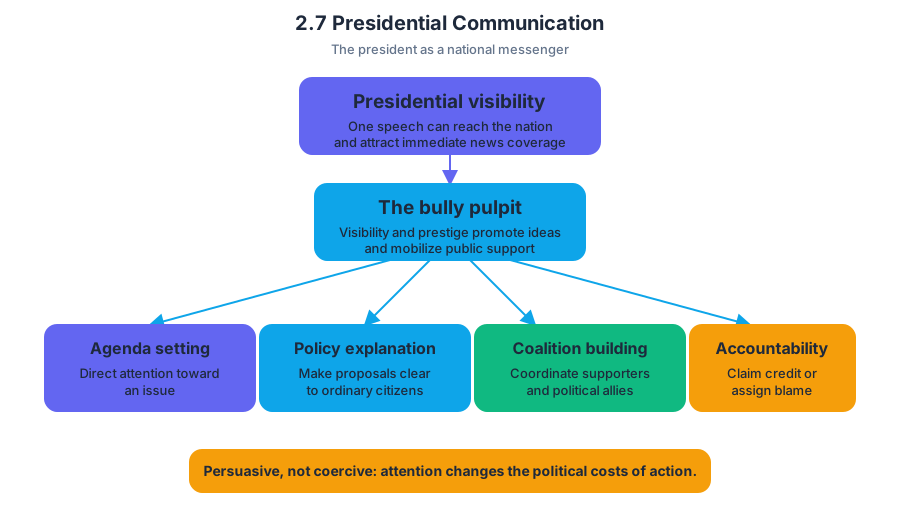
2.8 The Judicial Branch
A law can pass Congress, receive presidential approval, and still be refused by the courts if it conflicts with the Constitution. That power—judicial review, the authority of courts to determine whether government action is constitutional—is the judiciary’s central check on the legislative and executive branches.
2.8 The Judicial Branch
A law can pass Congress, receive presidential approval, and still be refused by the courts if it conflicts with the Constitution. That power—judicial review, the authority of courts to determine whether government action is constitutional—is the judiciary’s central check on the legislative and executive branches.
LO 2.8.A: Explain the principle of judicial review and how it checks the power of other branches.
The constitutional foundation: Article III
Article III of the Constitution establishes the judicial branch of the national government. It creates a federal judiciary headed by the Supreme Court and gives federal judges an important protection: they serve during “good behavior,” effectively giving them tenure that is not tied to election cycles.
This arrangement supports judicial independence, meaning that judges can decide cases without needing to satisfy voters, party leaders, or the president in order to remain in office. Independence does not mean that courts are unlimited or unaccountable; it means that decisions should be based on constitutional and legal reasoning rather than direct political pressure.
The constitutional checking relationship can be represented as a three-stage test:
- Congress or the president takes action. Congress passes a statute, or the executive branch enforces a policy.
- A constitutional conflict reaches a federal court. Courts generally evaluate government action through an actual legal dispute rather than issuing abstract advice.
- The court applies the Constitution. If the action conflicts with the Constitution, the judiciary may refuse to enforce it or invalidate the law as unconstitutional.
Judicial review therefore checks power by placing constitutional limits above ordinary government decisions. A majority in Congress cannot make an unconstitutional act valid merely by voting for it, and presidential enforcement cannot rescue a policy that violates constitutional protections.
Federalist No. 78: why an independent judiciary can check power
Federalist No. 78 provides the argument for why judicial independence helps preserve limited government. The judiciary is not elected in the same way as the legislative and executive branches, and federal judges hold office for life during good behavior. These features make courts less directly dependent on temporary popular or partisan pressures.
The point is not that judges should govern instead of elected officials. Rather, the judiciary acts as an interpreter and defender of the Constitution when ordinary political actors exceed their authority. Judicial review makes the Constitution an enforceable limit, not merely a statement of ideals.
Key distinction: Judicial review gives courts power to judge the constitutionality of government actions; judicial independence helps courts exercise that power without direct electoral retaliation.
Worked example: checking congressional power
Imagine that Congress passes a law allowing federal investigators to search every person’s private digital messages without a warrant or individualized suspicion. The president directs executive agencies to enforce the law, and an affected person challenges the search in federal court.
The court would reason through the dispute rather than simply asking whether the policy is popular:
| Step | Constitutional reasoning |
|---|---|
| Government action | Congress enacted the statute, and the executive branch began enforcing it. |
| Legal challenge | A person whose messages were searched claims that the law violates constitutional protections. |
| Judicial review | The court compares the statute and its enforcement with the Constitution. |
| Possible check | If the law is unconstitutional, the court can block its application to the plaintiff or invalidate the conflicting provision. |
The example shows why the branches interact rather than operate in isolation. Congress makes laws, the president executes them, and the judiciary determines whether the challenged action fits within constitutional boundaries. The court is not replacing the legislature’s policy judgment; it is enforcing the higher legal authority of the Constitution.
Misconception check: “Judicial review makes the Supreme Court more powerful than Congress”
Misconception: Because courts can invalidate laws, the Supreme Court is constitutionally superior to the elected branches in every respect.
Correction: Judicial review is a check, not a general power to create policy. Courts decide legal disputes within the judicial function, while Congress legislates and the president administers the laws. Judicial independence limits political control over judges, but the judiciary still depends on the other branches for implementation, funding, appointments, and compliance with decisions.
AP skill in action: SCOTUS Application 2.B
SCOTUS Application 2.B: Explain how a required Supreme Court case relates to a foundational document or to other primary or secondary sources.
For Topic 2.8, the strongest source connection is between a required Supreme Court case involving judicial review and the foundational documents Article III and Federalist No. 78. A complete explanation must do more than name the documents: it should connect Article III’s creation and protection of the federal judiciary to Federalist No. 78’s argument that an independent judiciary can restrain unconstitutional actions by the other branches.
Retrieval check: A student writes, “Article III establishes the judicial branch, while Federalist No. 78 explains why judges’ independence and life tenure allow courts to use judicial review to preserve limited government.” What makes this stronger than simply writing “the judiciary checks Congress”?
Answer: It identifies two specific pieces of evidence and explains their relationship to the claim: Article III supplies the constitutional foundation, while Federalist No. 78 explains how judicial independence enables the check.
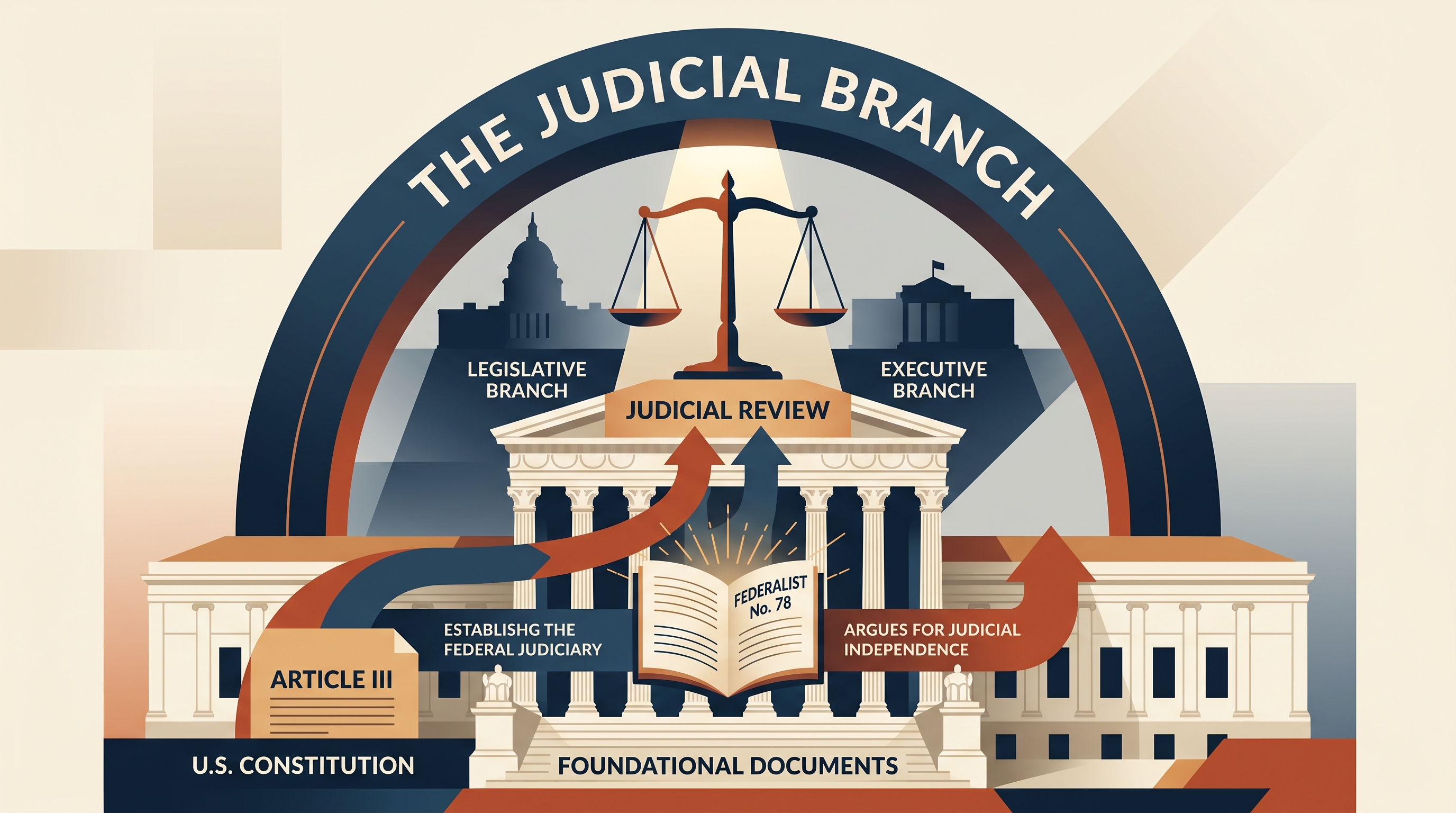
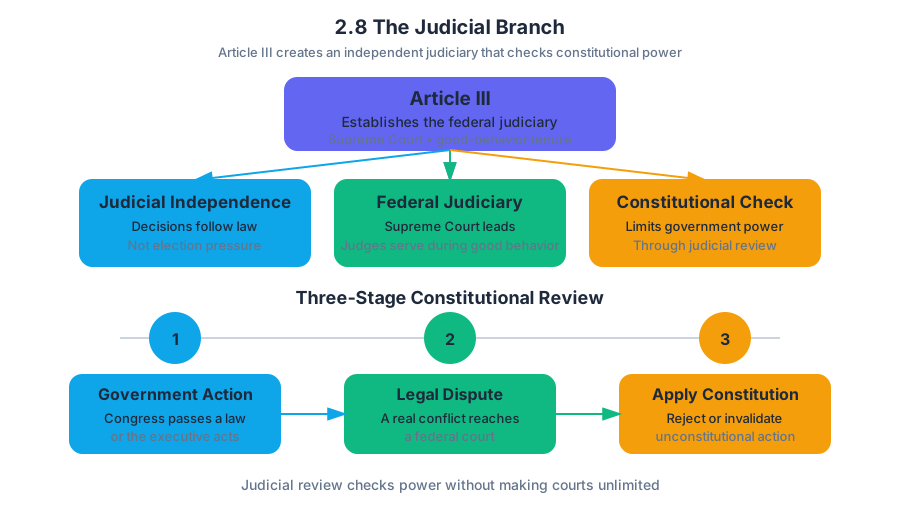
2.9 The Role of the Judicial Branch
Key concepts: Role of the judicial branch · Independent judiciary · Judicial review · Limited government · Checks and balances · Congressional oversight · New Deal conflict between Congress and the judiciary · Judicial decision making · Natural rights and protection from discrimination · Lessee (1816)
An independent judiciary can preserve limited government by reviewing whether government officials and institutions have acted within constitutional boundaries.
2.9 The Role of the Judicial Branch
An independent judiciary can preserve limited government by reviewing whether government officials and institutions have acted within constitutional boundaries.
LO 2.9.A: Explain the role of legal precedent in judicial decision making.
The central tension is straightforward: courts must be strong enough to restrain unconstitutional government action, yet limited enough to respect elected institutions and legal precedent. Judicial review gives courts this checking role; stare decisis gives their decisions continuity.
Independence, judicial review, and limited government
Judicial review is the authority of courts to determine whether laws or government actions conflict with the Constitution. It supports limited government, the principle that government power is restricted by law, constitutional rules, and individual rights.
Alexander Hamilton defended an independent judiciary in Federalist No. 78. Article III establishes the federal judicial branch and protects the conditions under which judges exercise judgment rather than simply follow temporary political pressures. Life tenure during “good Behaviour” is designed to reduce direct dependence on elected officials, although the judiciary remains connected to the political system through presidential appointments and Senate confirmation.
The relationship can be represented as a constitutional feedback loop:
- Congress passes a law.
- The executive branch enforces it.
- A legal dispute reaches a court.
- The court applies constitutional principles and precedent.
- If the law violates the Constitution, judicial review can block its enforcement.
- Congress and the executive may respond through new legislation, appointments, funding decisions, or changes in enforcement.
This arrangement illustrates checks and balances: each branch has tools that limit the others. Judicial review is a particularly important check because courts can protect constitutional boundaries even when a law has been approved by elected officials.
Precedent and stare decisis
EK 2.9.A.1: Stare decisis is the legal doctrine under which courts follow legal precedents when deciding cases with similar facts. A precedent is an earlier judicial decision that supplies a rule or reasoning for later cases.
Precedent makes law more predictable. If two cases involve substantially similar constitutional questions, treating them alike promotes stability and reduces the risk that legal outcomes will depend only on which judges happen to be sitting on a particular day. However, stare decisis is not an absolute command. Courts may distinguish a precedent because the facts differ, limit its reach, or reject it when constitutional interpretation changes.
EK 2.9.A.2: Ideological changes in the composition of the Supreme Court resulting from presidential appointments have led the Court to establish new precedents or reject existing ones. Appointments therefore can influence constitutional meaning over time, but a new justice does not automatically produce a new ruling; the Court must still decide an actual case and justify its reasoning.
Worked example: Martin v. Hunter’s Lessee (1816)
In Martin v. Hunter’s Lessee (1816), the Supreme Court addressed whether it could review a decision by a state court involving federal law. The practical issue was not merely who owned disputed property. The larger constitutional question was whether federal judicial authority could operate consistently across the states.
Reasoning chain:
| Question | Constitutional significance |
|---|---|
| Could a state court’s interpretation of federal law be reviewed? | Federal law requires a uniform national interpretation. |
| Could state courts have the final word on federal questions? | Different state interpretations could weaken national constitutional authority. |
| What institutional principle follows? | The federal judiciary has a role in maintaining consistent constitutional law. |
The case demonstrates the judicial branch’s role as an interpreter of federal law and constitutional limits. It also shows why judicial review is connected to federalism: courts help determine how authority is divided between state and national governments.
The legislature as both check and accountable institution
Some argue that the judiciary is more effective than the legislature at preserving limited government because judicial review allows courts to invalidate unconstitutional actions directly. Courts are insulated from immediate electoral pressure, and an individual or group can challenge government action even when it is politically popular.
The legislature, however, has its own constitutional importance. Members of Congress can be held responsible by voters through elections, and Congress can check the other branches through legislation, appropriations, confirmations, investigations, and congressional oversight—the process of monitoring executive agencies and officials. This creates a trade-off: courts may offer stronger protection against majoritarian violations, while legislators possess greater direct democratic accountability.
A New Deal conflict illustrates this tension. During the 1930s, the Supreme Court invalidated parts of President Franklin Roosevelt’s economic program, while Congress had enacted major legislation to respond to the Great Depression. Critics viewed the Court as obstructing elected lawmakers’ efforts to address an emergency; defenders argued that constitutional limits must remain enforceable even during a crisis.
Misconception check
Misconception: “Judicial review makes the Supreme Court superior to Congress.” Judicial review gives courts authority to judge constitutionality in cases, but it does not make the judiciary the only branch that interprets the Constitution. Congress remains electorally accountable and can write new laws, oversee implementation, propose amendments, control funding, and shape the federal courts through appointments and jurisdictional decisions permitted by the Constitution.
Judicial outcomes can therefore be connected to foundational principles such as natural rights and the government’s responsibility to protect people from discrimination. The judicial branch does not simply settle private disputes; through precedent and constitutional interpretation, it helps define how liberty, equality, and limited government operate in practice.
Suggested Skill — Concept Application: Describe political principles, institutions, processes, policies, and behaviors illustrated in different scenarios in context. SCOTUS Application is especially useful here: connect a case such as Martin v. Hunter’s Lessee to judicial review, federal authority, and an independent judiciary rather than merely recalling its name.
Retrieval check
A law is popular, Congress passes it, and the executive begins enforcing it. A court later finds that it violates a constitutional right. Identify the mechanism involved, explain how it supports limited government, and name the doctrine that encourages courts to treat similar future cases consistently.
Answer: The mechanism is judicial review; it supports limited government by enforcing constitutional restrictions on government power; and the doctrine is stare decisis.
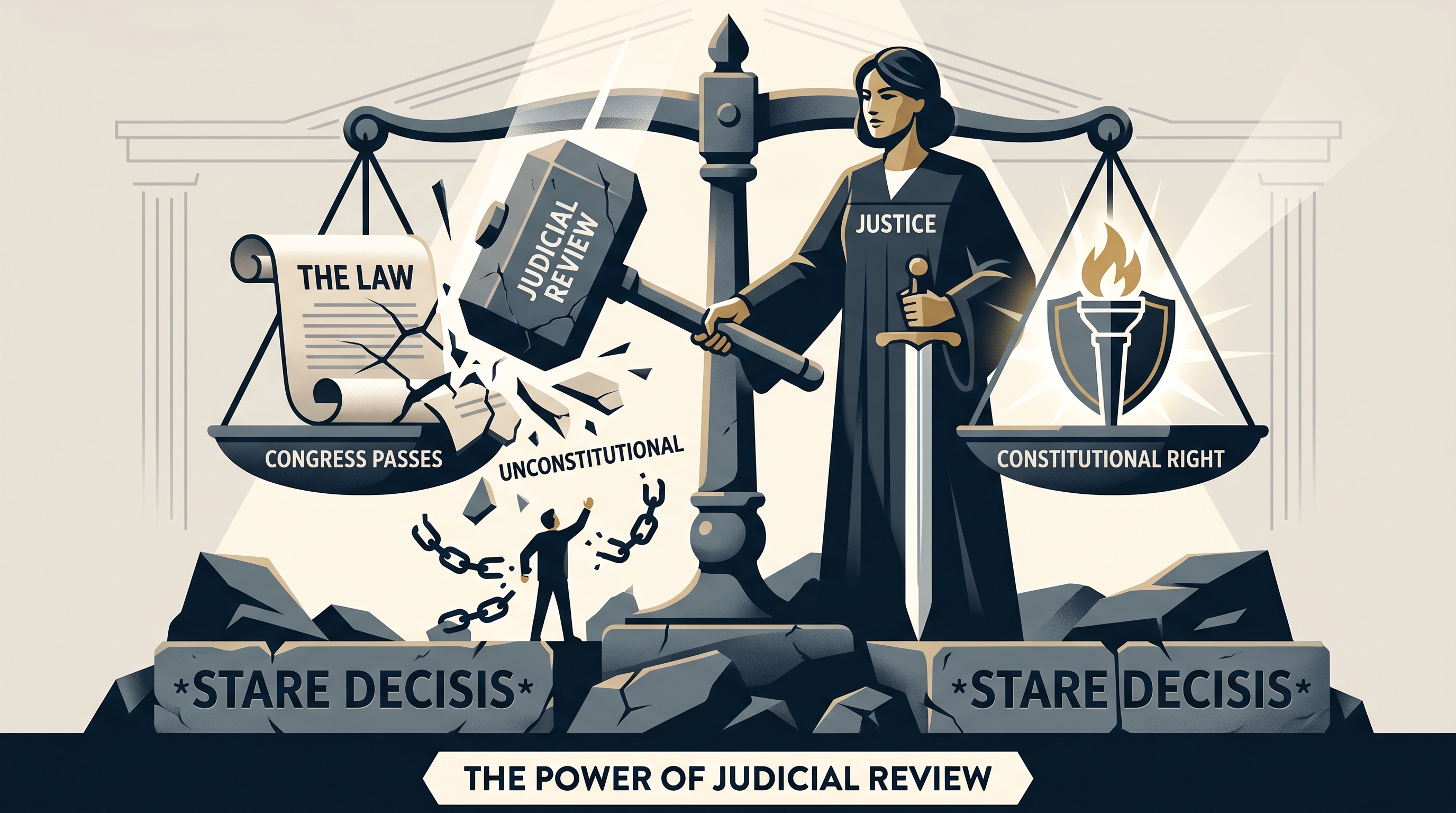
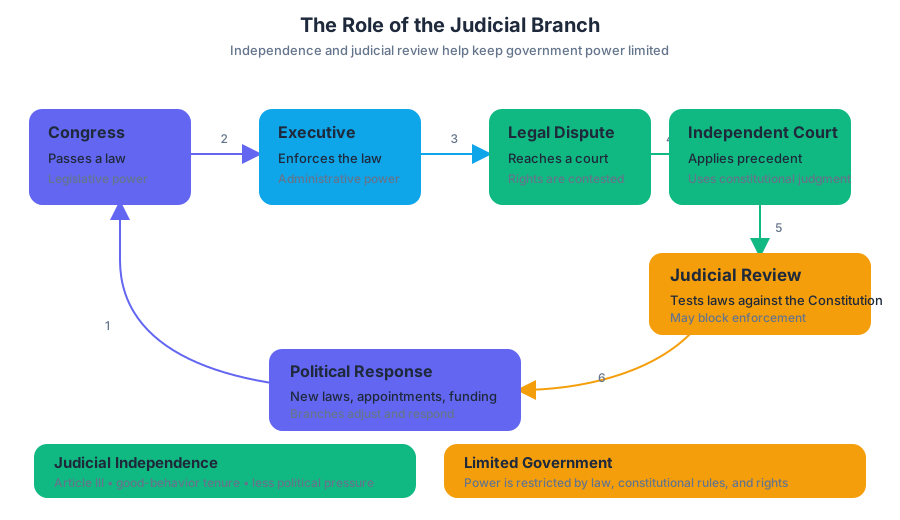
2.10 The Court in Action
Key concepts: Supreme Court decision-making and legal holdings · SCOTUS case comparison · Equal Protection Clause and racial gerrymandering · Commerce Clause · Natural rights and democratic ideals · First Amendment freedom of speech · Clear and present danger doctrine · Congressional power to regulate interstate commerce · Wisconsin v. Yoder and Cantwell v. Connecticut · Concept application using Supreme Court cases
A Supreme Court decision is not merely a vote for “yes” or “no”; it is a holding, the Court’s legally controlling answer to a constitutional question, built from the facts of a case, the relevant constitutional clause, and the Court’s reasoning.
2.10 The Court in Action
A Supreme Court decision is not merely a vote for “yes” or “no”; it is a holding, the Court’s legally controlling answer to a constitutional question, built from the facts of a case, the relevant constitutional clause, and the Court’s reasoning. The same constitutional principle can produce different holdings when the regulated activity changes.
CED alignment: Topic 2.10 The Court in Action; Learning Objective CON-6; Essential Knowledge CON-6.A, CON-6.B, and CON-6.C; AP Skill SCOTUS Application 5.A: Identify the constitutional principles and relevant Supreme Court holdings in a given scenario; 5.B: Compare the reasoning and outcomes of different Supreme Court cases; and 5.C: Explain how Supreme Court decisions affect constitutional principles, government power, and individual rights.
A case reaches the Court as a chain of reasoning
A reliable way to analyze a required case is to follow this chain:
The key question is not only what did the Court decide? It is also: What constitutional clause connected the facts to that decision? AP questions often award a point for naming the clause and additional points for explaining how the facts produced the holding.
Racial gerrymandering: Shaw v. Reno and Bush v. Vera
Racial gerrymandering occurs when race is used as the predominant factor in drawing electoral district boundaries. The constitutional limit comes from the Equal Protection Clause of the Fourteenth Amendment, which requires government to treat people equally under the law.
In Shaw v. Reno (1993), North Carolina created a majority-minority congressional district whose boundaries were unusually shaped. The Court held that voters could challenge a districting plan when race appeared to be the dominant consideration, because racial classifications in redistricting can violate equal protection.
After the 1990 census, Texas received three additional congressional districts. When the state legislature redrew its congressional boundaries, race played a predominant role in shaping several districts. In Bush v. Vera (1996), the Court applied the same Equal Protection Clause principle: districts drawn primarily on the basis of race must satisfy constitutional scrutiny, and the Texas plan was found unconstitutional.
The cases therefore share both a constitutional basis and a constitutional problem:
| Feature | Shaw v. Reno | Bush v. Vera |
|---|---|---|
| Constitutional clause | Equal Protection Clause of the Fourteenth Amendment | Equal Protection Clause of the Fourteenth Amendment |
| Government action | Congressional redistricting | Congressional redistricting after Texas gained three districts |
| Central concern | Race used as the predominant factor | Race used as the predominant factor |
| Holding | Racially driven districting may be challenged | Racially driven districts violated equal protection |
Misconception check — “Majority-minority districts are automatically unconstitutional.” Not exactly. The problem is not simply that a district contains a racial majority. The constitutional issue is whether race was used as the predominant factor in drawing the boundaries without sufficient constitutional justification.
Retrieval check: Which clause connects Shaw and Bush? What fact must a comparison explain to earn more than a simple case description?
Answer: The Equal Protection Clause of the Fourteenth Amendment; the response must explain how race-driven redistricting produced similar holdings.
The Commerce Clause: Katzenbach v. McClung and United States v. Lopez
The Commerce Clause gives Congress authority to regulate interstate commerce—economic activity that crosses state lines or substantially affects the national market. The Court’s interpretation of this clause can either support broad federal power or impose limits on it.
In Katzenbach v. McClung, a restaurant received supplies from out of state. Even though the restaurant itself operated locally, its purchases connected it to interstate commerce. Congress could therefore regulate the restaurant under the Commerce Clause, including prohibiting racial discrimination in public accommodations.
United States v. Lopez reached a different holding. The case concerned possession of a firearm in a school zone. Unlike the restaurant’s commercial purchasing, possessing a firearm in a school zone was not sufficiently commercial or connected to interstate commerce. Congress had exceeded its Commerce Clause power.
The comparison turns on the facts, not on a vague statement that both cases involve federalism:
Katzenbach also reflects the democratic ideal of natural rights—rights understood as inherent in all people rather than gifts from government. By permitting Congress to prohibit racial discrimination in public accommodations, the decision protected equal access and treated discrimination as a threat to rights belonging to everyone.
Speech and danger: Schenck v. United States
In Schenck v. United States, Charles Schenck distributed antiwar pamphlets urging resistance to the military draft. He was convicted under the Espionage Act, and the Court upheld the conviction under the clear and present danger doctrine: First Amendment protection does not extend to speech that presents a clear and present danger to public welfare.
The distinction is between speech that is merely offensive and speech the government identifies as creating a serious danger connected to unlawful action or public safety. Thus, a constitutional analysis must examine the speech’s context, purpose, and likely consequences rather than treating “free speech” as unlimited protection.
Misconception check — “The First Amendment protects every statement a person makes.” The First Amendment restricts government censorship, but recognized categories and circumstances can permit government regulation. In Schenck, the Court treated draft resistance during wartime as speech presenting a clear and present danger.
Final interpretation check: Why did Katzenbach support federal regulation while Lopez limited it?
Answer: The restaurant’s out-of-state purchases connected its commercial activity to interstate commerce; firearm possession in a school zone lacked a sufficient commercial connection. A strong SCOTUS comparison names the shared clause, identifies the decisive facts, states each holding, and explains the causal link between facts and outcome.
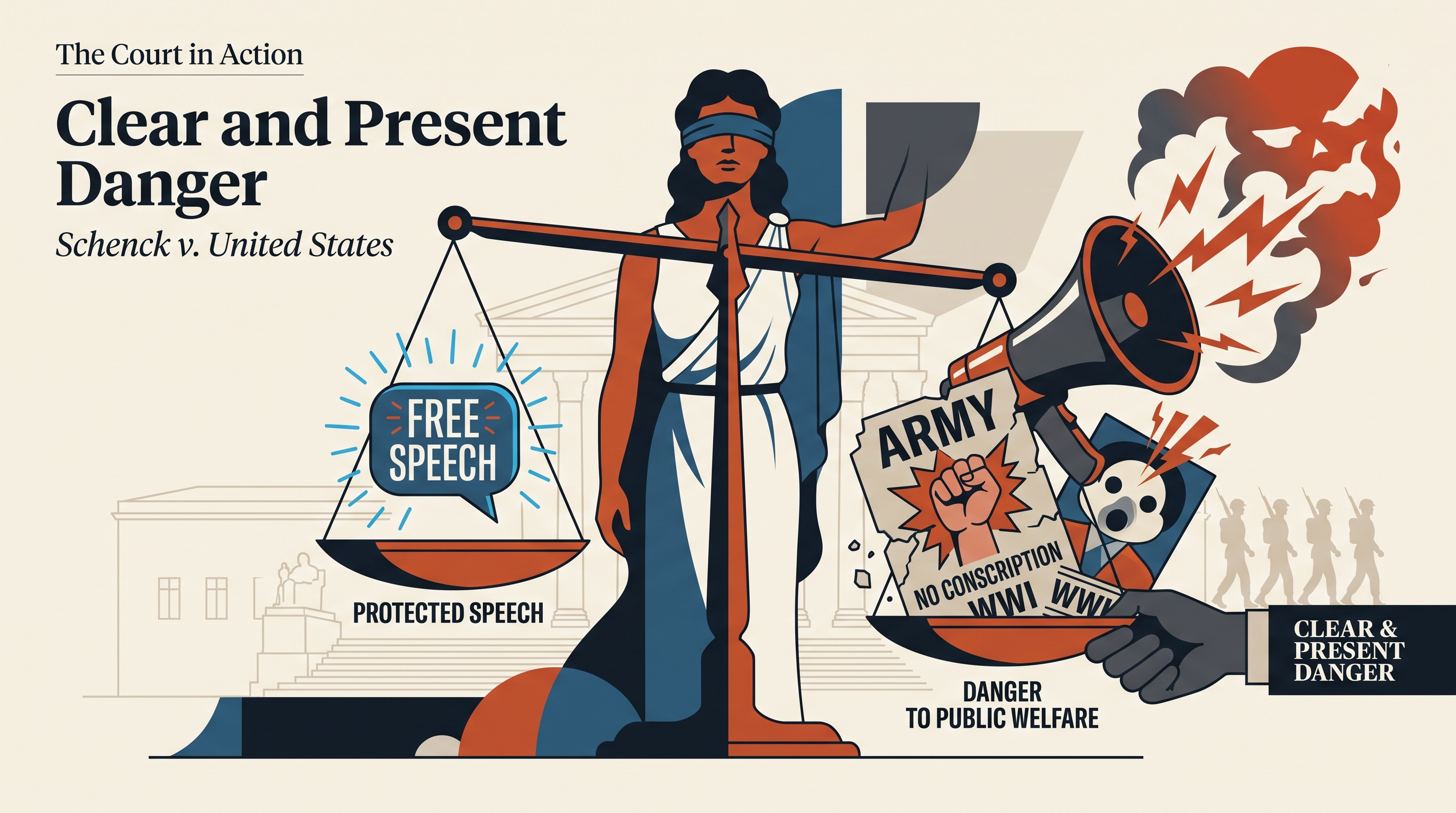
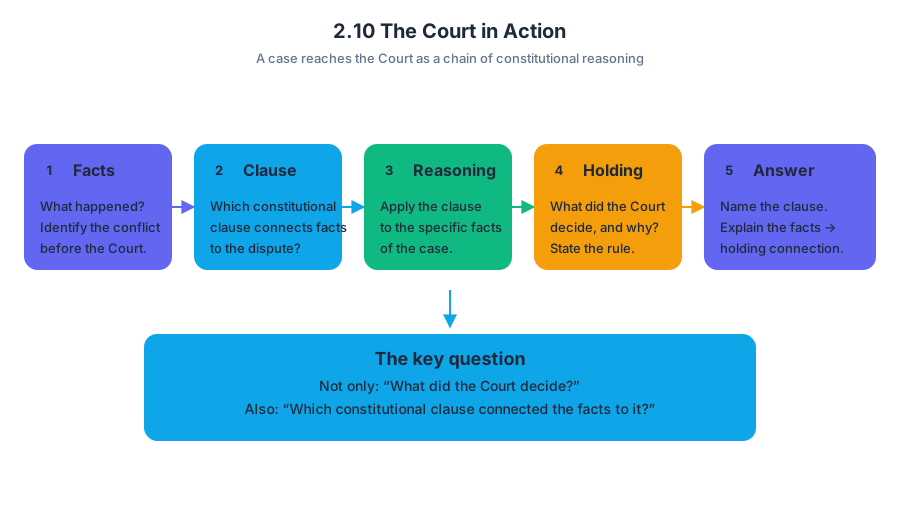
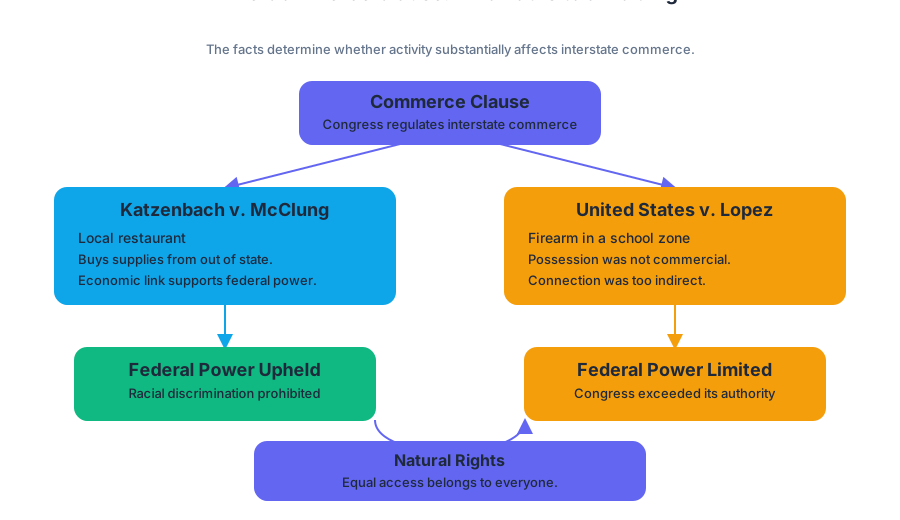
2.11 Checks on the Judicial Branch
Key concepts: Checks and balances among the three branches of government · Checks on the judicial branch · Judicial review · Judicial activism · Judicial restraint · The debate over legislative authority versus an independent judiciary · Congressional powers to limit or check the judiciary · Federalist No. 78 and the role of the judiciary · The relationship between the Constitution, judicial decisions, and federal law · Required Supreme Court case analysis
An independent judiciary can restrain the elected branches—but the judiciary itself is not unlimited. The central constitutional question is therefore two-sided: How can courts prevent governmental overreach, and how can Congress and the president prevent courts from becoming the government’s final policymaker on…
2.11 Checks on the Judicial Branch
An independent judiciary can restrain the elected branches—but the judiciary itself is not unlimited. The central constitutional question is therefore two-sided: How can courts prevent governmental overreach, and how can Congress and the president prevent courts from becoming the government’s final policymaker on every issue?
Learning Objective LO 2.11.A: Explain how the other branches of government check the power of the judicial branch.
Essential Knowledge EK 2.11.A.1: The legislative and executive branches use constitutional powers—including appointments, legislation, and constitutional amendments—to limit or respond to judicial decisions.
Suggested skill: Skill 1: Concept Application.
Judicial review creates power—and invites debate
Judicial review is the power of courts to determine whether a law or government action violates the Constitution. When a court invalidates an unconstitutional statute, it checks the legislative branch; when it blocks an executive order or administrative action, it checks the executive branch. This power helps enforce limited government, but it also raises a democratic problem: federal judges are not elected by voters.
Key insight: Judicial independence protects constitutional limits, while checks on the judiciary protect against unchecked judicial power.
Activism versus restraint
The debate over judicial power often uses two contrasting terms. Judicial activism asserts that judicial review permits courts to overturn laws or government actions when judges conclude that constitutional principles require intervention. Judicial restraint argues that judicial review should be constrained by current constitutional standards, established legal rules, and precedent—earlier judicial decisions that guide later cases.
These terms describe approaches to judging, not permanent labels for political parties or particular judges. A court may act assertively in one constitutional area and cautiously in another. The key comparison is how willing judges are to invalidate government action and depart from precedent.
| Approach | Main emphasis | Likely judicial behavior | Constitutional concern |
|---|---|---|---|
| Judicial activism | Active enforcement of constitutional principles | More willing to overturn laws, executive actions, or precedent | Courts may substitute judicial judgment for policymaking by elected officials |
| Judicial restraint | Deference to elected branches and established law | More likely to uphold laws unless a clear constitutional violation exists | Courts may fail to protect minority rights or prevent governmental overreach |
Named misconception check — “Activism always means liberal.” Not necessarily. “Activist” describes the willingness to use judicial review assertively; “restrained” describes reluctance to do so. Either approach can produce decisions associated with different ideological positions.
How the other branches check the courts
The judicial branch is part of a system of checks and balances, not a branch that operates without limits. Article I establishes congressional powers that matter here, while the president and Senate share authority over judicial appointments.
- Legislative overrides: Congress can respond to a judicial interpretation by passing a new statute that addresses the issue, provided the new law remains constitutional. Congress cannot simply vote to erase a constitutional ruling, but it can change the statutory basis of a case.
- The amendment process: A constitutional amendment can alter the legal rule that produced a judicial decision. The Sixteenth Amendment, which authorized a federal income tax, illustrates this mechanism after the Supreme Court had treated an income tax as unconstitutional.
- Appointment and confirmation: The president nominates federal judges, and the Senate confirms or rejects nominees. Over time, this allows elected officials to influence the judiciary’s composition and interpretive direction.
- Non-implementation or evasion: Executive officials may delay, narrow, or resist carrying out a decision, although such resistance can create a constitutional crisis and cannot lawfully nullify judicial authority.
- Jurisdiction stripping: Congress may attempt to restrict the kinds of cases federal courts can hear. Because jurisdictional limits implicate separation of powers and constitutional rights, this power is politically and legally contested.
The legislature or the independent judiciary?
The underlying disagreement is about which institution better preserves limited government. Supporters of an elected legislature argue that lawmakers are accountable to voters and can deliberate openly about public policy. Supporters of an independent judiciary argue that courts are better positioned to enforce constitutional boundaries when majorities or officials exceed their authority.
Federalist No. 78 is an assigned secondary source for analyzing this debate. Alexander Hamilton defended an independent judiciary and judicial review as safeguards against legislative violations of the Constitution. The argument is not that judges should govern generally; it is that courts must refuse to enforce laws that conflict with the higher authority of the Constitution.
A useful application is Swann v. Charlotte-Mecklenburg Board of Education (1970), which involved judicial enforcement of constitutional equality in public education. An activist interpretation sees strong judicial remedies as necessary when ordinary political institutions fail to correct constitutional violations. A restraint-oriented critique asks whether courts are exceeding their proper role by designing detailed policy solutions better left to elected institutions.
Worked concept application
Scenario: Congress proposes a constitutional amendment stating that federal courts may not hear challenges to a newly enacted federal income tax.
Reasoning: The amendment process is a check on the judiciary because it can change the constitutional rule governing a dispute. The jurisdiction restriction is a separate check because it attempts to limit the courts’ authority to hear the case. A strong answer distinguishes the two: the amendment changes what the Constitution permits, while jurisdiction stripping changes which disputes courts may decide.
Exam-ready conclusion: The example demonstrates that judicial review is powerful but embedded in a larger system of interbranch checks and balances.
Retrieval check: A Supreme Court invalidates a federal statute, and Congress responds by proposing a constitutional amendment that would authorize the statute’s policy. Which check is being used, and why is it stronger than simply passing the same statute again?
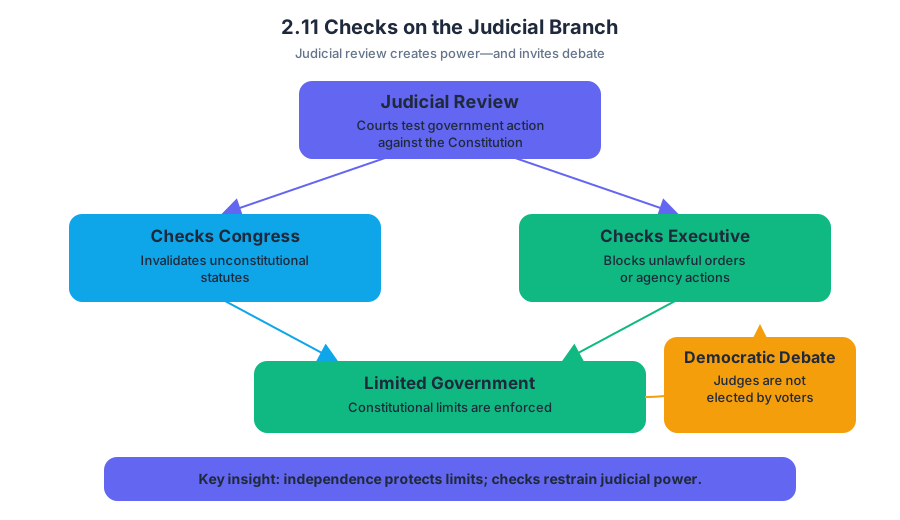
2.12 The Bureaucracy
Key concepts: The expansion of the bureaucracy over time · Causes and effects of bureaucratic expansion · The impact of events such as 9/11 on the bureaucracy · How bureaucratic interpretations, policies, and behaviors apply to policymaking · Connections between group activism and policymakers or the policymaking process · Prospective voting · The distinction between political appointees and career bureaucrats · Secretary Ross as a political appointee
The federal bureaucracy is the government’s permanent operating machinery: departments, agencies, bureaus, offices, and commissions that turn broad laws into everyday public action. Congress may pass a law about aviation safety, disaster relief, or national security, but bureaucratic organizations determine how…
2.12 The Bureaucracy
The federal bureaucracy is the government’s permanent operating machinery: departments, agencies, bureaus, offices, and commissions that turn broad laws into everyday public action. Congress may pass a law about aviation safety, disaster relief, or national security, but bureaucratic organizations determine how that law is administered in practice.
Learning Objective CON-5.A: Explain how the bureaucracy carries out the responsibilities of the federal government.
Essential Knowledge CON-5.A.1: The federal bureaucracy is a complex system of departments, agencies, bureaus, offices, and other organizations.
Why the bureaucracy expands
Bureaucratic expansion usually follows a combination of new public demands, national crises, technological change, and congressional delegation. As the responsibilities of the federal government grow, policymakers create or enlarge administrative organizations with the expertise and personnel needed to carry out those responsibilities.
The expansion is visible across American history:
- The growth of industrial production created demands for economic regulation.
- Economic crisis led to new administrative responsibilities for relief, recovery, and financial supervision.
- Social programs required permanent agencies to deliver benefits and enforce standards.
- Advances in transportation, communication, science, and technology created policy problems that legislators could not manage through one-time statutes alone.
- National-security threats produced new intelligence, defense, and emergency-management responsibilities.
The attacks of September 11, 2001, illustrate how a crisis can rapidly reorganize bureaucracy. The federal government expanded its capacity to coordinate intelligence, transportation security, emergency preparedness, and homeland protection. The creation of the Department of Homeland Security consolidated several existing offices and agencies into a larger organizational structure.
The effect was not simply “more government” in the abstract. Expansion produced specialization and coordination: agencies developed expertise in particular tasks, while the government also needed new systems for sharing information across organizational boundaries. The trade-off was that larger bureaucracies could become more difficult to supervise, coordinate, and hold accountable.
Causes and effects of bureaucratic change
A useful causal chain is:
Public problem or crisis $\rightarrow$ legislative response $\rightarrow$ new or expanded agency authority $\rightarrow$ administrative implementation $\rightarrow$ new oversight and accountability demands
For example, if repeated infrastructure failures create public pressure, Congress may enact safety legislation and assign implementation to an agency. The agency then interprets the law, establishes procedures, inspects facilities, and imposes penalties. Its decisions affect citizens and organizations directly, even though voters did not elect the agency’s administrators.
Bureaucratic change can therefore produce both benefits and problems:
| Change | Potential benefit | Potential problem |
|---|---|---|
| More specialized agencies | Greater expertise | Fragmentation and duplication |
| More administrative staff | Capacity to deliver programs | Higher cost and complexity |
| Broader agency responsibilities | Faster, more practical implementation | More discretion and less direct control |
| Consolidation after a crisis | Improved coordination | Concentration of authority and bureaucratic delay |
A common misconception is that bureaucrats merely “follow orders.” Congress often writes broad laws because technical details change quickly or because legislators lack the expertise to specify every procedure. Bureaucratic interpretations, policies, and behaviors consequently become part of policymaking: implementation choices determine how a policy works on the ground.
Bureaucracy, groups, and policymaking
Group activism connects citizens to bureaucratic policymaking as well as to elected officials. Advocacy organizations may provide technical information, testify at hearings, submit comments, organize affected constituents, publicize agency decisions, or pressure Congress to alter an agency’s funding and authority.
Consider an environmental organization campaigning for stricter pollution controls. Its activism may influence legislators to authorize regulation, agency officials to prioritize enforcement, and the broader public to view the issue as urgent. Industry groups may respond with their own research, lobbying, and mobilization. This is a pluralist process: multiple organized interests compete to shape policy outcomes.
Exam-quality connection: Do not stop at “the group protested” or “the group lobbied.” Explain how the activism reaches a policymaker or policymaking process and what decision it could change.
This distinction addresses a frequent response error: repeating what an agency did without identifying the bureaucratic power involved or connecting group activism to policymakers. A complete explanation names the actor, the action, the target of influence, and the policy consequence.
Prospective voting—and the Secretary Ross trap
Prospective voting is voting based on a candidate’s expected future performance and proposed policies. A voter asks, “What will this candidate do if elected?” This differs from retrospective voting, which evaluates an officeholder’s past performance, and from party-line voting, which relies primarily on party identification.
Prospective voting applies most directly to candidates seeking elected office. It was therefore incorrect to apply the concept to Secretary Ross, who was a political appointee rather than an elected candidate. A strong answer would identify the category error: evaluating what Ross might do as an appointed administrator is not the same as choosing among candidates based on their promised future actions.
Misconception check: “Anyone who makes policy can be evaluated through prospective voting.” Not quite. Prospective voting describes a voter’s choice among candidates for office, not simply a prediction about the future behavior of an appointed bureaucrat.
Skill focus: applying bureaucracy to a scenario
This topic most directly exercises Skill 1: Concept Application, especially 1.A Define and describe political concepts and processes and 1.B Explain how political concepts or processes apply in a given context. On an exam, naming “bureaucratic expansion” earns less than showing the mechanism: identify the event, explain why government responsibilities changed, and trace the effect on agency structure or policy implementation.
It also develops Skill 5: Argumentation, particularly when weighing whether bureaucratic growth improves effective governance or creates accountability problems. The strongest reasoning acknowledges both sides, then uses a specific example—such as post-9/11 reorganization—to support a defensible conclusion.
Retrieval check
A national crisis leads Congress to create a new agency, while a professional association campaigns for the agency to adopt a particular safety standard. Identify one cause of bureaucratic expansion, one effect of expansion, and one way the association could influence policymaking. Finally, explain why applying prospective voting to Secretary Ross would be incorrect.
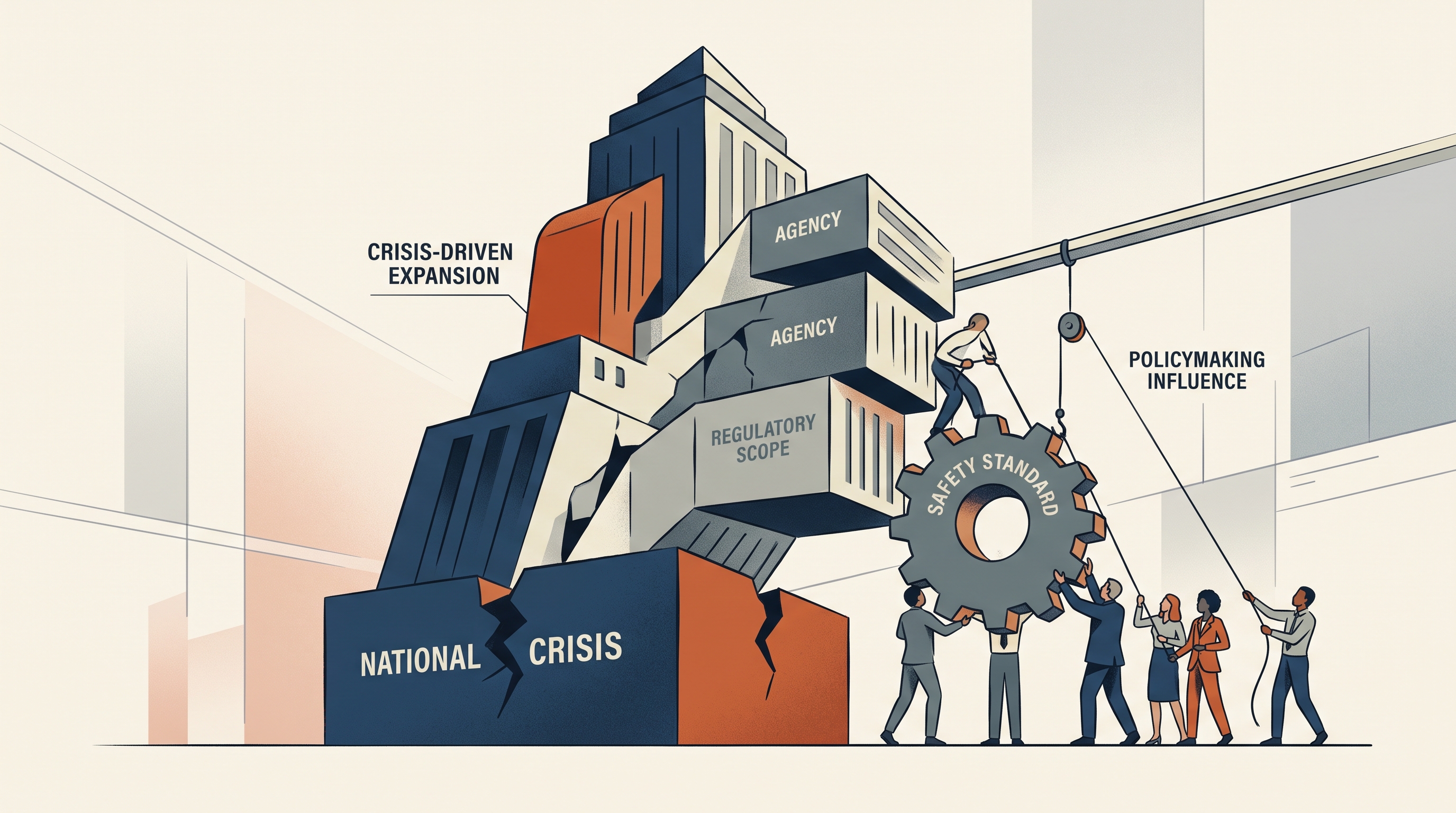
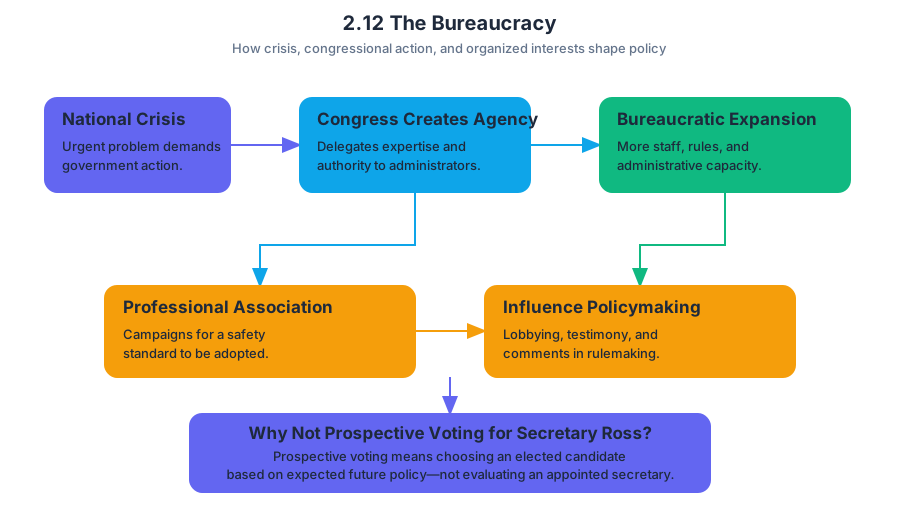
2.13 Discretionary and Rulemaking Authority
Key concepts: Federal bureaucratic agencies use discretion to implement policy · Bureaucratic agencies have rulemaking authority · Discretion allows agencies to make choices about how to implement laws or missions · Rulemaking allows agencies to establish regulations and safety requirements · Agency policymaking involves interaction among bureaucratic agencies, Congress, and citizens · Congress can exercise oversight of bureaucratic agencies · NASA, as part of the bureaucracy, can use discretionary or rulemaking authority · The president can influence the bureaucratic agenda through persuasion or the bully pulpit · Citizens can pressure Congress to oversee agency implementation · Congressional hearings are a tool of oversight
A president can announce a mission, but an agency determines what that mission requires in practice. When President John F. Kennedy committed the United States to sending a person to the Moon, NASA did not merely “carry out orders.” Its experts had to choose timelines, technical methods, safety procedures, and…
2.13 Discretionary and Rulemaking Authority
A president can announce a mission, but an agency determines what that mission requires in practice. When President John F. Kennedy committed the United States to sending a person to the Moon, NASA did not merely “carry out orders.” Its experts had to choose timelines, technical methods, safety procedures, and implementation standards. That space between a broad political goal and its concrete execution is where discretionary authority and rulemaking authority operate.
Learning Objective 2.13.A: Explain how the bureaucracy uses discretionary authority and rulemaking authority to implement policy.
Essential Knowledge 2.13.A.1: Federal bureaucratic agencies use discretionary authority to make choices about how to implement laws, policies, and missions. Essential Knowledge 2.13.A.2: Bureaucratic agencies use rulemaking authority to establish regulations that give policy practical force.
Two ways agencies turn goals into action
Discretionary authority is an agency’s power to make its own implementation decisions within the boundaries established by law. Congress may create a general program, and the president may establish an agenda, but agency officials often possess the expertise needed to decide the sequence, timing, priorities, and methods of implementation.
Rulemaking authority is an agency’s power to create and enforce regulations—detailed requirements that explain how a law or mission will operate. A statute might require safe transportation, clean air, or secure workplaces without specifying every technical standard. The responsible agency can write regulations that translate the broad requirement into enforceable rules.
| Authority | Central question | Example in the Moon mission |
|---|---|---|
| Discretionary authority | “Which lawful method should we use?” | NASA adjusts the mission timeline or selects the safest technical approach. |
| Rulemaking authority | “What specific standards must be followed?” | NASA establishes safety requirements for spacecraft testing and mission operations. |
The distinction matters because implementing policy is itself a policymaking process. NASA could use its expertise to slow down or speed up the Moon mission, select a particular engineering strategy, or determine that a proposed step was not yet feasible. It could also write regulations for safety and mission success. These choices would shape the president’s agenda without necessarily rejecting it.
Worked example: the Moon mission
Suppose a president publicly announces that the United States will complete a crewed Moon mission. The president supplies the political objective, but NASA must convert that objective into an operational plan.
Step 1 — Exercise discretion. NASA evaluates launch technology, crew training, testing schedules, and the risks of different designs. Its technical judgment might lead the agency to accelerate one phase, delay another, or revise the implementation sequence.
Step 2 — Use rulemaking authority. NASA establishes specific safety requirements for equipment, testing, mission control, and crew procedures. Those regulations determine what contractors and agency personnel must do before a launch can proceed.
Step 3 — Implement the agenda. NASA’s choices help realize the presidential mission. The agency is not legally obstructing the president; it is using lawful expertise and authority to determine the best way to carry out the mission. An answer that merely says “NASA carries out the policy” is incomplete because it does not identify the agency’s policy choices.
Agencies, Congress, citizens, and presidential persuasion
Agency policymaking occurs through interaction among bureaucratic agencies, Congress, and citizens. Congress creates agencies, writes statutes, authorizes programs, and controls funding. Agencies apply expertise and make implementation choices. Citizens, organized groups, affected industries, and voters respond to those choices and can pressure elected officials to change or monitor them.
Congress can check agency power through oversight, the legislative practice of monitoring executive-branch implementation. A congressional committee might hold hearings on space exploration, question NASA officials, investigate delays or safety decisions, or use funding decisions to pressure the agency to follow congressional intent.
The president can influence this process through the bully pulpit—the informal power to use the presidency’s public visibility to persuade citizens and set the policy agenda. A presidential speech supporting the Moon mission could encourage voters to demand that Congress fund and oversee the project. It could also provoke political opponents in Congress to demand closer scrutiny of NASA’s activities.
Misconception check
Misconception: “Discretion means the agency may ignore the president.” Discretion is not unlimited independence or illegal obstruction. It is lawful choice within an agency’s mission and governing statutes. Misconception: “The iron triangle is the answer whenever an agency appears in a scenario.” An iron triangle concerns relationships among an agency, congressional committees, and interest groups; it does not substitute for explaining how NASA’s discretion or rulemaking directly implements policy.
Retrieval check
A president gives a speech demanding rapid development of a national safety program. The agency delays one phase after technical review and issues new inspection standards. Identify one use of discretionary authority, one use of rulemaking authority, and one way the president’s bully pulpit could increase congressional oversight. A complete response must connect each concept to a specific action and its effect.
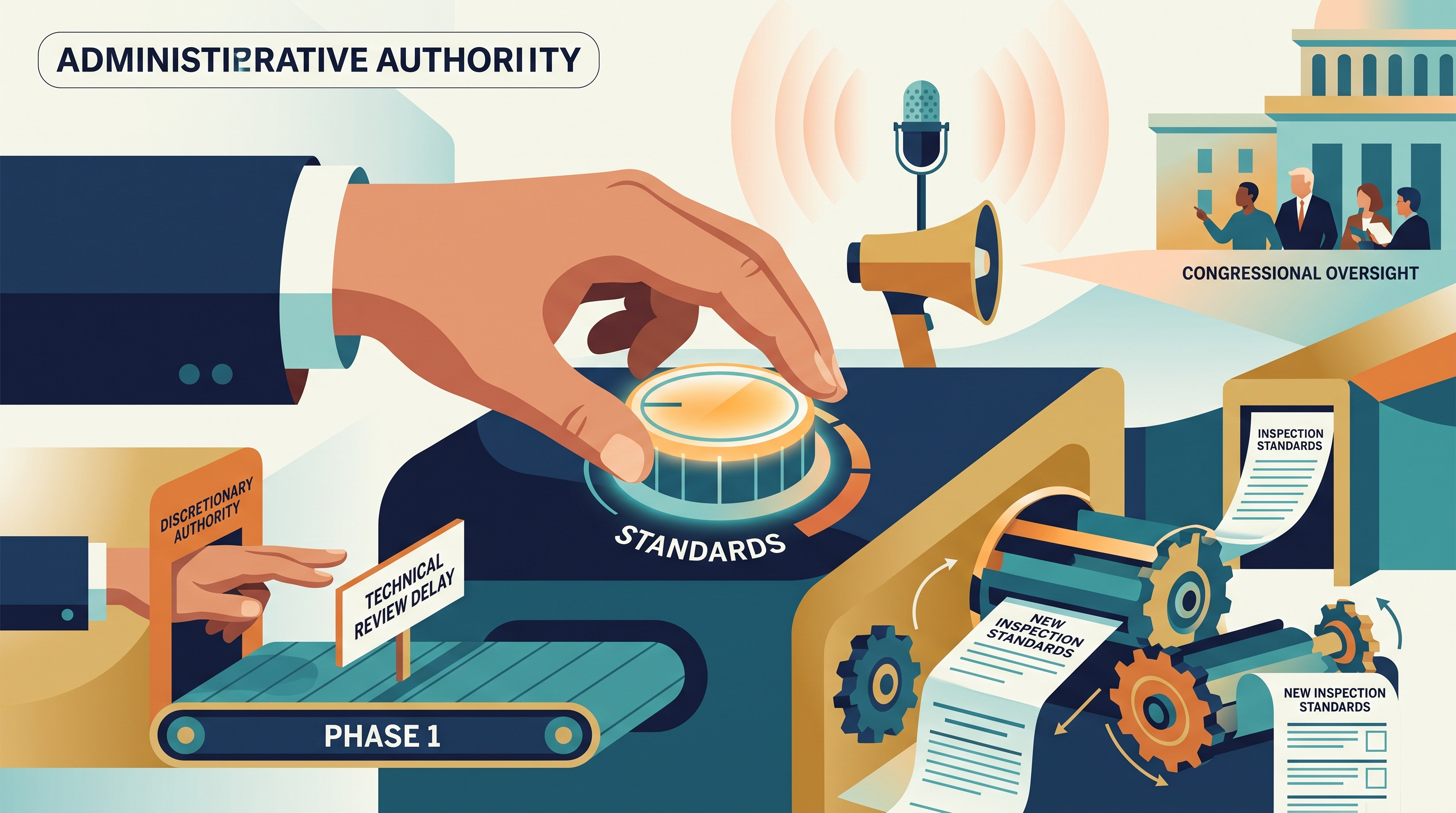
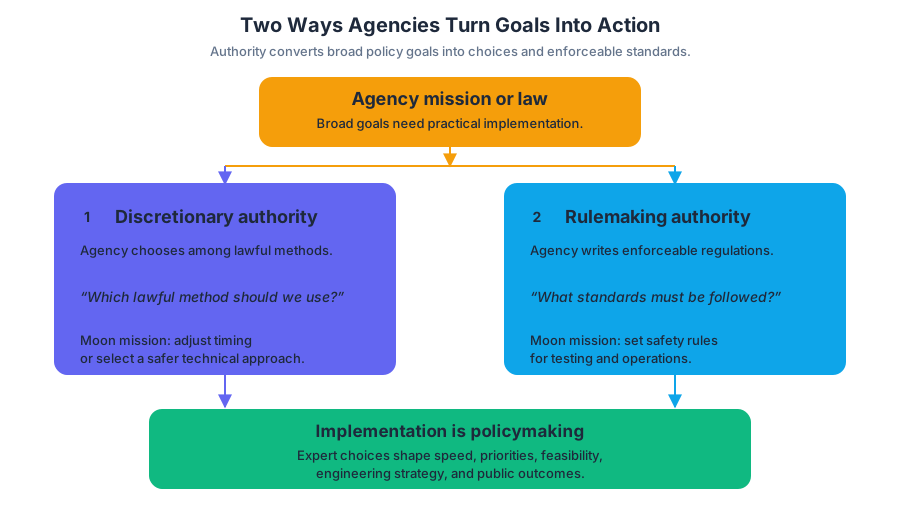
2.14 Holding the Bureaucracy Accountable
Key concepts: Congressional oversight · Implied powers of Congress · Power of the purse · Joint committees · Budget and Impoundment Control · Bureaucratic accountability · Congressional hearings and investigations · Executive-agency accountability · Bureaucratic discretion in implementing laws · Republican accountability in policymaking
Congress does not need to run every federal agency to control what agencies do; it can investigate, monitor, supervise, and deny or condition funding. This relationship is congressional oversight: Congress’s use of its constitutional and implied powers to determine whether the executive branch is carrying out laws…
2.14 Holding the Bureaucracy Accountable
Congress does not need to run every federal agency to control what agencies do; it can investigate, monitor, supervise, and deny or condition funding. This relationship is congressional oversight: Congress’s use of its constitutional and implied powers to determine whether the executive branch is carrying out laws as intended.
LO 2.14.A: Explain how Congress uses its oversight power in its relationship with the executive branch.
EK 2.14.A.1: Congressional oversight of the bureaucracy to ensure that legislation is implemented as intended includes review, monitoring, and supervision of bureaucratic agencies; investigation and committee hearings of bureaucratic activity; and the power of the purse, or Congress’s authority to control funding.
The accountability toolkit
Congressional oversight works like an external inspection system. Agencies possess expertise and operate continuously, while Congress writes laws and controls resources. Oversight allows legislators to ask: Did the agency follow the law? Did it use public money properly? Did its implementation produce the result Congress intended?
The tools reinforce one another rather than functioning as isolated powers:
- Review, monitoring, and supervision: Congress examines agency reports, policies, performance, and implementation decisions.
- Investigation: Committees gather information about possible mismanagement, failures, or violations.
- Committee hearings: Agency officials may be questioned publicly and required to explain their actions.
- Power of the purse: Congress appropriates funds and can restrict, redirect, or condition money.
- Implied oversight power: Although the Constitution does not present one single sentence labeled “oversight,” Congress derives oversight authority from its legislative, investigative, appropriations, and necessary-and-proper powers.
Oversight in action: the 2020 census
The 2020 census provides a clear example of accountability in a policymaking context. The House Committee on Oversight and Reform, led by Chairperson Maloney, investigated Secretary of Commerce Wilbur Ross after concerns arose that he had failed to disclose problems affecting census execution.
The reasoning chain is specific:
- The bureaucratic problem was poor execution and inadequate disclosure in the census process.
- The congressional response was investigation and committee oversight.
- The official held accountable was Secretary Ross, who led the department responsible for the census.
- The constitutional connection was Congress’s implied power to oversee executive agencies and ensure that legislation is implemented as intended.
A strong response would therefore say that the House committee used congressional oversight—through investigation and a hearing—to require the secretary to explain the census problems and to examine whether the executive branch was administering the law properly. Merely writing “checks and balances” is incomplete: it names a broad principle but does not identify the oversight method or connect it to the census facts.
Exam precision: Identify the tool, identify the agency or official, and connect the tool to the bureaucratic failure described in the scenario.
The power of the purse
Congressional control over money is one of its most practical checks on the bureaucracy. Through appropriations, Congress decides how much funding an agency receives and may attach conditions to that funding. An agency may have discretion in carrying out a law, but it cannot spend money Congress has not authorized or appropriated.
The Budget and Impoundment Control Act (1974) is relevant because it strengthened Congress’s role in the federal budget process and addressed presidential attempts to withhold, or impound, funds that Congress had provided. The larger principle is institutional: executive officials cannot simply nullify congressional priorities by refusing to spend appropriated money.
Committees and continuing supervision
Congress often conducts oversight through committees because committees specialize in policy areas and can hold hearings, request documents, question officials, and examine agency performance. Joint committees, which include members of both the House and Senate, provide one mechanism for coordinating congressional attention across the two chambers, although not every joint committee has the same legislative authority as a standing committee.
Oversight can also respond to national crises. After the 9/11 terrorist attacks, Congress examined the performance and coordination of intelligence and security agencies. Such investigations sought to identify failures and improve implementation, demonstrating that bureaucratic accountability is not limited to ordinary budget disputes.
Administration changes, implementation changes
The EPA Superfund example under the Reagan administration illustrates how the implementation of environmental laws can change when a new administration changes agency priorities and management practices. The statute may remain in force while the bureaucracy alters enforcement emphasis, administrative choices, or the pace of implementation.
This does not mean that agencies may ignore law. It means that bureaucratic accountability matters precisely because agencies possess room to interpret and administer broad congressional instructions. Congress can respond through hearings, investigations, statutory revisions, reporting requirements, or funding decisions.
Common misconception — “Oversight means Congress directly commands every agency decision.”
Oversight is monitoring and accountability, not day-to-day administration. Agencies implement policy, while Congress uses its legislative and budgetary powers to check whether implementation follows congressional intent.
AP skill: Data Analysis (3.C)
Data Analysis (3.C): Explain patterns and trends in data to draw conclusions. A bureaucracy question may include performance data, funding figures, inspection results, or implementation trends. Do not merely identify that one number is higher or lower. Explain what the pattern suggests about agency performance and then connect that conclusion to an oversight tool.
For example, if an agency’s inspection completion rate falls while its appropriation rises, the pattern may support congressional investigation or a hearing about management. If funding is repeatedly withheld from a program, the trend may indicate that Congress is using the power of the purse to pressure the agency.
Retrieval check
A committee discovers that a federal agency mishandled a major program and summons the agency’s secretary to explain the failure. Which oversight method is most directly being used, and why is calling it only “checks and balances” insufficient?
Answer: The method is congressional investigation and a committee hearing, an exercise of Congress’s implied oversight power. “Checks and balances” is too general because it does not identify the concrete mechanism or explain how it addresses the agency’s failure.
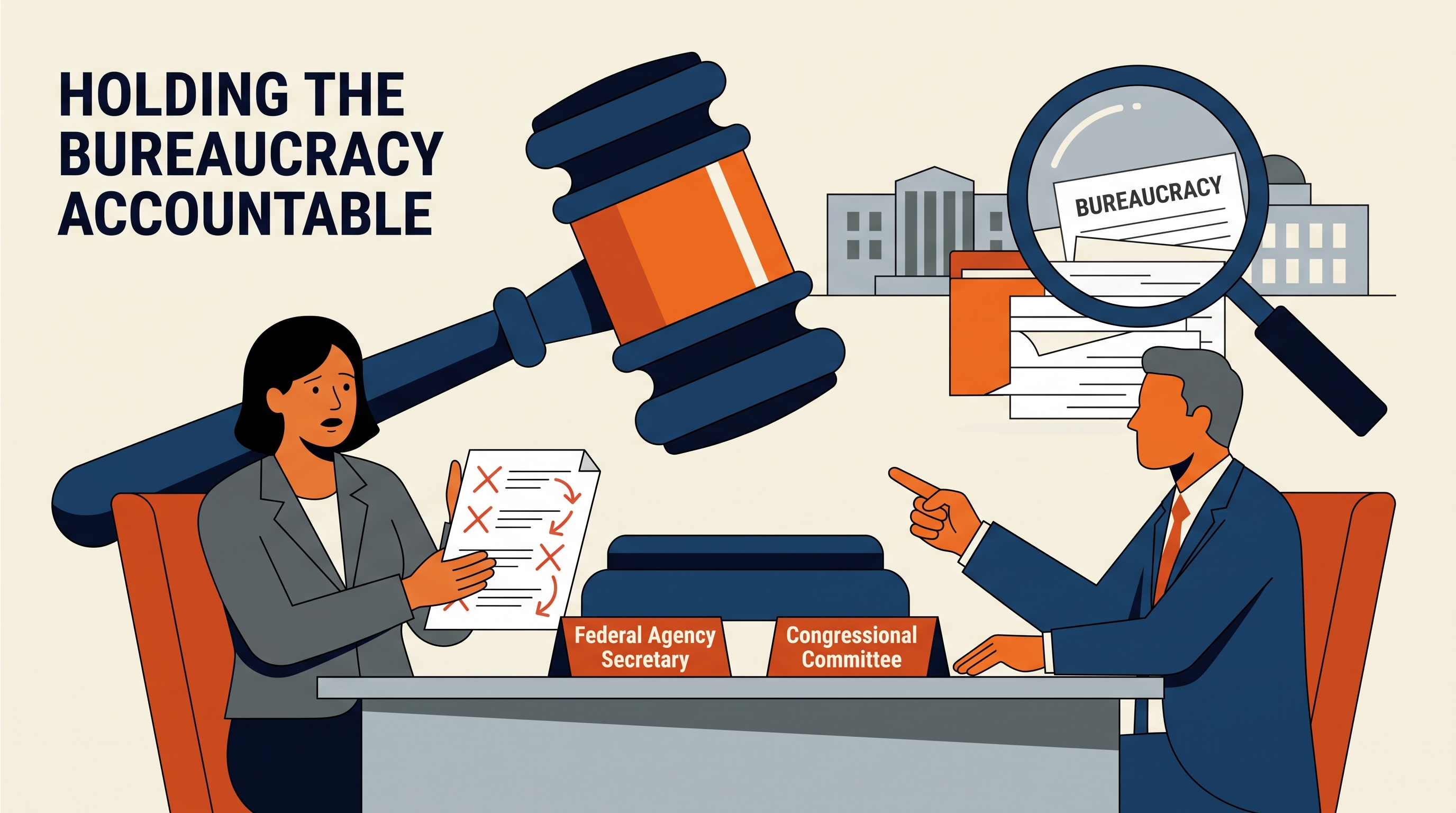
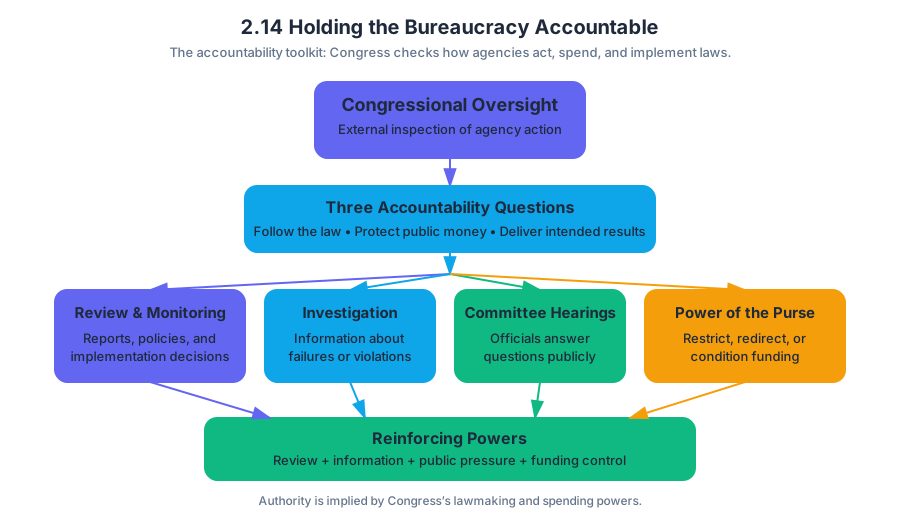
2.15 Policy and the Branches of Government
Key concepts: The role of Congress in the public policy process · Enumerated and implied congressional powers · The legislative process in both chambers of Congress · The influence of public support for legislation · The interaction between Congress and the president in policymaking · The role of executive communication in shaping policy · The Supreme Court’s role in establishing or rejecting legal precedents · The effects of communication technology on presidential communication · The relationship between government branches, bureaucratic agencies, and budgets · Federalist perspectives on government institutions and processes
Congress, the president, the courts, and the bureaucracy rarely act in a neat sequence; national policy emerges from their overlapping powers, competing incentives, and repeated negotiations.
2.15 Policy and the Branches of Government
Congress, the president, the courts, and the bureaucracy rarely act in a neat sequence; national policy emerges from their overlapping powers, competing incentives, and repeated negotiations.
LO 2.15.B: Explain how the distribution of powers among the three branches of government impacts policymaking.
EK 2.15.B.1: The allocation of powers among the three branches of government creates multiple access points for stakeholders and institutions to influence public policy.
EK 2.15.B.2: National policymaking is constrained by the sharing of powers between the three branches.
Congress: the lawmaking center of policymaking
The Constitution gives Congress enumerated powers, meaning powers specifically listed in Article I, Section 8. These include taxing, spending, regulating interstate commerce, declaring war, and raising and maintaining the armed forces. Congress may also exercise implied powers, which are not written word-for-word but are reasonably connected to an enumerated power through the Necessary and Proper Clause.
For example, Congress’s authority to maintain the armed forces permits more than simply voting to create an army or navy. Congress may enact laws establishing military departments, setting rules for military organization, funding defense programs, and creating administrative systems needed to carry out that constitutional responsibility.
A president may propose an agenda, persuade lawmakers, and ask Congress to act, but the president does not formally introduce legislation in Congress. A member of the House or Senate must sponsor a bill. The bill must then pass both chambers in identical form before it can reach the president.
The legislative process in two chambers
The House and Senate are not interchangeable. The House has stricter debate rules and gives considerable control to the Rules Committee, while the Senate permits extended debate. A senator may use a filibuster to delay or prevent a final vote; the Senate can generally end debate through cloture, which ordinarily requires a three-fifths vote, or at least $60$ senators when all $100$ seats are filled.
Support for a bill affects every stage: whether party leaders schedule it, whether committees report it, whether members remain unified, and whether the bill can survive debate and voting. Public opinion, interest-group pressure, lobbying, campaign considerations, and presidential persuasion can all change the coalition needed for passage.
Worked example: Suppose Congress considers a bill funding a new national emergency communications system. A House committee may hold hearings and revise the bill; House leaders may limit debate to secure a vote. In the Senate, opponents may prolong debate, forcing supporters to seek enough votes for cloture. If both chambers pass different versions, a compromise must be approved by both. The president can then sign the bill, allow it to become law without signing under applicable constitutional rules, or veto it. Congress may override the veto with a two-thirds vote in both chambers.
Misconception check — “The president makes laws.” The president strongly influences policy, but Congress performs the central lawmaking function. Presidential influence cannot substitute for congressional passage when a new statute is required.
Shared powers and competing access points
LO 2.15.A: Explain the extent to which governmental branches can hold the bureaucracy accountable given the competing interests of Congress, the president, and the federal courts.
EK 2.15.A.1: Formal and informal powers of Congress, the president, and the courts over the bureaucracy are used to maintain its accountability.
Policy is shaped through legislation, executive approval or implementation, and possible judicial review—but not every policy passes through each step. Congress can shape outcomes through statutory language and agency budgets; the president can direct executive priorities and influence implementation; courts can determine whether governmental action is consistent with the Constitution or with federal law.
Budgets are especially powerful. Even when Congress does not repeal a program, it can restrict or expand the money available to an agency. An agency may possess legal authority to act, yet lack the personnel, equipment, or funding to carry out every possible policy choice.
The branches therefore create multiple access points for stakeholders. A group seeking a policy change might lobby Congress for a statute, encourage the president to issue an executive directive, participate in an agency rulemaking process, or bring a lawsuit. The same policy dispute can move among institutions rather than ending when one branch acts.
Presidential communication and policymaking
Presidential communication has had an increasing impact as communication technology has advanced. Television, digital media, social platforms, and direct public addresses allow presidents to shape the public agenda rapidly. This informal influence is often called the bully pulpit: the president’s ability to use public attention and persuasion to pressure Congress, mobilize supporters, and define a policy problem.
Communication does not guarantee legislative success. A president who publicly advocates a bill may increase constituent pressure on legislators, but lawmakers still respond to party strategy, district interests, Senate procedure, interest groups, and electoral incentives. The president’s message becomes one force inside a larger bargaining system.
Courts, precedents, and constitutional conflict
The judiciary adds another possible policymaking arena. Supreme Court cases can establish new precedents or reject existing precedents, changing how constitutional principles and federal statutes apply. Judicial review may therefore alter the legal boundaries within which Congress, the president, and agencies operate.
Federalist No. 51 captures the logic of this arrangement: because people and institutions possess competing ambitions, dividing power among branches can make each branch check the others. The competing concern expressed by Antifederalists such as the author of Brutus No. 1 is that a powerful national government might use those powers to threaten individual liberty. Federalist No. 70 adds the opposing argument that an energetic, unified executive can act with speed and decisiveness.
Retrieval check: A bill passes the House and Senate, but the president vetoes it. Identify one constitutional route by which it could still become law, and explain one way Congress could later influence how the resulting policy is carried out.
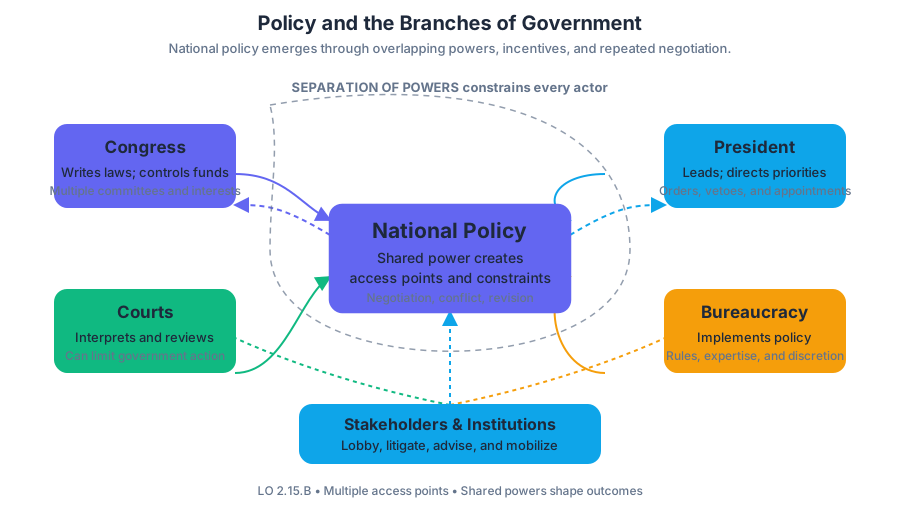
3.1 The Bill of Rights
Key concepts: Bill of Rights · Individual liberties · Civil rights · Protection from arbitrary government interference · Constitutional rights · Rights of citizens · Rights involving opinions and property · Judicial interpretation · Supreme Court cases · Liberty and order
A government can become dangerous not only when it is too weak to keep order, but also when it is powerful enough to silence opinions, search homes, punish dissent, or take property without fair procedures.
3.1 The Bill of Rights
A government can become dangerous not only when it is too weak to keep order, but also when it is powerful enough to silence opinions, search homes, punish dissent, or take property without fair procedures. The Bill of Rights is the Constitution’s explicit answer to that danger: the first ten Amendments establish protections against arbitrary government interference.
Bill of Rights: The first ten Amendments to the Constitution, which enumerate the liberties and rights of individuals.
The central tension is liberty and order. Government must maintain public safety and administer laws, but constitutional rights limit the methods it may use. The Bill of Rights therefore does not eliminate government power; it places boundaries around that power.
Constitutional liberties versus civil rights
Civil liberties are constitutionally established guarantees and freedoms that protect citizens, their opinions, and their property against arbitrary government interference. Examples include freedom of speech, protection against unreasonable searches, religious liberty, and the right to a fair criminal trial.
Civil rights concern protection from unequal treatment and the guarantee of equal protection under the law. The distinction is useful but not absolute: a dispute may involve both liberty and equality. For example, a government rule could restrict expression, while its selective enforcement against one racial or religious group could raise a civil-rights issue as well.
| Concept | Core question | Typical constitutional concern |
|---|---|---|
| Civil liberties | What may government not do to an individual? | Can officials search, censor, or punish without sufficient justification? |
| Civil rights | Is government treating people equally under the law? | Is a law or policy discriminating against a protected group? |
Misconception check — “The Bill of Rights protects people from every unfair action.” Not exactly. Its primary function is to restrict government action. A private employer, website, or neighbor may create serious problems, but the constitutional question is usually whether a government actor is responsible and whether a specific constitutional protection applies.
What the first ten Amendments protect
EK 3.1.B.1: The Bill of Rights consists of the first ten Amendments to the Constitution, which enumerate the liberties and rights of individuals. Their protections include:
- First Amendment: religion, speech, press, assembly, and petition.
- Second Amendment: the right to keep and bear arms.
- Third Amendment: protection against the quartering of soldiers in private homes.
- Fourth Amendment: protection against unreasonable searches and seizures, including requirements related to warrants.
- Fifth Amendment: protections involving grand juries, double jeopardy, self-incrimination, due process, and property taken for public use.
- Sixth Amendment: rights of criminal defendants, including a speedy and public trial, an impartial jury, notice of charges, confrontation of witnesses, and assistance of counsel.
- Seventh Amendment: jury trials in certain civil cases.
- Eighth Amendment: limits on excessive bail, excessive fines, and cruel and unusual punishments.
- Ninth Amendment: recognition that listing certain rights does not mean people possess no other rights.
- Tenth Amendment: reservation to the states or the people of powers not delegated to the United States by the Constitution.
This list is not a menu that government may selectively ignore. Each protection must be interpreted in context. The meaning of an “unreasonable” search, an “excessive” punishment, or a sufficient form of due process may depend on the facts of a case and on how courts understand constitutional principles.
Courts make the protections operational
EK 3.1.A.3: The application of the Bill of Rights is continuously interpreted by the courts. Courts examine the facts, identify the constitutional issue, interpret the relevant text and precedent, and announce a holding—the legal rule that resolves the dispute.
A useful case-analysis chain is:
Facts → constitutional issue → holding → reasoning → effect on government power
For instance, imagine police officers enter a person’s home without a warrant because they believe evidence might be inside. The constitutional issue is not simply whether the officers were trying to solve a crime. The analysis asks whether the search was reasonable under the Fourth Amendment, whether an exception to the warrant requirement applies, and what remedy or limitation follows if the search was unconstitutional.
Worked application: liberty and order
A city adopts a rule allowing officials to inspect every home without individualized suspicion during a period of heightened security. Supporters argue that universal inspections improve public safety. A constitutional analysis begins by identifying the affected liberty—security against government searches—then asks whether the city’s broad method is reasonable, whether less intrusive alternatives exist, and whether the rule gives officials uncontrolled discretion.
A strong response does not merely write “the Fourth Amendment applies.” It explains the conflict: the city pursues order, while the Amendment protects liberty by limiting suspicionless government searches. The court’s interpretation determines how those values are balanced in practice.
AP skill connection
LEARNING OBJECTIVE LO 3.1.A: Explain how the U.S. Constitution protects individual liberties and rights. EK 3.1.A.1 identifies the Constitution’s Bill of Rights as specifically designed to protect individual liberties and rights. EK 3.1.A.2 defines civil liberties as constitutional guarantees against arbitrary government interference.
This topic is assessed through Suggested Skill: Concept Application — Describe political principles and through Supreme Court reasoning. Skill 2.A: Describe the facts, issue, holding, reasoning, decision, and majority opinion of required Supreme Court cases. Skill 2.C requires applying constitutional principles and reasoning to a political situation. In case comparisons, 5.A and 5.B emphasize using evidence and explaining how it supports a conclusion rather than merely naming similarities or differences.
Retrieval check: A state bans a peaceful public demonstration criticizing the governor. Is the strongest initial classification a civil liberty or a civil-rights issue? Identify the relevant amendment and explain, in one sentence, how the policy creates a liberty-and-order conflict.
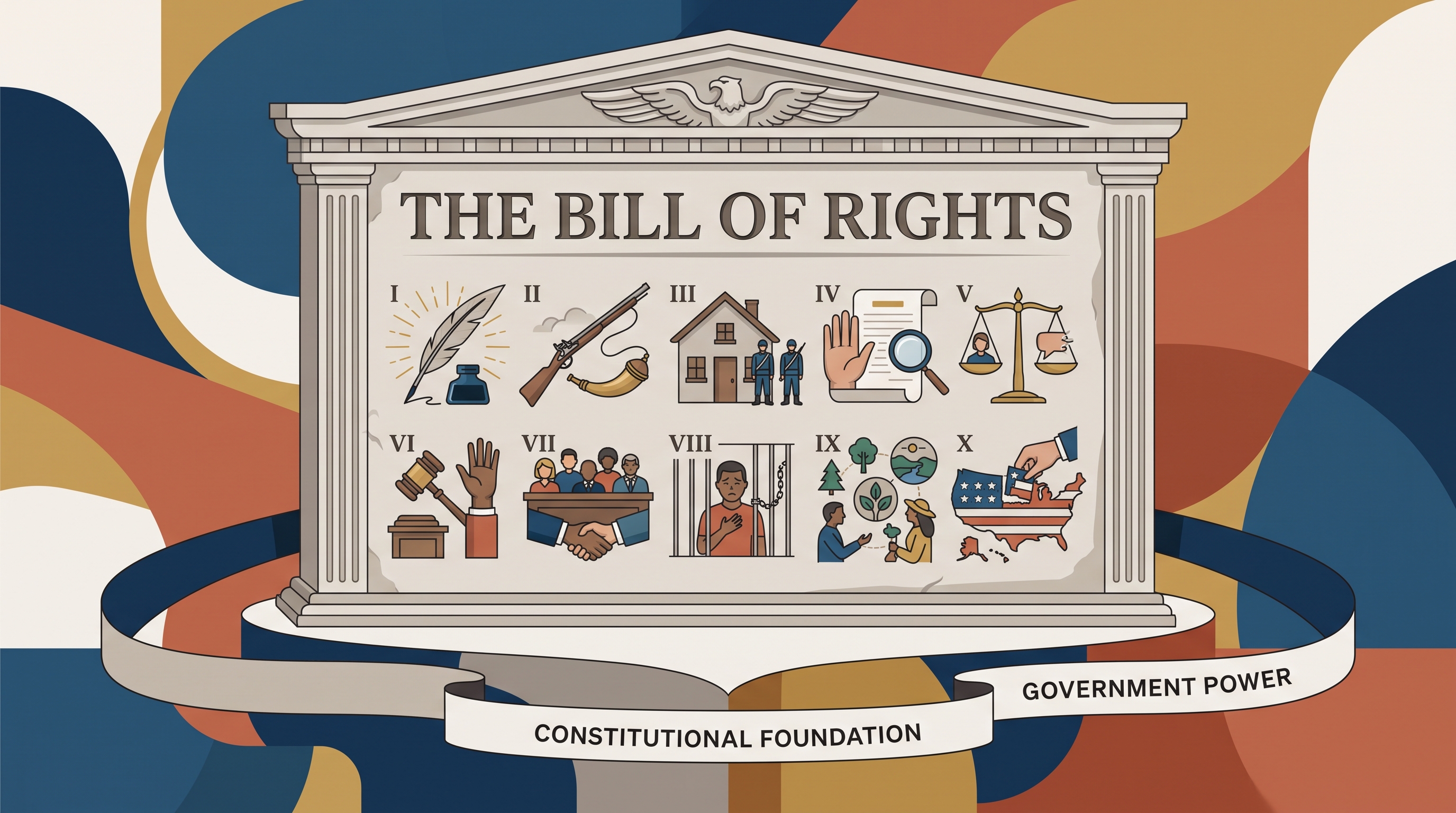
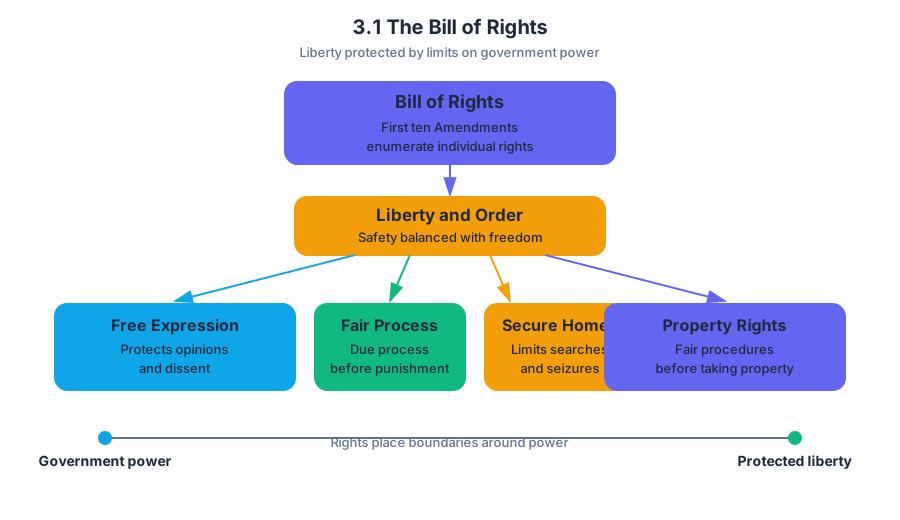
3.2 First Amendment: Freedom of Religion
Key concepts: First Amendment freedom of religion · Free Exercise Clause · Establishment Clause · Wisconsin v. Yoder (1972) · Cantwell v. Connecticut (1940) · SCOTUS case comparison · Religious liberty versus government power · Compulsory education requirements · School vouchers and religious schools · Civil liberties as protection against arbitrary government interference
The First Amendment protects religious liberty in two different ways: it limits government from establishing religion and protects individuals who wish to practice religion. The distinction becomes clearest when the government is not choosing a religion, but is regulating conduct that a person considers religiously…
3.2 First Amendment: Freedom of Religion
The First Amendment protects religious liberty in two different ways: it limits government from establishing religion and protects individuals who wish to practice religion. The distinction becomes clearest when the government is not choosing a religion, but is regulating conduct that a person considers religiously required.
Investigative question: When does a neutral government rule become an unconstitutional burden on religious practice?
Two clauses, two constitutional problems
The Free Exercise Clause protects an individual’s ability to practice, express, and live according to religious beliefs without unjustified government interference. The Establishment Clause prevents government from officially supporting, promoting, or sponsoring religion.
A useful diagnostic is to identify who is acting and what the government is doing:
| Constitutional clause | Government problem | Illustrative example |
|---|---|---|
| Free Exercise Clause | Government burdens religious practice or expression | Requiring Amish children to remain in school beyond the age their faith permits |
| Establishment Clause | Government promotes or endorses religious belief | School-led prayer |
| Both can involve religion | The key question is whether government is restricting practice or sponsoring religion | A neutral rule may still require constitutional analysis |
The most common misconception is that the Establishment Clause means “freedom of religion” generally. It does not. Establishment concerns government sponsorship of religion; free exercise concerns the individual’s religious practice. In Wisconsin v. Yoder (1972) and Cantwell v. Connecticut (1940), the common constitutional issue is the Free Exercise Clause.
Worked comparison: Wisconsin v. Yoder and Cantwell v. Connecticut
In Wisconsin v. Yoder, Wisconsin required children to attend school until age 16. Amish parents objected because continued formal schooling conflicted with their religious beliefs and community practices. The Supreme Court held that applying the compulsory-education requirement to these parents violated their First Amendment religious rights.
In Cantwell v. Connecticut, Jehovah’s Witnesses objected to Connecticut regulations governing door-to-door religious solicitation. The Court held that the soliciting activities were protected by the Free Exercise Clause. The case also helped incorporate the Free Exercise Clause through the Fourteenth Amendment’s Due Process Clause, making the protection applicable against state governments.
The cases share a constitutional principle but involve different government actions:
| Feature | Wisconsin v. Yoder | Cantwell v. Connecticut |
|---|---|---|
| Religious group | Amish parents | Jehovah’s Witnesses |
| Government action | Compulsory education until age 16 | Regulation of door-to-door solicitation |
| Religious practice affected | Raising children within Amish religious life | Religious proselytizing and solicitation |
| Holding | The requirement conflicted with protected religious rights | The soliciting activity was protected |
| Larger significance | Religious liberty outweighed the state’s educational interest in these facts | States could not use regulation to suppress religious expression |
The important comparison is not merely that “the Court sided with religion.” In each case, the Court examined a specific government interest and a specific burden on religious practice. In Yoder, the state’s compulsory-education rule threatened the Amish way of life; in Cantwell, state solicitation regulations burdened religious outreach. The facts explain why the government’s authority had to be balanced against constitutional rights.
AP reasoning pattern: Identify the clause → state the relevant facts → connect those facts to the holding → explain the constitutional significance.
The Establishment Clause in action
The Establishment Clause prohibits school-led prayer because a public school is a government institution. When school officials organize or direct prayer, the government is not merely allowing private religious expression; it is sponsoring religious activity.
Zelman illustrates a different constitutional arrangement. The Court supported the constitutionality of a school-voucher program that included religious schools because public aid reached those schools through the independent choices of families rather than through a government decision favoring a particular religion. The constitutional question therefore turned on the structure of the program, not simply on whether religious schools ultimately received funds.
AP skill focus: SCOTUS Application
This topic most directly develops Skill 2: SCOTUS Application, especially 2.A—describing the relevant facts, issue, holding, reasoning, or implications of a Supreme Court case—and 2.B—comparing the reasoning, decision, or implications of Supreme Court cases. A strong response uses case facts as evidence rather than listing case names.
For a comparison, write: “Both cases involved the Free Exercise Clause, but Yoder concerned compulsory education while Cantwell concerned solicitation regulations. In each case, the Court found that state authority burdened protected religious practice, so the relevant facts supported similar holdings.”
Retrieval check
A state requires students to attend school until age 16; a religious community objects because the requirement conflicts with its way of life. Which clause is implicated, and which case provides the closest comparison? Answer: the Free Exercise Clause, with Wisconsin v. Yoder as the closest comparison. A school administrator who leads students in prayer raises an Establishment Clause issue instead.
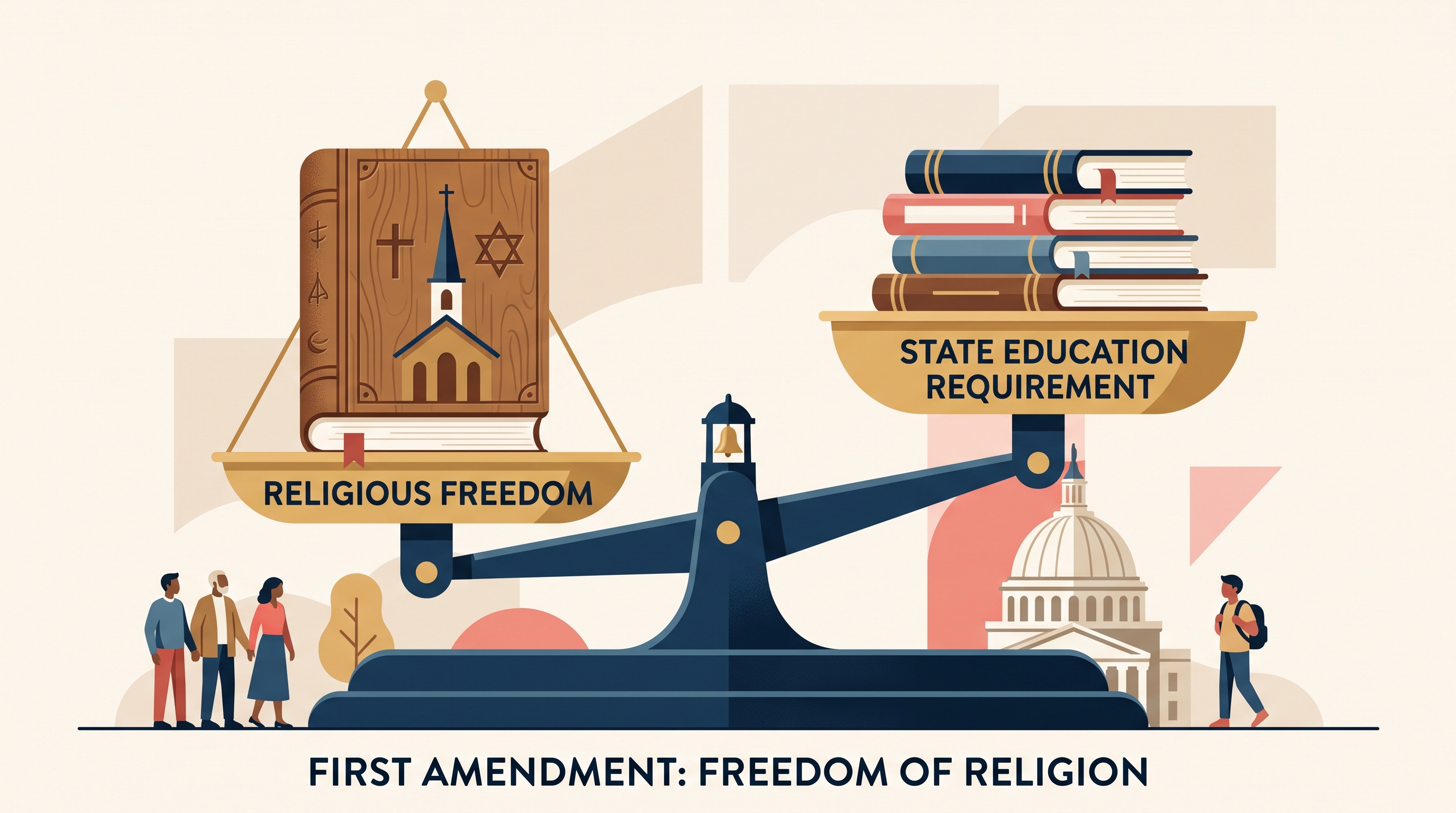
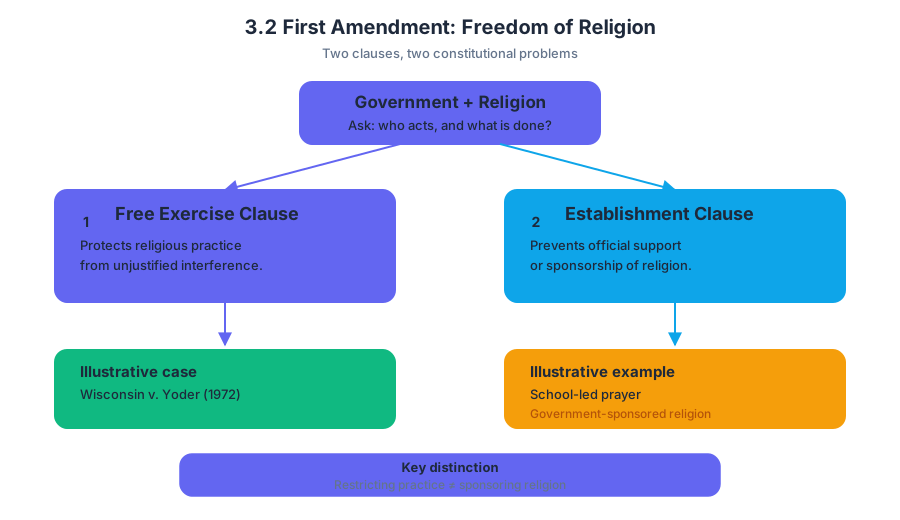
3.3 First Amendment: Freedom of Speech
Key concepts: First Amendment freedom of speech · Supreme Court interpretation of free speech · Clear and present danger doctrine · Symbolic speech · Time, place, and manner restrictions · Political speech and campaign spending · Corporate, association, and labor-union political spending · Freedom of expression and compelled speech · Equal Protection Clause · Redistricting and political-question doctrine
The First Amendment protects political communication because democratic self-government depends on people being able to criticize officials, advocate change, and express unpopular beliefs. The protection is powerful but not unlimited: the Supreme Court has permitted restrictions when speech falls into a legally…
3.3 First Amendment: Freedom of Speech
The First Amendment protects political communication because democratic self-government depends on people being able to criticize officials, advocate change, and express unpopular beliefs. The protection is powerful but not unlimited: the Supreme Court has permitted restrictions when speech falls into a legally unprotected category or when the government regulates the conditions of communication without targeting the message.
LO 3.3.A: Explain the extent to which the Supreme Court’s interpretation of the First Amendment reflects a commitment to free speech.
The constitutional principle: expression receives protection
Symbolic speech is nonverbal action that communicates an idea or belief. A protester wearing a black armband, displaying a political sign, or engaging in another expressive act may be communicating a political message even without speaking or writing words.
In West Virginia Board of Education v. Barnette (1943), the Court held that the First Amendment protects freedom of expression, including opposition to compelled expression—being forced by the government to communicate a message. The principle is broader than protection from censorship: government generally may not force individuals to affirm an official belief.
Worked example: A public school requires students to participate in a political pledge. A student refuses because the pledge conflicts with the student’s beliefs. The constitutional issue is not whether the student’s opinion is popular; it is whether the government is compelling expression. Under Barnette, compelled political expression conflicts with the First Amendment’s protection of individual freedom.
When speech may be limited
The Court balances social order and individual freedom. EK 3.3.A.1 identifies symbolic speech as protected expression, while EK 3.3.A.2 identifies categories and circumstances in which speech may be restricted.
The important distinction is between offensive political expression, which is generally protected, and legally defined categories that receive reduced or no protection. These can include legally defined obscenity, defamation, true threats, and fighting words. Defamation is a false statement that unlawfully harms another person’s reputation: libel is written defamation, while slander is spoken defamation. Mere vulgarity or political offensiveness does not automatically make speech regulable.
In Schenck v. United States (1919), the Court used the historical clear and present danger doctrine: speech creating a clear and present danger was not protected and could be limited. The doctrine shows that the First Amendment does not protect speech simply because it is labeled political if the circumstances make serious harm sufficiently immediate.
Later decisions narrowed this boundary. In Brandenburg v. Ohio (1969), the modern imminent lawless action standard generally protects advocacy unless it is directed toward producing imminent lawless action and is likely to produce it. Therefore, merely expressing a radical idea, criticizing government, or using offensive political language is ordinarily protected; urging immediate unlawful conduct in circumstances likely to trigger it may not be.
Misconception check: “Schenck means the government can ban any speech it considers dangerous.”
Correction: Schenck supplies a historically important formulation. Later doctrine, especially Brandenburg, requires a much tighter connection to imminent unlawful action.
Time, place, and manner restrictions
The government may impose content-neutral time, place, and manner restrictions—rules governing when, where, or how communication occurs without targeting its message. Examples include limiting the hours of a large public event, designating a location for demonstrations, or enforcing noise limits.
Content neutrality alone is not enough. A valid restriction must serve a significant governmental interest, be narrowly tailored, and leave open adequate alternative channels of communication. A city may control event noise to protect nearby residents, but it cannot disguise viewpoint discrimination as a noise rule or make communication practically impossible.
Worked example: A city permits demonstrations in a public park but requires amplified sound to stop at $10{:}00$ p.m. The rule is more likely constitutional if it applies equally to all viewpoints, protects residents’ ability to sleep, is narrowly tailored to that interest, and leaves demonstrators other ways to communicate—such as signs, daytime events, or nonamplified speech.
Political speech and campaign spending
Political speech includes communication intended to influence public debate and elections. In Citizens United v. Federal Election Commission (2010), the Court held that political spending by corporations, associations, and labor unions is protected speech under the First Amendment. The decision connects campaign participation to constitutional protection for political communication.
A useful analytical distinction is between the identity of the speaker and the content of the message. Supporters of Citizens United emphasize that restricting organizational spending can restrict the spread of political ideas; critics argue that concentrated spending can give wealthy organizations disproportionate influence. For AP analysis, the constitutional holding is the anchor: political spending is treated as protected expression, not merely as an ordinary economic transaction.
Keeping cases in their proper constitutional lane
Brown v. Board of Education (1954) held that race-based school segregation violates the Equal Protection Clause of the Fourteenth Amendment, and Baker v. Carr (1962) held that redistricting claims could be heard by federal courts rather than automatically dismissed as political questions. Both are required Supreme Court precedents, but neither is primarily a First Amendment freedom-of-speech case. Do not use them as evidence for symbolic speech or campaign-spending rules.
AP skill connection and retrieval check
This topic especially exercises Concept Application (1.A): Define and explain political concepts and processes, SCOTUS Application (2.A): Describe the facts, reasoning, and decision in a Supreme Court case, and SCOTUS Application (2.B): Explain how a Supreme Court case relates to a political principle, institution, process, policy, or behavior. A strong comparison identifies the shared constitutional principle, explains the legally important factual difference, and connects the holding to the broader tension between liberty and order.
Retrieval check: A city bans only demonstrations criticizing the mayor, while allowing demonstrations praising the mayor. Is this a content-neutral time, place, and manner restriction? What required element fails first?
Answer: No. It targets viewpoint or content, so it fails content neutrality before the city can rely on the time, place, and manner test.
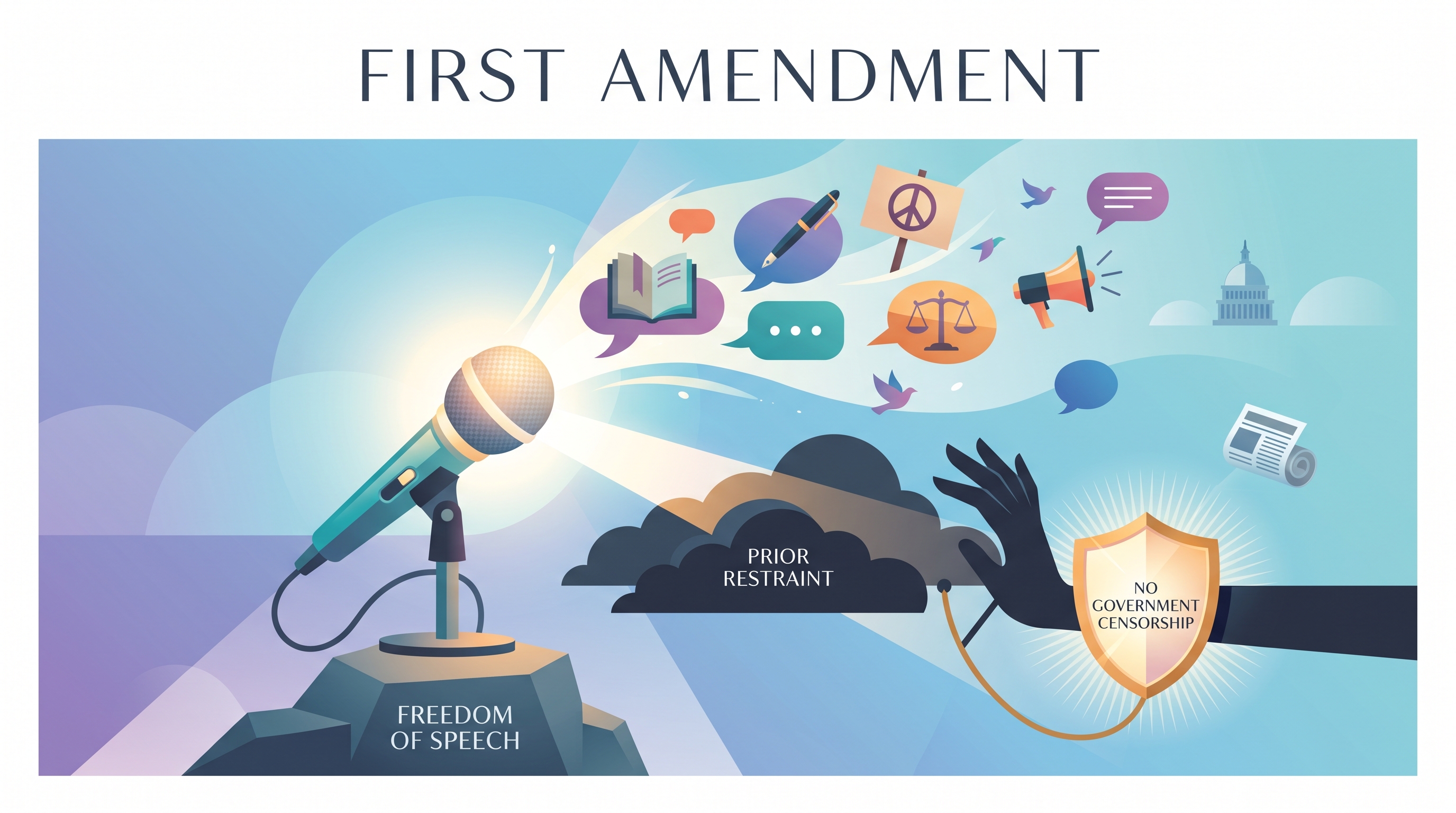
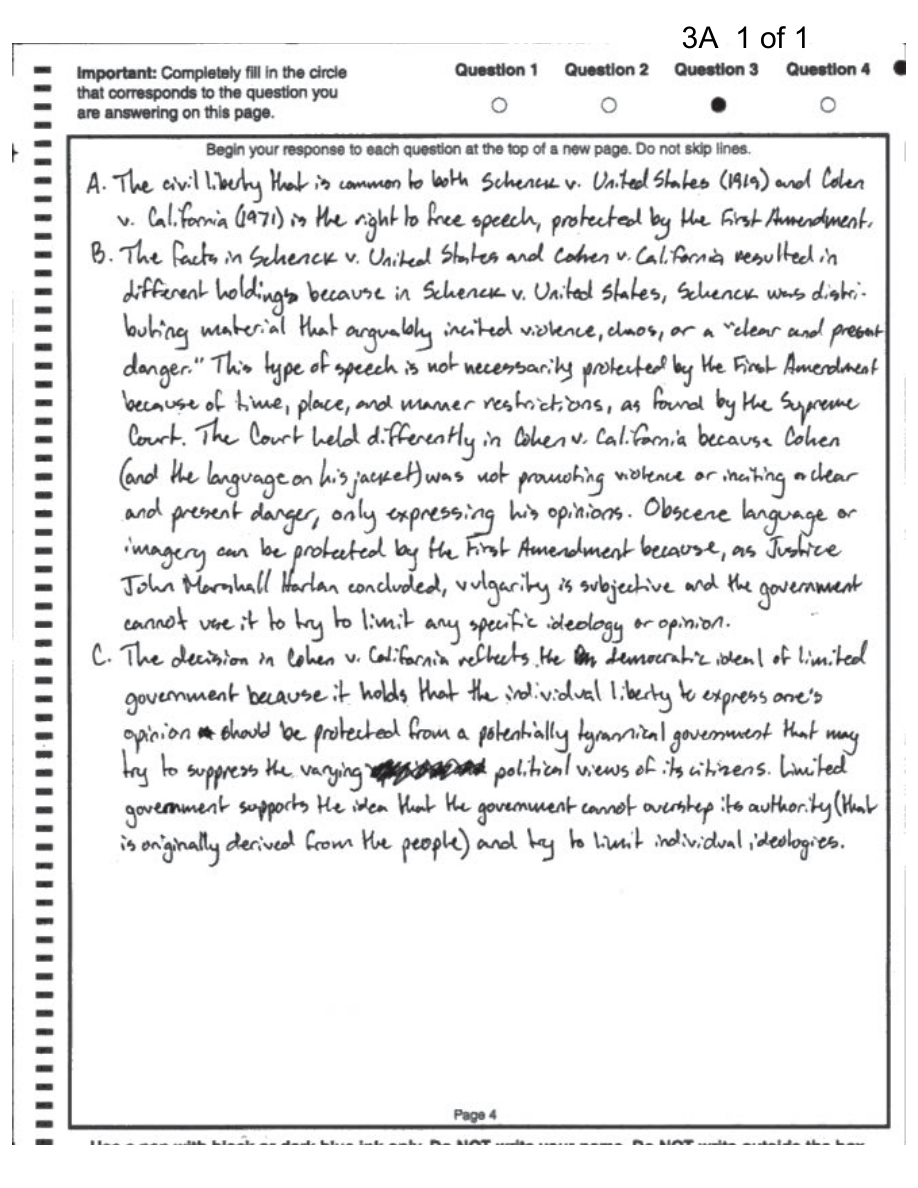
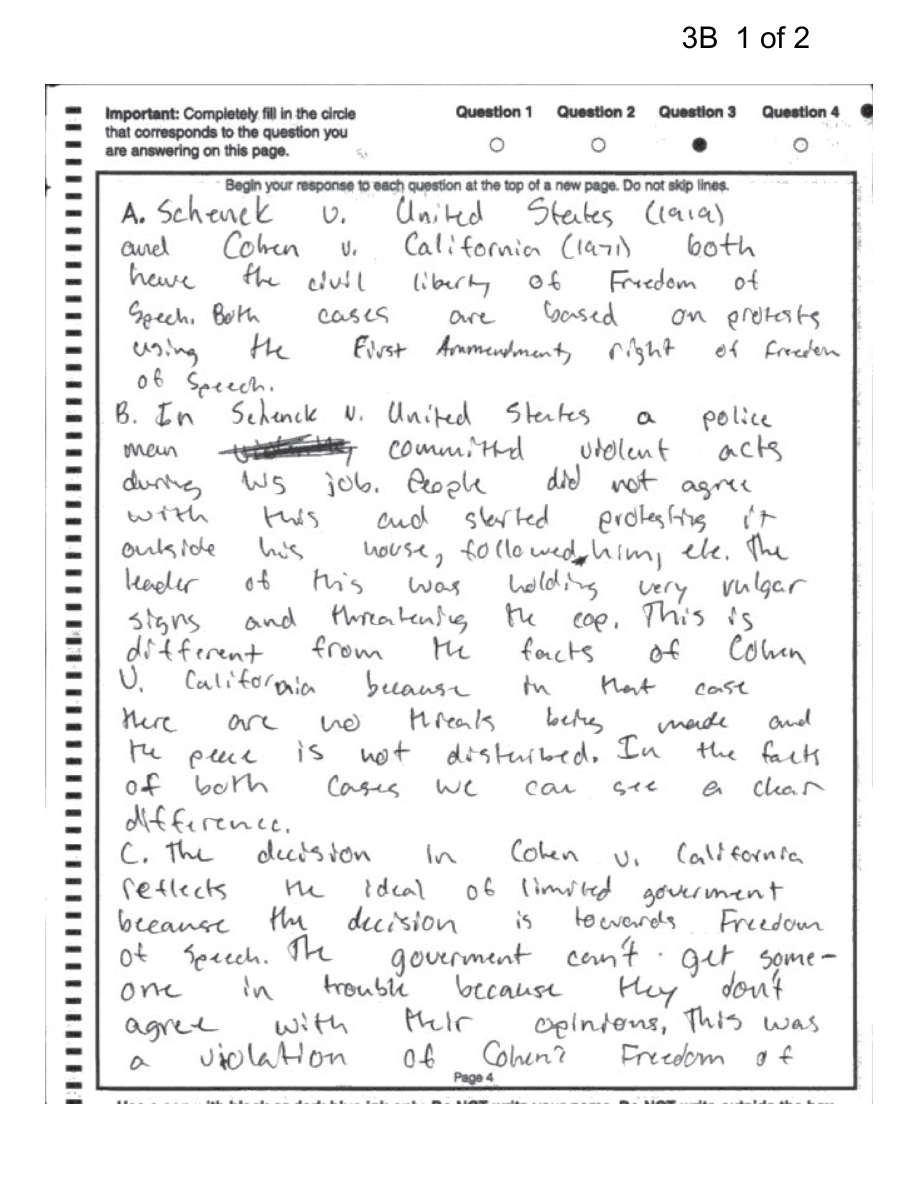
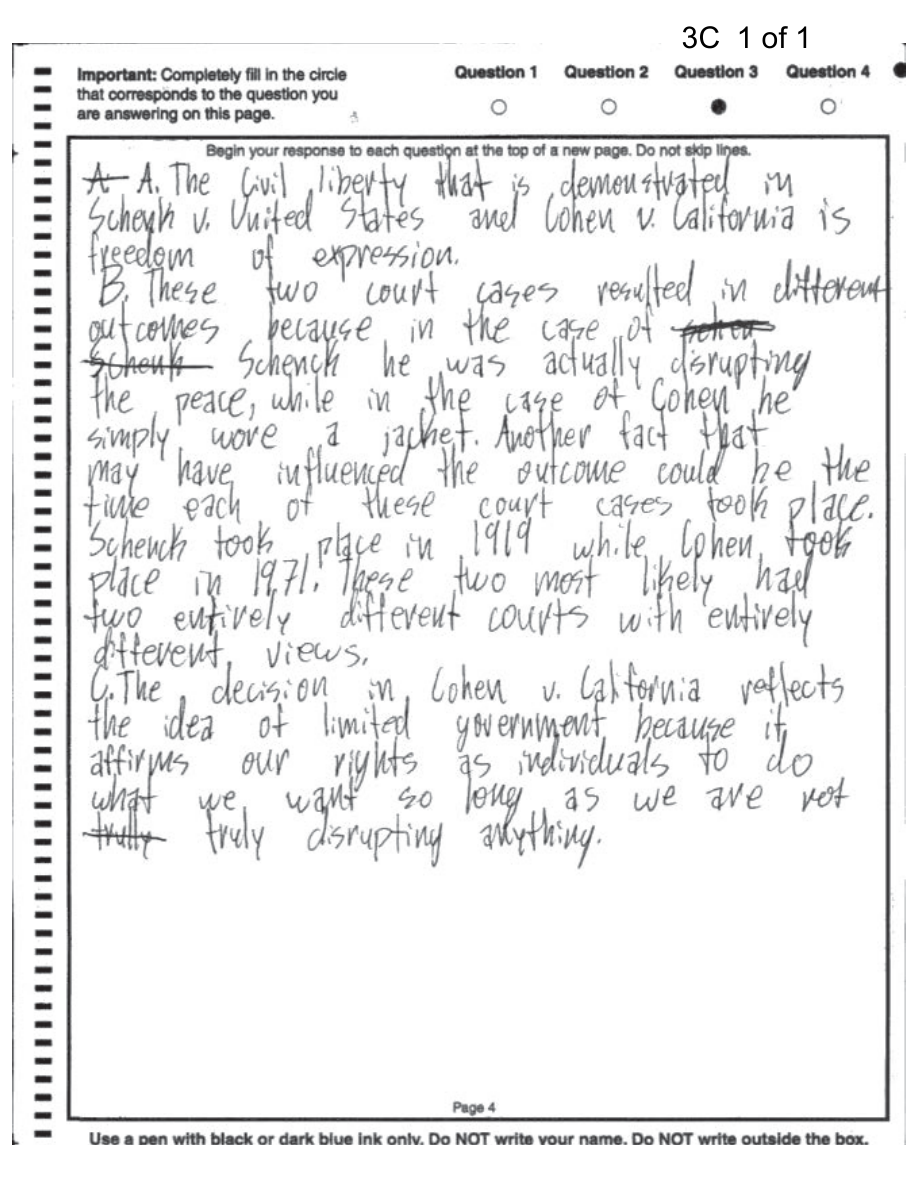
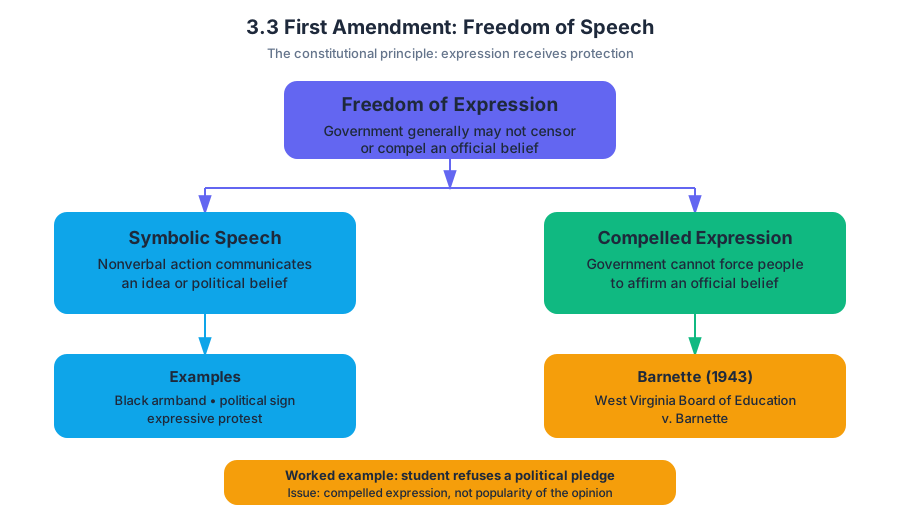
3.4 First Amendment: Freedom of the Press
Key concepts: First Amendment protection of freedom of the press · Supreme Court interpretation of individual liberty · Prior restraint · National security and press freedom · New York Times Co. v. United States (1971) · Heavy presumption against prior restraint · Wisconsin v. Yoder (1972) · Free Exercise Clause · SCOTUS application skill
A government order that stops a newspaper from publishing information before publication is called prior restraint, and the Supreme Court has treated it as one of the most serious threats to individual liberty.
3.4 First Amendment: Freedom of the Press
A government order that stops a newspaper from publishing information before publication is called prior restraint, and the Supreme Court has treated it as one of the most serious threats to individual liberty.
Investigative question
How should a democracy respond when officials claim that publishing information could endanger national security?
The constitutional tension is immediate:
| Government’s concern | Press-freedom concern |
|---|---|
| Publication could reveal military or diplomatic information. | Officials might invoke “security” to hide errors, misconduct, or embarrassing facts. |
| Preventing publication may appear safer than punishing publication later. | Censorship before publication prevents the public from receiving information and prevents the press from performing its watchdog role. |
The constitutional principle: liberty before censorship
The First Amendment protects freedom of the press, meaning that government generally may not suppress news reporting or editorial publication simply because officials dislike the information or fear its political consequences. This protection reflects a commitment to individual liberty: people must retain the freedom to seek, receive, and communicate information rather than depend entirely on government-approved accounts.
The protection is not absolute. The key constitutional distinction is when the government acts. A law that imposes consequences after publication raises one set of constitutional questions; an order that blocks publication in advance is prior restraint.
New York Times Co. v. United States (1971)
In New York Times Co. v. United States (1971), the federal government attempted to prevent newspapers from publishing classified material concerning the Vietnam War. The government argued that publication threatened national security. The newspapers argued that the First Amendment protected their ability to publish information important to public debate.
The Supreme Court rejected the government’s attempt to impose prior restraint and bolstered First Amendment freedom-of-the-press protections. The decision established a heavy presumption against prior restraint, meaning that the government faces an exceptionally difficult burden when it seeks to stop publication before it occurs.
Heavy presumption against prior restraint: Courts begin with a strong constitutional assumption that government censorship before publication is invalid, even when the government invokes national security.
The word heavy matters. The Court did not declare that national security can never justify limiting publication. Instead, it required an extraordinarily strong justification before allowing the government to silence the press in advance. National security is therefore relevant, but it does not automatically override press freedom.
Worked constitutional application
Imagine that a federal agency asks a court to stop a newspaper from publishing a report based on leaked documents. The agency claims that publication could harm national security.
- Identify the constitutional protection. The First Amendment protects freedom of the press.
- Identify the government action. The court order would prevent publication before it occurs, so it is prior restraint.
- Apply the precedent. Under New York Times Co. v. United States (1971), there is a heavy presumption against such an order, even in a national-security case.
- Explain the principle. Allowing officials to block publication merely by asserting national security would give the government excessive control over public information. The Court’s interpretation protects individual liberty by preserving the press’s ability to inform citizens and support democratic accountability.
Exam-ready conclusion: The order is constitutionally suspect because it is a prior restraint, and New York Times Co. v. United States established a heavy presumption against prior restraint even when national security is cited.
Connecting press freedom to religious liberty
Wisconsin v. Yoder (1972) illustrates the same broader constitutional commitment to individual liberty in a different First Amendment setting. The Court held that compelling Amish students to attend school beyond the eighth grade violated the Free Exercise Clause.
The cases do not concern the same freedom: New York Times concerns freedom of the press, while Yoder concerns free exercise of religion. Their connection is analytical: in both cases, the Court examined whether government could impose a generally asserted public goal at the expense of a constitutionally protected individual liberty.
Do not conflate the holdings: New York Times Co. v. United States concerns prior restraint and freedom of the press; Wisconsin v. Yoder concerns religious exercise and compulsory education.
Common misconception check
Misconception: “The First Amendment prevents the government from ever regulating the press.”
Correction: The principle is more precise. The First Amendment creates strong protection against government censorship, and New York Times established a heavy presumption against prior restraint. That presumption makes advance censorship exceptionally difficult, but it does not mean every conceivable regulation or consequence involving published material is automatically unconstitutional.
CED and AP skill alignment
Learning Objective LO 3.4.A: Explain the extent to which the Supreme Court’s interpretation of the First Amendment reflects a commitment to individual liberty.
Essential Knowledge: The required case principle is New York Times Co. v. United States (1971): freedom-of-the-press protections were strengthened through a heavy presumption against prior restraint, including in cases involving national security.
This topic is especially assessed through SCOTUS Application (SCOTUS-1): identify the holding, apply it to a new constitutional scenario, and connect the Court’s reasoning to individual liberty. It also uses Concept Application (CON-1) when a prompt asks you to apply prior restraint, press freedom, or liberty to a contextual situation.
Retrieval check
A court is asked to block publication of a newspaper investigation because officials claim the article may damage national security. What two features make the case resemble New York Times Co. v. United States (1971), and what constitutional presumption applies?
Answer: The case involves freedom of the press and government censorship before publication, making it prior restraint. The court must apply a heavy presumption against prior restraint, even though the government invokes national security.
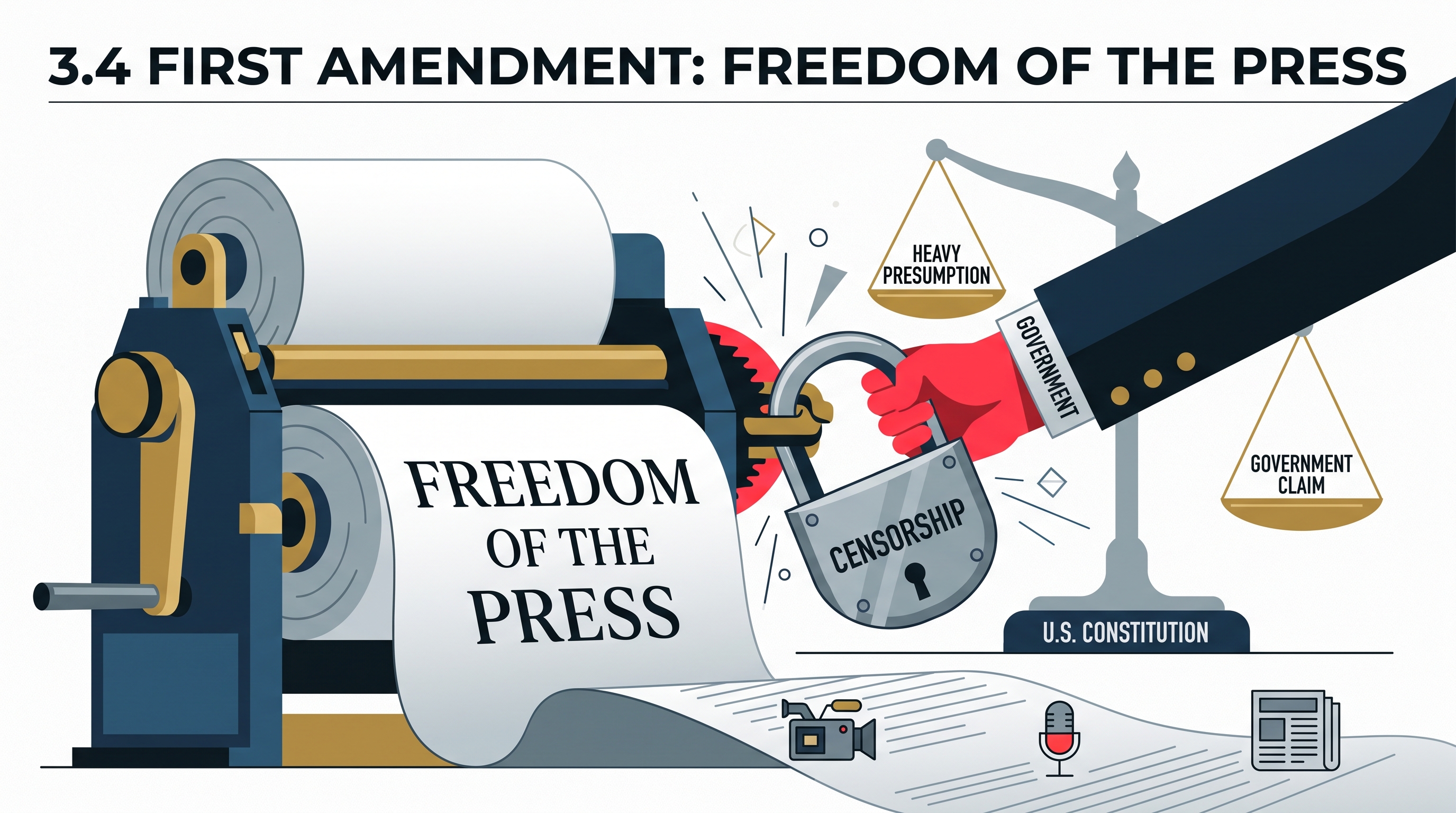
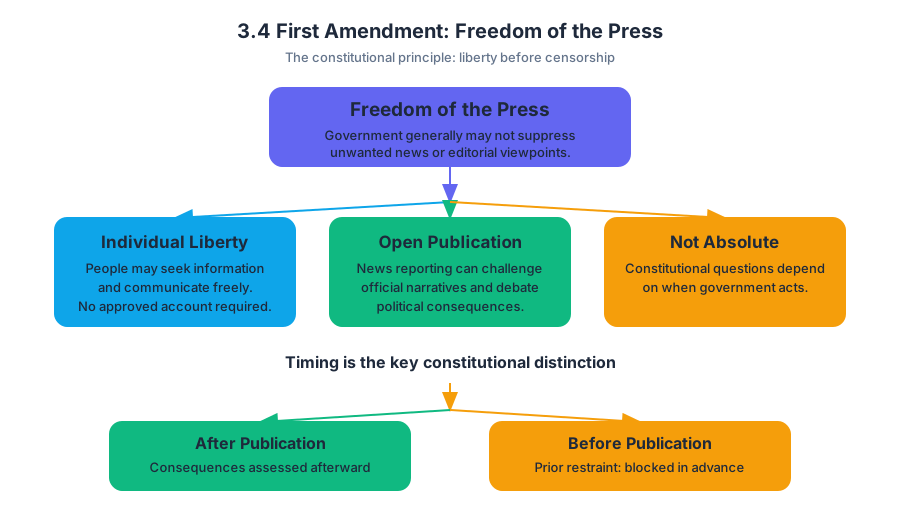
3.5 Second Amendment: Right to Bear Arms
Key concepts: Second Amendment right to bear arms · Supreme Court interpretation of constitutional rights · Individual liberty · Right to keep and bear arms for self-defense · Incorporation of the Second Amendment against the states · McDonald v. Chicago · United States v. Lopez · Commerce Clause limits on congressional power · Gun possession in a school zone · Equal Protection Clause and related case comparisons
The Supreme Court’s interpretation of the Second Amendment asks a deceptively sharp question: is the right to keep and bear arms a collective power connected only to organized militia service, or an individual liberty that protects personal self-defense?
3.5 Second Amendment: Right to Bear Arms
The Supreme Court’s interpretation of the Second Amendment asks a deceptively sharp question: is the right to keep and bear arms a collective power connected only to organized militia service, or an individual liberty that protects personal self-defense? The Court’s answer, as reflected in the required course content, treats the Amendment as protecting an individual right.
Learning Objective LO 3.5.A: Explain the extent to which the Supreme Court’s interpretation of the Second Amendment reflects a commitment to individual liberty.
Essential Knowledge EK 3.5.A.1: The Supreme Court’s decisions on the Second Amendment rest upon its constitutional interpretation of the right to bear arms.
The core idea: individual liberty
Individual liberty means the protection of personal choices and freedoms from unnecessary government interference. Applied to the Second Amendment, the concept concerns whether individuals may keep and bear arms for the purpose of self-defense.
The constitutional reasoning can be pictured as a chain:
Second Amendment text
↓
Supreme Court interpretation of “the right to bear arms”
↓
Individual right to keep and bear arms for self-defense
↓
Fourteenth Amendment incorporation
↓
Protection applies against state and local governments
The key distinction is between recognizing a constitutional right and deciding the boundaries of that right. The Court’s interpretation reflects individual liberty because it identifies self-defense as a constitutionally protected purpose. That does not mean every firearm regulation is automatically unconstitutional; it means the government must regulate within the limits established by constitutional interpretation.
McDonald v. Chicago (2010): applying the right to the states
McDonald v. Chicago (2010) held that the Second Amendment right to keep and bear arms for self-defense applies to the states. This is an example of incorporation: the process through which rights listed in the Bill of Rights become enforceable against state and local governments through the Fourteenth Amendment.
Before incorporation, the Bill of Rights primarily restricted the national government. After incorporation, many of those protections also restrict state and local governments. McDonald therefore changed the practical reach of the Second Amendment: a city could not treat the right as relevant only to federal officials or federal laws.
Worked example: identifying the constitutional issue
Suppose a city adopts a regulation that effectively prevents residents from keeping a firearm in the home for self-defense. A strong constitutional analysis proceeds in three steps:
- Identify the right: The regulation concerns the Second Amendment right to keep and bear arms for self-defense.
- Identify the precedent: Under McDonald v. Chicago, the Second Amendment applies to the states and their local governments.
- Connect to the principle: Because the rule burdens an individual liberty protected by the Constitution, the city’s regulation must be evaluated against the Second Amendment rather than treated as an issue controlled solely by local policymaking.
The case does not turn on the Equal Protection Clause merely because the government is involved. The relevant constitutional question is the scope and application of the Second Amendment right.
United States v. Lopez (1995): a federalism case, not a Second Amendment holding
United States v. Lopez (1995) held that Congress exceeded its authority under the Commerce Clause when it made possession of a gun in a school zone a federal crime. The Court’s reasoning concerned the limits of congressional power: possessing a gun in a local school zone was not sufficiently connected to interstate commerce to justify federal regulation under the Commerce Clause.
Lopez is therefore useful beside Second Amendment cases, but it answers a different question:
| Case | Main constitutional issue | Holding |
|---|---|---|
| United States v. Lopez (1995) | Commerce Clause and federalism | Congress exceeded its commerce power by creating a federal school-zone gun-possession crime. |
| McDonald v. Chicago (2010) | Second Amendment and Fourteenth Amendment incorporation | The individual right to keep and bear arms for self-defense applies to the states. |
A federal law may fail because Congress lacked constitutional authority to enact it, while a state law may raise a separate question about whether it violates an individual right. Keeping those questions separate is essential to accurate Supreme Court application.
Misconception check: matching cases to clauses
Named misconception: “Every gun-related case is a Second Amendment case.” Not so. Lopez involved a gun, but its controlling issue was the Commerce Clause. Katzenbach v. McClung involved racial discrimination by a restaurant and is associated with congressional power and civil-rights enforcement, including the constitutional context of equal protection—not with the Second Amendment. Citizens United v. Federal Election Commission (2010) concerned political spending as protected speech under the First Amendment, not the right to bear arms.
For an exam response, begin with the constitutional clause before discussing the facts. Ask: What power or right is the Court interpreting? If the answer is the individual right to keep and bear arms for self-defense, McDonald is relevant. If the answer is whether Congress may regulate local gun possession under the Commerce Clause, Lopez is relevant.
AP skill connection
This topic most directly develops SCOTUS Application:
- SCOTUS-1.A — Identify the facts and reasoning presented in a required Supreme Court case. In McDonald, identify the state or local regulation, the Second Amendment right, and the incorporation issue.
- SCOTUS-1.B — Compare the reasoning and decision-making of required Supreme Court cases. Contrast McDonald’s individual-right and incorporation reasoning with Lopez’s Commerce Clause and federalism reasoning.
- SCOTUS-1.C — Explain how a required Supreme Court case relates to a foundational principle or constitutional concept. Connect McDonald to individual liberty and Lopez to limits on national power.
Retrieval check: A city bans residents from keeping firearms for self-defense. Which required case is the strongest starting point, and why? A complete answer names McDonald v. Chicago, identifies the Second Amendment right to keep and bear arms for self-defense, and explains that incorporation makes that right applicable to state and local governments.
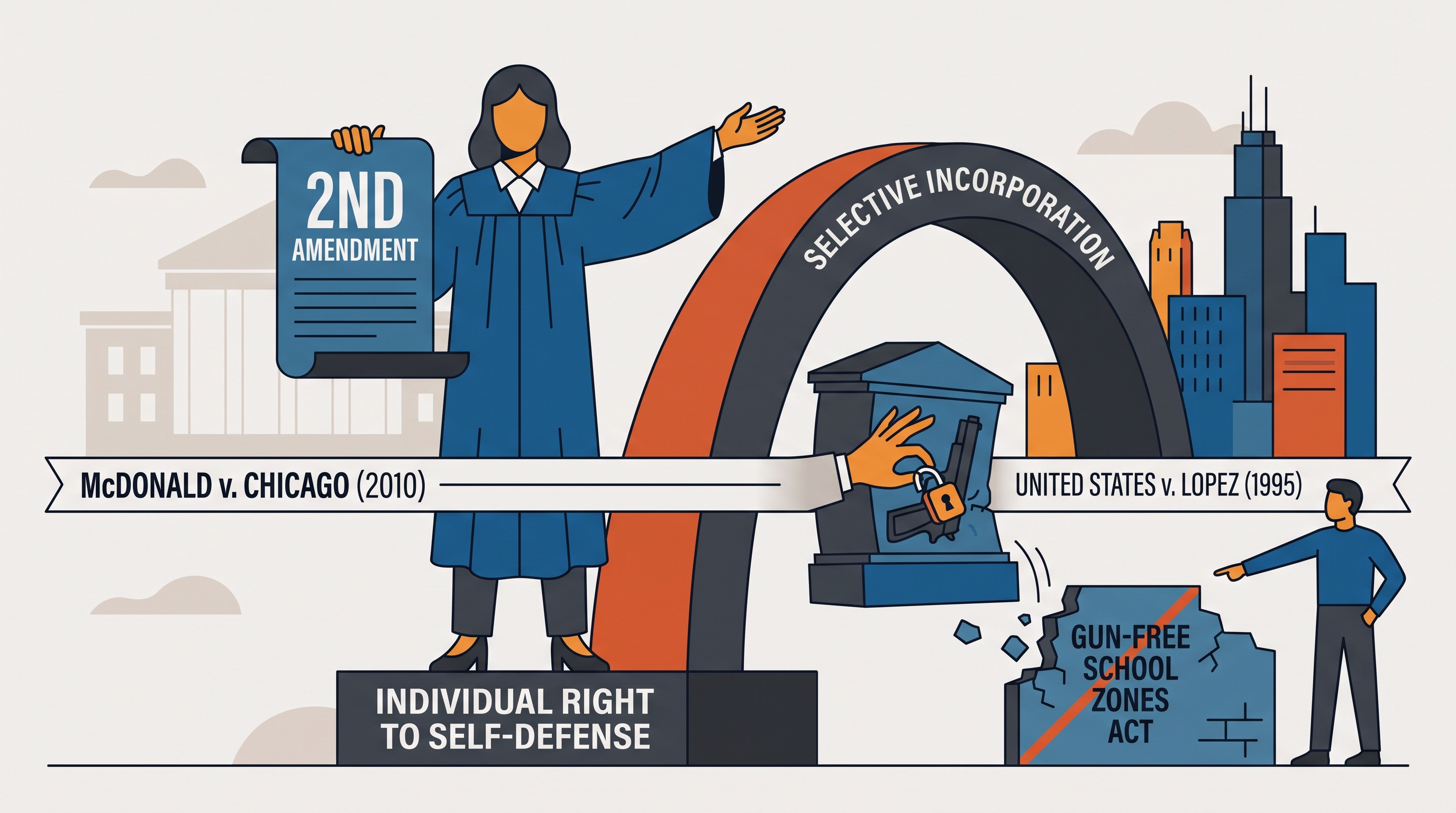
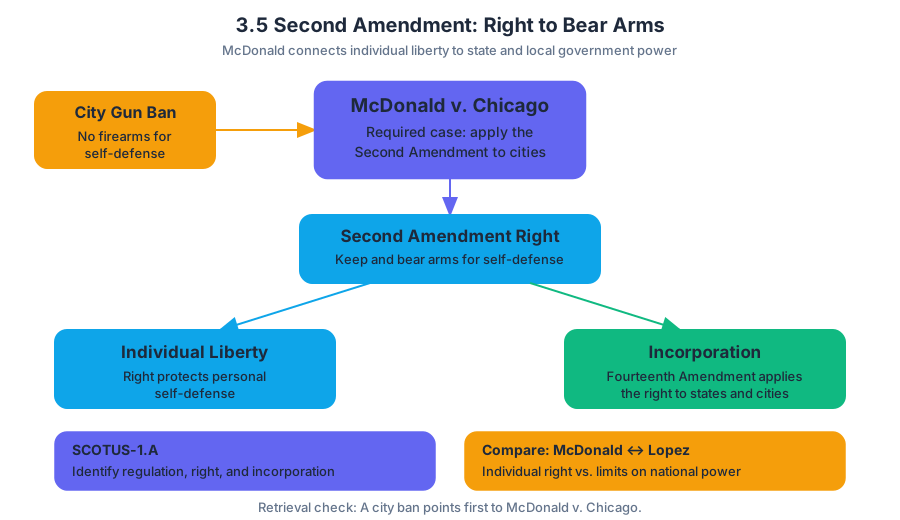
3.6 Amendments: Balancing Individual Freedom with Public Order and Safety
Key concepts: Balancing individual freedom with public order and safety · Supreme Court decisions · Constitutional rights · Public safety · Individual rights · Civil liberties and civil rights · Unit 3: Civil Liberties and Civil Rights · Learning Objective 3.6.A · Essential Knowledge 3.6.A.1 · Suggested Skill 5.B
A constitutional right is rarely absolute: the Supreme Court must decide how far individual freedom extends when government argues that a restriction is necessary to protect public order and safety.
3.6 Amendments: Balancing Individual Freedom with Public Order and Safety
A constitutional right is rarely absolute: the Supreme Court must decide how far individual freedom extends when government argues that a restriction is necessary to protect public order and safety. That recurring conflict is the core of 3.6 Amendments: Balancing Individual Freedom with Public Order and Safety.
In Unit 3, civil liberties are protections from government action, while civil rights concern equal treatment and protection under the law. Topic 3.6 focuses primarily on civil liberties, especially the problem of deciding when government enforcement procedures become an unacceptable intrusion on individual freedom.
The constitutional balancing problem
Imagine a city defending a policy that allows police to collect large amounts of digital location data. Officials argue that the information helps identify dangerous suspects and prevent crime. Critics respond that constant government access to personal information can expose innocent people and chill their freedom to associate, travel, or communicate.
The constitutional question is not simply “Is public safety important?” It is whether the government has protected safety through means consistent with constitutional rights. The Court therefore interprets constitutional text, examines the government’s purpose and procedures, and evaluates the burden placed on individual liberty.
| Government’s claim | Individual-rights concern | Supreme Court’s task |
|---|---|---|
| A restriction prevents danger or disorder. | The restriction may punish, search, or control people unfairly. | Define the right and determine whether the government’s method is constitutionally permissible. |
| Enforcement must be effective. | Enforcement may become excessive or arbitrary. | Require limits, procedures, or standards that protect liberty. |
| The public benefits from regulation. | Individuals may bear the constitutional cost. | Balance public order and safety against the scope of the protected freedom. |
Learning Objective 3.6.A
Learning Objective 3.6.A: Explain how the Supreme Court has attempted to balance claims of individual freedom with laws and enforcement procedures that promote public order and safety.
The verb explain requires more than naming an amendment or case. A strong explanation identifies the government’s safety objective, identifies the constitutional liberty at stake, describes the Court’s interpretation, and shows whether the decision strengthened, limited, or reshaped either side of the balance.
Cruel and unusual punishment: the Eighth Amendment
Essential Knowledge 3.6.A.1: Court decisions defining cruel and unusual punishment involve interpretation of the Eighth Amendment and its application to death penalty statutes.
The Eighth Amendment prohibits “cruel and unusual punishments.” The Supreme Court has treated this language as requiring interpretation rather than applying a fixed list of forbidden punishments. The central tension is visible in death-penalty cases: the government seeks a severe punishment for especially serious crimes, while the accused claims that the punishment is excessive, arbitrary, or constitutionally unacceptable.
In Furman v. Georgia (1972), the Court invalidated existing death-penalty procedures because their discretionary application could produce arbitrary results. The decision did not permanently abolish capital punishment; it required states to revise their statutes. In Gregg v. Georgia (1976), the Court upheld a redesigned death-penalty system that included procedures intended to guide discretion and produce more consistent decisions.
Worked example: A state argues that capital punishment deters crime and expresses society’s condemnation of murder. A defendant argues that juries receive too little guidance, so similar defendants may receive different punishments. Under the reasoning associated with Furman, the problem is not merely whether the death penalty promotes safety; it is whether the procedure imposes the punishment arbitrarily. A later statute with structured procedures may survive under Gregg because it addresses that constitutional defect.
Firearms, metadata, and public safety
Essential Knowledge 3.6.A.2: The debate about the Second and Fourth Amendments involves concerns about public safety and whether government regulation of firearms or collection of digital metadata promotes or interferes with public safety and individual rights.
The Second Amendment debate asks whether firearm regulation reduces violence or improperly burdens the right to keep and bear arms. The Fourth Amendment debate asks whether government searches or surveillance protect people from crime and terrorism or intrude on the right to be secure against unreasonable searches.
In District of Columbia v. Heller (2008), the Court recognized an individual Second Amendment right to possess a firearm for lawful purposes such as self-defense, while also indicating that the right is not unlimited. This illustrates how a decision can protect individual liberty while leaving room for some public-safety regulation.
Digital metadata—information about communications or activity, such as when a phone connects to a location network—can reveal highly personal patterns even when it does not contain the message’s words. In Carpenter v. United States (2018), the Court held that the government generally needs a warrant supported by probable cause to obtain extended historical cell-site location information. The ruling treated the government’s investigative interest as important but concluded that the privacy intrusion required stronger constitutional protection.
Supreme Court decisions: promoting or interfering with safety and rights
A decision may promote public safety by permitting carefully designed enforcement, limiting dangerous conduct, or allowing officials to gather evidence under lawful procedures. The same decision may also interfere with safety from the government’s perspective if constitutional safeguards make investigations slower or restrict available enforcement tools.
Conversely, a decision may promote individual rights by preventing arbitrary punishment, requiring warrants, or recognizing a protected sphere of personal autonomy. Critics may argue that the ruling interferes with safety if it removes a law-enforcement tool or makes regulation more difficult. AP analysis should identify whose claim is being advanced rather than treating “safety” or “freedom” as self-proving conclusions.
Skill focus: 5.B — Support an argument or claim/thesis using relevant evidence
The suggested analytical skill is 5.B: Support an argument or claim/thesis using relevant evidence. Evidence is relevant when it directly supports the claim being made. A case name alone is not evidence; the reasoning and constitutional effect of the decision must be connected to the argument.
Argument example: “Supreme Court decisions can promote individual rights without completely rejecting public safety concerns.” Relevant evidence includes Gregg, because the Court allowed a death-penalty system with procedural safeguards, and Carpenter, because the Court required a warrant for sensitive location data while leaving lawful investigations possible.
Misconception check — “Balancing” means splitting the difference. The Court does not automatically compromise by giving each side half of what it wants. It may invalidate an entire procedure, uphold a restriction, require a warrant, or recognize a right while permitting limited regulation. The constitutional result depends on the text, precedent, facts, and procedures involved.
Retrieval check: A state claims that a new surveillance system will improve public safety, but it collects detailed location histories from millions of people without individualized judicial approval. Identify the relevant amendment, state the individual-rights concern, and use Carpenter as evidence for one defensible claim about why the procedure might be constitutionally limited.
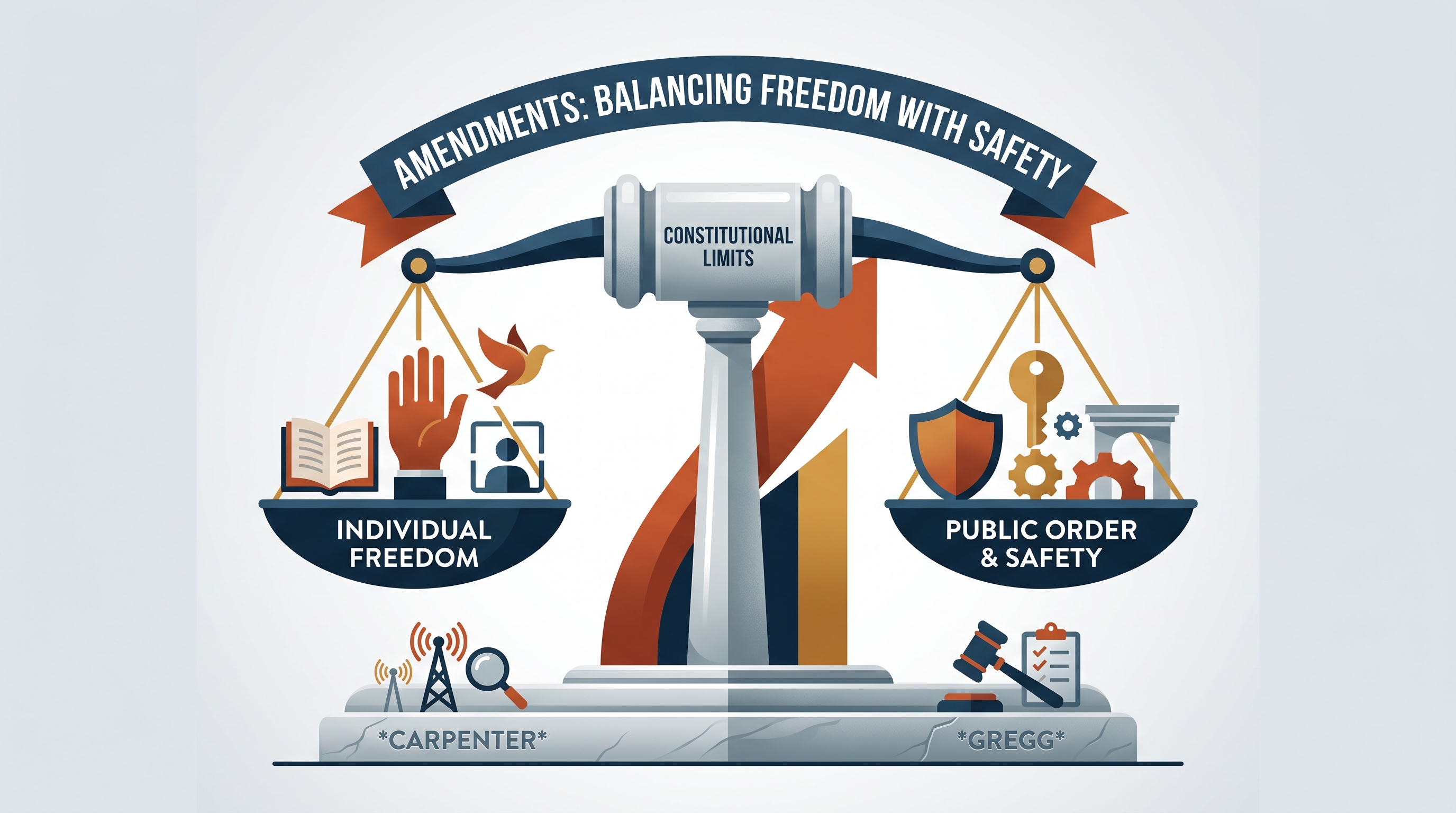
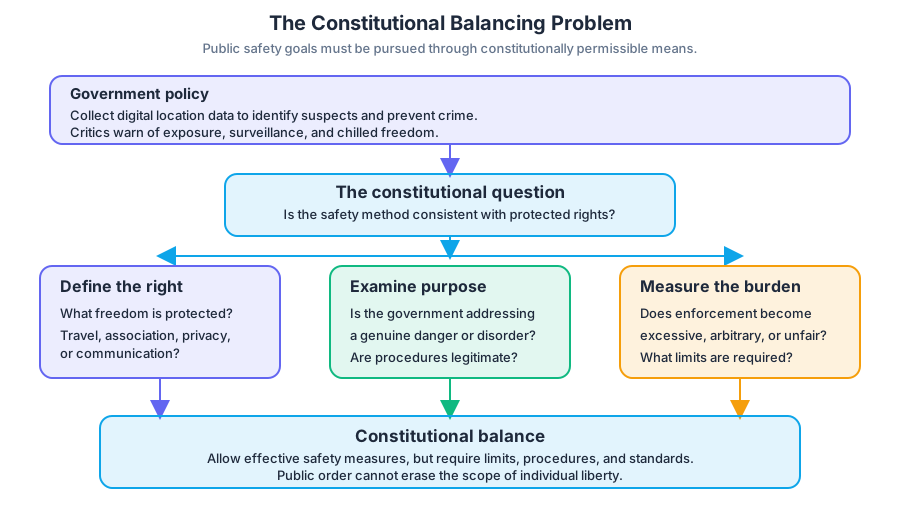
3.7 Selective Incorporation
Key concepts: Selective incorporation
The Bill of Rights originally restricted only the national government, but today most of its protections also limit state and local governments through the Fourteenth Amendment.
3.7 Selective Incorporation
The Bill of Rights originally restricted only the national government, but today most of its protections also limit state and local governments through the Fourteenth Amendment. The constitutional process that extended these protections one right at a time is called selective incorporation.
Selective incorporation is the gradual application of specific protections in the Bill of Rights to the states through the Fourteenth Amendment’s Due Process Clause.
The constitutional problem: two levels of government
The original Bill of Rights begins with restrictions directed at the federal government: Congress may not establish a religion, violate freedom of speech, conduct unreasonable searches, or deny other listed protections. For much of the nineteenth century, however, a state could violate those freedoms under its own laws unless its state constitution offered protection.
The Supreme Court made this distinction clear in Barron v. Baltimore (1833). John Barron argued that Baltimore had taken property without providing just compensation, violating the Fifth Amendment. The Court ruled that the Bill of Rights limited only the national government, not the states.
Visual sequence:
Bill of Rights → originally limited federal government only
Fourteenth Amendment, 1868 → Due Process Clause becomes a constitutional pathway
Supreme Court decisions → individual rights applied to states one protection at a time
Modern result → most Bill of Rights protections bind state and local governments
The Fourteenth Amendment changes the pathway
The Fourteenth Amendment prohibits states from depriving any person of life, liberty, or property without due process of law. The Supreme Court interpreted “liberty” to include certain fundamental freedoms protected by the Bill of Rights. When the Court determines that a particular freedom is fundamental and applies it to the states, that right has been incorporated.
The process is selective because the Court did not apply the entire Bill of Rights to the states in one decision. Instead, incorporation developed incrementally through individual cases. The First Amendment’s protection of speech, for example, was applied to the states in Gitlow v. New York (1925), while other rights were incorporated in later decisions.
Worked example: McDonald v. Chicago
Suppose Chicago prohibits residents from possessing handguns in their homes for self-defense. A resident argues that the restriction violates the Second Amendment, which the Supreme Court had interpreted in District of Columbia v. Heller (2008) as protecting an individual right to possess a firearm for lawful purposes such as self-defense in the home.
In McDonald v. Chicago (2010), the Supreme Court held that the Second Amendment right recognized in Heller applies to state and local governments through the Fourteenth Amendment. The reasoning has two steps:
- The Second Amendment protects an individual constitutional liberty.
- The Fourteenth Amendment’s Due Process Clause makes that fundamental liberty enforceable against the states.
The decision did not mean that every firearm regulation is unconstitutional. Incorporation answers the question which level of government must respect the right; it does not automatically answer whether a particular law is a permissible regulation of that right.
Incorporation is not total application
Most, but not all, protections in the Bill of Rights have been incorporated. Some provisions remain applicable only to the federal government, and some protections have been incorporated only partially. For example, incorporation of a right does not necessarily require states to use every federal procedure or remedy in exactly the same way.
| Question | What selective incorporation answers |
|---|---|
| Who must respect the right? | State and local governments, as well as the federal government |
| How does the right reach the states? | Through the Fourteenth Amendment |
| Does incorporation erase all regulation? | No. Courts may still permit reasonable constitutional limits |
| Did incorporation happen all at once? | No. Rights were applied through separate Supreme Court decisions |
Common misconception check
Misconception: “The Fourteenth Amendment automatically applied the entire Bill of Rights to the states.”
Correction: The Fourteenth Amendment supplied the constitutional basis for incorporation, but the Supreme Court decided the status of individual rights case by case. Barron represents the earlier nonincorporation rule; Gitlow and McDonald illustrate the later selective-incorporation approach.
AP skill connection
This topic most directly develops SCOTUS Application 2.A: Describe or explain the reasoning, decision, or significance of a Supreme Court case and SCOTUS Application 2.B: Explain how a Supreme Court decision relates to a political concept or issue. A strong response identifies the relevant constitutional provision, states what the Court decided, and connects that decision to selective incorporation rather than merely naming the case.
It also supports Concept Application 1.A: Define and explain political concepts and processes. In an argument, the key causal chain is: the Fourteenth Amendment’s Due Process Clause provides the route, the Supreme Court identifies a fundamental liberty, and the protection becomes enforceable against state and local governments.
Retrieval check
A state law restricts a freedom protected by the First Amendment. Which constitutional development allows a person to challenge that state law in federal court, and why is the process called selective incorporation?
Answer: The Fourteenth Amendment’s Due Process Clause allows the challenge because the Supreme Court has applied fundamental Bill of Rights protections to the states. It is called selective because the Court incorporated rights individually over time rather than applying every protection simultaneously.
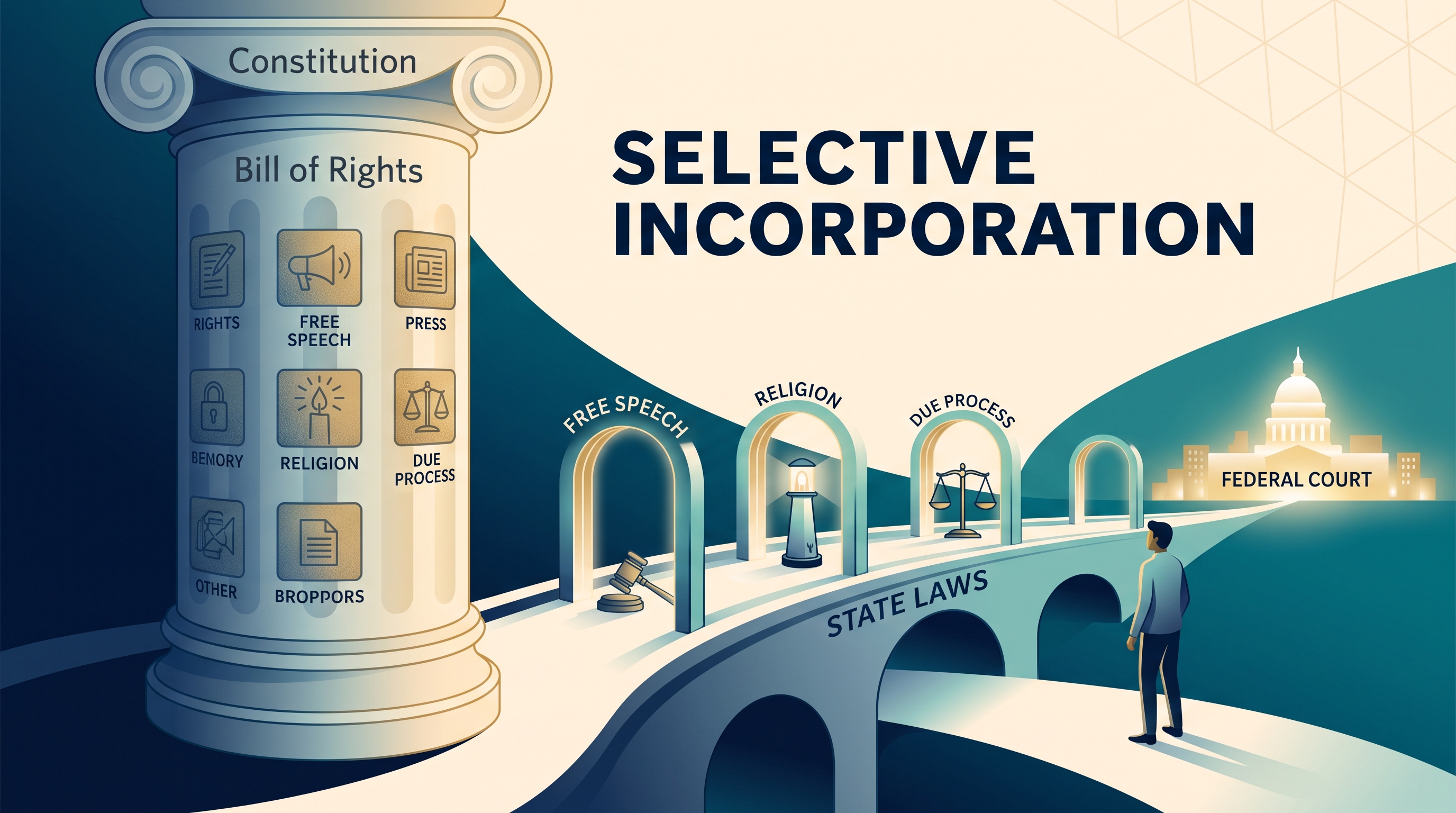
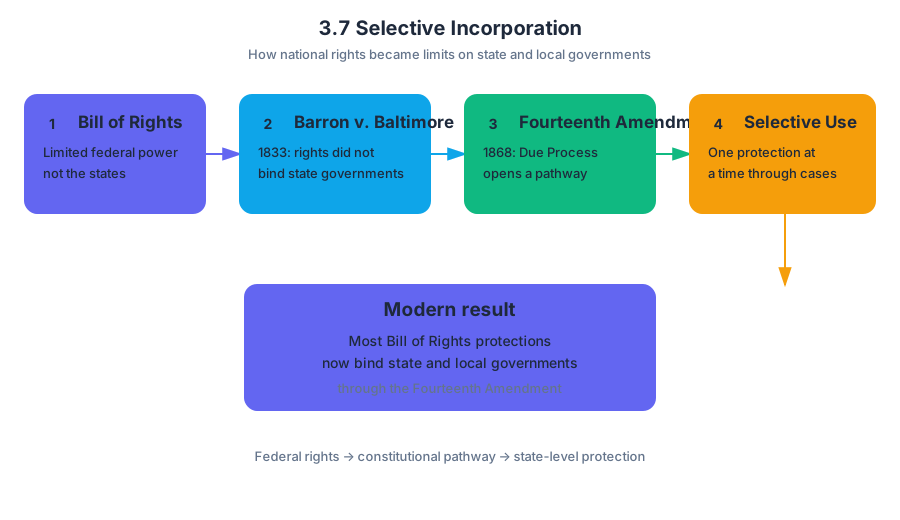
3.8 Amendments: Due Process and the Rights of the Accused
Key concepts: Due process of law · Procedural due process · Fifth Amendment protections · Fourteenth Amendment protections · Life, liberty, and property rights · Incorporation of the Bill of Rights · Rights of the accused · Government limits on state regulation of civil liberties · Public safety exception to Miranda warnings · Limits on bulk collection of telecommunications metadata
Government cannot lawfully take a person’s life, liberty, or property simply because an official says so. Due process of law requires both constitutional authority and fair, nonarbitrary procedures before the government acts against a protected interest.
3.8 Amendments: Due Process and the Rights of the Accused
Government cannot lawfully take a person’s life, liberty, or property simply because an official says so. Due process of law requires both constitutional authority and fair, nonarbitrary procedures before the government acts against a protected interest.
LO 3.8.A — Explain the extent to which the government is limited by procedural due process from infringing upon individual rights.
The constitutional promise: fair government action
The Fifth Amendment limits the national government: it may not deprive a person of “life, liberty, or property, without due process of law.” The Fourteenth Amendment applies the same basic limitation to state governments. Together, these clauses establish that government power has procedural boundaries even when officials pursue legitimate public goals.
Procedural due process means that government officials must use methods that are not arbitrary when making and carrying out decisions affecting constitutionally protected interests. The central question is not only what the government decided, but also how it reached and implemented that decision.
A person’s protected interest may be concrete, such as physical property, or personal, such as liberty. For example, before the government removes a professional license, terminates a public benefit, or imposes a criminal penalty, due process may require notice of the proposed action and a meaningful opportunity to respond. The exact procedure depends on the government interest, the individual interest, and the risk that an arbitrary decision would produce an unjust result.
EK 3.8.A.1 — The Fifth and Fourteenth Amendments include clauses stating that the government may not infringe upon a person’s right to life, liberty, or property without due process of law.
Due process does not make every government action unconstitutional
Due process is a limitation on arbitrary methods, not an absolute ban on restricting individual rights. Government interests can justify restrictions when officials act through constitutionally acceptable procedures. Speech, for instance, may be limited when it presents a demonstrated danger to public safety; the government must still justify the restriction and apply its rules fairly rather than targeting people without a legitimate basis.
Common misconception: “Due process means the government can never restrict liberty.”
Correction: Due process requires lawful and fair procedures. It does not guarantee that every person will win a hearing or avoid every restriction.
Procedural protections for the accused
Procedural protections for accused people are reinforced by other provisions of the Bill of Rights and by Supreme Court doctrines. Miranda is a related constitutional protection, but it should not be treated as identical to procedural due process. Miranda warnings primarily implement the Fifth Amendment privilege against self-incrimination by requiring police to inform a person in custody, before custodial interrogation, of the right to remain silent and the right to an attorney.
The Sixth Amendment right to counsel is distinct. It protects the accused after formal criminal charges have begun and concerns the assistance of counsel in the prosecution. Thus, an AP response should distinguish the two doctrines: Miranda concerns warnings before custodial interrogation; the Sixth Amendment right to counsel attaches in the charged criminal case.
When state police give Miranda warnings, the result reflects incorporation of the Fifth Amendment protection against compelled self-incrimination through the Fourteenth Amendment. That application limits state as well as national officials, but Miranda protections are not absolute. The Supreme Court has recognized a public safety exception: in an urgent situation involving an immediate threat, some unwarned questioning may produce statements admissible in court when officers reasonably seek information needed to protect the public.
National security and limits on information gathering
Due process debates also arise when government gathers information in the name of security. The Patriot Act expanded federal investigative tools after the September 11 attacks, including authority related to telecommunications metadata. The USA Freedom Act later placed limitations on the government’s bulk collection of that metadata, illustrating how Congress can revise the scope of executive and intelligence authority.
These laws demonstrate the recurring constitutional tension between individual liberty and public safety. A strong analysis does not simply label one side “constitutional” and the other “unconstitutional”; it identifies the protected interest, the government’s purpose, the procedure used, and the legal limit placed on official power.
Worked application
Scenario: State officers arrest a person suspected of possessing explosives. Before giving Miranda warnings, officers ask where the explosives are because a crowded transit station may be at risk. The person answers, and prosecutors seek to use the statement.
Reasoning: The Fifth Amendment protects against compelled self-incrimination, and Miranda ordinarily requires warnings before custodial interrogation. However, the immediate threat to public safety may fit the recognized exception. The best conclusion is qualified: the statement may be admissible if the questioning was reasonably directed at neutralizing an urgent danger, but the exception does not create unlimited authority to interrogate without warnings.
AP skill connections
This topic most directly develops Concept Application, especially CON-1, by applying due process, protected interests, and government limitations to a new scenario. It also develops SCOTUS Application, especially SCOTUS-1, by explaining how Supreme Court doctrine distinguishes Miranda, the Sixth Amendment right to counsel, and the public safety exception.
A response can also require Source Analysis, especially SOUR-1, when a court opinion, statute, or constitutional passage supplies the evidence. Argumentation, especially ARG-1, matters when defending an extent claim: identify the constitutional rule, apply the facts, acknowledge the government’s competing interest, and reach a qualified conclusion.
Retrieval check
A state agency cancels a person’s license without notice, hearing, or explanation. Which constitutional principle is most directly implicated, and why does the answer differ from saying that the agency may never cancel the license?
Answer: Procedural due process is implicated because the agency used potentially arbitrary methods to affect a protected liberty or property interest. Due process does not necessarily prevent cancellation; it generally requires lawful, fair procedures such as notice and an opportunity to respond.

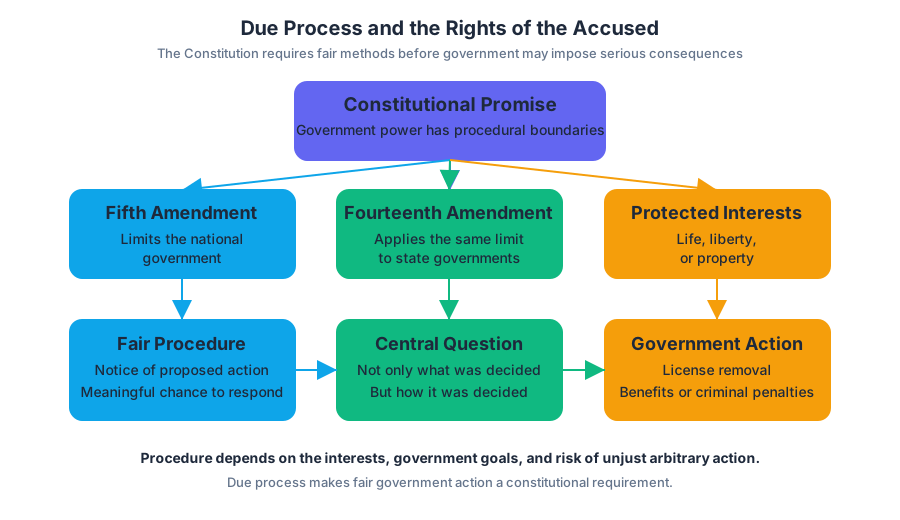
3.9 Amendments: Due Process and the Right to Privacy
Key concepts: Substantive due process · Procedural due process · The constitutional right to privacy · The Ninth Amendment and unenumerated rights · The Fourteenth Amendment’s Due Process and Equal Protection Clauses · Fourth Amendment protections against unreasonable searches and seizures · The exclusionary rule · Privacy in the digital age · Individual rights and government limits
Substantive due process asks whether the government has violated a fundamental liberty through an unjustified or arbitrary law, even when the government has followed formally correct procedures.
3.9 Amendments: Due Process and the Right to Privacy
Substantive due process asks whether the government has violated a fundamental liberty through an unjustified or arbitrary law, even when the government has followed formally correct procedures. The central puzzle is that the Constitution does not explicitly use the phrase right to privacy, yet the Supreme Court has recognized privacy as a constitutionally protected interest.
LO 3.9.A: Explain the extent to which substantive due process limits the government from infringing upon individual rights.
EK 3.9.A.1: The Supreme Court has recognized unenumerated rights—rights not specifically listed in the Constitution—including a right to privacy. The Ninth Amendment supports this reasoning by stating that listing certain rights does not mean that people lack other rights retained by the people.
Two meanings of due process
Procedural due process concerns the fairness of the government’s method: Did the government provide appropriate notice, a meaningful opportunity to be heard, access to counsel when required, and a fair or impartial decision-maker before taking away life, liberty, or property? These safeguards regulate how government acts.
Substantive due process concerns the substance of the government’s action: Is the law itself an unjustified infringement on a protected liberty? A government cannot necessarily make an unconstitutional deprivation acceptable merely by providing a hearing first.
| Question | Constitutional focus | Typical protections |
|---|---|---|
| Procedural due process | Was the government’s process fair? | Notice, hearing, counsel where required, impartial decision-maker |
| Substantive due process | Is the government’s interference with a protected liberty itself unjustified? | Judicial review of arbitrary infringements on fundamental rights |
| Fourth Amendment | Was a search or seizure reasonable? | Warrants and protection against unreasonable searches and seizures |
| Sixth Amendment | Were criminal-trial rights protected? | Counsel, speedy and public trial, impartial jury |
Important distinction: an impartial jury is a Sixth Amendment protection, and protection against unreasonable searches and seizures is a Fourth Amendment protection. Both may matter in a criminal case, but neither should be casually labeled as a generic example of procedural due process.
The constitutional right to privacy
The Supreme Court developed the constitutional right to privacy through interpretation rather than through one express constitutional sentence. In Griswold v. Connecticut (1965), the Court recognized a privacy right involving marital decisions about contraception. The reasoning drew on protections located in several amendments—the Constitution’s “penumbras” and “emanations”—as well as the broader principle that individual liberty is not limited to rights printed in a single list.
In Roe v. Wade (1973), the Court used substantive due process to recognize a constitutional privacy right protecting a pregnant woman’s decision regarding abortion. The decision treated the liberty protected by the Fourteenth Amendment’s Due Process Clause as extending to that decision, thereby limiting state authority to regulate abortion.
In Dobbs v. Jackson Women’s Health Organization (2022), the Court overturned Roe. The decision held that the Constitution does not confer a federal constitutional right to abortion under the reasoning used by Roe, returning primary authority over abortion regulation to elected legislatures. The broader debates over privacy, liberty, and substantive due process therefore continue.
Worked constitutional application: Suppose a state prohibits married couples from obtaining contraception. The government might provide notice and a hearing, satisfying a procedural requirement, but the law could still be challenged substantively because it intrudes on a recognized liberty interest. Under Griswold, the government’s formal procedure would not answer the deeper question: whether the law itself arbitrarily invades protected privacy.
Privacy, equality, and the Fourteenth Amendment
The Fourteenth Amendment’s Due Process Clause applies constitutional liberty protections against the states and provides the foundation for substantive due process analysis. Its Equal Protection Clause addresses a related but distinct problem: whether government has treated similarly situated people differently without sufficient constitutional justification. Topic 3.9 centers on due process and privacy; equal protection becomes especially important when the classification of people, rather than the intrusion on liberty alone, is the constitutional issue.
Digital privacy and the Fourth Amendment
The Fourth Amendment protects people against unreasonable searches and seizures. Courts have applied that protection to modern technology because digital records can expose far more than a single physical search.
In Carpenter v. United States (2018), the Supreme Court held that obtaining historical cell-site location information generally requires a warrant. Cell-site records can reveal an extensive record of a person’s movements, so the government cannot treat access to that information as equivalent to observing a few isolated public actions.
The exclusionary rule is an enforcement mechanism: evidence obtained through an unconstitutional search or seizure is generally barred from use against the accused in a criminal prosecution. It does not mean every procedural mistake automatically ends a case; the key question is whether the evidence was obtained through a constitutional violation and whether an applicable exception affects its admissibility.
National-security surveillance also illustrates the tension between liberty and security. The Patriot Act expanded government surveillance authority after the September 11 attacks, while the USA Freedom Act placed limitations on the bulk collection of telecommunications metadata. These laws show that privacy protections are shaped not only by court decisions but also by legislation responding to changing technologies and security concerns.
Misconception check
Misconception: “Privacy is protected only when the word appears in the Constitution.” The Ninth Amendment supports recognition of unenumerated rights, and the Supreme Court has interpreted the Fourteenth Amendment’s liberty protection to include certain privacy interests. However, recognizing a privacy interest does not make every private decision immune from regulation; the constitutional question is the extent of the protected liberty and whether the government’s infringement is justified.
Suggested AP skill — SCOTUS Application 2.C: Explain the implications of a Supreme Court decision. Apply it by identifying the constitutional principle in Carpenter, then explaining its consequence: government access to historical cell-site location information generally requires a warrant because the data creates an extensive movement record.
Retrieval check: A state gives a person notice, a hearing, and an impartial decision-maker before imposing a restriction, but the restriction directly invades a recognized fundamental liberty. Which concept allows a court to examine the restriction itself rather than only the fairness of the procedure—and which Supreme Court case illustrates the privacy principle involved?
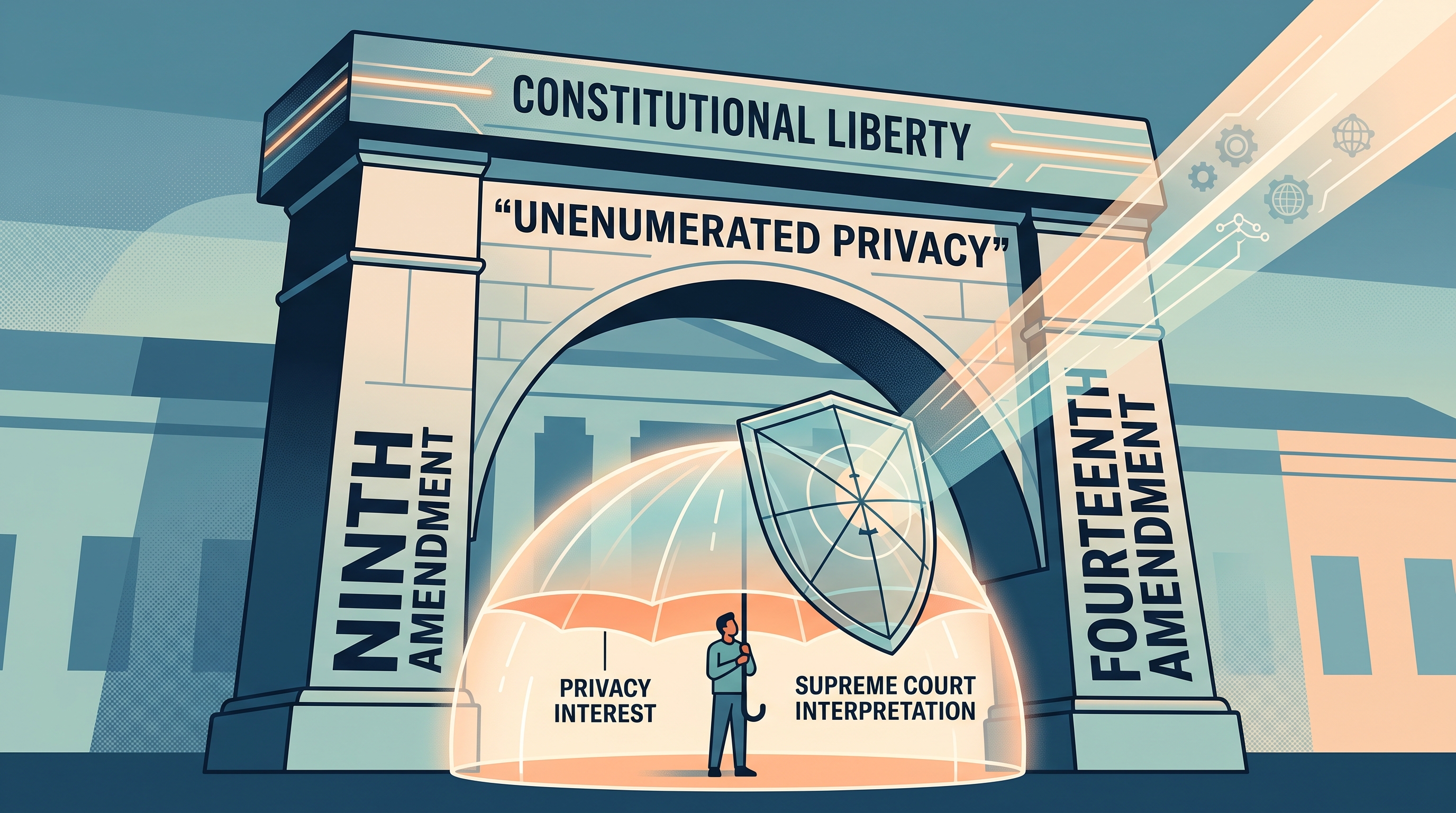
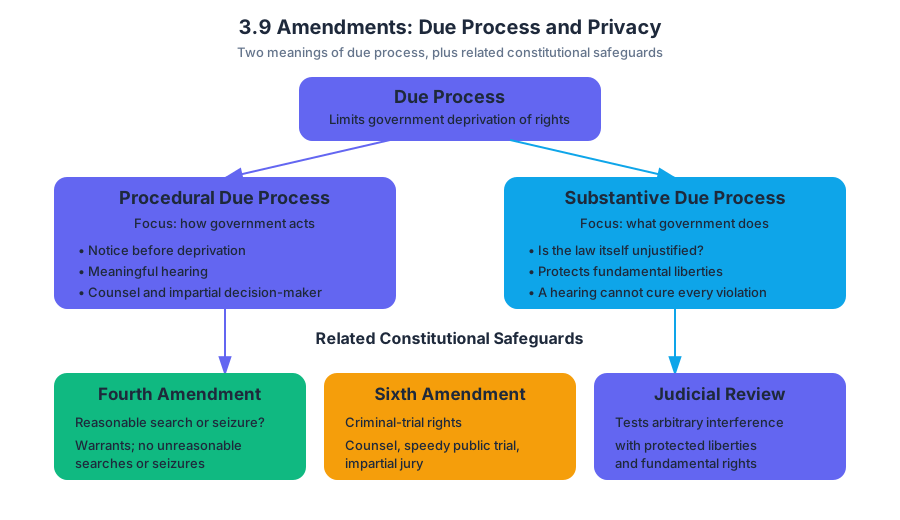
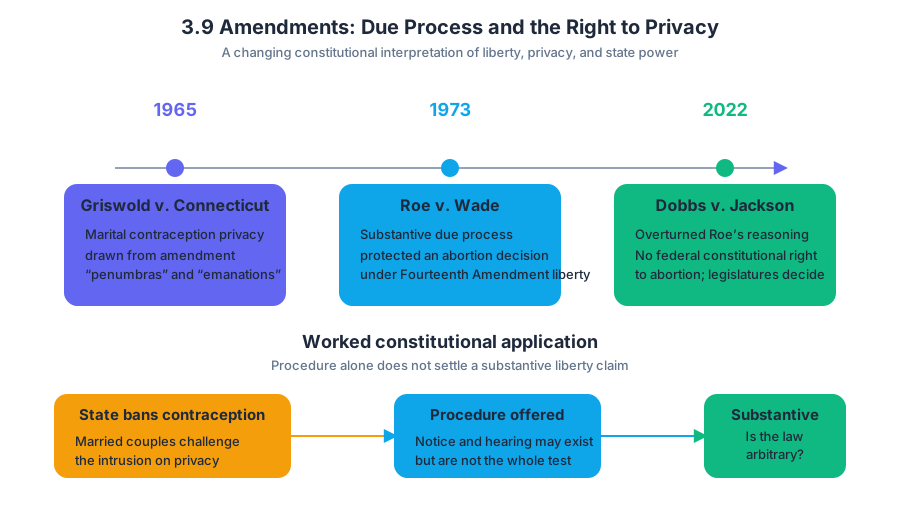
3.10 Social Movements and Equal Protection
Key concepts: Equal Protection Clause of the Fourteenth Amendment · Civil rights and protection from discrimination · Social movements · Participatory model of democracy · Civil Rights Act of 1964 · Title VII and workplace equality · LGBTQ rights advocacy · Women’s participation and equal opportunity · Racial gerrymandering and voting rights · Civil disobedience and the Letter from Birmingham Jail
The Equal Protection Clause of the Fourteenth Amendment turns a demand for equal treatment into a constitutional claim: government may not deny any person the equal protection of the laws.
3.10 Social Movements and Equal Protection
The Equal Protection Clause of the Fourteenth Amendment turns a demand for equal treatment into a constitutional claim: government may not deny any person the equal protection of the laws. That principle has not operated only inside courtrooms; it has also helped organize people into social movements demanding that constitutional equality become real in daily life.
Learning Objective 3.10.A: Explain how constitutional provisions have supported and motivated social movements.
Equal protection and civil rights
Civil rights are protections against discrimination—unjust treatment based on characteristics such as race, national origin, religion, and sex. These protections arise from the Constitution’s due process and equal protection guarantees and from laws enacted by Congress.
The constitutional principle and the political movement reinforce one another:
| Constitutional or legal protection | Problem addressed | Movement or political demand |
|---|---|---|
| Fourteenth Amendment Equal Protection Clause | Unequal treatment by government | Civil rights and equal-rights campaigns |
| Civil Rights Act of 1964, Title II | Discrimination in public accommodations | Integration of public places and facilities |
| Civil Rights Act of 1964, Title VII | Employment discrimination | Equal employment opportunities |
| Title IX | Unequal opportunities in education and athletics | Women’s equality |
| Equal-protection litigation | Discriminatory laws or governmental classifications | Strategic court challenges |
The Civil Rights Act of 1964 translated constitutional equality into enforceable national policy. Title II prohibited discrimination in public accommodations, such as restaurants, hotels, and other public places, while the Act also supported the integration of schools and public facilities. Title VII prohibited employment discrimination and advanced equal employment opportunities for women and other protected groups.
Title VII: workplace equality
Title VII matters because discrimination at work can restrict political and economic participation even when a person formally possesses the right to vote. For example, if an employer refuses to hire qualified applicants because they are women, the legal issue is not merely personal unfairness; it is unequal access to employment opportunities based on sex.
A useful distinction is that the Fourteenth Amendment directly constrains government action, whereas congressional civil-rights legislation can regulate discrimination in areas that Congress has constitutional authority to reach. On an AP response, identify both the constitutional principle and the statute’s concrete policy effect rather than treating them as interchangeable.
Social movements as participatory democracy
A social movement is a large-scale, organized effort to change public policy, laws, institutions, or social practices. Social movements illustrate the participatory model of democracy, in which citizens influence government through sustained political action—not only by voting, but also through protests, boycotts, litigation, petitions, organizing, public argument, and coalition building.
Consider a simplified chain of action:
- People experience or identify unequal treatment.
- They connect individual grievances to a constitutional principle such as equal protection.
- Organizations coordinate participation and communicate demands.
- Courts, Congress, political parties, and public officials face pressure to respond.
- A ruling or law changes the formal rules, which may generate further organizing to secure enforcement.
The civil rights movement of the 1960s, the women’s rights movement, and advocacy for LGBTQ rights show how constitutional language can motivate collective action. The National Organization for Women, for example, connected women’s claims about employment, education, and political equality to broader equal-protection principles. LGBTQ-rights advocacy similarly uses equality arguments to challenge discriminatory governmental policies and practices.
Civil disobedience and unjust laws
In Dr. Martin Luther King Jr.’s “Letter from Birmingham Jail,” civil disobedience means intentionally violating an unjust law in a public, nonviolent way in order to expose injustice and create pressure for reform. King does not argue that people may casually ignore every law; he distinguishes between just laws, which respect human dignity, and unjust laws, which degrade or deny equality.
Key insight: Civil disobedience can respect the general importance of law while rejecting laws that contradict justice.
This argument explains why marches, sit-ins, and boycotts can be understood as political participation rather than disorder alone. Participants make a constitutional claim, accept visibility and often legal consequences, and use public action to persuade institutions and the broader public.
Equal protection and electoral districts
Shaw v. Reno (1993) and Bush v. Vera (1996) applied the Fourteenth Amendment’s Equal Protection Clause to racial gerrymandering. Both cases addressed constitutional limits on using race when drawing electoral districts. Race may be relevant to protecting minority voting power, but making race the predominant factor in district design can trigger equal-protection scrutiny.
This creates a constitutional tension: government may need to recognize race to remedy racial discrimination and preserve fair representation, yet it may also violate equal protection if racial classifications dominate districting without sufficient constitutional justification. The cases therefore connect civil rights to representative democracy, not merely to personal treatment.
Misconception check
Misconception: “Equal protection requires identical treatment in every circumstance.” Equal protection does not mean that every classification is automatically unconstitutional. The key question is whether government’s distinction is constitutionally justified and whether the use of race or another classification improperly denies equal protection.
Retrieval check: A student says, “Title VII and the Equal Protection Clause are the same rule.” Correct the statement in one sentence, then explain how a social movement could use both a court challenge and congressional legislation to pursue equal employment opportunities.
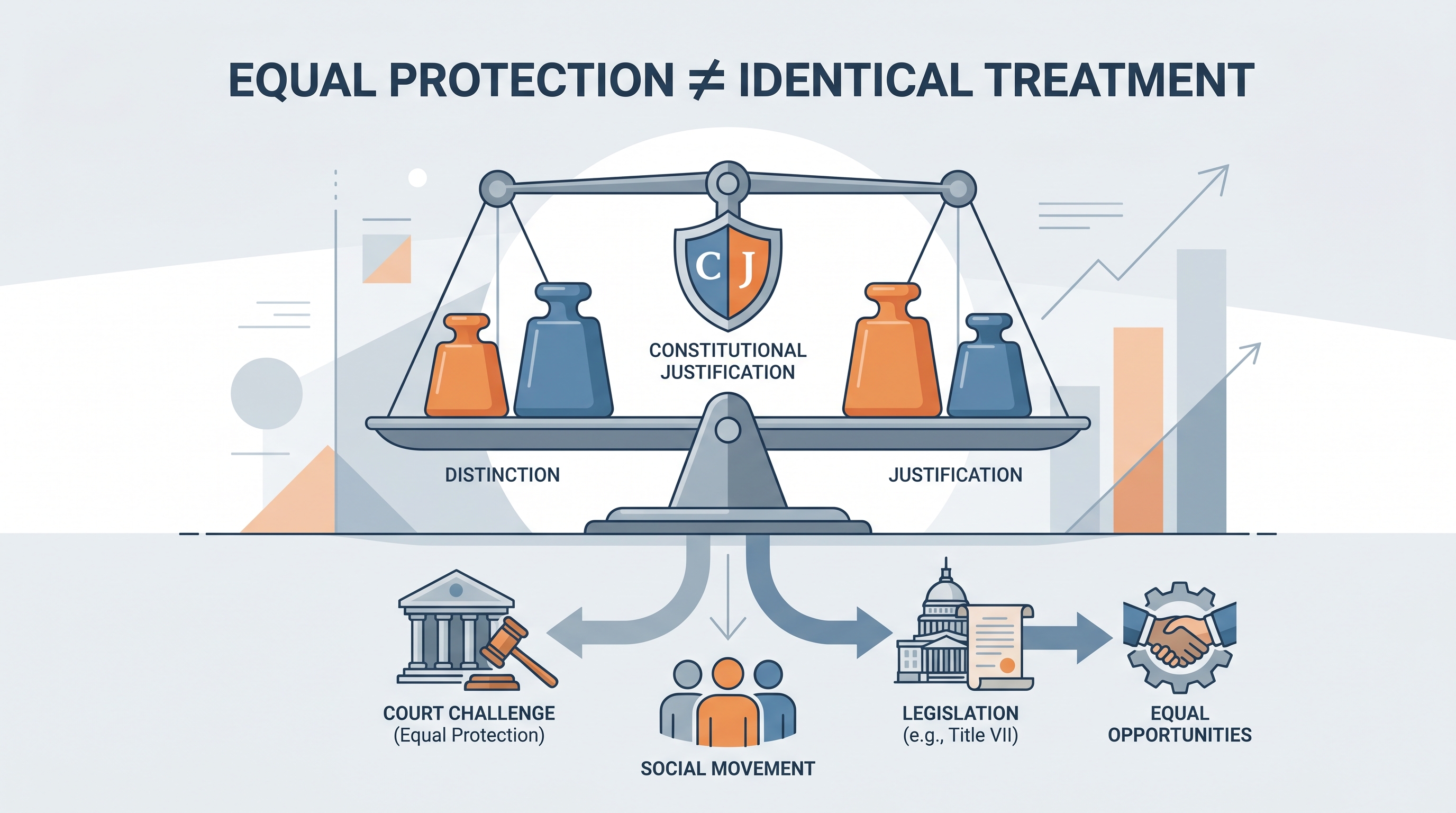
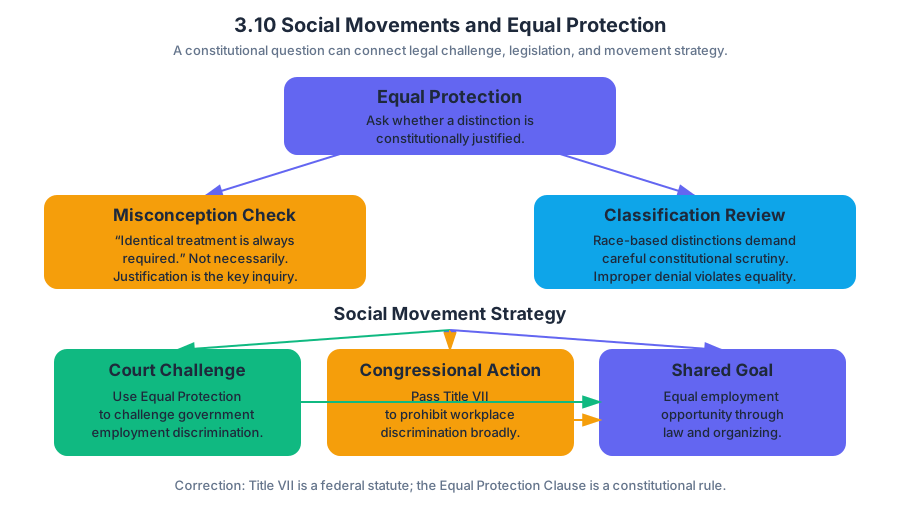
3.11 Government Responses to Social Movements
Key concepts: Government responses to social movements · Explaining implications of an argument or perspective · Political principles, institutions, processes, and policies · Qualitative inference from quantitative evidence · Partisanship · Political news acquisition · Social media and questionable information · Defensible thesis · Line of reasoning · Responding to an alternative perspective
Social movements can change government without holding office: organized citizens may alter public opinion, pressure institutions, reshape political agendas, and produce new laws or administrative practices.
3.11 Government Responses to Social Movements
Social movements can change government without holding office: organized citizens may alter public opinion, pressure institutions, reshape political agendas, and produce new laws or administrative practices. The central question is not simply whether protest “works,” but how a public argument travels through political principles, institutions, processes, policies, and behaviors.
Learning Objective 3.11.A: Explain how an argument or perspective can affect political principles, institutions, processes, policies, and behaviors.
Essential Knowledge 3.11.A.1: Social movements and other forms of political participation can influence government action by shaping public opinion, putting issues on the political agenda, and pressuring elected officials and institutions.
From public argument to government action
An argument is a position supported by reasoning and evidence. A social movement’s argument may challenge an existing practice, reinterpret a constitutional principle, or demand a policy change. Its effects can appear at several levels:
| Political level | What changes? | Illustrative effect |
|---|---|---|
| Principles | Ideas about liberty, equality, participation, or representation | Equality becomes understood as requiring legal protection against discrimination |
| Institutions | Behavior of Congress, the presidency, courts, or bureaucracy | Congress investigates an issue or an agency changes enforcement priorities |
| Processes | How citizens and officials participate in politics | Protests, boycotts, litigation, and media campaigns increase political pressure |
| Policies | Laws, regulations, court rulings, or executive actions | A government adopts protections demanded by a movement |
| Behaviors | Actions by voters, officials, organizations, and citizens | More people vote, contact officials, join organizations, or change party support |
The Civil Rights Movement illustrates the chain. Public demonstrations and arguments about constitutional equality increased national attention; political institutions responded through legislation and executive enforcement; policies changed; and political behavior changed as citizens organized, voted, litigated, and continued pressing government to enforce legal equality in practice.
Building an argument that earns credit
A strong argumentative response begins with a thesis, meaning a clear, defensible side on an issue. “Social movements matter” is too broad to establish a position. A stronger thesis takes a side and gives a reason: Social movements are more effective than institutional checks at making government respond to public demands because sustained public action can place neglected issues on the policy agenda.
A claim should include reasoning that connects it to evidence, often through words such as because, by, or when. Evidence alone does not earn the reasoning point. The writer must explain the political relationship:
- Evidence: Federalist No. 10 argues that factions can be controlled by setting them against one another.
- Reasoning: This supports the claim that institutional checks can protect the public from one faction because divided institutions make it harder for a temporary majority to impose its will.
- Additional evidence: “Letter from a Birmingham Jail” argues that direct action can force an issue ignored by government into public attention.
- Reasoning: This supports the competing claim that social movements can produce change by making officials confront demands they might otherwise avoid.
A complete response also addresses an alternative perspective rather than merely restating the opposite claim. For example, a writer may concede that checks and balances prevent government from becoming too powerful, then rebut that point by explaining that constitutional protections do not automatically place an ignored injustice on the government’s agenda. The response must show why its original position remains stronger.
Quantitative evidence and partisanship
The same reasoning pattern applies to data analysis. Suppose a graph shows an increasing trend in the percentage of voters choosing Senate and presidential candidates from the same political party. The correct qualitative inference is that partisanship is increasing: voters are becoming more likely to support candidates using a consistent party label across offices.
The evidence does not prove that every voter is more ideological, nor does it establish why the trend occurred. It supports the narrower inference that straight-ticket or same-party voting increased. To earn the explanation, connect the pattern to a possible political process: increasingly partisan political news may reinforce party identities and make voters more likely to select candidates from one party.
Political news acquisition means how people obtain political information. An overall graph trend may reflect changes from newspapers and broadcast networks toward ideological websites, online platforms, and social media. Social media can broaden participation and introduce people to political issues, but it may also expose them to questionable information, selective framing, or highly partisan content. That perspective must be considered in an argument about whether social media strengthens or weakens democracy.
AP skill application
- Skill 4.C — Explain the implications of an argument or perspective: Trace how a movement’s claim could affect principles, institutions, processes, policies, or behaviors.
- Skill 3.D — Use quantitative analysis to make a qualitative inference: Move from a numerical trend to a defensible political conclusion, such as increasing same-party voting indicating greater partisanship.
- Skill 2.B — Explain how a required Supreme Court case relates to a foundational document or other source: Connect constitutional principles, judicial decisions, and movement arguments rather than naming a case without explanation.
- Skill 5.A — Articulate a defensible claim/thesis: Take a clear side.
- Skill 5.B — Support an argument using evidence: Provide relevant information from foundational documents or course concepts.
- Skill 5.C — Use reasoning to explain why evidence supports a claim: State the causal or logical connection and address an alternative perspective.
Misconception check
Misconception: “If a response names accurate evidence, it has explained the argument.” Correction: evidence identifies what happened; reasoning explains why that evidence supports the claim. Likewise, a graph’s rising line does not automatically prove every possible cause. Identify the trend first, make the limited inference it supports, and then explain a plausible connection to political behavior.
Retrieval check
A graph shows that same-party Senate and presidential voting rises from one election period to the next. What qualitative inference is supported, and how could changing political news acquisition help explain it? A complete answer should identify increasing partisanship and connect the trend to increasingly partisan, ideological, or socially mediated news environments—while recognizing that social media may also spread questionable information.

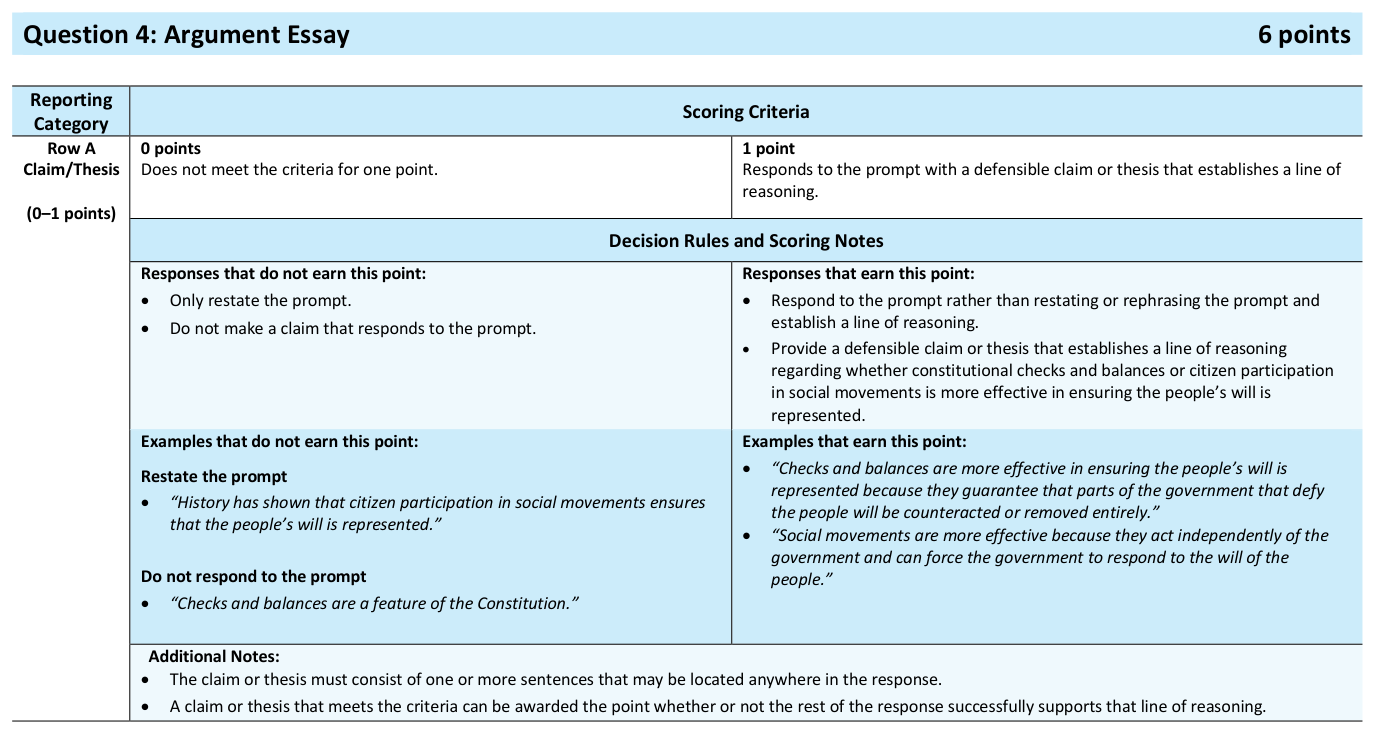
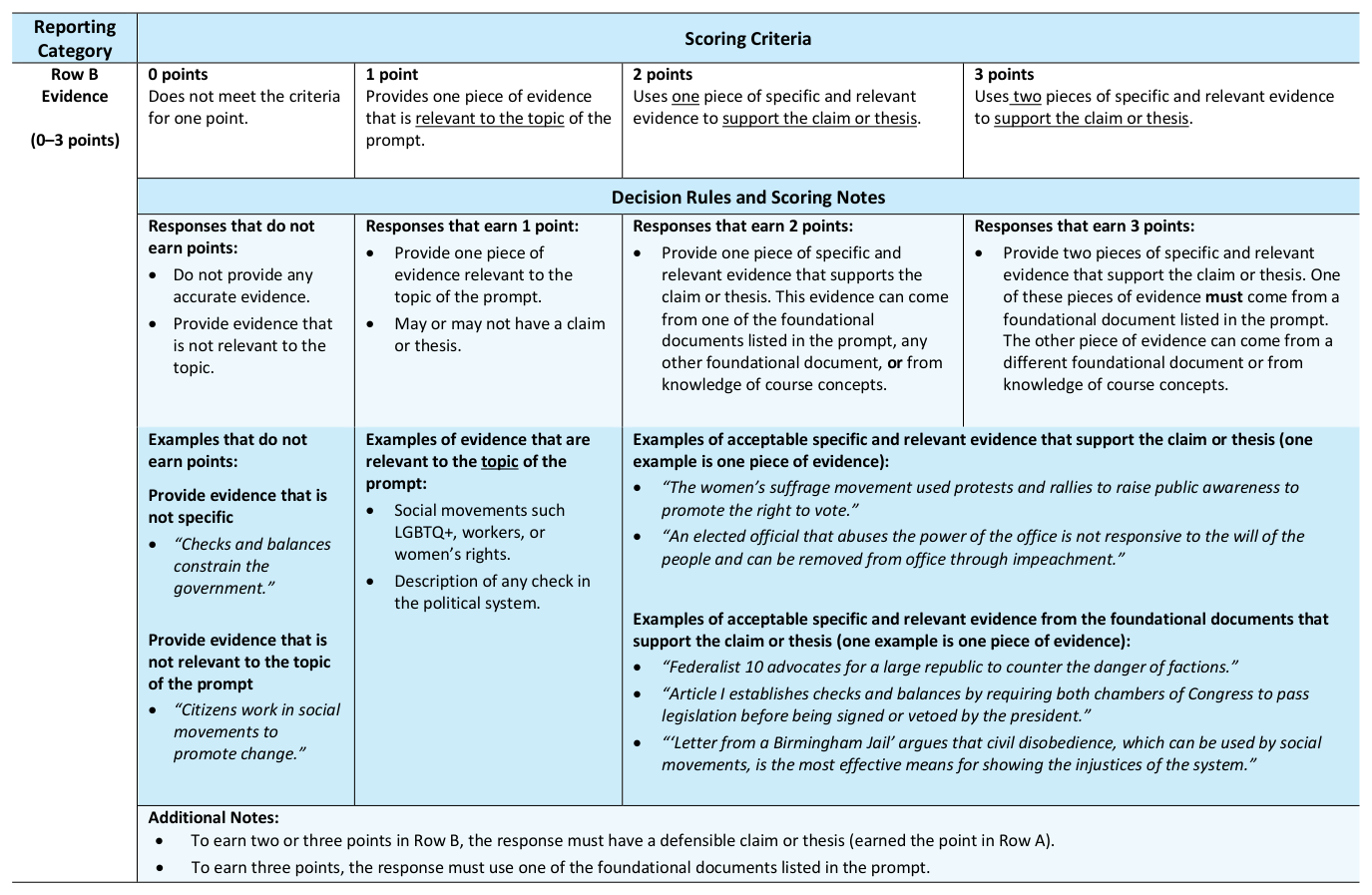
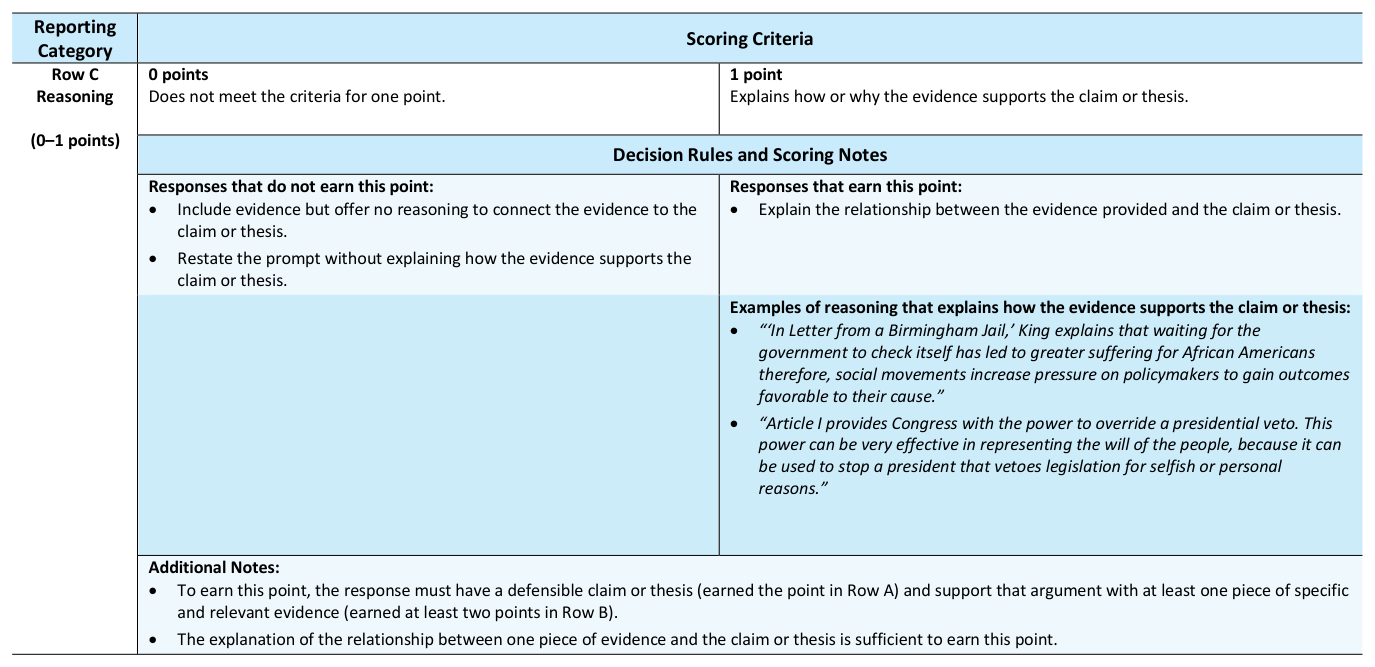
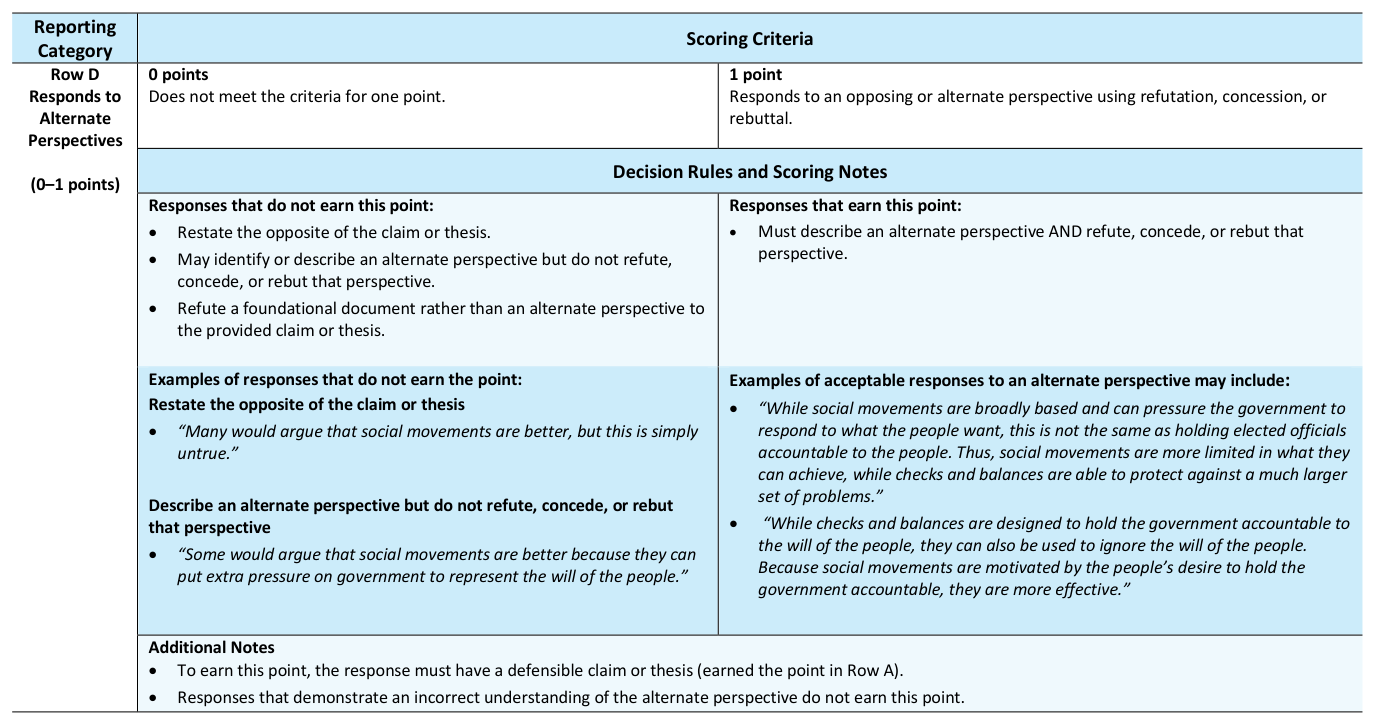
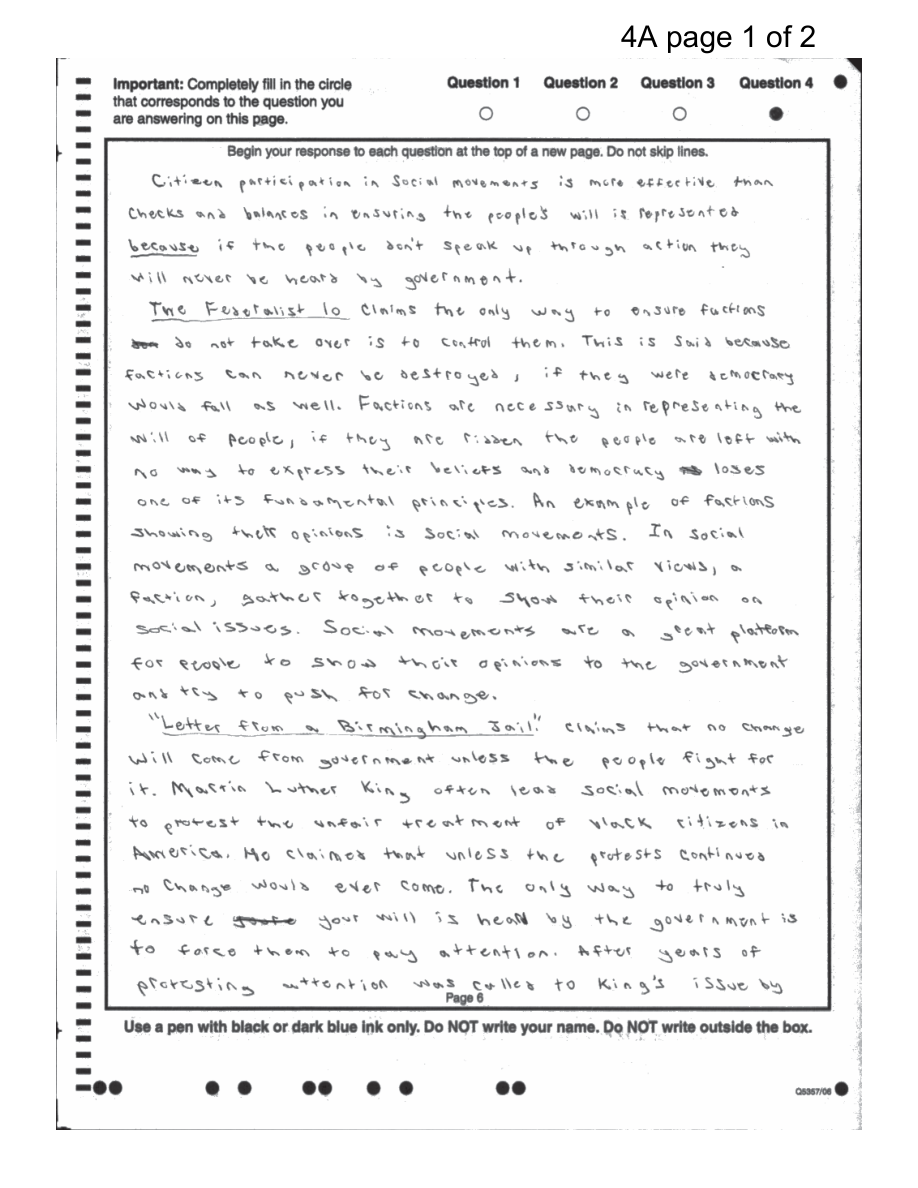
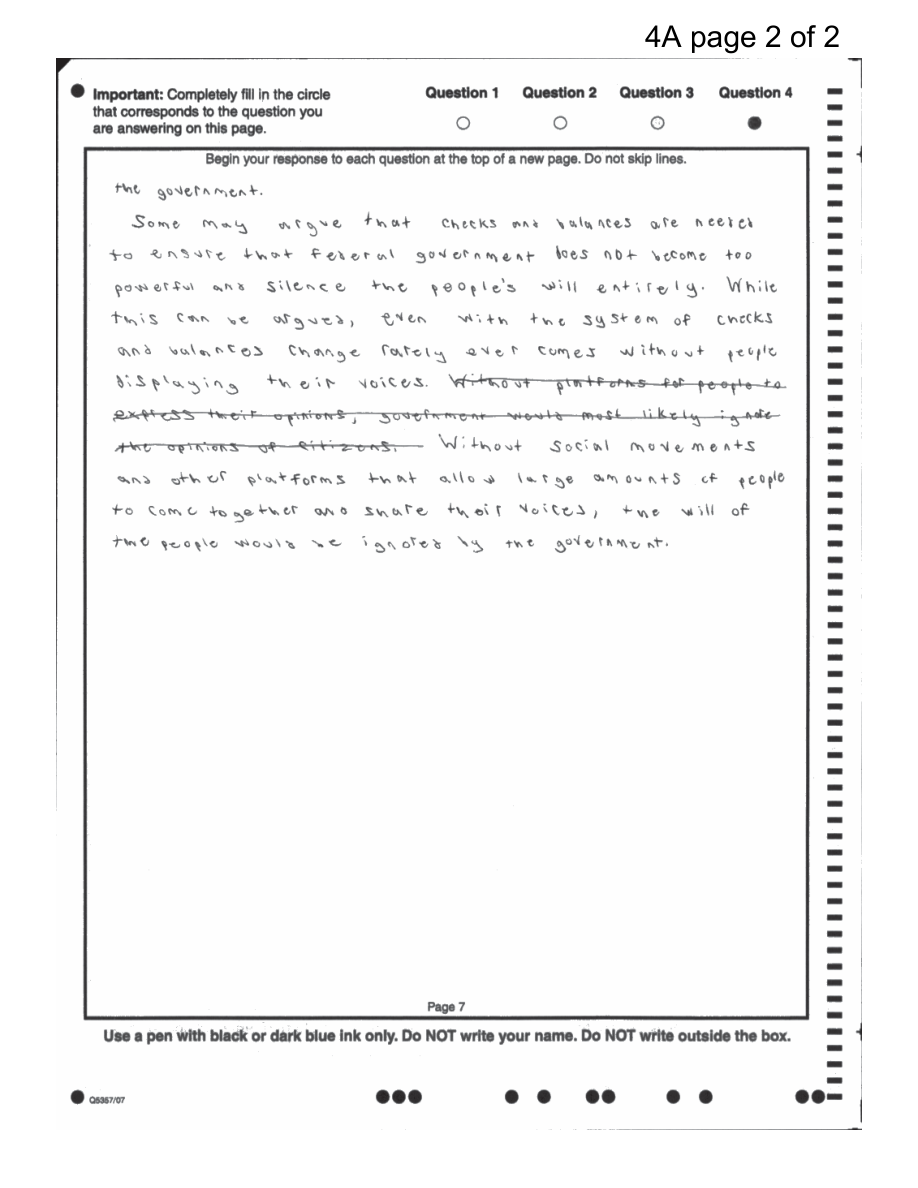
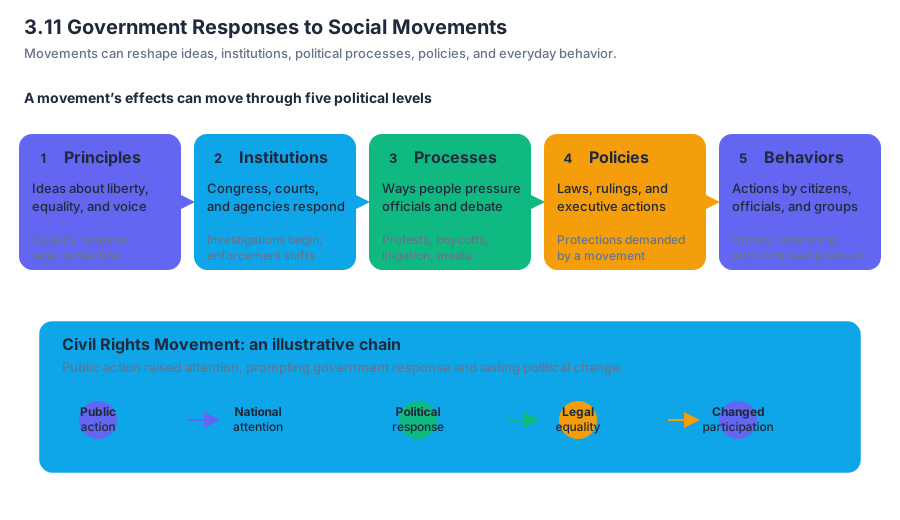
3.12 Balancing Minority and Majority Rights
Key concepts: Equal Protection Clause of the Fourteenth Amendment · Supreme Court decisions on school segregation · Race-based school segregation · Balancing minority and majority rights · Supreme Court protection of majority rights
A constitutional democracy must solve a difficult problem: How can government protect a minority from majority rule without allowing race to determine political representation? The answer has changed across U.S.
3.12 Balancing Minority and Majority Rights
A constitutional democracy must solve a difficult problem: How can government protect a minority from majority rule without allowing race to determine political representation? The answer has changed across U.S. history. Government has sometimes restricted minority rights, sometimes expanded them, and sometimes limited race-conscious policies in the name of protecting the rights of the majority.
LO 3.12.A: Explain how the government has at times allowed the restriction of the civil rights of minority groups and at other times has protected those rights.
The Equal Protection Clause
The Fourteenth Amendment’s Equal Protection Clause requires states to provide equal protection of the laws to people within their jurisdiction. In plain language, a state may not enforce laws in a way that denies a class of people equal legal protection without sufficient constitutional justification.
The clause became a constitutional tool for challenging racial discrimination after the Civil War. Its meaning, however, has depended on how courts interpreted government classifications: some classifications have been struck down as unconstitutional discrimination, while others have been permitted when the government offered a constitutionally sufficient reason.
From legalized segregation to constitutional protection
The government’s record is not a straight line toward equality. The Emancipation Proclamation freed enslaved people in the states rebelling against the United States, and the subsequent ratification of the Thirteenth Amendment permanently abolished slavery. These actions marked a major shift away from legally sanctioned racial subordination, but abolition did not immediately produce equal treatment in public institutions.
For decades, states and local governments maintained race-based school segregation and separated people in public facilities such as transportation, restaurants, and hotels. In Plessy v. Ferguson, the Supreme Court permitted racial segregation under the “separate but equal” doctrine. That decision illustrates how the Court can allow a restriction of minority rights even when the Constitution contains a promise of equality.
The Supreme Court later rejected that constitutional interpretation in Brown v. Board of Education. The Court held that state-sponsored racial segregation in public schools violated the Fourteenth Amendment’s Equal Protection Clause because separate schools were inherently unequal. The decision demonstrates the judiciary’s role in addressing school segregation: courts can invalidate state policies when those policies conflict with constitutional rights.
The constitutional conflict can be visualized as a change in the Court’s interpretation:
| Constitutional question | Earlier interpretation | Later interpretation |
|---|---|---|
| May a state separate students by race? | Plessy: Yes, if facilities are supposedly equal | Brown: No; state-enforced separation itself denies equality |
| Constitutional principle at issue | “Separate but equal” | Equal protection under the Fourteenth Amendment |
| Effect on minority rights | Permitted racial segregation | Protected students from government-imposed segregation |
When protecting majority rights limits race-conscious representation
The Court has also upheld the rights of the majority in cases involving majority-minority districting—electoral districts drawn so that a racial or ethnic minority is likely to elect a preferred candidate. Such districts may be designed to prevent minority voters from being submerged within a larger voting population, but race cannot automatically become the controlling principle in drawing every district.
In Shaw v. Reno and Bush v. Vera, the Supreme Court addressed racial gerrymandering through the Equal Protection Clause. The central issue was not whether racial discrimination in schools was being challenged; it was whether the government had relied too heavily on race when designing legislative districts. The Court therefore recognized that a policy intended to help minority voters can still raise constitutional concerns if race is used as the predominant factor without adequate justification.
This creates an important distinction: protecting minority voting power is not identical to permitting unlimited race-based districting. A court may protect minority voters from discriminatory electoral arrangements while also limiting district designs that treat voters primarily as members of racial categories.
Misconception check
Misconception: “Equal protection always requires identical treatment.” Equal protection does not mean that every government policy must treat every person identically in every circumstance. It means that government classifications must satisfy constitutional standards, and racial classifications receive especially demanding judicial review. The constitutional question is whether the government’s classification and its purpose can be justified under the Equal Protection Clause.
Skill 2.C: SCOTUS Application
Skill 2.C: “Explain how the facts, issue, holding, reasoning, decision, and majority opinion of a required Supreme Court case compare to a non-required Supreme Court case.” A strong comparison identifies a shared constitutional principle and then explains the difference in application. For example, Brown v. Board of Education and Shaw v. Reno both involve the Equal Protection Clause, but Brown prohibited state-enforced racial school segregation, whereas Shaw limited the government’s use of race as the predominant factor in drawing electoral districts.
Retrieval check
A state assigns students to separate public schools solely by race. Which constitutional provision is most directly implicated, and which Supreme Court decision provides the strongest precedent against the policy? Answer: The Fourteenth Amendment’s Equal Protection Clause; Brown v. Board of Education. A districting plan designed to increase minority representation may still be challenged when race predominates in its design, as shown by Shaw v. Reno.
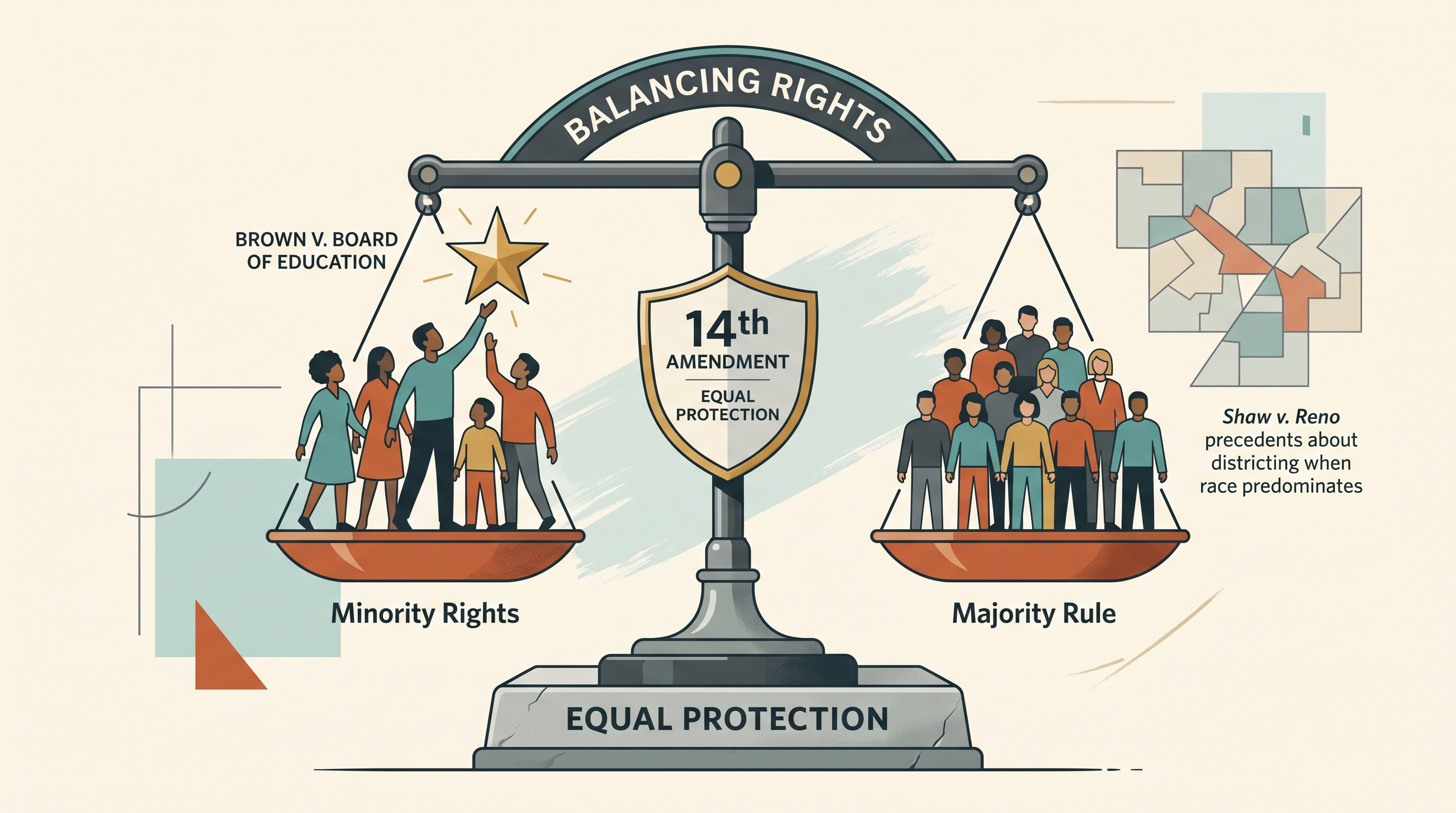
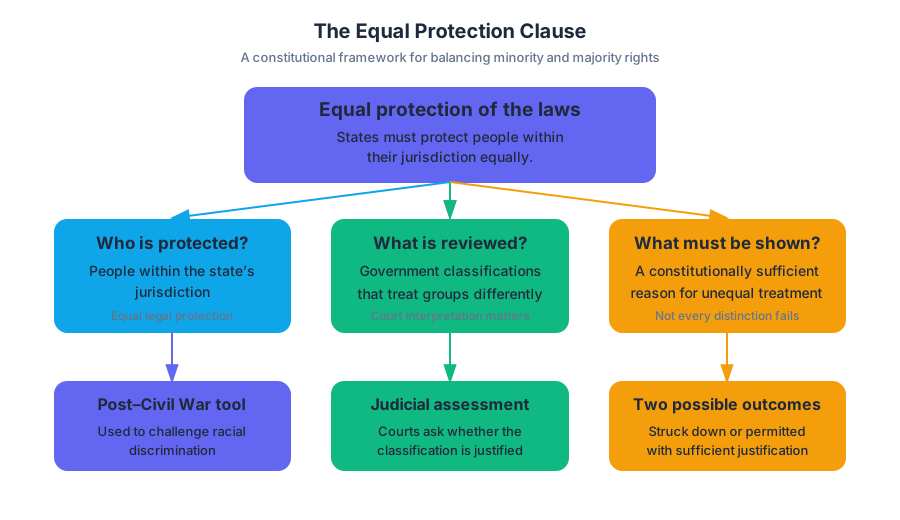
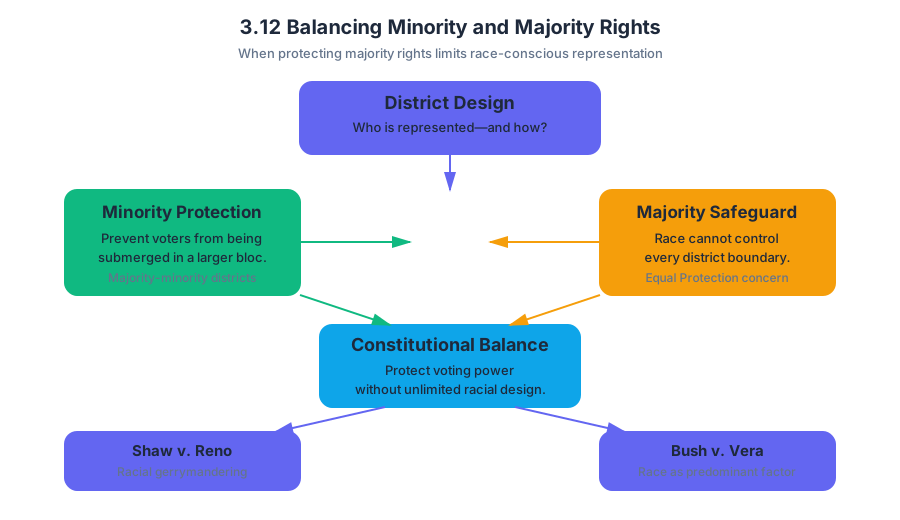
3.13 Affirmative Action
Affirmative action consists of policies intended to address the effects of past discrimination and expand opportunities for groups that have historically faced exclusion. The central constitutional question is not simply whether inequality exists, but whether—and how—the government may respond to it without…
3.13 Affirmative Action
Affirmative action consists of policies intended to address the effects of past discrimination and expand opportunities for groups that have historically faced exclusion. The central constitutional question is not simply whether inequality exists, but whether—and how—the government may respond to it without creating a new form of unequal treatment.
Investigative question: When does treating people differently promote equal opportunity, and when does it violate the Equal Protection Clause?
What affirmative action is designed to do
Formal equality means applying the same rule to everyone. Substantive equality asks whether people who begin from unequal historical conditions can realistically access the same opportunities. Affirmative action developed from the second concern: neutral rules may preserve unequal outcomes when earlier discrimination shaped access to education, employment, housing, wealth, or political influence.
A university, for example, might discover that its admissions process consistently excludes applicants from groups historically denied equal educational opportunities. An affirmative-action policy could respond by recruiting more broadly, reviewing socioeconomic disadvantage, supporting outreach programs, or—under earlier constitutional rules—considering race as one factor within an individualized admissions process.
Important distinction: affirmative action is not one single policy. Its legal status depends on the government institution, the policy’s design, the constitutional justification offered, and the relevant Supreme Court precedent.
Constitutional foundation: Equal Protection
The Fourteenth Amendment’s Equal Protection Clause requires states to provide equal protection of the laws. Through selective incorporation and constitutional interpretation, equal-protection principles also shape how governmental classifications are evaluated. A policy that treats people differently because of race receives especially demanding judicial review, commonly called strict scrutiny.
Under strict scrutiny, the government generally must show that a racial classification serves a compelling governmental interest and is narrowly tailored to achieve that interest.
This creates a constitutional tension. The government may argue that an affirmative-action policy remedies the continuing effects of discrimination or advances educational diversity. Opponents may argue that using racial classifications disadvantages individuals based on their racial identity and conflicts with the principle that government should treat citizens as individuals rather than as members of racial categories.
Supreme Court development
The Supreme Court’s affirmative-action decisions illustrate how constitutional interpretation changes as cases present different facts and legal arguments.
| Case | Constitutional significance |
|---|---|
| Regents of the University of California v. Bakke (1978) | The Court rejected a rigid racial quota in university admissions but allowed race to be considered as one factor in an individualized process. |
| Grutter v. Bollinger (2003) | The Court upheld a law-school admissions system that considered race in a holistic process designed to produce educational diversity, while rejecting mechanical point systems or fixed racial targets. |
| Fisher v. University of Texas (2016) | The Court applied demanding review to a race-conscious admissions policy and required the university to demonstrate that its approach was necessary to achieve its diversity objective. |
| Students for Fair Admissions v. Harvard (2023) | The Court held that the admissions programs challenged in the case violated the Equal Protection Clause, sharply limiting the use of race in college admissions. |
The practical lesson is that the Court has distinguished between individualized consideration and automatic racial formulas. More recent doctrine makes clear that colleges may not use race in the earlier broad manner approved by cases such as Grutter. Admissions officials may still consider an applicant’s experiences—including how race affected that person’s life—but they may not treat race itself as a positive or negative admissions factor.
Worked contextual example: evaluating an admissions policy
Suppose State University adopts this policy: “Applicants from Group A automatically receive ten additional admission points, and applicants from Group B automatically lose ten points.” The university says the policy will correct historical inequality.
Step 1: Identify the constitutional classification. The policy explicitly uses race, so it creates a racial classification.
Step 2: Identify the standard of review. Because race is a suspect classification, a court applies strict scrutiny rather than merely asking whether the policy is rational.
Step 3: Examine the policy’s structure. Automatic points treat applicants as members of racial groups rather than evaluating them individually. That design resembles a mechanical racial preference, not a narrowly tailored process.
Step 4: State the likely conclusion. The policy would face serious constitutional problems because its fixed points make race determinative and do not provide individualized review. A policy examining academic preparation, family income, neighborhood resources, educational obstacles, and personal experiences would use race-neutral criteria; a policy considering an applicant’s account of race-related experiences would need to avoid converting race into an automatic admissions advantage.
Misconception check
Misconception: “Affirmative action means lowering standards or admitting unqualified applicants.” That is not the constitutional definition. Affirmative-action disputes concern the criteria and procedures used to pursue equal opportunity, not an automatic assumption that beneficiaries lack merit.
Misconception: “Any policy designed to help a historically disadvantaged group is automatically constitutional.” Government purpose alone is insufficient. Courts examine the classification, governmental interest, evidence, and fit between the policy and its objective.
AP skill connection
Skill 1: Concept Application is central to Topic 3.13 Affirmative Action. To apply the concept, identify the policy’s governmental actor, the group classification, the constitutional principle involved, and the relevant Supreme Court standard. Then connect those features to a concrete conclusion rather than merely defining affirmative action.
A strong application might say: “Because the state university assigns automatic points based on race, the policy uses an explicit racial classification. Under Equal Protection analysis, that classification receives strict scrutiny, and the mechanical point system is unlikely to be narrowly tailored.” The answer earns strength from the chain fact → constitutional concept → legal standard → conclusion.
Retrieval check
A public university considers applicants individually and allows them to explain how racial discrimination affected their educational opportunities, but it does not award automatic points for racial identity. What constitutional distinction is the university attempting to preserve, and why did Students for Fair Admissions v. Harvard make that distinction especially important?
Answer: It is attempting to distinguish individualized consideration of an applicant’s experiences from treating race itself as an automatic admissions preference. Students for Fair Admissions v. Harvard sharply limited race-conscious admissions, making that distinction central to current Equal Protection analysis.
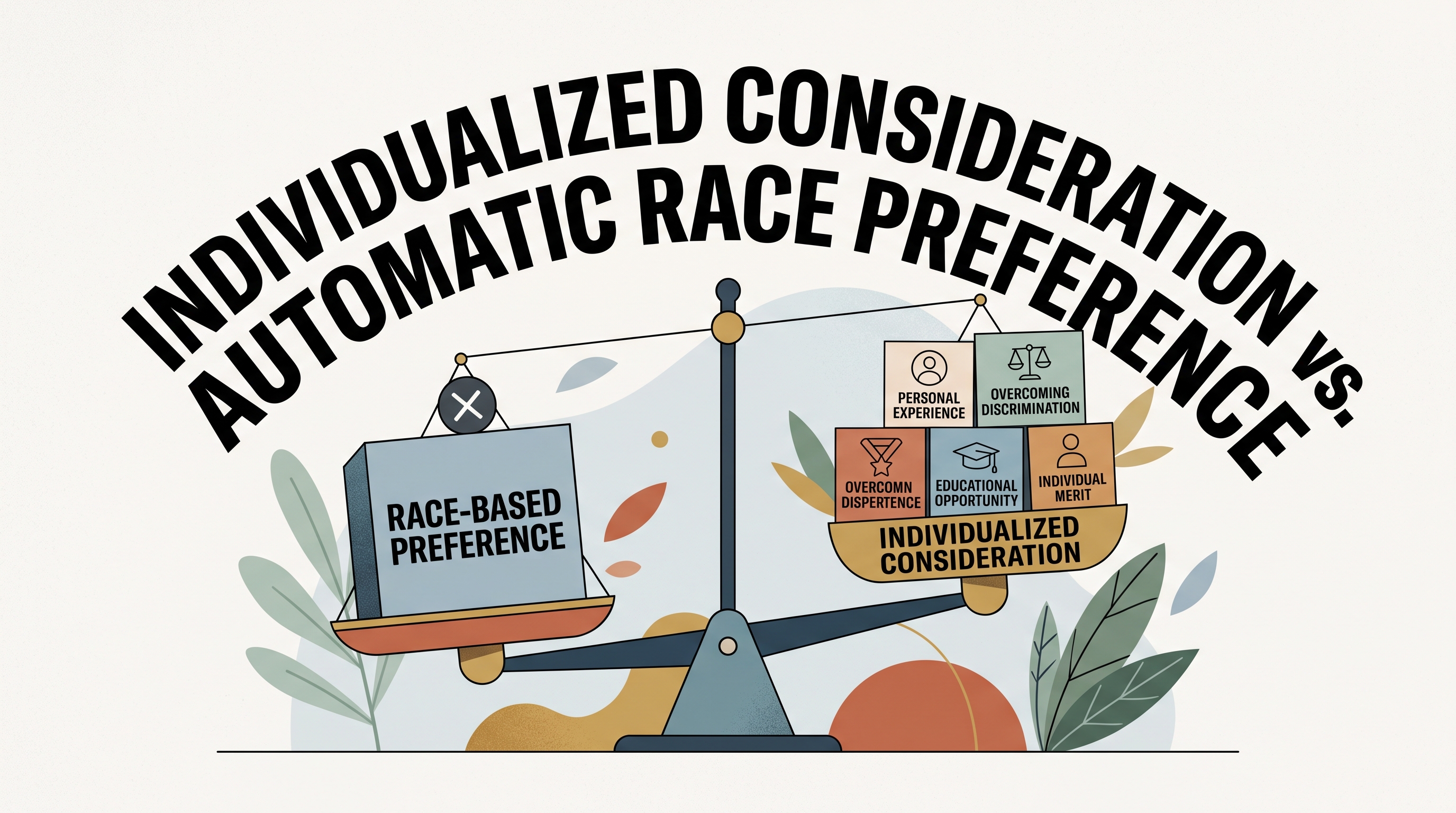
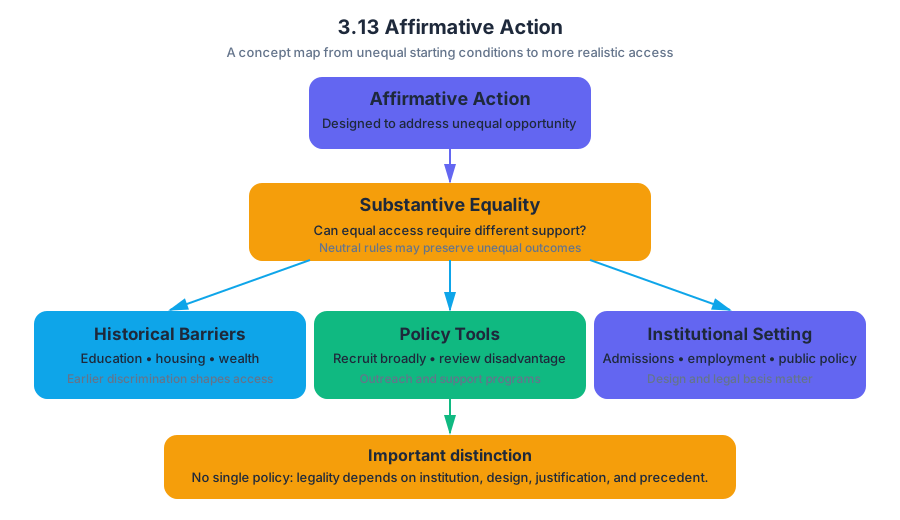
4.1 American Attitudes About Government and Politics
Key concepts: Popular sovereignty · Representative democracy · American political attitudes, behaviors, and ideologies · Competing interests in policymaking · The relationship between governmental institutions, processes, and policies · Constitutional balancing of liberty and order · Civic participation · Evidence-based analysis of political data and sources
A representative democracy depends on a demanding idea: popular sovereignty, the principle that governmental authority ultimately comes from the people. Citizens do not vote on every law directly, so they express sovereignty through elections, public debate, organized advocacy, protest, media use, and other forms…
4.1 American Attitudes About Government and Politics
A representative democracy depends on a demanding idea: popular sovereignty, the principle that governmental authority ultimately comes from the people. Citizens do not vote on every law directly, so they express sovereignty through elections, public debate, organized advocacy, protest, media use, and other forms of participation.
Popular sovereignty means that the people are the ultimate source of legitimate political power.
The Constitution connects popular sovereignty to republicanism, or representative democracy: citizens choose officials who make policy on their behalf. It also reflects individualism, the belief that individuals possess rights and interests that government must respect. These principles create a permanent tension: government must be powerful enough to maintain order, but limited enough to preserve liberty.
The political-attitude system
Political outcomes do not come from institutions alone. Political attitudes are evaluations or feelings about government, leaders, issues, and political groups. Political behaviors are actions such as voting, contacting officials, joining an interest group, donating, protesting, or choosing not to participate. Political ideologies are organized sets of beliefs about the proper role of government and the policies it should pursue.
These elements interact over time. A person who believes that government should actively reduce economic inequality may support candidates who favor expanded social programs; that attitude can produce a behavior such as voting, campaigning, or contacting a representative. Institutions then translate those preferences unevenly into policies because different actors possess different resources and access.
| Political element | Meaning | Possible expression |
|---|---|---|
| Attitude | Evaluation or belief about politics | Trust or distrust in government |
| Behavior | Political action or nonaction | Voting, protesting, contacting officials |
| Ideology | Connected beliefs about government and policy | Liberal, conservative, or another policy orientation |
| Institution | Formal structure exercising public authority | Congress, presidency, courts, bureaucracy |
A crucial distinction is that attitudes do not mechanically determine behavior. Someone may strongly support an environmental policy but not vote, perhaps because of registration barriers, weak political efficacy, competing demands, or the belief that one vote will not affect the outcome. Conversely, a person may participate because a group, candidate, or major event activates an otherwise weak preference.
Worked example: from belief to policy
Imagine that residents of a coastal state increasingly favor stronger protections against flooding. Their attitudes may lead them to vote for candidates supporting infrastructure spending, join a coastal-residents association, attend public hearings, or contact legislators. Businesses concerned about construction costs may organize in opposition.
The resulting policy is not simply “what the public wants.” Multiple actors and institutions compete: voters select representatives; legislators write and negotiate a bill; the executive branch implements it; agencies interpret statutory language; courts may review constitutional challenges; and organized interests provide information, pressure, and campaign support. The final policy reflects both public preferences and the institutional process through which those preferences travel.
Liberty, order, and constitutional interpretation
Governmental laws and policies that balance liberty and order are based on the U.S. Constitution. Liberty protects individual freedom; order refers to public safety, stability, and the government’s capacity to enforce laws. Constitutional principles and policies have been interpreted differently over time, so the same broad principle can generate different conclusions in different historical circumstances.
For example, a government may defend a public-safety regulation as necessary for order while critics argue that it burdens individual liberty. Constitutional analysis asks which governmental power is being used, which right or principle is affected, whether the government’s action is justified, and how courts or political institutions have interpreted the Constitution in that context.
Constitutional balancing is not a permanent declaration that liberty always wins or order always wins. It is an argument about how constitutional principles apply to a particular policy and historical setting.
Named misconception check
Misconception: “Popular sovereignty means the majority may do anything it wants.”
Correction: Majority rule operates within constitutional limits. The Constitution structures government power, protects individual rights, and creates checks and balances that can prevent a temporary majority—or any single institution—from exercising unlimited authority.
Reading politics as evidence
Political analysis requires more than identifying a position. Students must read and interpret data, compare perspectives, apply concepts to scenarios, and develop evidence-based arguments. A source supporting expanded government action and a source warning against government overreach may describe the same policy conflict from different political perspectives; strong analysis identifies each perspective and connects it to constitutional principles, institutions, processes, policies, or behaviors.
The principal suggested skill for Topic 4.1 is 1.D: Describe political principles, institutions, processes, policies, and behaviors illustrated in different scenarios in context. To use 1.D, first identify the political concept, then explain how the surrounding facts activate it. Do not merely label a scenario “popular sovereignty”; show how citizens’ participation gives the policy its democratic justification.
Retrieval check: A city council adopts a curfew after public safety concerns, while residents challenge it as an unnecessary restriction. Identify the two competing constitutional values, explain why the policy involves constitutional interpretation, and name one political behavior citizens could use to influence the result.
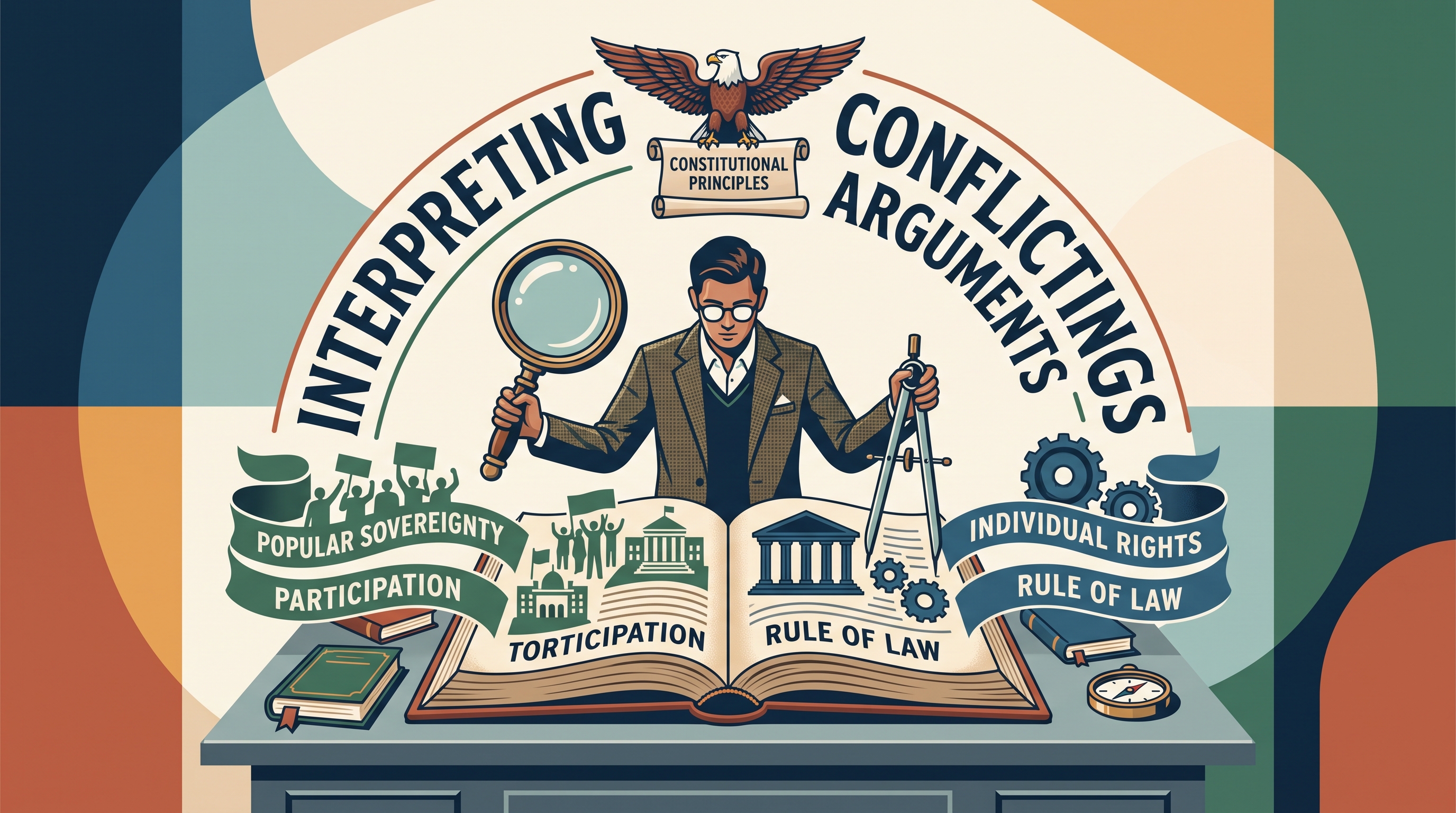

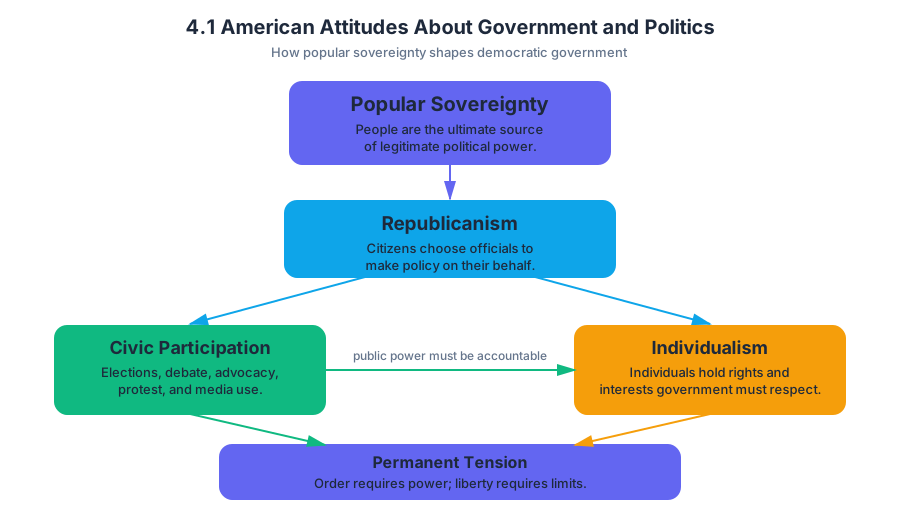
4.2 Political Socialization
Political socialization is the process through which people develop political beliefs, values, identities, and patterns of political behavior. A child does not begin with an opinion about climate policy, voting, or the proper size of government; those views develop through repeated contact with people,…
4.2 Political Socialization
Political socialization is the process through which people develop political beliefs, values, identities, and patterns of political behavior. A child does not begin with an opinion about climate policy, voting, or the proper size of government; those views develop through repeated contact with people, institutions, media, and major events.
CED Learning Objective 4.2.A: Explain how political socialization affects political beliefs and behaviors.
Political socialization helps explain why people exposed to the same political system can reach different conclusions. Two citizens may receive the same news about climate change but interpret it differently because their families, communities, religious traditions, peer groups, schools, and personal experiences have supplied different political lenses.
The agents that shape political attitudes
An agent of political socialization is a person, group, institution, or experience that influences political learning. The major agents include family, schools, religion, peers, the media, and major political events.
| Agent | How it can shape political beliefs or behavior |
|---|---|
| Family | Introduces early opinions about government, parties, public issues, and civic participation |
| Schools | Teach constitutional principles, political institutions, citizenship, and participation |
| Religion | Provides moral or ethical perspectives that may influence views on social and economic policy |
| Peer groups | Reinforce, challenge, or modify political opinions through discussion and social pressure |
| Media | Supplies political information and frames which issues appear important or urgent |
| Major political events | Create lasting impressions that may shape an entire generation or alter existing beliefs |
Family often has an especially early influence because political ideas are learned before individuals can independently evaluate competing arguments. However, early influence is not permanent. Schools, friends, media environments, employment, community conditions, and major events can reinforce or change political attitudes over time.
Worked example: climate-change opinion
Imagine a line graph showing the percentage of Americans who believed that climate change would pose a serious threat in their lifetime. The graph reports that 32% of Americans held that belief in 2010 and shows an overall increase from 1997 to 2015.
To interpret the political-socialization connection, proceed in three steps:
- Identify the political attitude: concern about climate change.
- Describe the change: the percentage believing climate change posed a serious lifetime threat increased overall between 1997 and 2015.
- Explain the mechanism: repeated exposure to scientific information, media coverage, school instruction, political debate, and experiences with severe weather could socialize citizens into viewing climate change as a more serious public issue.
That change in public opinion can affect political behavior. An environmental interest group could use the upward trend to argue that more citizens support environmentally friendly policies and could pressure Congress through lobbying, public campaigns, or constituent mobilization. The key reasoning is not merely that people changed their minds; it is that socializing influences helped shape an attitude, and that attitude could motivate participation and policymaking pressure.
Political socialization and political generations
People who experience the same major event during their formative years may develop a shared political outlook. A generation that comes of age during an economic crisis, war, civil-rights movement, terrorist attack, pandemic, or major environmental disaster may remember the event as evidence about what government can do, what threats matter, or whether political institutions deserve trust.
This does not mean every member of a generation thinks alike. Political socialization interacts with race, socioeconomic status, geography, religion, education, family experience, and personal interests. A major event may therefore produce a broad generational tendency without creating uniform political beliefs.
Essential Knowledge 4.2.A.1: Political socialization is the process by which individuals develop political beliefs and values.
Essential Knowledge 4.2.A.2: Family, schools, religion, peer groups, the media, and major political events influence political socialization.
Named misconception check
Misconception: Political socialization means political indoctrination. Socialization does not necessarily involve deliberate propaganda or forced agreement. It describes the broader process of learning political ideas, including ordinary conversations at home, classroom experiences, media exposure, community traditions, and firsthand encounters with government.
Misconception: One agent determines a person’s political ideology. No single influence mechanically produces a political position. Political beliefs emerge from the interaction of multiple agents, and later experiences can modify earlier views.
AP skills in action
This topic most directly develops Skill 1.B: Explain how political concepts and processes relate to political institutions, government policies, political behaviors, and outcomes. For example, connect political socialization to an interest group’s decision to pressure Congress or to a citizen’s decision to vote, protest, or contact a representative.
It also uses Skill 3.A: Identify and describe the data presented in a table, chart, or graph, Skill 3.B: Describe the patterns and trends in quantitative data, and Skill 3.C: Draw conclusions from quantitative data. A strong response identifies the relevant value, accurately describes the overall trend, and then draws a supported conclusion about political behavior or policymaking.
Retrieval check
A survey shows that concern about an issue rises sharply after sustained media coverage and a major national event. Name two agents of political socialization, describe one trend the survey might show, and explain how the trend could influence political participation or public policy. A complete answer must connect the influence to a specific political behavior or outcome—not merely state that public opinion changed.
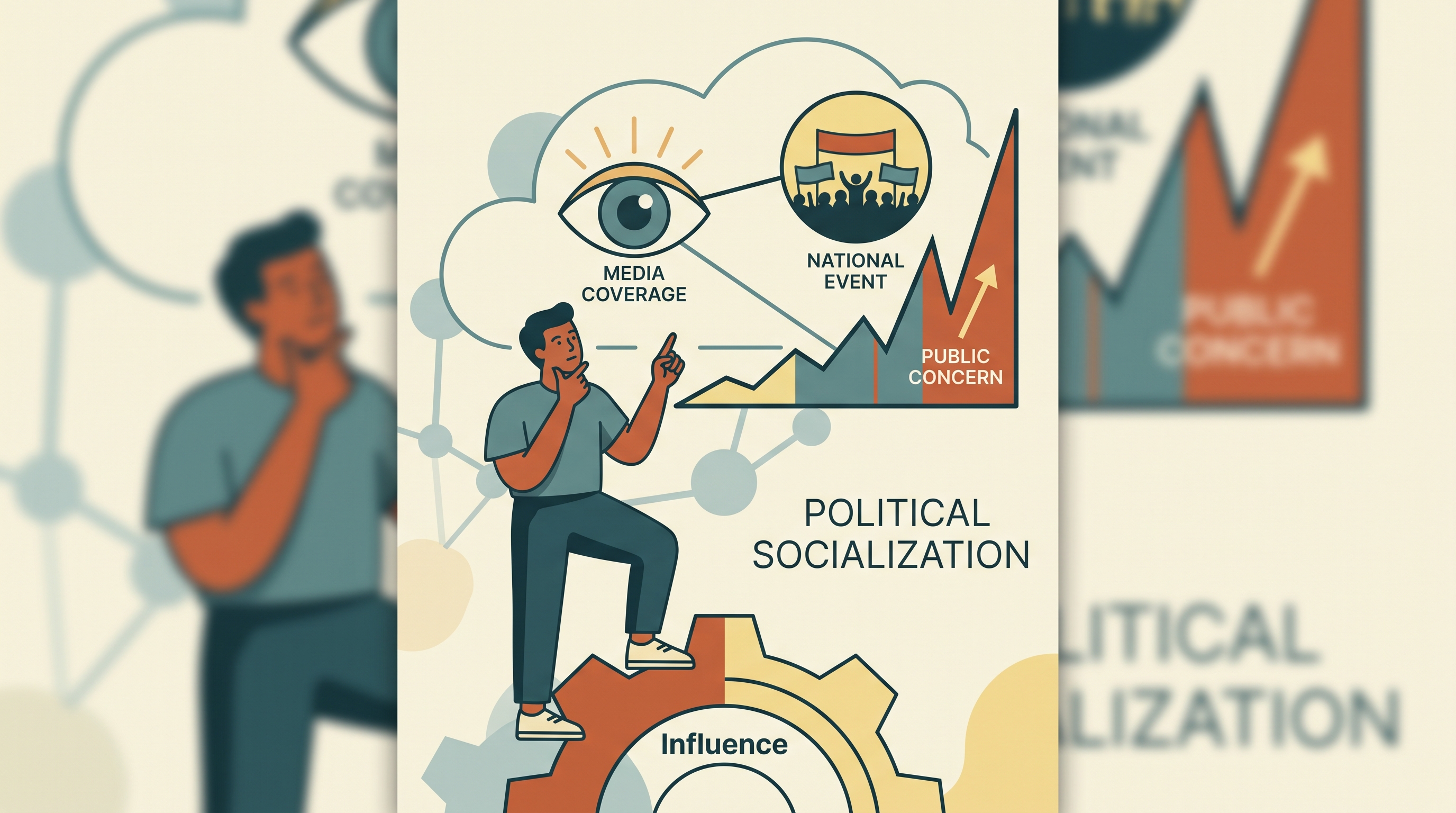
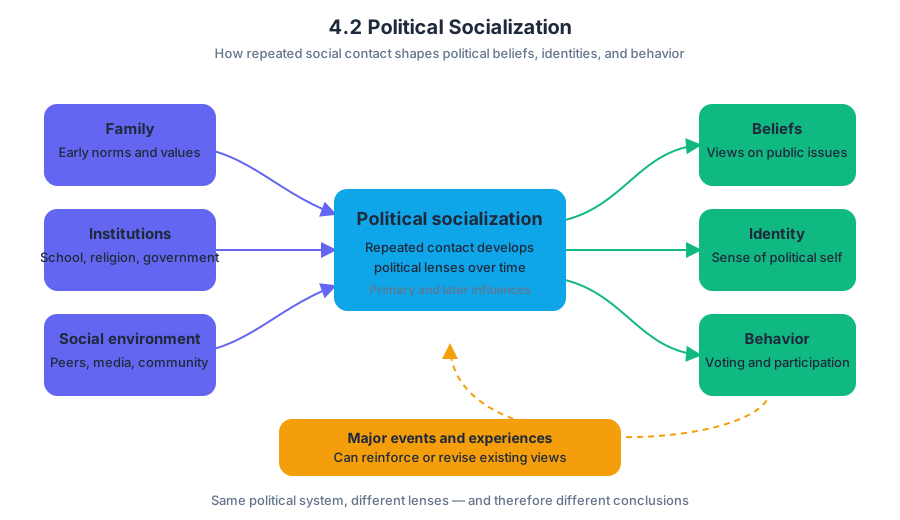
4.3 Changes in Ideology
Political ideology changes when people’s beliefs about government, society, and public policy shift across generations, across the life cycle, or in response to broad changes affecting an entire population.
4.3 Changes in Ideology
Political ideology changes when people’s beliefs about government, society, and public policy shift across generations, across the life cycle, or in response to broad changes affecting an entire population. The important question is not simply whether Americans are “more liberal” or “more conservative,” but which groups changed, in what direction, and over what period of time.
Learning Objective 4.3.A: Explain how political ideologies change over time.
Essential Knowledge 4.3.A.1: Political ideology can change because of generational differences, life-cycle effects, and period effects.
Three ways ideology changes
A useful way to separate these explanations is to ask whether the change follows a person, a generation, or a historical moment.
| Pattern | What changes? | Example |
|---|---|---|
| Generational effect | A group carries political attitudes formed during its formative years | People who came of age during a major economic crisis may retain stronger support for government economic intervention |
| Life-cycle effect | Individuals change as they age, take on new responsibilities, or experience new economic circumstances | A young adult may favor expanded public services, while later supporting lower taxes after becoming a homeowner or business owner |
| Period effect | People of different ages respond to the same event or condition at roughly the same time | A national security crisis may temporarily increase support for executive power across several age groups |
These effects can overlap. If older Americans are more likely than younger Americans to favor a particular policy, the difference might reflect aging, the distinctive experiences of that older generation, or the influence of a recent event. A single survey showing an age gap cannot automatically identify which explanation is correct.
What drives ideological change?
Political ideology is influenced by changing social and economic conditions. Shifts in racial and ethnic composition, education, religious affiliation, urbanization, family structure, income, and employment can alter the distribution of political attitudes. Political parties may also adapt their positions when the groups that form their coalitions change.
For example, suppose repeated national surveys show that younger respondents increasingly support government action on climate policy, while older respondents change very little. That pattern could indicate a generational difference, but it could also reflect differences in education, geographic residence, partisan identification, or exposure to environmental conditions. The evidence supports a description of the pattern before it supports an explanation of its cause.
Key distinction: A change in the public’s ideological distribution is not the same as a change in the ideology of every individual. The national average may move because existing groups change their views, because the measured population or survey sample changes, or because groups with different attitudes become larger or smaller.
Skill 3.B: Describe patterns and trends in data
Topic 4.3 is assessed through Skill 3.B: Describe patterns and trends in data. A strong response should identify the variables being compared, state the direction and size of the pattern when possible, compare groups or time periods, and avoid claiming that one variable caused another unless the evidence supports that conclusion.
Worked example: Imagine a survey reporting support for expanded public health programs:
- In 2005, support was $48%$ among adults ages $18$–$29$ and $44%$ among adults age $65$ and older.
- In 2025, support was $67%$ among adults ages $18$–$29$ and $51%$ among adults age $65$ and older.
The trend is that support increased in both groups, but the increase was larger among younger adults: $19$ percentage points compared with $7$ percentage points. The age gap therefore widened from $4$ percentage points to $16$ percentage points. A careful conclusion would say that support increased across both groups and increased more rapidly among younger adults; it would not conclude automatically that age caused the difference.
Misconception check: “Ideology changes only because people age”
Correction: Aging is only one possible explanation. A generation may retain attitudes formed during a distinctive historical period, or a major event may shift attitudes across the population. In addition, apparent survey changes may result from changes in who is included in the measured population or survey sample rather than from ideological conversion by individuals.
Another misconception is that political ideology moves permanently in one direction. In reality, attitudes can change unevenly: the public may become more supportive of government involvement in one policy area while becoming more skeptical of government authority in another. Ideology is multidimensional, so “liberal” and “conservative” labels do not predict every individual’s position on every issue.
Retrieval check
A survey finds that support for a policy rises among every age group after a major national crisis, but rises most among younger adults. Identify one period effect, one possible generational effect, and the data pattern that Skill 3.B: Describe patterns and trends in data requires you to report before making a causal claim.

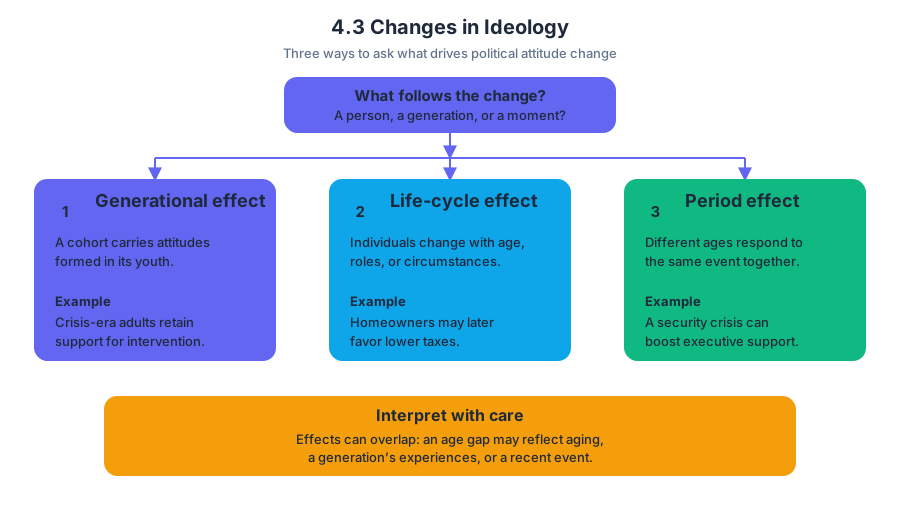
4.4 Influence of Political Events on Ideology
A major political event can change how people understand government, public problems, and the proper use of political power. Those changed attitudes may become part of an individual’s political ideology—a relatively consistent set of beliefs about government, policy, liberty, equality, and authority.
4.4 Influence of Political Events on Ideology
A major political event can change how people understand government, public problems, and the proper use of political power. Those changed attitudes may become part of an individual’s political ideology—a relatively consistent set of beliefs about government, policy, liberty, equality, and authority.
LO 4.4.A: Explain how major political events influence political ideology.
EK 4.4.A.1: Major political events can influence the development of individual political attitudes, which is an example of political socialization. Political socialization, in turn, influences political ideology.
The event-to-ideology pathway
The key mechanism is political socialization, the process through which people develop political attitudes and beliefs. Families, schools, peers, media, and religious or community institutions all contribute to political socialization, but major political events can create especially powerful moments of learning and interpretation.
The relationship is not automatic. The same event may produce different ideological reactions because people interpret it through different experiences, identities, values, and prior beliefs.
| Political event | Individual interpretation | Political attitude | Possible ideological effect |
|---|---|---|---|
| Economic crisis | Government failed to protect citizens | Support for stronger regulation or social programs | Greater acceptance of activist government |
| Terrorist attack | National security requires expanded government power | Support for surveillance or military action | Greater emphasis on order and security |
| Civil-rights protest | Existing institutions deny equal treatment | Support for legal protections and reform | Greater emphasis on equality and government enforcement |
Worked example: an economic crisis
Imagine that a severe economic crisis causes widespread unemployment. A teenager watches a parent lose a job, sees a local business close, and observes the national government provide emergency assistance. The event is not merely something in a history book: it becomes a personal political experience.
The teenager may develop the attitude that government should intervene during economic emergencies. Over time, that attitude can influence support for unemployment benefits, financial regulation, or public investment. If these positions become connected to broader beliefs about the government’s responsibility to promote economic security, the person’s political ideology may shift toward a more supportive view of active government.
The same crisis could produce a different response. Another person might conclude that government mismanagement caused the crisis or that emergency programs create excessive dependence. That person may develop stronger preferences for limited government, private-sector solutions, or reduced regulation. The event influenced both individuals, but it did not determine their conclusions.
Why interpretation matters
Political events supply information, but individuals assign meaning to that information. A person who experiences a public-health emergency may favor expanded government action because coordinated institutions appeared necessary. Another person may become more skeptical of government mandates because the same event made government power feel intrusive.
This explains why political events can influence ideology without producing ideological uniformity. The event enters the process of political socialization; family discussion, media framing, group identity, and personal experience help shape the resulting attitude.
Source Analysis — Skill 4.B
The suggested skill for Topic 4.4 is Source Analysis: 4.B — Explain how the argument or perspective in the source relates to political principles, institutions, processes, policies, and behaviors.
To apply 4.B, identify the source’s argument or perspective, then connect it to the event-to-ideology pathway:
- Name the perspective. Does the source portray the event as evidence of government success, government failure, social injustice, or a threat to public order?
- Identify the political attitude. What belief about government or policy does that perspective encourage?
- Explain the ideological connection. How could that attitude contribute to a broader ideology?
- Connect to politics. Show how the belief could affect institutions, policies, political participation, or behavior.
For example, if a source argues that a crisis revealed the need for national government action, a strong explanation would connect the argument to the political principle of collective responsibility, the institution of the national government, support for assistance programs, and increased approval of leaders who favor intervention. Merely saying that “the event changed people’s opinions” is too vague because it does not explain the political mechanism.
Common misconception check
Misconception: A major event pushes everyone in the same ideological direction.
Correction: Events influence political attitudes, but people interpret them differently. Political socialization is an interaction between the event and the individual’s existing experiences, groups, information, and values.
Misconception: One changed opinion automatically equals a changed ideology.
Correction: An attitude is a belief about a particular issue. Ideology is a broader pattern of beliefs. A political event may change one attitude without reorganizing a person’s entire ideological outlook.
Retrieval check
A national security crisis leads one person to support expanded surveillance and another to oppose it as a threat to civil liberties. What does this contrast demonstrate? Answer: The event became part of both individuals’ political socialization, but different interpretations produced different political attitudes and possible ideological effects.
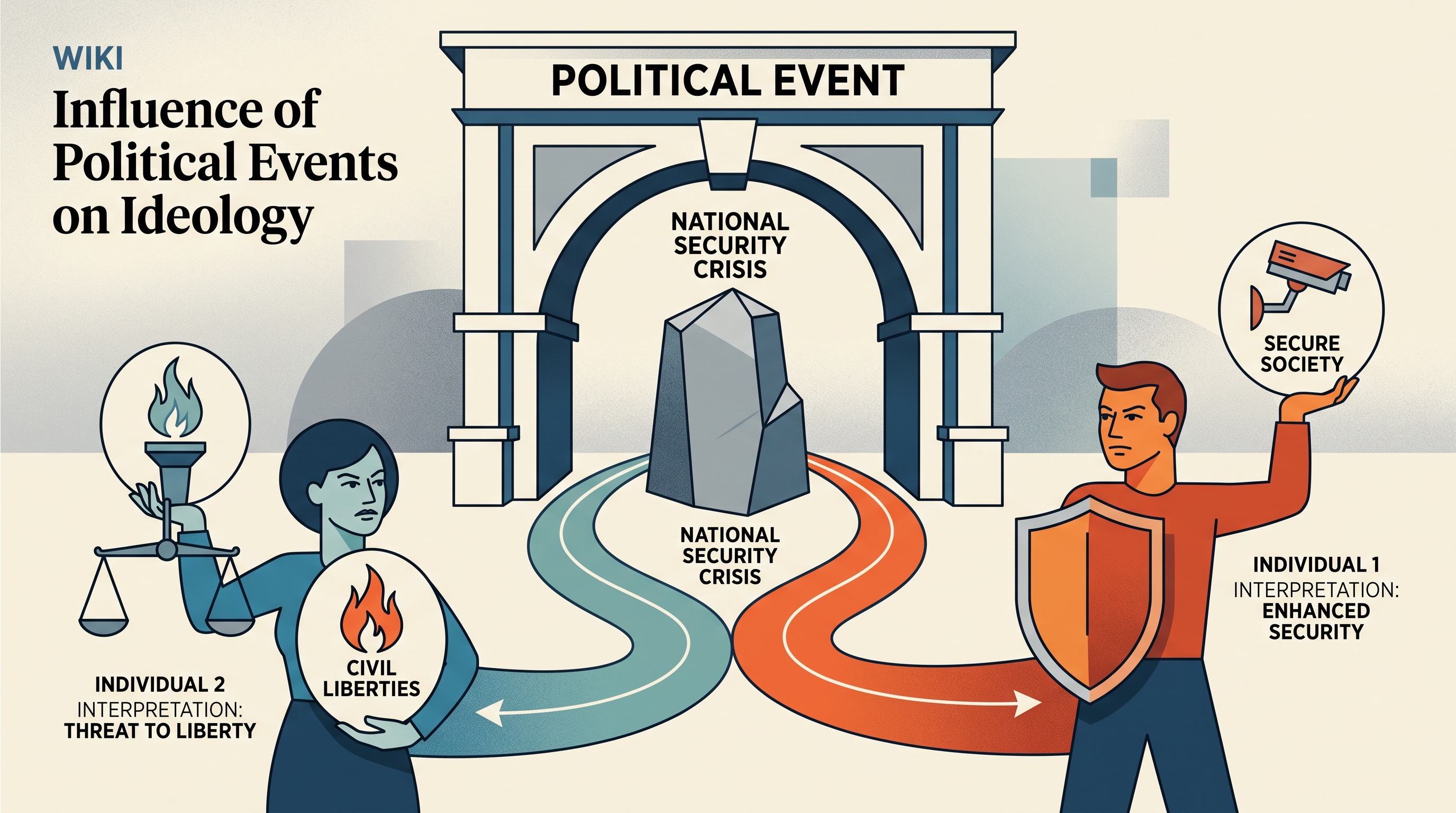
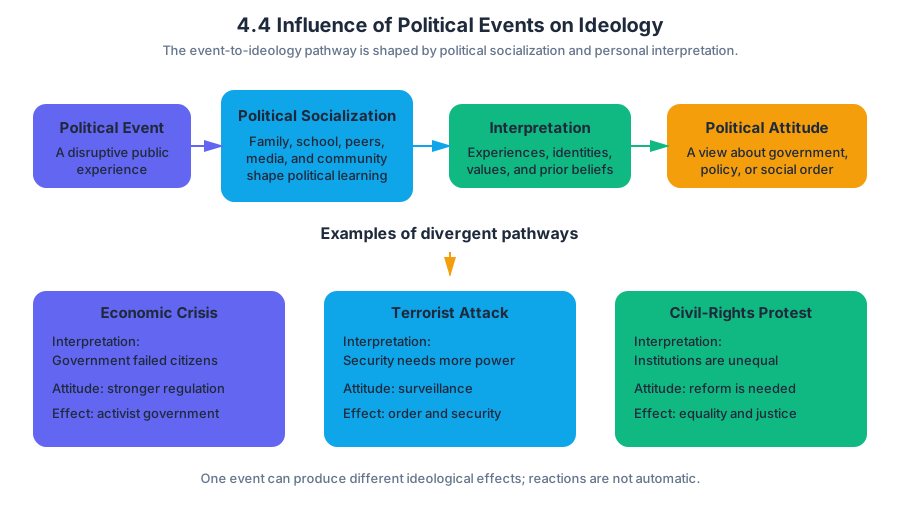
4.5 Measuring Public Opinion
A poll is not a crystal ball; it is a carefully designed measurement instrument that uses a smaller group of people to estimate what a larger population thinks.
4.5 Measuring Public Opinion
A poll is not a crystal ball; it is a carefully designed measurement instrument that uses a smaller group of people to estimate what a larger population thinks. Its usefulness depends less on the number of questions asked than on how the sample was selected, how the questions were worded, and how the results were reported.
Learning Objective 4.5.A: Explain how scientific polling can be used to measure public opinion.
From a population to a sample
The population is the full group a poll seeks to understand—for example, all likely voters in a state. A sample is the smaller group actually questioned. Because polling every member of the population is usually impractical, pollsters use sampling methods designed to produce a sample that resembles the population in politically important ways.
A strong sample is not simply a large one. If a poll asks only people who attend a particular political rally, it may receive thousands of responses but still fail to represent the broader electorate. Accurate sampling methods give different members of the target population a meaningful chance of being included and reduce systematic distortion.
A poll also commonly reports a margin of error, an estimate of how much the sample result may differ from the actual population view because the poll questioned a sample rather than everyone. If Candidate Rivera receives $52%$ support in a poll with a margin of error of $\pm 3$ percentage points, the poll estimates that support could plausibly fall within a range from $49%$ to $55%$, assuming the poll was properly designed.
Three campaign-related polls
Different polls answer different questions about political opinion. Their timing and purpose matter:
| Poll type | Main purpose | What it establishes |
|---|---|---|
| Benchmark poll | Creates an initial baseline view of a candidate | Where candidate support begins |
| Tracking poll | Follows changes in candidate views during a campaign | Whether support appears to shift over time |
| Exit poll | Questions voters after they vote | Why voters say they voted as they did |
A campaign might begin with a benchmark poll showing Rivera at $38%$ support. After several weeks of advertising and debates, tracking polls can record how reported opinions change. On Election Day, an exit poll may ask voters which issue mattered most and why they selected a particular candidate. The three polls do not serve interchangeable purposes: the first establishes a baseline, the second monitors movement, and the third gathers explanations from people who have already voted.
Why wording changes measurement
Neutral framing of questions means using specific, unbiased wording that does not push respondents toward a preferred answer. Compare these original examples:
- “Do you support the mayor’s reckless spending plan?”
- “Do you support the mayor’s proposal to increase funding for public transit?”
Both questions address the same policy proposal, but the first embeds a negative judgment in the word reckless. A respondent’s answer may therefore reflect the poll’s wording rather than an independently held opinion. Precise polling avoids loaded language, clarifies what policy is being described, and provides response choices that do not conceal important alternatives.
Why reporting matters
Accurate reporting requires clear presentation of what the data actually show and conclusions that the data can support. A poll should identify the population surveyed, the sample, the timing of interviews, and the margin of error when appropriate. Without that information, readers cannot tell whether a result describes registered voters, likely voters, adults generally, or some narrower group.
Suppose a statewide poll reports Rivera with $52%$ support and opponent Chen with $49%$ support, with a margin of error of $\pm 3$ percentage points. Reporting Rivera as “leading by exactly $3$ points” creates false precision: the reported difference is smaller than the possible uncertainty around each estimate. The responsible description is that the candidates are separated by a small reported difference and that the poll does not establish a certain outcome.
Named misconception check
Misconception: “A poll is reliable because it surveyed a lot of people.” A large sample can still be biased if its participants were selected poorly or if the questions were slanted. Conversely, a carefully selected smaller sample can provide useful information. Sample quality, question neutrality, and transparent reporting work together.
Retrieval check
A poll begins by asking a politically neutral question of a properly selected sample of likely voters. It is conducted before any campaign advertising, repeated during the campaign, and administered to voters leaving polling places. Identify the sequence of poll types.
Answer: The sequence is benchmark poll, tracking poll, and exit poll. The sampling, wording, and reporting criteria introduced here provide the basis for evaluating public-opinion data in the next topic.
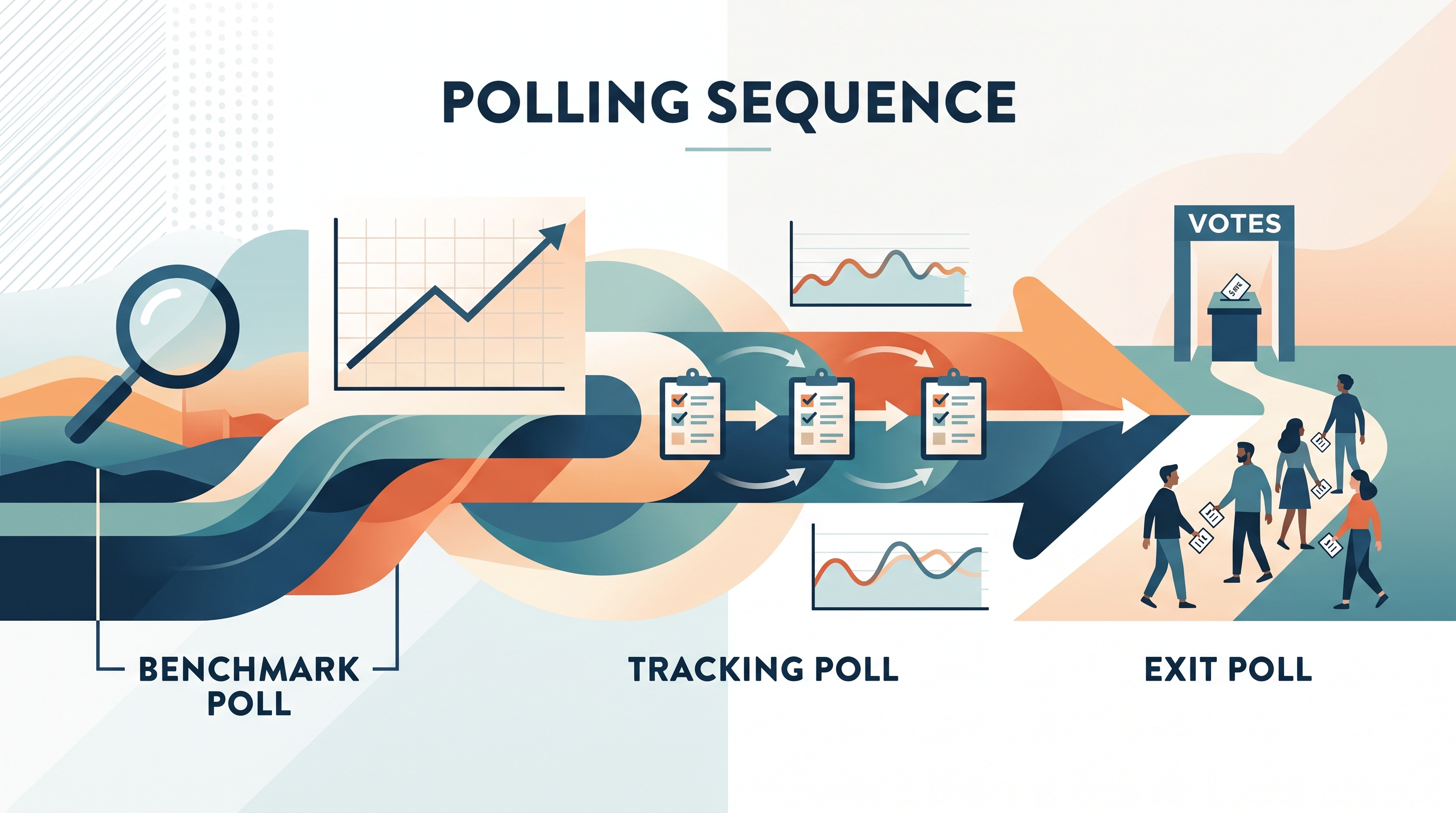
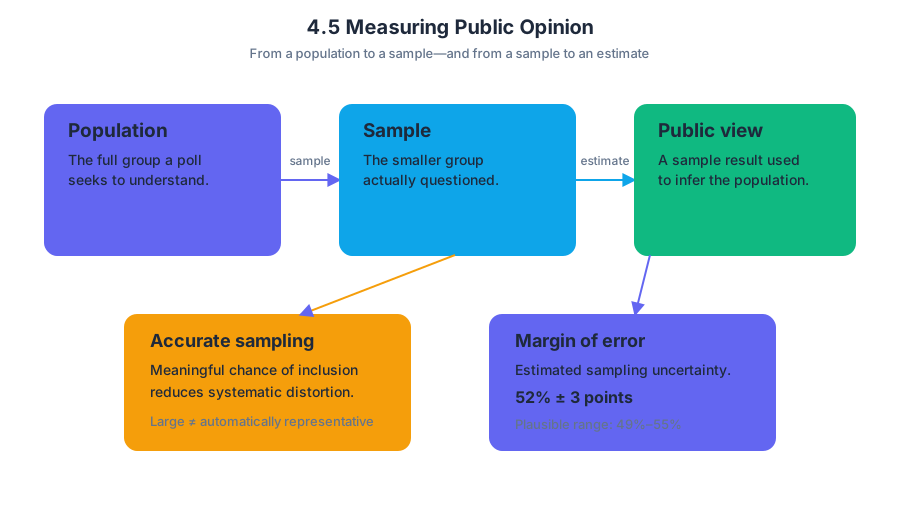
4.6 Evaluating Public Opinion Data
A poll can produce a precise-looking percentage and still support a misleading political claim. Evaluating public opinion data means judging both the political importance of the evidence and the reliability of the method used to collect it.
4.6 Evaluating Public Opinion Data
A poll can produce a precise-looking percentage and still support a misleading political claim. Evaluating public opinion data means judging both the political importance of the evidence and the reliability of the method used to collect it.
LO 4.6.A — Quality, credibility, and political influence
A claim based on public opinion data should be tested with two questions:
- Does public opinion matter in this political context?
- Can the data be trusted?
The first question concerns political influence. Public opinion may matter greatly during a closely contested election, when officials are deciding whether a policy has broad support, or when organized groups use polling results to pressure policymakers. It may matter less when elected officials face strong constitutional limits, party commitments, or an issue that the public is paying little attention to.
The 2012 election illustrates how polling could influence campaign strategy: candidates and parties watched changing preferences in competitive states and adjusted their messages and resource allocation. During the 2016 Clinton–Trump election, public opinion data likewise shaped claims about candidate strength, although differing polls and interpretations demonstrated why credibility matters as much as visibility.
Key insight: A poll’s political importance does not automatically make it accurate, and an accurate poll does not automatically determine policy.
EK 4.6.A.1 — Why credibility affects political claims
Credibility is the degree to which evidence deserves to be believed. A public-opinion claim becomes more credible when the data are collected systematically, the questions do not push respondents toward an answer, and the reported conclusion matches what the data actually show.
A headline such as “Most voters reject the proposal” is incomplete without information about the sample, question wording, timing, and uncertainty. A responsible evaluator asks whether the apparent result reflects genuine public attitudes or merely a feature of the poll’s design.
EK 4.6.A.2 — What makes polling methodology precise?
Polling methodology is the set of procedures used to select respondents, ask questions, collect answers, and report results. The methodology is more precise when it includes three features:
| Methodological feature | What it requires | Why it matters |
|---|---|---|
| Accurate sampling methods | Selecting respondents who reasonably represent the population being studied; reporting a margin of error | A biased or unrepresentative sample can distort the result |
| Neutral framing of questions | Using specific, balanced, and unbiased wording | Loaded wording can influence how people answer |
| Accurate reporting | Drawing conclusions that the data support and clearly stating limitations | A true number can still be used to create a false impression |
Worked example: evaluating one poll from start to finish
Imagine a poll of $600$ registered voters reports that $52%$ support a proposed transportation law, with a margin of error of $\pm 4$ percentage points.
Step 1: Evaluate the sample. If the poll used a sound method to select voters from the relevant population, the sample may provide useful evidence. If it surveyed only people who voluntarily clicked an online link, respondents may be unusually interested in the issue, so the result may not represent voters generally.
Step 2: Interpret the margin of error. The reported support is not best understood as exactly $52%$. The plausible range is approximately $48%$ to $56%$. Because that range includes both less than and more than half, the poll does not establish that a majority definitely supports the law.
Step 3: Inspect the question. “Do you support the transportation law?” is more neutral than “Do you support the law that will reduce dangerous traffic delays?” The second wording supplies a favorable description and may encourage agreement.
Step 4: Inspect the conclusion. “Support is measured at $52%$, with a margin of error of $\pm 4$ points” accurately reports the evidence. “Voters overwhelmingly demand the law” overstates it: the percentage is only slightly above half, and the uncertainty is substantial.
Named misconception check
Misconception: A larger number automatically makes a poll scientific. A large sample can improve precision, but it cannot repair a systematically biased sample or slanted question. For example, asking $10{,}000$ members of one advocacy organization about a national policy does not create a representative national poll.
Misconception: The margin of error is a guarantee. The margin of error describes sampling uncertainty under the poll’s assumptions; it does not correct inaccurate wording, nonresponse, dishonest answers, or a poorly chosen population.
AP Skill: Data Analysis — Explain what the data implies or illustrates
For the AP skill Data Analysis — Explain what the data implies or illustrates, do more than repeat a percentage. Identify the pattern, explain its political meaning, and connect the evidence to a principle, institution, process, policy, or behavior. A strong explanation might state that the transportation poll shows modest support but cannot demonstrate majority backing because its margin-of-error range crosses the $50%$ threshold.
Retrieval check: A poll reports $58%$ support with a margin of error of $\pm 3$ points. What is the approximate range, and what additional information must you examine before calling the result credible? The range is $55%$ to $61%$; then examine the sampling method, question framing, and whether the reported conclusion accurately reflects those data.
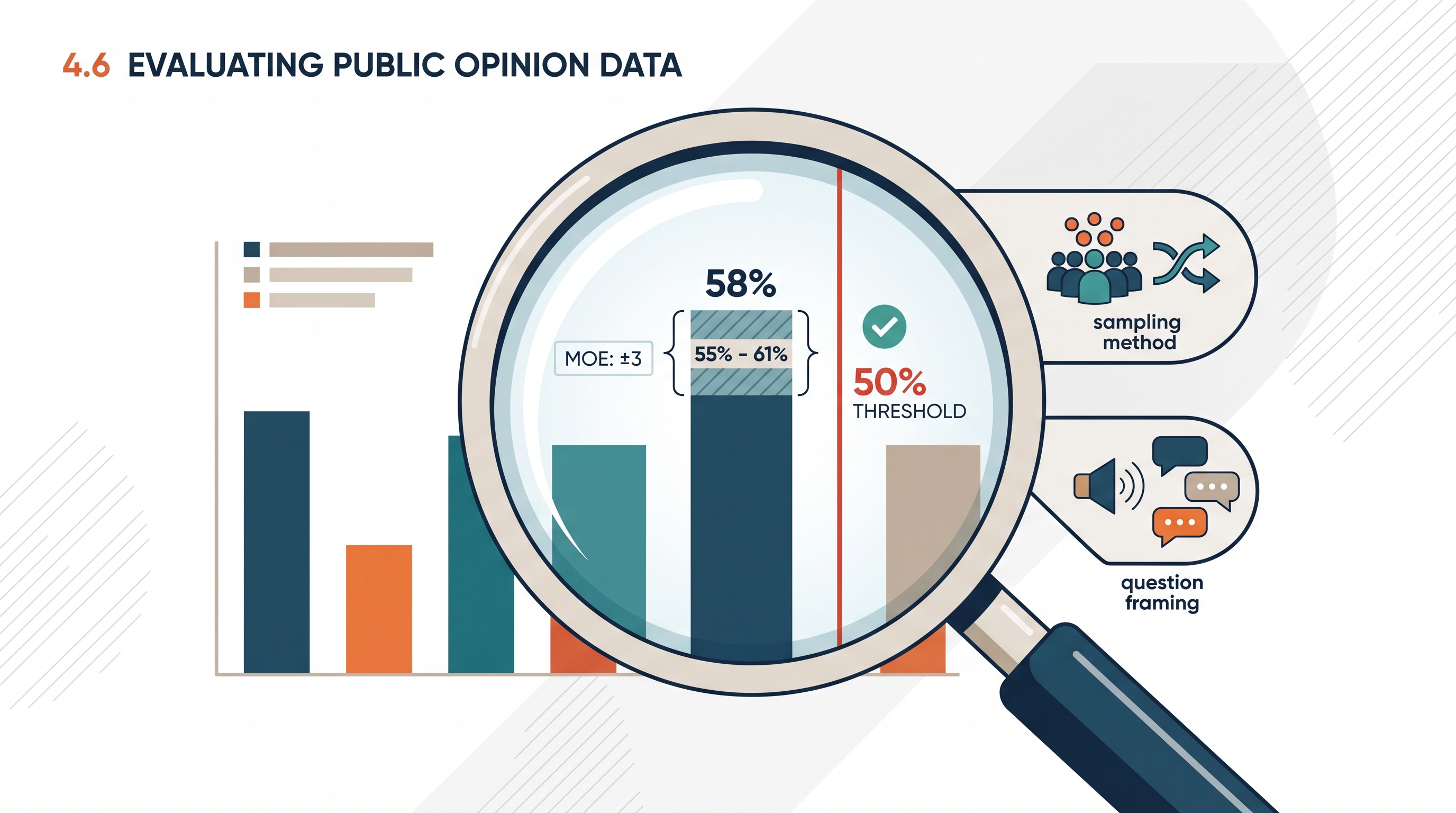
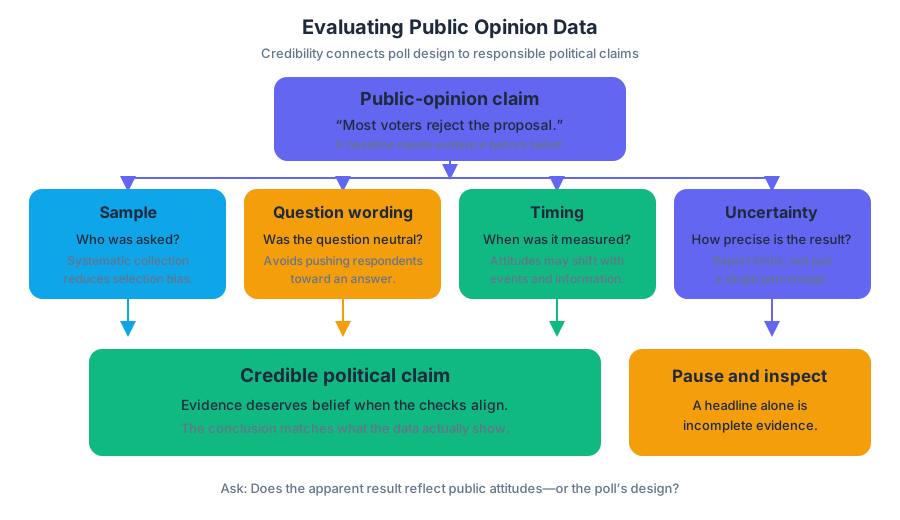
4.7 Ideologies of Political Parties
A political party is not simply a club with a single opinion: it is a coalition of people, organized around shared beliefs and policy goals, that seeks to win elections and influence government.
4.7 Ideologies of Political Parties
A political party is not simply a club with a single opinion: it is a coalition of people, organized around shared beliefs and policy goals, that seeks to win elections and influence government. The central puzzle is this: How can a party hold together voters who agree on broad values but disagree about specific policies?
Key distinction: A party’s ideology is its general set of beliefs about government, society, and the economy; a party’s platform is its current collection of policy positions.
In the United States, the Democratic and Republican parties are broad coalitions rather than perfectly uniform ideological groups. Each includes elected officials, activists, interest groups, donors, and voters whose views overlap but are not identical. A party therefore functions like a large team: members must coordinate around enough common goals to compete successfully, while tolerating some internal disagreement.
From core values to party platforms
American political debates often begin with values that many people share, including individualism, equality of opportunity, free enterprise, the rule of law, limited government, and popular sovereignty. Agreement on a value does not guarantee agreement about its meaning. For example, two people may support equality of opportunity but disagree about whether government should expand public programs to reduce unequal starting conditions.
Political ideology supplies a pattern for answering these disagreements. In broad terms, liberal perspectives tend to view government action as a useful tool for addressing economic inequality, protecting civil rights, and providing public services. Conservative perspectives tend to place greater emphasis on limited government, individual responsibility, free enterprise, social stability, and preserving established institutions. These are general tendencies, not rigid rules that determine every position held by every party member.
A party platform translates broad principles into proposals. The translation is not mechanical: political leaders must decide which problems deserve attention, which government powers are legitimate, and which compromises can attract enough support. Platforms also change as parties respond to new social conditions, political events, demographic coalitions, and electoral incentives.
Worked example: reading a party position
Imagine that one party platform calls for expanded public investment in health care, arguing that government should ensure that citizens can obtain essential services. Another platform favors reducing federal involvement and relying more heavily on private providers, arguing that competition and individual choice produce better results.
Step 1 — Identify the policy. Both statements address the government’s role in health care.
Step 2 — Identify the underlying value. Both may appeal to individual well-being and equality of opportunity.
Step 3 — Identify the ideological difference. The first gives greater weight to government responsibility and collective provision; the second gives greater weight to limited government, private choice, and free enterprise.
Step 4 — Avoid overclaiming. The disagreement does not prove that one party supports “government” and the other opposes it. Both parties use government; they differ over its proper scope, methods, and priorities.
This same reasoning can be applied to excerpts from the Republican and Democratic Party platforms. Rather than labeling a statement only “liberal” or “conservative,” connect its language to a specific core value and explain how the proposed role of government reflects an ideological preference.
Party ideology is not voter uniformity
A common misconception is that every Democratic voter holds liberal views on every issue and every Republican voter holds conservative views on every issue. In reality, voters may cross ideological categories: a voter might favor conservative economic policies but liberal civil-liberties policies, or support a party mainly because of identity, leadership, group ties, or a particular issue.
A second misconception is that party platforms remain fixed. Parties adapt. A platform can preserve long-standing commitments while adding new priorities or reframing old ones for a changed electorate. The enduring party label provides continuity, but the coalition behind that label—and therefore the policy emphasis of the party—can shift over time.
AP skill focus: Skill 1.E — Concept Application
For Skill 1.E, apply ideological concepts to a concrete political statement, party platform, or policy dispute. A strong response does more than identify a party as “liberal” or “conservative”: it names the relevant concept, points to evidence in the scenario, and explains the connection.
In-flow retrieval check: A platform proposes stricter environmental regulations because pollution imposes costs on communities, while opponents argue that regulation threatens free enterprise and individual economic choice. Which core value or ideological tension is most directly present, and how does each side connect its position to that value? A complete answer should identify the conflict between collective government action and limited government or free enterprise, then tie each claim to the platform language.
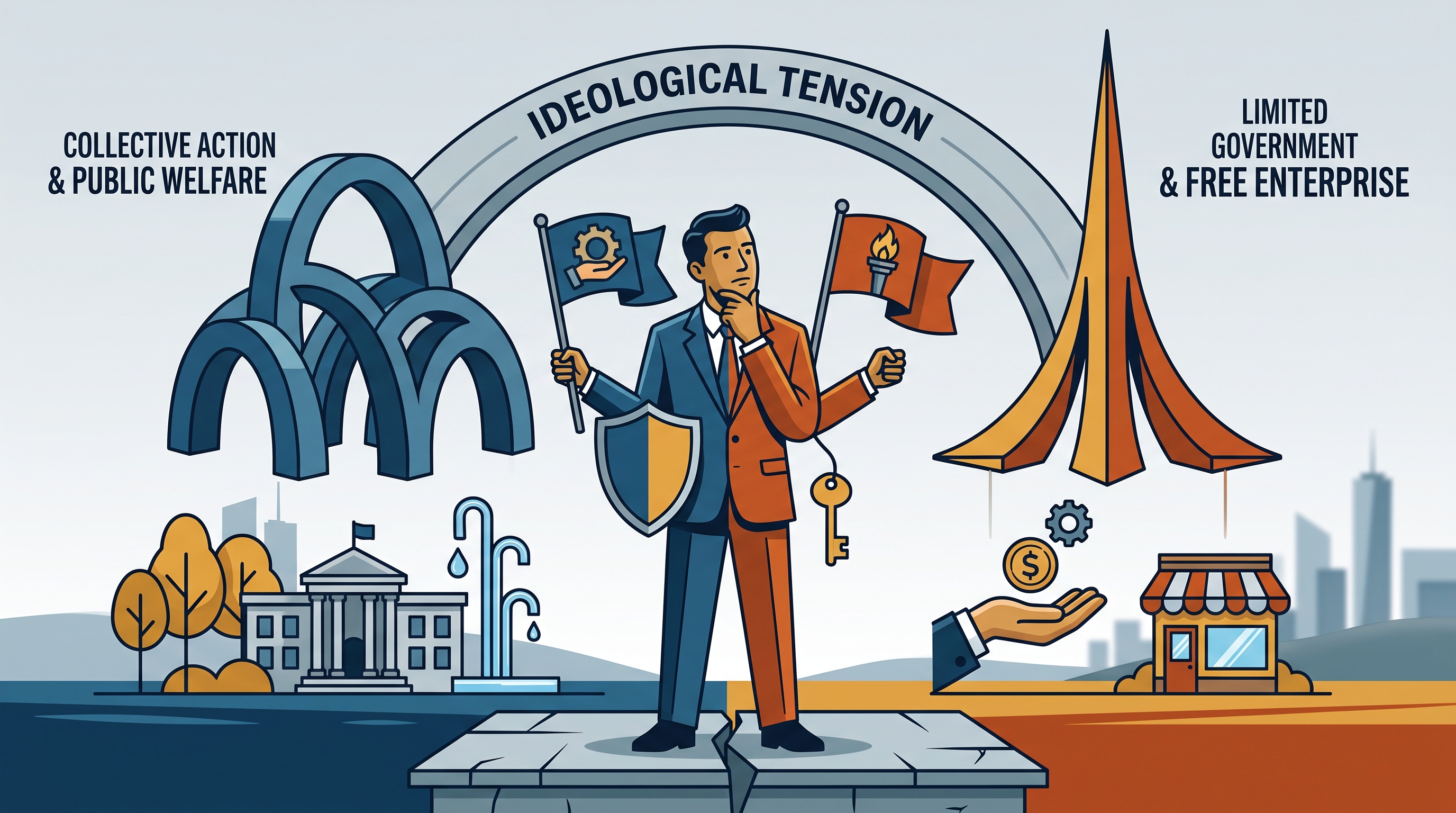
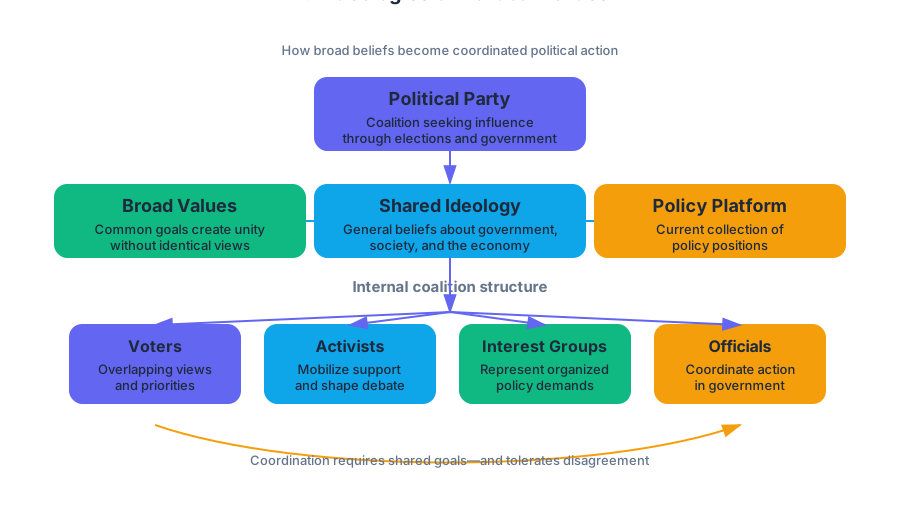
4.8 Ideology and Policymaking
A political ideology becomes politically consequential when it turns a belief about government into a preferred policy choice: What problem deserves attention, what should government do, and who should bear the cost?
4.8 Ideology and Policymaking
A political ideology becomes politically consequential when it turns a belief about government into a preferred policy choice: What problem deserves attention, what should government do, and who should bear the cost? Ideology and policymaking therefore connects abstract values—such as equality, individual liberty, limited government, or collective responsibility—to concrete decisions about laws and public programs.
Essential question: How do political ideology and core values influence government policymaking?
From beliefs to policy
A policymaker does not move directly from “liberal” or “conservative” beliefs to a final law. The reasoning usually passes through several steps. Two people may agree that a problem exists but define it differently, choose different goals, and support different tools.
| Stage | Guiding question | Example: rising housing costs |
|---|---|---|
| Values and assumptions | What principles matter most? | Equality of opportunity, property rights, local control, or limited government |
| Problem definition | What is causing the problem? | Insufficient housing supply, excessive regulation, low wages, or government subsidies |
| Policy goal | What result should government seek? | More affordable housing, greater construction, or less government intervention |
| Policy tool | What should government do? | Tax credits, zoning limits, direct assistance, deregulation, or no new program |
| Predicted consequences | What will the policy change? | Prices, construction, taxes, neighborhood patterns, or access |
| Evaluation | Did the policy achieve its goal? | Compare outcomes with the original objective and examine unintended effects |
This chain explains why ideology influences both the substance of policy and the arguments used to defend it. A liberal perspective may emphasize government action to reduce unequal outcomes; a conservative perspective may emphasize individual responsibility, market incentives, or limiting government power. These are tendencies, not rigid predictions: actual policymakers may combine approaches or change positions in response to evidence, constituents, political pressure, or changing circumstances.
Policy choices are not ideology in isolation
Political ideology is a consistent pattern of ideas about the proper role of government, the distribution of authority, and the best ways to address public problems. In policymaking, ideology interacts with public opinion, party coalitions, interest groups, institutions, constitutional limits, and available evidence.
For example, imagine that a state experiences severe wildfire damage. A policymaker who prioritizes limited government may oppose a large permanent bureaucracy and favor private insurance, local responsibility, or temporary emergency aid. A policymaker who prioritizes collective responsibility may support stronger building standards, public funding for prevention, and a permanent state program. Both may support immediate emergency response; their ideological differences become clearer when deciding who pays, how much authority the state should exercise, and whether the policy should continue after the crisis.
Worked example: interpreting an ideological argument
Suppose a city proposes a public transportation subsidy. One argument says that affordable transit expands access to jobs and reduces inequality. Another says that the subsidy transfers money from taxpayers who may not use transit and that private providers should compete to serve riders.
To analyze the arguments, identify the policy reasoning, not merely the label attached to each speaker:
- The first argument defines transportation as an opportunity problem.
- Its goal is broader access to employment and services.
- Its preferred tool is public funding that lowers fares or expands routes.
- It predicts social benefits that individual consumers may not be able to create alone.
- The second argument defines transportation as a government-efficiency and individual-choice problem.
- Its goal is limited taxation and competitive service.
- Its preferred tool is market provision rather than a broad public subsidy.
An AP response earns stronger analysis by explaining this causal connection: because the first perspective prioritizes equality of opportunity and accepts a larger governmental role, it is more likely to support a subsidy; because the second prioritizes limited government and market choice, it is more likely to oppose or narrow the subsidy. Simply calling one position “liberal” and the other “conservative” does not explain policymaking.
Misconception check
Misconception: ideology determines policy automatically. It does not. Institutional barriers, divided government, federalism, constitutional interpretation, budget constraints, public opinion, and interest-group activity can prevent an ideologically preferred policy from becoming law. A policymaker can also support a policy associated with another ideology when practical circumstances or constituency demands change.
Misconception: one policy always belongs exclusively to one ideology. Policy tools can be supported for different ideological reasons. A tax credit might be defended as social assistance, as a market-based alternative to direct regulation, or as an incentive for private investment. Explain the reasoning and predicted consequences rather than relying on labels.
AP skill connection
Topic 4.8 Ideology and Policymaking is assessed through Skill 4.D: Explain the implications of political processes, institutions, and behaviors. Apply the skill by tracing how an ideological perspective affects a policy goal, a governmental action, or the expected consequences of a policy. The key move is to connect perspective to implication: If policymakers prioritize this value, what decision becomes more likely, and how might that decision affect institutions, policies, or political behavior?
Retrieval check
A legislator supports a national paid-leave program because workers should not lose economic security when caring for a newborn or sick relative. Identify the likely value, policy goal, and policy tool. Then explain one reason why that ideological preference might still fail to become law.
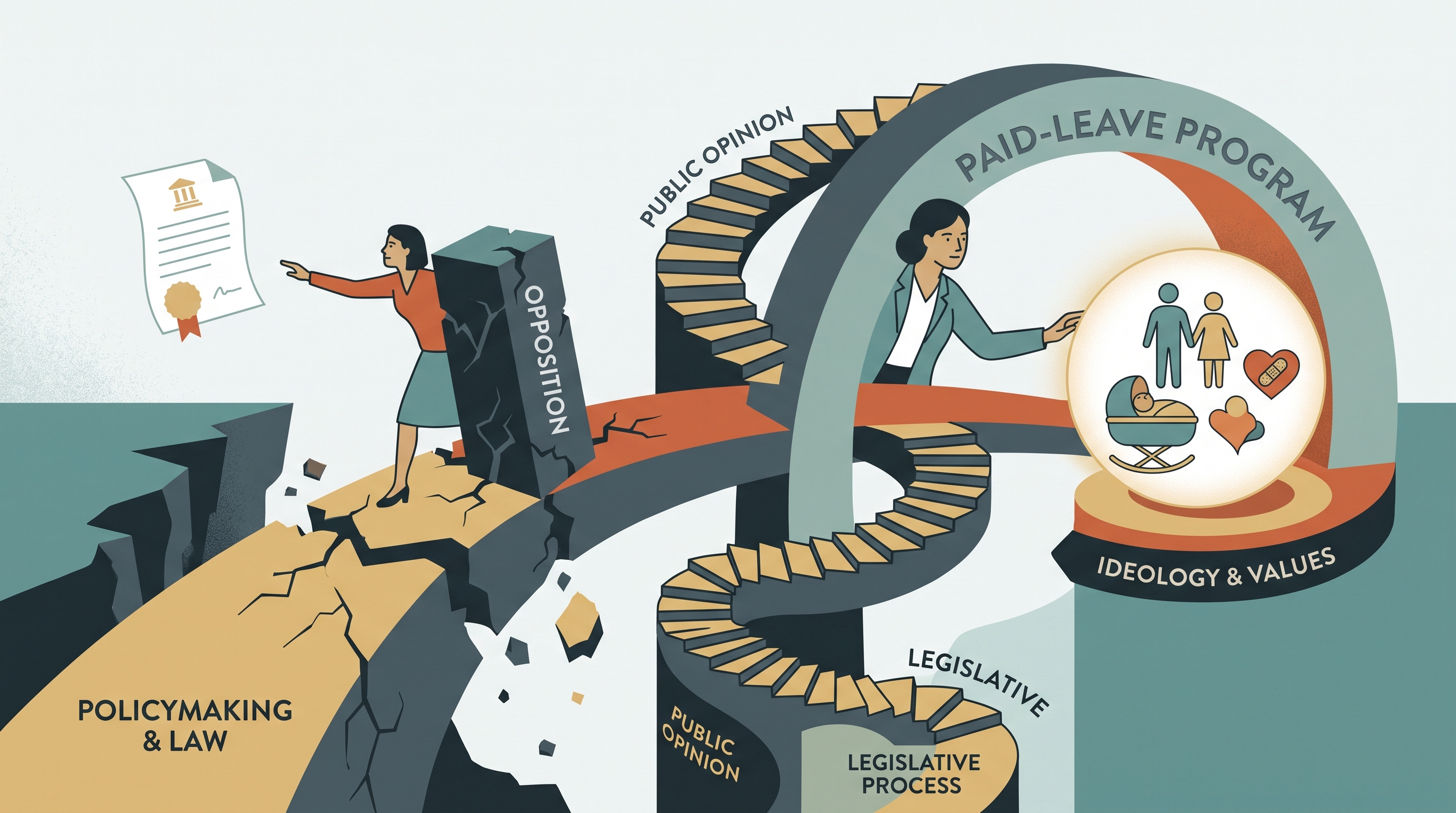
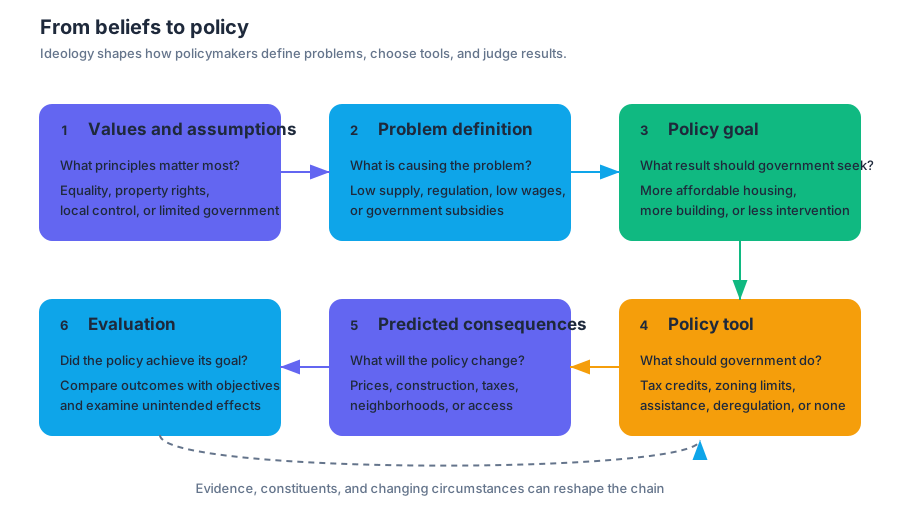
4.9 Ideology and Economic Policy
Economic policy asks a practical question with competing answers: How much should government shape the economy, and by what means? A proposal to raise the minimum wage, expand public health insurance, reduce business regulation, or cut taxes is never only a technical decision; it reflects beliefs about equality,…
4.9 Ideology and Economic Policy
Economic policy asks a practical question with competing answers: How much should government shape the economy, and by what means? A proposal to raise the minimum wage, expand public health insurance, reduce business regulation, or cut taxes is never only a technical decision; it reflects beliefs about equality, individual responsibility, economic freedom, and the proper role of government.
4.9.A — Explain how ideologies of Democrats and Republicans influence economic policies.
The central distinction is not that one party supports “the economy” and the other does not. Both major parties claim to promote prosperity, employment, and national well-being. They usually differ over the tools government should use, the amount of government involvement considered legitimate, and which economic costs or inequalities are most acceptable.
The ideological divide over the economy
Liberal economic ideology generally supports a more active government role in managing economic conditions and reducing inequality. Common liberal policy preferences include progressive taxation, public spending on social programs, stronger labor protections, consumer and environmental regulation, and government action intended to address unemployment or economic insecurity.
Conservative economic ideology generally places greater emphasis on free enterprise, private property, individual responsibility, and limited government intervention. Common conservative policy preferences include lower taxes, reduced regulation, restrained government spending, and policies intended to encourage private investment and market competition.
These are tendencies, not mathematical laws. Democrats and Republicans contain internal factions, and elected officials may change positions in response to voters, economic conditions, interest groups, party coalitions, or regional concerns. The labels describe broad ideological patterns rather than guarantees about every individual politician.
| Economic question | Liberal tendency | Conservative tendency |
|---|---|---|
| Taxation | More progressive taxation; higher-income individuals may pay a larger share | Lower overall tax burdens; concern that high taxes may reduce investment |
| Regulation | Stronger rules for workers, consumers, financial institutions, and the environment | Fewer or less costly regulations; concern about effects on business activity |
| Social welfare | Larger public programs to reduce poverty and economic insecurity | More limited programs, often emphasizing work, private charity, or state responsibility |
| Government spending | Public investment may be used to address needs or stimulate demand | Spending restraint and reduced deficits are emphasized |
| Economic freedom | Freedom is balanced against unequal resources and market power | Freedom is closely associated with voluntary exchange and limited government |
| Inequality | Government should more actively reduce major economic disparities | Differences in outcomes may be acceptable if opportunities and rules are fair |
The comparison is best understood as a debate over trade-offs. A regulation may protect workers or consumers but increase costs for businesses. A tax cut may encourage investment or leave the government with less revenue for public services. A welfare program may reduce hardship but also raise questions about cost, eligibility, and incentives to work.
Worked example: choosing an economic response
Imagine that a state faces rising housing costs and stagnant wages. One proposal would create a publicly funded housing-assistance program financed through higher taxes on high-income households. Another would reduce regulations on housing construction and offer tax credits to private developers.
The first proposal reflects a more liberal approach: government directly addresses economic insecurity, uses progressive taxation, and treats unequal access to housing as a problem requiring public intervention. The second reflects a more conservative approach: government attempts to expand supply through market incentives and fewer restrictions, while avoiding a large new public program.
Neither ideological description alone proves which policy will work best. An AP response should connect the policy instrument to the ideology: higher taxes and direct assistance indicate a preference for active government redistribution; deregulation and private-sector incentives indicate a preference for market-based solutions.
Why economic conditions can shift policy preferences
Ideological commitments interact with economic indicators. Policymakers may debate how to respond to unemployment, inflation, economic growth, poverty, or income inequality. For example, increased public spending may be defended as a way to support demand during a downturn, while critics may argue that spending increases inflation or expands the national debt.
The same policy can therefore be evaluated through different ideological priorities. A progressive tax may be viewed as a method of funding public goods and reducing inequality, or as a burden that discourages investment. Government regulation may be viewed as necessary protection against unsafe practices, or as an obstacle to innovation and competition.
Common misconception check
Misconception: “Democrats always support higher taxes and Republicans always oppose them.” The more accurate claim is that Democrats are generally more likely to support progressive taxation and government-funded programs, while Republicans are generally more likely to favor lower taxes and limited spending. Specific proposals, fiscal conditions, and party factions can produce exceptions.
AP skill connection
This topic most directly develops Skill 1: Concept Application, especially 1.A, applying economic-ideology concepts to a new policy scenario. It also uses Skill 3: Data Analysis, particularly 3.A and 3.B, when students identify economic trends and explain what a graph or table suggests; Skill 4: Source Analysis, especially 4.A and 4.B, when interpreting a party platform or political statement; and Skill 5: Argumentation, including 5.A and 5.B, when making and supporting a defensible claim about how ideology shaped a policy choice. Skill 2: SCOTUS Application is less central here unless an economic-policy dispute requires applying a relevant constitutional principle or Supreme Court decision.
Retrieval check
A government proposes a higher tax on corporations and uses the revenue to expand unemployment benefits. Which ideological position does the proposal most closely reflect, and what two policy features support your answer?
Answer: It most closely reflects a liberal economic approach because it combines greater government involvement through expanded social welfare with increased taxation to fund that intervention.
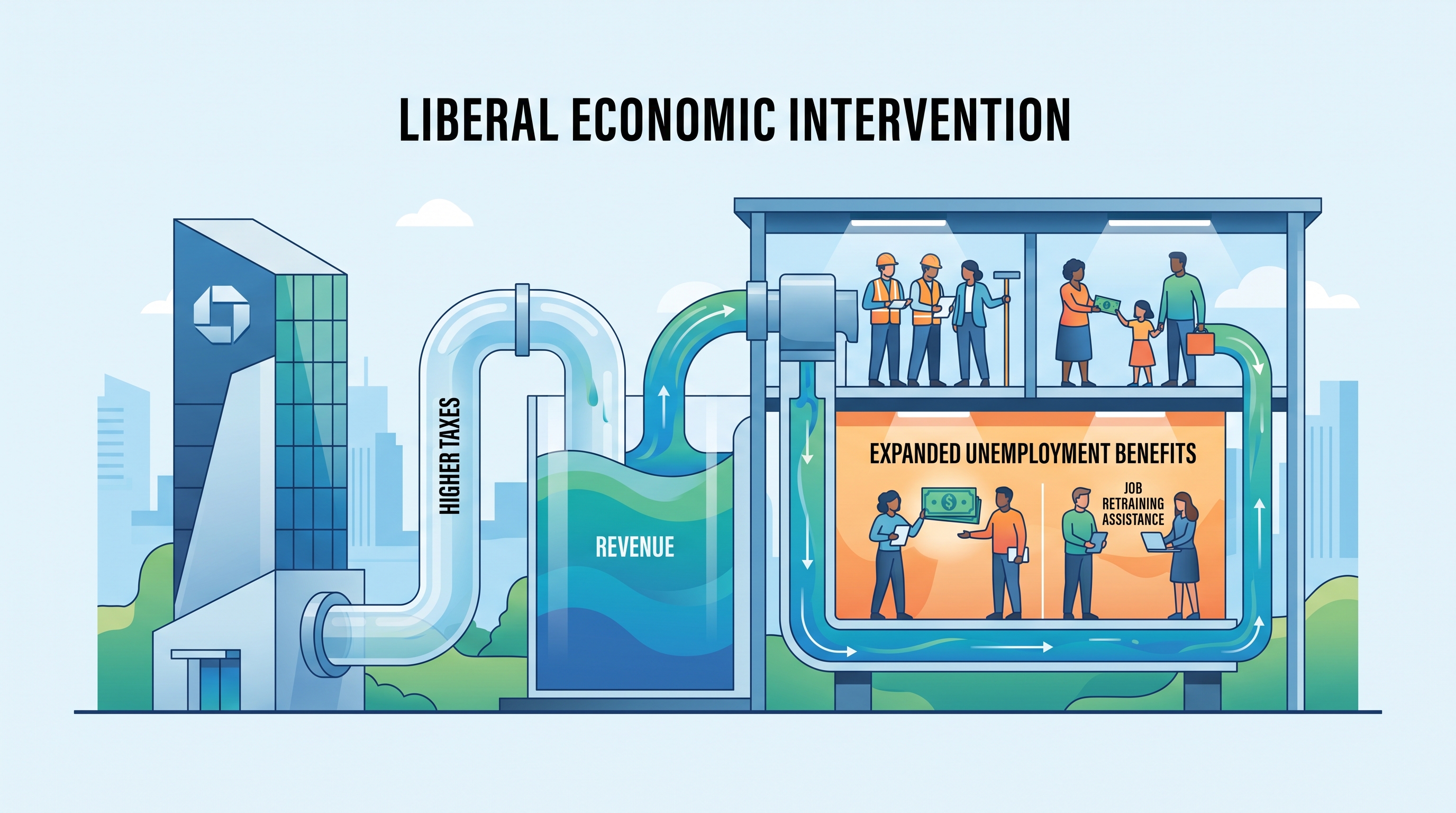
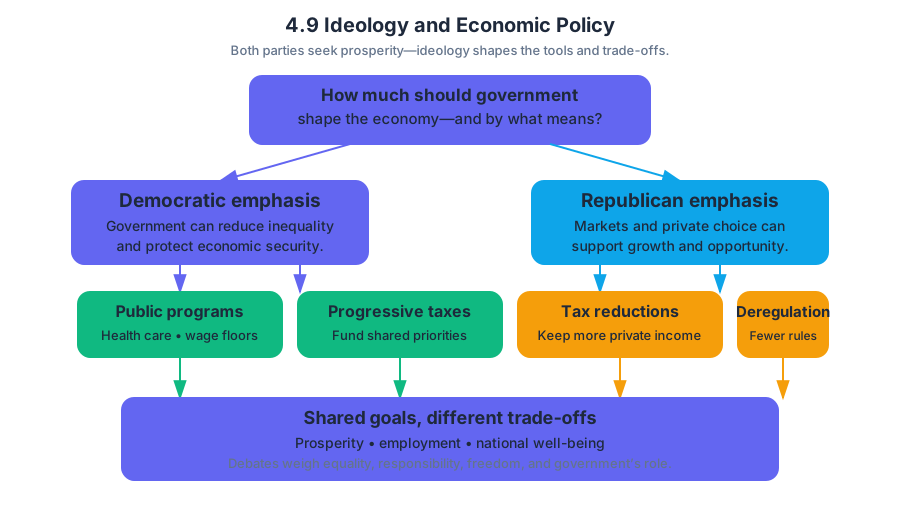
4.10 Ideology and Social Policy
Key concepts: First Amendment speech protections · Social media · Information sharing · Voter access to information · Public policy information · Candidate agendas · News stations · Live news updates · Citizen awareness
Social media has transformed the First Amendment’s protection of speech into a daily political contest: citizens, candidates, parties, interest groups, and news organizations can communicate with large audiences almost instantly.
4.10 Ideology and Social Policy
Social media has transformed the First Amendment’s protection of speech into a daily political contest: citizens, candidates, parties, interest groups, and news organizations can communicate with large audiences almost instantly. The constitutional question is not simply who can speak, but how information changes voters’ understanding of social policy and candidate agendas.
LO 4.10.A — Explain how political ideologies influence social policy.
Social policy consists of government choices affecting social relationships, rights, access, and participation. Political ideology helps citizens and policymakers decide which goals deserve priority. Social media connects those ideological preferences to policy information: voters may compare candidates’ positions, parties may promote agendas, and interest groups may organize supporters around particular issues.
Speech protections meet social media
The First Amendment protects freedom of speech from government censorship. In the digital era, people may use social media to share information about topics with audiences interested in those topics. A voter might encounter a candidate’s explanation of an education proposal, an interest group’s argument about voting access, or a news station’s live update about a public event.
This communication can strengthen participatory democracy, a system in which citizens do more than select leaders periodically; they also develop opinions, exchange information, discuss policy, and act politically. News organizations can post live information, keeping citizens updated on current events. Candidates and political parties can communicate directly with voters rather than relying entirely on traditional news coverage.
Important constitutional distinction
The First Amendment generally restricts government from abridging speech. It does not require a private social-media company to publish every post, preserve every account, or provide every speaker with an unlimited audience. Therefore, “speech is protected” does not mean “every online post must remain available.” The relevant constitutional issue is whether the government is suppressing protected expression, not whether a private platform moderates content under its own rules.
Misconception check: The First Amendment does not guarantee equal reach, guaranteed publication, or freedom from criticism. It protects expression against unjustified government interference.
From information to social-policy choices
Social media can make voters more informed about public policy information—information about what government is doing or what candidates propose to do. A voter can compare candidate agendas, examine party positions, follow interest groups, and observe how competing factions frame the same issue. This comparison matters because voters may be more likely to vote based on issues rather than choosing only the candidate who seems to represent their general ideology.
The process is not automatically beneficial. Information can be incomplete, misleading, or presented only to people who already agree with it. A person who follows only one political party may receive a steady stream of arguments supporting that party’s social-policy agenda while rarely encountering opposing evidence. Thus, social media expands access to political information while also making source evaluation essential.
Worked example: a social-policy campaign
Imagine that a city is debating whether to expand access to early voting. A local news station posts live updates from the city council meeting. One candidate posts a plan supporting expanded access; another argues that existing procedures are sufficient. An interest group shares statistics and asks supporters to contact representatives.
A voter who encounters these messages can identify the policy, compare candidate agendas, connect each position to a broader ideology, and decide whether to vote or participate in the debate. The causal chain is:
First Amendment speech protection → online information sharing → greater awareness of policy and candidates → more informed participation → possible issue-based voting.
This example also reflects the logic of Federalist No. 10: factions—groups pursuing shared political interests—are unavoidable in a free society. Social media gives factions new tools to organize, persuade, and compete for influence. Competition can expose citizens to multiple viewpoints, although it does not guarantee that every viewpoint receives equal attention.
AP skills in action
This topic most directly develops Concept Application (1.A) by applying ideology, social policy, participatory democracy, and First Amendment principles to a contemporary communication setting. It also develops Source Analysis (4.A) when evaluating a candidate post, news update, or interest-group message for its perspective and purpose, and Argumentation (5.A) when defending whether social media strengthens or weakens democratic participation with a claim, evidence, and reasoning.
Retrieval check: A news station posts live election information, while a private platform removes a candidate’s post under its moderation policy. Which action raises the clearest First Amendment question, and why? A strong answer identifies the government-action distinction and then explains how access to reliable information can affect voter awareness and participation.
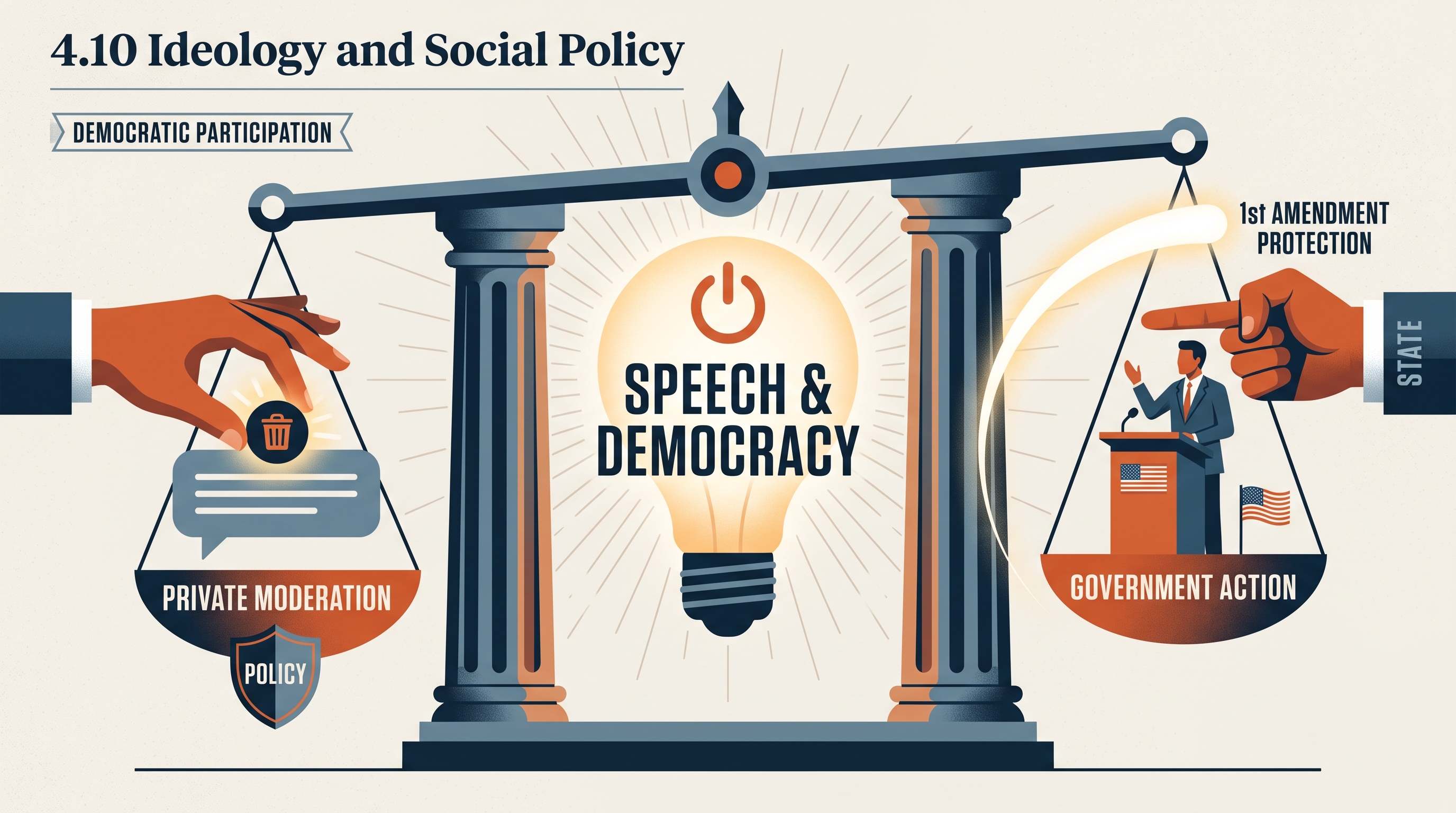
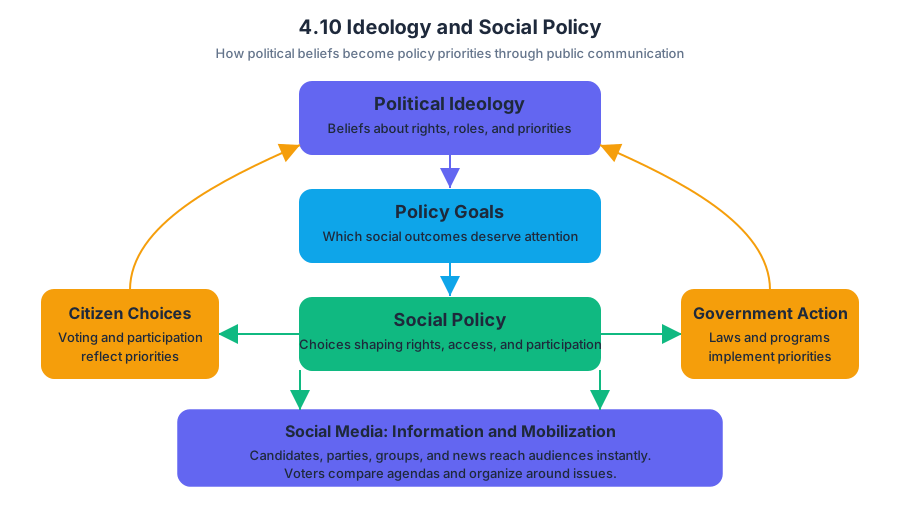
5.1 Voting Rights and Models of Voting Behavior
Voting is both a legal opportunity and a political decision: the Constitution and voting-rights legislation determine who may participate, while individual voters decide how to use that opportunity.
5.1 Voting Rights and Models of Voting Behavior
Voting is both a legal opportunity and a political decision: the Constitution and voting-rights legislation determine who may participate, while individual voters decide how to use that opportunity. LO 5.1.A asks you to explain how political participation is protected; LO 5.1.B asks you to describe models that explain voting behavior.
The legal expansion of voting rights
The American electorate expanded through constitutional amendments and federal legislation. EK 5.1.A.1 identifies the major constitutional protections:
| Amendment | Voting-rights significance |
|---|---|
| 14th Amendment | Granted citizenship to all persons born or naturalized in the United States, including formerly enslaved people. |
| 15th Amendment | Prohibited denying African American men the right to vote on the basis of race. |
| 17th Amendment | Established direct election of U.S. senators by the people rather than selection by state legislatures. |
| 19th Amendment | Prohibited denying women the right to vote on the basis of sex. |
| 24th Amendment | Eliminated poll taxes in federal elections. |
| 26th Amendment | Lowered the voting age to 18. |
These amendments changed the formal rules of political participation, but constitutional language alone did not always guarantee practical access. States and local governments used devices such as literacy tests, intimidation, registration barriers, and discriminatory administration to exclude eligible voters.
The Voting Rights Act of 1965 addressed this gap. It prohibited discriminatory voting practices and authorized federal enforcement to protect access to the ballot. In practical terms, the law gave the national government tools to challenge systems that appeared formally neutral but operated to deny minority citizens meaningful participation.
Worked legal example: Suppose a county requires a $10 fee before a citizen may vote in a federal election. That requirement conflicts with the 24th Amendment, which prohibits poll taxes in federal elections. If the same fee is imposed in a state election, the 24th Amendment does not directly govern that election; however, Harper v. Virginia Board of Elections held that poll taxes in state elections violate equal-protection principles. The key reasoning is to identify both the election level and the constitutional rule that applies.
Misconception check: The 14th Amendment did not itself create a universal voting right for every adult. It established citizenship and equal-protection principles. The voting-rights amendments address particular barriers, and legislation such as the Voting Rights Act strengthens enforcement.
Models of voting behavior
Legal eligibility answers who may vote. Voting models answer a different question: what considerations shape a voter’s choice? EK 5.1.B.1 identifies four models.
- Rational choice voting: Individuals choose the option they perceive as serving their best interest. A voter might support a candidate who promises lower transportation costs because that policy would directly benefit the voter’s household.
- Retrospective voting: Individuals judge a party or candidate in power by looking at the recent past. A voter may support reelection after observing strong economic performance or reject the incumbent after experiencing poor governmental results.
- Prospective voting: Individuals predict how a party or candidate will perform in the future. A voter may choose a challenger because the challenger’s proposed energy plan seems more likely to reduce future costs.
- Straight-ticket voting: Individuals vote for every candidate from one political party on the ballot.
These models can overlap. A voter might use retrospective reasoning to evaluate the incumbent’s record, prospective reasoning to compare future promises, and rational-choice reasoning to select whichever option appears most beneficial. Straight-ticket voting describes the pattern of choices across offices; it does not necessarily reveal whether the voter relied on past performance, future expectations, party loyalty, or perceived self-interest.
Worked scenario: identifying the model
Imagine that Jordan is voting in an election. Jordan says, “The current mayor failed to improve bus service, so I will not support the mayor’s party.” That is retrospective voting because Jordan evaluates recent past performance. Jordan then adds, “The challenger’s transportation proposal seems more realistic, so I expect better service next year.” That is prospective voting because the judgment rests on a prediction about future performance. If Jordan votes for every candidate from the challenger’s party, the ballot also demonstrates straight-ticket voting.
The strongest AP response names the model and connects it to the evidence. Merely saying “Jordan is voting based on transportation” is incomplete; the decisive clue is whether Jordan is evaluating the past, predicting the future, choosing perceived personal benefit, or selecting one party across the ballot.
Skill connection — Concept Application (1.D): When a scenario describes a voter, first locate the behavior in context. Then match the evidence to the precise model: past results indicate retrospective voting, future expectations indicate prospective voting, perceived personal advantage indicates rational choice voting, and voting for every candidate of one party indicates straight-ticket voting.
Retrieval check: A voter says, “My family’s taxes will be lower under Candidate A, so I support A,” and votes for Candidate A’s party in every contest. Which two models are illustrated, and what specific evidence supports each? The answer is rational choice voting because the voter emphasizes perceived personal benefit, and straight-ticket voting because the voter selects the same party across contests.
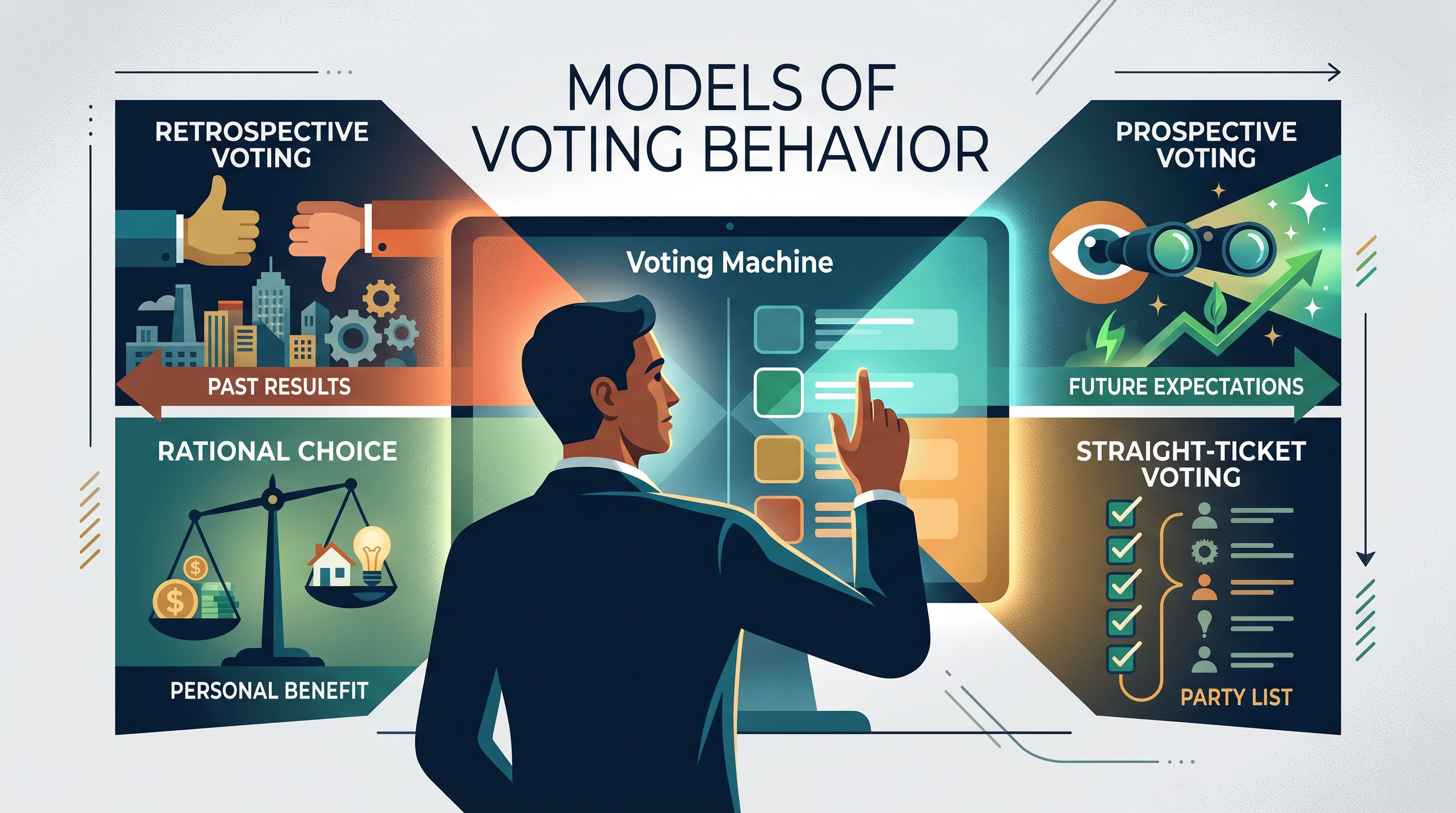
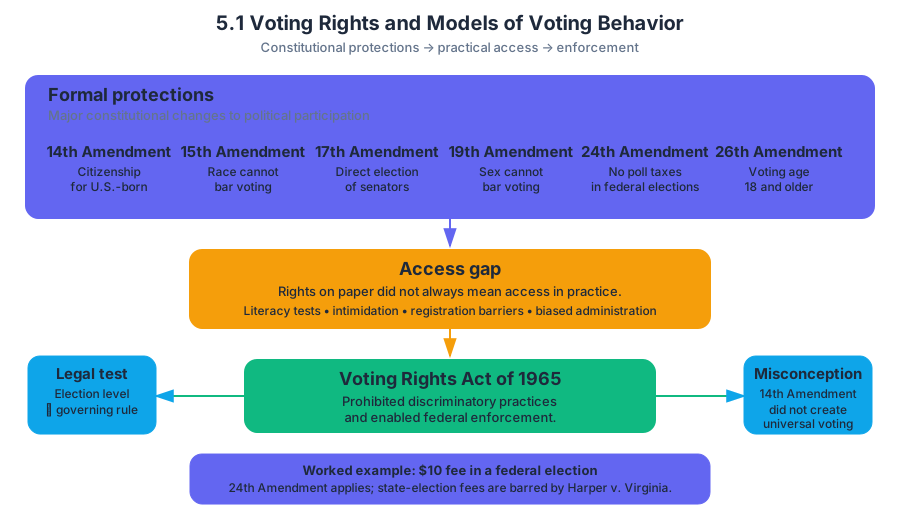
5.2 Voter Turnout
Voter turnout is the proportion of eligible citizens who cast a ballot in an election. The central puzzle is simple: if voting can influence who governs and which policies are adopted, why does any eligible citizen stay home?
5.2 Voter Turnout
Voter turnout is the proportion of eligible citizens who cast a ballot in an election. The central puzzle is simple: if voting can influence who governs and which policies are adopted, why does any eligible citizen stay home?
Measurement matters: turnout can be calculated using the voting-age population—everyone old enough to vote—or the voting-eligible population—those old enough, citizens, and legally qualified to vote. Because the voting-age population includes people who cannot legally vote, the voting-eligible population usually gives a more precise measure of participation.
The turnout decision: benefits versus costs
Voting requires resources: learning about candidates, registering, reaching a polling place, waiting in line, and finding time away from work or family responsibilities. These are the costs of voting. The perceived benefits include influencing policy, supporting a preferred candidate, expressing civic duty, and helping one’s political group win.
A rational-choice model represents the decision this way:
$$ \text{Vote when perceived benefits} > \text{perceived costs} $$
The model does not mean voters are selfish or uninterested in democracy. Civic duty, identity, anger, solidarity, and the belief that one vote matters can all increase the perceived benefit. The model simply asks why the same eligible citizen may vote in one election but not another.
Three families of turnout factors
| Factor family | How it changes turnout | Illustrative mechanism |
|---|---|---|
| Attitudinal factors | Raises or lowers the perceived benefit of voting | Political efficacy, civic duty, interest, trust, or belief that the election matters |
| Government requirements | Raises or lowers the practical cost | Registration deadlines, voter-identification rules, registration access, and election administration |
| Institutional forces | Changes convenience or the expected impact of voting | Election frequency, competitiveness, voting technology, and the type of election |
Political efficacy means the belief that one’s participation can affect government. A person with high internal efficacy may feel capable of understanding politics; a person with high external efficacy may believe government responds to citizens. Low efficacy can reduce turnout because voting appears unlikely to produce a meaningful result.
Election competitiveness also matters. When candidates are closely matched, citizens may believe their votes are more consequential, and campaigns have stronger incentives to mobilize them. In an overwhelmingly predictable election, the expected benefit of voting may seem smaller—even though the election still determines real policies.
Worked example: lowering the cost of voting
Imagine that State A has same-day registration and several convenient voting options. State B requires registration weeks before Election Day and requires voters to obtain a particular form of identification. Assume citizens in both states have similar interest in politics.
For a citizen in State A, registration can occur close to the election, travel time is limited, and the administrative process is relatively easy. The policy lowers the costs of voting, so more citizens may decide that the benefits outweigh the costs. In State B, the earlier deadline and identification requirement may create additional barriers; citizens who would otherwise vote may not complete the process.
This example does not prove that every turnout difference is caused by one law. Demographic characteristics, campaign mobilization, competitiveness, political interest, and election timing may also differ. A strong analysis identifies the likely mechanism while avoiding the claim that correlation alone establishes causation.
Why election type changes turnout
Turnout is generally higher in presidential elections than in midterm, state, or local elections. Presidential elections receive more media coverage, attract more campaign spending, and make the stakes more visible. Lower-salience elections often produce lower turnout because fewer citizens know about them or believe their participation will affect national outcomes.
Frequent elections can create voter fatigue, the decline in motivation that may occur when citizens are repeatedly asked to participate. The same institutional design that creates many opportunities for participation can therefore reduce participation by increasing the time and attention required.
Misconception check
Misconception: “Low turnout means citizens are apathetic.” Apathy is one possible explanation, but turnout is shaped by both motivation and access. A citizen may care deeply about politics yet fail to vote because of registration rules, work schedules, transportation problems, identification requirements, confusing procedures, or the belief that the election is not competitive.
AP skill connection: Skill 3.C
Skill 3.C — Explain the implications of political data. When analyzing a turnout graph or table, do more than identify which group has the higher percentage. Explain what the difference could imply about political influence, campaign strategy, representation, or public policy.
For example, if turnout rises after same-day registration is adopted, the implication may be that reducing administrative costs expands participation. A careful response should still consider other explanations, such as a more competitive election or an unusually strong mobilization campaign.
Retrieval check
A state makes registration easier but holds many low-salience elections. Predict two forces that could increase turnout and one that could reduce it. Then state whether the evidence would show causation automatically.
Answer: Easier registration could lower costs, and a competitive campaign could raise perceived benefits. Frequent low-salience elections could produce voter fatigue and reduce turnout. The pattern would suggest a relationship, but it would not automatically prove causation.
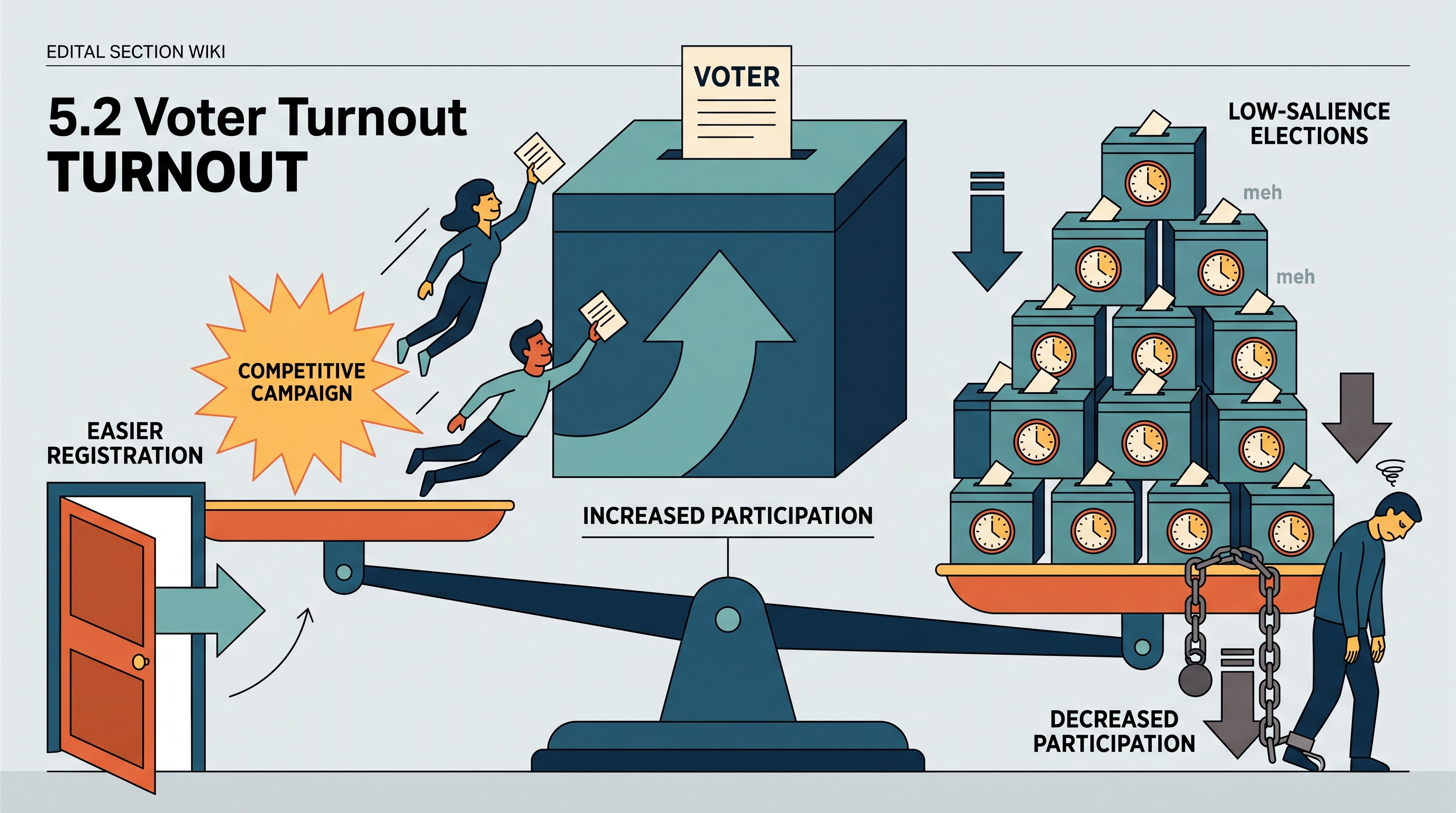
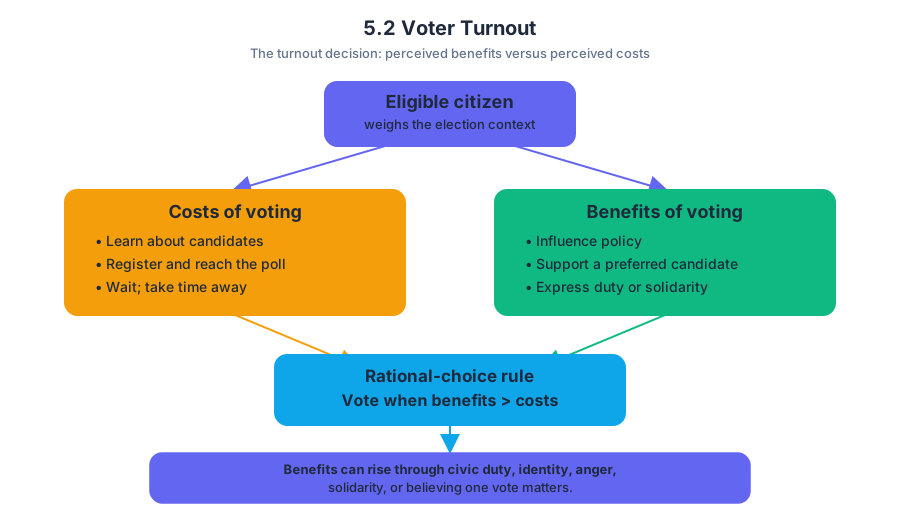
5.3 Political Parties
A political party is an organized group that seeks to influence government by nominating candidates, winning elections, shaping public policy, and mobilizing citizens. Parties do more than label candidates “Democrat” or “Republican”: they connect citizens to government and help turn scattered opinions into…
5.3 Political Parties
A political party is an organized group that seeks to influence government by nominating candidates, winning elections, shaping public policy, and mobilizing citizens. Parties do more than label candidates “Democrat” or “Republican”: they connect citizens to government and help turn scattered opinions into coordinated political action.
In a large representative democracy, most citizens cannot personally evaluate every candidate, bill, and policy proposal. Political parties reduce that information problem by offering recognizable teams, policy positions, campaign organizations, and governing agendas.
The three faces of a political party
Political parties operate simultaneously in three connected arenas. Confusing these arenas is one of the most common sources of incorrect reasoning about parties.
| Party component | What it includes | Main political work |
|---|---|---|
| Party in the electorate | Citizens who identify with or regularly support a party | Voting, donating, volunteering, persuading others |
| Party organization | National, state, and local party committees and officials | Recruiting candidates, raising money, coordinating campaigns, and mobilizing voters |
| Party in government | Elected officials who belong to the party | Organizing legislative action, selecting leaders, and pursuing the party’s policy goals |
The three components overlap but are not identical. A voter may identify with a party without belonging to its formal organization, and an elected official may disagree with the party’s national position on a particular issue.
Parties as linkage institutions
A linkage institution is a structure that connects people to government and communicates public preferences to policymakers. Political parties perform this role by translating individual concerns—such as housing costs, health care, taxes, or public safety—into platforms, candidates, campaign messages, and legislative priorities.
Parties also help citizens interpret politics. A party label supplies a shortcut: voters may use a candidate’s party affiliation as evidence about likely policy positions. This shortcut is useful, but it can also encourage voters to rely on party identity rather than examining a candidate’s actual record.
What parties do
The core functions of political parties include recruiting candidates, organizing elections, mobilizing voters, presenting alternative policy positions, and coordinating government. Parties identify people willing to seek office, help them campaign, assemble volunteers and donors, communicate with voters, and organize elected officials after the election.
A party platform is a public statement of the party’s policy priorities. Platforms can help voters compare parties and give candidates a common message, although elected officials are not legally required to follow every platform promise.
The party in government performs an especially important coordinating function. In Congress, party members choose leaders, distribute committee assignments, develop legislative priorities, and try to assemble the votes necessary to pass bills. In the executive branch, a president often relies on party networks and shared goals to build support for an administrative agenda.
Worked example: turning an issue into political action
Suppose residents become concerned about the rising cost of home insurance after repeated storms. The issue begins as an individual problem: each household experiences higher premiums. Political parties can transform it into a broader political process.
- Party in the electorate: Residents discuss the issue, join advocacy efforts, donate, volunteer, and vote for candidates who address insurance costs.
- Party organization: Local and state party committees recruit candidates, arrange meetings, distribute campaign materials, and target likely supporters.
- Candidates and platforms: Candidates propose policies such as insurance regulation, disaster assistance, or incentives for stronger construction.
- Party in government: Winning legislators introduce bills, use committee hearings to develop them, and coordinate with party leaders to seek passage.
- Accountability: At the next election, voters evaluate whether the party’s officials acted on the issue.
This example shows why parties are more than campaign machines. They connect public concerns to candidates, elections, institutions, and policy outcomes.
Skill focus: Skill 1.B — Describe political concepts and processes
Topic 5.3 Political Parties is associated with Skill 1.B: Describe political concepts and processes. To apply this skill, identify the political concept precisely and explain how it operates in context. A strong response does not merely state that parties “help elections”; it describes the mechanism—candidate recruitment, voter mobilization, policy coordination, or linkage between citizens and government.
For example, if a prompt describes a state party recruiting volunteers, creating campaign materials, and coordinating election-day transportation, the best description identifies the party organization, not simply “the party.” If it describes citizens who consistently support one party but hold no formal party position, the relevant component is the party in the electorate.
Precision rule: Name both what the party is doing and which part of the party system is doing it.
Misconception check
Misconception: “A political party is just the people who hold office under its label.” The party in government is only one component. Parties also include ordinary voters and the formal organizations that recruit, fund, coordinate, and mobilize political activity.
Misconception: “Party identification means a voter agrees with every party position.” Party identification is a durable political attachment, not a complete checklist of opinions. Individuals may support a party generally while disagreeing with it on particular policies or candidates.
Retrieval check
A local party committee recruits a candidate, organizes volunteers, and sends targeted reminders to likely supporters. Which party component is acting, and which party function is most directly illustrated? Answer: the party organization is acting, primarily performing candidate recruitment and voter mobilization.
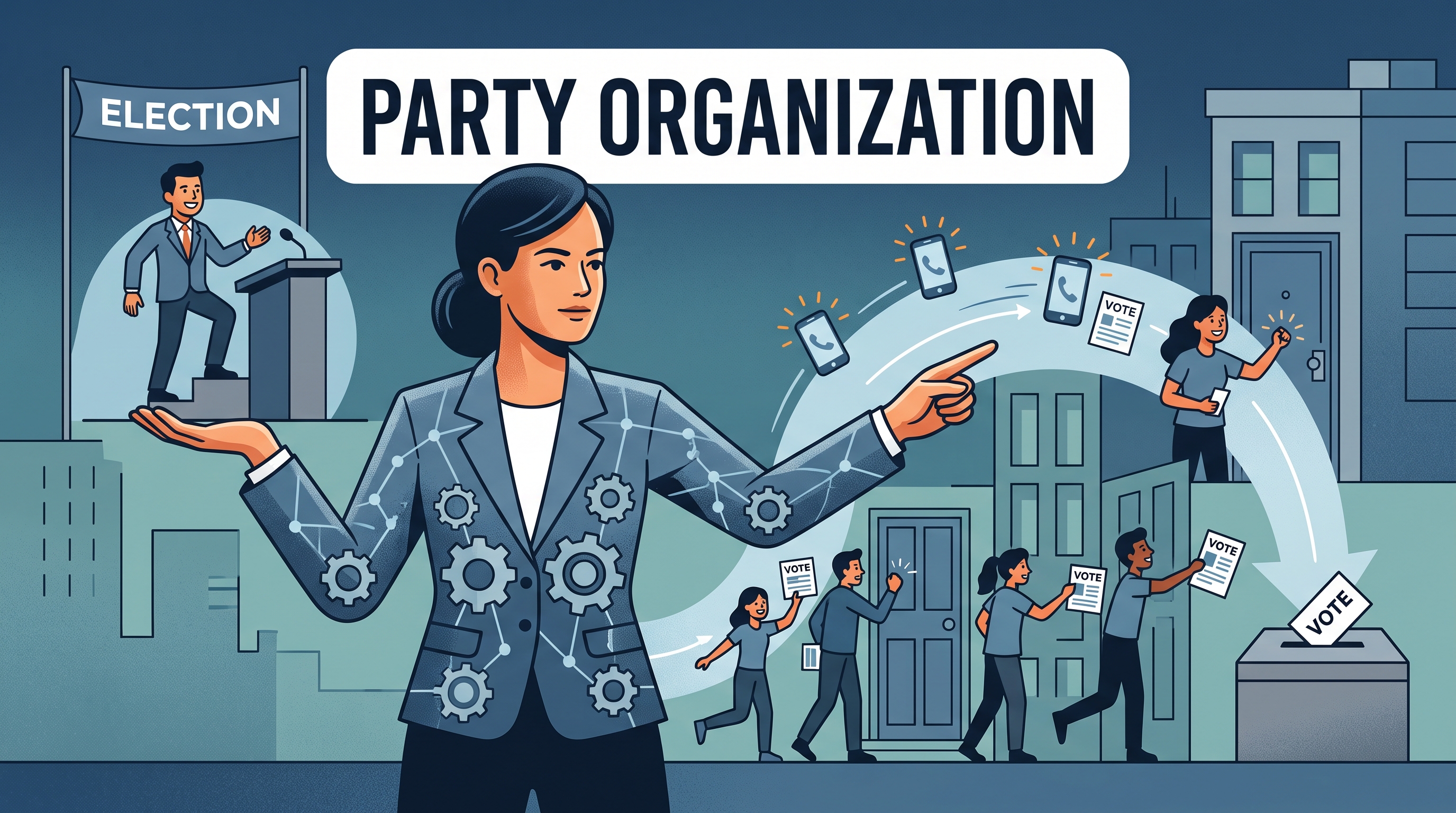
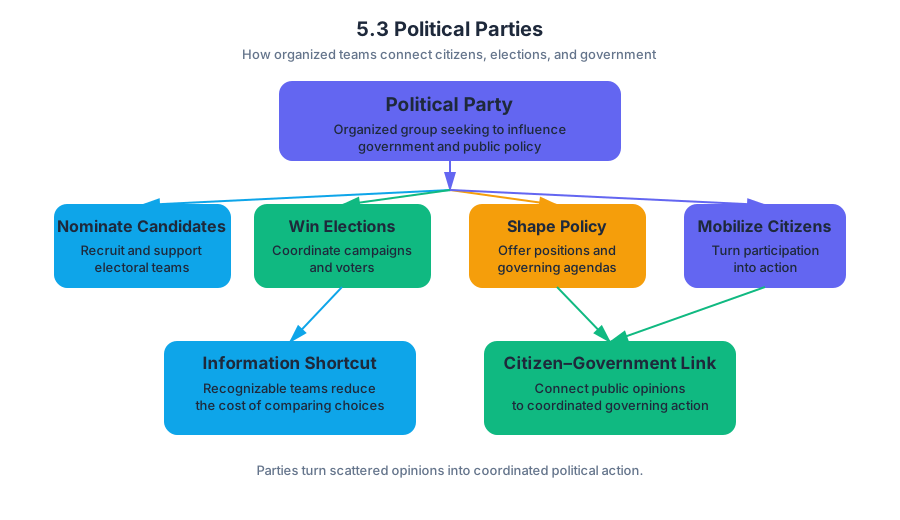
5.4 How and Why Political Parties Change and Adapt
Key concepts: Political party adaptation · Candidate-centered campaigns · Public focus on candidate characteristics rather than party identity · Political parties’ role in the nominating process · Educating voters · Recruiting candidates · Organizing leadership within legislative bodies · Explaining how and why political processes change
A modern presidential campaign can look less like a party selling a fixed product and more like a candidate building a personal brand. Voters may respond to a candidate’s biography, communication style, identity, or perceived leadership before they think carefully about the party label.
5.4 How and Why Political Parties Change and Adapt
A modern presidential campaign can look less like a party selling a fixed product and more like a candidate building a personal brand. Voters may respond to a candidate’s biography, communication style, identity, or perceived leadership before they think carefully about the party label. This is the central shift behind candidate-centered campaigns: public attention focuses primarily on the characteristics of the candidate rather than on the political party.
LO 5.4.A — Explain why and how political parties change and adapt.
EK 5.4.A.1 — Parties have adapted to candidate-centered campaigns where the public focus is on the characteristics of the candidate and not on the party. The role of parties in nominating candidates has also been weakened.
From party-centered politics to candidate-centered campaigns
In a more party-centered system, party organizations had greater control over nominations, campaign messages, and electoral strategy. In a candidate-centered system, individual candidates often build their own fundraising networks, media operations, data systems, and personal organizations. Parties still provide valuable support, but they must adapt to candidates who may already possess their own public following and campaign infrastructure.
The change in the nominating process is especially important. Primaries and caucuses give voters a larger role in selecting party nominees, reducing the ability of party leaders alone to determine which candidate represents the party. As a result, parties often work after candidates emerge from the nomination process to unify supporters, coordinate campaign resources, and connect the candidate to the party platform.
Misconception check — “Candidate-centered” means “party-free.” It does not. A candidate-centered campaign may depend heavily on party fundraising networks, voter files, volunteers, endorsements, and organizational support. The point is not that parties disappear; the point is that the candidate becomes the campaign’s most visible and influential center.
Worked example: campaign technology and adaptation
Consider the 2012 presidential campaign. Mitt Romney’s campaign used ORCA, while Barack Obama’s campaign used Project Narwhal. These operations illustrate how campaigns adapted to large-scale voter data, digital communication, targeted mobilization, and rapid coordination. The technology was associated with the candidates’ campaign organizations, showing how modern parties and campaigns respond when electoral competition revolves around an individual candidate’s operation.
The reasoning chain is:
- Voters and media focus heavily on the presidential candidate.
- The candidate’s organization develops specialized data and communication systems.
- The party adapts by supporting, coordinating with, and learning from candidate-centered campaign structures.
- Campaign strategy becomes more personalized and technologically sophisticated.
- The party’s traditional control over nominations and messaging becomes less exclusive.
This example demonstrates why parties change: institutions such as primaries, media systems, campaign technology, and voter behavior alter the environment in which parties operate. It also demonstrates how they change: parties modify their organization, messaging, recruitment, and campaign support to remain electorally useful.
What parties continue to do
Candidate-centered politics has not eliminated the core functions of parties. Political parties remain linkage institutions, connecting citizens to government through several activities:
| Party function | How adaptation appears |
|---|---|
| Educating voters | Parties explain policy choices, frame political issues, distribute information, and help voters interpret candidates and public events. |
| Recruiting candidates | Parties identify, encourage, train, endorse, and support people seeking office at national, state, and local levels. |
| Organizing legislative leadership | Party organizations structure leadership within legislative bodies by helping select leaders, assign committee positions, coordinate agendas, and organize voting coalitions. |
| Shaping policies and messaging | Parties adjust platforms and communication to appeal to different demographic coalitions, or groups of voters with shared characteristics or interests. |
EK 5.4.A.2 — Parties may adapt their policies and messaging to appeal to various demographic coalitions.
A party might therefore preserve broad commitments while changing the language, examples, messengers, or policy priorities it emphasizes for different constituencies. Adaptation is not automatically hypocrisy or abandonment of principle; it can be a strategic response to changing voters, institutions, and political conditions. At the same time, adaptation can create internal conflict when different coalitions demand incompatible policies.
EK 5.4.A.3 — The structure of parties has been influenced by changes in campaign organization, communication, and the wider electoral environment.
EK 5.4.A.4 — Political parties perform continuing functions that include educating voters, recruiting candidates, and organizing the leadership structure within legislative bodies.
AP skill connection: explaining an argument
The relevant Source Analysis skill is: “Explain how the argument or perspective in the source relates to political principles, institutions, processes, policies, and behaviors.” For this topic, do not merely identify that a source discusses candidate-centered campaigns. Explain the relationship: for example, a source arguing that candidates control more campaign resources can be connected to the nominating process, voter behavior, party organization, and the weakening of traditional party-leader control.
Retrieval check: A party loses some control over nominations because primary voters choose nominees, while candidates increasingly build independent campaign organizations. Name one way a party can adapt and one continuing function it performs. A strong answer might identify data-driven campaign support as the adaptation and voter education, candidate recruitment, or legislative leadership organization as the continuing function.
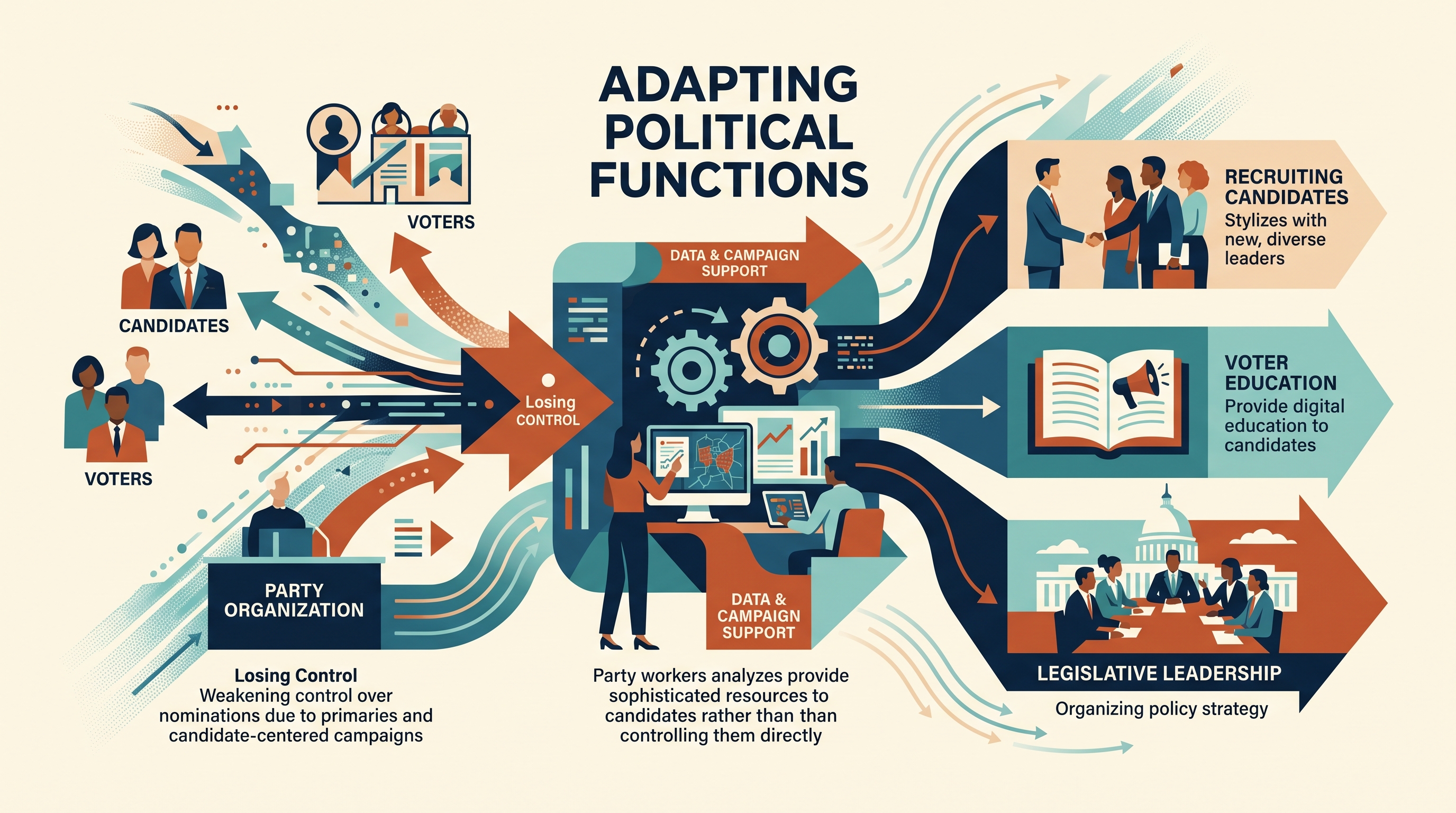
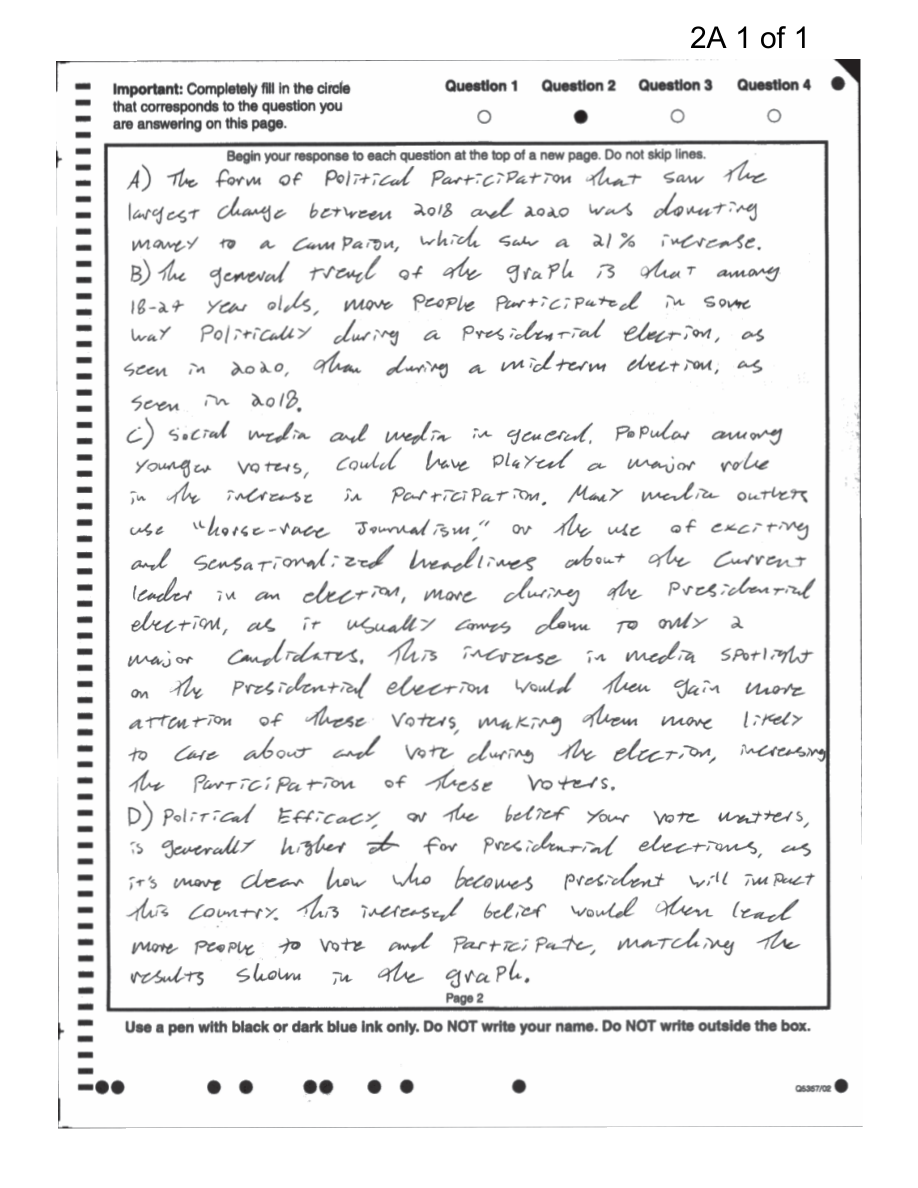
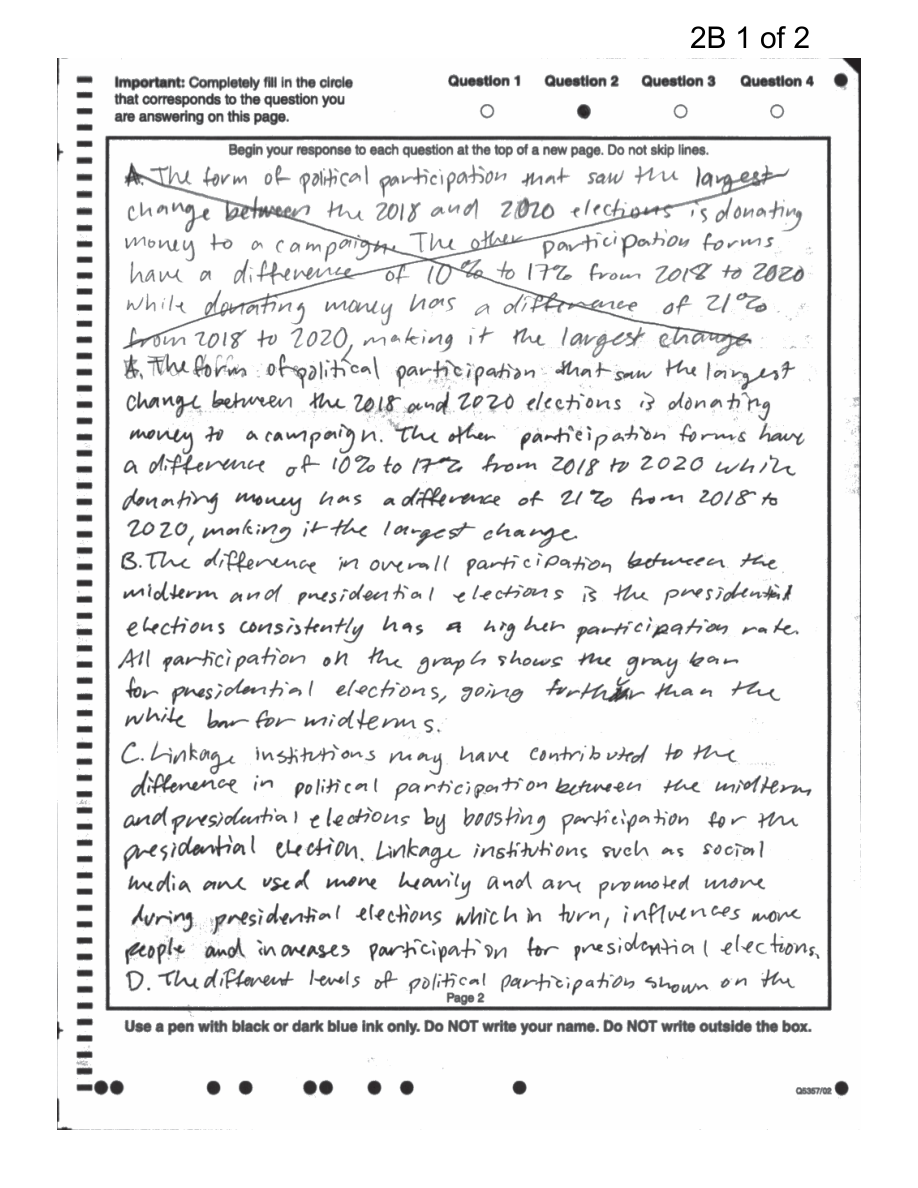
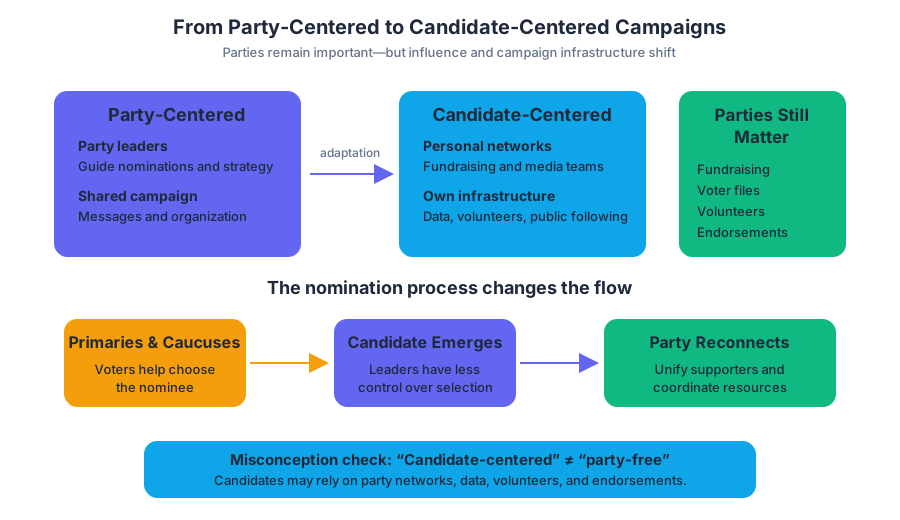
5.5 Third-Party Politics
Key concepts: Third-party candidates · Major-party dominance · Electoral competition · Vote splitting · Spoiler effect · Issue advocacy · Party adaptation · Influence on election outcomes
A candidate can lose an election while helping determine who wins it. Third-party candidates run outside the two major U.S. parties, and although they rarely win national elections, they can reshape electoral competition by attracting votes, changing the issues major parties discuss, and sometimes acting as spoilers.
5.5 Third-Party Politics
A candidate can lose an election while helping determine who wins it. Third-party candidates run outside the two major U.S. parties, and although they rarely win national elections, they can reshape electoral competition by attracting votes, changing the issues major parties discuss, and sometimes acting as spoilers.
Learning Objective LO 5.5.A: Explain how structural barriers affect third-party and independent candidate success.
The central puzzle is that third-party candidates may have meaningful political influence without winning office. The U.S. electoral system makes national victory difficult, but it does not make third-party campaigns irrelevant.
Why the U.S. system favors two major parties
Essential Knowledge EK 5.5.A.1: In comparison to proportional systems, winner-take-all voting districts serve as a structural barrier to third-party and independent candidate success. Winner-take-all voting advantages the two-party system in the U.S.
A winner-take-all system awards the available electoral prize to the candidate who receives the most votes, even if that candidate does not receive a majority. By contrast, a proportional system distributes representation roughly according to each party’s share of the vote. A party that earns $10%$ of the vote in a proportional system may receive about $10%$ of the seats; in a winner-take-all system, it may receive no seat at all.
In a winner-take-all system, voters often make a strategic calculation: Which candidate can actually finish first? Supporting a third-party candidate may express a genuine preference, but it may also seem unlikely to produce representation. This discourages voters from supporting smaller parties and makes donors, media organizations, and political activists more likely to concentrate on the two major parties.
Major-party dominance therefore results not only from voter preferences but also from electoral rules. Ballot-access requirements, debate standards, fundraising networks, and the distribution of electoral votes can reinforce the same pattern: the two major parties receive the greatest resources, while third-party and independent candidates must overcome larger organizational barriers.
Worked example: the spoiler effect
Imagine a winner-take-all presidential contest with three candidates:
| Candidate | Vote share |
|---|---|
| Major Party A | $46%$ |
| Major Party B | $44%$ |
| Third Party C | $10%$ |
Candidate A wins because $46%$ is the largest share. Now suppose Candidate C’s supporters were generally closer to Candidate B on the central issue. If Candidate C had not run, some of those $10%$ of voters might have supported Candidate B. Candidate B could then have received more than Candidate A and won the state’s entire winner-take-all electoral reward.
A spoiler effect occurs when a third-party candidate draws enough support from one major-party candidate’s likely voters to alter the election outcome. The third-party candidate does not need to win; splitting the vote can be enough. Vote splitting means that support for similar candidates is divided, allowing a different candidate with a larger single bloc of support to prevail.
The spoiler analysis must remain conditional. A third-party candidate’s presence does not automatically cause a major-party loss. To establish a spoiler effect, an analyst must connect the third-party vote to the margin between the major-party candidates and explain how a different distribution of those votes could change the result.
Influence without winning
Essential Knowledge EK 5.5.A.2: The incorporation of third-party agendas into platforms of major political parties serves as a barrier to third-party and independent candidate success.
Third parties can practice issue advocacy: using a campaign to bring public attention to an issue, even when winning office is unlikely. If a third-party candidate makes an issue electorally visible, a major party may later adopt part or all of that candidate’s position to attract those voters.
This creates a political paradox. A third party may succeed at changing the policy conversation, but that success can reduce its future electoral distinctiveness. Once a major party incorporates the third party’s agenda into its platform, voters may choose the major party because it appears more capable of winning. The third party’s ideas gain visibility while the third party itself loses some of its reason for existing as a separate electoral choice.
Misconception check
Misconception: “If a third-party candidate does not win, the campaign had no effect.” The candidate may influence the election by splitting votes, force major parties to address neglected issues, or encourage a major party to revise its platform. Electoral success and political influence are different outcomes.
Skill connection — Data Analysis 3.D: Explain what the data implies or illustrates about political principles, institutions, processes, policies, and behaviors.
For a data question, do more than identify that a third-party candidate received votes. Explain the political implication: a noticeable third-party vote in a close winner-take-all contest may illustrate a potential spoiler effect, while strong support in a noncompetitive contest may show issue advocacy without clear evidence that the third party changed the winner.
Retrieval check: In a winner-take-all election, Candidate A receives $48%$, Candidate B receives $45%$, and Candidate C receives $7%$. What additional evidence would be needed to argue that Candidate C acted as a spoiler, rather than merely participating in the election?

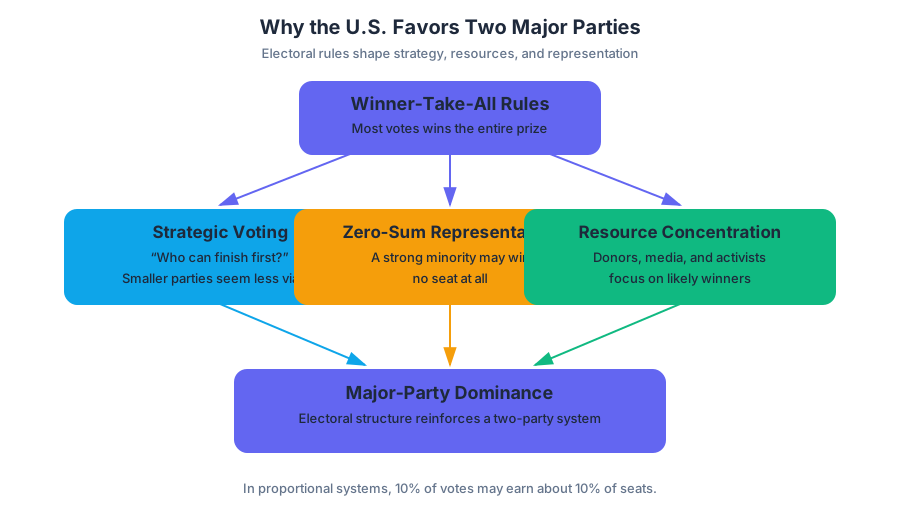
5.6 Interest Groups Influencing Policymaking
Key concepts: Interest groups and policymaking · Lobbying · Drafting legislation · Mobilizing members to apply pressure · Working with legislators · Interest-group influence on elections · Variation in interest-group resources · Large memberships and member mobilization · Financial resources and access to policymakers · Collective action and the influence of organized groups
A policy rarely moves from public concern to government action by itself. Interest groups organize people or resources around a shared policy goal and attempt to influence voters, officeholders, government agencies, and sometimes courts.
5.6 Interest Groups Influencing Policymaking
A policy rarely moves from public concern to government action by itself. Interest groups organize people or resources around a shared policy goal and attempt to influence voters, officeholders, government agencies, and sometimes courts.
Investigative question: How can a group that does not hold public office nevertheless shape elections and public policy?
The influence pipeline
Interest groups influence policymaking through several connected strategies. The process is not a single “lobbying” conversation; it is a chain of activities that can begin with public education and continue through legislation, implementation, and judicial review.
| Stage | What an interest group may do | Intended effect |
|---|---|---|
| Build support | Educate voters and officeholders | Make an issue visible and persuasive |
| Develop policy | Draft proposed legislation | Give lawmakers ready-to-use policy language |
| Apply pressure | Mobilize members through calls, letters, meetings, or public campaigns | Raise the political cost of ignoring the group |
| Work with government | Lobby legislators and government agencies | Shape laws, regulations, and implementation |
| Influence elections | Use memberships and financial resources | Support favorable candidates or policy positions |
| Influence courts | File an amicus curiae brief, or “friend of the court” brief | Supply information and arguments for justices considering a case |
Lobbying is more than persuasion
Lobbying is organized communication intended to influence government decisions. A lobbyist may meet with a legislator, provide technical information, suggest amendments, or explain how a proposed rule would affect the group’s members.
Interest groups also draft legislation. This does not mean that legislators surrender their constitutional role. Rather, a group may possess specialized knowledge, legal staff, or policy language that helps lawmakers construct a bill. The legislator still decides whether to introduce, revise, support, or oppose the proposal.
Groups can also mobilize their members. A large membership gives an organization potential political reach, but membership matters most when people actually respond to messages, contact officials, attend meetings, donate, or vote. Mobilization converts a group’s size into visible political pressure.
Unequal resources produce unequal access
LO 5.6.B asks students to explain how differences in interest-group types and resources affect influence over elections and policymaking. EK 5.6.B.1 emphasizes that resources are unequal: groups with large memberships, strong member mobilization, and substantial financial reserves generally have greater access and influence.
A group such as AARP illustrates the potential strength of a large membership. Its members can be mobilized around policies affecting older Americans, while its organizational resources can support communication with policymakers. By contrast, a group with a narrow or poorly organized membership may struggle to gain sustained attention even when its policy argument is strong.
This inequality creates a central democratic tension. Interest groups can bring specialized knowledge and many voices into policymaking, but access is not distributed evenly. A policymaker may hear from groups that can afford professional staff, maintain long-term relationships, or quickly mobilize constituents more often than from less-resourced communities.
Parties, networks, and policymaking
Interest groups do not operate only through direct contact with individual legislators. They may work within party coalitions, joining other organizations that share a broad political outlook. They may also participate in iron triangles and issue networks—relationships connecting interest groups, congressional committees, bureaucratic agencies, and other policy actors.
An iron triangle tends to involve a relatively stable, mutually supportive relationship among a congressional committee, a government agency, and an interest group. An issue network is usually broader and less fixed, bringing together multiple groups, experts, officials, and advocates around a policy issue. Both mechanisms help groups influence policy across party coalitions.
Worked example: subsidies and tax policy
Consider tobacco subsidies. Tobacco-related interests can use lobbying, policy expertise, member or producer networks, and political resources to encourage policies favorable to their industry. The example demonstrates influence on policymaking: the group need not control government directly; it must persuade or pressure decision makers at relevant stages.
Tax cuts enacted under George W. Bush provide another example of interest-group influence. Groups favoring lower taxes could support candidates, communicate with lawmakers, mobilize members, and provide arguments for tax legislation. The example does not prove that one group alone caused the policy. It shows how organized interests can participate in a larger coalition influencing elected officials and policy outcomes.
Collective action and democratic participation
Mancur Olson’s The Logic of Collective Action: Public Goods and the Theory of Groups (1965) examines why people may fail to participate even when they would benefit from a group’s success. A public good is a benefit available broadly, including to people who did not help produce it. This creates a free-rider problem: individuals may prefer to let others do the organizing.
E. E. Schattschneider’s The Semisovereign People: A Realist’s View of Democracy in America (1960) examines participation and influence in American democracy. Together, Olson and Schattschneider help frame two competing insights: organized groups can expand participation by bringing voices into politics, but the political system may still favor groups able to overcome participation barriers and secure access.
Worked contextual example: the National Association of Home Builders
The National Association of Home Builders scenario illustrates an interest group taking action in an election or policymaking context. To analyze it, trace the mechanism rather than merely naming the group:
- Identify the group’s policy interest.
- Identify its resource—membership, money, expertise, or organizational access.
- Identify its action—such as lobbying, mobilizing members, working with legislators, or influencing elections.
- Explain how that action could affect government decisions.
This is the difference between identification and explanation. “The group lobbied” identifies a strategy; “the group used its resources to pressure lawmakers, increasing the political cost of rejecting its preferred policy” explains influence.
AP skills in action
This topic most directly develops CON-1 Concept Application, applying interest-group concepts to a new scenario; DAT-1 Data Analysis, if membership, spending, polling, or election data are provided; SRC-1 Source Analysis, when interpreting a group’s statement or political document; and ARG-1 Argumentation, when evaluating whether interest-group influence strengthens or weakens representative democracy. SCOTUS-1 SCOTUS Application may apply when an amicus curiae brief or a relevant court dispute is presented.
Named misconception check: Interest groups are not the same as political parties. Parties seek to win government office and organize broad electoral coalitions; interest groups seek to influence policy, elections, or implementation without primarily trying to control government through elected office.
Retrieval check: A well-funded group has few members, while a large-membership group has little money. Which group has the stronger potential influence, and why might the answer depend on whether policymakers value financial resources, specialized information, or visible member mobilization?
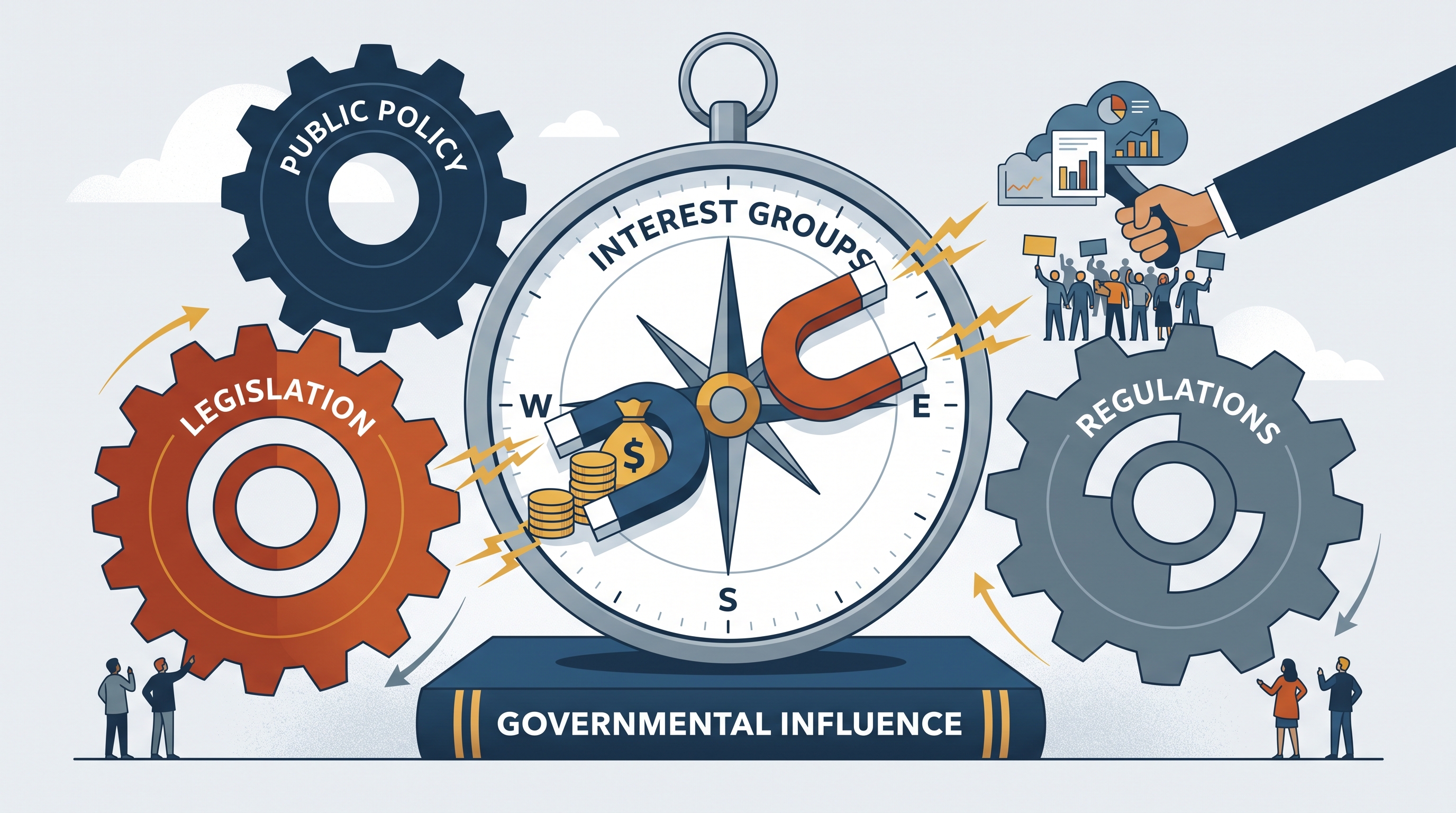
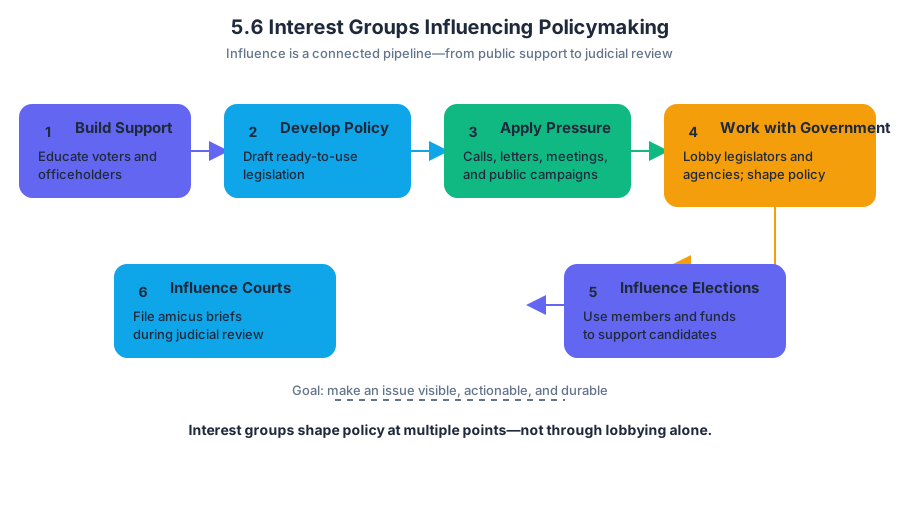
5.7 Groups Influencing Policy Outcomes
Key concepts: Groups influencing policy outcomes · Group membership · Dues-paying members · Selective benefits · Exclusive goods and services · Group funding · Group resources · Political influence · Elections · Political parties
A group’s political influence depends not only on the strength of its ideas but also on the resources it can organize, maintain, and deploy. Two groups may support opposite policies, yet the group with more members, reliable funding, specialized information, or stronger organizational capacity may have a greater…
5.7 Groups Influencing Policy Outcomes
A group’s political influence depends not only on the strength of its ideas but also on the resources it can organize, maintain, and deploy. Two groups may support opposite policies, yet the group with more members, reliable funding, specialized information, or stronger organizational capacity may have a greater ability to shape what government does.
The resource problem: why membership matters
Group membership means formally joining an organization that seeks to affect public policy or political outcomes. Membership can provide a group with money, volunteers, expertise, communication networks, and evidence that many people support its position. These resources make it easier for a group to contact policymakers, communicate with the public, and remain active over time.
The central organizational difficulty is the free-rider problem. A free rider benefits from an interest group’s success without joining the group or contributing financially. For example, if an organization successfully supports cleaner air regulations, many people may enjoy cleaner air even though they never paid dues or volunteered.
This creates a paradox: the benefits of political action may be widely shared, but the costs of organizing that action fall on a smaller number of participants. If too many people remain free riders, the group may lack the funding and personnel necessary to sustain its influence.
Selective benefits: turning shared goals into organized support
Groups address free riding by offering selective benefits, which are goods or services available only to members. Examples include magazines, discounts, specialized information, legal assistance, professional training, or access to members-only events. Unlike a general policy victory, a selective benefit can be withheld from people who do not officially join.
Dues-paying members therefore receive two kinds of returns: they may benefit from the group’s broader policy goals, and they receive an exclusive benefit immediately because they joined. This gives people a practical incentive to contribute rather than simply wait for others to pay for the group’s work.
| Organizational resource | How it can affect policy influence |
|---|---|
| Dues-paying members | Provide recurring funding and demonstrate organized support |
| Selective benefits | Encourage people to join and reduce free riding |
| Specialized information | Help a group make credible policy arguments |
| Volunteers and staff | Sustain communication, research, and advocacy |
| Funding | Supports offices, outreach, research, and political activity |
A group’s resources affect its ability to maintain influence, but resources do not guarantee success. Policymakers may face competing actors, constitutional limits, public opposition, or electoral pressure. Influence is best understood as capacity: resources increase what a group can do, while political circumstances affect whether those efforts produce a particular policy outcome.
Worked contextual example: Club for Growth
Consider the illustrative example of the Club for Growth supporting limits on taxation. The group’s policy position alone does not create influence. To affect outcomes, it must attract members who support that position, collect dues or other funding, produce specialized information, communicate with policymakers and voters, and maintain its activity across political campaigns and policy debates.
The causal chain is:
$$ \text{Selective benefits} \rightarrow \text{More members} \rightarrow \text{More dues and organizational resources} \rightarrow \text{Greater capacity to influence policy} $$
The example does not mean that every dues-paying member personally determines tax policy. It shows how membership incentives can transform a broad policy preference into an organized institution with resources capable of sustaining political action.
Elections, parties, and policy shifts
Interest groups operate within larger political processes. Elections and political parties are related to major policy shifts or initiatives, and changes in electoral coalitions can alter which groups receive access or which policies become feasible. In some cases, these changes produce political realignments, meaning lasting shifts in the voting constituencies that support political parties.
A group may therefore gain or lose influence when party coalitions change, even if its membership and funding remain stable. Policy outcomes reflect interaction among organized groups, elected officials, political parties, voters, and the institutional rules governing decision-making.
Essential Knowledge connection — EK 5.7.A.2 and EK 5.7.A.3: Resources and membership incentives help groups sustain influence, while elections and political parties can contribute to major policy shifts and, occasionally, political realignments.
AP skill: Concept Application (1.E)
Concept Application (1.E) requires explaining how political principles, institutions, processes, policies, and behaviors apply to different scenarios in context. For a scenario about a group, do not merely identify “interest-group influence.” Explain the mechanism: identify the group’s resource, show how it supports organized action, and connect that action to a possible policy outcome.
Named misconception check — “A large number of beneficiaries automatically creates a large interest group.” False. A policy may benefit millions of people, but those people may have little incentive to join or pay dues. Selective benefits help solve this problem by giving individuals an exclusive reason to become official members.
Retrieval check: A national organization provides members with a monthly policy magazine and discounted legal services. What problem are these benefits designed to reduce, and how could the resulting increase in dues-paying members affect the organization’s policy influence? Answer: They reduce free riding by giving people exclusive incentives to join. More dues-paying members can increase funding, staff capacity, information production, and sustained political activity.
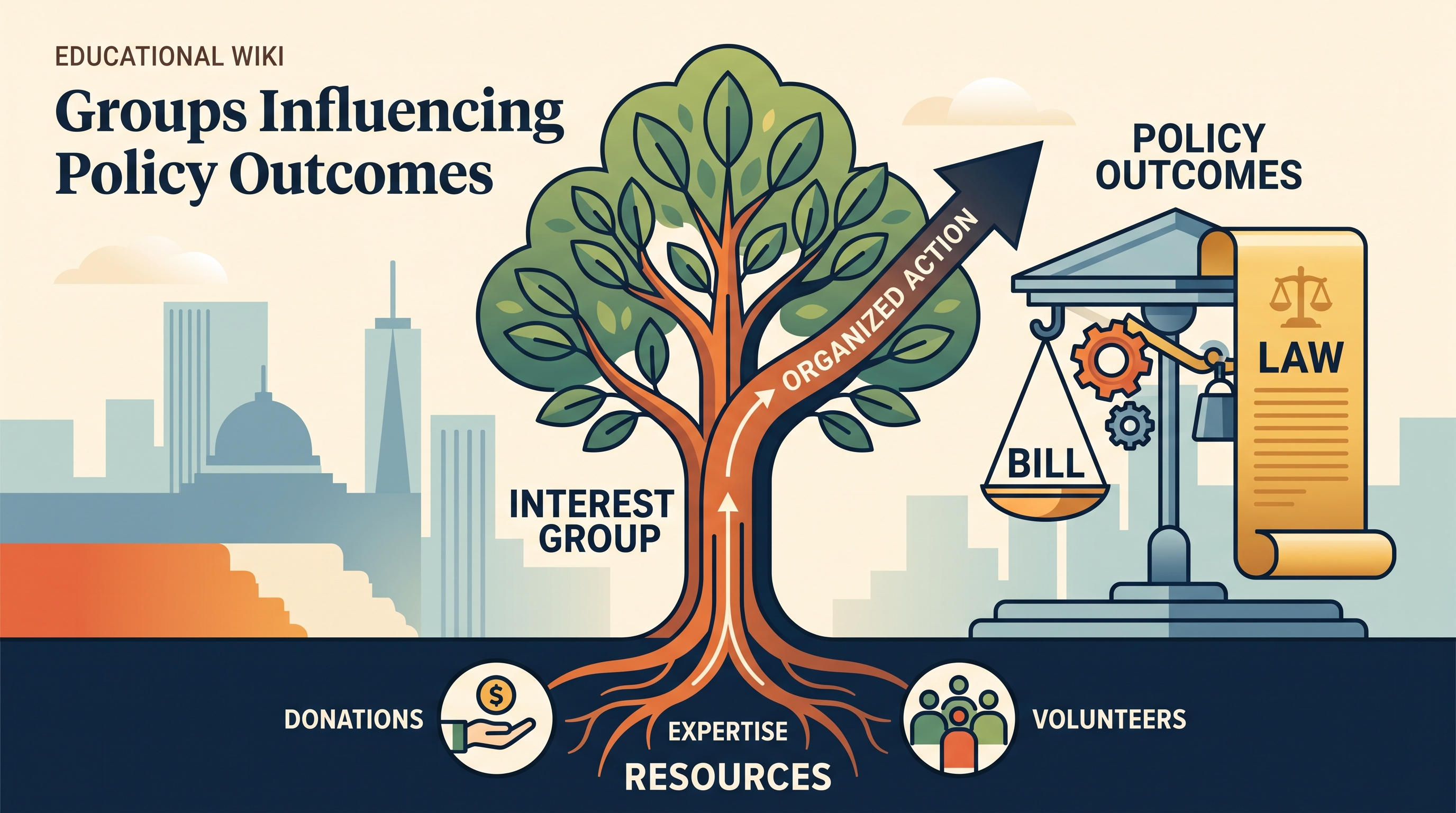
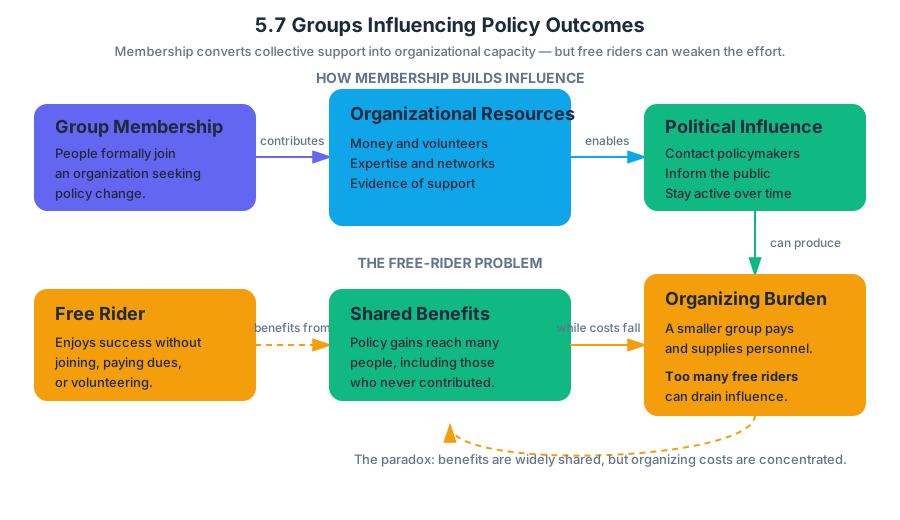
5.8 Electing a President
A presidential election is not one nationwide vote for the candidate with the most individual votes; it is a state-based process in which voters help choose members of the Electoral College, the body that formally selects the president.
5.8 Electing a President
A presidential election is not one nationwide vote for the candidate with the most individual votes; it is a state-based process in which voters help choose members of the Electoral College, the body that formally selects the president. The central question is therefore: How can a candidate win the presidency without winning the national popular vote?
CED alignment: Topic 5.8 Electing a President; assessed through Skill 5.A: Make a claim. The topic connects constitutional design, party nomination, campaign strategy, federalism, and the difference between popular support and institutional victory.
The election has two linked stages
Presidential elections combine a nomination process with a general election. First, political parties select nominees through state-level primaries and caucuses. Then, the party nominees compete in the general election, where the Electoral College determines the outcome.
A simplified sequence looks like this:
- Primaries and caucuses: voters or party participants help choose delegates.
- National party conventions: delegates formally nominate a presidential and vice-presidential ticket.
- General election: voters in each state select a presidential ticket.
- Electoral vote allocation: each state awards electoral votes according to its election rules.
- Electoral College meeting: electors cast the formal votes.
- Congressional counting: Congress counts the electoral votes.
- Inauguration: the candidate who receives the required electoral majority becomes president.
Primaries, caucuses, and conventions
A primary is a state election in which voters choose among candidates or select delegates pledged to those candidates. A caucus is a party meeting in which participants discuss candidates and express their preferences through a party-controlled process. States may use open, closed, or partly open primary systems, so the people eligible to participate can differ from one state to another.
The process is decentralized: states set many of their own election rules, while national parties establish broader requirements. Early contests receive disproportionate attention because they can generate media coverage, donations, endorsements, and a perception of momentum. A candidate who performs poorly may lose financial support even before most states vote.
At the national convention, delegates formally nominate the party’s presidential candidate. The convention also presents the party platform and confirms the ticket, but modern conventions usually ratify a contest whose decisive stages occurred during the state contests.
The Electoral College
The Electoral College is the constitutional mechanism through which the president is elected. Each state receives electoral votes equal to its total representation in Congress: its number of representatives in the House plus its two senators. The District of Columbia receives electoral votes under the Twenty-Third Amendment, although it is not a state.
Most states use a winner-take-all rule: the candidate who wins the state’s popular vote receives nearly all of that state’s electoral votes. Maine and Nebraska use a district-based variation, awarding some electors by congressional district and others based on the statewide result.
The system rewards geographic distribution rather than simply national vote totals. A candidate can win large margins in some states but receive no additional electoral votes for votes beyond what was needed to win those states. Meanwhile, a candidate may narrowly win several competitive states and collect their entire electoral-vote totals.
Worked example: popular votes versus electoral votes
Imagine a country with three states:
| State | Electoral votes | Candidate A | Candidate B | Winner |
|---|---|---|---|---|
| Redwood | 20 | 60% | 40% | A |
| Lakeside | 18 | 49% | 51% | B |
| Prairie | 12 | 49% | 51% | B |
Candidate A wins Redwood by a large margin and receives $20$ electoral votes. Candidate B wins Lakeside and Prairie narrowly and receives $30$ electoral votes. Candidate A may have many more individual votes in Redwood, but Candidate B wins the presidency because the Electoral College result is $30$ to $20$.
This is why campaigns focus heavily on battleground states, states in which the major-party candidates have relatively similar levels of support. A candidate has little incentive to spend additional resources in a state that is safely secured or nearly impossible to win, while a narrow shift in a competitive state can change the national result.
Making an AP argument
For Skill 5.A: Make a claim, an effective claim must answer the prompt directly and establish a defensible position. For example:
The Electoral College encourages presidential candidates to prioritize competitive states because winner-take-all allocation converts narrow state victories into large electoral advantages.
That claim is stronger than “the Electoral College affects campaigns” because it identifies the mechanism: winner-take-all allocation. Evidence should then identify a campaign pattern, and reasoning should explain why concentrating resources in competitive states follows from that institutional rule.
Misconception check
Misconception: “The candidate with the most votes nationwide automatically wins.”
The national popular vote measures total individual votes across all states, but the presidency is decided through electoral votes. The two totals often point in the same direction, but they measure different things: one aggregates voters nationally, while the other aggregates state-based electoral outcomes.
Retrieval check
A candidate wins a state by $50.4%$ to $49.6%$ and receives all of its electoral votes. Which feature of presidential elections explains this result, and why does it make the state strategically important?
Answer: The state’s winner-take-all allocation gives the victor the full electoral-vote bloc despite the narrow margin. If the state is competitive, a small change in voter preference can transfer all of those electoral votes to the other candidate, making it a battleground state.
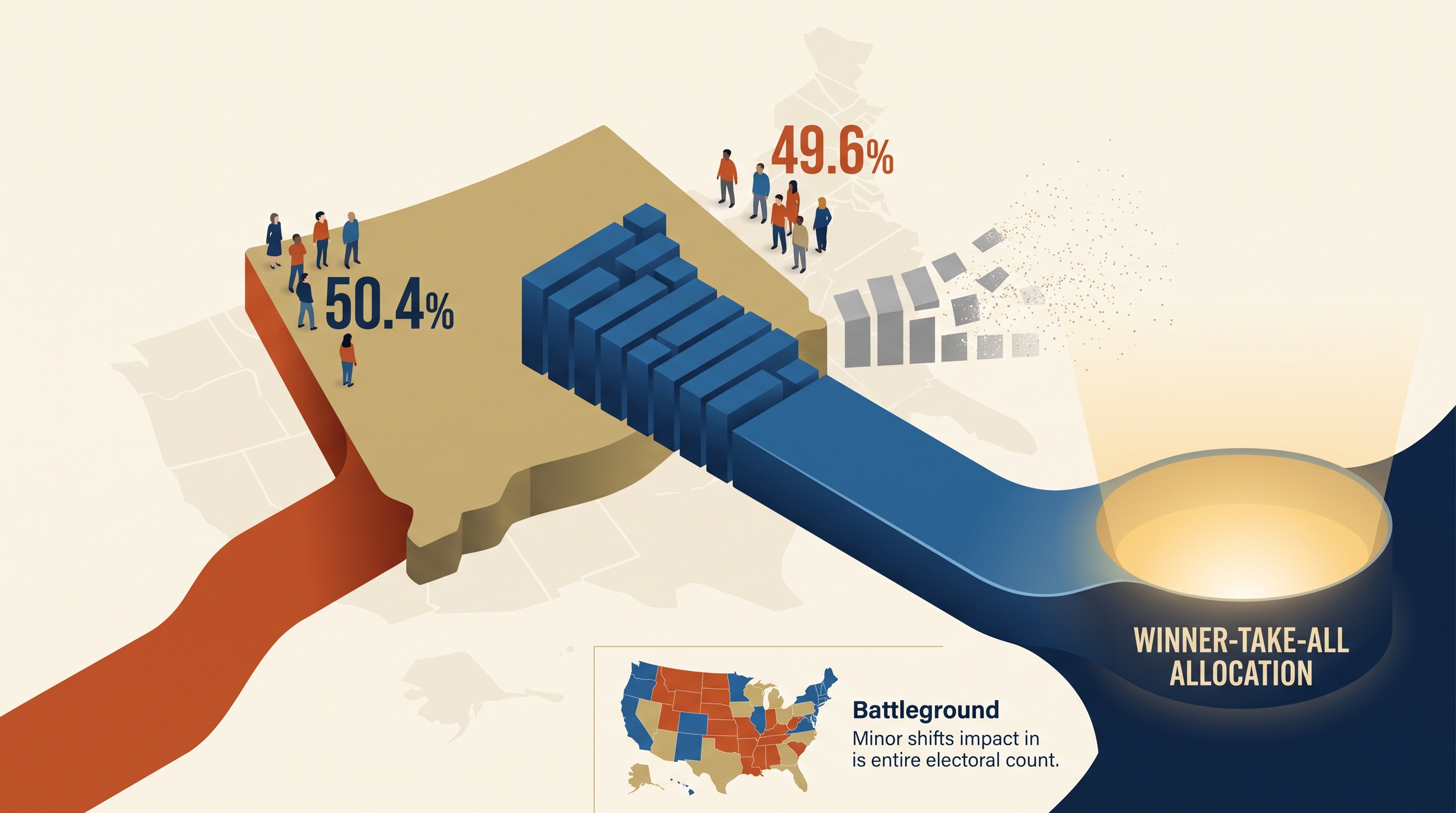
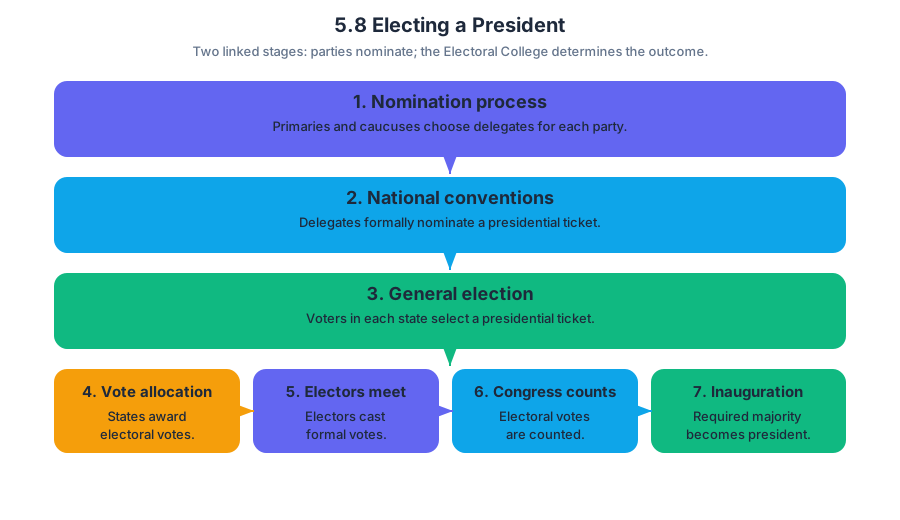
5.9 Congressional Elections
A congressional election can change national policy even when the president remains in office, because voters choose the legislators who write, amend, fund, and investigate federal policy.
5.9 Congressional Elections
A congressional election can change national policy even when the president remains in office, because voters choose the legislators who write, amend, fund, and investigate federal policy. The central question is not simply who wins a district or state, but how electoral rules, district boundaries, incumbency, turnout, and national political conditions shape the composition of Congress.
Investigative question: Why do congressional elections often produce a different political result from a presidential election?
What makes congressional elections distinctive?
Congressional elections select members of the House of Representatives and the Senate, but the two contests operate differently. House members run in individual geographic districts every two years. Senators represent entire states and serve six-year terms, with approximately one-third of Senate seats contested in any one election cycle.
House elections are therefore highly local: district boundaries, the incumbent’s record, local economic conditions, and the partisan balance of the district matter greatly. Senate elections are statewide and usually involve larger, more expensive campaigns in which national issues and the candidates’ public profiles can matter more.
The timing of congressional elections also matters. Midterm elections occur halfway through a president’s four-year term. Because no presidential candidate appears at the top of the ballot, turnout is often lower than in presidential years, and the president’s party commonly loses congressional seats. This pattern is not automatic, but it reflects weaker participation among some groups and the tendency of voters to use midterms to express approval or disapproval of the president.
Incumbency and the electoral advantage
An incumbent is the officeholder seeking reelection. Incumbents often possess an incumbency advantage because they have greater name recognition, established fundraising networks, experience with constituent service, and a record that can be presented to voters. House incumbents may also benefit from districts designed to be politically safe for their party.
This advantage does not make reelection guaranteed. Scandals, unpopular votes, strong challengers, major national events, or changes in district boundaries can weaken it. An open-seat election, in which no incumbent is running, is usually more competitive because neither candidate begins with the same institutional advantages.
Misconception check: Incumbency advantage does not mean voters automatically support incumbents. It means incumbents begin with structural benefits that challengers must overcome.
District boundaries, reapportionment, and redistricting
Every ten years, the national census supplies population data used for reapportionment, the redistribution of House seats among the states. A state that gains population may gain House seats; a state that grows more slowly may lose seats. After reapportionment, states redraw district boundaries through redistricting.
When political actors draw boundaries to advantage a party, incumbent, or group of voters, the practice may become gerrymandering. Packing concentrates opposing voters into a small number of districts, while cracking divides them among several districts so that they form a minority in each. These techniques can produce many safe seats and reduce the number of genuinely competitive general elections.
The Supreme Court case Shaw v. Reno (1993) established that racial classifications in redistricting can violate the Equal Protection Clause when race becomes the predominant factor without sufficient constitutional justification. The case does not prohibit every district that considers race; it requires courts to scrutinize districts whose shapes and design reveal excessive racial sorting.
Congressional elections and policymaking
Electoral outcomes influence policymaking through party control of Congress. If one party controls both chambers, it may find it easier to organize committees, schedule legislation, and pass bills. If control is divided between parties, bargaining, oversight, and gridlock become more likely. Even when the president’s party loses seats, the president may still negotiate with the new congressional majority to advance legislation.
Congressional elections can also produce split-ticket voting, in which a voter supports candidates from different parties for different offices. For example, a voter might choose one party’s presidential candidate but support the other party’s House member because of the local candidate’s record or district concerns. Split-ticket voting shows why congressional elections cannot be predicted solely from presidential results.
Worked contextual example
Imagine that a president’s party wins the presidency but loses several House seats in the same election. The president’s party still controls the executive branch, but the opposing party now holds a House majority.
Reason through the consequences:
- The new House majority selects its speaker, controls committee leadership, and gains greater power over the legislative agenda.
- It may refuse to advance the president’s preferred bills or attach conditions to them.
- It can conduct investigations and use oversight hearings to examine executive-branch actions.
- The president may veto bills passed by Congress, creating a policy stalemate unless the House and Senate override the veto with sufficient votes.
- The election therefore changes policymaking even though the presidency has not changed hands.
This example illustrates Skill 5.B: Argumentation—Support an argument using specific and relevant evidence. A strong claim would connect the election result to institutional consequences: The congressional election increases the opposition party’s influence because control of the House gives it agenda-setting and oversight authority. The evidence must identify those powers, not merely state that the election was “important.”
Retrieval check
A state gains population after the census, receives additional House seats, and redraws its districts. Identify the process that redistributed seats, the process that redrew boundaries, and one way a party could manipulate those boundaries. Then explain why a midterm election can produce a different congressional majority from the president’s party.
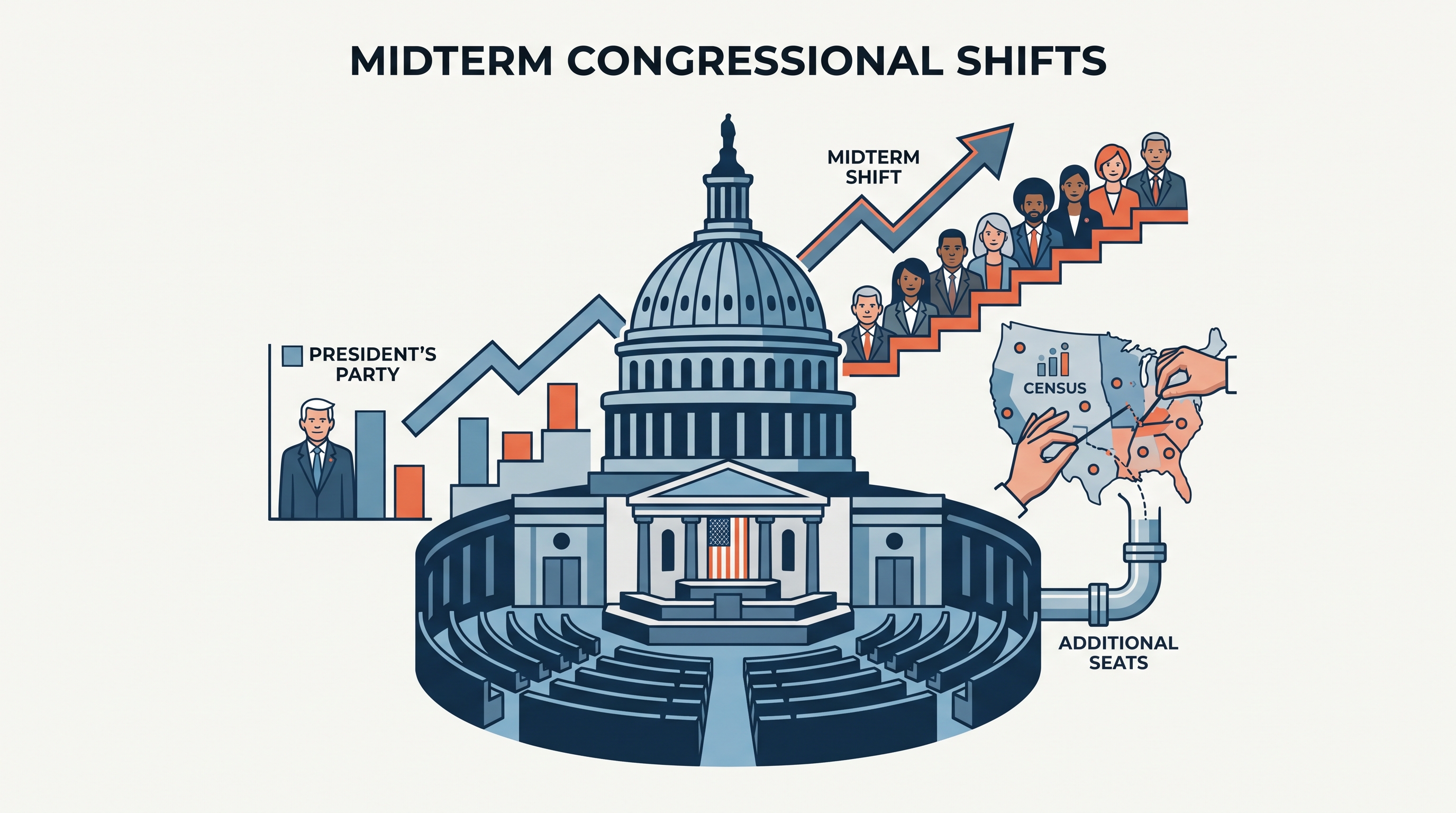
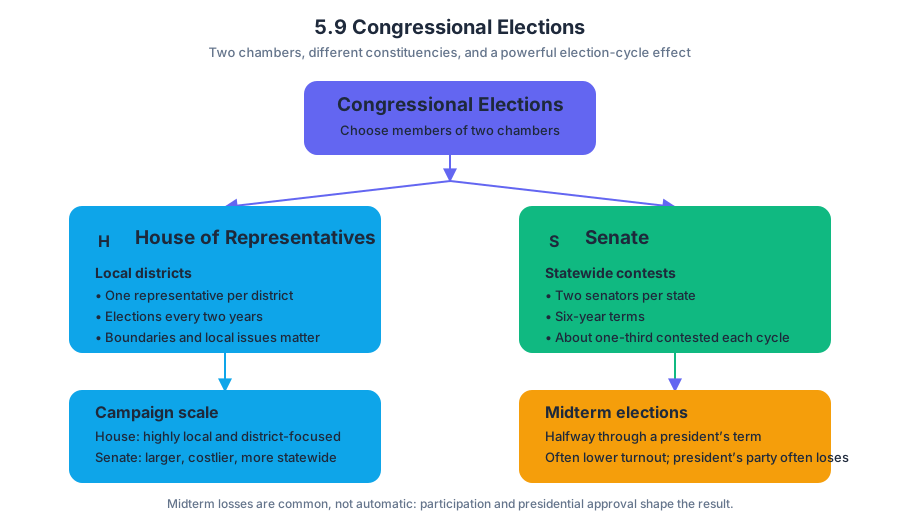
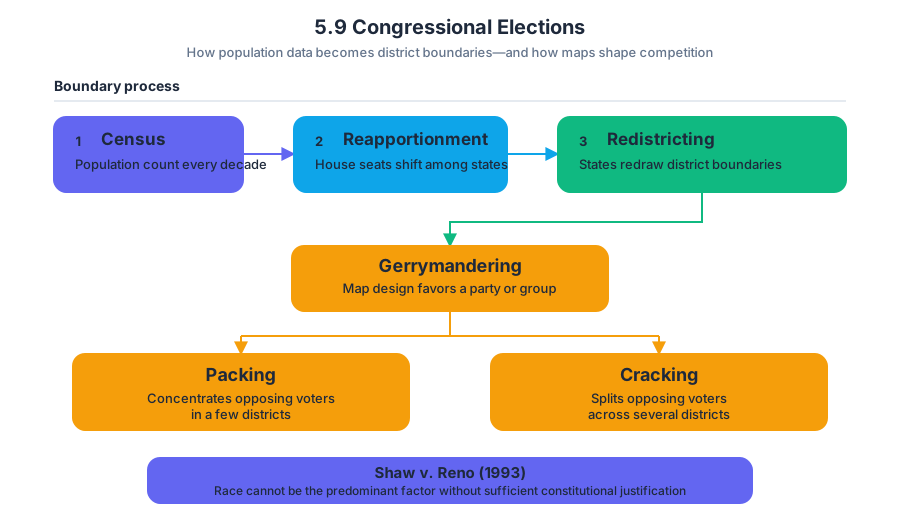
5.10 Modern Campaigns
Modern campaigns are increasingly candidate-centered: voters often respond more to an individual candidate’s image, message, personal biography, and media strategy than to a detailed party platform.
5.10 Modern Campaigns
Modern campaigns are increasingly candidate-centered: voters often respond more to an individual candidate’s image, message, personal biography, and media strategy than to a detailed party platform. Technology has intensified this shift by allowing candidates to communicate directly with voters, target particular groups, and react rapidly to political events.
The central question is not simply who wins an election? It is: How do modern campaigns organize people, messages, money, and media to persuade voters and shape political behavior?
From party-centered politics to candidate-centered campaigns
In a party-centered campaign, the political party supplies much of the candidate’s identity, organization, platform, and campaign structure. The party label helps voters predict what the candidate stands for. In a candidate-centered campaign, the individual candidate becomes the main political brand. The campaign emphasizes personal leadership, biography, public image, and a small number of memorable issues.
This change does not mean that parties have disappeared. Parties still provide fundraising networks, voter lists, volunteers, endorsements, policy ideas, and election infrastructure. Instead, the balance of attention has shifted: the party remains an important organizational engine, while the candidate often controls the public-facing message.
| Campaign emphasis | Party-centered campaign | Candidate-centered campaign |
|---|---|---|
| Main political identity | Party platform and label | Candidate’s image and message |
| Communication | Party organizations and traditional media | Candidate-controlled and targeted media |
| Voter appeal | Broad party coalition | Personal biography, issues, and targeted groups |
| Major risk | Party brand may become unpopular | Candidate may lack durable party support |
Why technology changes campaigns
Modern communication reduces the distance between candidates and voters. Television made visual performance and campaign advertising central to elections; websites and email allowed campaigns to distribute information quickly; social media now permits candidates to publish messages immediately, mobilize supporters, respond to opponents, and encourage participation without waiting for journalists or party organizations.
Technology also makes campaigns more precisely targeted. A campaign may send different messages to younger voters, suburban voters, rural voters, or occasional voters. The same candidate can therefore present different issue emphases to different audiences while maintaining a broader public identity.
This produces a political trade-off. Direct communication can increase participation by making it easier to volunteer, donate, attend events, or share political information. However, highly targeted communication can fragment the electorate: different voters may encounter different claims, priorities, and interpretations of the same campaign.
Campaigns as persuasion and mobilization systems
A campaign performs two connected tasks. Persuasion attempts to change a voter’s preference, while mobilization attempts to motivate a person who is already sympathetic to actually participate. A campaign message praising a candidate’s education policy may persuade an undecided voter; a text reminding a supporter to vote early is primarily mobilization.
Campaigns also use polling, voter-contact records, public events, advertising, debates, endorsements, and social-media communication to decide where to concentrate limited attention. A candidate does not need to communicate equally with every voter at every moment. Campaign strategy usually prioritizes voters, geographic areas, and issues that could affect the result.
Worked contextual example: evaluating a campaign strategy
Imagine Candidate Rivera is running a statewide campaign. Rivera begins with a broad television advertisement describing experience in public service. The campaign then uses digital messages: one highlights transportation for urban voters, another emphasizes agricultural markets for rural voters, and a third urges previously supportive young voters to register and participate.
Step 1: Identify the campaign model. The strategy is primarily candidate-centered because Rivera’s personal experience is the central brand, even though the campaign adapts its issue messages for different audiences.
Step 2: Explain the role of technology. Digital communication allows the campaign to send targeted messages quickly and to distinguish persuasion from mobilization. The transportation message may persuade; the registration reminder primarily mobilizes.
Step 3: Analyze the consequence. The strategy may increase efficiency because each audience receives a relevant appeal. Its weakness is that voters may receive unequal or inconsistent information, making it harder for the public to evaluate the candidate using a shared set of claims.
Step 4: Construct an argument. A defensible claim would be: Modern technology strengthens candidate-centered campaigns because it allows candidates to bypass traditional intermediaries and tailor appeals to specific voters, although that same targeting can make public accountability more difficult.
Skill 5.C: Use reasoning to organize and analyze evidence
Topic 5.10 is assessed through Skill 5.C: Use reasoning to organize and analyze evidence, explaining its significance to justify an argument or claim/thesis. This skill requires more than listing facts. The response must connect evidence to a claim and explain why that evidence proves, supports, qualifies, or complicates the claim.
A strong chain of reasoning looks like this:
Claim → Evidence → Explanation of significance → Qualification or consequence
For example, “campaigns use social media” is evidence but not yet analysis. The reasoning appears when the writer explains that direct, targeted communication can increase mobilization and reduce dependence on party organizations, thereby strengthening the candidate’s independent public identity.
Misconception check
Misconception: Technology automatically makes elections more democratic. Technology can lower communication barriers and expand participation, but access, misinformation, selective targeting, and unequal digital engagement can also distort political understanding. Its political effect depends on how campaigns and voters use it.
Retrieval check
A campaign sends one message to undecided voters and a different reminder to loyal supporters. Identify which message is primarily persuasion, which is primarily mobilization, and explain one way this strategy reflects a candidate-centered campaign. Then write one sentence explaining the significance of the evidence, as required by Skill 5.C.
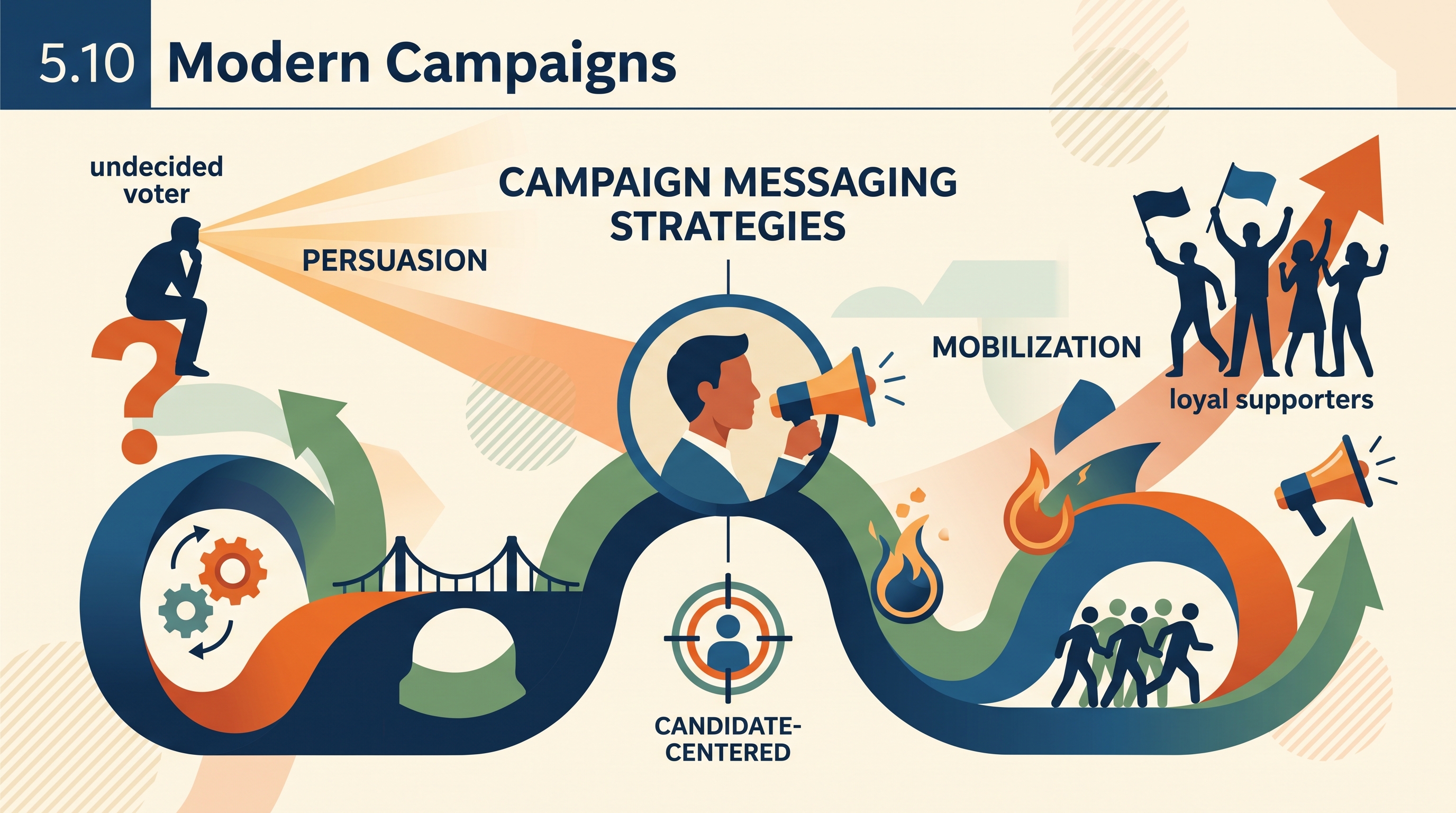
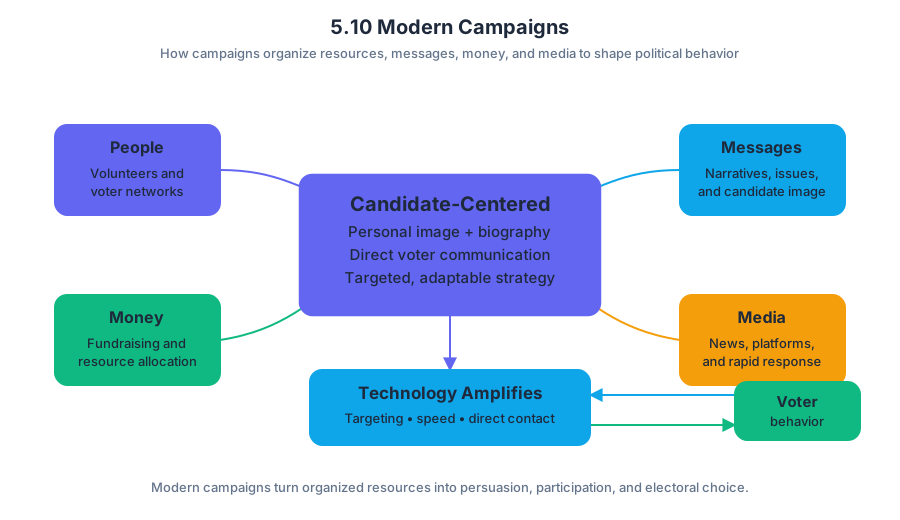
5.11 Campaign Finance
A candidate may receive a donation, while an outside organization may spend millions supporting that candidate without coordinating with the campaign. The constitutional question is not simply who spent the money, but whether the spending counts as protected political expression and whether government may regulate it.
5.11 Campaign Finance
A candidate may receive a donation, while an outside organization may spend millions supporting that candidate without coordinating with the campaign. The constitutional question is not simply who spent the money, but whether the spending counts as protected political expression and whether government may regulate it.
Campaign finance is the system of laws, institutions, and practices governing how political campaigns and political organizations raise and spend money. It shapes who can participate, how candidates communicate with voters, and how much influence wealthy individuals, corporations, unions, political parties, and organized interests may exercise.
Campaign-finance regulation attempts to balance two competing principles: protecting political participation and preventing corruption or its appearance.
The basic structure: contributions versus expenditures
A contribution is money given directly to a candidate, campaign committee, or political party. An expenditure is money spent to influence an election. The distinction matters because direct contributions create a closer relationship between the donor and the candidate, while independent expenditures are made without coordination with the candidate.
Consider a fictional Senate election. A local construction company gives Candidate Rivera’s campaign $20,000. That is a direct contribution and may be subject to legal limits and disclosure requirements. A separate organization spends $500,000 producing its own advertisement supporting Rivera, without consulting the campaign; that is an independent expenditure.
The second arrangement is constitutionally significant. If the organization coordinates its advertisement with Rivera’s campaign, the spending may be treated like an in-kind contribution. If it acts independently, the spending receives stronger First Amendment protection under modern campaign-finance doctrine.
Federal regulation and the Federal Election Commission
The Federal Election Commission, or FEC, is the federal agency responsible for administering and enforcing campaign-finance law. The Federal Election Campaign Act, or FECA, established the central federal framework for regulating contributions, requiring financial disclosure, and creating public-financing mechanisms.
The Bipartisan Campaign Reform Act of 2002, commonly called McCain-Feingold, attempted to limit the influence of unregulated “soft money” in federal elections. Soft money refers to funds that were not given directly to a specific candidate but could be used by political parties for activities affecting elections. The law also restricted certain election-related communications close to elections.
The regulatory challenge is persistent: when Congress closes one route for political spending, donors and organizations may search for another route. Money can move among candidate committees, party committees, political action committees, nonprofit organizations, and independent-expenditure groups.
PACs, Super PACs, and independent spending
A political action committee, or PAC, collects contributions and gives money to candidates or spends money to influence elections, subject to federal rules. A Super PAC may raise unlimited amounts from individuals, corporations, unions, and other organizations, but it may not contribute directly to candidates or coordinate its spending with their campaigns.
| Organization or activity | May contribute directly to a candidate? | May make independent expenditures? | Central limitation |
|---|---|---|---|
| Candidate campaign committee | Yes | Yes | Must follow contribution and disclosure rules |
| Traditional PAC | Yes, within limits | Yes | Contribution limits apply |
| Super PAC | No | Yes, without a spending cap | No coordination with candidates |
| Independent expenditure | Not itself an organization | Yes | Must remain independent |
This creates an important practical distinction. A Super PAC cannot hand Candidate Rivera a check for $500,000, but it can spend $500,000 on its own advertisement praising Rivera, provided the campaign does not direct or coordinate that spending.
Citizens United v. Federal Election Commission (2010)
In Citizens United v. Federal Election Commission (2010), the Supreme Court held that the government could not prohibit corporations and unions from making independent political expenditures. The decision treated independent political spending as a form of speech protected by the First Amendment.
The ruling did not allow corporations or unions to contribute unlimited money directly to candidates. Its key effect was to protect unlimited independent expenditures by organizations, helping create the legal environment in which Super PACs became powerful actors in elections.
Worked analysis: reading a campaign-finance graph
Suppose a graph shows the following independent expenditures in a House race:
- Year 1: $2 million
- Year 2: $8 million
- Year 3: $20 million
Using Skill 2.B — Describe the data presented in a graph, map, or visual representation, first state the pattern accurately: independent expenditures increased in every reported year, rising from $2 million to $20 million. Do not jump immediately to causation. The graph demonstrates a trend, but by itself it does not prove that Citizens United alone caused the increase; additional evidence would be needed to establish causation.
Misconception check
Misconception: “Citizens United allowed corporations to donate unlimited money directly to candidates.”
Correction: The decision protected independent expenditures by corporations and unions. Direct contributions to candidates remain subject to regulation. The legally decisive word is independent.
Retrieval check: A nonprofit spends $1 million supporting a presidential candidate after receiving advice from that candidate’s campaign. Is the spending independent? Explain why the coordination changes the legal analysis.
Answer: No. Coordination means the expenditure is not genuinely independent. It may therefore be treated as an in-kind contribution and regulated differently from spending made without campaign involvement.
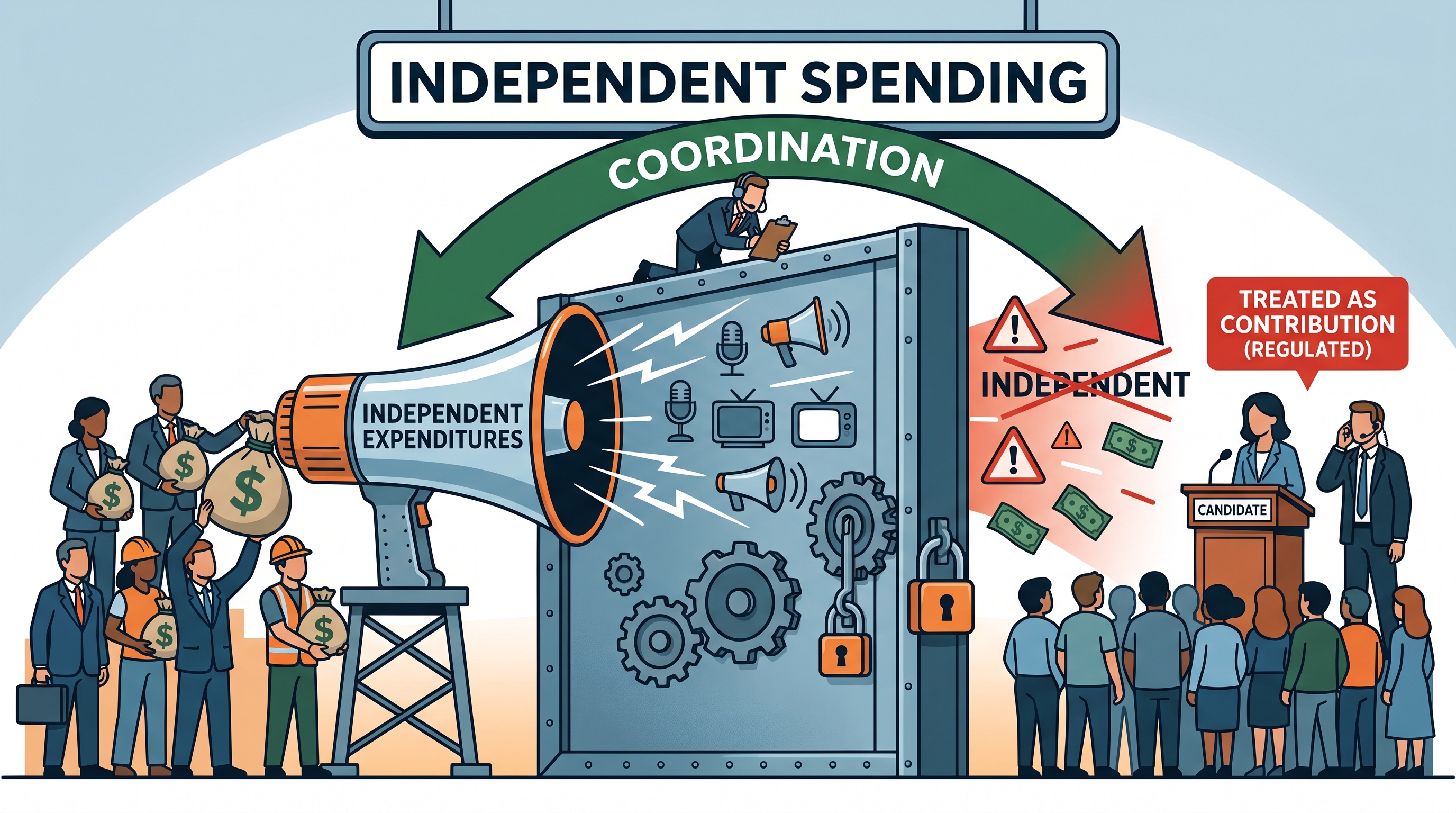
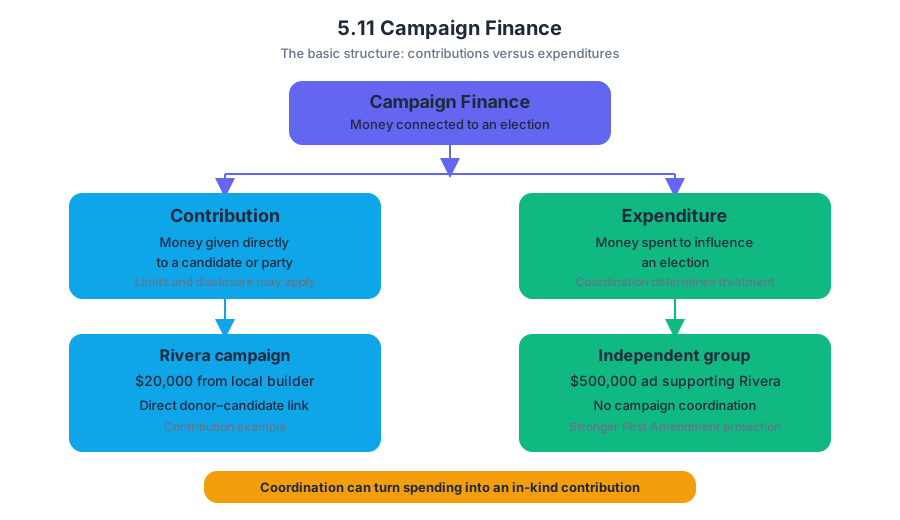
5.12 The Media
A news story can change an election without telling anyone how to vote: by deciding which problem becomes impossible to ignore. The media are communication channels—such as newspapers, television, radio, websites, and social-media platforms—that distribute political information and connect citizens to government.
5.12 The Media
A news story can change an election without telling anyone how to vote: by deciding which problem becomes impossible to ignore. The media are communication channels—such as newspapers, television, radio, websites, and social-media platforms—that distribute political information and connect citizens to government.
In American politics, the media function as a linkage institution, an organization that connects people to government by communicating public concerns to officials and reporting government actions back to the public. This makes the media important to participatory democracy, but it also creates risks when citizens receive incomplete, partisan, or unreliable information.
Key idea: The media do not merely report politics; by selecting, emphasizing, and framing information, they influence which political problems citizens notice and how citizens interpret them.
What the media do in the political process
Media influence operates through several connected mechanisms. Agenda setting occurs when media attention increases the public visibility of an issue. Framing occurs when coverage presents an issue through a particular interpretation—for example, describing a budget dispute as government waste, a tax burden, or a failure of public services. Gatekeeping occurs when editors, journalists, producers, or platform systems decide which events receive attention and which do not.
The media also provide a watchdog function by investigating public officials and exposing possible misconduct. In addition, media coverage can serve a political socialization function: repeated exposure to political arguments, symbols, and information can shape citizens’ beliefs about government, parties, and public policy.
These functions can strengthen democracy when they help citizens make informed decisions. They can also weaken participation when people encounter ideological “echo chambers,” misinformation, or such a large volume of competing claims that they become less confident in distinguishing reliable information from unsupported opinion.
Worked example: the 2003 California recall
In California’s 2003 recall election, voters removed Governor Gray Davis and elected Arnold Schwarzenegger. A strong explanation does not stop at saying that Schwarzenegger was famous or that the media covered the election. It identifies the mechanism connecting media coverage to voter behavior.
The media gave widespread attention to California’s budget shortfall and energy crisis. That coverage highlighted failures associated with Davis’s time in office, giving voters information they could use in a retrospective voting model—a model in which citizens evaluate a leader’s past performance when deciding whether to keep that leader in office.
Causal chain
Media attention to policy failures $\rightarrow$ greater public awareness of Davis’s record $\rightarrow$ retrospective evaluation $\rightarrow$ votes to recall Davis
The celebrity-focused explanation is incomplete. Schwarzenegger’s fame may have helped attract attention, but the politically relevant explanation is that media coverage connected voters’ awareness of budget and energy problems to their judgment about Davis’s past performance.
Benefits and risks of contemporary media
The media can widen political participation by allowing more people to encounter political information and express opinions to large audiences. Social media may improve the relationship between citizens and government by strengthening linkage institutions: citizens can publicize grievances, organize supporters, and communicate directly with elected officials.
The same tools can produce harmful effects. Ideologically driven programming may encourage people to consume only information that confirms their existing beliefs. This can reduce political knowledge across ideological groups, increase polarization, and make citizens less willing to trust sources that present opposing perspectives.
A further problem is credibility. When unreliable claims circulate alongside professional reporting, citizens may treat all news as equally untrustworthy. More opportunities to speak do not automatically produce better democratic deliberation; participation is more valuable when citizens can evaluate evidence and distinguish assertion from verified information.
| Media effect | Democratic possibility | Democratic risk |
|---|---|---|
| Agenda setting | Brings neglected problems to public attention | Makes some issues appear more important than others |
| Framing | Helps citizens understand complicated policy disputes | Encourages one-sided interpretations |
| Watchdog reporting | Exposes misconduct and increases accountability | Can emphasize conflict or scandal over policy substance |
| Political expression | Gives citizens a larger public voice | Produces misinformation, overload, or harassment |
| Ideological programming | Offers specialized perspectives | Reinforces partisan divisions and selective exposure |
Misconception check
Misconception: “Media bias means every report is false.” Bias can instead refer to choices about which stories receive attention, which facts appear first, what language describes an event, or which voices are treated as authoritative. A report may contain accurate facts while still presenting a selective frame.
Misconception: “More media participation always improves democracy.” Increased participation can improve representation, but it can also damage public deliberation if credibility declines or if citizens receive politically isolated streams of information.
AP skill connection
This topic is assessed especially through Concept Application (CON): apply the media’s linkage-institution, agenda-setting, framing, watchdog, and political-socialization roles to a new political situation. It also uses Source Analysis (SOU) when interpreting a news excerpt or political communication, Data Analysis (DAT) when connecting media-use patterns to participation or partisanship, and Argumentation (ARG) when weighing whether media effects strengthen or weaken participatory democracy.
Retrieval check
A city’s power crisis receives sustained television coverage, and voters subsequently blame the mayor for failing to address it. Which media mechanism and voting model are operating? The strongest answer identifies agenda setting as the mechanism that increased issue visibility and retrospective voting as the model voters used to judge the mayor’s past performance.
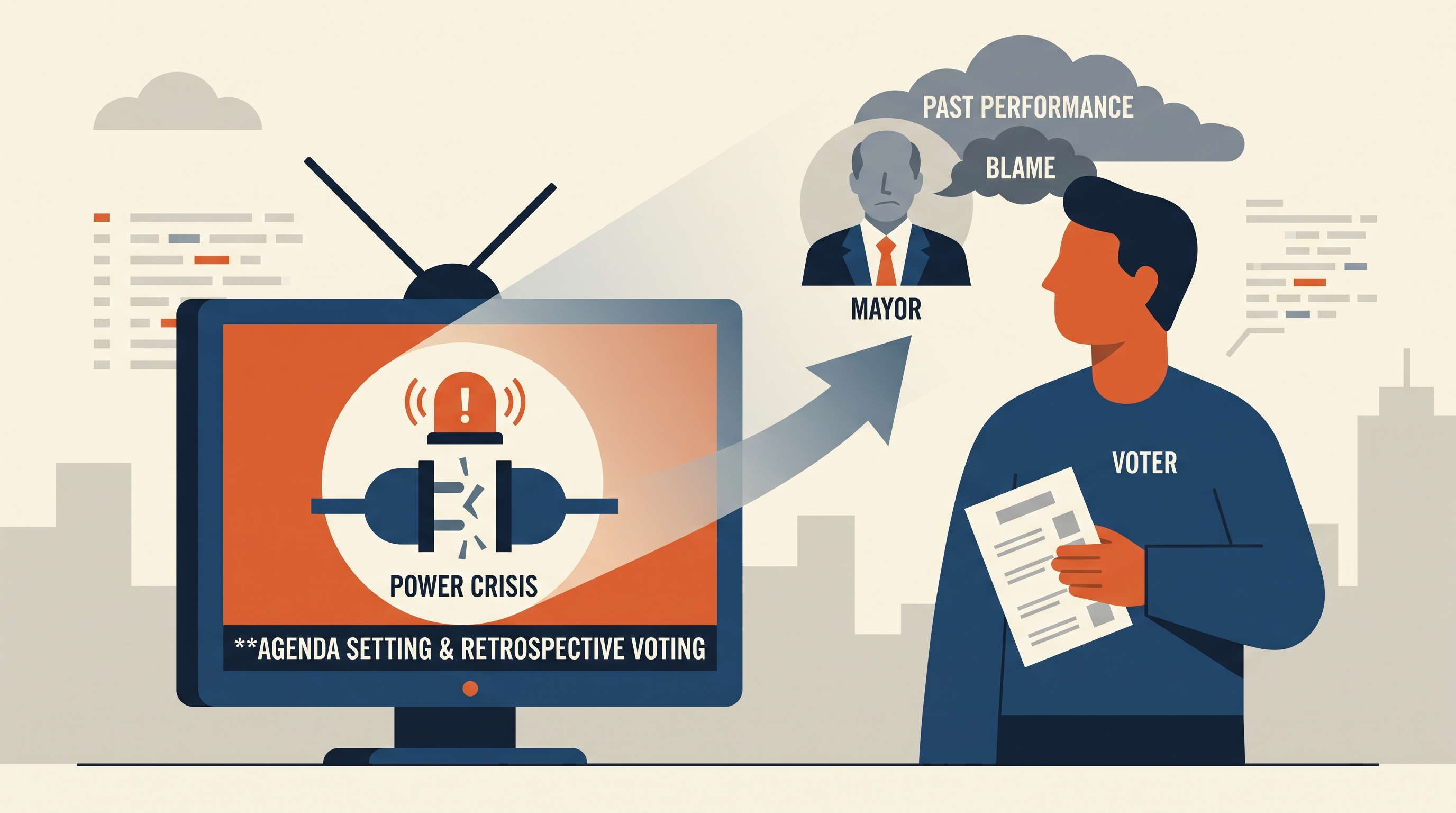
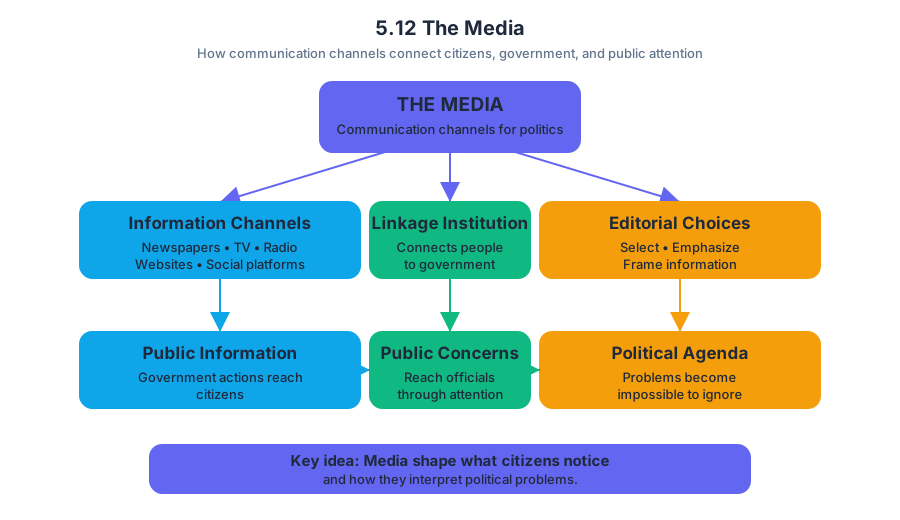
5.13 Changing Media
A political message can now travel from a candidate’s phone to millions of voters before a newspaper editor, television producer, or government official has time to respond.
5.13 Changing Media
A political message can now travel from a candidate’s phone to millions of voters before a newspaper editor, television producer, or government official has time to respond. Changing media refers to the way new communication technologies reshape how political information is created, distributed, interpreted, and used for participation.
Learning Objective 5.13.A: Explain how changes in technology influence political communication and behavior.
Essential Knowledge 5.13.A.1: Changes in technology influence the ways in which citizens learn about politics. Essential Knowledge 5.13.A.2: Changes in technology influence the ways in which citizens communicate and participate in politics.
From gatekeepers to personalized political environments
Older media systems relied heavily on gatekeepers—editors, producers, publishers, and journalists who selected which events and arguments would reach a large audience. Digital media reduce the number of institutional gatekeepers. A candidate, advocacy group, or ordinary citizen can publish directly through a website, video platform, podcast, or social-media account.
That change expands access to political communication, but it also makes information environments more personalized. Selective exposure is the tendency to seek information that agrees with one’s existing beliefs. Narrowcasting is the delivery of messages to a small, targeted audience rather than to the general public. Together, these processes can strengthen political polarization: people encounter more arguments that confirm their views and fewer that challenge them.
The key distinction is not simply “old media versus new media.” Digital technology changes the pathway of communication:
| Communication feature | More traditional pattern | Changing-media pattern |
|---|---|---|
| Distribution | A few organizations reach a mass audience | Many actors publish directly |
| Audience | Broad and relatively shared | Segmented and personalized |
| Feedback | Mostly one-way | Immediate comments, sharing, and responses |
| Political targeting | General demographic appeals | Data-informed messages to specific groups |
| Information control | Editors filter content | Platforms, algorithms, users, and networks filter content |
Worked example: one issue, three information environments
Imagine that a city is considering a major transit expansion. A local newspaper publishes one article describing the cost and another describing expected environmental benefits. A transportation advocacy group posts short videos emphasizing reduced traffic. A neighborhood account posts images of construction risks and directs followers to an online petition.
A resident who follows the advocacy group may repeatedly see pro-expansion messages. Another resident who follows neighborhood activists may see mostly opposition arguments. Both residents can communicate directly with officials, organize supporters, and circulate evidence without joining a traditional organization. Technology has therefore influenced both political communication—how messages move—and political behavior—how citizens participate.
However, repeated exposure does not prove that one side possesses the complete truth. A persuasive post may simplify evidence, omit context, or contain false information. The political consequence depends on how citizens evaluate sources, compare perspectives, and decide whether to act.
Why changing media can increase participation—and distortion
Digital communication lowers the cost of participation. A person can sign a petition, donate, contact a representative, attend a virtual meeting, or share a political message almost instantly. These tools can bring previously less-visible voices into public debate and help groups coordinate collective action.
The same speed can amplify rumors and misinformation, meaning inaccurate information shared regardless of whether the sender intended to deceive. A related concern is confirmation bias, the tendency to notice and accept information that supports existing beliefs more readily than information that challenges them. The lesson is not that all online information is false; it is that abundance and speed do not automatically produce accuracy.
A useful evaluation routine is:
- Identify who created and funded the message.
- Separate factual claims from emotional framing.
- Compare the claim with coverage from ideologically different sources.
- Check whether the evidence is current, complete, and independently supported.
- Determine what action the message is trying to produce.
Applying Skill 2.D: Explain how a required Supreme Court case relates to a political concept or issue
Topic 5.13 is assessed through Skill 2.D: Explain how a required Supreme Court case relates to a political concept or issue. The required case Citizens United v. Federal Election Commission (2010) connects changing media to political communication because independent political spending can finance messages distributed through television, websites, videos, targeted advertisements, and other communication networks.
The reasoning must show the connection rather than merely name the case. For example: Citizens United protected corporate and union independent expenditures because the Court treated political spending used for advocacy as protected political expression. As digital platforms make it cheaper to distribute targeted messages, that constitutional protection can operate through many new media channels, although the decision does not guarantee that audiences will receive accurate or balanced information.
High-value explanation: A case name is evidence only when the answer explains its constitutional principle and connects that principle to the issue in the prompt.
Misconception check
Misconception: “Social media creates political polarization by itself.” Technology creates opportunities and incentives, but polarization also reflects political identities, organized interests, partisan media, social networks, and individual choices. A strong explanation identifies the mechanism—such as selective exposure or narrowcasting—rather than treating technology as an automatic cause.
Retrieval check
A video platform recommends increasingly one-sided political content to a user, who then shares those videos and signs an online petition. Identify one way changing media influenced political communication and one way it influenced political behavior. For an AP-quality response, name the mechanism: the recommendation system may contribute to selective exposure or narrowcasting, while sharing and petition-signing illustrate lower-cost political participation.

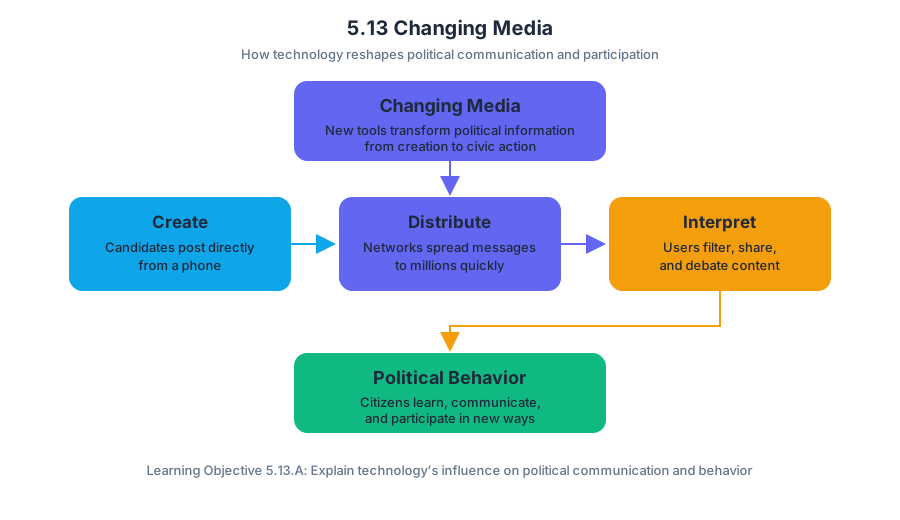
AP Practice 1
A Concept Application free-response question asks you to use a political concept in a specific scenario—not merely define a term from memory. You must identify the relevant institution, process, policy, or behavior and explain how it operates in context.
AP Practice 1
A Concept Application free-response question asks you to use a political concept in a specific scenario—not merely define a term from memory. You must identify the relevant institution, process, policy, or behavior and explain how it operates in context.
Exam task: Concept Application
On the current AP U.S. Government and Politics exam, the Concept Application question is one of the four free-response questions in Section II, which lasts 1 hour 40 minutes and represents 50% of the exam score. This task commonly presents a political scenario and asks you to describe or explain the effects of a political institution, behavior, or process.
A reliable response follows this chain:
Scenario detail → Political concept → Specific explanation of cause and effect
Do not begin with a dictionary definition and stop. The point is to show that you can connect an abstract principle—such as federalism, checks and balances, political parties, or interest-group influence—to what the actors in the scenario actually do.
Original practice prompt
This original question is unofficial and does not reproduce released College Board wording.
A state legislature passes a law requiring all public schools to use a newly developed digital platform for reporting student attendance and academic progress. The federal Department of Education announces that states using the platform will receive additional administrative grants. Several state education officials support the program, but a state teachers’ association argues that the platform imposes costly reporting requirements without providing enough funding. The association begins contacting legislators and testifies at a committee hearing.
(a) Identify the political process demonstrated when the teachers’ association testifies before the legislative committee.
(b) Explain how the teachers’ association could use this process to influence education policy.
(c) Explain one reason the federal grant program might increase cooperation between the federal government and state governments.
Timing plan
| Task | Suggested time |
|---|---|
| Read and annotate the scenario | $1$–$2$ minutes |
| Answer part (a) | About $1$ minute |
| Answer part (b) | About $2$ minutes |
| Answer part (c) | About $2$ minutes |
| Check for missing explanations | About $1$ minute |
Underline the actors, action verbs, and government level in the prompt. Here, the important clues are teachers’ association, testifies, legislators, committee hearing, federal Department of Education, and state governments.
Worked reasoning
Part (a): Identify the process
The teachers’ association is engaging in interest-group lobbying or interest-group influence on policymaking. Lobbying occurs when an organized group attempts to affect government decisions by communicating with public officials.
Credit-worthy answer:
The teachers’ association is engaging in interest-group lobbying by testifying before a legislative committee.
The answer earns the identification point because it names a political process and connects it to the action in the scenario. Naming only “political participation” is too broad; naming only “testifying” repeats the scenario without identifying the process.
Part (b): Explain policy influence
A strong explanation includes a mechanism. The association is not influential simply because it exists. Its testimony can provide legislators with information about implementation costs, persuade lawmakers to amend the law, and mobilize teachers or other members to contact representatives.
Credit-worthy answer:
The association could influence education policy by presenting legislators with information about the platform’s costs and practical effects. This information could persuade committee members to revise the law, increase its funding, or delay implementation.
The examiner rewards the explanation because it shows a causal sequence: testimony supplies information → legislators reassess the proposal → policy changes. A vague statement such as “the group can make its opinion known” does not explain how the process affects policymaking.
Part (c): Explain federal–state cooperation
The grant program uses a financial incentive to encourage states to participate in a federal policy. This reflects cooperative federalism: national and state governments work together, although the federal government may use funding conditions to shape state behavior.
Credit-worthy answer:
The grants could increase cooperation because state governments receive financial resources in exchange for adopting the federal government’s platform. The states retain responsibility for operating their schools, while the federal government provides funding and encourages a shared administrative policy.
This response explains both sides of the relationship. It does not incorrectly claim that the federal government automatically controls public schools merely because it offers grants.
What the rubric is looking for
| Rubric target | What earns credit | Common weak response |
|---|---|---|
| Identify | Names the relevant process or principle and links it to the scenario | Gives a broad label such as “democracy” |
| Explain influence or effect | Shows how one action produces a political result | Restates what happened |
| Apply the concept | Uses the scenario’s actors and institutions specifically | Gives a memorized textbook paragraph |
The relevant AP skill is Skill 1.D: Describe political principles, institutions, processes, policies, and behaviors illustrated in different scenarios in context. The central move is contextual application: the same concept must be attached to the facts presented, not floating above them.
Misconception check
Misconception: “Interest groups are the same as political parties.”
Political parties seek to win elections and organize government across many policy areas. Interest groups usually focus on influencing policy without nominating a broad slate of candidates for office. The teachers’ association is therefore an interest group, even though it may support or oppose particular candidates.
Retrieval check
A city-government employee speaks at a public hearing urging council members to reject a proposed budget cut. Is this automatically lobbying by an interest group? Identify the best concept and explain what additional fact would be needed to classify the action more precisely.
Answer: The action is political advocacy or participation, but it is not automatically interest-group lobbying. To classify it as lobbying, the scenario would need to show that the employee is representing an organized group or attempting to influence lawmakers on that group’s behalf.
Error-review routine
After completing a Concept Application question, label each sentence I for identification, M for mechanism, or C for context. If an answer contains only definitions, add the missing mechanism. If it contains a mechanism but no scenario detail, insert the relevant actor, institution, or action. A high-quality response repeatedly connects the political concept to the exact facts presented.
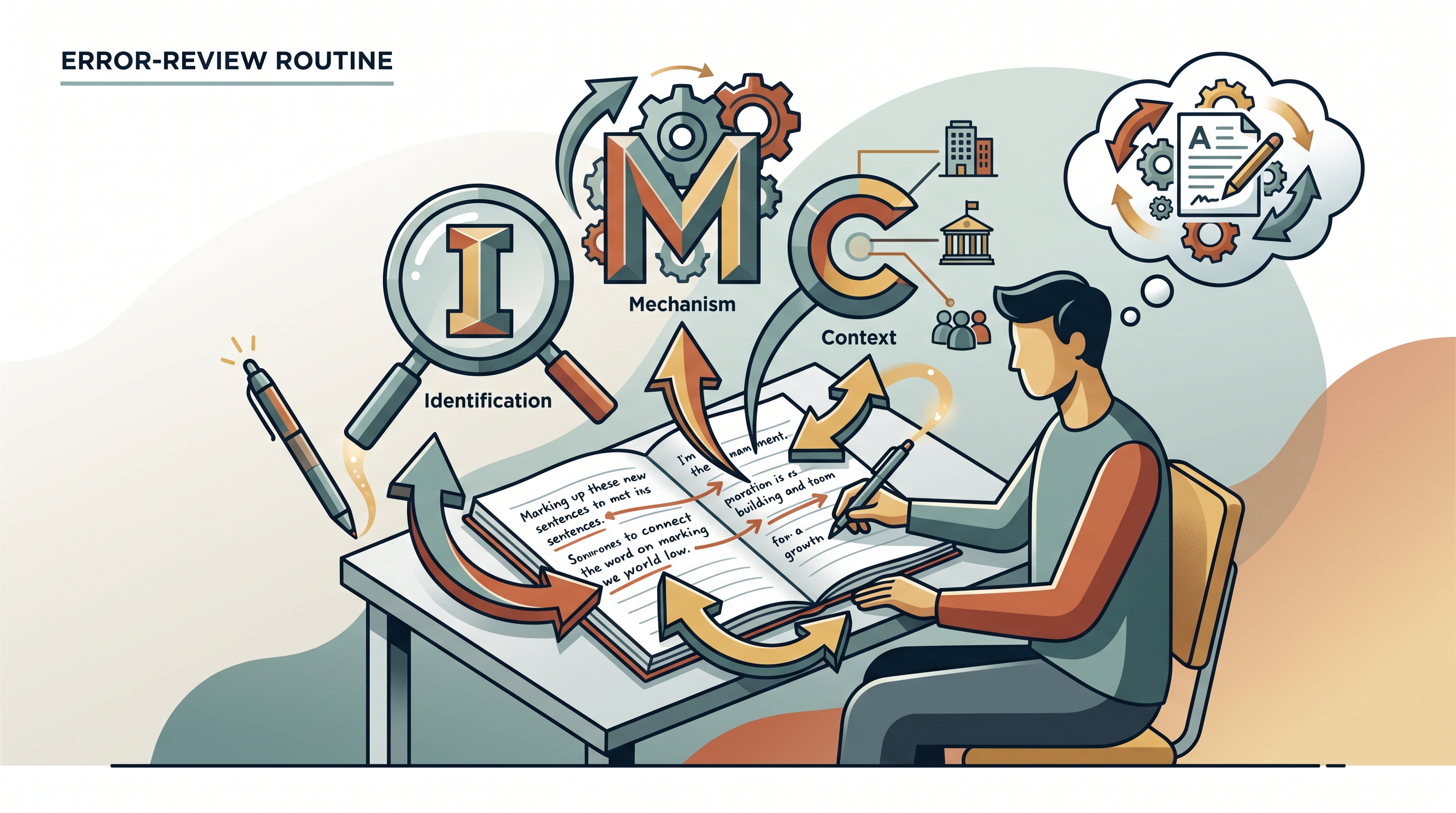
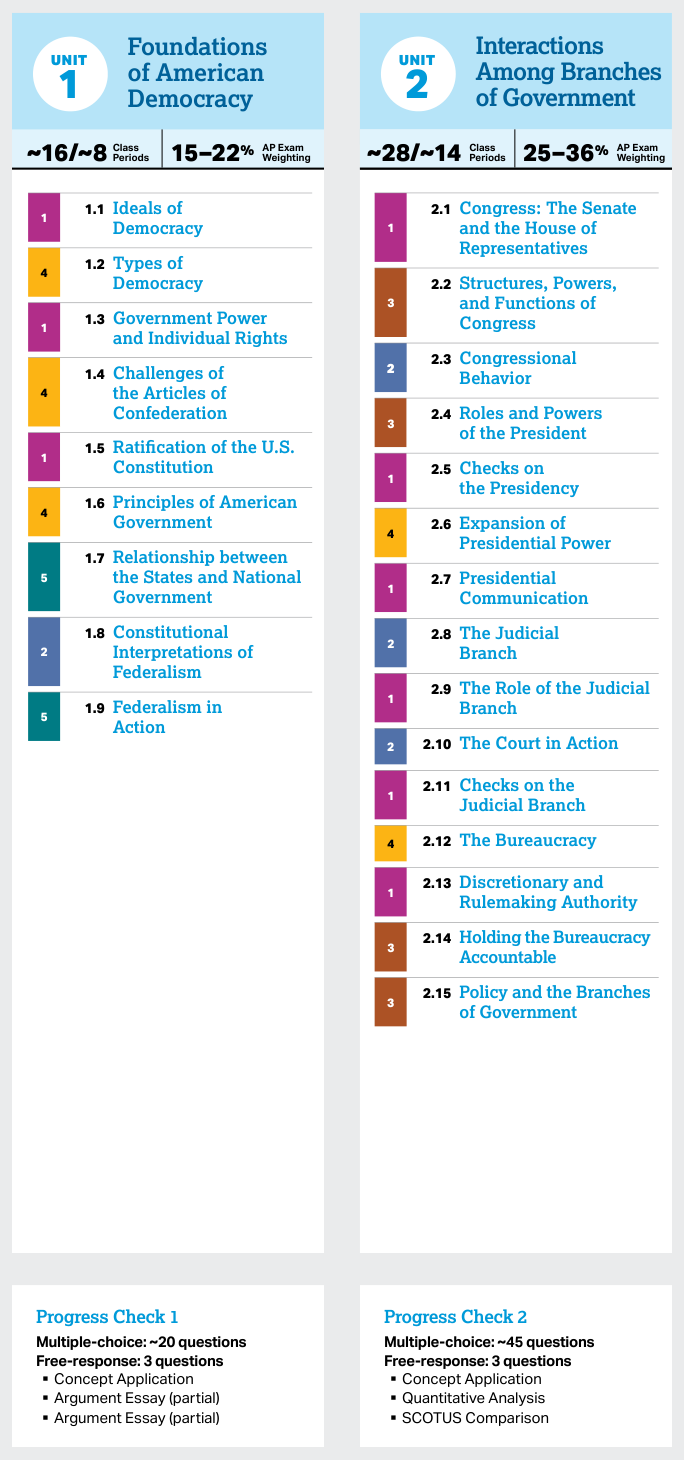
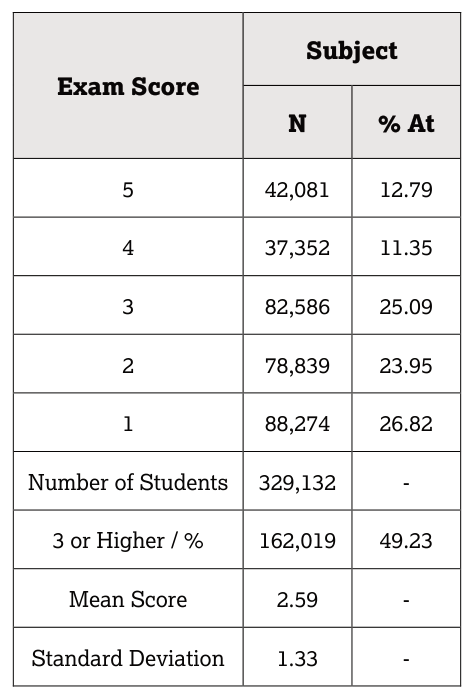
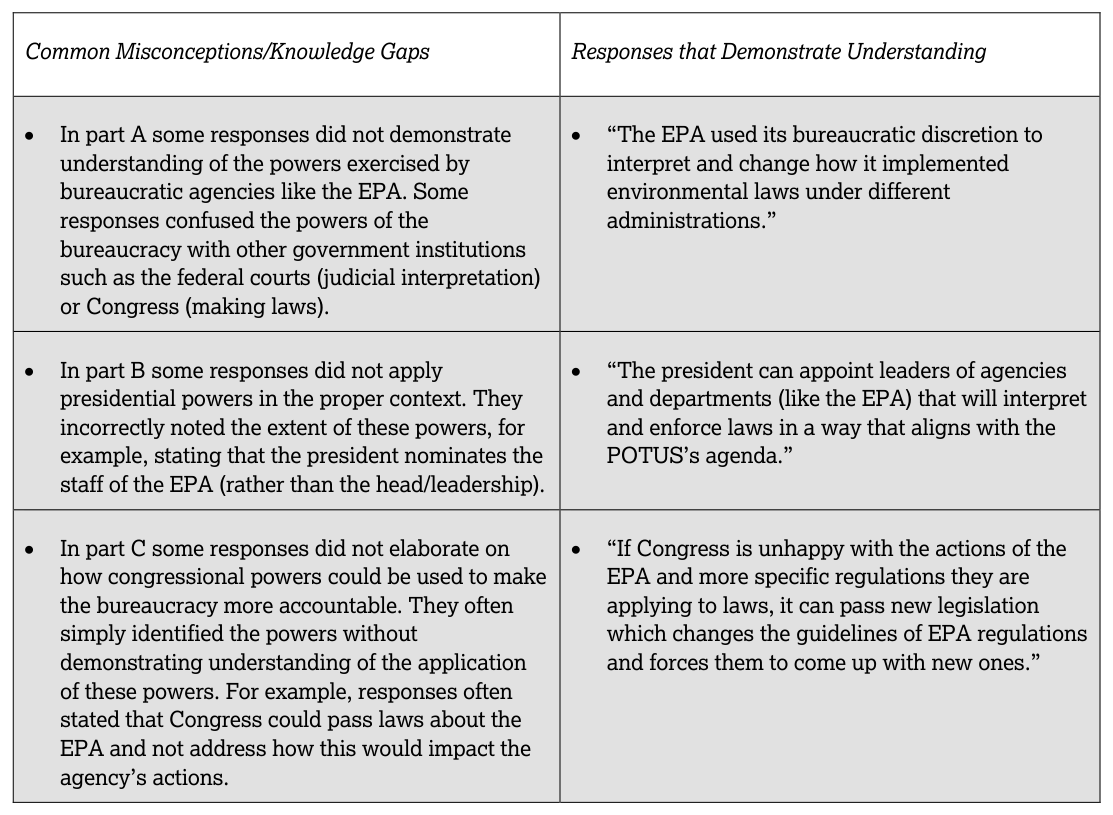
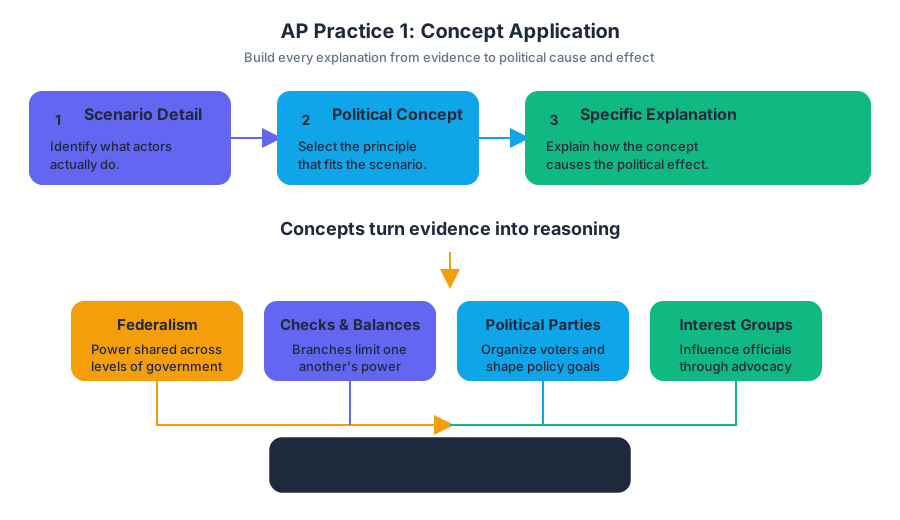
AP Practice 2
A data set is never “just a graph.” It is evidence: a limited window into political behavior that must be described accurately before it can support a conclusion.
AP Practice 2
Quantitative Analysis Free-Response Question
A data set is never “just a graph.” It is evidence: a limited window into political behavior that must be described accurately before it can support a conclusion. The Quantitative Analysis free-response question tests whether you can identify patterns, compare values, draw defensible conclusions, and connect evidence to a political concept.
Exam task type: Quantitative Analysis FRQ
Primary skill: Data Analysis
Useful reasoning processes: identify relevant categories, describe patterns and trends, compare evidence, and draw conclusions supported by data.
Suggested timing: approximately 20 minutes, including reading, calculations, and checking.
Original Practice Prompt
The table shows the percentage of registered voters in four states who reported voting in a recent statewide election. It also shows the percentage of adults in each state who reported having contacted a public official during the previous year.
| State | Reported voter turnout among registered voters | Adults who contacted a public official |
|---|---|---|
| Northland | $72%$ | $18%$ |
| Eastmont | $61%$ | $24%$ |
| Southridge | $49%$ | $11%$ |
| Westhaven | $38%$ | $16%$ |
(a) Identify the state with the highest reported voter turnout.
(b) Describe one pattern in the relationship between voter turnout and contacting public officials shown in the table.
(c) Calculate the difference, in percentage points, between Northland’s voter turnout and Westhaven’s voter turnout.
(d) Explain how the data could support the claim that political participation includes more than voting.
Worked Reasoning and Scoring
Part (a): Locate a specific value
Northland has the highest reported voter turnout, at $72%$.
Why this earns credit: The response identifies the correct state and does not confuse the turnout column with the contacting-public-officials column.
Scoring target: State the correct value or category directly. Do not provide a vague answer such as “the northern state.”
Part (b): Describe a relationship
One valid pattern is that voter turnout and contacting public officials do not move together perfectly. Northland has the highest voter turnout, $72%$, but Eastmont has the highest percentage of adults who contacted a public official, $24%$.
Why this earns credit: The response describes a comparison using values from both variables. It does not merely repeat one column.
A weaker response would say, “Eastmont has $24%$ contacting officials.” That is accurate, but it does not describe a relationship. A stronger response explains what the comparison means: a state can rank highest in voting without ranking highest in another form of participation.
Part (c): Calculate a percentage-point difference
The requested difference is:
$$ 72% - 38% = 34 \text{ percentage points} $$
Northland’s reported voter turnout is $34$ percentage points higher than Westhaven’s.
Why this earns credit: The calculation uses the correct two states, subtracts in the requested direction, and reports the result as a percentage-point difference.
Do not confuse percentage points with percent change. The difference between $72%$ and $38%$ is $34$ percentage points. The percent increase relative to Westhaven would be calculated differently:
$$ \frac{72-38}{38}\times 100 \approx 89.5% $$
That is not what the prompt asks.
Part (d): Connect evidence to a political claim
The data support the claim because contacting a public official is a form of political participation separate from voting. Eastmont illustrates this distinction: it has the highest rate of contacting officials, $24%$, but its voter turnout, $61%$, is lower than Northland’s $72%$. Therefore, participation cannot be measured only by whether people cast ballots; citizens may also attempt to influence policy by communicating with government officials.
Why this earns credit: The explanation does three jobs:
- identifies a form of participation other than voting;
- cites relevant evidence from the table; and
- explains how that evidence supports the claim.
What Examiners Reward
| Response move | What it demonstrates | Common failure |
|---|---|---|
| Identify the correct state or value | Accurate data reading | Choosing the largest number from the wrong column |
| Describe a pattern | Comparison between variables or categories | Repeating one isolated statistic |
| Perform the calculation | Quantitative accuracy | Giving percent change when percentage points are requested |
| Explain the claim | Evidence linked to political meaning | Listing data without explaining its significance |
Misconception Check: Correlation Is Not Proof of Causation
The table does not prove that voting causes people to contact officials, or that contacting officials causes voting. It shows an observed relationship among four states. A careful answer describes what the data support without inventing an explanation that the table cannot establish.
Timing and Error Review
Use the first few minutes to read the title, labels, units, and question verbs. Then answer in the prompt’s order: locate, describe, calculate, explain. Reserve the final minute to check arithmetic, specify units, and confirm that every explanation contains both evidence and reasoning.
After scoring your response, label each missed point as one of four errors: reading error, comparison error, calculation error, or reasoning error. Rewrite only the sentence that lost the point, making the smallest possible correction; this reveals whether the problem was understanding the data or connecting the data to the political concept.
Retrieval check: If a table shows that one state has the highest turnout but another has the highest rate of contacting officials, what conclusion can you safely draw—and what conclusion would go beyond the evidence?

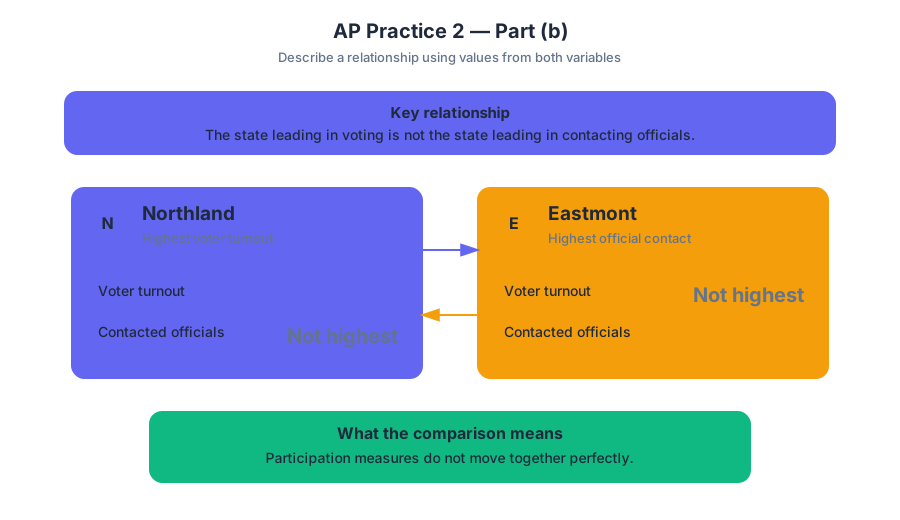
AP Practice 3
A Supreme Court case is not merely a name to memorize: it is a constitutional tool. On the AP exam, SCOTUS Application asks you to use that tool by identifying relevant facts, stating a case’s holding, explaining the majority’s reasoning, and applying that reasoning to a new constitutional situation.
AP Practice 3
A Supreme Court case is not merely a name to memorize: it is a constitutional tool. On the AP exam, SCOTUS Application asks you to use that tool by identifying relevant facts, stating a case’s holding, explaining the majority’s reasoning, and applying that reasoning to a new constitutional situation.
This practice targets Skill 2.A: SCOTUS Application. The skill requires more than recognizing that two cases involve federalism or individual rights. A strong response connects the cases through a specific constitutional principle and explains why the Court reached its decision.
High-value rule: Do not compare case topics only. Compare the constitutional reasoning that links the facts to the holding.
The case pair: McCulloch v. Maryland and United States v. Lopez
In McCulloch v. Maryland (1819), Congress created a national bank under its implied powers. Maryland attempted to tax the bank. The Supreme Court held that Congress had the power to create the bank under the Necessary and Proper Clause and that Maryland could not tax it because state action could not interfere with a legitimate constitutional exercise of national power.
In United States v. Lopez (1995), Congress enacted a law banning guns near schools. The Court held that Congress had exceeded its Commerce Clause authority because possessing a gun near a school was not sufficiently connected to interstate commerce. Unlike McCulloch, where the Court accepted a broad reading of national power, Lopez placed a meaningful limit on that power.
The contrast can be represented as a constitutional decision path:
| Case | Congressional action | Constitutional question | Holding | Federalism result |
|---|---|---|---|---|
| McCulloch | Created a national bank | Could Congress use implied powers? Could Maryland tax the bank? | Congress could create the bank; Maryland could not tax it | Broad national authority; federal law prevails |
| Lopez | Banned guns near schools | Did the law fall within the Commerce Clause? | Congress lacked sufficient commerce authority | Limitation on national authority; state power protected |
Original unofficial practice prompt
A state legislature passes a law imposing a special fee on a federally chartered emergency communications corporation. The corporation argues that the fee interferes with a federal program created under Congress’s implied powers. In a separate case, Congress passes a law regulating the possession of certain devices in local government buildings, asserting that the devices might indirectly affect the national economy.
Respond to all parts.
(A) Identify the constitutional principle from McCulloch v. Maryland that is most relevant to the emergency communications corporation.
(B) Explain how the holding in McCulloch v. Maryland would apply to the state fee.
(C) Identify the constitutional principle from United States v. Lopez that is most relevant to Congress’s regulation of devices in local government buildings.
(D) Explain how the reasoning in United States v. Lopez could be used to challenge Congress’s regulation.
Worked reasoning
Part A: Identify the principle
A complete answer identifies federal supremacy and implied powers. Congress may use powers that are not expressly listed when those powers are appropriate means of carrying out an enumerated power. In addition, a state may not interfere with a valid federal action.
Rewardable idea: The relevant principle is not simply “federalism.” It is that valid federal action is supreme over conflicting state action.
Part B: Apply McCulloch
The state fee would likely be unconstitutional if it functioned as a tax or burden designed to control, punish, or substantially interfere with the federally created corporation. Under McCulloch, the state cannot use its authority to obstruct a legitimate federal program because “the power to tax involves the power to destroy.”
Notice the reasoning chain:
$$ \text{Federal program is constitutionally authorized} \rightarrow \text{state measure burdens the program} \rightarrow \text{federal authority prevails} $$
A weak response would say only that “the federal government is more powerful.” A stronger response explains that the federal corporation exists through an implied congressional power and that state interference violates the Supremacy Clause principle applied in McCulloch.
Part C: Identify the principle
The relevant principle from Lopez is that the Commerce Clause does not give Congress unlimited authority over every activity that might have an indirect economic effect. The regulated conduct must have a sufficiently substantial connection to interstate commerce.
Part D: Apply Lopez
The regulation could be challenged because possessing devices in local government buildings may be noncommercial activity with no substantial connection to interstate commerce. Merely asserting that the activity might affect the national economy would not necessarily satisfy the constitutional limit recognized in Lopez.
The best answer distinguishes the result from McCulloch: McCulloch involved a federal instrument directly connected to an enumerated national power, while Lopez involved an attempt to regulate local conduct without a sufficiently demonstrated commerce connection.
Misconception check
Misconception: “Lopez overturned McCulloch.” It did not. The cases address different constitutional powers. McCulloch supports implied powers when Congress is carrying out an enumerated responsibility; Lopez limits the Commerce Clause when Congress regulates activity too weakly connected to interstate commerce.
Timing and error review
Allow approximately 20 minutes for this SCOTUS Application task. Spend the first few minutes identifying the constitutional clause or principle, then write one direct application for each part. Afterward, label each response as principle, holding, reasoning, or application. If an answer contains only a case name or conclusion, revise it by adding the constitutional mechanism that explains why the conclusion follows.
Retrieval check
Why would McCulloch generally support a federally chartered program against state interference, while Lopez could limit Congress’s attempt to regulate local conduct? Answer in one sentence using both implied powers and the Commerce Clause.
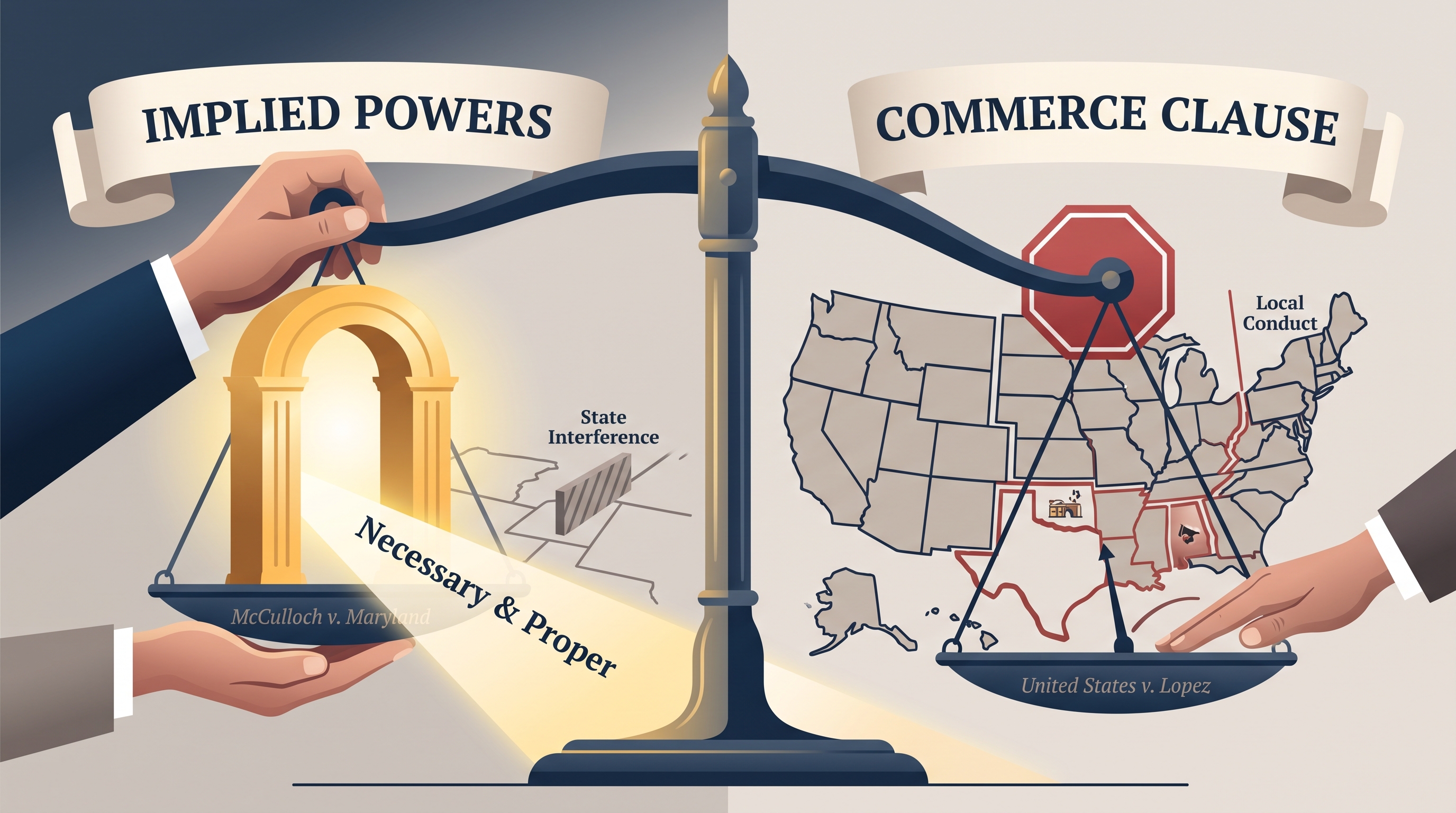
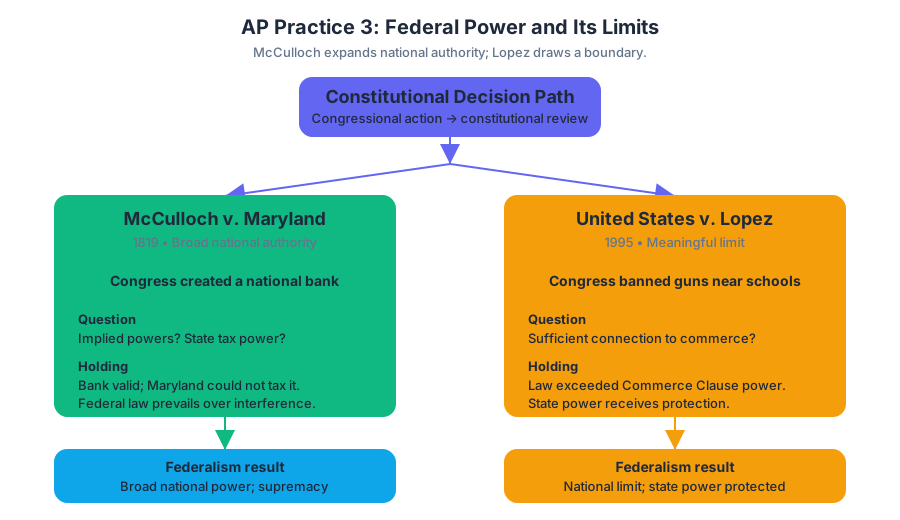
AP Practice 4
A strong AP Government argument is not a list of facts; it is a defensible claim supported by constitutional evidence and connected through explicit reasoning.
AP Practice 4
A strong AP Government argument is not a list of facts; it is a defensible claim supported by constitutional evidence and connected through explicit reasoning. The argument task asks you to decide how far a political principle applies, then prove that judgment with required foundational documents and relevant political knowledge.
The task: build a constitutional argument
Original practice prompt — unofficial
Develop an argument that evaluates the extent to which dividing governmental power among multiple institutions protects individual liberty in the United States. In your response, use at least two required foundational documents as evidence, including Federalist No. 51. You may also use relevant knowledge from the course.
A useful structure is:
| Argument move | What it must do |
|---|---|
| Claim or thesis | Answer the prompt directly and establish a defensible position. |
| Evidence | Use specific evidence from at least two required foundational documents. |
| Reasoning | Explain why each piece of evidence proves or supports the claim. |
| Qualification | Show a limit, tension, or condition affecting the argument. |
| Political knowledge | Connect the documents to a concrete constitutional mechanism, institution, case, or policy. |
The most common failure is evidence dumping: naming a document without explaining its significance. Writing “Federalist No. 51 supports checks and balances” is not yet an argument. The reader must see the chain: document principle → constitutional mechanism → effect on liberty.
Step 1: Turn the prompt into a position
The prompt asks about the extent to which divided power protects liberty. That wording invites a qualified claim rather than an absolute one. A defensible thesis might be:
Dividing governmental power generally protects individual liberty because separate branches can restrain one another, but this protection is incomplete when institutional conflict produces inaction or when a determined majority controls several institutions at once.
This thesis earns argumentative strength because it does three things: it answers the question, identifies a primary reason, and acknowledges a limitation. It does not merely restate that the Constitution divides power.
Step 2: Select and connect foundational documents
Federalist No. 51 argues that the constitutional structure should make “ambition” counteract ambition. Its logic is institutional: because officials possess different powers and incentives, each branch can resist encroachment by another branch. This supports the claim that liberty does not depend entirely on officials’ personal virtue.
A second document can provide a contrasting concern. Brutus No. 1 warns that a powerful national government may gradually absorb authority and threaten the people’s liberty. Used carefully, Brutus does not disprove Federalist No. 51. Instead, it supplies the qualification: divided institutions may restrain one another, but national power can still expand unless federal authority remains limited and accountable.
Worked argument
Dividing governmental power generally protects individual liberty because it prevents any single institution from exercising unlimited authority. In Federalist No. 51, James Madison explains that government must be arranged so that “ambition” counteracts ambition. This principle appears in the Constitution’s separation of powers: Congress writes laws, the president executes them, and the judiciary interprets them. For example, Congress may refuse to fund an executive initiative, while the president may veto legislation and courts may invalidate actions that violate the Constitution. Because each branch has tools that affect the others, a branch seeking to threaten individual rights faces institutional resistance.
However, divided power does not automatically protect liberty. Brutus No. 1 argues that a strong national government could become distant from the people and eventually endanger their freedom. This concern is visible when Congress delegates broad authority to executive agencies or when political polarization prevents Congress from effectively overseeing the executive branch. In such circumstances, separation of powers may produce gridlock without guaranteeing rights. Therefore, divided power is most protective when constitutional checks are actively used and when citizens, courts, Congress, and state governments hold officials accountable.
The response earns value through its reasoning, not its length. It identifies a claim, uses Federalist No. 51 and Brutus No. 1 specifically, explains constitutional mechanisms, and qualifies the argument with delegation, oversight, and gridlock.
Timing and error review
For a timed argument essay, reserve approximately 5 minutes to identify the task and plan, 30 minutes to write, and 5 minutes to revise. Before writing, sketch three lines: claim, document one plus explanation, and document two plus qualification.
Afterward, perform an error review:
- Thesis check: Does the first paragraph answer the exact question?
- Document check: Did you use at least two required foundational documents accurately?
- Explanation check: Does every document reference explain how it supports the claim?
- Reasoning check: Did you connect evidence to a constitutional mechanism or political outcome?
- Qualification check: Did you address a limit rather than contradict your own thesis?
Named misconception — “More branches always mean more liberty.” Divided power creates opportunities for restraint; it does not guarantee effective restraint. Checks and balances can protect rights, but they can also create delay, encourage evasion of responsibility, or fail when officials share the same goal. The strongest argument recognizes both the constitutional design and the conditions required for that design to work.
Retrieval check
In one sentence, explain why Federalist No. 51 supports separation of powers, and in a second sentence explain how Brutus No. 1 can qualify rather than simply reject that argument.
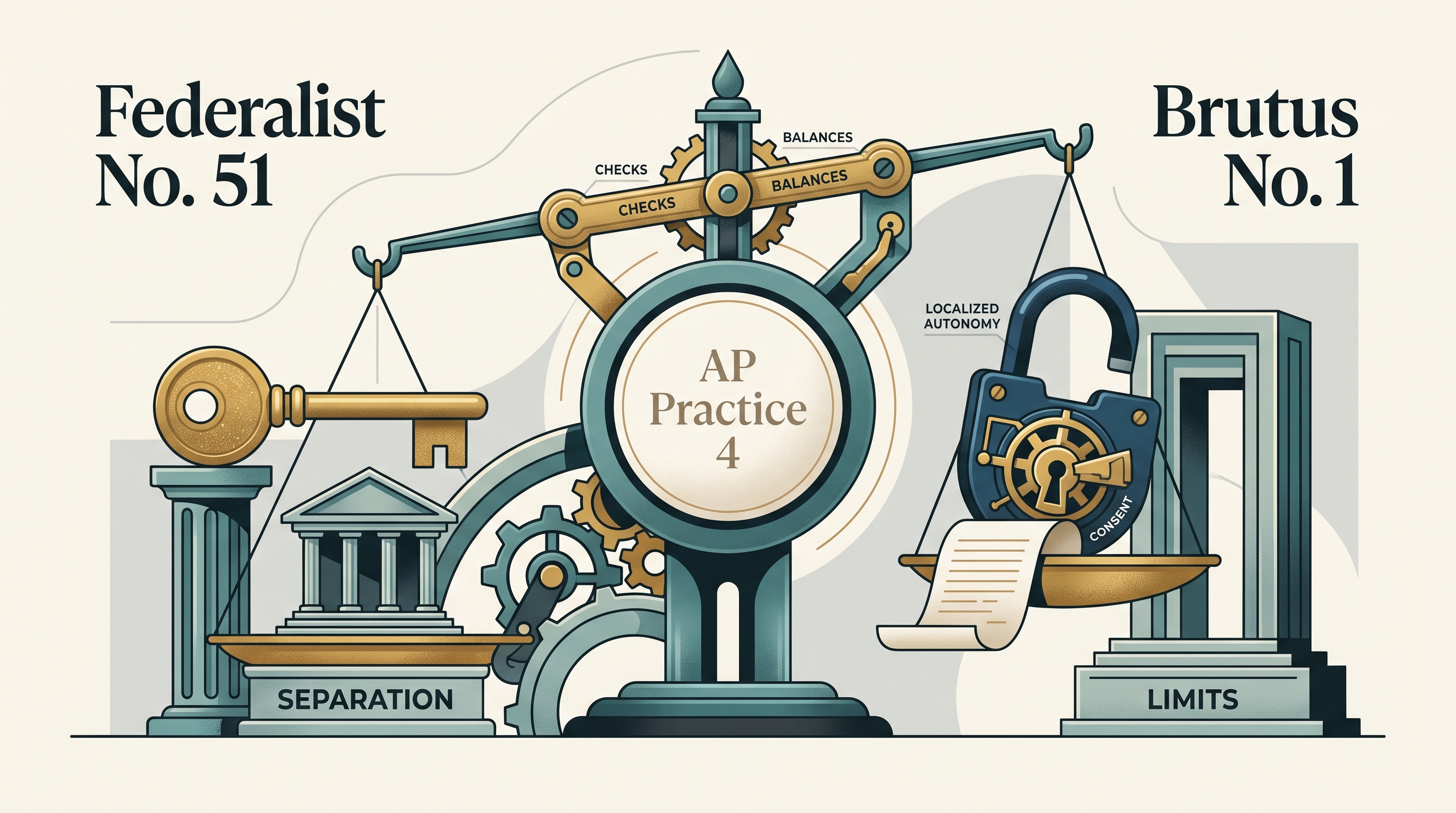
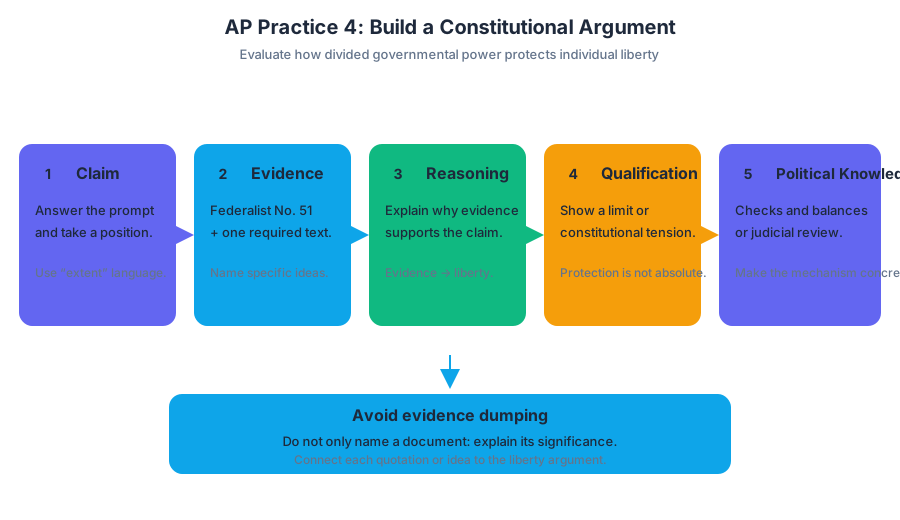
AP Practice 5
A federal law can be constitutional in one case and unconstitutional in another even when both cases involve Congress regulating activity inside a state. The decisive question is not simply whether Congress acted, but whether the Constitution gives Congress the power it used and whether the law is a valid means of…
AP Practice 5
A federal law can be constitutional in one case and unconstitutional in another even when both cases involve Congress regulating activity inside a state. The decisive question is not simply whether Congress acted, but whether the Constitution gives Congress the power it used and whether the law is a valid means of carrying out that power.
Task type: Supreme Court Comparison FRQ
This practice targets Skill 2: SCOTUS Application, especially Skill 2.A, which requires applying Supreme Court decisions by identifying the relevant facts, constitutional issue, holding, reasoning, and decision of a majority opinion. The task also requires transferring a constitutional principle from one required case to a new situation.
Examiner’s central question: Can you use a Supreme Court case as a legal tool, rather than merely naming it?
Original practice prompt
In McCulloch v. Maryland (1819), the Supreme Court considered whether Congress had constitutional authority to establish a national bank and whether Maryland could impose a tax on that bank.
In United States v. Lopez (1995), the Supreme Court considered whether Congress could prohibit possession of a firearm near a school by relying on its power to regulate interstate commerce.
Answer the following.
(a) Identify the constitutional clause that provided the primary basis for the decision in McCulloch v. Maryland.
(b) Describe the holding in McCulloch v. Maryland and explain the reasoning the Court used to reach that holding.
(c) Explain how the reasoning in United States v. Lopez differs from the reasoning in McCulloch v. Maryland.
Timing target
Spend approximately $20–25 minutes: about 3 minutes reading and planning, 14–17 minutes writing, and 3–5 minutes checking. Because this is a short free-response task, each paragraph should perform a visible job: identify, describe, or explain.
Worked response and scoring logic
(a) Constitutional clause
Creditworthy answer: The Necessary and Proper Clause, also called the Elastic Clause, provided the primary basis for the decision.
The clause permits Congress to enact laws that are appropriate means of carrying out its enumerated powers. A response that names only the Commerce Clause is not the best answer for this part because McCulloch centered on Congress’s implied powers and the constitutionality of creating the bank.
Rewarded reasoning: Correctly identify the constitutional provision that supplied the legal authority at issue.
(b) Holding and reasoning
Creditworthy answer: The Court held that Congress had the implied power to establish a national bank, even though the Constitution did not expressly list “creating a bank” as a congressional power. The Court reasoned that Congress may choose appropriate means to execute its enumerated powers, including collecting taxes, borrowing money, and regulating commerce. The Necessary and Proper Clause therefore allowed the bank as a useful instrument for carrying out those legitimate powers. The Court also held that Maryland could not tax the national bank because the power to tax could be used to destroy or control a constitutional federal instrument.
This answer earns the relevant credit because it contains all three required pieces:
- Holding: Congress could establish the bank.
- Constitutional reasoning: The Necessary and Proper Clause supports implied powers connected to enumerated powers.
- Federalism consequence: Maryland’s tax was invalid because state action could not undermine a lawful federal institution.
A vague statement such as “the Court expanded federal power” is incomplete. It identifies an effect but does not explain the constitutional mechanism that produced it.
(c) Comparison with United States v. Lopez
Creditworthy answer: The reasoning in Lopez placed a limit on congressional power under the Commerce Clause, whereas the reasoning in McCulloch broadly recognized implied congressional powers under the Necessary and Proper Clause. In McCulloch, the national bank was sufficiently connected to enumerated federal powers, so Congress could use it as an appropriate means of carrying out those powers. In Lopez, possessing a gun near a school was not sufficiently connected to interstate commerce because the law regulated a noneconomic local activity without requiring a demonstrated connection to interstate commercial activity. Therefore, the Court rejected Congress’s asserted Commerce Clause authority in Lopez.
The comparison must identify a meaningful similarity or difference in constitutional reasoning, not merely summarize two outcomes. The strongest response explains why the cases point in different directions: McCulloch permits implied means that help Congress execute legitimate powers, while Lopez prevents Congress from converting the Commerce Clause into a general power over every local activity.
Named misconception check
Misconception: “The Necessary and Proper Clause gives Congress unlimited power.” It does not. The clause supports means that are appropriate and connected to an enumerated power; it does not create an independent general authority. McCulloch expanded implied powers, but Lopez demonstrates that the Court still polices the boundaries of federal authority.
Error-review routine
After writing, label each sentence F for fact, I for constitutional issue, H for holding, or R for reasoning. If you have facts and holdings but very few R sentences, your response is probably describing cases rather than applying them.
Then check three precision points:
- Did you name the Necessary and Proper Clause for McCulloch?
- Did you explain the connection between implied powers and enumerated powers?
- Did you explain why the activity in Lopez lacked a sufficient Commerce Clause connection?
Quick retrieval check: Which case is more protective of congressional authority, and which constitutional principle explains that result? A defensible answer should identify McCulloch and connect it to implied powers under the Necessary and Proper Clause.
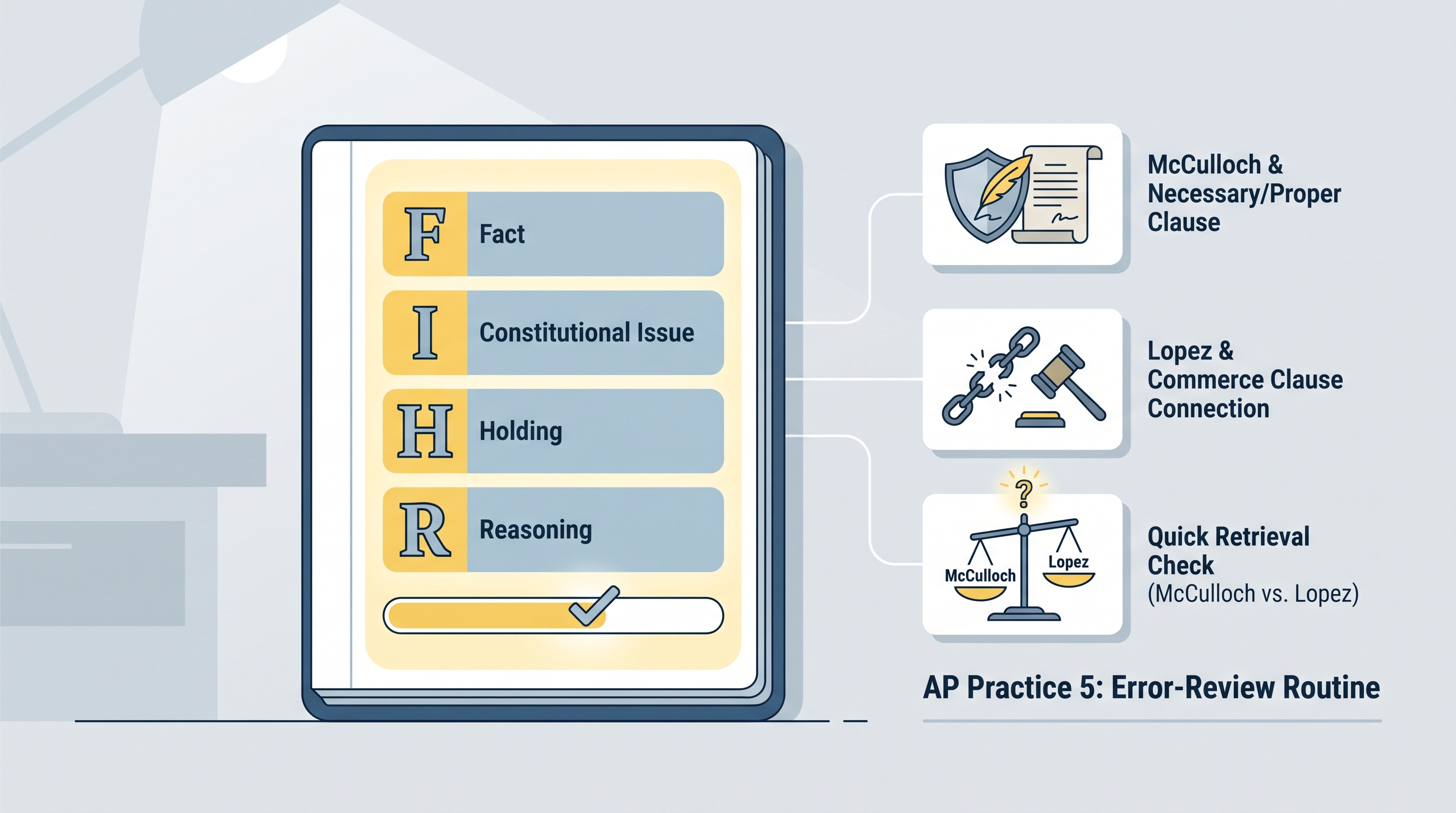
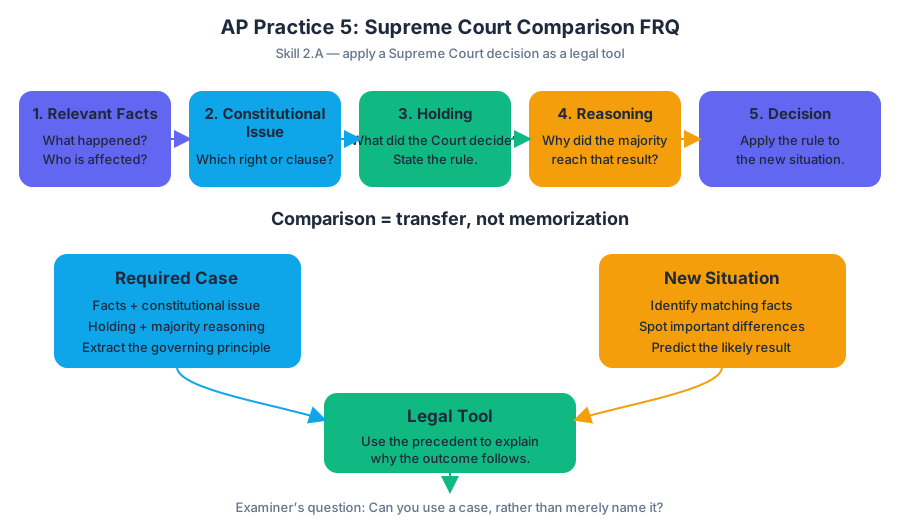
AP Practice 6
A strong AP Government argument does not merely announce an opinion; it makes a defensible claim, supports that claim with precise evidence, and explains why the evidence proves the claim.
AP Practice 6
A strong AP Government argument does not merely announce an opinion; it makes a defensible claim, supports that claim with precise evidence, and explains why the evidence proves the claim. AP Practice 6 focuses on the free-response Argument Essay, the exam task that most directly measures Skill 5: Argumentation.
Argumentation means constructing a logical political argument in essay form using a defensible claim, relevant evidence, and reasoning that connects the evidence to the claim.
The argument essay at a glance
The Argument Essay is one of four free-response questions. The free-response section contains four questions and is completed in approximately $1$ hour and $40$ minutes. A practical target is about $30$ minutes for this task, leaving time for the other three questions.
| Required move | What the reader must see |
|---|---|
| Skill 5.A: Develop a thesis/claim | A clear position that directly answers the prompt |
| Skill 5.B: Support the argument using specific and relevant evidence | Accurate evidence from required foundational documents, required Supreme Court cases, course concepts, or political examples |
| Skill 5.C: Use reasoning to organize an argument and explain why evidence supports a claim | Explicit explanation connecting each piece of evidence to the thesis |
Original practice prompt
Prompt:
Some political scientists argue that divided government—the condition in which different political parties control the presidency and at least one chamber of Congress—protects democratic liberty. Others argue that divided government makes it harder for elected officials to respond to public problems.
Develop an argument that evaluates the extent to which divided government protects democratic liberty.
In your response:
- Present a defensible claim or thesis.
- Use at least two pieces of specific and relevant evidence.
- Use at least one required foundational document as evidence.
- Explain how your evidence supports your claim.
Step 1: Build a defensible thesis
A defensible thesis must do more than repeat the question. It should take a position and establish a line of reasoning. A useful structure is:
$$\text{Although } X,\ \text{divided government } Y\ \text{because } A \text{ and } B.$$
Worked thesis:
Although divided government can delay responses to national problems, it generally protects democratic liberty because competing institutions can check executive power and force public debate over major policy changes.
This thesis earns the argument’s central claim because it answers how far divided government protects liberty and identifies two reasons: checking executive power and forcing public debate. The concession strengthens the claim because it recognizes a legitimate counterargument without abandoning the position.
Step 2: Select evidence that does actual work
The best evidence is specific and connected to the reasoning. Possible evidence includes:
- Federalist No. 51: The Constitution divides power among institutions so that “ambition” can counteract ambition.
- Federalist No. 70: The executive needs energy, but that energy must operate within constitutional limits.
- Youngstown Sheet & Tube Co. v. Sawyer (1952): The Supreme Court rejected presidential seizure of private steel mills when the president lacked constitutional or statutory authority.
- Congressional oversight, appropriations restrictions, confirmation power, and the Senate’s role in approving treaties and executive appointments.
A response should not simply name Federalist No. 51. It must use the document’s idea. For example: Federalist No. 51 supports divided government because it explains that institutional ambition can restrain institutional ambition. When Congress is controlled by a different party, legislators have stronger incentives to investigate executive actions and limit presidential initiatives, making it more difficult for one branch to accumulate unchecked power.
Step 3: Explain the connection
The reasoning chain should be visible:
$$ \text{Divided party control} \rightarrow \text{greater institutional oversight} \rightarrow \text{fewer unchecked executive actions} \rightarrow \text{stronger protection for liberty} $$
For example, if a president attempts to use executive authority to implement a controversial policy, a Congress controlled by the opposition party may conduct hearings, restrict funding, refuse confirmation of nominees, or pass legislation limiting the policy. These actions do not automatically produce good policy, but they illustrate the constitutional principle that liberty is safer when power is divided and monitored.
A compact high-scoring outline
- Thesis: Divided government generally protects liberty by checking executive power, although it may slow policymaking.
- Evidence 1: Federalist No. 51—separated institutions restrain one another.
- Reasoning: Opposition-controlled Congress has incentives and tools to investigate and limit presidential action.
- Evidence 2: Youngstown Sheet & Tube Co. v. Sawyer—presidential power is limited when Congress has not authorized the action.
- Reasoning: Judicial and legislative checks prevent executive claims from becoming unlimited authority.
- Qualification: Gridlock can delay responses to emergencies, so divided government protects liberty more reliably than it promotes efficient policymaking.
Misconception check: “More checks always mean better government”
Misconception: Divided government automatically improves democracy.
Correction: Divided government can strengthen accountability and protect liberty, but it can also produce gridlock. The strongest argument distinguishes liberty from efficiency: a system may protect citizens from concentrated power while making policy change slower.
Timing and error review
Spend about $4$ minutes planning, $22$ minutes writing, and $4$ minutes checking. During the final check, underline the thesis, circle each specific piece of evidence, and draw an arrow from each evidence sentence to the explanation showing why it supports the claim.
A useful error-review routine is:
- Claim error: Did I take a position rather than summarize both sides?
- Evidence error: Did I identify a specific document, case, institution, or political process?
- Reasoning error: Did I explain the causal or constitutional connection?
- Scope error: Did I answer the question about democratic liberty rather than drifting into general policy efficiency?
Retrieval check: If an essay names Federalist No. 51 but never explains how separated institutions protect liberty, which argumentation requirement is missing? The answer is Skill 5.C: Use reasoning to organize an argument and explain why evidence supports a claim.
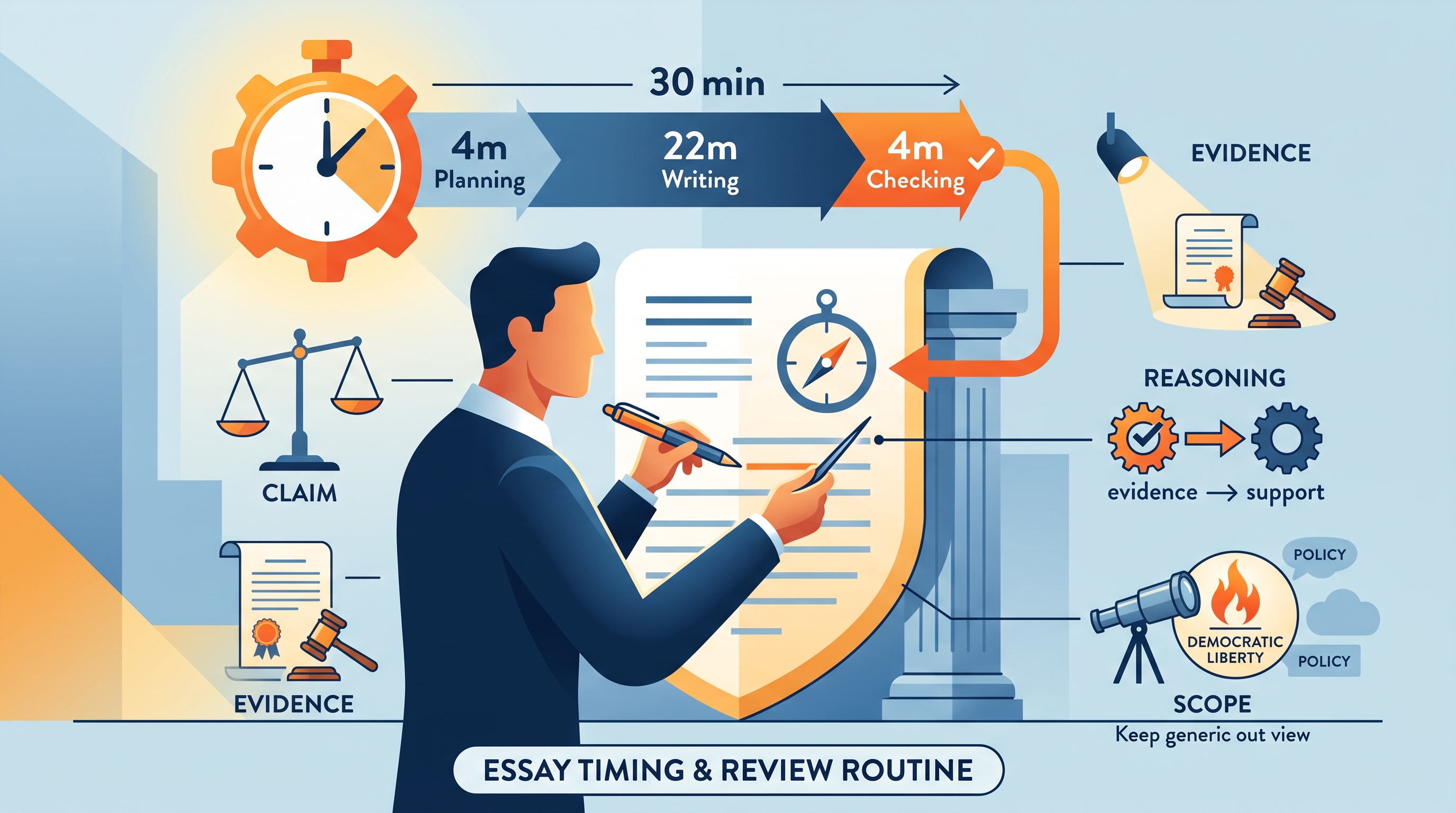
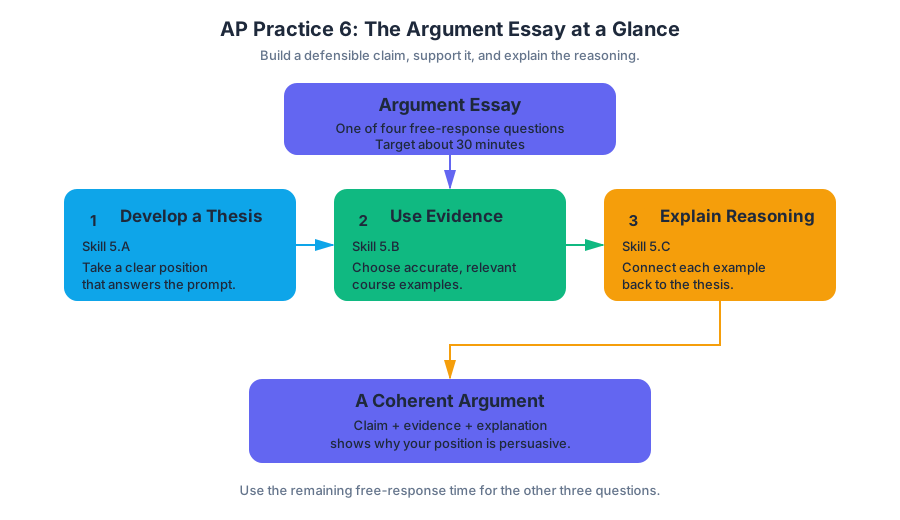
Source Materials
- AP U.S. Government and Politics Course and Exam Description
- Learn More (.pdf)
- AP U.S. Government and Politics Course Overview
- AP U.S. Government and Politics Course at a Glance
- AP United States Government and Politics Course at a Glance Poster
- AP United States Government and Politics
- AP United States Government and Politics
- United States Government and Politics Sample Syllabus 1
- Figure — AP U.S. Government and Politics Course and Exam Description (p. 1)
- Figure — AP U.S. Government and Politics Course and Exam Description (p. 15)
- Course Framework V.1 |
- Figure — AP U.S. Government and Politics Course and Exam Description (p. 24)
Study AP United States Government and Politics with AI — Free on Lykke
Sign up for free to generate personalized flashcards, quizzes, and study guides from this course. Chat with an AI tutor that knows the material.
Get Started FreeView this course wiki on Lykke · Browse all public course wikis