AP Music Theory
Institution: MIT
99 study materials · 59 sections
AP Music Theory students working the current College Board Course and Exam Description, including first-time students with no prior background, plus teachers reviewing the page for CED alignment.; Teach every official CED unit and every numbered topic at topic granularity.; Develop every AP skill / science-practice code explicitly and by name.; Replace description with teaching: worked contextual examples, named misconceptions, and in-flow retrieval checks.; Build an exam-practice unit covering every task type on the current exam.
Course Sections
Course Framework, Skills and Reasoning Processes
Key concepts: AP Music Theory course framework · College-level curriculum alignment · Instructional model and unit sequencing · Essential questions and conceptual understandings · Content and skill development · Aural analysis and listening practice · Score analysis of notated music · Sight-singing and dictation · Composition and production of music · Progress monitoring and actionable assessment feedback
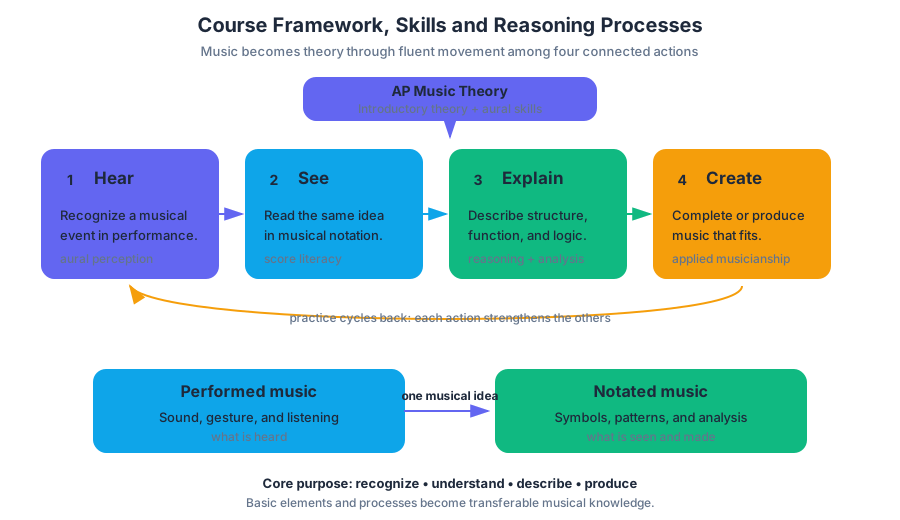
Music becomes theory when a listener can move fluently among four actions: hearing a musical event, seeing it notated, explaining how it works, and creating or completing music that follows its logic.
Course Framework, Skills and Reasoning Processes
Music becomes theory when a listener can move fluently among four actions: hearing a musical event, seeing it notated, explaining how it works, and creating or completing music that follows its logic. AP Music Theory is built around that fluency. It corresponds to approximately one or two semesters of introductory college music theory and aural-skills coursework, while allowing colleges to organize comparable material in different ways.
Core purpose: Students learn to recognize, understand, describe, and produce the basic elements and processes of performed and notated music.
The phrase performed and notated is crucial. A chord heard in a recording, the same chord represented on a score, a Roman-numeral analysis of its function, and a correctly written continuation are connected manifestations of one musical idea—not four unrelated exercises.
Why the framework is college-level
AP courses use challenging, research-based curricula aligned with expectations in higher education. AP teachers and college faculty collaborate in course and exam development, and college faculty review AP teachers’ course syllabi. The framework therefore describes knowledge and skills typical of introductory college music theory without pretending that every college teaches the material in exactly the same sequence or with identical terminology.
College credit or placement depends on the institution, but the underlying preparation is consistent: students work with pitch, rhythm, melody, harmony, voice leading, musical form, notation, listening, and composition. The repertoire used for analysis may include standard Western tonal music, contemporary art music, jazz, popular music, and other diverse musical contexts.
The instructional model: build, connect, assess
The framework’s sequence moves from materials that must be identified accurately toward processes that must be interpreted and produced. Fundamentals support chords; chords support harmonic function; harmonic function supports voice leading, embellishment, secondary function, modes, and form.
| Stage | Musical work | Typical evidence |
|---|---|---|
| Identify | Hear or read pitch, rhythm, scale, chord, or expressive feature | Recognition in performed or notated music |
| Explain | Describe relationships among motives, phrases, chords, or cadences | Aural or score analysis |
| Convert | Move between sound and notation | Dictation, sight-singing, and error detection |
| Produce | Write or perform music that satisfies given constraints | Composition, part writing, harmonization, and sight-singing |
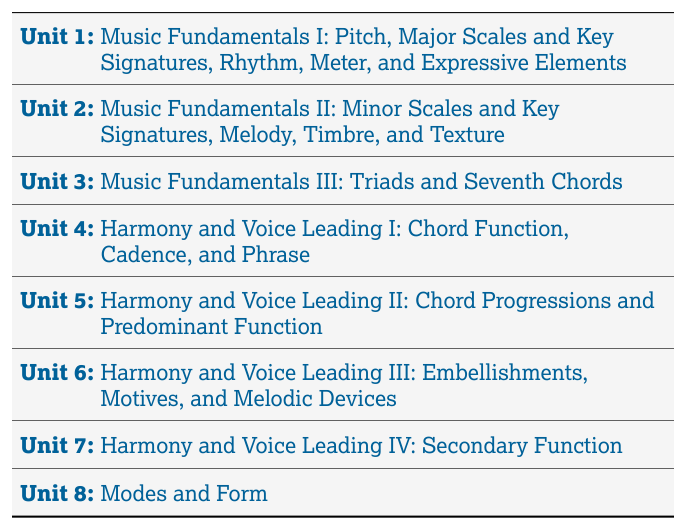
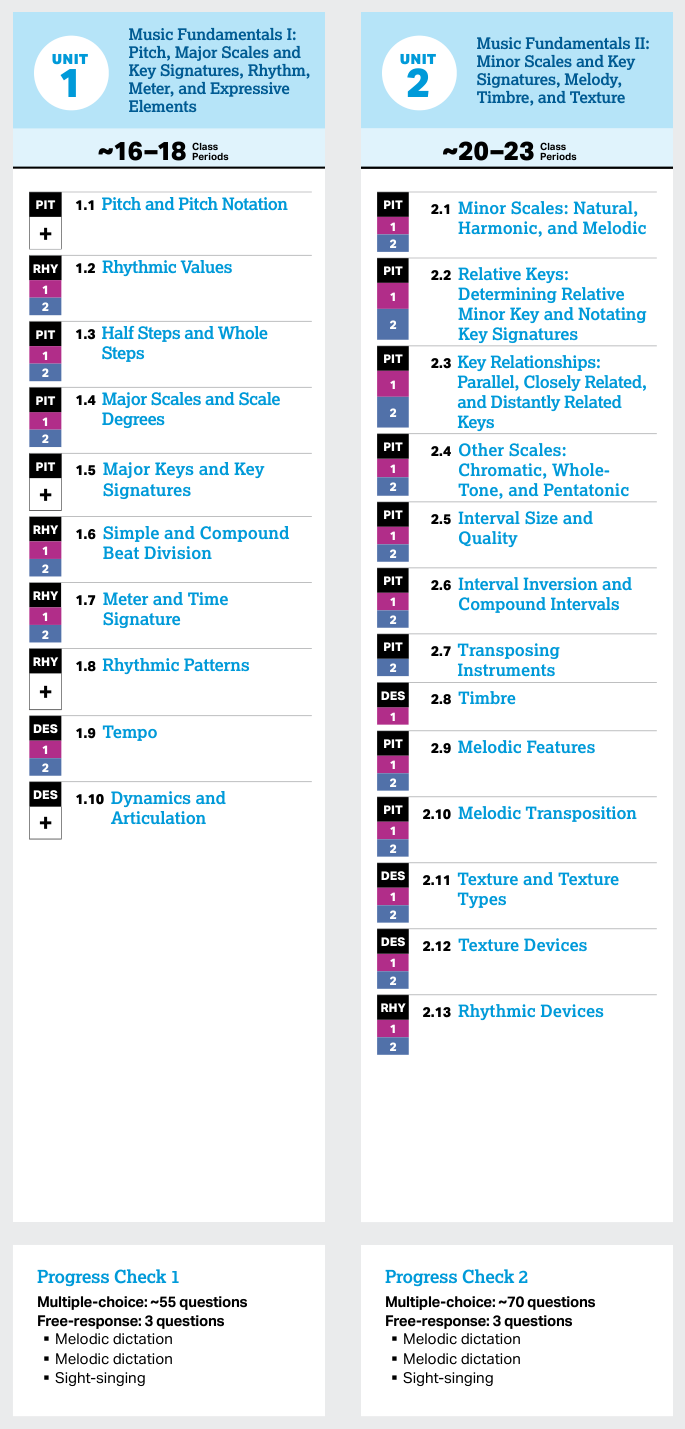
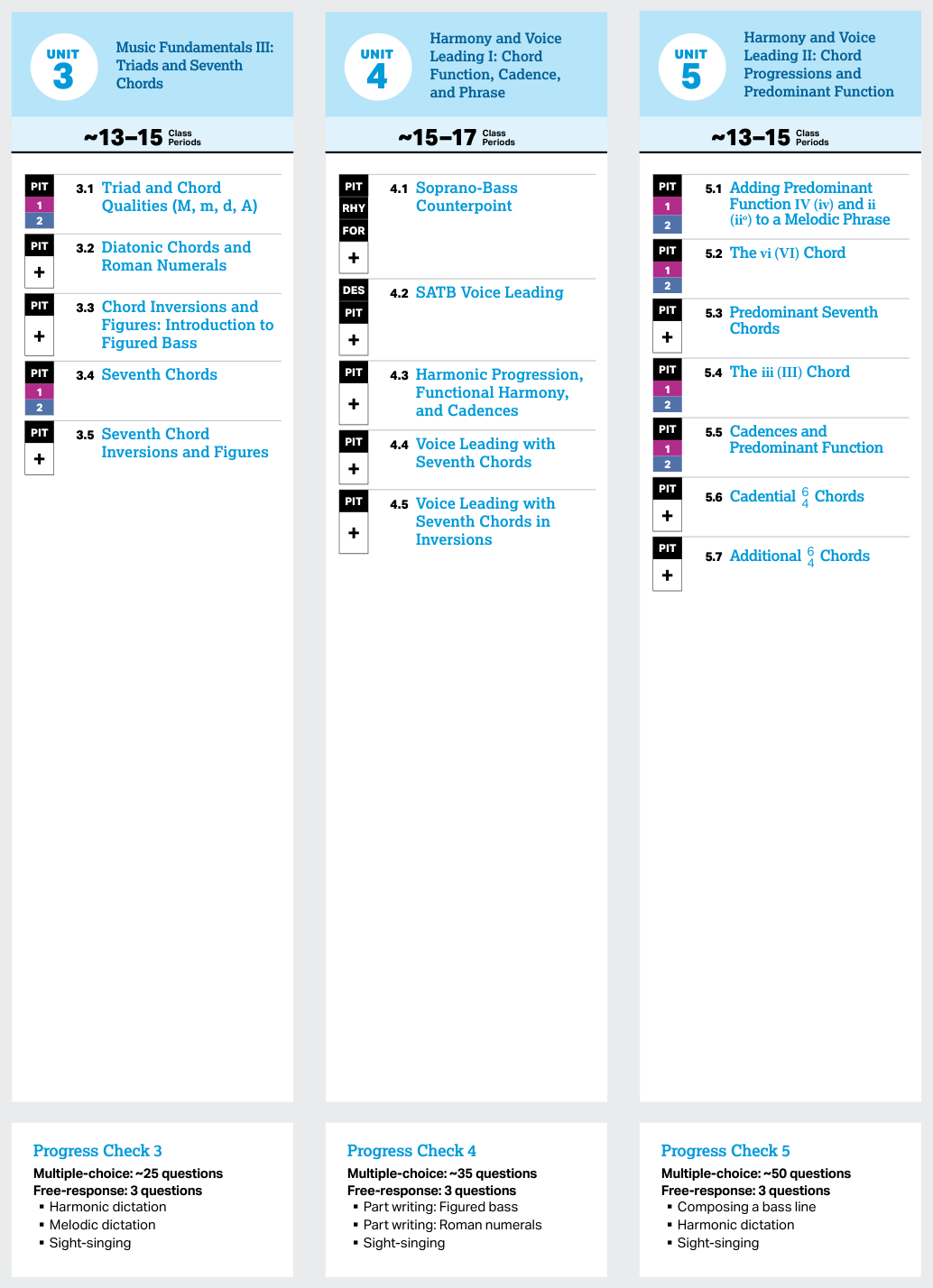
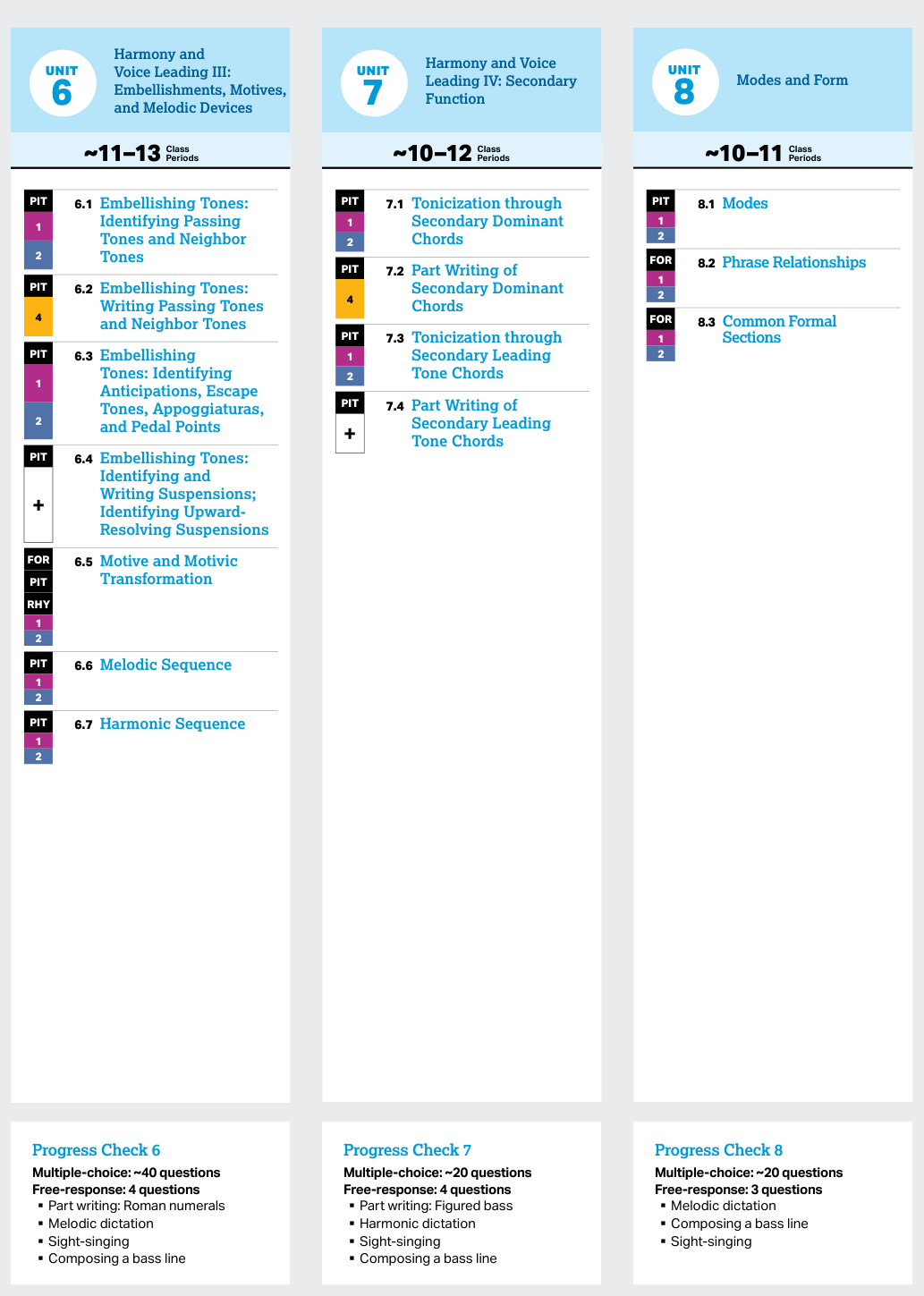
Teachers should review each unit overview for its essential questions, conceptual understandings, and skills. The Unit at a Glance table then shows how topics build toward a common understanding, connects topics to enduring-understanding codes such as pitch, rhythm, form, and musical design, and provides suggested pacing. Pacing is a planning recommendation, not a measure of how quickly a student ought to master a concept.
The four official skill categories
The framework organizes application through four official skill categories. They are not separate “aural” and “written” courses; each is a different direction of travel through the same musical knowledge.
-
Skill 1: Analyze performed music. Students listen for melodic features, chords, harmonic progressions, cadences, motives, phrases, and phrase relationships in music that is heard. The reasoning begins with sound: a listener may identify a cadence by its sense of arrival before labeling the chords that create it.
-
Skill 2: Analyze notated music. Students inspect a score for the same kinds of information, including pitch patterns, rhythmic organization, chord structures, harmonic progressions, cadences, motives, phrases, and relationships among phrases.
-
Skill 3: Convert between performed and notated music. Students translate sound into notation or notation into sound. Melodic and harmonic dictation, sight-singing, and identifying an error in a performed or written passage all require this conversion skill.
-
Skill 4: Complete based on cues. Students produce music from constraints supplied by a prompt: a melody, bass line, figured bass, harmonic progression, stylistic expectation, or other musical cue. Part writing, composition, harmonization, and continuation tasks test whether students can apply conventions rather than merely name them.
Aural analysis is not an accessory
A student who can label a dominant seventh chord on paper but cannot hear its pull toward tonic has learned a symbol without fully understanding the process. Consistent practice should therefore combine aural analysis, score analysis, sight-singing, dictation, and composition.
A productive loop looks like this:
$$ \text{hear} \rightarrow \text{locate or notate} \rightarrow \text{analyze} \rightarrow \text{sing or write} \rightarrow \text{hear again} $$
For example, a listener may hear a melodic leap, locate the corresponding interval in a score, identify the phrase’s cadence, sing the line, and then write a brief continuation. Each pass strengthens a different part of the same musical understanding.
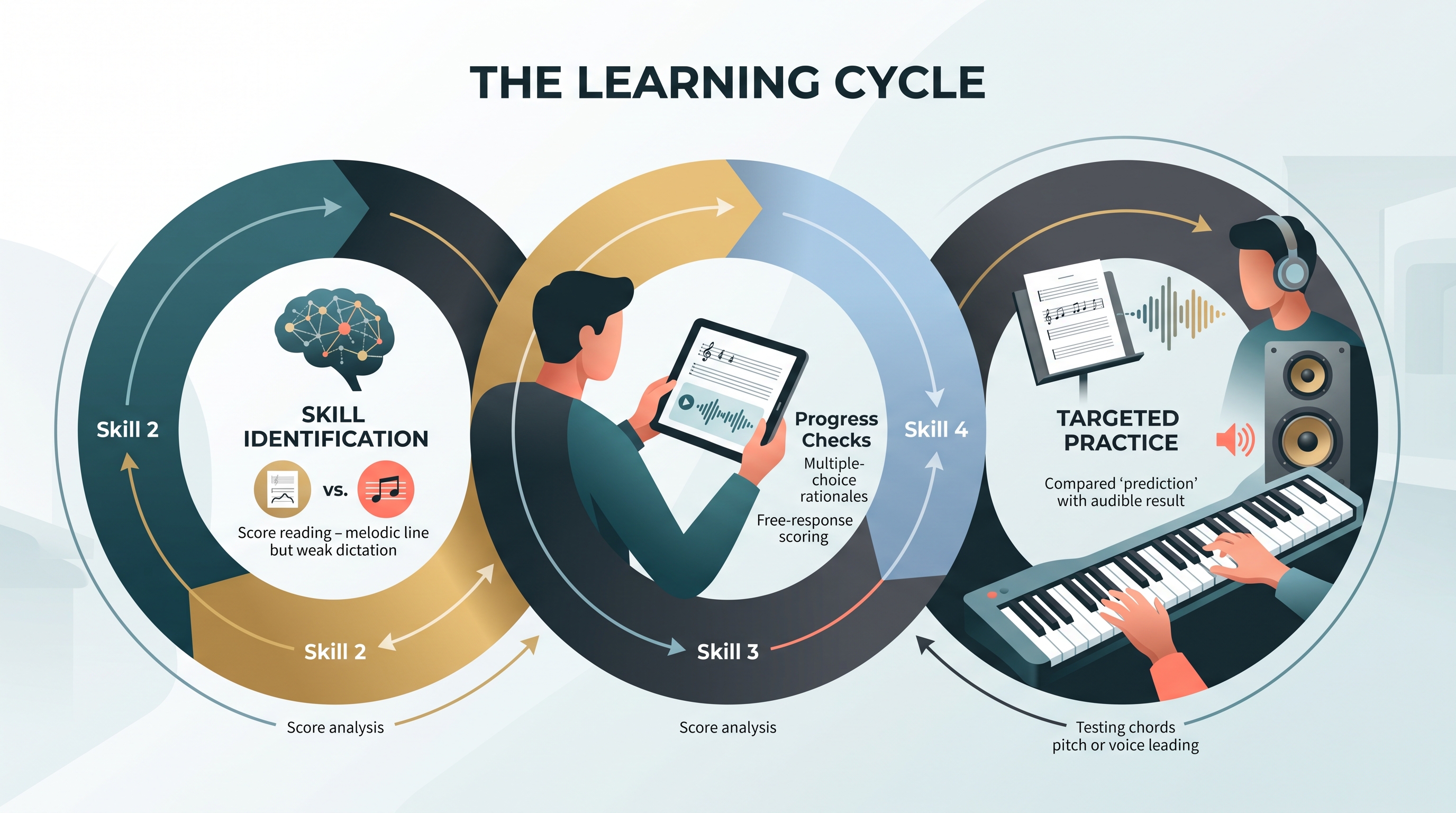
Feedback and the learning cycle
At the end of a unit, Progress Checks combine multiple-choice questions with rationales and free-response questions with scoring information. Question-level feedback identifies the reasoning behind an individual answer; unit- and skill-level feedback helps reveal broader patterns, such as accurate score reading but weak melodic dictation.
A well-equipped classroom supports this cycle with a piano or electronic keyboard, sound-reproduction equipment, and access to audio materials. These are not merely conveniences: reliable sound makes it possible to compare a written prediction with an audible result, while a keyboard makes pitch relationships, chords, and voice leading physically testable.
Retrieval check: If a student hears a cadence, labels it from a score, sings the soprano line, and writes an appropriate bass continuation, which official skills are active? The strongest answer includes Skill 1: Analyze performed music, Skill 2: Analyze notated music, Skill 3: Convert between performed and notated music, and Skill 4: Complete based on cues.


1.1 Pitch and notation
Key concepts: Reading and interpreting pitch notation · Bass clef fluency · Key signatures and tonality · Pitch accuracy and interval recognition · Rhythmic accuracy and subdivisions · Time signatures and meter · Tempo, dynamics, and phrasing · Singing from visual notation · Scalar, leap, and chromatic motion · Starting pitch and tonal context
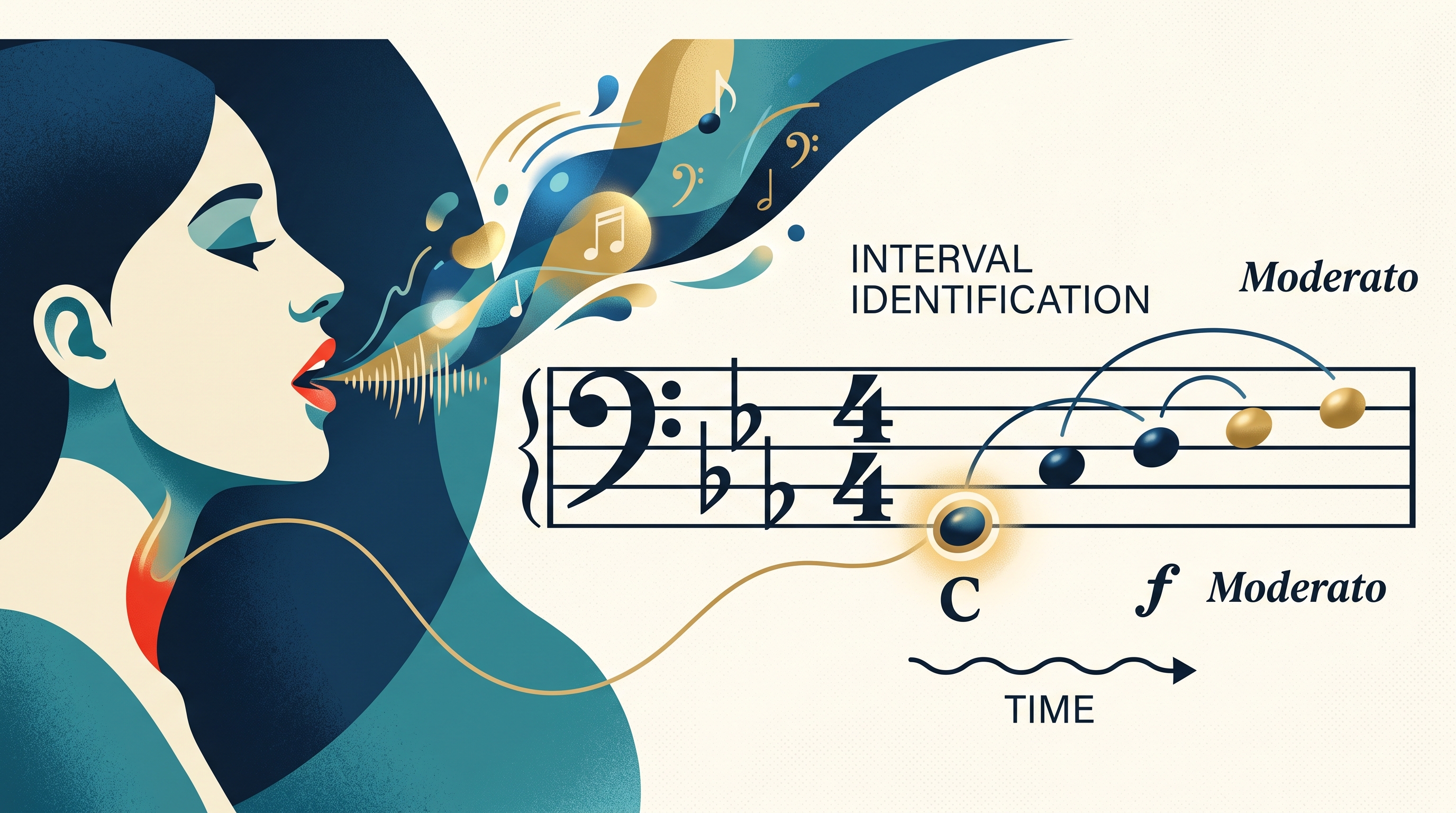
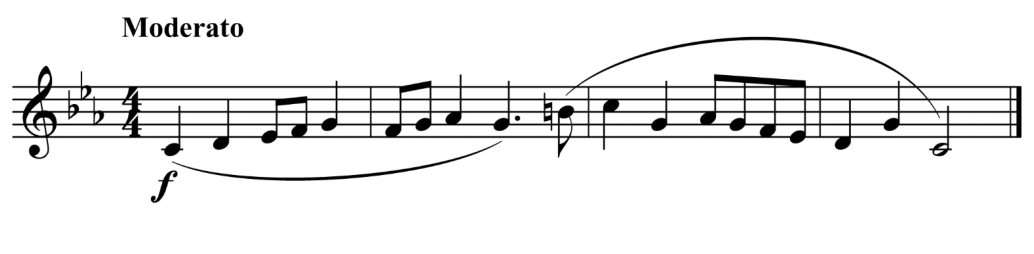
A written melody becomes performable when three coordinates agree: where the pitch sits, which tonal collection governs it, and when the sound occurs. In a bass-clef melody marked with three flats, for example, the performer must read the staff, preserve the key of E-flat major, and keep every note aligned with the…
1.1 Pitch and notation
A written melody becomes performable when three coordinates agree: where the pitch sits, which tonal collection governs it, and when the sound occurs. In a bass-clef melody marked with three flats, for example, the performer must read the staff, preserve the key of E-flat major, and keep every note aligned with the meter.
CED traceability: Topic 1.1 Pitch and notation; Big Idea PIT: Pitch; associated skills include Skill 1: Analyze performed music, Skill 2: Analyze notated music, Skill 3: Convert between performed and notated music, and Skill 4: Complete based on cues. The topic is assessed through visual reading, aural interpretation, and performance from notation.
The staff is a pitch map
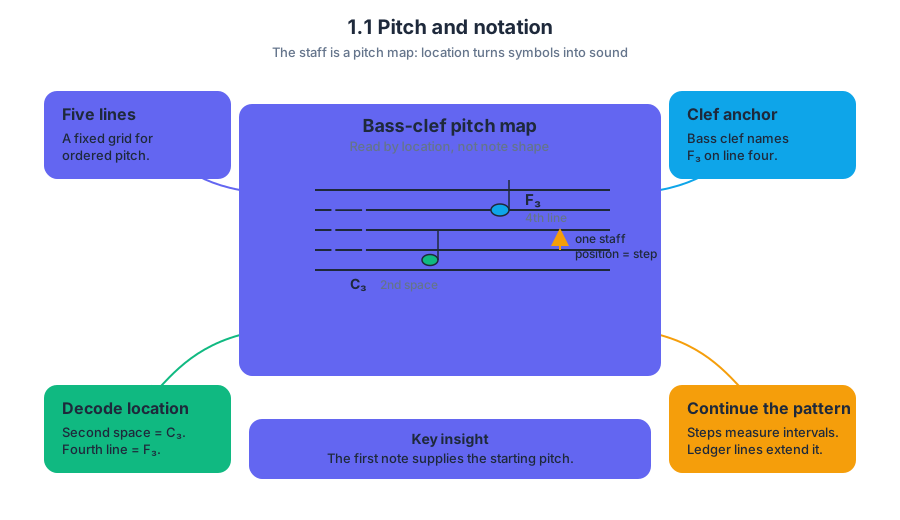
A staff is a set of five horizontal lines. A clef assigns pitch names to those lines and spaces. The bass clef places $F_3$ on the fourth line from the bottom, so the surrounding notes can be decoded relative to that anchor:
For bass-clef fluency, read by location, not by guessing from the shape of a note. A note on the second space is $C_3$; a note on the fourth line is $F_3$. Ledger lines extend the same ordered pattern above or below the staff. Moving one staff position—line to adjacent space or space to adjacent line—produces a scalar step; skipping a staff position creates a larger interval.
Key insight: The printed first note is not decorative. It supplies the starting pitch from which the rest of the melody’s relative intervals can be measured.
Key signatures establish tonality
A key signature is the group of sharps or flats placed after the clef. It tells the performer which pitches are altered throughout the passage unless an accidental changes one temporarily. Three flats—$B\flat$, $E\flat$, and $A\flat$—identify E-flat major or its relative minor, $C$ minor. In a melody clearly centered on $E\flat$, the scale is
$$ E\flat-F-G-A\flat-B\flat-C-D-E\flat. $$
A practical reading routine is:
- Locate the tonic, or tonal “home,” $E\flat$.
- Recall the three flats: $B\flat$, $E\flat$, and $A\flat$.
- Read each notated pitch using the clef and key signature together.
- Listen for whether the melody moves toward or away from the tonic.
The key signature does not mean that every melody begins on the tonic. A printed opening pitch may be a scale degree such as $3$ or $5$, so the performer must maintain the tonal center internally rather than repeatedly searching for the first note.
Steps, leaps, and chromatic motion
Pitch accuracy means producing the correct relative distances between notes, not merely singing isolated pitches. Scalar motion moves by adjacent scale steps; a leap covers a larger interval. For instance, $F_4$ to $B\flat_4$ is a leap of a perfect fourth. Chromatic motion uses a pitch outside the diatonic collection, such as $B\natural$ rising by a half step to $C$.
When reading, identify the contour first: rising, falling, repeated, stepwise, or leaping. Then measure the interval. A leap such as $F_4\rightarrow B\flat_4$ should be heard as a single target distance, while $B\natural\rightarrow C$ should be heard as a tight leading-tone-to-tonic pull.
Misconception check — “The key signature guarantees every note is diatonic.”
It does not. Accidentals can introduce chromatic pitches, and those pitches must be interpreted in context rather than automatically corrected to the key signature.
Meter, tempo, and expressive notation
The time signature $4/4$ indicates four quarter-note beats per measure, with the quarter note receiving one beat. Accurate performance requires both correct durations and a steady pulse. Common subdivisions include dotted quarters and mixtures of eighth and sixteenth notes; the performer must preserve their internal proportions instead of flattening them into approximately equal sounds.
Moderato indicates a moderate tempo. Forte, written $f$, calls for a strong dynamic level, while a slur connects notes into a smooth phrase. The slur usually suggests connected delivery and helps reveal logical breathing or shaping points; it does not erase the individual pitches or their rhythmic values.
| Notation cue | Performance decision |
|---|---|
| Bass clef | Identify pitch from the $F_3$ anchor |
| Three flats | Maintain $B\flat$, $E\flat$, and $A\flat$ |
| $4/4$ | Organize four quarter-note beats per measure |
| Moderato | Keep a moderate, continuous tempo |
| $f$ | Sing with forte intensity |
| Slur | Connect notes and shape the phrase |
Worked reading: from page to performance
Suppose a four-measure bass-clef melody is in E-flat major, begins on the printed pitch $C_3$, and is marked Moderato, $f$, and $4/4$. First, sound or internally hear $C_3$ as the given starting pitch. Next, establish $E\flat$ as tonal home, then decode each note using the bass clef and the three-flat signature. A step such as $C\rightarrow D\rightarrow E\flat$ should feel like a return toward tonic; a leap such as $F_4\rightarrow B\flat_4$ requires deliberate interval targeting.
Before performing, silently count each measure, speak or tap the subdivisions, and trace the slurs. Then sing on note names, scale-degree numbers, solfège, or a neutral syllable. In sight-singing performance, relative pitch, rhythmic accuracy, and continuity matter more than the quality of the singing voice. If a comfortable register is needed, the melody may be transposed while preserving its interval pattern and tonal relationships.
Retrieval check
A melody displays bass clef, three flats, $4/4$, Moderato, and $f$. Name the likely key, identify the altered pitches, state how many quarter-note beats belong in each measure, and explain why the printed first note should be used before singing the remaining intervals. Then distinguish the motion in $G\rightarrow A\flat$ from the motion in $B\natural\rightarrow C$: the first is a diatonic step in E-flat major, while the second is chromatic half-step motion.
1.2 Rhythmic values
Key concepts: Rhythmic accuracy · Quarter-note values · Beamed eighth-note values · Dotted-quarter-note values · 4/4 meter · Maintaining continuity while performing rhythms
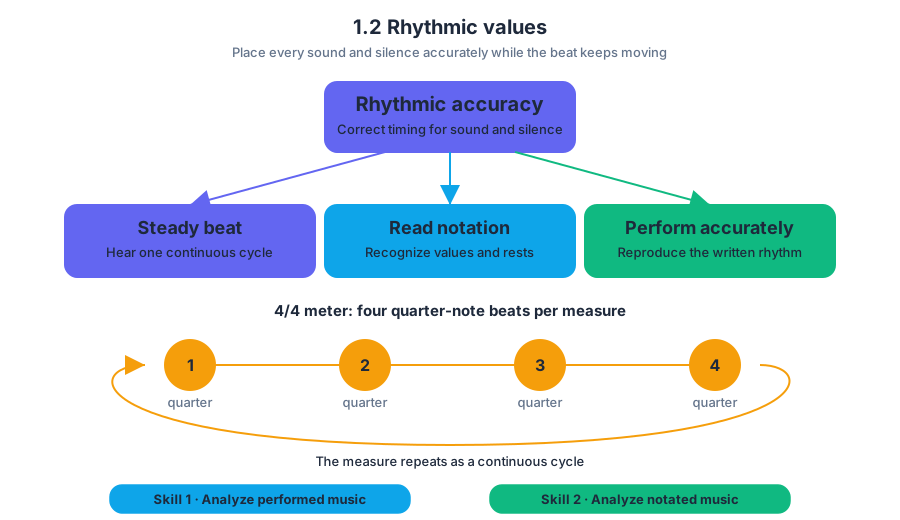
Rhythmic accuracy means placing every sound and silence at the correct moment while keeping the beat moving steadily. In $4/4$ meter, the quarter note is the basic beat: four quarter-note beats fill one measure, so the performer must hear the measure as a continuous cycle rather than as four unrelated events.
1.2 Rhythmic values
Rhythmic accuracy means placing every sound and silence at the correct moment while keeping the beat moving steadily. In $4/4$ meter, the quarter note is the basic beat: four quarter-note beats fill one measure, so the performer must hear the measure as a continuous cycle rather than as four unrelated events.
CED traceability: Topic 1.2 Rhythmic Values belongs to Big Idea RHY and is assessed through Skill 1: Analyze Performed Music and Skill 2: Analyze Notated Music. In practice, these skills work together: you must recognize rhythm in notation and then reproduce it accurately when performing.
The beat as a measuring grid
Imagine a steady walking pulse. Each step is one quarter-note beat. A measure of $4/4$ is four steps long, and the bar line marks the boundary between one group of four steps and the next.
| Rhythmic value | Duration in quarter-note beats | How it fits inside $4/4$ |
|---|---|---|
| Quarter note | $1$ beat | Four quarter notes fill a measure |
| Beamed eighth note | $\frac{1}{2}$ beat each | Two eighth notes fill one beat |
| Dotted quarter note | $1\frac{1}{2}$ beats | Two dotted quarters equal three beats |
The table describes duration, not necessarily emphasis. The first beat of a $4/4$ measure usually feels strongest, the third beat often receives secondary emphasis, and beats two and four are weaker. A correct performance preserves both the exact spacing of notes and the larger four-beat organization.
Quarter notes: establish the pulse
A quarter note lasts exactly one beat. Count a measure containing four quarter notes as:
$$ 1 \quad 2 \quad 3 \quad 4 $$
To perform the pattern accurately, begin with an even internal pulse and avoid stretching the final note of the measure. The next measure must begin on the next beat, not after an unplanned pause.
Worked example: Suppose a melody begins with four quarter notes followed by a bar line. Speak or sing one syllable on each count: “ta” on $1$, “ta” on $2$, “ta” on $3$, and “ta” on $4$. If the fourth note is held too long, the bar line arrives late and every subsequent measure shifts.
Beamed eighth notes: divide the beat, do not accelerate
A pair of beamed eighth notes divides one quarter-note beat into two equal parts. Count the measure with alternating quarter notes and eighth-note pairs as:
$$ 1 \quad 2\text{-and} \quad 3 \quad 4\text{-and} $$
The syllable “and” must occur halfway between numbered beats. The two eighth notes therefore occupy the same total time as one quarter note:
$$ \frac{1}{2}+\frac{1}{2}=1 $$
Worked example: For the pattern quarter note, two eighth notes, quarter note, two eighth notes, count:
The first note sounds on $1$; the next two sounds occur on $2$ and “and”; the following note begins on $3$; and the final pair occurs on $4$ and “and.” Keep the underlying numbered beats equally spaced.
Dotted-quarter notes: three eighth-note subdivisions
A dotted-quarter note lasts one and a half beats because the dot adds half of the original value:
$$ 1+\frac{1}{2}=1\frac{1}{2} $$
In $4/4$, a dotted-quarter note crosses the midpoint between two beats. A useful count is “$1$ and $2$,” with the note beginning on $1$ and continuing through the “and” into beat $2$. If followed by an eighth note, that eighth note begins on the second half of beat $2$.
Worked example: A dotted-quarter note followed by an eighth note occupies two beats:
$$ \text{dotted quarter}+\text{eighth}
1\frac{1}{2}+\frac{1}{2}=2 $$
Do not treat the dotted quarter as two beats. That mistake makes the following eighth note late and usually causes the performer to rush in order to recover.
Rhythmic continuity: never abandon the grid
Continuity means maintaining the rhythmic flow from beginning to end, even after a mistake. In sight-singing and performed-music tasks, a brief wrong note is less damaging than stopping, restarting, or losing the steady tempo.
A reliable procedure is:
- Establish the $4/4$ pulse before beginning.
- Subdivide internally whenever eighth notes or dotted quarters appear.
- Track each bar line as a reset point, not a stopping point.
- If one rhythm goes wrong, rejoin at the next beat or measure.
Named misconception check — “The notation tells me when to pause.” A bar line separates measures but does not automatically create silence. Unless a rest or phrase marking indicates otherwise, continue directly into the next measure.
Named misconception check — “A dotted quarter is just a long quarter note.” The dot changes the duration from $1$ beat to $1\frac{1}{2}$ beats. Its defining feature is that it crosses a beat boundary.
Retrieval check
In $4/4$, how many beats do two beamed eighth notes occupy? How many beats do a dotted-quarter note and an eighth note occupy together? Finally, if you lose your place during a melody, should you stop or continue to the next secure beat?
Answers: two beamed eighth notes occupy $1$ beat; a dotted quarter plus an eighth occupies $2$ beats; and you should continue, preserving the steady pulse and rejoining at the next secure point.
1.3 Half steps and whole steps
Key concepts: Half steps as the smallest interval between two pitches · Whole steps as intervals equal to two half steps · Identifying half-step and whole-step relationships in performed and notated music · Pitch patterns made up of half and whole steps · Major and minor scales as ordered pitch patterns · Ascending and descending scale motion · Accidentals used when a pitch requires notation outside the naturals · Conjunct melodic motion as stepwise movement · Disjunct melodic motion as movement by leaps
A half step is the smallest possible distance between two pitches in the standard pitch system; a whole step is exactly two half steps. These two distances are the musical “atoms” from which scales and many melodic patterns are built.
1.3 Half steps and whole steps
A half step is the smallest possible distance between two pitches in the standard pitch system; a whole step is exactly two half steps. These two distances are the musical “atoms” from which scales and many melodic patterns are built.
Essential Knowledge PIT-1.C.1: Pitch patterns include intervals, scales, triads, seventh chords, and other short successions of notes. The half step, also called a semitone, is the smallest possible distance between two pitches; the whole step, also called a whole tone, equals two half steps.
The pitch-distance map
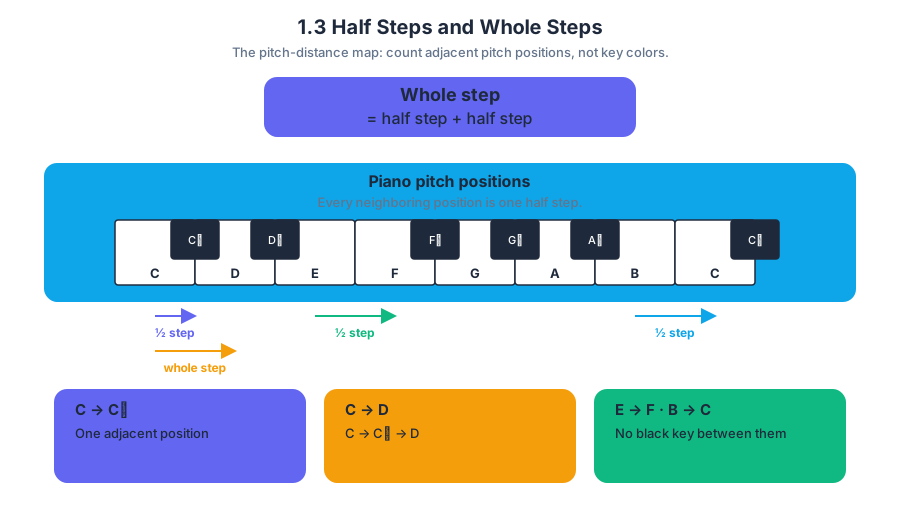
On a piano, a half step moves from one key to the immediately adjacent key, whether that key is black or white. A whole step skips over one half-step position and therefore contains two adjacent half steps.
For example:
- $C$ to $C\sharp$ is a half step.
- $C$ to $D$ is a whole step: $C$ to $C\sharp$, then $C\sharp$ to $D$.
- $E$ to $F$ is a half step, even though no black key lies between them.
- $B$ to $C$ is also a half step.
The visual pattern is therefore not “white key versus black key.” It is adjacent pitch positions:
$$ \text{whole step} = \text{half step} + \text{half step} $$
Accidentals matter
Natural notes—$A$, $B$, $C$, $D$, $E$, $F$, and $G$—do not represent every pitch position. Accidentals alter a natural pitch: a sharp raises it by a half step, a flat lowers it by a half step, and a natural sign cancels a previous sharp or flat.
When a pitch requires an accidental in written music, the accidental appears to the left of the notehead. Thus, $F\sharp$ is one half step above $F$, while $B\flat$ is one half step below $B$. Because $E$ to $F$ and $B$ to $C$ are already half steps, $E\sharp$ sounds like $F$ and $C\flat$ sounds like $B$, although the notation may differ according to musical context.
Common misconception — “A half step always includes a black key.” It does not. $E$–$F$ and $B$–$C$ are decisive counterexamples. The reliable test is adjacency in pitch, not the color of a piano key.
Reading and hearing the distance
PIT-1.C — Learning Objective: Identify half and whole steps presented in:
- performed music;
- notated music.
For notated music, first identify the two pitches by letter name and accidental. Then count the chromatic distance between them. For performed music, listen for the size of the motion: a half step sounds tightly compressed, while a whole step sounds like a slightly wider step. Singing the first pitch and then reproducing the second can be more dependable than relying on visual memory alone.
Worked example: A melody moves upward from $D$ to $E\flat$, then from $E\flat$ to $F$.
- $D$ to $E\flat$ is a half step: $D$–$D\sharp/E\flat$.
- $E\flat$ to $F$ is a whole step: $E\flat$–$E$–$F$.
- The pattern is therefore half step, whole step.
If the same melody is sung rather than written, listen for a narrow first movement followed by a wider second movement. The order matters: reversing the notes produces descending motion, but the distance remains a half step or whole step.
Scale patterns: steps arranged in order
PIT-1.D — Learning Objective: Identify major scales presented in performed music and notated music.
PIT-1.D.1 — Essential Knowledge: Pitches arranged in specific patterns of half and whole steps in ascending or descending order form major and minor scales.
A scale is an ordered pitch pattern. A major scale follows this ascending sequence:
$$ W-W-H-W-W-W-H $$
where $W$ means whole step and $H$ means half step. The pattern is the same when the scale descends, but it is heard and notated in reverse order:
$$ H-W-W-W-H-W-W $$
At this stage, the important task is recognizing the pattern—not yet assigning scale-degree names. Accidentals are often necessary to preserve the required sequence of whole and half steps.
Stepwise motion versus leaps
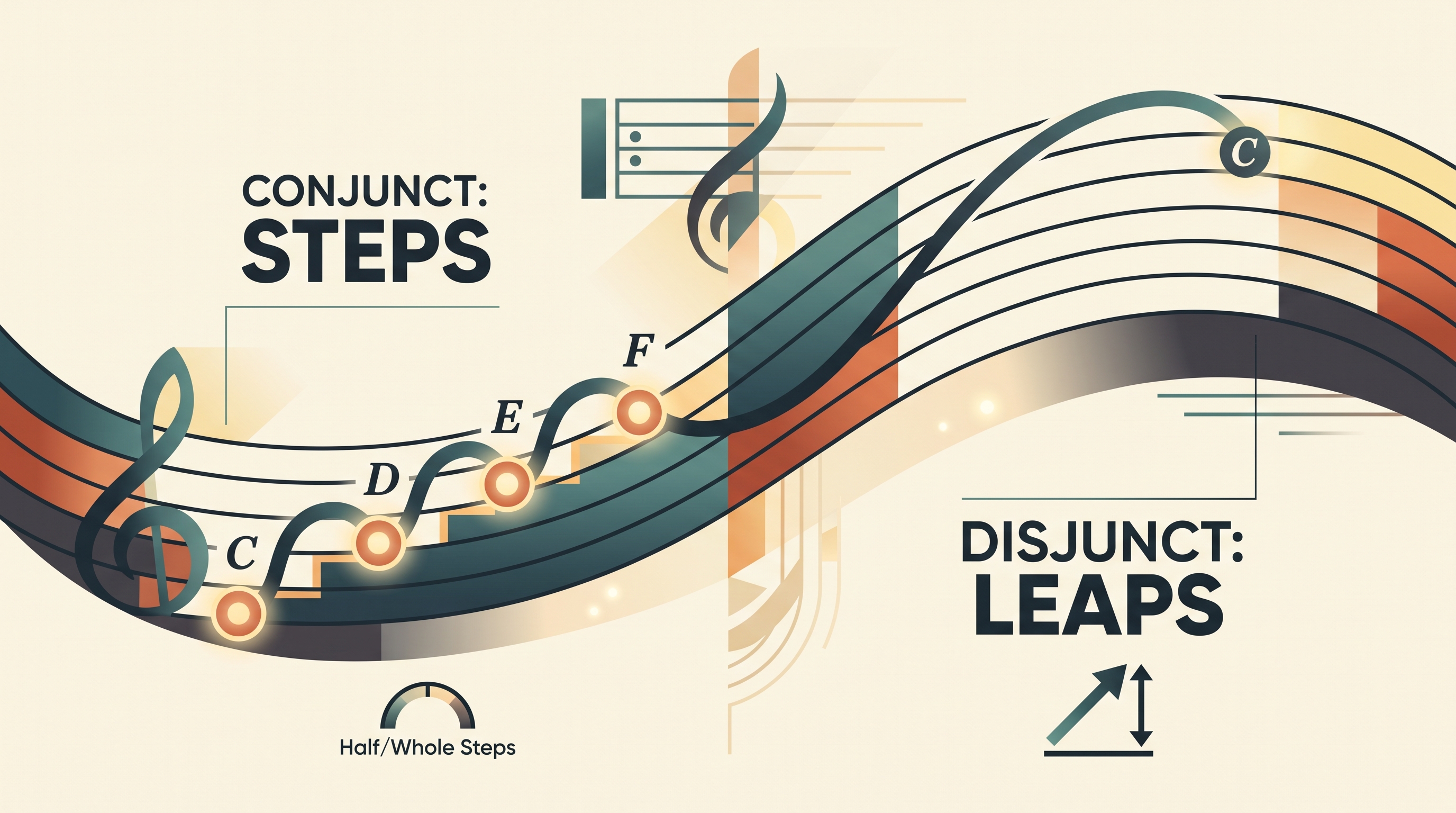
Conjunct motion is stepwise motion, moving by half steps or whole steps. Disjunct motion is leaping motion, moving by an interval larger than a whole step. In the sequence $C$–$D$–$E$, every connection is conjunct; in $C$–$G$, the motion is disjunct. A melody can alternate between the two, so identify each pair of neighboring pitches rather than labeling the entire melody too quickly.
Skill connection: Skill 1: Analyze Performed Music asks you to hear these distances and patterns. Skill 2: Analyze Notated Music asks you to identify them from a score. Skill 3: Convert Between Performed and Notated Music becomes relevant when you hear a step and must represent it with the correct note letter and accidental.
Retrieval check: Classify each motion as a half step, whole step, or leap: $F$ to $G$, $B$ to $C$, and $C$ to $E$. Which accidentals would you need to write if a melody required the pitch one half step above $A$?
1.4 Major scales and scale degrees
Key concepts: Major scales · Minor scales · Scale degrees · Tonic and pitch function · Major pentatonic scales · Major and minor keys · Tonic progressions · Cadences · Melodic dictation · Sight-singing stepwise melodies
A scale degree is a pitch understood by its function relative to a tonic, the pitch that acts as the tonal center of a major or minor scale.
1.4 Major scales and scale degrees
A scale degree is a pitch understood by its function relative to a tonic, the pitch that acts as the tonal center of a major or minor scale. The same sounding pitch can therefore have different scale-degree identities: $G$ is scale degree $\hat{1}$ in G major, but $\hat{5}$ in C major.
From a collection of notes to a tonal system
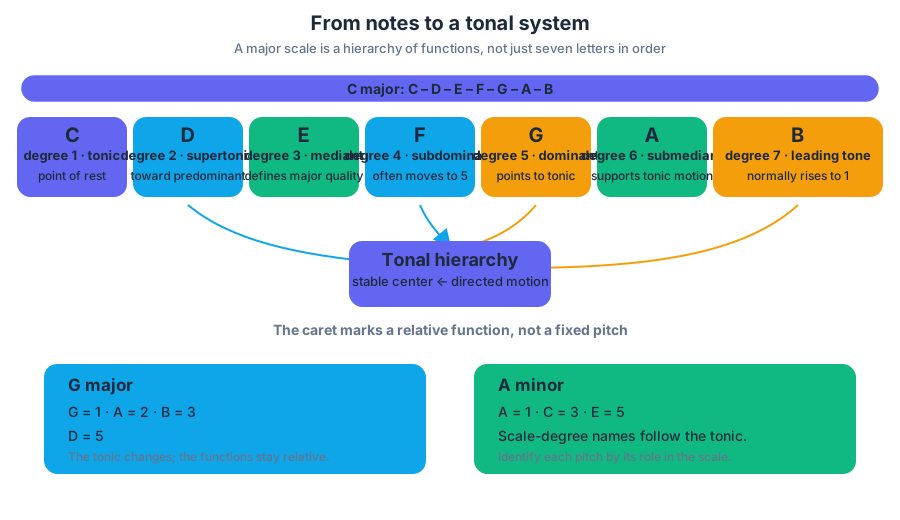
A major scale is not merely seven alphabet letters in order. Its pitches form a hierarchy: some feel stable, while others seem to lean toward the tonic. In C major, the notes are C–D–E–F–G–A–B–C, but their functions are different:
| Scale degree | Name | Function in C major |
|---|---|---|
| $\hat{1}$ | tonic | tonal center and point of rest |
| $\hat{2}$ | supertonic | often moves toward a predominant function |
| $\hat{3}$ | mediant | helps define major quality |
| $\hat{4}$ | subdominant | often moves toward $\hat{5}$ |
| $\hat{5}$ | dominant | strongly points back toward $\hat{1}$ |
| $\hat{6}$ | submediant | often supports tonic-related motion |
| $\hat{7}$ | leading tone | normally rises to $\hat{1}$ |
The caret identifies a scale-degree number, not a fixed pitch. Thus, in G major, G is $\hat{1}$, A is $\hat{2}$, B is $\hat{3}$, and D is $\hat{5}$. In A minor, A is $\hat{1}$, C is $\hat{3}$, and E is $\hat{5}$. This relative labeling is the central idea in PIT-1.E.1: identify the function of a pitch relative to a tonic and its scale using scale-degree names and/or numbers.
Reading major-scale patterns
PIT-1.D.1 requires identifying major scales in both performed music and notated music. A major scale arranges pitches in a characteristic pattern of whole and half steps, ascending or descending. Once the tonic is located, number the successive scale pitches from $\hat{1}$ through $\hat{7}$, then return to $\hat{1}$ at the octave.
Worked example: hearing a cadence
Suppose a melody in C major ends with the pitches B–C. The first pitch is $\hat{7}$, the leading tone, and the final pitch is $\hat{1}$, the tonic. Even without seeing the key signature, the directed motion from $\hat{7}$ to $\hat{1}$ strongly suggests a tonic arrival. If the preceding notes are F–G–C, their scale degrees are $\hat{4}$–$\hat{5}$–$\hat{1}$, a familiar progression into a cadence.
The reasoning is:
- Locate the tonal center: C.
- Translate pitches into relative numbers: F–G–C becomes $\hat{4}$–$\hat{5}$–$\hat{1}$.
- Hear or observe the motion toward $\hat{1}$.
- Describe the ending as a tonic-directed cadence rather than merely naming the notes.
Misconception check — “The highest or last note is always the tonic.” A final note often is the tonic, but not always. A melody may end on another scale degree, and a tonic can appear in the middle of a phrase. Identify the tonal center from the complete melodic and harmonic context, not from location alone.
Major, minor, and pentatonic selection
Major and minor scales each contain seven basic scale pitches, but their scale-degree patterns differ. In a major scale, the third scale degree is major relative to the tonic; in natural minor, the third, sixth, and seventh are lowered in comparison with major. Scale-degree numbers remain functional: $\hat{1}$ still names the tonic in either mode.
A pentatonic scale selects five pitches from the seven pitches of its corresponding major or minor scale. A major pentatonic scale contains $\hat{1}$, $\hat{2}$, $\hat{3}$, $\hat{5}$, and $\hat{6}$. For C major, that produces C–D–E–G–A. A minor pentatonic scale contains $\hat{1}$, $\hat{3}$, $\hat{4}$, $\hat{5}$, and $\hat{7}$ of the natural-minor scale; A minor pentatonic is A–C–D–E–G.
The missing pitches matter: major pentatonic omits $\hat{4}$ and $\hat{7}$, while minor pentatonic omits $\hat{2}$ and $\hat{6}$. Misconception check — “Pentatonic means any five notes.” The five pitches must be selected according to the major- or natural-minor scale-degree pattern.
Performed music, notation, and musical production
Apply Skill 1: Analyze Performed Music by listening for the tonic, scale pattern, and characteristic arrivals such as $\hat{5}$–$\hat{1}$. Apply Skill 2: Analyze Notated Music by locating the tonic in a melody and labeling pitches with scale-degree numbers. Apply Skill 3: Convert Between Performed and Notated Music through melodic dictation: first capture the simple rhythm and contour, then determine the tonic and assign scale degrees before writing exact pitches. Apply Skill 4: Complete Based on Cues by continuing a stepwise melody with pitches that fit the established major-scale pattern.
For sight-singing, identify the tonic and key before singing. Then treat $\hat{1}$ as the home pitch, use stepwise scale patterns for neighboring notes, and preserve the written rhythm. A melody such as $\hat{1}$–$\hat{2}$–$\hat{3}$–$\hat{2}$–$\hat{1}$ can be sung in any major key once its tonic relationship is secure.
Retrieval check
In E major, name the scale-degree numbers of the pitches B, C-sharp, and A. Then identify the major-pentatonic pitches by degree. Finally, explain why a melody ending on D-sharp–E sounds like a tonic arrival. (Answer: B is $\hat{5}$, C-sharp is $\hat{6}$, A is $\hat{4}$; major pentatonic uses $\hat{1}$, $\hat{2}$, $\hat{3}$, $\hat{5}$, and $\hat{6}$; D-sharp is $\hat{7}$ and E is $\hat{1}$.)
1.5 Major keys and key signatures
Key concepts: Major keys · Major scales · Key signatures · Tonic or central pitch · D major · Identifying keys in notated music · Representing scale pitches with a key signature · Major and minor scales · Clefs and notated music
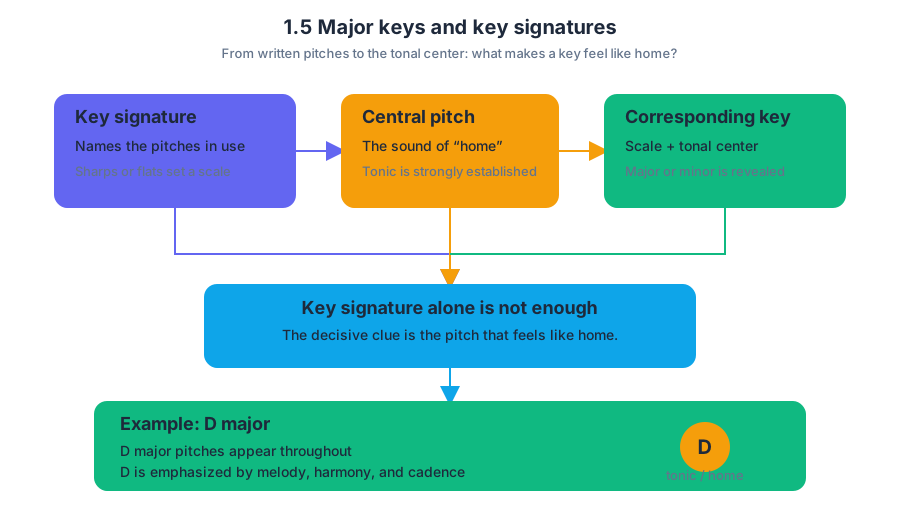
A key signature tells you which pitches belong to a scale, but it does not by itself tell you whether the music is major or minor.
1.5 Major keys and key signatures
A key signature tells you which pitches belong to a scale, but it does not by itself tell you whether the music is major or minor. The decisive clue is the central pitch—the pitch that sounds like “home.”
PIT-1.F.1: When a particular major or minor scale is used prominently and its tonic is established as the central pitch, the music is said to be in the corresponding key.
For example, a passage may use the pitches of the D major scale and repeatedly emphasize $D$ through melody, harmony, or cadence. Because $D$ functions as the tonal center, the passage is in the key of D major.
Key, scale, and key signature
A scale is an ordered collection of pitches. A key is the tonal organization created when one pitch—the tonic, or central pitch—acts as the point of rest. A key signature is the grouping of sharps or flats placed after the clef that represents the pitch collection associated with a major or minor key.
In D major, the scale is:
$$D\ E\ F\sharp\ G\ A\ B\ C\sharp\ D$$
The key signature contains two sharps, $F\sharp$ and $C\sharp$. Once those sharps appear in the signature, every $F$ and $C$ is normally performed as sharp unless an accidental temporarily changes it.
Pitches belonging to the prevailing scale are diatonic. A pitch outside that scale is chromatic. Thus, $F\sharp$ is diatonic in D major, while $F\natural$ is chromatic unless the music changes its tonal context.
Major and minor can share a key signature
A major key and a minor key may use the same key signature. D major and B minor are a crucial example:
| Tonal collection | Pitches | Key signature |
|---|---|---|
| D major | $D\ E\ F\sharp\ G\ A\ B\ C\sharp$ | $F\sharp$, $C\sharp$ |
| B natural minor | $B\ C\sharp\ D\ E\ F\sharp\ G\ A$ | $F\sharp$, $C\sharp$ |
The shared signature represents the natural-minor collection for B minor. Minor music may then alter pitches with accidentals. In B harmonic minor, the seventh scale degree $A$ is raised to $A\sharp$:
$$B\ C\sharp\ D\ E\ F\sharp\ G\ A\sharp\ B$$
In ascending B melodic minor, the sixth and seventh degrees are raised:
$$B\ C\sharp\ D\ E\ F\sharp\ G\sharp\ A\sharp\ B$$
The raised $G\sharp$ and $A\sharp$ are written as accidentals in the music; they are not added to the ordinary B-minor key signature. This distinction matters: the key signature identifies the underlying collection, while accidentals show temporary alterations such as harmonic- or melodic-minor inflections.
Identifying a key signature in notation
Read a key signature in two stages:
- Identify the sharps or flats and their order.
- Decide which pitch acts as tonic.
For sharp signatures, the last sharp is usually one half step below the major tonic. If the signature contains $F\sharp$ and $C\sharp$, the last sharp is $C\sharp$; one half step above it is $D$. The major key is therefore D major.
For flat signatures, the major tonic is generally the second-to-last flat. For example, a signature containing $B\flat$, $E\flat$, and $A\flat$ points to E-flat major, because $E\flat$ is the second-to-last flat. The one-flat signature is the exception: it identifies F major.
The clef changes where the symbols appear on the staff, but not what they mean. In treble clef, a key signature containing $F\sharp$ and $C\sharp$ still means those pitch classes are sharp; in bass clef, the symbols are positioned differently but identify the same signature.
Major or relative minor?
When a key signature could represent either a major or minor key, inspect the musical evidence. Look for the final or longest-held pitch, repeated emphasis, melodic arrival points, and harmonic cadences. A signature of two sharps may indicate D major if $D$ feels like home, or B minor if $B$ is the tonal center.
Common misconception: “The key signature tells me the key automatically.”
A key signature tells you the available default pitches, not necessarily the tonic. The same two-sharp signature can belong to D major or B minor; tonal center determines the answer.
Common misconception: “A raised seventh changes the key signature.”
In minor music, a raised seventh such as $A\sharp$ in B harmonic minor is normally written as an accidental. It changes the pitch used at that moment, not the underlying key signature.
Worked identification
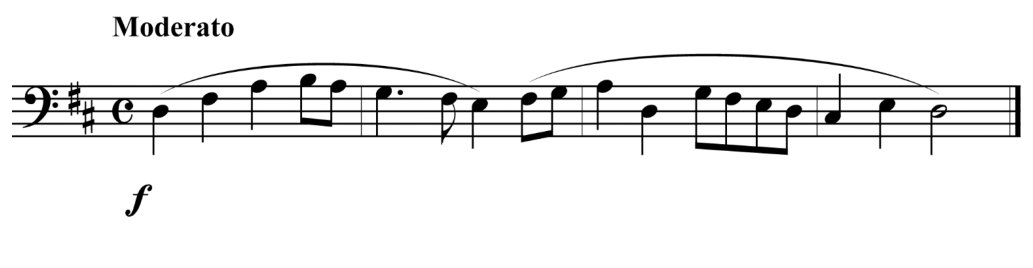
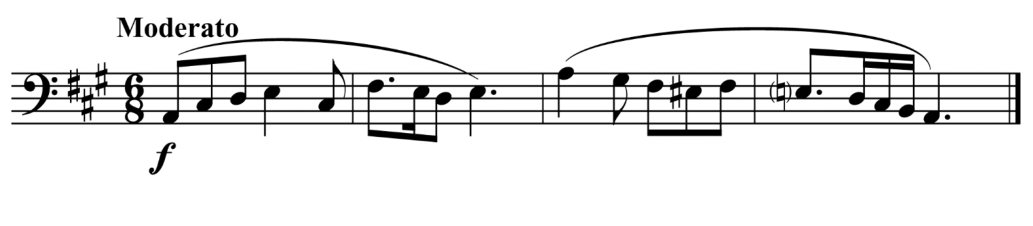
Suppose a bass-clef melody has two sharps in its key signature, repeatedly ends on $B$, and uses $A\sharp$ before the final $B$. The reasoning is:
- Two sharps establish the shared D-major/B-minor pitch collection.
- The repeated arrival on $B$ identifies $B$ as the tonal center.
- The $A\sharp$ is a raised seventh, supporting harmonic minor.
- Therefore, the passage is in B minor, not D major.
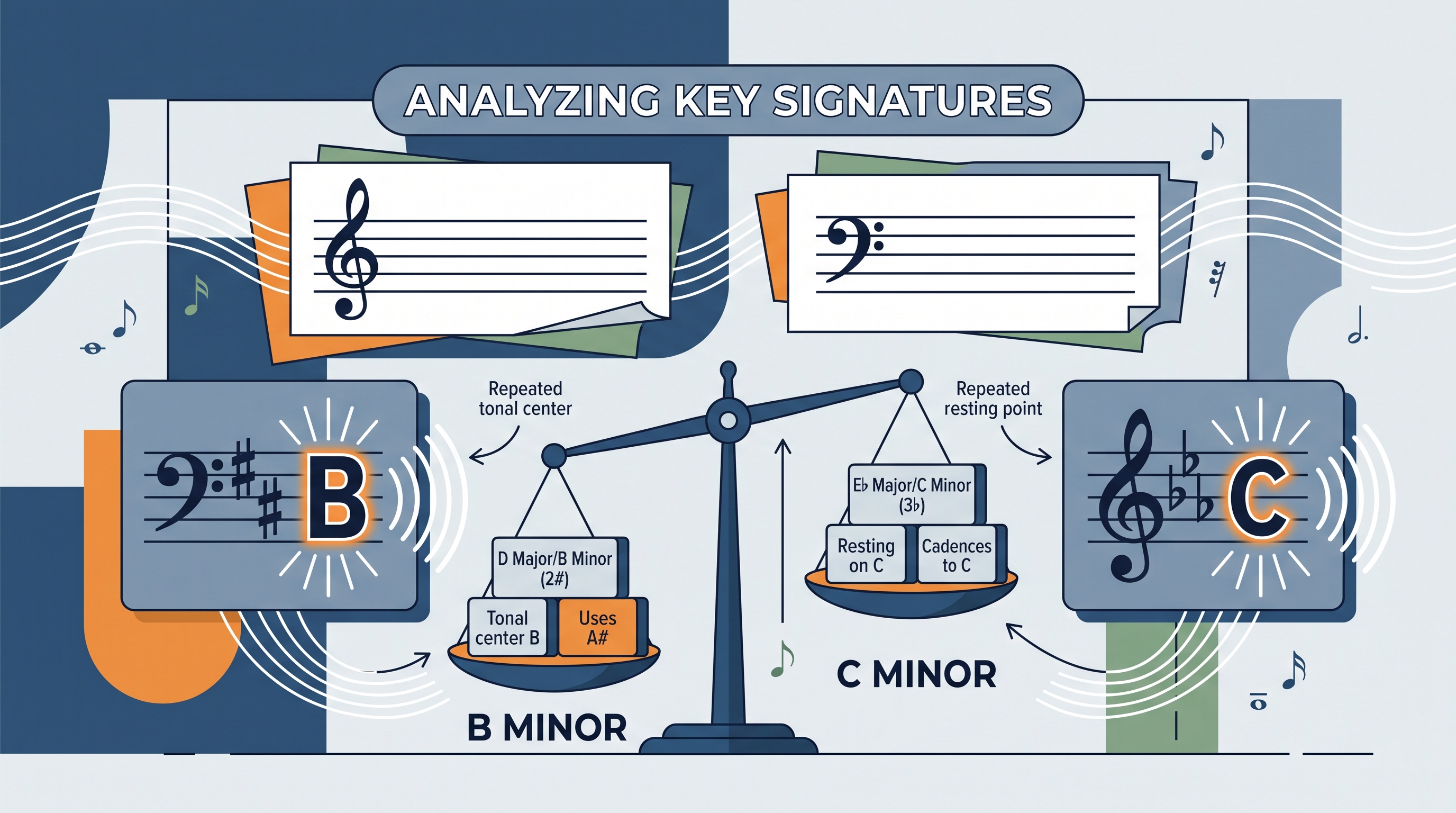
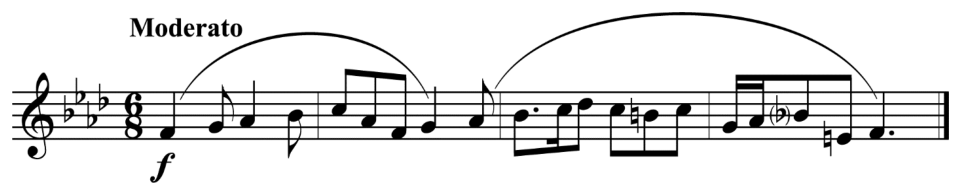
Retrieval check: A treble-clef passage has three flats, repeatedly rests on $C$, and cadences to $C$. Is it C minor or E-flat major? What evidence would confirm your answer, and which pitch alterations might appear in C harmonic or melodic minor?
1.6 Simple and compound beat division
Key concepts: Rhythm · Meter · Beat · Beat division · Measure · Simple meter · Compound meter · Rhythmic values · Rhythmic patterns · Triplets
Rhythm is music organized in time: long and short sounds, separated by silences, unfold against a pulse that listeners can feel even when no instrument states it directly.
1.6 Simple and compound beat division
Rhythm is music organized in time: long and short sounds, separated by silences, unfold against a pulse that listeners can feel even when no instrument states it directly. The crucial question is: How is one beat subdivided—as two equal parts or as three? That distinction creates the difference between simple and compound meter.
RHY-1 — Rhythm and meter: Rhythm is the temporal aspect of music, often governed by a layered structure of interrelated pulses called meter.
The three layers of meter
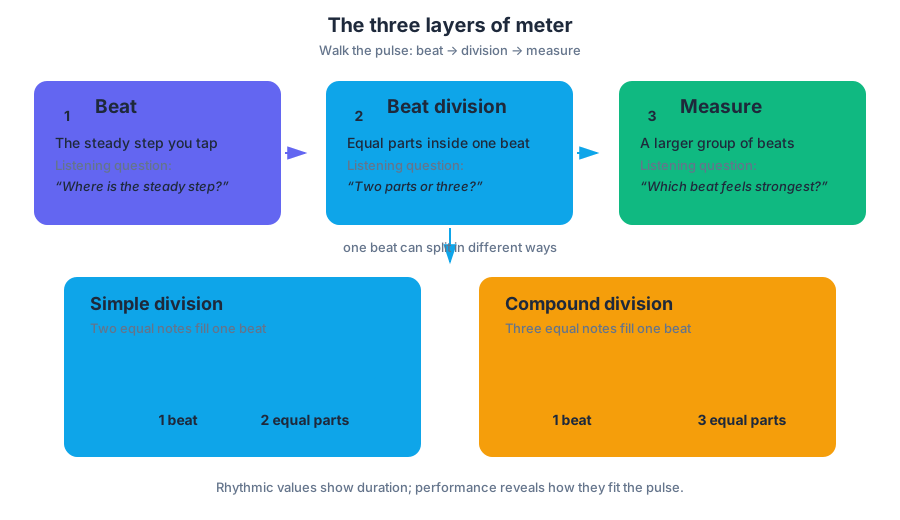
Imagine walking while a drummer plays. Your regular footsteps establish the beat. The smaller motions inside each step establish beat division. The recurring pattern that groups several steps together establishes the measure. These three pulse speeds interlock:
| Pulse layer | What it means | Listening question |
|---|---|---|
| Beat | The recurring pulse you could tap or conduct | “Where is the steady step?” |
| Beat division | The equal parts inside one beat | “Does each beat split into two or three?” |
| Measure | A larger grouping of beats | “Which beats feel stronger or weaker?” |
A rhythmic value symbolizes the duration of a note or rest. Several rhythmic values may fill a single beat. For example, if one beat is divided simply, two equal shorter notes can occupy it; if it is divided compoundly, three equal shorter notes can occupy it. The written symbols show duration, while the performed sound reveals how those durations fit the pulse.
Simple versus compound division
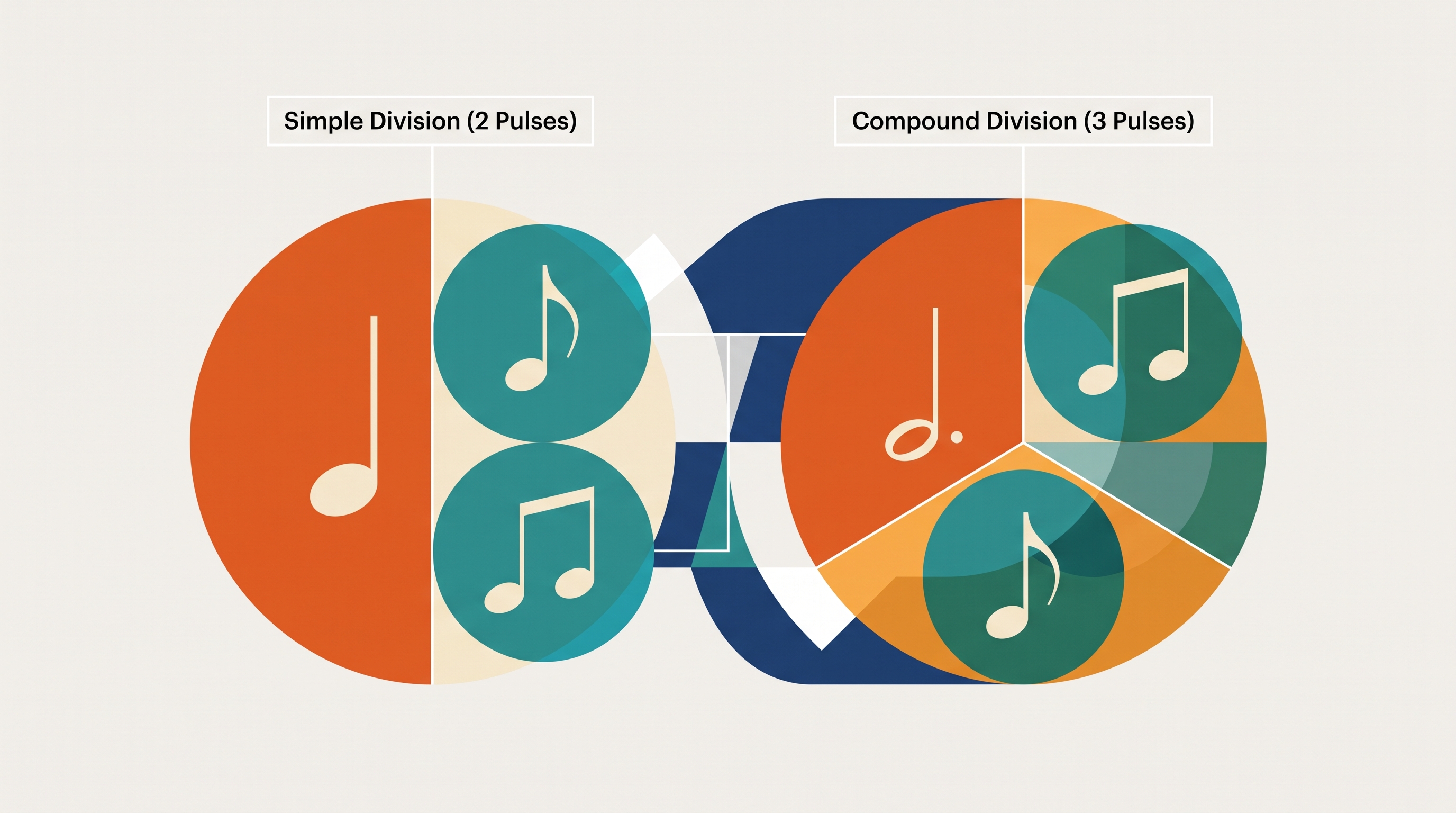
A simple meter is a meter in which the beat is parsed, or divided, into two equal divisions. A compound meter is a meter in which the beat is parsed into three equal divisions.
| Beat division | Internal pattern | Syllabic feel |
|---|---|---|
| Simple | $1;+;2$ equal parts | “one-and” |
| Compound | $1;+;2;+;3$ equal parts | “one-la-li” or “one-and-a” |
The distinction concerns the beat itself, not merely the number of notes visible on the page. A beat in simple meter can contain one note, two equal notes, or a rest-and-note combination. A beat in compound meter can contain one sustained note, three equal notes, or other combinations whose total duration equals the three-part beat.
Triplets: three in the space of two
A triplet occurs when three notes of equal duration take up the time normally held by two notes of equal duration, or when an equivalent three-part grouping is compressed into a two-part rhythmic space. In a simple-meter beat, three eighth-note triplet notes can occupy the duration of two ordinary eighth notes.
Worked example: Suppose one beat normally contains two equal eighth notes:
$$\text{beat} = \text{eighth}+\text{eighth}$$
To create a triplet, fit three equal notes into that same beat:
$$\text{beat} = \text{three triplet notes}$$
The three notes are therefore not three ordinary eighth notes lasting one and one-half beats. Their bracket or numeral indicates that their combined duration has been reduced to the time of two eighth notes.
Misconception check: “Three notes always mean compound meter.”
Correction: A triplet is a temporary three-part subdivision inside a meter that may otherwise be simple. Meter describes the prevailing organization; a triplet describes a local rhythmic event.
Identifying meter in sound and notation
RHY-1.B.1 identifies meter as three interlocking pulse speeds—beat, beat division, and measure. RHY-1.B.2 distinguishes simple beat division, in which the beat divides into two, from compound beat division, in which it divides into three. RHY-1.C and RHY-1.C.1 extend the task to identifying meter type in both performed and notated music.
Meter type depends on two relationships: the relationship of the beat to its division—simple or compound—and the relationship of the beat to the measure. A measure grouping two beats is duple; three beats is triple; four beats is quadruple. Thus, common time, $\binom{4}{4}$, is simple quadruple: the quarter-note beat divides into two eighth-note parts, and four beats group into each measure.
When listening, first tap the steady beat, then speak or sing smaller equal subdivisions. If “one-and, two-and” fits naturally, the division is probably simple. If “one-la-li, two-la-li” fits, the division is probably compound. In notation, inspect the rhythmic values and grouping, but do not decide from the upper numeral alone: the beat’s internal division is essential.
Skill application
This topic develops Skill 1.B — Analyze Performed Music: Use symbols and terms to describe features of rhythm in performed music, including meter, note values, and rhythmic patterns and devices, and Skill 2.B — Analyze Notated Music: Use symbols and terms to describe features of rhythm in notated music, including meter, note values, and rhythmic patterns and devices. It also supports recognizing patterns by ear, reading them aloud, performing them steadily, and notating the heard division accurately.
Retrieval check: A melody feels like each beat contains three equal pulses, but an occasional group of three appears in a passage whose prevailing beat divides into two. Is the passage necessarily compound meter? Name the local device and explain the difference.
Answer: No. The prevailing meter may be simple, while the local group is a triplet—three notes compressed into the time normally occupied by two.
1.7 Meter and time signatures
Key concepts: Simple and compound meter · Time signatures and their upper and lower numbers · Beat division and pulse levels · Triple meter · Compound triple meter · Asymmetrical or irregular meter · Unequal beat groupings · Changing or mixed meter · Identifying irregular beat division · Identifying irregular beat grouping in performed and notated music
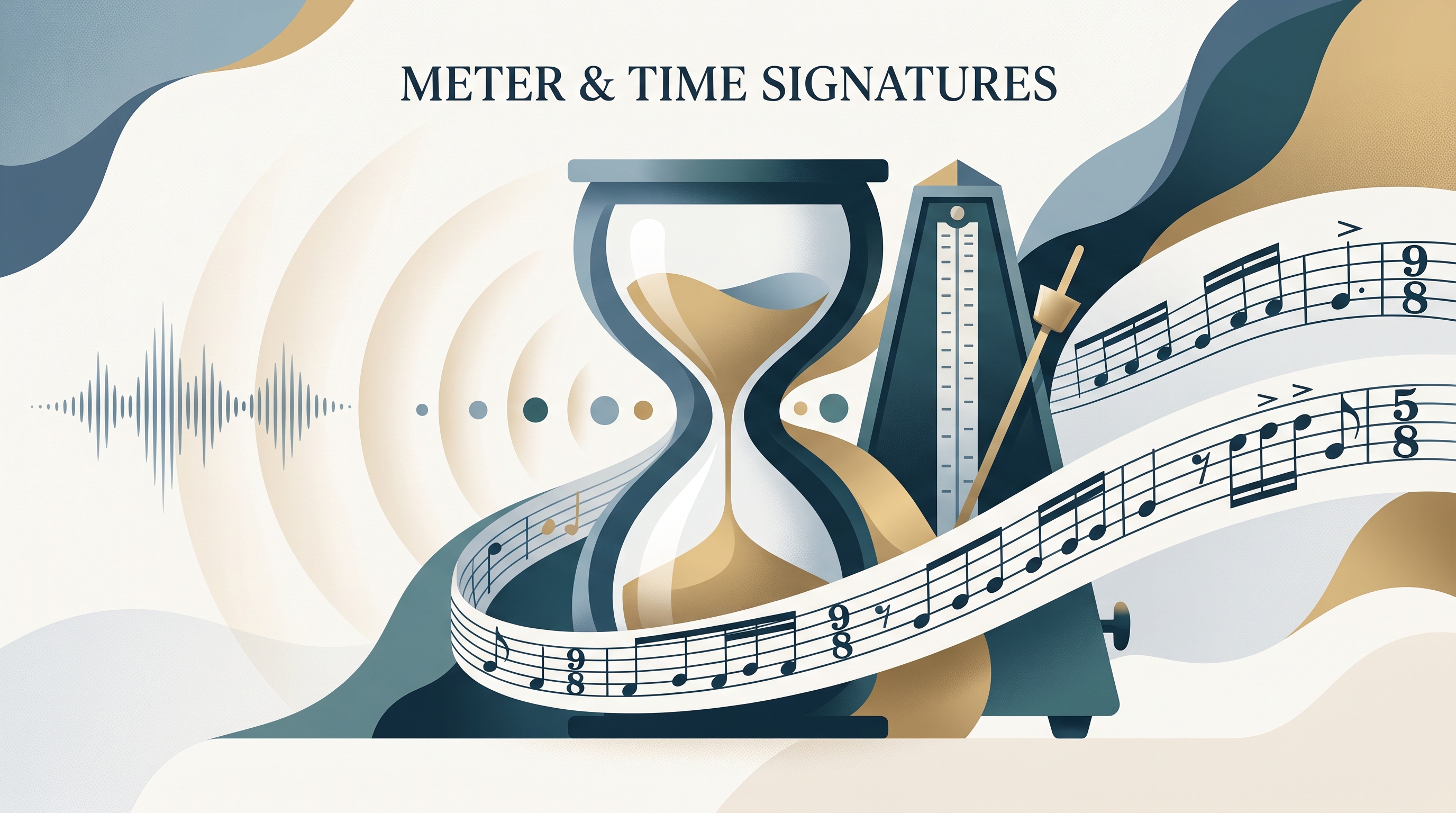
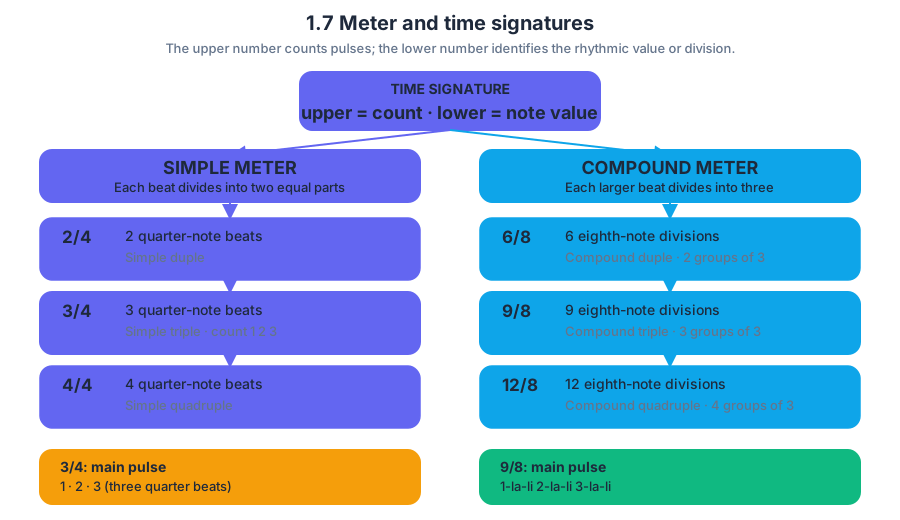
A time signature is a compact map of musical time: its upper number tells you how many beats or pulse levels occupy a measure, while its lower number identifies the note value used as the beat or division.
1.7 Meter and time signatures
A time signature is a compact map of musical time: its upper number tells you how many beats or pulse levels occupy a measure, while its lower number identifies the note value used as the beat or division. Read together, the two numbers reveal whether the meter is simple or compound and whether its basic grouping is duple, triple, or quadruple.
Learning Objective RHY-1.D: Describe the time signature in performed music and notated music.
Essential Knowledge RHY-1.D.1: Time signatures indicate the organization of beats, pulse levels, and divisions, including whether the meter is simple or compound.
Reading the two numbers
In a simple meter, the lower number represents the rhythmic value of the beat. Thus, in $\frac{3}{4}$, the $4$ indicates quarter-note beats, and the $3$ indicates three such beats in each measure. The meter is therefore simple triple meter: simple because each beat divides naturally into two equal parts, and triple because three beats form the measure.
In a compound meter, the lower number represents the rhythmic value of the division rather than the larger beat. The upper number counts those smaller pulse levels and signals the larger grouping:
| Time signature | Pulse divisions | Larger beats | Meter |
|---|---|---|---|
| $\frac{2}{4}$ | 2 quarter-note beats | 2 | Simple duple |
| $\frac{3}{4}$ | 3 quarter-note beats | 3 | Simple triple |
| $\frac{4}{4}$ | 4 quarter-note beats | 4 | Simple quadruple |
| $\frac{6}{8}$ | 6 eighth-note divisions | 2 groups of 3 | Compound duple |
| $\frac{9}{8}$ | 9 eighth-note divisions | 3 groups of 3 | Compound triple |
| $\frac{12}{8}$ | 12 eighth-note divisions | 4 groups of 3 | Compound quadruple |
The key visual distinction is the location of the main pulse. In $\frac{3}{4}$, count three quarter-note beats: $1\ 2\ 3$. In $\frac{9}{8}$, count three larger beats, each containing three eighth-note divisions: $1\text{-la-li}\ 2\text{-la-li}\ 3\text{-la-li}$. The nine eighth notes are not normally nine equally strong beats.
Symmetrical, asymmetrical, and mixed meter
Symmetrical meter organizes the measure into regularly spaced beats or pulse groups. Common simple meters such as $\frac{2}{4}$, $\frac{3}{4}$, and $\frac{4}{4}$, along with compound meters such as $\frac{6}{8}$, $\frac{9}{8}$, and $\frac{12}{8}$, provide predictable accent patterns. The listener can usually anticipate where the larger pulses and recurring accents will occur.
Asymmetrical or irregular meter contains unequal beat groupings within a measure. In $\frac{5}{8}$, the five eighth-note divisions can be grouped as $3+2$ or $2+3$:
$$ \frac{5}{8}=3+2 \qquad\text{or}\qquad \frac{5}{8}=2+3 $$
For $3+2$, the first beat contains three eighth-note divisions and the second contains two. For $2+3$, the order reverses. Although both patterns use five eighth notes, they produce different accent shapes; the grouping must be heard or shown in the notation rather than guessed from the fraction alone.
Changing or mixed meter occurs when the time signature shifts between measures. For example, a passage may contain one measure of $\frac{3}{4}$ followed by one measure of $\frac{4}{4}$:
$$ \left|\frac{3}{4}\right|\ \left|\frac{4}{4}\right|\ \left|\frac{3}{4}\right|\ \left|\frac{4}{4}\right| $$
This differs from asymmetrical meter. A measure of $\frac{5}{8}$ may have unequal internal groupings but retain one time signature; mixed meter changes the time signature itself from measure to measure.
Worked interpretation: $\frac{5}{8}$
Suppose a performed passage accents its eighth notes in the pattern strong–weak–weak–strong–weak. Divide the five pulse divisions into $3+2$:
$$ \underbrace{1\ 2\ 3}{\text{larger beat}}\ \underbrace{4\ 5}{\text{larger beat}} $$
The upper number $5$ tells us that five eighth-note divisions fill the measure, and the lower number $8$ identifies the eighth note as the division value. Because the larger beats contain unequal numbers of divisions, the passage is asymmetrical or irregular meter—not compound triple meter and not simply “five equal beats.”
Listening and notation checks
RHY-1.D requires identifying meter in both performed music and notated music. While listening, locate recurring accents and test possible groupings by tapping the larger pulse. While reading, inspect the time signature, beam groupings, accent marks, and bar lines; notation often makes a $3+2$ or $2+3$ pattern visible.
These observations exercise Skill 1: Analyze performed music and Skill 2: Analyze notated music. They can also involve Skill 3: Convert between performed and notated music when you hear a grouping and represent it with bar lines or rhythmic notation.
Misconception check: The upper number does not always equal the number of large beats. In $\frac{9}{8}$ it counts nine eighth-note pulse divisions, normally organized into three larger beats. In $\frac{5}{8}$ it counts five divisions that may be grouped unequally.
Retrieval check: Classify each passage.
- $\frac{9}{8}$ grouped $3+3+3$
- $\frac{5}{8}$ grouped $2+3$
- One measure of $\frac{3}{4}$ followed by one measure of $\frac{4}{4}$
Answers: $1$ is symmetrical compound triple meter; $2$ is asymmetrical or irregular meter; $3$ is changing or mixed meter.
1.8 Rhythmic patterns and devices
Key concepts: Rhythm · Meter · Note values · Rhythmic patterns · Rhythmic devices · Steady beat · Stressed beats · Augmentation · Diminution · Dotted rhythms
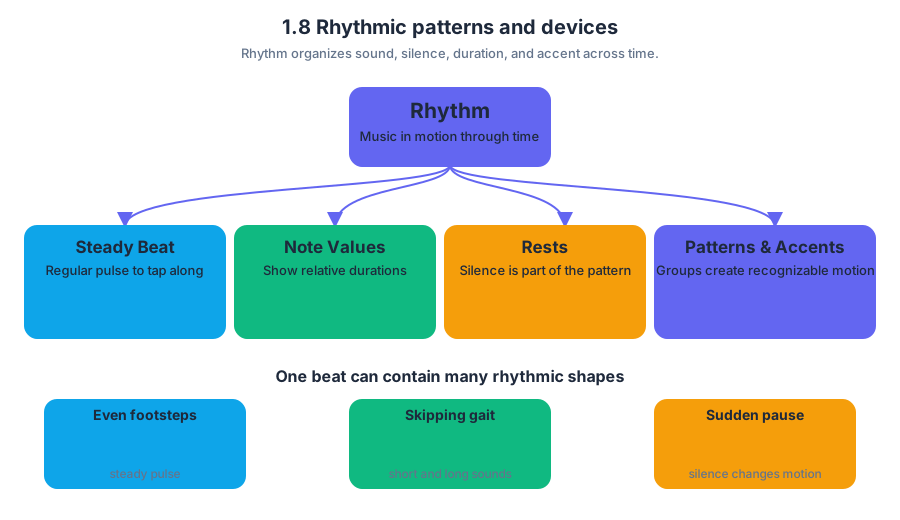
Rhythm is the temporal organization of music: long and short sounds, rests, and accents arranged across time. Against the meter established earlier, rhythm gives a passage its recognizable motion—like the difference between footsteps, a skipping gait, and a sudden pause in a conversation.
1.8 Rhythmic patterns and devices
Rhythm is the temporal organization of music: long and short sounds, rests, and accents arranged across time. Against the meter established earlier, rhythm gives a passage its recognizable motion—like the difference between footsteps, a skipping gait, and a sudden pause in a conversation.
A steady beat is the regular underlying pulse that listeners can often find by tapping along with a recording. The beat is not necessarily every note: several notes may occur within one beat, or a single note may last across several beats. Note values and rests represent these relative durations, while rhythmic patterns group those durations and silences into distinctive combinations.
Hearing rhythm as layers
Listen first for the steady beat, then notice which beats receive emphasis. Stressed beats—especially downbeats—help the ear recognize the meter, while the durations placed around those beats create the rhythm. A useful listening sequence is:
- Tap the pulse without trying to copy every note.
- Notice whether the pulse feels grouped in twos or threes.
- Hear where the music places longer sounds, rests, or accents.
- Describe the resulting pattern using note values and rhythmic-device vocabulary.
For example, imagine four beats in which the first beat contains two equal subdivisions, the second contains a longer sound followed by a shorter one, the third is silent, and the fourth contains two quick sounds. The meter supplies the repeating grid; the rhythm supplies the changing pattern of attacks and silences. If the longer sound begins on a normally weak subdivision, the pattern may sound syncopated—its accent conflicts with the expected metric emphasis.
Rhythmic patterns that challenge regularity
A syncopation occurs when rhythm places emphasis on a weak beat or weak division, often by beginning a note there or sustaining a sound across a stronger beat. The listener still senses the steady beat, but the musical surface pulls against it.
A cross-rhythm, also called a polyrhythm, occurs when two or more rhythmic patterns happen simultaneously and do not derive from one another. The familiar “two-against-three” effect is a cross-rhythm: one layer divides the same span into two events while another divides it into three.
A hemiola creates a temporary reorganization of the metric accents so that a passage heard in groups of three seems briefly grouped in twos, or a passage in twos seems grouped in threes. The contrasting structures may occur successively or simultaneously; when simultaneous, the result can also be understood as a polyrhythmic relationship.
Some patterns are distinctive enough to receive names. A dotted rhythm, for instance, combines a note extended by a dot with a shorter following value. The dot adds half the original note’s value: a dotted quarter note lasts as long as a quarter note plus an eighth note, or $1 + \frac{1}{2} = 1\frac{1}{2}$ beats when the quarter note receives one beat.
Devices that reshape a pattern
Several rhythmic devices alter duration, placement, or emphasis:
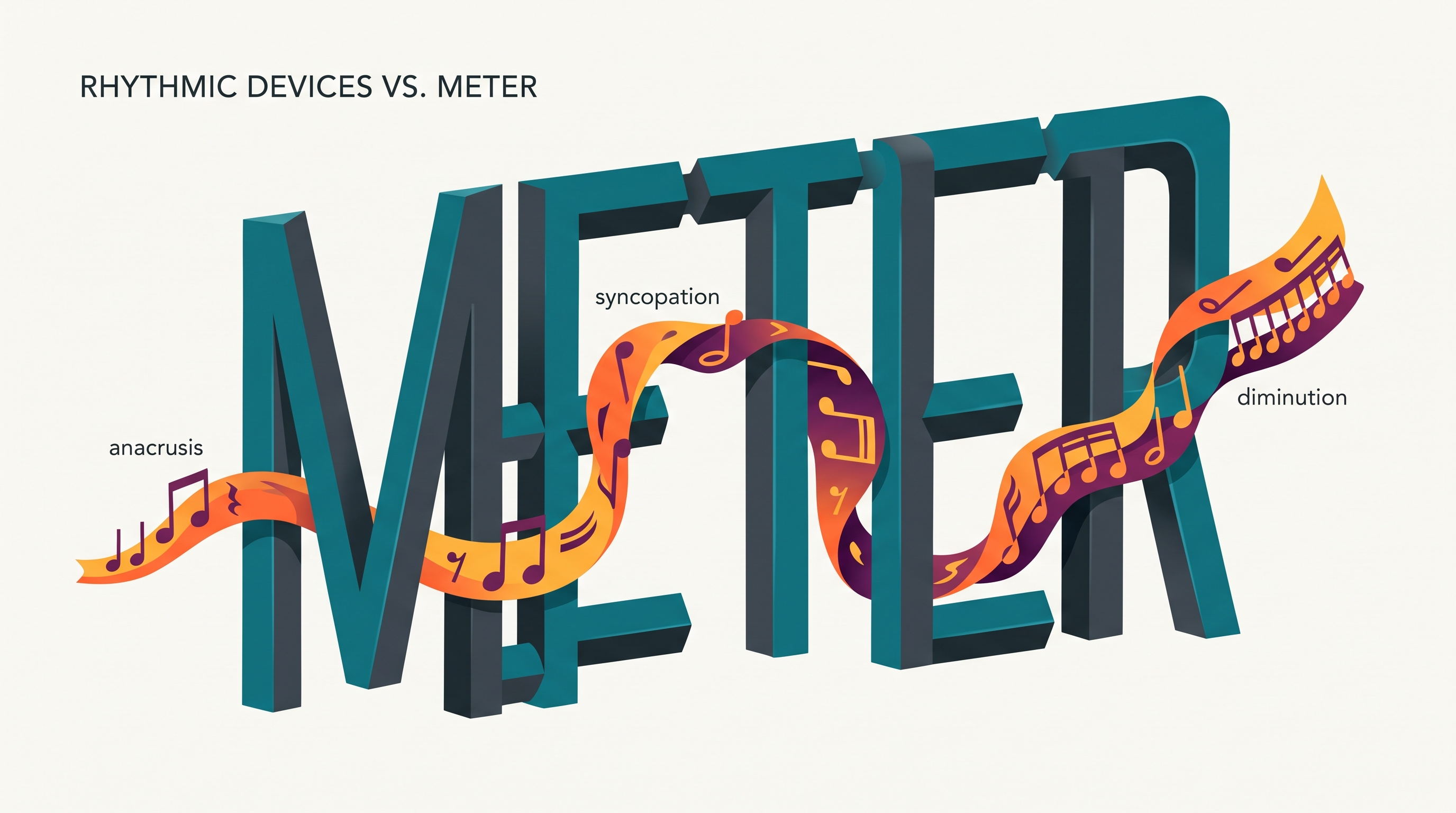
- Augmentation lengthens the note values of an existing rhythmic pattern. If a pattern contains four quarter notes, augmentation might transform it into four half notes while preserving the order of events.
- Diminution shortens the note values while preserving the pattern’s basic design. Four quarter notes might become four eighth notes.
- An agogic accent is emphasis created naturally by a longer note duration.
- An anacrusis, or pickup, is a note or group of notes that begins before the first downbeat of a phrase.
- A fermata placed over a note or rest indicates that it should last longer than its normal written duration.
Worked example: Suppose the original pattern is quarter note, two eighth notes, quarter note, quarter rest. To create diminution, halve every duration: the quarter note becomes an eighth note, each eighth note becomes a sixteenth note, and the quarter rest becomes an eighth rest. The order and contour of activity remain recognizable, but the pattern moves twice as quickly.
Misconception check
Misconception: “Rhythm and meter are the same thing.” Meter is the organized pulse framework; rhythm is the particular arrangement of durations, rests, and accents within—or sometimes against—that framework. A passage can keep the same meter while changing its rhythmic pattern completely.
Skill connection — Skill 1: Analyze performed music. In an aural example, identify the steady beat by tapping, locate stressed beats, and describe the rhythmic pattern or device you hear. In notation, use RHY-1, RHY-3.A.1, RHY-3.A.2, and RHY-3.B.1 to connect what is heard with precise descriptions of rhythmic values, devices, and transformations.
Retrieval check: A melody begins with two short notes before its first strong beat, sustains a note across a weak-to-strong boundary, and later changes four quarter notes into four eighth notes. Name the three devices or features: the opening is an anacrusis, the sustained displacement is syncopation, and the faster version is diminution.
1.9 Tempo
Key concepts: Tempo · Steady tempo · Accurate rhythm · Singing pitches · Performance of given exercises
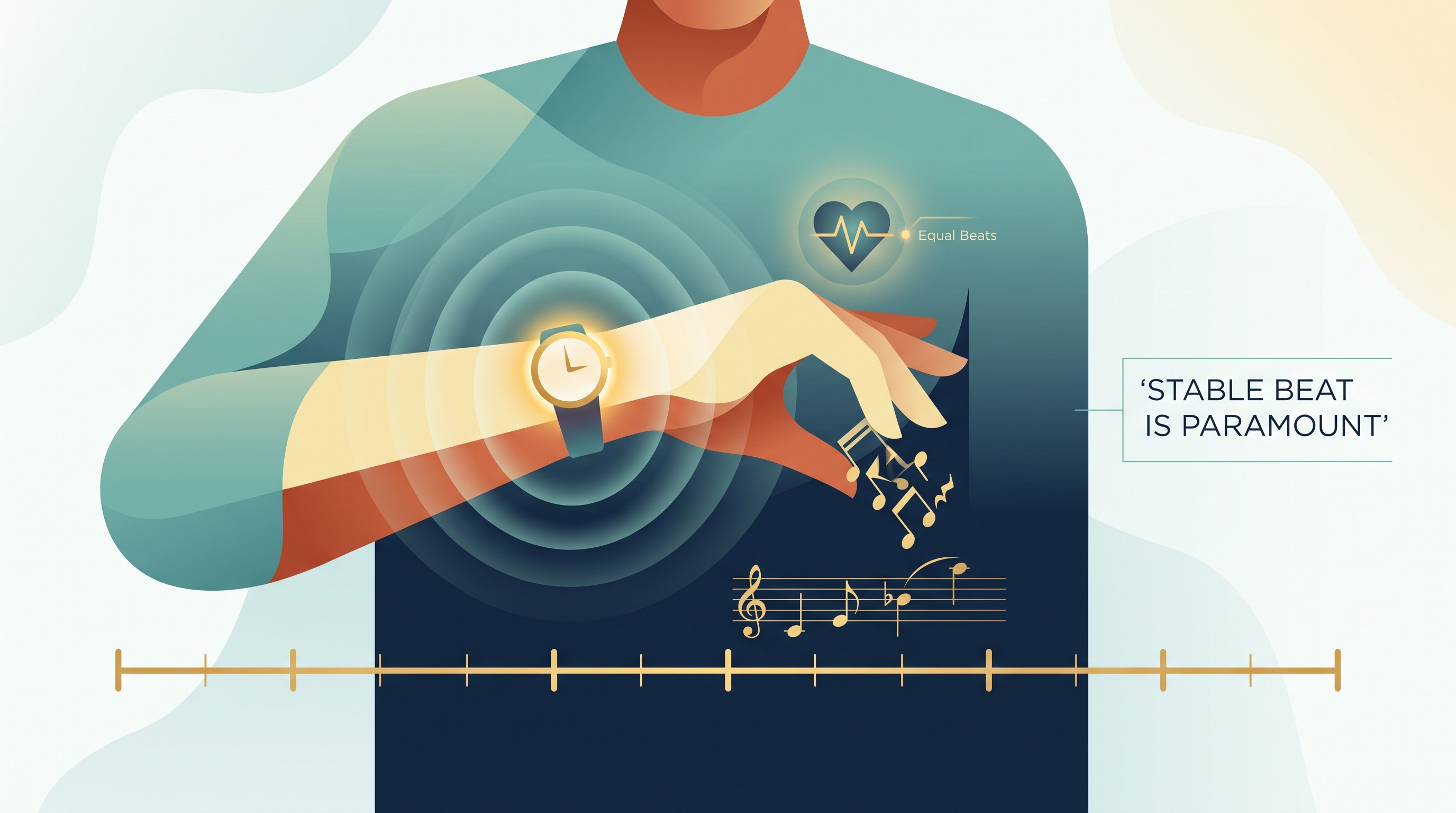
Tempo is the speed of the underlying beat, but successful performance requires more than starting at the right speed: the beat must remain stable while pitch and rhythm continue accurately.
1.9 Tempo
Tempo is the speed of the underlying beat, but successful performance requires more than starting at the right speed: the beat must remain stable while pitch and rhythm continue accurately. In sight singing, a rushed melody can contain the correct notes and still fail because its rhythmic structure and continuity have been damaged.
Steady tempo means maintaining a consistent beat from beginning to end, without unintended speeding up, slowing down, stopping, or restarting.
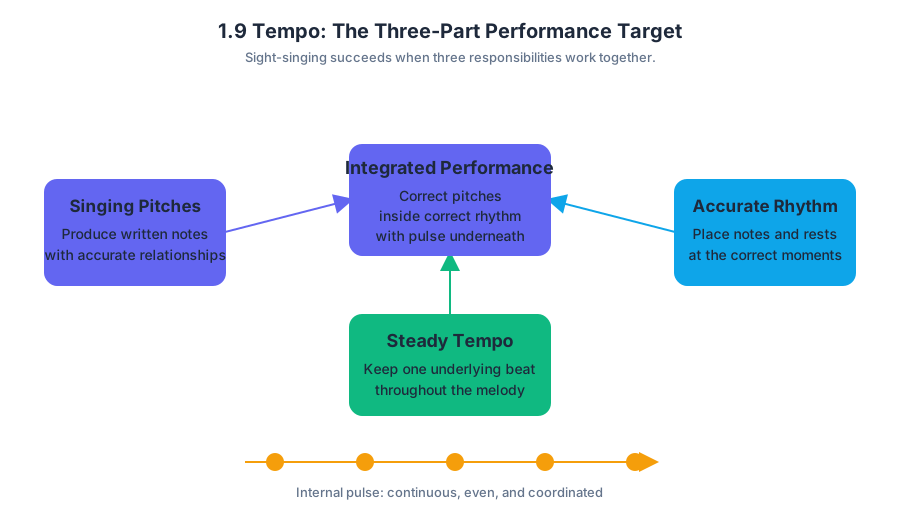
The three-part performance target
A strong sight-singing performance coordinates three independent responsibilities:
| Responsibility | What it means while singing |
|---|---|
| Singing pitches | Produce the written melodic pitches with accurate relative pitch. |
| Accurate rhythm | Enter each note, rest, and sustained duration at the correct moment. |
| Steady tempo | Preserve the same underlying beat throughout the melody. |
The goal is not to perform these in sequence. You must combine them: the voice should move through the correct pitches inside the correct rhythmic pattern while an internally controlled pulse continues underneath.
Tempo is a framework, not a decoration
Imagine walking while reading street signs. If your walking speed changes every time a sign becomes difficult, you may eventually reach the destination, but your movement becomes hesitant and discontinuous. In sight singing, the pulse is the walk: difficult intervals or unfamiliar rhythms should not cause the beat to collapse.
A tempo marking such as Andante or Moderato gives a general speed character rather than an exact universal number. The practical priority is choosing a manageable starting tempo and maintaining it. A slower, controlled performance is usually more effective than a fast performance that accelerates, hesitates, or stops.
A worked sight-singing example
Suppose an original four-measure melody is in common meter and contains this rhythmic outline:
$$ \text{quarter note} ;|; \text{two eighth notes} + \text{quarter note} ;|; \text{half note} ;|; \text{whole note} $$
Assume its pitches move mostly by step, with one larger leap in measure $3$.
Step 1: Establish the beat. During preparation, silently mark four equal beats per measure. Do not begin by guessing the first pitch repeatedly; first feel the pulse that will organize every entrance and duration.
Step 2: Speak or subdivide the rhythm. Count the two eighth notes as subdivisions within one beat. The half note must last for two beats, and the whole note must continue for all four beats of its measure.
Step 3: Sing the pitches on the pulse. If the leap in measure $3$ feels uncertain, identify its starting pitch and target pitch during the practice period, then sing through it without abandoning the beat.
Step 4: Preserve continuity. If a pitch is missed, continue at the next rhythmic entrance. A brief pitch error does not require a full restart; a stopped performance disrupts both tempo and the rest of the melody.
Sight-singing timing and choices
For the current sight-singing task, each of two melodies receives a practice period of $1$ minute and $15$ seconds and a performance period of $30$ seconds. A starting pitch is provided at the beginning of preparation. You may sing using note names, solfège syllables, scale-degree numbers, or a neutral syllable, and you may transpose the melody to a comfortable key.
Use preparation time strategically: mark difficult pitches, scan the meter and key signature, silently trace the contour, and sing aloud before the timed performance. The chosen tempo must allow the entire melody to fit within the performance period while remaining slow enough for accurate rhythm and pitch.
Misconception check: “Steady tempo means never changing speed”
A steady tempo does not mean that expressive music can never contain a written tempo change. It means that, in the absence of such a direction, your beat should not change accidentally because a leap, chromatic pitch, rest, or complex rhythmic cell feels difficult.
Common error: beginning too quickly, then slowing down at the hardest measure.
Correction: select a sustainable tempo before singing and keep a physical or mental pulse. If necessary, simplify the vocal delivery while preserving the written timing and continuity.
Skill connection and retrieval check
This topic primarily activates Skill 1: Analyze performed music, because you must hear and monitor whether the pulse remains stable; Skill 3: Convert between performed and notated music, because notation must become accurately timed sound; and Skill 4: Complete based on cues, because the given melody supplies pitches and rhythms that you must realize in performance.
Retrieval check: You begin a melody at a comfortable speed, but accelerate during a difficult leap and arrive early at the next bar line. Which target was lost first: pitch, rhythm, or steady tempo? What physical or mental action could restore the pulse without restarting?
Answer: The first loss is steady tempo, followed by rhythmic accuracy. Continue rather than restart, re-establish equal beats internally, and enter the next written event at its correct time.
1.10 Dynamics and articulation
Key concepts: Dynamics · Articulation · Tempo · Tempo markings · Moderato · Forte (f) · Relative speed of music · Dynamic level · Sight-singing performance assessment · Musical notation stimulus
A melody can have the correct notes and rhythm yet still sound musically incomplete if it ignores dynamics and articulation. Dynamics shape loudness; articulation shapes how one sound connects to the next.
1.10 Dynamics and articulation
A melody can have the correct notes and rhythm yet still sound musically incomplete if it ignores dynamics and articulation. Dynamics shape loudness; articulation shapes how one sound connects to the next. Together with the already-established pulse, these markings turn notation into an intentional performance.
Dynamics indicate the intended level of loudness or softness. Articulation indicates how individual notes are attacked, connected, separated, or sustained.
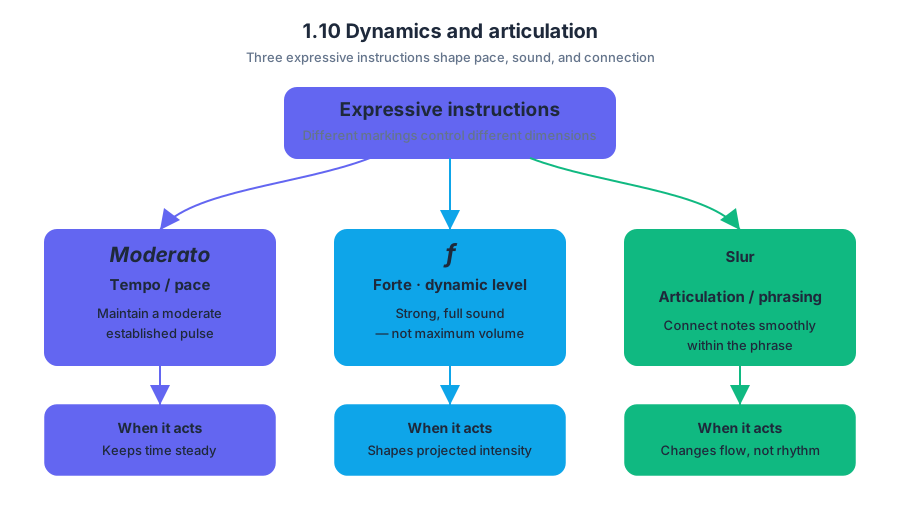
The three expressive instructions
The most important markings in this topic work on different musical dimensions:
| Marking | What it controls | Application |
|---|---|---|
| Moderato | The established tempo or pace | Maintain the previously determined moderate pulse |
| $f$, or forte | Dynamic level | Perform with a strong, full sound |
| Slur | Articulation and phrasing | Connect notes smoothly within the marked phrase |
A dynamic marking communicates the composer’s intended dynamic level. The symbol $f$ is the abbreviation for forte, meaning loud or strong. Forte does not mean “as loud as physically possible”; it means that the passage should project at a strong dynamic level appropriate to its register, instrument, ensemble, and musical context.
A slur is a curved line connecting several notes. In a vocal melody, it generally calls for legato articulation: the notes should flow smoothly, without unnecessary breaks between them. A slur is not a symbol that changes the written rhythm; it changes the manner in which the rhythm is performed.
Worked example: applying all three markings
Consider a four-measure sight-singing melody written on one treble-clef staff. It is in $4/4$ time, has a key signature indicating D major, begins and ends on D, and carries the markings Moderato and $f$. Two long phrasing slurs span measures $1$–$2$ and measures $3$–$4$.
Apply the markings in a deliberate order:
- Secure the notation first. Perform the written pitches and rhythms accurately; expressive choices cannot repair incorrect notes or durations.
- Establish the existing Moderato pulse. Keep the previously determined steady pace rather than allowing the forte marking to make the performance rush.
- Add forte. Use a clear, energized sound from the beginning, while keeping the tone controlled.
- Shape the slurs. Connect the notes in measures $1$–$2$ as one smooth phrase, then do the same for measures $3$–$4$.
- Preserve the written rhythm. Legato does not mean stretching notes or erasing the distinction between quarter notes and eighth notes.
The result should sound like one confident, flowing melody in two phrase units: strong in dynamic level, steady in pulse, and connected in articulation.
A common performance mistake
Misconception: forte means “sing loudly everywhere, regardless of control.” Forte describes a dynamic level, not a command to force the voice. A strained or shouted performance can obscure pitch and rhythm. The better interpretation is a supported, projecting sound that remains accurate and musically stable.
Misconception: a slur changes the rhythm. It does not. A slur changes the connection between notes, while the notation still determines exactly when each note begins and ends. Conversely, misconception: a slur means every note has identical emphasis is also incorrect; connected notes can still have direction within the phrase.
Reading markings in assessment
This topic is assessed through Analyze Notated Music, especially when a student must interpret expressive symbols in a notation stimulus, and through Analyze Performed Music when the listener identifies how dynamics or articulation operate in sound. The relevant musical-design identifiers include DES-3.A and DES-3.A.1: DES-3.A requires students to identify and apply tempo markings in performed and notated music, while DES-3.A.1 establishes tempo as the relative speed of the beat pulse and includes Moderato among moderate tempo indications.
In a sight-singing stimulus, the notated markings are part of the performance task. The melody is presented on a single treble-clef staff, and the performer must preserve accurate pitch, rhythm, and steady pulse while interpreting $f$ and the phrasing slurs. Regular scoring divides the melody into eight half-measure segments, awarding a point for a segment performed with correct pitch, rhythm, and tempo; a separate flow point rewards a complete response without hesitations or restarts when the required condition is met. Therefore, expressive markings should be integrated without sacrificing the elements that directly establish continuity and accuracy.
Retrieval check
A melody is marked Moderato, $f$, with a slur over two measures. What should change in performance: the pulse, the dynamic level, the articulation, or all three?
Answer: The pulse follows the established Moderato instruction, the dynamic level becomes forte, and the notes within the slur are connected smoothly. The written pitches and rhythms remain unchanged.
2.1 Minor scales: natural, harmonic, and melodic
Key concepts: Natural minor scale · Harmonic minor scale · Melodic minor scale · Major and minor scales · Altered forms of scales · Pitch patterns · Modes in relation to major and minor scales · Locrian mode · Key signatures · Chromatic alterations
A minor scale is not one fixed staircase of pitches: it can change its upper degrees depending on whether the music needs a darker color, a stronger pull toward the tonic, or a smoother melodic line.
2.1 Minor scales: natural, harmonic, and melodic
A minor scale is not one fixed staircase of pitches: it can change its upper degrees depending on whether the music needs a darker color, a stronger pull toward the tonic, or a smoother melodic line. The three forms—natural minor, harmonic minor, and melodic minor—are altered forms of the natural minor scale.
PIT-1.G: Identify forms of the minor scale, including natural, harmonic, and melodic forms, in performed music and notated music.
The basic pitch staircase
A scale is an ordered collection of pitches arranged by specific patterns of half steps and whole steps. A major or minor scale presents pitches successively, either ascending or descending, and gives the listener a tonal “map.” The pattern determines the sound more precisely than the note names alone.
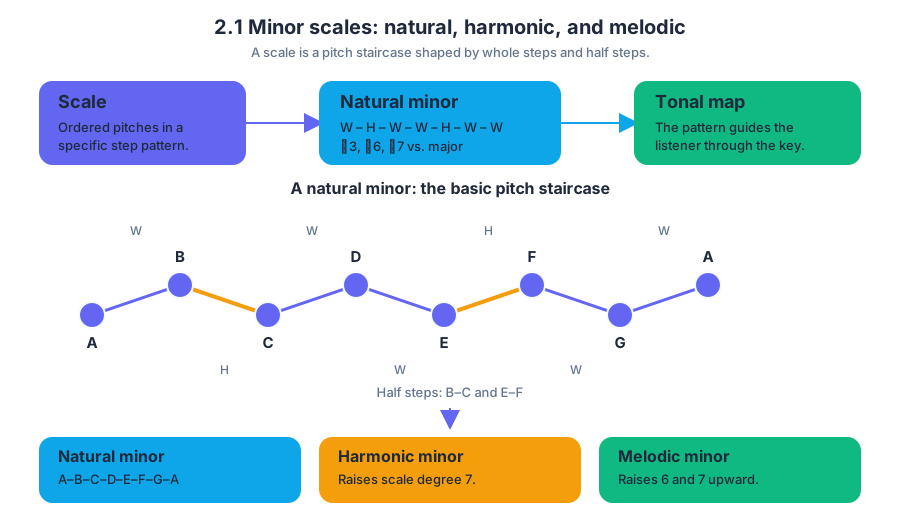
For a natural minor scale, the scale degrees follow this pattern:
$$ \text{whole} - \text{half} - \text{whole} - \text{whole} - \text{half} - \text{whole} - \text{whole} $$
In scale-degree notation, natural minor has lowered scale degrees $\hat{3}$, $\hat{6}$, and $\hat{7}$ when compared with the parallel major scale. For example, A natural minor uses the same pitch collection as C major:
$$ \text{A - B - C - D - E - F - G - A} $$
The half steps occur between B–C and E–F. Its third scale degree, C, gives the scale its minor quality.
Three forms, one minor tonic
The forms of minor are best understood by beginning with natural minor and then identifying which pitches have been chromatically altered.
| Form | Ascending pitch pattern in A minor | Defining alteration | Musical effect |
|---|---|---|---|
| Natural minor | A–B–C–D–E–F–G–A | No alteration | Dark, stable minor collection |
| Harmonic minor | A–B–C–D–E–F–G$\sharp$–A | Raised $\hat{7}$ | Strong leading-tone pull to A |
| Melodic minor, ascending | A–B–C–D–E–F$\sharp$–G$\sharp$–A | Raised $\hat{6}$ and $\hat{7}$ | Smoother ascent toward the tonic |
| Melodic minor, descending | A–G–F–E–D–C–B–A | Returns to natural minor | Familiar minor descent |
The harmonic minor scale raises scale degree $\hat{7}$ by a half step. In A minor, G becomes G$\sharp$. This creates the leading tone, which lies a half step below the tonic A and strongly directs the ear upward:
$$ \text{G}\sharp \rightarrow \text{A} $$
The distance from F to G$\sharp$ is an augmented second, a larger-than-usual melodic leap. That distinctive sound often signals harmonic minor in performed or notated music.
The melodic minor scale raises both $\hat{6}$ and $\hat{7}$ when ascending. In A minor, F becomes F$\sharp$ and G becomes G$\sharp$:
$$ \text{A - B - C - D - E - F}\sharp\text{ - G}\sharp\text{ - A} $$
The raised sixth removes the augmented second between F and G$\sharp$, making the ascent more stepwise. In the conventional form, the descending scale returns to natural minor. A passage does not have to play every scale degree in order; a few altered pitches can still reveal the minor-scale form.
Notation: key signature versus chromatic alteration
A key signature indicates the default pitches associated with a key on the staff. It does not permanently prevent other pitches from appearing. Harmonic and melodic minor forms usually require accidentals—such as $\sharp$, $\flat$, or $\natural$—because their raised scale degrees are chromatic alterations of the natural-minor collection.
For example, a melody in A minor has no sharps or flats in its key signature. If the melody uses G$\sharp$ to create a leading tone, the sharp must normally be written as an accidental beside the G. If it ascends through F$\sharp$ and G$\sharp$, both pitches must be shown as chromatic alterations unless the notation system has already established them within the measure.
Named misconception — “A minor has no sharps.”
A minor has no sharps or flats in its key signature, but music in A minor may still use G$\sharp$, F$\sharp$, or other accidentals. Confusing the key signature with the complete set of pitches used in a passage is one of the fastest ways to misidentify harmonic or melodic minor.
Minor scales and modes
Modes are also ordered pitch collections, but they are not simply interchangeable names for major and minor scales. Ionian corresponds to the major scale, while Aeolian corresponds to natural minor. Other modes, including Locrian, have their own characteristic scale-degree patterns and tonal behavior. Locrian is especially unstable because its tonic triad contains a diminished fifth.
When analyzing tonality, ask two separate questions: What is the tonic? and Which pitches surround it? A passage centered on A may use natural minor, harmonic minor, melodic minor, or even a modal collection. The presence of a raised $\hat{7}$ strongly supports a leading-tone function, but the entire melodic and harmonic context determines the most convincing interpretation.
Worked example: identifying the form
Consider the ascending passage:
The tonic is A, and the passage contains raised $\hat{6}$, F$\sharp$, and raised $\hat{7}$, G$\sharp$. Because both degrees are raised in the ascending direction, the passage uses the ascending form of melodic minor. If the same passage contained F natural but G$\sharp$, it would be harmonic minor. If it contained F natural and G natural, it would be natural minor.
Skill connection and retrieval check
This topic develops Skill 1: Analyze Performed Music by asking you to hear the raised leading tone or the characteristic augmented second in a melody. It develops Skill 2: Analyze Notated Music by requiring you to read the key signature, inspect accidentals, and identify the resulting pitch pattern. The same terminology applies to both heard and written music, supporting musical expression across genres, media, and styles.
Retrieval check: A melody centered on E contains C natural, D natural, and D$\sharp$, but no alteration to scale degree $\hat{6}$. Which minor form is most strongly indicated, and why?
Answer: Harmonic minor. In E minor, D is scale degree $\hat{7}$; raising it to D$\sharp$ creates the leading tone E. Because C remains natural, the passage does not show the raised $\hat{6}$ characteristic of ascending melodic minor.
2.2 Relative keys: determining relative minor keys and notating key signatures
Key concepts: Minor keys · Relative major and relative minor keys · Key signatures · Modes: major and minor · Parallel major and minor keys · Notation of minor keys
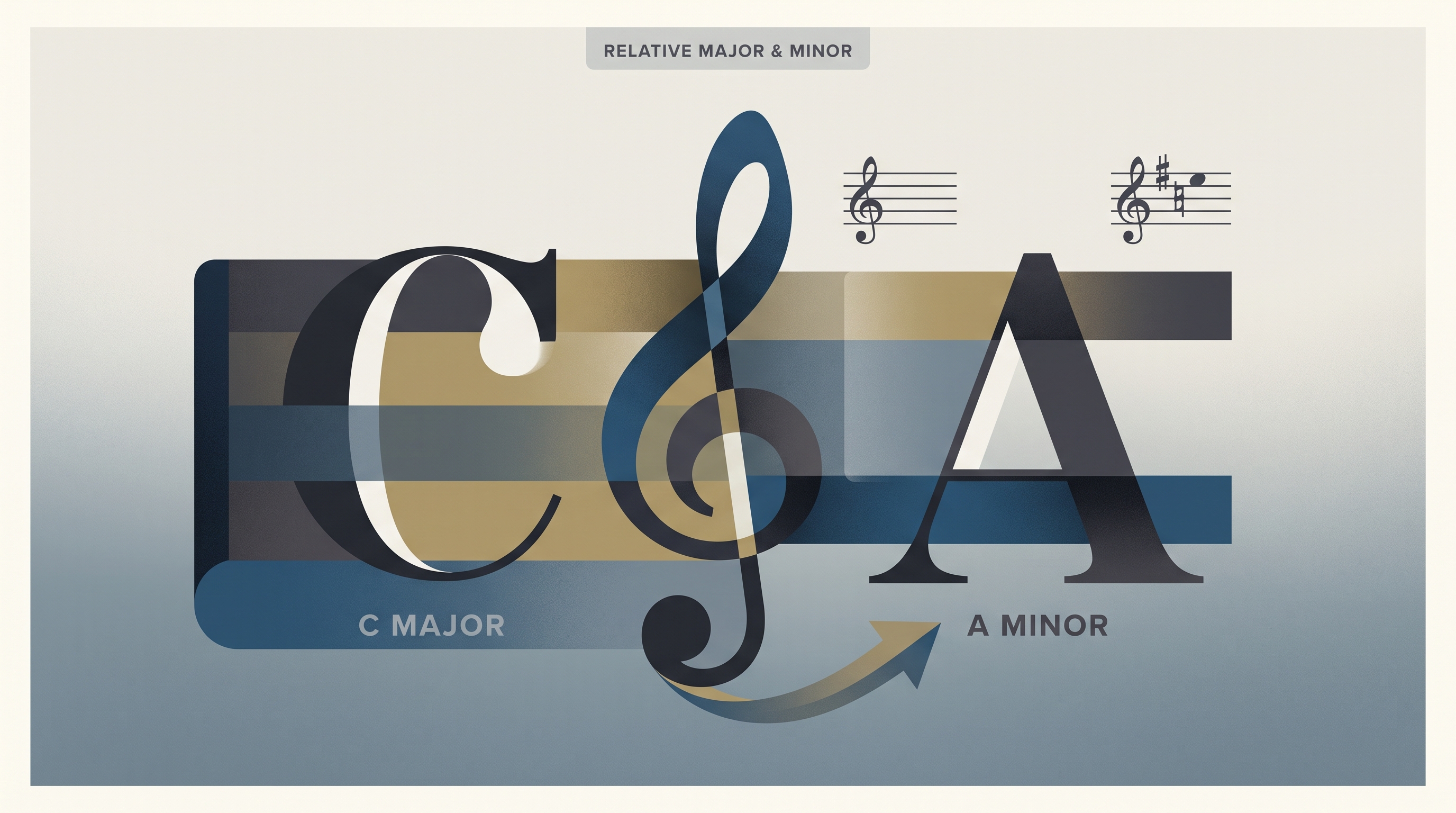
A major key and its relative minor key use the same key signature because they draw their notes from the same seven pitches. The difference is not the collection of notes but the tonal center—the pitch that feels like “home.”
2.2 Relative keys: determining relative minor keys and notating key signatures
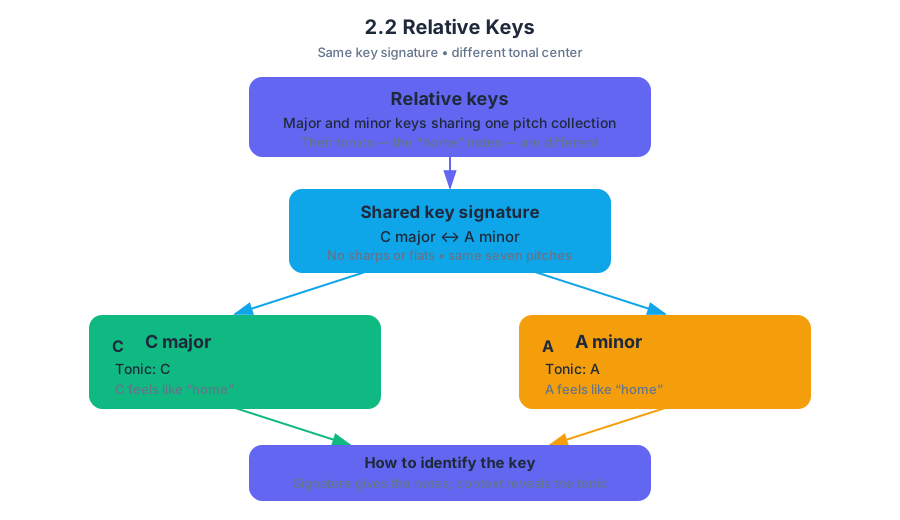
A major key and its relative minor key use the same key signature because they draw their notes from the same seven pitches. The difference is not the collection of notes but the tonal center—the pitch that feels like “home.”
Relative major and relative minor keys are major and minor keys that share a key signature but have different tonics.
For example, C major and A minor both use no sharps or flats. C major centers on C, while A minor centers on A. The key signature alone gives you the shared pitch collection; the musical context identifies which pitch functions as the tonal center.
Finding the relative minor from a major key
To find the relative minor of a major key, move downward by a minor third, or equivalently upward by a major sixth. In a standard major/minor analysis, the relative minor begins on scale degree $6$ of the major scale.
| Major key | Scale degree $6$ | Relative minor | Shared key signature |
|---|---|---|---|
| C major | A | A minor | no sharps or flats |
| G major | E | E minor | $1$ sharp: F-sharp |
| B-flat major | G | G minor | $2$ flats: B-flat, E-flat |
| D major | B | B minor | $2$ sharps: F-sharp, C-sharp |
Worked example: Find the relative minor of B major. Count the major scale degrees: B is $1$, C-sharp is $2$, D-sharp is $3$, E is $4$, F-sharp is $5$, and G-sharp is $6$. Therefore, B major’s relative minor is G-sharp minor, and both keys use the four-sharp signature F-sharp, C-sharp, G-sharp, and D-sharp.
Finding the relative major from a minor key
To reverse the process, move upward by a major third from the minor tonic. For instance, B to D spans a major third: B–C–D contains three letter names and four half steps. Therefore, B minor is relative to D major.
A practical shortcut is to locate the minor tonic and count upward through three letter names:
$$ A \rightarrow B \rightarrow C $$
A minor therefore has C major as its relative major. Likewise, E minor has G major, and G minor has B-flat major. Once the relative major is known, its key signature supplies the correct signature for the minor key.
Misconception check: The reverse operation is not an upward minor third. B to D is an upward major third, while D down to B is a downward minor third. Mixing up the direction and interval quality produces the wrong relative key.
Notating a minor key signature
A key signature belongs immediately after the clef and before the meter signature. When notating a minor key, write the key signature of its relative major; do not invent a separate signature merely because the music is minor.
For example:
- A minor: no sharps or flats, matching C major.
- D minor: one flat, matching F major.
- C-sharp minor: four sharps, matching E major.
- F minor: four flats, matching A-flat major.
The raised seventh used in harmonic minor does not normally change the key signature. In A minor, the key signature remains empty, even when G is raised to G-sharp within the melody or harmony. That alteration is written as an accidental at the note, not added permanently to the key signature.
Relative keys versus parallel keys
Relative keys share a key signature but have different tonics: C major and A minor. Parallel keys share the same tonic but use different major/minor collections: C major and C minor.
| Relationship | Same tonic? | Same key signature? | Example |
|---|---|---|---|
| Relative | No | Yes | C major and A minor |
| Parallel | Yes | Usually no | C major and C minor |
A passage can move from a major key to its relative minor without changing the key signature. If a passage begins with C as the tonal center but later establishes A through cadences, repeated emphasis, and melodic arrival, the listener may hear a shift from C major to A minor even though the written signature remains unchanged.
Do not treat the signature as an automatic answer. In standard major/minor key analysis, a signature narrows the likely choices to a major key and its relative minor—for example, no signature suggests C major or A minor. But other modes can use that same pitch collection. A passage centered on D with no sharps or flats may be Dorian rather than either C major or A minor; the signature does not identify the mode by itself.
Retrieval check:
- What is the relative minor of G major?
- What is the relative major of E-flat minor?
- Are A major and A minor relative or parallel keys?
- Why does a raised seventh in harmonic minor usually appear as an accidental rather than in the key signature?
Answers:
- E minor.
- G-flat major, because the minor tonic E-flat lies a major third below G-flat.
- Parallel: both have tonic A, but their key signatures differ.
- The key signature represents the basic major/minor pitch collection; the raised seventh is a temporary alteration used within the music.
2.3 Key relationships: parallel, closely related, and distantly related keys
Key concepts: Parallel keys · Closely related keys · Distantly related keys · Relative major and minor keys · Key signatures and accidentals · Major and minor keys with one additional or fewer sharp/flat · Diatonic major and minor triads · Key relationships as a basis for musical expression
A key relationship describes how one tonal center connects to another through tonic, mode, key signature, or diatonic harmony. These relationships help explain why a passage can sound like it has moved naturally, suddenly, brightly, or darkly—even when the music remains connected.
2.3 Key relationships: parallel, closely related, and distantly related keys
A key relationship describes how one tonal center connects to another through tonic, mode, key signature, or diatonic harmony. These relationships help explain why a passage can sound like it has moved naturally, suddenly, brightly, or darkly—even when the music remains connected.
Learning Objective PIT-1.J: Describe key relationships in performed and notated music.
Parallel keys: same tonic, different mode
Parallel keys share the same tonic—the same pitch that functions as the tonal “home”—but use different modes. The most familiar example is C major and C minor: both center on C, but their key signatures and scale collections differ.
For example:
- D major has the key signature of two sharps: F-sharp and C-sharp.
- D minor has one flat: B-flat.
- Both keys have D as tonic, but one is major and the other is minor.
The contrast is expressive. A composer, arranger, film scorer, or songwriter can shift from D major to D minor while preserving D as the musical center. The listener experiences a change of color or emotional atmosphere without losing the sense of “where home is.”
Essential Knowledge PIT-1.J.1: A parallel key shares the same tonic as the original key but has a different mode and key signature.
Important classification: Parallel keys are a subset of distantly related keys because their key signatures differ by more than one accidental. C major has no accidentals, while C minor has three flats, so the signatures differ by three accidentals.
Closely related keys: one accidental away
Closely related keys have key signatures that differ from the original by no more than one accidental. These are the keys to which a musical passage most commonly shifts because they retain much of the original pitch vocabulary while introducing only a small amount of change.
Essential Knowledge PIT-1.J.2: Closely related keys differ from the original key signature by no more than one accidental.
There are two reliable ways to identify them:
- Find the relative key, which shares the same key signature.
- Find the major and minor keys with one additional accidental and one fewer accidental, together with their relative keys.
Worked example: D major
D major has two sharps. Move through the key-signature neighborhood:
| Relationship to D major | Key | Key signature |
|---|---|---|
| Same signature: relative key | B minor | Two sharps |
| One additional sharp | A major | Three sharps |
| Relative of A major | F-sharp minor | Three sharps |
| One fewer sharp | G major | One sharp |
| Relative of G major | E minor | One sharp |
Therefore, the closely related keys of D major are B minor, A major, F-sharp minor, G major, and E minor. Notice that the list contains five keys, not merely three key signatures, because each neighboring major key has a relative minor.
A second method reaches the same answer through the original key’s diatonic triads—the major and minor triads built only from notes in the D-major scale:
- ii: E minor
- iii: F-sharp minor
- IV: G major
- V: A major
- vi: B minor
Each triad can function as the tonic triad of one closely related key. This gives the useful principle that the tonic triads of closely related keys are the diatonic major and minor triads of the original key. The relative key is therefore a subset of the closely related keys, not a competing category.
Distantly related keys: more than one accidental away
Distantly related keys have key signatures that differ from the original by more than one accidental. The word distant describes the amount of notational and pitch-material change, not necessarily the emotional effect or the physical distance between notes.
Essential Knowledge PIT-1.J.3: Distantly related keys differ from the original key signature by more than one accidental; parallel keys are a subset of distantly related keys.
From D major, E-flat major is distantly related: D major has two sharps, while E-flat major has three flats. The signatures differ by more than one accidental, so the relationship is not close under the CED definition.
A common misconception is that “relative” and “parallel” mean the same thing. They do not: relative keys share a key signature but have different tonics, while parallel keys share a tonic but have different modes and signatures.
AP skill lens and retrieval check
This topic can be assessed through all four official skill categories:
- Skill 1: Analyze performed music — hear a change of tonal center or mode and identify its likely relationship.
- Skill 2: Analyze notated music — compare key signatures, tonic pitches, and diatonic triads.
- Skill 3: Convert between performed and notated music — hear a modulation and represent the new key with the correct signature and accidentals.
- Skill 4: Complete based on cues — continue a passage after a cue such as a new tonic, mode, or key signature.
Retrieval check: Starting in A major, name the five closely related keys. Then classify A minor: is it closely or distantly related to A major, and why? The five closely related keys are F-sharp minor, E major, C-sharp minor, D major, and B minor. A minor is distantly related because A major has three sharps while A minor has no accidentals; the keys are parallel, so parallel-key relationships belong to the distantly related category.
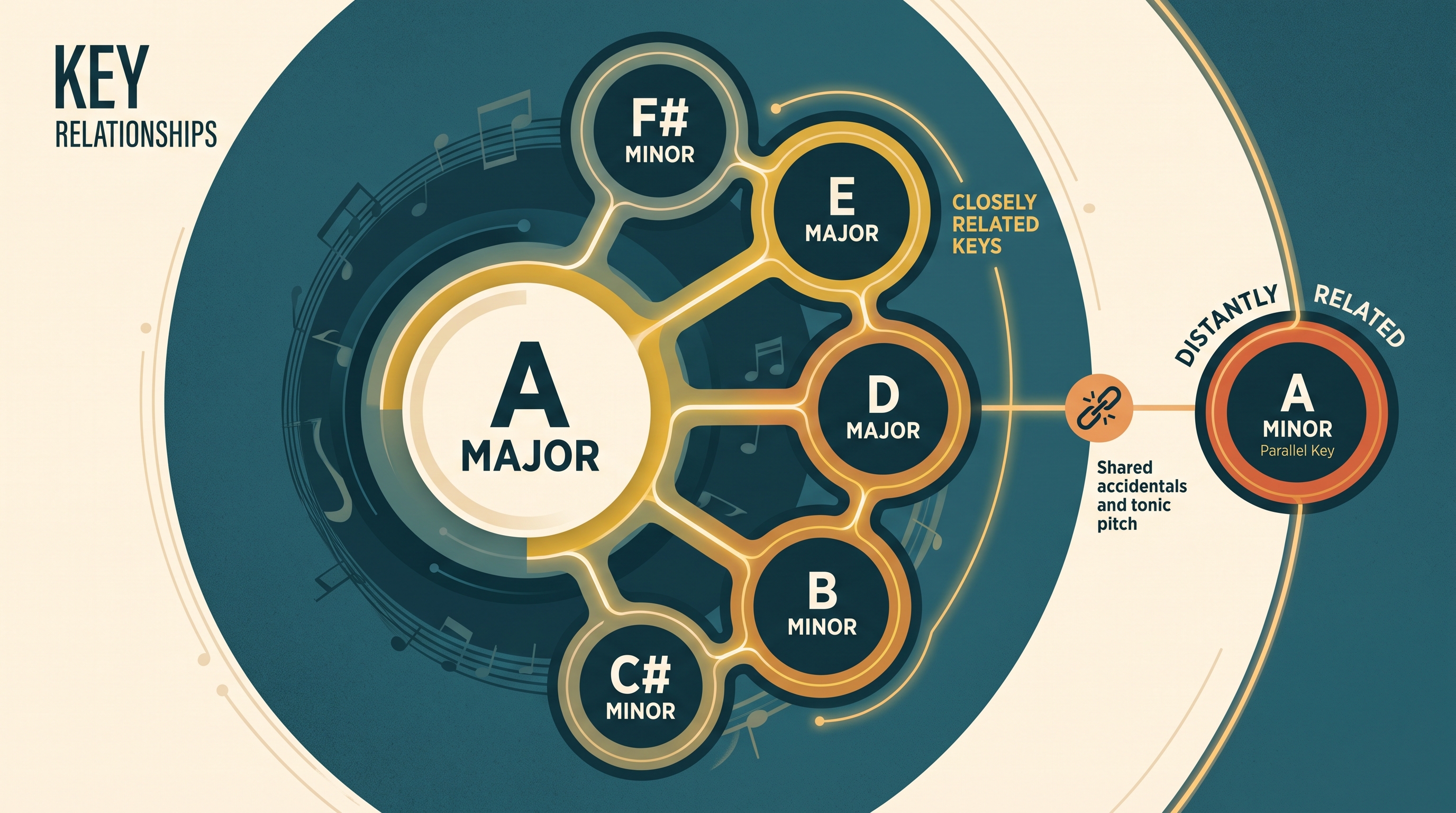
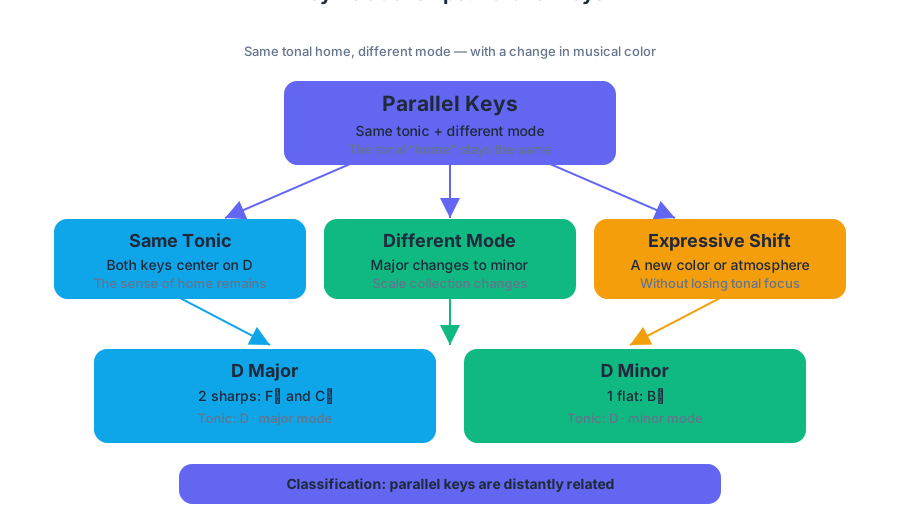
2.4 Chromatic, whole-tone, and pentatonic scales
Key concepts: Chromatic scales · Whole-tone scales · Pentatonic scales · Identifying scales in performed music · Identifying scales in notated music · Melodic passages using non-diatonic scales · Major pentatonic scale degrees · Pitch fundamentals and successive pitches · Listening for pentatonic scales in American folksongs, spirituals, and popular music · Singing chromatic and whole-tone scales by rote
A scale is an organized succession of pitches, and its pattern of steps can make a melody sound tense, floating, open, or familiar before you identify a single chord.
2.4 Chromatic, whole-tone, and pentatonic scales
A scale is an organized succession of pitches, and its pattern of steps can make a melody sound tense, floating, open, or familiar before you identify a single chord. Three especially useful patterns are the chromatic, whole-tone, and pentatonic scales.
PIT-1.K.1 — Essential Knowledge: Pitches are specific frequencies of sound and basic units of music. When pitches occur successively, they form melodies and scales; when they occur simultaneously, they contribute to chords and harmony.
Three scale designs
The fastest way to distinguish these scales is to count their pitches and inspect the distance between neighboring notes.
| Scale | Number of pitches | Defining pattern | Sound-world |
|---|---|---|---|
| Chromatic | $12$ | Every neighboring pitch is a half step apart | Completely filled-in pitch space; highly chromatic |
| Whole-tone | $6$ | Every neighboring pitch is a whole step apart | Symmetrical, floating, and without a strong leading-tone pull |
| Pentatonic | $5$ | Five pitches selected from a major or minor scale | Open, singable, and often free of half-step friction |
A chromatic scale uses all twelve pitch classes within the octave:
$$ \text{C--C\sharp--D--D\sharp--E--F--F\sharp--G--G\sharp--A--A\sharp--B--C} $$
Each adjacent pair is a half step. The spelling can change according to the key and melodic direction, but the defining sound is continuous motion by half steps.
A whole-tone scale contains six notes, each a whole step apart. Beginning on C, one version is:
$$ \text{C--D--E--F\sharp--G\sharp--A\sharp--C} $$
Beginning on a different pitch produces one of only two distinct whole-tone collections, because transpositions by a whole step eventually repeat the same six pitch classes.
A pentatonic scale contains five pitches drawn from the seven pitches of a major or minor scale. The major pentatonic scale uses scale degrees $\hat{1}$, $\hat{2}$, $\hat{3}$, $\hat{5}$, and $\hat{6}$. In C major:
$$ \hat{1},\hat{2},\hat{3},\hat{5},\hat{6}
\text{C--D--E--G--A} $$
The minor pentatonic scale uses scale degrees $\hat{1}$, $\hat{3}$, $\hat{4}$, $\hat{5}$, and $\hat{7}$ of the natural minor scale. In A natural minor:
$$ \hat{1},\hat{3},\hat{4},\hat{5},\hat{7}
\text{A--C--D--E--G} $$
Identifying scales in notated music
Learning Objective PIT-1.K requires identification of chromatic, whole-tone, and pentatonic scales in notated music and performed music. In notation, do not rely only on the first and last notes: scan the complete pitch collection and measure the recurring step pattern.
Worked example: A melody contains the notes C, D, E, F-sharp, G-sharp, and A-sharp, with no other pitches and with the line repeatedly moving by whole steps. There are six notes, every adjacent pitch is a whole step, and the collection therefore identifies a whole-tone scale.
For a pentatonic passage, look for the characteristic omissions. A C-major melody using C, D, E, G, and A—but avoiding F and B—matches the major pentatonic collection. A melody in A minor using A, C, D, E, and G matches the minor pentatonic collection.
Misconception check — “Five notes automatically means pentatonic.”
Not every five-note fragment is a pentatonic scale. The pitches must fit the major or minor pentatonic formulas, and the passage should present that collection as a meaningful melodic resource rather than merely passing through five accidental notes.
Identifying scales in performed music
In performed music, listen first for the motion of the melody. A chromatic line sounds like a smooth twelve-step climb or descent. A whole-tone line sounds unusually even because every move skips a half step. A pentatonic melody often sounds spacious and immediately singable because it avoids the half-step relationships found in the complete major or minor scale.
Pentatonic scales are especially important in American folksongs, spirituals, and popular music. Listening examples may not announce the scale explicitly: identify the limited pitch collection, then test whether it matches the major or minor pentatonic formula.
Rote singing makes these distinctions physical. Sing a chromatic scale slowly, noticing twelve closely packed steps; then sing a whole-tone scale, noticing the larger, identical gaps. Add major and minor pentatonic scales and compare their open, skip-based sound with the continuous chromatic line.
Melodic passages and exam reasoning
Melodic passages may employ these scales for an entire phrase or only for a brief gesture. A mostly diatonic melody can momentarily use chromatic pitches, while a passage built from six evenly spaced notes may reveal a whole-tone collection even if it does not begin on its “home” pitch.
The relevant course skills are Skill 1: Analyze performed music and Skill 2: Analyze notated music. For either skill, use the same evidence chain: collect the pitches, count them, inspect the step pattern, and compare the result with the defining formula.
Retrieval check: Identify each collection.
- C, C-sharp, D, D-sharp, E, F, F-sharp, G, G-sharp, A, A-sharp, B
- C, D, E, G, A
- C, D, E, F-sharp, G-sharp, A-sharp
Answers: $1$ is chromatic because it contains all twelve pitches by half step; $2$ is C-major pentatonic, using $\hat{1}$, $\hat{2}$, $\hat{3}$, $\hat{5}$, and $\hat{6}$; $3$ is whole-tone because it contains six pitches separated exclusively by whole steps.
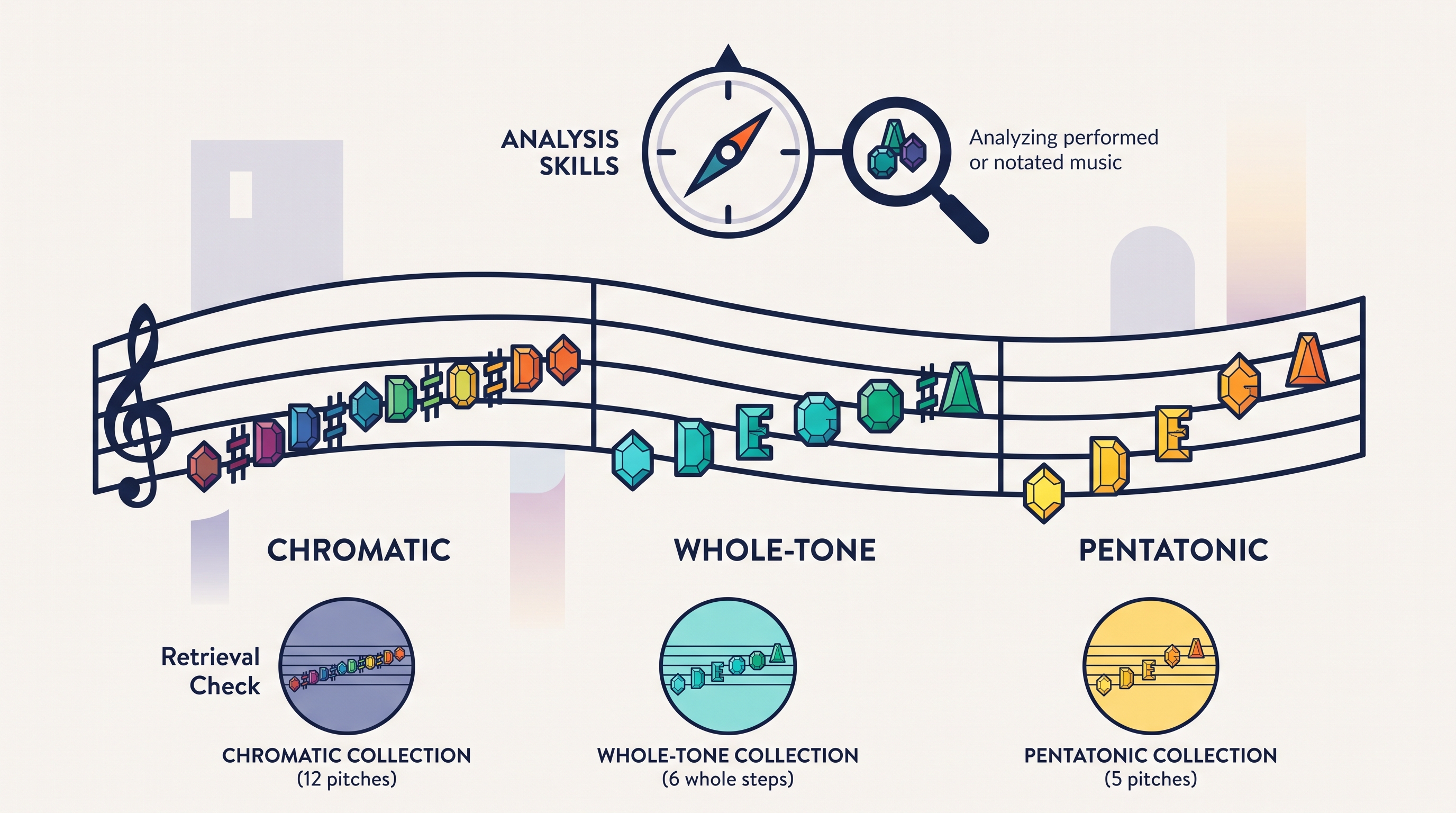
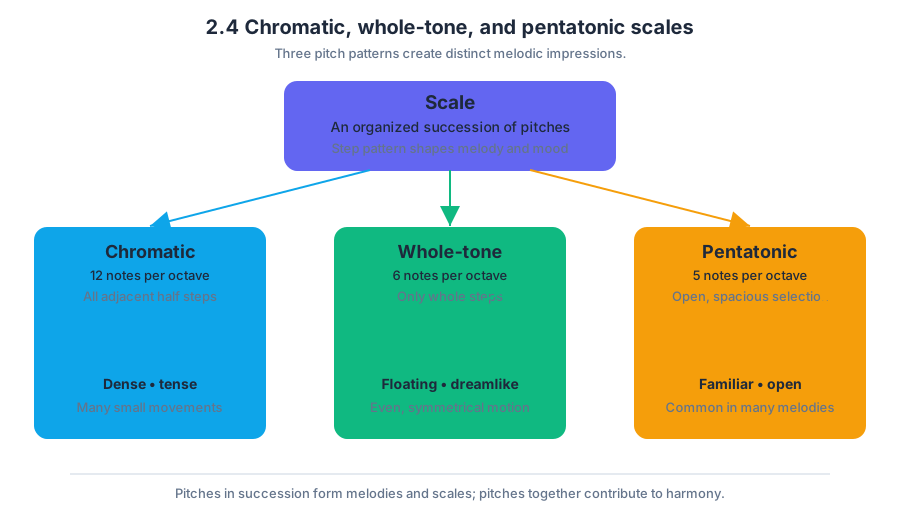
2.5 Interval size and quality
Key concepts: Interval size · Interval quality · Intervals in performed music · Intervals in notated music · Pitch as a feature of performed music · Melodic intervals (successive pitches) · Harmonic intervals (simultaneous pitches) · Pitch and intervals as elements of musical expression
An interval is the distance between two pitches, and a complete interval name tells you both how far apart the pitches are and what precise pitch relationship they form.
2.5 Interval size and quality
An interval is the distance between two pitches, and a complete interval name tells you both how far apart the pitches are and what precise pitch relationship they form.
Learning Objective PIT-1.L: Describe the size and quality of an interval in performed music and notated music.
The two-part name: size + quality
Interval size counts the letter names from the first pitch to the second, inclusively. A pitch followed by the same letter name is a unison or prime; adjacent letter names form a second; continuing upward produces thirds, fourths, fifths, sixths, sevenths, and octaves.
Interval quality gives the interval’s exact sound and spelling. The principal quality labels are major, minor, perfect, diminished, and augmented. Thus, “second” alone is incomplete: $C$ to $D$ is a major second, while $C$ to $D\flat$ is a minor second.
| Part of name | Question it answers | Example |
|---|---|---|
| Size | How many letter names are included? | $C$–$G$ is a fifth |
| Quality | How many semitones and what spelling does it contain? | $C$–$G$ is a perfect fifth |
| Complete name | What is the interval exactly? | perfect fifth |
The labels perfect normally apply to unisons, fourths, fifths, and octaves. Seconds, thirds, sixths, and sevenths are normally major or minor. Either family can become diminished or augmented when accidentals alter the expected distance.
Worked example: naming a notated interval
Suppose the lower note is $D$ and the upper note is $G\sharp$.
- Count letter names: $D$–$E$–$F$–$G$ gives four, so the size is a fourth.
- Compare the pitch distance with the usual perfect fourth. $D$ to $G$ is a perfect fourth; raising $G$ to $G\sharp$ widens it by a half step.
- The result is an augmented fourth.
Now respell the upper pitch as $A\flat$. The sound remains the same on an equal-tempered instrument, but $D$–$A\flat$ counts five letter names and is therefore a diminished fifth. These are enharmonic equivalents: intervals that sound identical but are spelled differently.
PIT-1.L.1: Intervals are identified by distance and quality. Spelling matters, even when two intervals sound the same.
Misconception check — “Same sound means same interval.” Not in notation. $D$–$G\sharp$ and $D$–$A\flat$ may have the same sounding pitch distance, but their sizes are fourth and fifth, respectively. The written letter names determine interval size; the pitch content determines quality.
Performed music: hear the interval’s behavior
In performed music, pitch is heard rather than read. Pitch—the perceived highness or lowness associated with a specific sound frequency—is a basic unit of musical expression across genres, media, and styles. Listening for the distance between pitches helps identify melodic contour, harmonic tension, and expressive character.
Pitches sounding successively create a melodic interval. If a singer moves from $C$ up to $E$, the listener hears a major third unfolding through time. Pitches sounding simultaneously create a harmonic interval; if $C$ and $E$ sound together, the same pitch relationship is heard vertically.
The analysis procedure is the same in both cases: determine the two pitches, estimate or calculate their distance, and identify the quality. The difference is temporal: melodic intervals are successive, while harmonic intervals are simultaneous.
Stability and expression
Some intervals are experienced as relatively stable, or consonant; others are relatively unstable, or dissonant. A consonant interval has no inherent need to move elsewhere, whereas a dissonant interval has a natural inclination to resolve toward a more stable sound. For example, a harmonic diminished fifth may resolve inward to a third.
PIT-1.L.3: Consonance describes inherent stability; dissonance describes inherent instability and a tendency toward resolution.
This does not mean that a dissonance is an error or that a consonance must remain still. Composers and performers use interval quality, register, context, articulation, and dynamics to create expectation, motion, brightness, tension, intimacy, or release.
The same skill in sound and notation
Skill 1: Analyze Performed Music asks you to extract interval information from what you hear. Track whether pitches occur melodically or harmonically, identify their relative pitch distance, and use tonal context to refine the quality.
Skill 2: Analyze Notated Music asks you to apply the same reasoning to a score. Count letter names first, then inspect accidentals and the key signature to determine quality. Do not rely only on the visual width of the notes on the staff.
PIT-1.L.2: Harmonic intervals contain simultaneous pitches; melodic intervals contain successive pitches.
Retrieval check: A melody moves from $E\flat$ to $B\flat$ one after the other. Is the interval melodic or harmonic? What is its size and quality? The answer is a melodic perfect fifth: the pitches are successive, and $E\flat$ through $B\flat$ spans five letter names with the perfect-fifth distance.
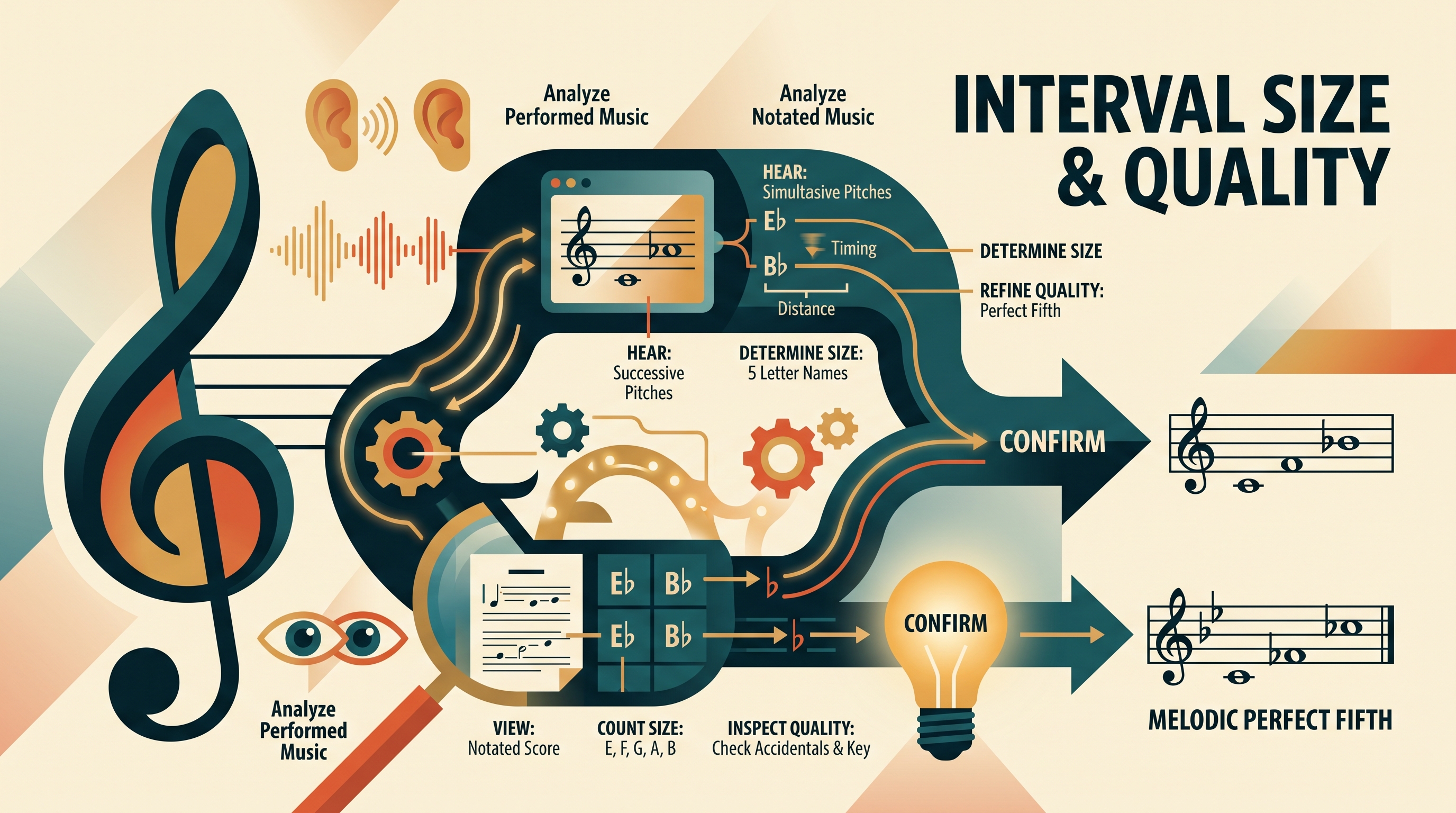
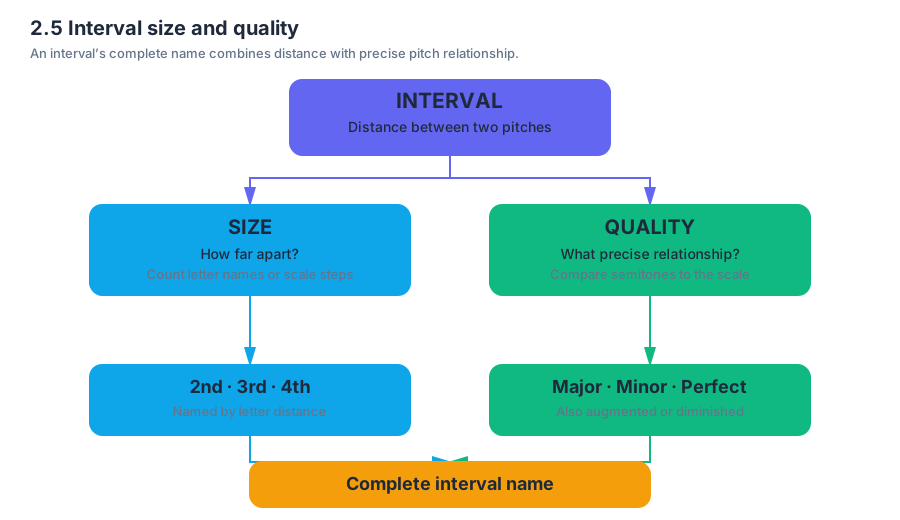
2.6 Interval inversion and compound intervals
Key concepts: Interval inversion · Compound intervals · Interval size and quality · Perfect intervals · Major and minor intervals · Diminished and augmented intervals · Performed music · Notated music
An interval inversion changes the register of an interval without changing its two pitch classes: move the lower note up one octave, and the interval turns “inside out.” A small interval becomes its complementary large interval, while its quality follows a fixed transformation.
2.6 Interval inversion and compound intervals
An interval inversion changes the register of an interval without changing its two pitch classes: move the lower note up one octave, and the interval turns “inside out.” A small interval becomes its complementary large interval, while its quality follows a fixed transformation.
PIT-1.M — Learning Objective: Identify interval inversions and compound intervals in performed music and notated music.
The essential knowledge for this objective is divided between PIT-1.M.1, the rules of inversion, and PIT-1.M.2, the distinction between simple and compound intervals. These rules matter because the same interval relationship may appear on the page, in a melody, or as a pair of simultaneously sounding pitches.
Inverting an interval: the mechanical move
Imagine two notes as two people standing on a staircase. To invert the interval, lift the lower person up exactly one octave so that the former lower note becomes the upper note. The original upper note remains where it is; only the lower note changes register.
For example, suppose the lower note is $C$ and the upper note is $E$. The interval is a major third. Move the lower $C$ up an octave to the $C$ above $E$. The new interval, from $E$ up to $C$, is a minor sixth.
$$ \text{major third} \longrightarrow \text{minor sixth} $$
The equivalent operation is to move the upper note down an octave. Both procedures produce the same inverted interval, because the two notes exchange their positions within the octave.
The Rule of Nine: interval sizes
The numerical sizes of an interval and its inversion always add to $9$. This is the Rule of Nine.
| Original interval | Inverted interval | Check |
|---|---|---|
| second | seventh | $2+7=9$ |
| third | sixth | $3+6=9$ |
| fourth | fifth | $4+5=9$ |
| fifth | fourth | $5+4=9$ |
| sixth | third | $6+3=9$ |
| seventh | second | $7+2=9$ |
| octave | unison | $8+1=9$ |
The rule works because the original interval and its inversion together fill an octave. Notice that a second does not invert to another kind of second: it becomes a seventh, because $2+7=9$.
Quality changes under inversion
Interval quality follows a second set of complementary rules. Perfect intervals remain perfect; major intervals become minor, and minor intervals become major; diminished intervals become augmented, and augmented intervals become diminished.
Worked example: invert a diminished fifth. Its size becomes a fourth because $5+4=9$. Its quality changes from diminished to augmented. Therefore:
$$ \text{diminished fifth} \longrightarrow \text{augmented fourth} $$
A perfect fourth similarly becomes a perfect fifth, not a major or minor fifth:
$$ \text{perfect fourth} \longrightarrow \text{perfect fifth} $$
Misconception check — “Inversion changes only the number.” It does not. A major third becomes a minor sixth, not a major sixth; a diminished interval becomes augmented. Always solve both parts: first the numerical size, then the quality.
Simple and compound intervals
A simple interval is an interval no larger than an octave. A compound interval is formed by adding an octave to a simple interval. Thus, an octave plus a major third produces a major tenth.
$$ \text{major third} + \text{octave} = \text{major tenth} $$
Compound and simple forms contain the same pitch classes in different registers, so they have a closely related sound. A major tenth and a major third are not the same written size, but both express the pitch-class relationship between $C$ and $E$.
To identify a compound interval in notation, count beyond the octave: an octave plus a second is a ninth, an octave plus a third is a tenth, and an octave plus a fourth is an eleventh. To identify one by ear, listen for the underlying simple relationship even though the notes are spread farther apart.
Performed and notated music
Skill 1: Analyze Performed Music applies when you hear two pitches and determine their interval, inversion, or compound form. First identify the lower and upper sounding pitches; then reduce a compound interval by an octave if useful, determine its simple size and quality, and finally name the full interval.
Skill 2: Analyze Notated Music applies when the notes are visible in a score. Count letter names for numerical size, inspect accidentals for quality, and use the Rule of Nine if the interval is inverted. For example, a notated $E$ below $C$ can be recognized as a compound sixth; reducing it by an octave reveals the corresponding simple interval.
Retrieval check:
- What does a major seventh invert to?
- What does an augmented fourth invert to?
- What is the compound form of a minor sixth?
Answers: A major seventh becomes a minor second; an augmented fourth becomes a diminished fifth; a minor sixth plus an octave becomes a minor thirteenth.
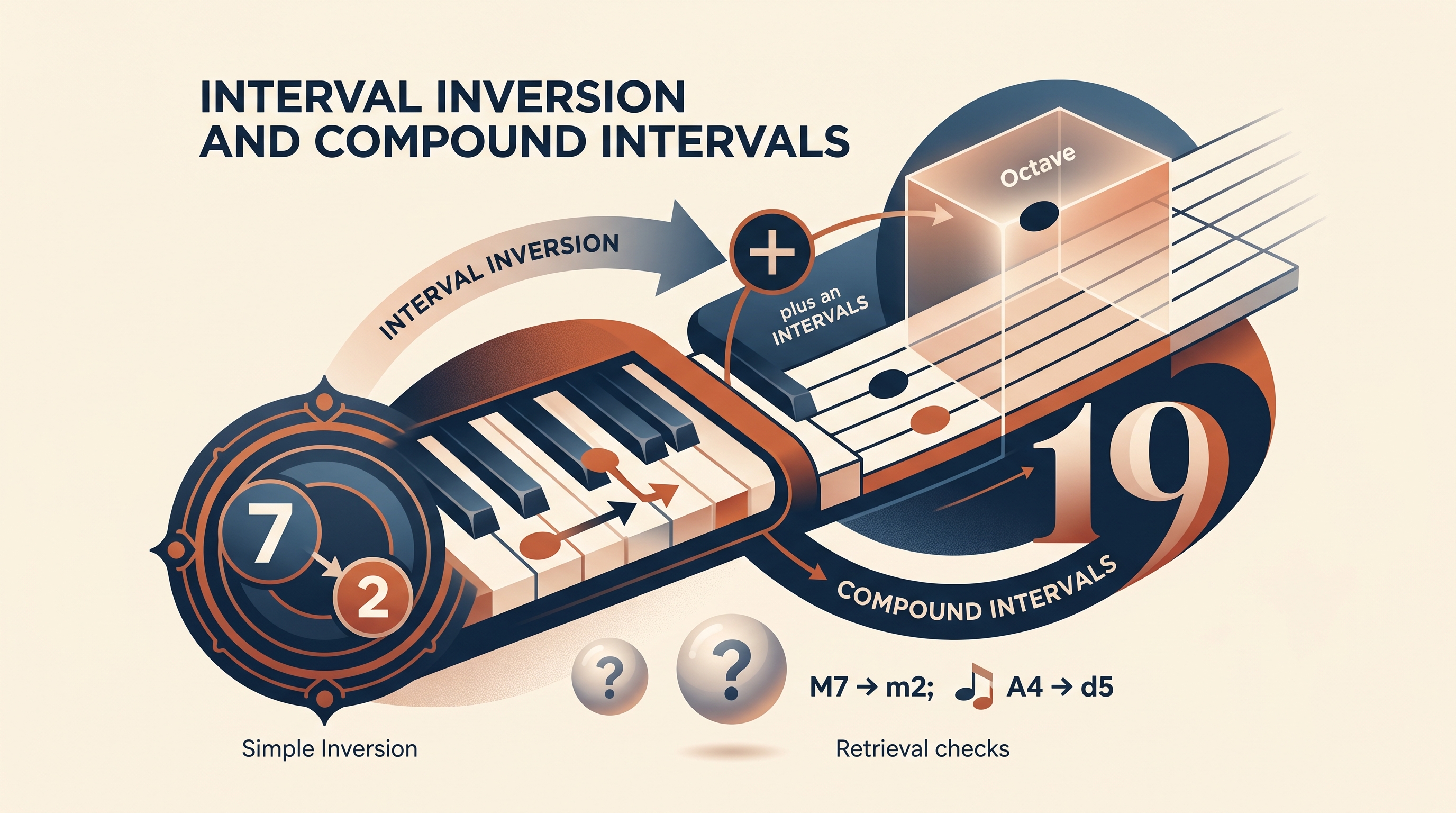
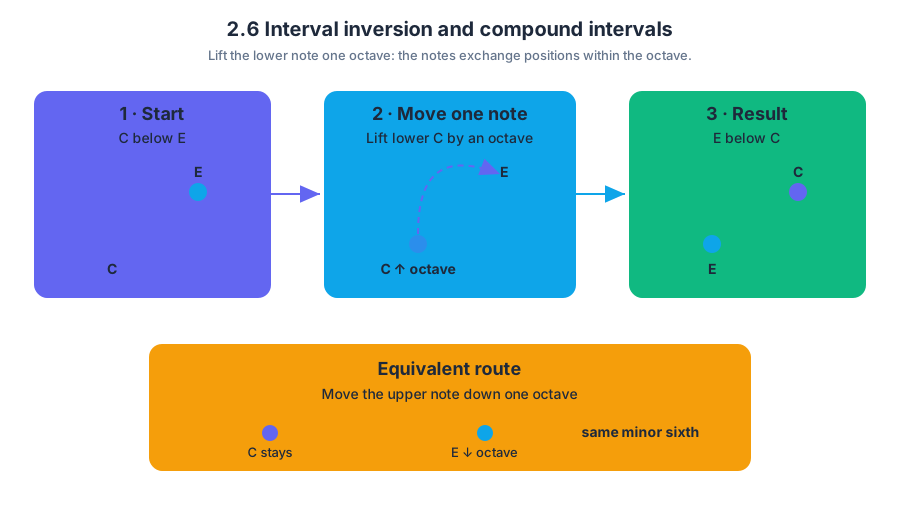
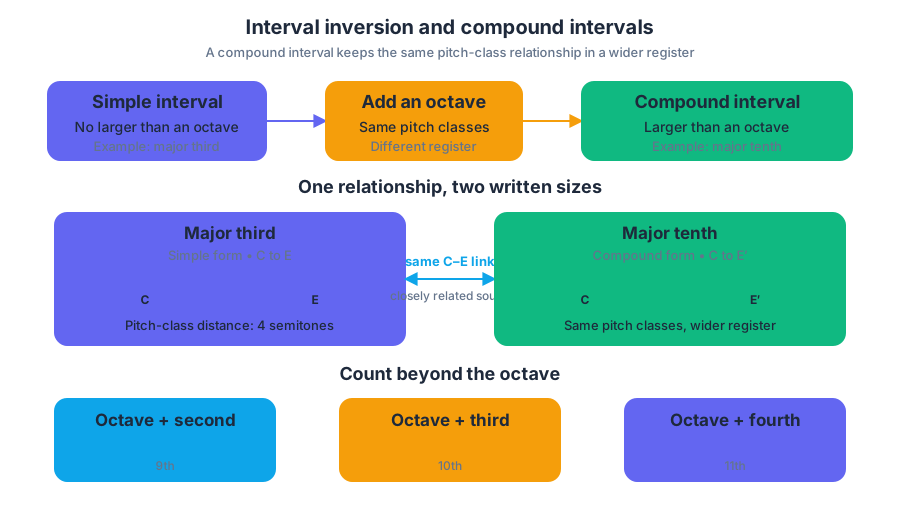
2.7 Transposing instruments
Key concepts: Transposing instruments · Identifying transposing instruments · Transposing musical exercises · Specified levels of transposition · AP Music Theory Exam presentation of transposing-instrument exercises
A transposing instrument is an instrument whose written, or notated, pitch differs from the pitch that actually sounds. The notation tells the performer which fingering or key to use; the resulting sound may be higher or lower than the written note.
2.7 Transposing instruments
A transposing instrument is an instrument whose written, or notated, pitch differs from the pitch that actually sounds. The notation tells the performer which fingering or key to use; the resulting sound may be higher or lower than the written note.
Core idea: Always identify the requested direction and interval before changing any notes.
The distinction is easiest to see as a two-step path:
For example, if a score says that a clarinet in B-flat sounds a major second below the notated pitch, a written $D$ produces a sounding $C$. The interval is a major second because $D$ down to $C$ spans two letter names, and the pitch distance is two semitones.
Identifying a transposing instrument
In a musical exercise, first inspect the instrument label or the question directions. Do not assume that every part sounds exactly as written. The exercise may identify the instrument directly and may provide its transposition in words such as “sounding a major second below notated pitch.”
The AP Music Theory framework places this work under the big idea PIT: Pitch, especially PIT-1.N.1, which concerns the relationship between notated and sounding pitch. The relevant skill categories are Skill 2: Analyze notated music and Skill 3: Convert between performed and notated music. When the task asks you to complete or adapt a musical exercise based on the printed directions, it also draws on Skill 4: Complete based on cues.
A reliable identification routine
Use this visual scan before writing anything:
- Read the instrument name. Look for a part whose notation may not represent concert pitch.
- Find the stated interval. The score or directions should specify the level of transposition.
- Find the direction. Determine whether the sounding pitch is above or below the written pitch.
- Decide what the answer requires. Are you converting written notes into sounding notes, or sounding notes into notation?
Worked example: converting notation into sounding pitch
Suppose a short clarinet line is written as:
$$ D ;-; E ;-; F^\sharp ;-; G $$
The directions state: “Clarinet in B-flat sounding a major second below notated pitch.”
Transpose every note downward by a major second:
| Notated pitch | Direction | Sounding pitch |
|---|---|---|
| $D$ | down a major second | $C$ |
| $E$ | down a major second | $D$ |
| $F^\sharp$ | down a major second | $E$ |
| $G$ | down a major second | $F$ |
The sounding line is therefore:
$$ C ;-; D ;-; E ;-; F $$
The accidentals must move with the pitches. A written $F^\sharp$ becomes sounding $E$, not $E^\sharp$ or $F$, because the specified interval is applied to the pitch itself while preserving the correct letter-and-interval relationship.
Specified levels and directions of transposition
The AP Music Theory Exam supplies the information needed for the conversion. Students do not need to memorize the transpositions of specific instruments. The exercise indicates the specific level, and the question directions specify the direction.
This prevents a frequent error: using a familiar convention instead of the interval actually printed in the question. If a prompt says “sounding a perfect fourth above notated pitch,” move upward by a perfect fourth even if you associate that instrument with a different convention in ordinary performance practice.
Exam rule: The printed interval and direction outrank memory.
The octave exception
The stated boundary is instruments whose transposition is an octave, such as the double bass. These instruments are treated as an exception to the special AP presentation described for other transposing instruments. When an exercise involves a non-octave transposition, expect the score and directions to identify exactly how the conversion works.
Common misconception check
Misconception: “I must memorize which instruments transpose and by how much.”
Correction: For AP Music Theory transposing-instrument exercises, the necessary transposition level is indicated in the score, and the direction is specified in the question directions.
Misconception: “Transposing means changing only the key signature.”
Correction: Transposition changes every pitch in the exercise by the stated interval. A key signature may change as a consequence, but the central operation is pitch-by-pitch conversion.
Retrieval check
A part is labeled “instrument sounding a minor third below notated pitch.” If the written melody begins $E$–$F$–$G$, what are the sounding pitches?
Move each note down a minor third: $E$ becomes $C^\sharp$, $F$ becomes $D$, and $G$ becomes $E$. The sounding opening is therefore:
$$ C^\sharp ;-; D ;-; E $$
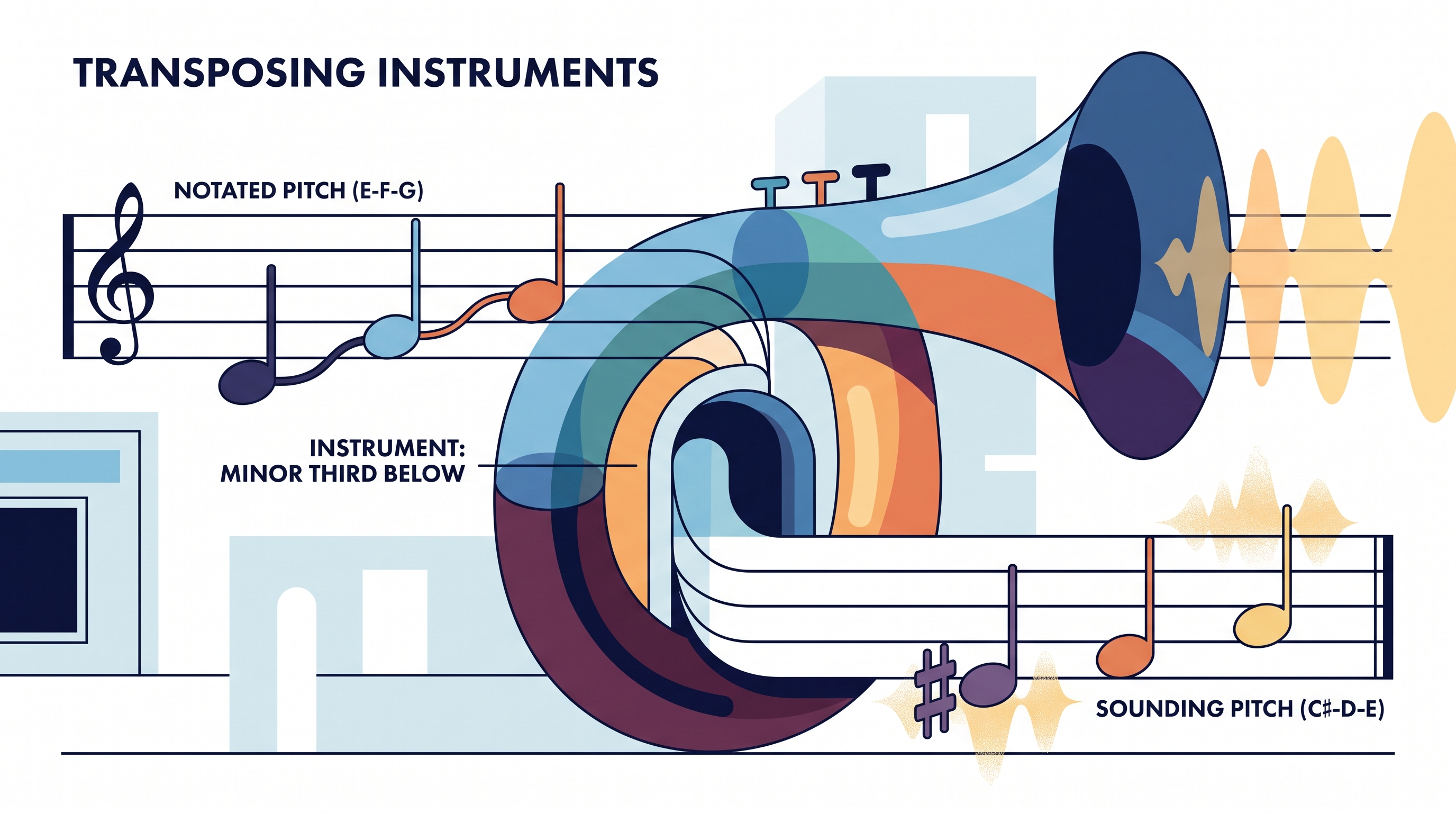
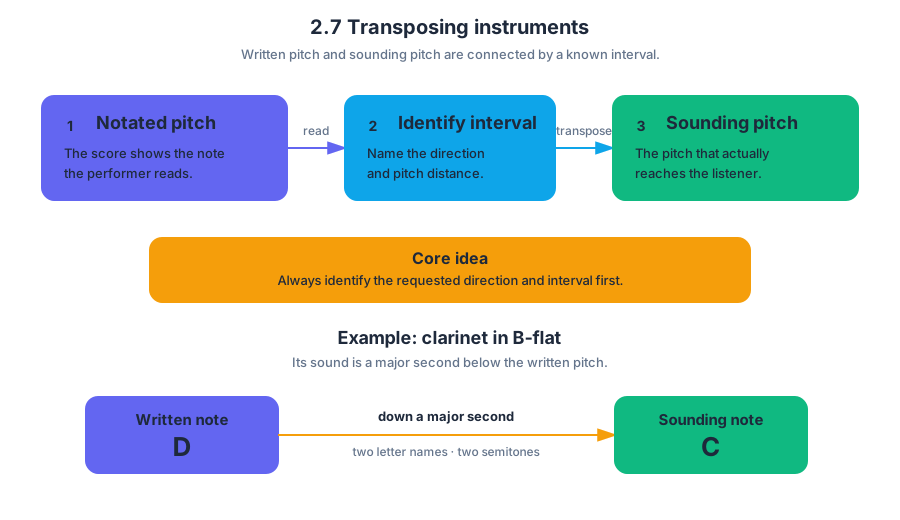
2.8 Timbre
Two instruments can play the same pitch at the same loudness and still sound unmistakably different because timbre is the quality of sound that lets us identify its source.
2.8 Timbre
Two instruments can play the same pitch at the same loudness and still sound unmistakably different because timbre is the quality of sound that lets us identify its source. A flute and a violin may both perform the note $A_4$ at piano volume, yet the flute sounds airy and focused while the violin sounds bowed, resonant, and complex.
Timbre is the distinctive tone color of a sound, shaped by its overtone mixture, attack, decay, and performance method.
Timbre answers the listening question, “What is making this sound, and how is it being produced?” It is therefore different from pitch, which describes perceived highness or lowness; dynamics, which describes loudness; and articulation, which describes how a note begins, connects, or ends.
The sound’s identity: four listening clues
A useful way to hear timbre is to separate the sound into four interacting clues:
- Overtone content: A musical tone normally contains a fundamental frequency plus additional frequencies called overtones. The relative strength of those overtones gives a sound its characteristic color.
- Attack: The attack is the beginning of the sound. A piano hammer creates a sharp attack; a bowed string can enter more gradually; a breathy flute may begin with an audible burst of air.
- Decay and sustain: Some sounds fade quickly after the attack, while others can be sustained or shaped continuously.
- Performance method: Bowing, plucking, striking, blowing, singing, muting, and electronic processing can all change the same instrument’s timbre.
These clues work together rather than independently. A trumpet played with a mute is still a trumpet, but its altered attack and overtone profile may make it sound distant, nasal, or veiled. Likewise, a violin played pizzicato has a shorter, more percussive timbre than the same violin played arco.
Timbre is not the same as instrumentation
Instrumentation names the instruments or voices present; timbre describes the sound qualities those sources produce. Saying “the excerpt uses clarinet and strings” identifies instrumentation. Saying “the clarinet has a rounded, woody tone above a bright, lightly bowed string layer” analyzes timbre.
This distinction matters in performed-music analysis. A listener may hear a single melody twice and recognize that the second statement has changed even when the pitch and rhythm remain constant. If the melody moves from oboe to trumpet, the musical identity changes through timbre rather than through melody.
Worked listening example: a film-score excerpt
In the opening-credits music from Aladdin, create a “musical map” that records more than melody and harmony. First identify the sound sources you hear: perhaps a solo voice, percussion, strings, winds, or electronic layers. Then describe how their tone colors enter, combine, and change the character of the passage.
A strong analysis might proceed like this:
- The opening sound has a prominent vocal or instrumental color that immediately establishes the atmosphere.
- Percussive attacks add immediacy because they begin sharply and may decay quickly.
- Sustained instrumental layers create a contrasting background whose timbre is smoother and less sharply articulated.
- When the opening motive returns, a changed instrument or vocal color can make the repetition feel larger, brighter, darker, or more intense even if the pitch pattern is unchanged.
- The result is a change in musical design—the Unit 2 map identifies timbre under DES (Musical Design)—rather than merely a change in notes.
The exact instrument label should be evidence-based. If you cannot identify an instrument confidently, describe what you can hear: “a nasal reed-like tone,” “a bright brass attack,” “a breathy high register,” or “a dense string sonority.” A precise sonic description is better than an unsupported guess.
AP skill connection
Topic 2.8 Timbre is mapped to DES and Skill 1: Analyze performed music. In practice, this means listening for audible evidence and explaining how sound color contributes to musical meaning, contrast, continuity, or emphasis.
Do not treat timbre as a label-hunt. The strongest analysis connects a heard color to its function: a solo timbre may bring a melody forward; a darker timbre may signal a change in atmosphere; a newly added instrumental color may mark a return or intensification; and contrasting colors may help listeners distinguish musical layers.
Misconception check
Misconception: “Timbre means which instrument is playing.” Instrument identity is one clue, but timbre also changes with register, dynamics, articulation, playing technique, and recording treatment. A softly sung note, a shouted note, and a whispered note may come from the same performer but possess very different timbres.
Misconception: “Higher means brighter, and lower means darker.” Register can influence perceived color, but pitch and timbre are separate properties. A low flute and a low cello can share a register while remaining clearly distinguishable by their overtone patterns and attacks.
Retrieval check
A recording presents the same four-note melody twice. The second statement uses a trumpet instead of a clarinet, with no change in pitch, rhythm, or loudness. What changed, and what evidence would you cite?
Answer: The timbre changed. The evidence is the different tone color—especially the trumpet’s more prominent attack and brass-like overtone character compared with the clarinet’s reed-based, rounded sound.
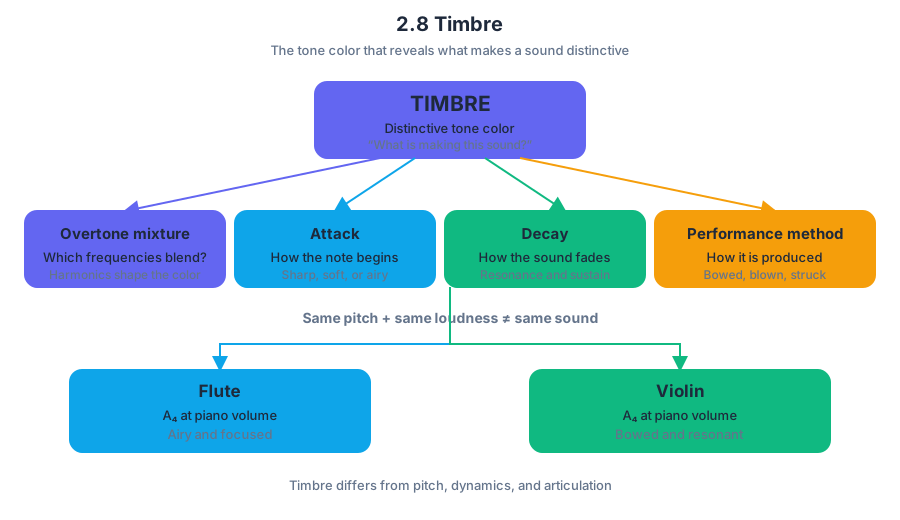
2.9 Melodic features
Key concepts: Melodic features · Features of melody · Motives · Timbre · Texture · Meter · Treble clef · Bass clef · Musical fluency
A melody becomes recognizable not from its pitches alone, but from the way those pitches move, repeat, and occupy musical time. The same sequence of notes can sound completely different when performed by a different voice or instrument, placed in a new texture, or reorganized by the meter.
2.9 Melodic features
A melody becomes recognizable not from its pitches alone, but from the way those pitches move, repeat, and occupy musical time. The same sequence of notes can sound completely different when performed by a different voice or instrument, placed in a new texture, or reorganized by the meter.
Investigative question: What makes a short stream of notes sound like a coherent musical idea rather than a random collection of pitches?
Topic 2.9: Melodic features connects the shape of a melody with the conditions in which listeners encounter it. You will examine features of melody, identify motives—short, recognizable musical ideas—and interpret those ideas alongside timbre, texture, and meter. The CED skill emphasis is especially practical: Skill 1: Analyze performed music, Skill 2: Analyze notated music, Skill 3: Convert between performed and notated music, and Skill 4: Complete based on cues.
Reading the “shape” of a melody
A melody has a contour, or overall pitch shape. It may rise, fall, arch upward and downward, remain fairly level, or alternate between directions. Other useful melodic features include range—the distance between the lowest and highest pitches—along with register, repeated notes, stepwise motion, leaps, and rhythmic repetition.
Consider this notated outline in treble clef:
$$ \text{C4–D4–E4–G4–E4–D4–C4} $$
The melody begins at C4, ascends mostly by step, leaps from E4 to G4, then descends to its starting pitch. Its contour is arch-shaped, its range is a perfect fifth, and its return to C4 creates a strong sense of closure. The leap to G4 is not an isolated fact: it becomes expressive because the surrounding notes approach and leave it by smaller intervals.
A melody’s rhythm is part of its identity as well. Two melodies can use the same pitches but sound unrelated if their note lengths and accents differ. Conversely, a repeated rhythmic pattern can make a melody recognizable even when its pitches change.
Motives: small ideas with large consequences
A motive is a short musical idea—melodic, rhythmic, or both—that can be recognized and reused. A motive may be repeated exactly, moved to a different pitch level, altered rhythmically, fragmented into a smaller portion, or combined with other material.
For example, imagine the opening idea:
$$ \text{G4–A4–B4–A4} $$
If the same contour and rhythm return later as D4–E4–F-sharp4–E4, the pitches have changed, but the listener may still recognize the motive. The important evidence is the pattern of relationships: up by step, up by step, then down by step, supported by the same rhythmic design.
Skill 2: Analyze notated music asks you to locate such repetition in notation. Skill 1: Analyze performed music asks you to hear it when the notation is absent. Skill 3: Convert between performed and notated music operates in both directions: you may hear a motive and represent it with notes, or see a notated pattern and describe how it sounds.
Melody does not exist alone
Timbre and texture change how melodic features are perceived. A melody sung by one voice may be easy to follow as a single line; the same melody played by several instruments may become the prominent strand in a thicker texture. A melody can also move between parts, disappear into accompaniment, or become more noticeable when its timbre contrasts with the surrounding sound.
Meter and clef fluency
Meter organizes beats into recurring patterns of strong and weak accents. When examining a melody, do not analyze its pitches separately from its meter: an identical contour can feel different when accents shift or when the same motive is placed in a different metric position.
Read and perform examples in both treble and bass clefs early and often. Treble clef places middle C below the staff; bass clef places middle C above it. The purpose is not merely faster note naming. Fluency across clefs and meters lets you recognize a motive, follow its contour, and perform its rhythm without stopping to decode every symbol.
Worked interpretation: Suppose a bass-clef melody repeats a three-note descending idea at the beginning of each measure. The repeated notes may form a motive; the consistent placement on the first beat may make it rhythmically prominent; and a contrasting treble-clef line may create a texture in which the bass motive functions as an identifying foundation. A complete analysis considers all three layers—melodic pattern, meter, and texture.
Misconception check
Misconception: “A motive must be repeated at exactly the same pitches.”
A motive is identified by its recognizable musical relationships, not necessarily by literal pitch repetition. Transposed or rhythmically adjusted versions can preserve the motive’s identity.
Misconception: “Melodic analysis means naming every interval.”
Interval identification can help, but analysis also requires hearing or seeing contour, range, rhythm, repetition, metric placement, and interaction with timbre and texture.
Retrieval check
A short melody rises by step, leaps upward, repeats its rhythm, and then returns downward to its opening pitch. Name two melodic features, describe its contour, and explain one piece of evidence that could identify a motive. Then ask: would your interpretation change if the idea moved from treble clef and a solo voice into bass clef within a thick instrumental texture?
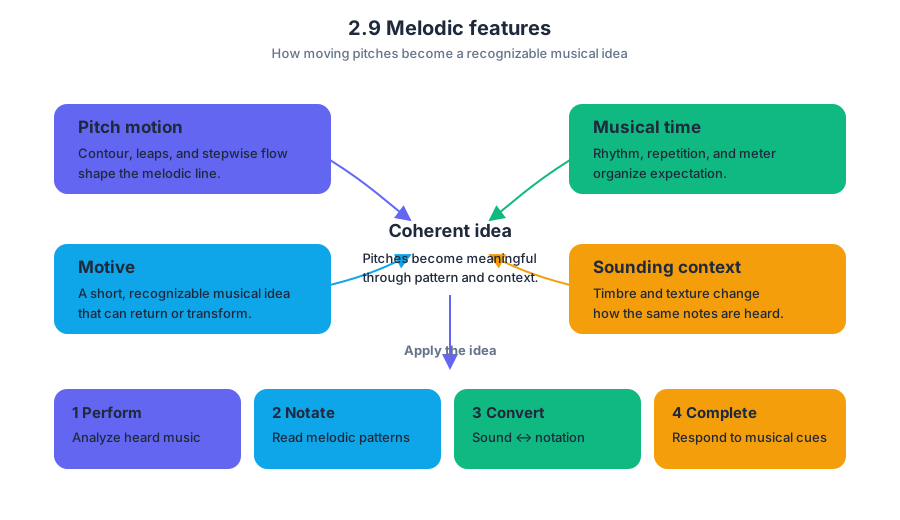
2.10 Melodic transposition
Key concepts: Melodic transposition
A melody can be moved to a new key without changing its musical identity: its interval pattern stays the same while every pitch shifts by the same amount.
2.10 Melodic transposition
A melody can be moved to a new key without changing its musical identity: its interval pattern stays the same while every pitch shifts by the same amount. That process is melodic transposition.
Imagine moving a sentence from one speaking register to another: the words remain recognizable, but the entire sound is higher or lower. In music, the “words” are the melody’s contour and intervals; the new register is the destination key.
The central rule: preserve intervals
A transposed melody preserves the distance between successive notes. If the original begins with an ascending major second followed by a descending minor third, the transposed version must begin with those same two interval qualities, regardless of its new starting pitch.
Melodic transposition: rewriting or performing a melody at a different pitch level while preserving its intervallic relationships and rhythmic pattern.
The melody’s rhythm, contour, and interval qualities remain constant. The key signature, pitches, and accidentals may change because the melody now belongs to a different tonal environment.
| Feature | Remains the same | May change |
|---|---|---|
| Rhythm | Yes | No |
| Contour | Yes | No |
| Interval qualities | Yes | No |
| Starting pitch | No | Yes |
| Key signature | No | Yes |
| Written accidentals | No | Yes |
| Clef or register | Not necessarily | Sometimes |
Worked example: transposing by a perfect fourth
Suppose a melody in C major uses the pitch sequence
$$ C - D - E - G - F - E - D - C $$
To transpose it up a perfect fourth, identify the destination of every original pitch:
- $C$ up a perfect fourth becomes $F$.
- $D$ up a perfect fourth becomes $G$.
- $E$ up a perfect fourth becomes $A$.
- $G$ up a perfect fourth becomes $C$.
- $F$ up a perfect fourth becomes $B\flat$.
The transposed melody is therefore
$$ F - G - A - C - B\flat - A - G - F $$
The destination key is F major, whose key signature contains one flat, $B\flat$. Notice that the original melodic pattern is unchanged: the opening rises by step, the melody leaps upward to the fifth scale degree, and the later notes descend back to the tonic. Only the pitch level has moved.
Two reliable methods
Interval method
In the interval method, calculate the interval from the original note to its transposed destination, then apply that same interval to every note. This method is especially useful when the transposition is specified as “up a major third” or “down a perfect fifth.”
For example, transposing $E - F\sharp - G\sharp$ down a minor third gives:
$$ E \rightarrow C\sharp,\qquad F\sharp \rightarrow D,\qquad G\sharp \rightarrow E $$
The result is
$$ C\sharp - D - E $$
The chromatic spelling matters: $F\sharp$ lowered by a minor third is $D$, not an enharmonically equivalent but incorrectly spelled alternative.
Scale-degree method
In the scale-degree method, identify each note’s role in the original key and reproduce that role in the destination key. The C-major melody $C-D-E-G$ represents
$$ \hat{1}-\hat{2}-\hat{3}-\hat{5} $$
In F major, those same scale degrees are
$$ F-G-A-C $$
This method is often faster for diatonic melodies because it treats the melody as a pattern within a key rather than as isolated letter names.
Accidentals and notation
A melody may contain chromatic notes that are not included in the destination key signature. Transpose the pitch relationship first, then decide whether each resulting note is represented by the key signature or needs an accidental.
For instance, a raised fourth scale degree in C major is $F\sharp$. If the melody is transposed up a perfect fourth into F major, that pitch becomes $B$, because $F\sharp$ shifted upward by a perfect fourth produces $B$. The destination key signature already supplies $B\flat$ in F major, so the written note must use a natural sign:
$$ B\flat \rightarrow B\natural $$
This is a frequent source of error: students copy the destination key signature mechanically and forget that an accidental may cancel or override a pitch supplied by that signature.
AP skills and reasoning processes
Skill 2.A, Analyze Notated Music, applies when you inspect the original notation, determine its key and scale-degree relationships, and identify the exact interval pattern that must survive the transposition.
Skill 3.A, Convert Between Performed and Notated Music, applies when you hear or sing a melody in one key and notate it in another. The performer may use solfège, scale-degree numbers, note names, or a neutral syllable, but the transposed notation must preserve the melody’s rhythmic and pitch relationships.
Skill 4.A, Complete Based on Cues, applies when a destination key, starting pitch, or transposition interval supplies the cue and you must complete the rewritten melody accurately.
Misconception check
Misconception: “Transposition means moving each note the same number of staff spaces.” Staff distance alone does not guarantee correct interval quality. A transposition must preserve both interval size and quality, so letter names, key signatures, and accidentals must be checked together.
Retrieval check: A melody in G major begins $G-A-B-D$. Transpose it up a perfect fourth. What are the new pitches, and which key signature should you use?
Answer: $C-D-E-G$ in C major. The scale-degree pattern is $\hat{1}-\hat{2}-\hat{3}-\hat{5}$, and the rhythm and contour remain unchanged.
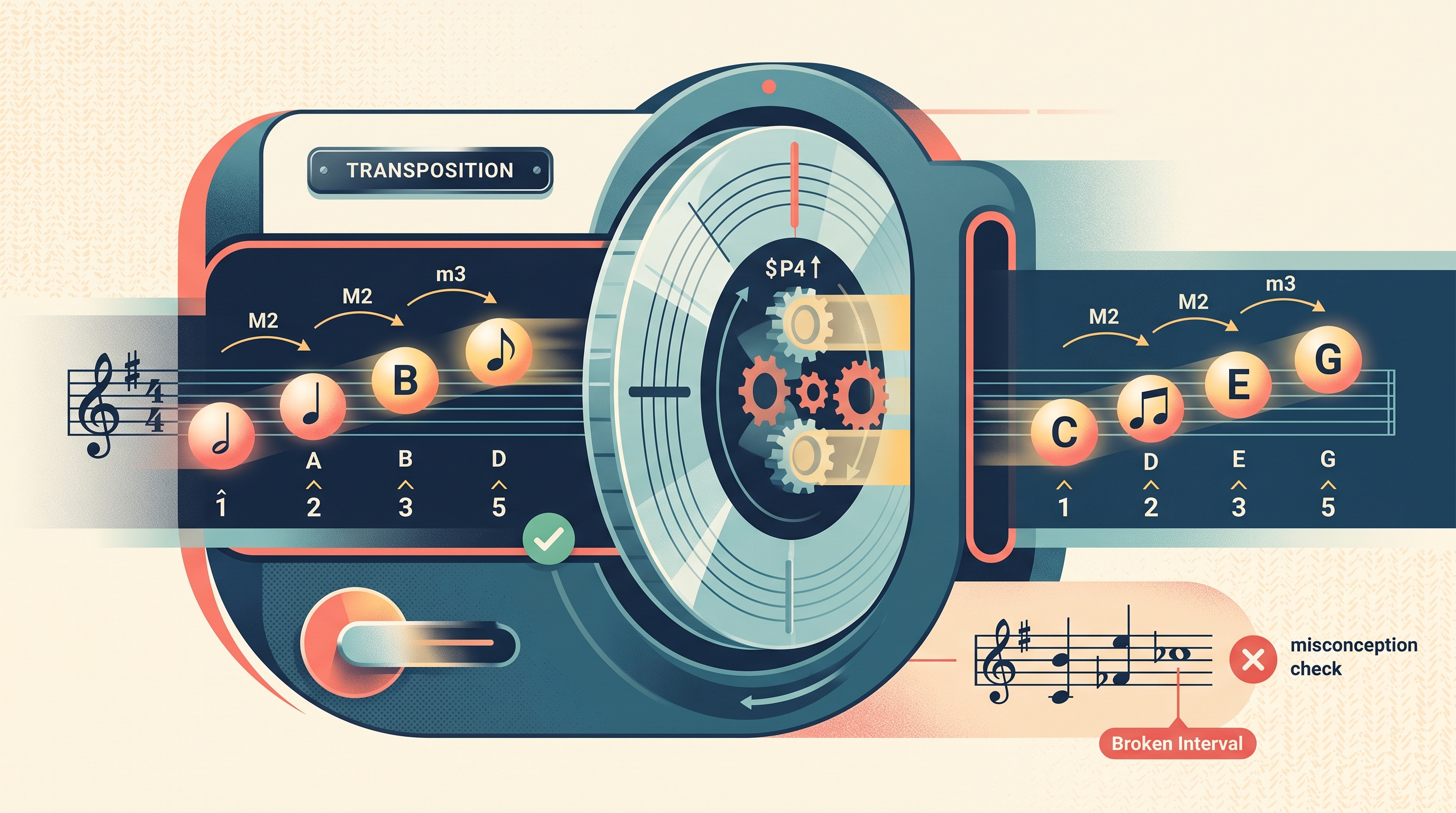
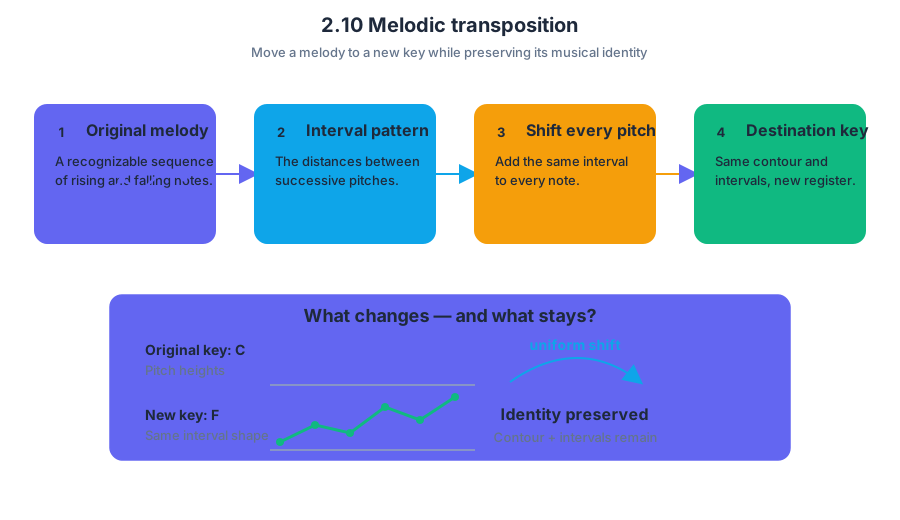
2.11 Texture and texture types
Key concepts: Texture · Monophony · Homophony · Chordal homophony · Melody with accompaniment · Polyphony · Timbre · Pitch density and spacing · Pitch range · Performed and notated music
Texture is the way musical components combine simultaneously to create the listener’s overall sound. A solo singer, a melody supported by chords, and several independent melodies can use the same notes yet produce radically different musical experiences because their textures differ.
2.11 Texture and texture types
Texture is the way musical components combine simultaneously to create the listener’s overall sound. A solo singer, a melody supported by chords, and several independent melodies can use the same notes yet produce radically different musical experiences because their textures differ.
Texture applies to both performed music—what you hear—and notated music—what you see in a score. To identify texture, listen or look for three questions: How many musical lines are present? What is the melodic character of each line? How are those lines combined at the same time?
Essential Knowledge DES-1.A.1: Texture refers to how musical components combine simultaneously to form an overall sound. It is influenced by how music is produced, the density and spacing of pitches, and the pitch range encompassed.
What shapes the overall sound?
The number of lines is only the beginning. Timbre—the distinctive quality of a sound—can make two identical textures sound unlike each other: one melody sung by a child, played by a flute, or performed by a brass ensemble produces different perceptual layers. Texture is also affected by pitch density and spacing: widely separated pitches may sound transparent, while many closely packed pitches may sound thick. Finally, pitch range matters; a texture spanning several octaves can feel broader than one confined to a narrow register.
For example, four instruments may perform four distinct pitches, but if all four sustain a single chord, the result is not automatically polyphony. The musical lines’ independence and melodic behavior matter more than simply counting sounding notes.
The main texture types
The principal texture types are monophony, homophony, and polyphony. The CED also identifies heterophony as a texture type, although the most central contrasts for this topic are the three types below.
| Texture | What happens simultaneously | Listening or score clue |
|---|---|---|
| Monophony | One melodic line sounds alone, either in one voice or doubled at another octave | Everyone performs the same melody; there is no independent accompaniment |
| Homophony | One part is primary while other parts support it | A recognizable melody moves with chordal support or a coordinated chordal rhythm |
| Polyphony | Two or more relatively independent melodic lines sound together | Several melodies retain their own contours and rhythmic identities |
Monophony: one line
Monophony means a single melodic line without independent harmonic support. A person singing alone is monophonic. Several people singing the same melody in unison or octaves can still create monophony because they perform one musical line rather than separate melodies.
Misconception check: “More than one performer means polyphony.” Not necessarily. If every performer follows the same melody, the texture remains monophonic.
Homophony: coordinated support
Homophony contains a primary musical line supported by other parts. Its two important forms are chordal homophony and melody with accompaniment.
In chordal homophony, the parts move together in a similar rhythm, producing a sequence of coordinated chords. A hymn in which soprano, alto, tenor, and bass change notes together often has chordal homophony. The voices are separate lines in notation, but their rhythmic alignment makes the chordal unit the dominant impression.
In melody with accompaniment, one line stands out as the melody while the remaining parts provide harmonic or rhythmic support. A singer carrying the tune over piano chords is an obvious example. The accompaniment may be active—such as a repeating broken-chord pattern—yet it remains subordinate if it does not behave like an independent competing melody.
A useful diagnostic is to temporarily remove the supporting parts. If one line remains clearly identifiable as the musical foreground and the others mainly explain its harmony, the texture is probably homophonic.
Polyphony: independent lines
Polyphony combines two or more melodic lines that possess meaningful independence. Each line may have its own contour, rhythm, and points of imitation. Polyphony can be nonimitative, in which the lines use contrasting material, or imitative, in which one line repeats or echoes material introduced by another.
Counterpoint is closely related to polyphony. It refers specifically to the practice of composing polyphonic music, often according to historical conventions, as well as to the resulting contrapuntal texture. Terms such as canon or canonic describe imitative relationships in which a melody is answered by a delayed copy; they are texture-related descriptions, not replacements for the broader category of polyphony.
Worked analysis: three versions of one idea
Imagine the tune $C-D-E-G$:
- One singer performs $C-D-E-G$ alone: monophony.
- A singer performs $C-D-E-G$ while a piano plays supporting chords: homophony, specifically melody with accompaniment.
- A second voice enters with its own version of the tune while the first continues independently: polyphony.
The pitch material has not changed enough to explain the difference. The decisive factor is how the musical lines interact simultaneously.
AP analysis skills
This topic develops Skill 1: Analyze Performed Music by requiring you to hear line count, independence, timbre, register, and accompaniment relationships. It develops Skill 2: Analyze Notated Music by requiring you to inspect simultaneous parts, rhythmic alignment, pitch spacing, and relative melodic prominence in a score. When moving between an audio realization and its notation, Skill 3: Convert Between Performed and Notated Music supports the same judgment across representations.
Essential Knowledge DES-1.A.2: Texture types are determined by the number of musical lines, the melodic character of those lines, and the ways in which the lines combine simultaneously. The major categories include monophony, homophony—including chordal homophony and melody with accompaniment—and polyphony.
Retrieval check
A choir sings one melody in octaves while a low voice sustains a separate drone. Is the texture automatically polyphonic? Answer: Not automatically. If the drone functions as sustained support rather than an independent melodic line, the texture is best heard as homophonic or a monophonic melody supported by a drone. Count lines, but then judge their melodic independence.
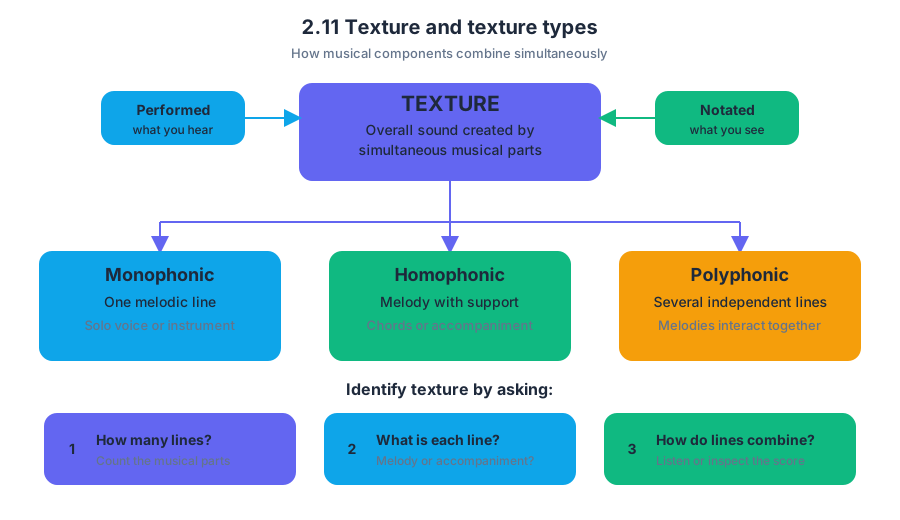
2.12 Texture devices
Key concepts: Texture devices · Rhythm · Musical design
A texture device is a compositional procedure that organizes how musical parts interact over time. Building on the texture type already identified, the device names the procedure organizing the parts—such as imitation, call and response, or ostinato.
2.12 Texture devices
A texture device is a compositional procedure that organizes how musical parts interact over time. Building on the texture type already identified, the device names the procedure organizing the parts—such as imitation, call and response, or ostinato.
CED identifiers: Topic 2.12 Texture Devices; Big Ideas RHY — Rhythm and DES — Musical Design.
Imitation: one part follows another
Imitation occurs when one voice or instrument presents a musical idea and another part repeats it, usually at a different pitch or after a short delay. The repeated idea may be exact, or it may be adjusted to fit the key, mode, or harmony.
Imagine one person saying, “Where are you?” and another answering with the same contour a moment later. In music, the second part does not merely add another independent line: it refers directly to the first part.
Worked example
- Melody 1: $C-D-E-G$
- Melody 2 enters one beat later: $C-D-E-G$
The second entrance imitates the first. If Melody 2 instead begins on $G$ and preserves the same interval pattern—whole step, whole step, minor third—it is still imitation, even though the pitches have shifted.
Imitation may be:
- Exact, preserving pitches and rhythm.
- Transposed, preserving the interval pattern at another starting pitch.
- Rhythmic, preserving the rhythm while changing the pitches.
- Partial, repeating only a recognizable fragment.
The important evidence is the relationship between entrances: listen or look for the same contour, rhythm, motive, or interval pattern returning in another part.
Call and response
Call and response divides musical activity into two roles. One part presents a phrase—the call—and another part answers with a contrasting or complementary phrase—the response.
The response need not copy the call. It may use different pitches, a different rhythm, or a different register while still sounding like a reply. A call may create expectation through an open ending, and the response may provide completion through a stronger cadence.
For example:
- Call: a soprano phrase rises and ends on scale degree $2$.
- Response: an alto or instrumental group enters with a descending phrase that ends on scale degree $1$.
The musical design is dialogic: the listener hears an exchange rather than simultaneous imitation. In performed music, changes in timbre, register, dynamics, or articulation can make the two roles especially clear.
Ostinato
An ostinato is a short musical pattern that repeats persistently while other material changes around it. The pattern may be melodic, rhythmic, harmonic, or a combination of these.
Worked contextual example
Suppose a bass instrument repeats the two-measure pattern
$$ \text{C-G-C-G} \mid \text{C-G-C-G} $$
with the same rhythm throughout a passage. Above it, the melody changes from phrase to phrase. The bass pattern is an ostinato because its repeated identity remains stable while the surrounding musical design develops.
An ostinato can act like a musical floor: it provides continuity, pulse, and identity. Its RHY role may be especially strong when the repeated element is a distinctive rhythmic cell. Its DES role becomes clear when contrasting melodies, harmonies, or timbres are layered over that stable pattern.
An ostinato is not simply “any repeated note.” The repeated material must function as a recognizable pattern. A single pitch held continuously is better described as a drone; a recurring multi-note or rhythmic figure is an ostinato.
Recognizing devices in notation and sound
The four AP skill categories give different routes to the same musical conclusion:
- Skill 1: Analyze performed music — identify entrances, repetition, contrast, and recurring patterns by listening.
- Skill 2: Analyze notated music — compare motives, rhythms, phrase endings, and repeated figures in a score.
- Skill 3: Convert between performed and notated music — hear an ostinato or imitation and represent its recurring pattern accurately.
- Skill 4: Complete based on cues — continue a passage by preserving the established device, such as repeating an ostinato or answering a call.
Named misconception check: A device is not defined only by how many parts are present. Two parts can create imitation, call and response, or an ostinato-plus-melody design. The question is not “How many voices do I hear?” but “What procedure governs their interaction?”
Retrieval check
A short rhythmic pattern repeats in the percussion while the melody changes above it. Is the repeated pattern most likely imitation, call and response, or ostinato? What specific musical evidence supports your answer?
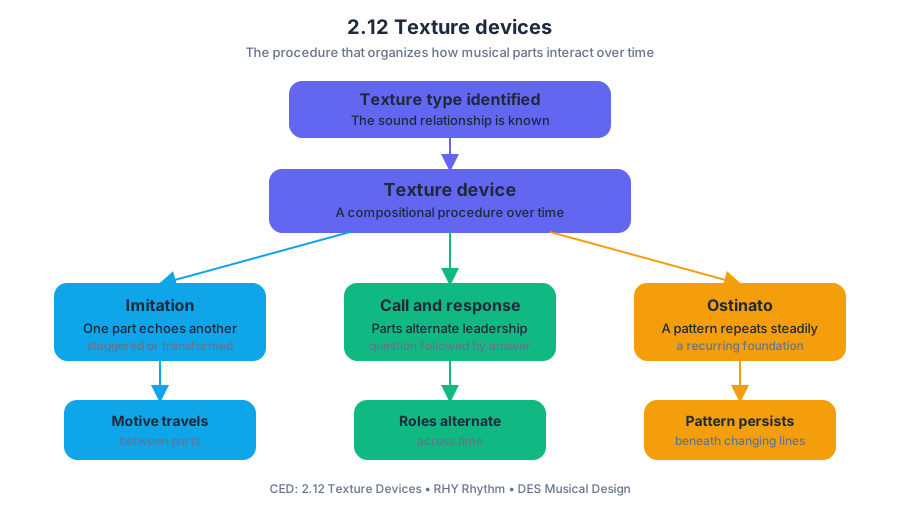
2.13 Rhythmic devices
A rhythm can become more than a sequence of durations when it creates expectation, interruption, or competing patterns. A rhythmic device is a recurring or distinctive way of organizing beats and durations that shapes a passage’s energy, groove, and musical design.
2.13 Rhythmic devices
A rhythm can become more than a sequence of durations when it creates expectation, interruption, or competing patterns. A rhythmic device is a recurring or distinctive way of organizing beats and durations that shapes a passage’s energy, groove, and musical design. In AP Music Theory, Topic 2.13 Rhythmic Devices is associated with the big idea RHY (Rhythm) and Skill 1: Analyze Performed Music plus Skill 2: Analyze Notated Music.
The main devices: what the listener notices
The most reliable way to identify a rhythmic device is to compare the written durations with the heard accents. A pattern may sound unstable because it delays an expected accent, repeats insistently, or places two regular groupings against each other.
| Device | What happens | Listening or notation clue |
|---|---|---|
| Syncopation | An accent falls on a normally weak part of the beat, or an expected strong beat is tied across | A note begins off the beat and continues through the next strong beat |
| Ostinato | A short rhythmic or melodic pattern repeats persistently | The same pattern returns while other material changes |
| Duple–triple conflict or cross-rhythm | Two simultaneous layers organize the same span in different groupings, commonly $2$ against $3$ | One layer groups events in twos while another groups them in threes |
| Triplet subdivision | A beat normally divided into two equal parts is divided into three | Three equal notes occupy the time of two |
| Hemiola | The perceived grouping temporarily shifts, often from three groups of two to two groups of three | Accents reorganize without necessarily changing the notated meter |
Syncopation: moving the expected accent
In a simple meter such as $4/4$, listeners normally expect beat $1$ to be strongest, followed by beat $3$, with subdivisions supporting those beats. Syncopation deliberately emphasizes a weak location—for example, an eighth-note beginning on the “and” of beat $2$ and tied across beat $3$. The duration is not merely unusual; its placement changes the listener’s sense of forward motion.
Worked example. Imagine a $4/4$ melody whose notes enter on the eighth-note counts $1$, “and” of $2$, and $4$, with the second note tied across beat $3$. The tie prevents a new attack on beat $3$, so the melody’s audible emphasis falls away from the expected strong beat. The accompaniment may continue marking beats $1$, $2$, $3$, and $4, creating tension between the meter’s pulse and the melody’s accents.
Key insight: Syncopation concerns accent and expectation, not simply complicated notation.
Repetition and competing groupings
An ostinato is a repeated pattern that acts like a rhythmic loop. It may remain unchanged beneath a changing melody, harmony, or texture. When analyzing performed music, listen for the layer that keeps returning; when analyzing notation, bracket the smallest repeating unit and verify that its boundaries remain consistent.
A cross-rhythm is different from syncopation because it involves simultaneous grouping systems. Suppose an accompaniment in $3/4$ gives equal accents on beats $1$, $2$, and $3$, while a melody accents every other eighth note. Across the same span, the accompaniment projects three equal beats and the melody projects two larger groupings. The resulting recurring $2$-against-$3$ relationship is a duple–triple conflict, not automatically syncopation.
A diagnostic method
Use this four-step analysis whenever a passage sounds rhythmically unsettled:
- Establish the meter: identify the notated time signature and likely beat unit.
- Mark attacks: write the exact beat or subdivision on which each layer begins.
- Mark accents: distinguish written accents, repeated attacks, longer durations, and performance emphasis.
- Compare layers: decide whether the effect comes from displaced accents, repetition, or competing groupings.
Named misconception — “Any offbeat rhythm is syncopation.” An offbeat entrance may be syncopated, but an every-other-eighth-note pattern against a steady triple meter can instead create a cross-rhythm. Always locate the accent pattern in both layers before naming the device. A meter change requires the underlying time organization to change; a cross-rhythm can occur while the notated meter remains constant.
Retrieval check
In $3/4$, the accompaniment accents beats $1$, $2$, and $3$, while the melody accents every other eighth note, producing a recurring $2$-against-$3$ pattern. Is this best described as syncopation, a duple–triple conflict/cross-rhythm, a meter change, or a timbre device? Explain how the simultaneous accent patterns support your choice.
Answer: It is a duple–triple conflict/cross-rhythm. The accompaniment maintains three beat groupings, while the melody projects two recurring groupings across the same time span; the meter itself has not changed, and timbre is unrelated to the accent organization.
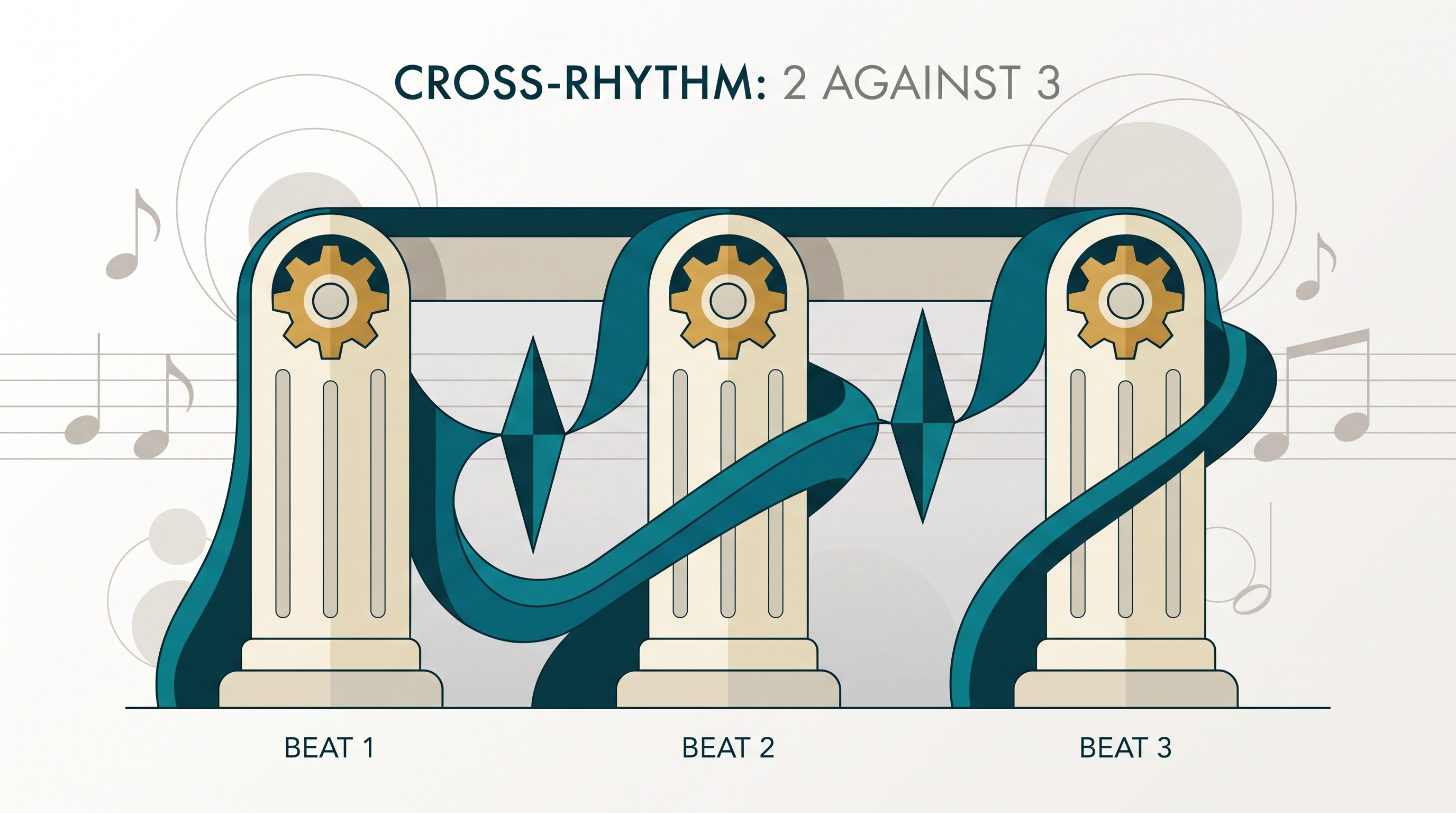
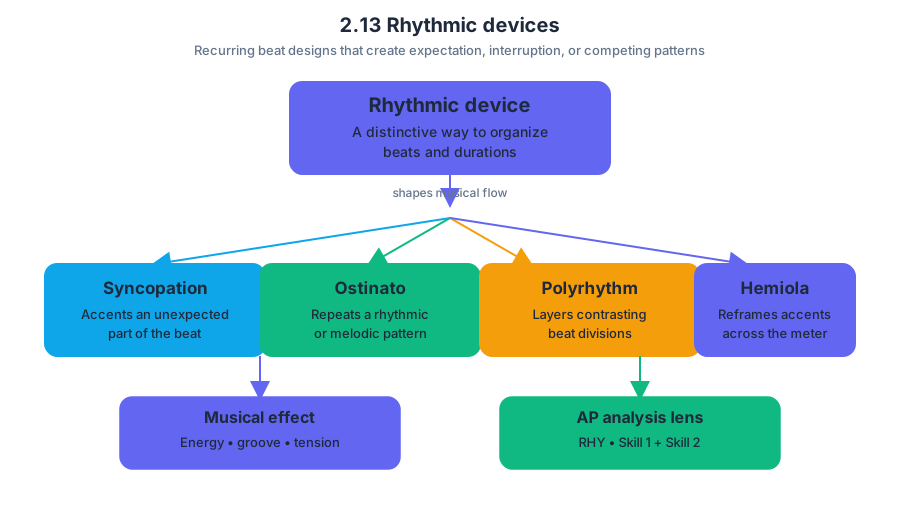
3.1 Triad and chord qualities
Key concepts: Chord definition and perception · Triads as three distinct pitches stacked in thirds · Seventh chords as four distinct pitches stacked in thirds · Triad qualities determined by major and minor thirds · Major, minor, diminished, and augmented triad qualities · Recognizing chord quality in performed music · Recognizing chord quality in notated music · Root position and inversions of triads · Chord-quality examples in harmonic analysis · Arpeggiation as a way of perceiving a chord
A chord is a group of three or more pitches heard simultaneously—or perceived as a single grouping when the pitches are sounded successively through arpeggiation, a broken-chord performance.
3.1 Triad and chord qualities
A chord is a group of three or more pitches heard simultaneously—or perceived as a single grouping when the pitches are sounded successively through arpeggiation, a broken-chord performance. The ear can therefore recognize a chord even when its notes do not arrive at exactly the same moment.
From stacked thirds to chord identity
In Western music, the two basic chord types are triads and seventh chords. A triad contains three distinct pitches arranged as adjacent letter names when placed in its essential stacked-third form; a seventh chord contains four distinct pitches arranged the same way.
When a chord is rearranged into stacked thirds, its lowest pitch is called the root. The other chord members are named by their intervallic position above the root: the third, the fifth, and, in a seventh chord, the seventh. The sounding bass note may be different from the root when the chord is inverted, but the chord’s quality still depends on the intervals measured from its root.
The essential structure can be visualized as follows:
| Chord type | Number of distinct pitches | Stacked-third members |
|---|---|---|
| Triad | 3 | root, third, fifth |
| Seventh chord | 4 | root, third, fifth, seventh |
PIT-1.O.1 defines the chord, triad, and seventh chord; PIT-1.O.2 supplies the names of the chord members; and PIT-1.O.3 explains that chord quality is determined by the chord’s interval structure. These identifiers belong to Learning Objective PIT-1.O: Describe the quality of a chord in performed music and notated music.
How thirds determine triad quality
A triad’s quality is determined by the two thirds formed above its root. The interval from root to third and the interval from third to fifth create a compact “interval recipe.”
| Triad quality | Lower interval | Upper interval | Example |
|---|---|---|---|
| Major | major third | minor third | C–E–G |
| Minor | minor third | major third | F-sharp–A–C-sharp |
| Diminished | minor third | minor third | B–D–F |
| Augmented | major third | major third | C–E–G-sharp |
A major triad sounds bright or stable because its root-to-third span is a major third and its third-to-fifth span is a minor third. A minor triad reverses that order. A diminished triad contains two minor thirds and produces a more tense, compressed sound, while an augmented triad contains two major thirds and has an unusually expanded, unsettled quality.
Worked example: identifying F-sharp minor
Suppose notation shows the pitches F-sharp, A, and C-sharp. First, arrange them as stacked thirds: F-sharp–A–C-sharp. The root is F-sharp, the third is A, and the fifth is C-sharp.
Now measure the intervals: F-sharp to A is a minor third, and A to C-sharp is a major third. The interval recipe is therefore minor third plus major third, so the triad is F-sharp minor.
The same reasoning works when the notes are sounded as an arpeggio. Listen for the implied root and mentally reorder the notes into thirds; do not classify the chord solely from the first pitch performed.
Seventh-chord quality
A seventh chord adds a fourth distinct pitch above the triad’s root. For example, a D major-minor seventh chord contains D, F-sharp, A, and C. Its stacked thirds are major third, minor third, and minor third: D to F-sharp, F-sharp to A, and A to C.
The phrase “major-minor seventh” names the combination of a major triad below and a minor seventh above the root. The quality label describes the complete interval structure, not merely the quality of the triad at the bottom.
Reading and hearing quality
For Skill 1: Analyze performed music, identify chord quality by listening for the characteristic interval pattern. A useful method is to hear the lowest apparent root, sing or imagine the third, and decide whether the third is major or minor; then distinguish the fifth as perfect, diminished, or augmented.
For Skill 2: Analyze notated music, read the pitches, reconstruct the stacked-third arrangement, and compare the intervals with the four triad recipes. These skills meet the learning objective in both required settings: performed music and notation.
Misconception check: The first note heard is not necessarily the root. An arpeggio may begin on the third or fifth, and an inverted chord may place another chord member in the bass. Identify the root from the complete pitch collection and its stacked-third structure.
Quality symbols provide a compact label: major may be marked M, minor m, diminished with $^\circ$ or d, and augmented with $+$ or A. For instance, $B^\circ/D$ means a diminished B triad—B, D, and F—with D in the bass; the symbol $^\circ$ identifies quality, while the bass note after the slash identifies the voicing or inversion.
Retrieval check
A chord contains E, G, and B. What is its quality? E–G is a minor third and G–B is a major third, so the answer is E minor. If the same pitches are performed in the order B–E–G, the chord’s quality does not change: the sounding order changes, but the pitch collection still forms an E-minor triad.
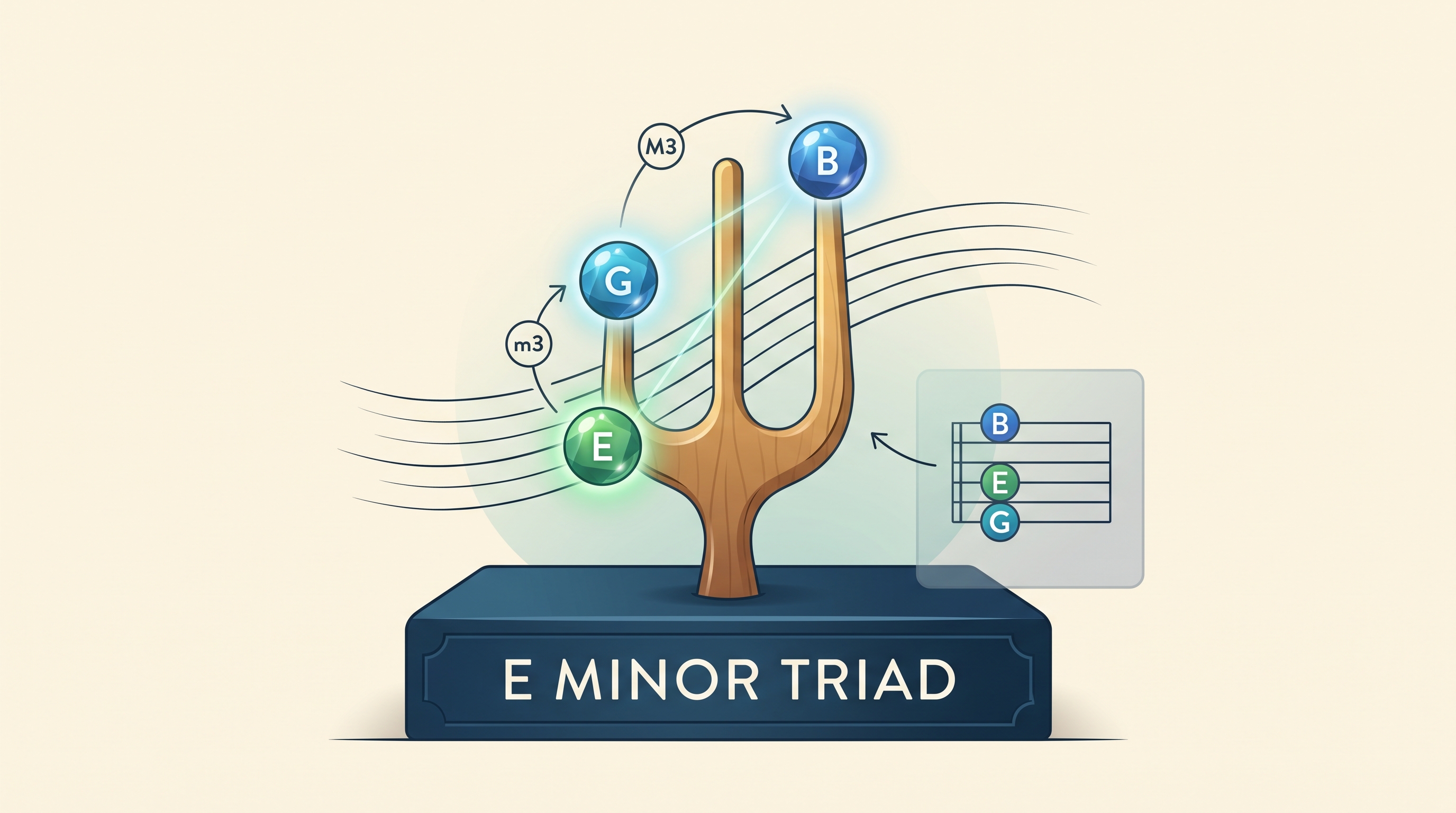
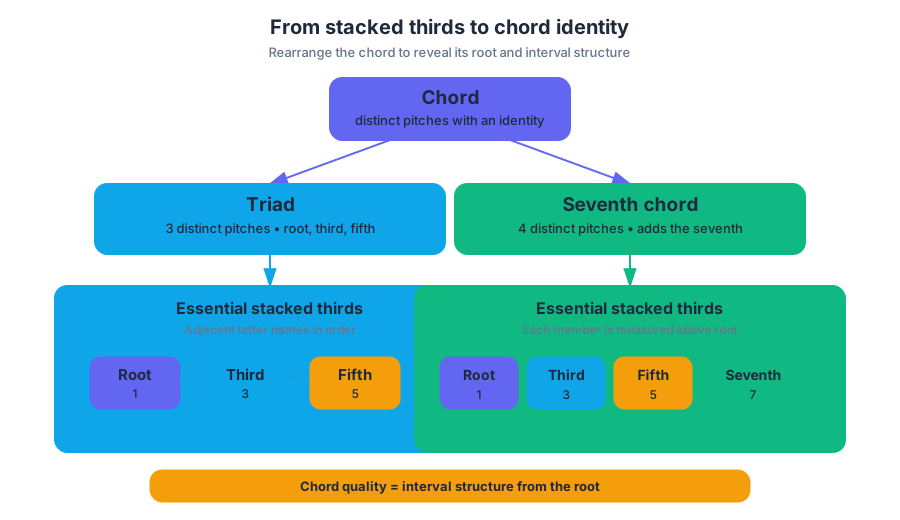
3.2 Diatonic chords and Roman numerals
Key concepts: Diatonic chords · Roman-numeral analysis · Scale-degree identification of chord roots · Chord quality notation · Uppercase and lowercase Roman numerals · Arabic numerals for chord inversions · Figured-bass notation · Harmonic function in chord progressions · Outer-voice notation and analysis · 18th-century voice leading
A Roman numeral turns a chord into a map coordinate: it tells you which scale degree supplies the root and, through capitalization, what quality the chord has.
3.2 Diatonic chords and Roman numerals
A Roman numeral turns a chord into a map coordinate: it tells you which scale degree supplies the root and, through capitalization, what quality the chord has. In a key such as C major, the numeral V means “the chord built on scale degree $5$,” while v would mean “a minor chord built on scale degree $5$.”
Roman-numeral analysis identifies a chord by its root’s scale-degree position and its chord quality. Uppercase numerals indicate major chords; lowercase numerals indicate minor chords. The symbol $^\circ$ marks diminished quality when needed.
From scale degrees to chord symbols
In C major, the diatonic triads can be represented as follows:
| Scale degree | Root | Roman numeral | Quality |
|---|---|---|---|
| $1$ | C | I | major |
| $2$ | D | ii | minor |
| $3$ | E | iii | minor |
| $4$ | F | IV | major |
| $5$ | G | V | major |
| $6$ | A | vi | minor |
| $7$ | B | vii$^\circ$ | diminished |
The numeral is not a letter name. It is a relationship to the key. For example, an E-major chord is III in C major only if the chord’s notes have been chromatically altered; the diatonic chord built on scale degree $3$ in C major is E–G–B, so its analysis is iii. Change the key, and the same sounding chord may receive a different numeral.
Roman numerals also describe harmonic function
A harmonic function is the role a chord plays in creating movement and stability. Diatonic chords commonly group into three functional families:
- Tonic function: stability or arrival, especially I; vi can also substitute for tonic.
- Predominant function: motion away from tonic toward dominant, especially ii and IV.
- Dominant function: tension that strongly points back to tonic, especially V and vii$^\circ$.
These roles explain why a harmonic progression—a particular sequence of chords underlying a passage—often sounds directed rather than random. A useful basic pattern is
$$ \mathrm{I \rightarrow vi \rightarrow ii \rightarrow V \rightarrow I}. $$
In C major, this means
$$ \mathrm{C \rightarrow Am \rightarrow Dm \rightarrow G \rightarrow C}. $$
The opening I establishes tonic. The vi remains relatively stable but creates contrast without leaving the tonic family. The ii acts as predominant, preparing V; V supplies dominant tension; and the final I restores tonic stability.
This functional reading is more informative than simply listing chord names. I–vi–ii–V–I tells both what the chords are and how they behave: tonic area, predominant preparation, dominant tension, and tonic resolution.
Applying an analysis to performed or notated music
Roman-numeral analysis applies to music heard in performance as well as music shown in notation. Start by determining the key, identify the likely chord roots from the sounding notes, and then express each chord relative to the key. The sounding soprano and bass are especially useful clues, but an accurate analysis must account for every written or heard note assigned to each harmony.
For example, suppose a notated passage in C major contains the simultaneous pitch collections C–E–G, A–C–E, D–F–A, G–B–D, and C–E–G. The analysis is I–vi–ii–V–I. Every note belongs to its assigned diatonic chord, and the progression’s functional pattern supports the interpretation.
PIT-2.F.1: Notes of a bass line, especially when combined with other information, may be used with Arabic numerals to show chord inversion and/or specific voice leading. If the Roman-numeral analysis is accurate, all given notes must be explainable by the chords represented.
Arabic numerals may be added to a Roman numeral to indicate inversion or a particular voice-leading configuration, such as a chord symbol containing a figure like $6$. That compact addition says which chord and gives limited information about how it is arranged. It is not the same as figured bass: in figured bass, Arabic numerals are intervals to be performed above the given bass note, whereas Roman-numeral analysis labels the harmony itself. Detailed inversion and figured-bass procedures belong with chord inversions.
Voice-leading accuracy and exam reasoning
Roman numerals should describe the harmony that actually explains the music, not merely provide a plausible sequence. In 18th-century-style writing, chord choices and their connections follow voice-leading procedures; a theoretically possible label can still produce a poor progression if the parts move incorrectly. Common warning signs include an unstable root-position vii$^\circ$ used without an appropriate resolution and parallel motion by first-inversion chords, except in contexts where the style permits it.
For performed harmonic progressions, PIT-2.G.1 emphasizes accurate notation of the sounding pitches and rhythms, while PIT-2.G.2 requires the outer voices—soprano and bass—to provide clues to the chords and requires every written note to be accounted for in the Roman-numeral analysis. PIT-2.G therefore connects hearing, notation, and harmonic labeling rather than treating them as separate tasks.
Misconception check
Misconception: “Uppercase means the chord’s letter name is uppercase.” Uppercase and lowercase describe quality, not spelling style: IV means a major chord on scale degree $4$, while iv means a minor chord on scale degree $4$. In C major, F–A–C is IV; F–A-flat–C would be iv, because the third has changed.
Retrieval check
In G major, identify the Roman numerals and functions for the progression G–E minor–A minor–D–G. Then explain why the final chord sounds like a resolution. A complete answer should name the sequence I–vi–ii–V–I, identify tonic, predominant, and dominant areas, and connect the dominant V to the returning tonic I.
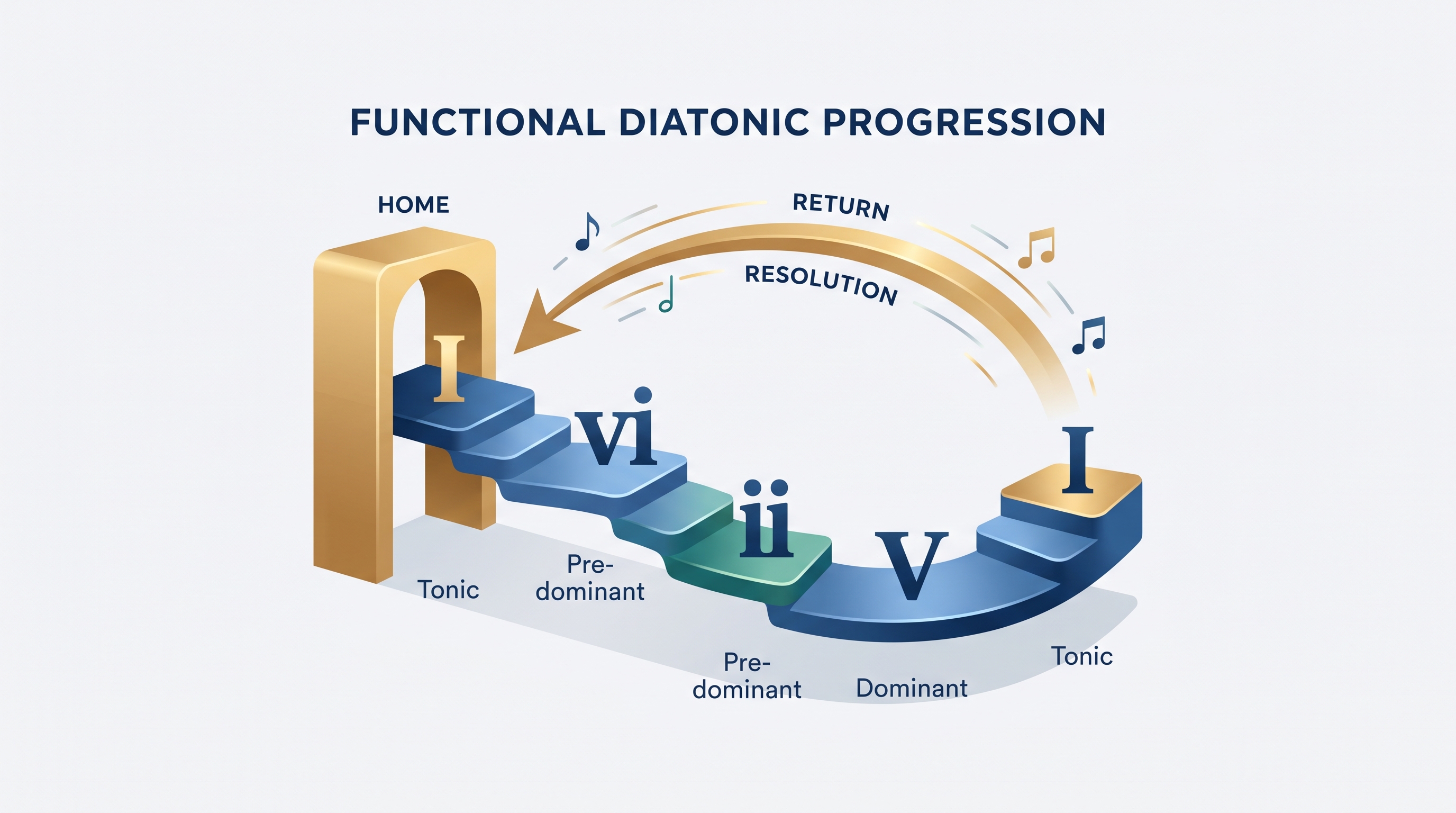
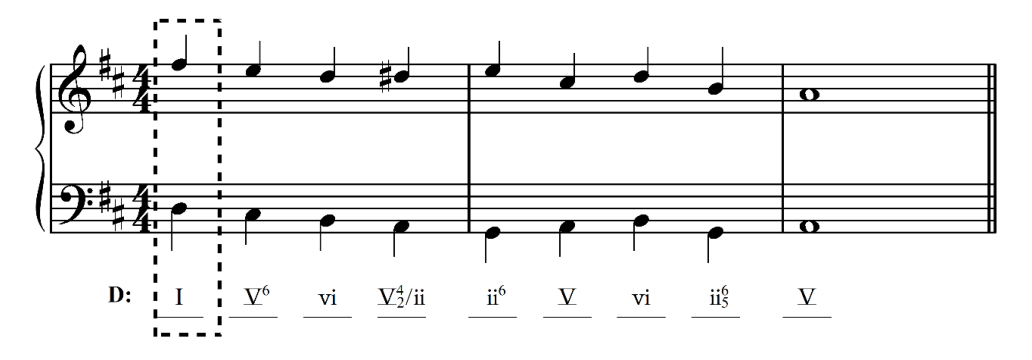
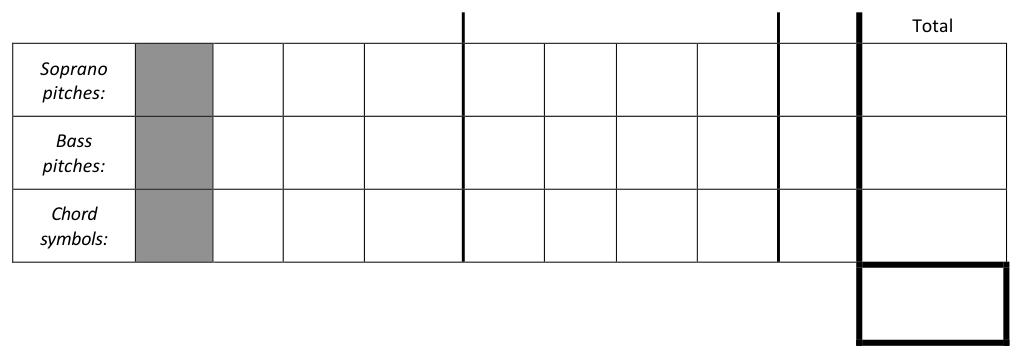
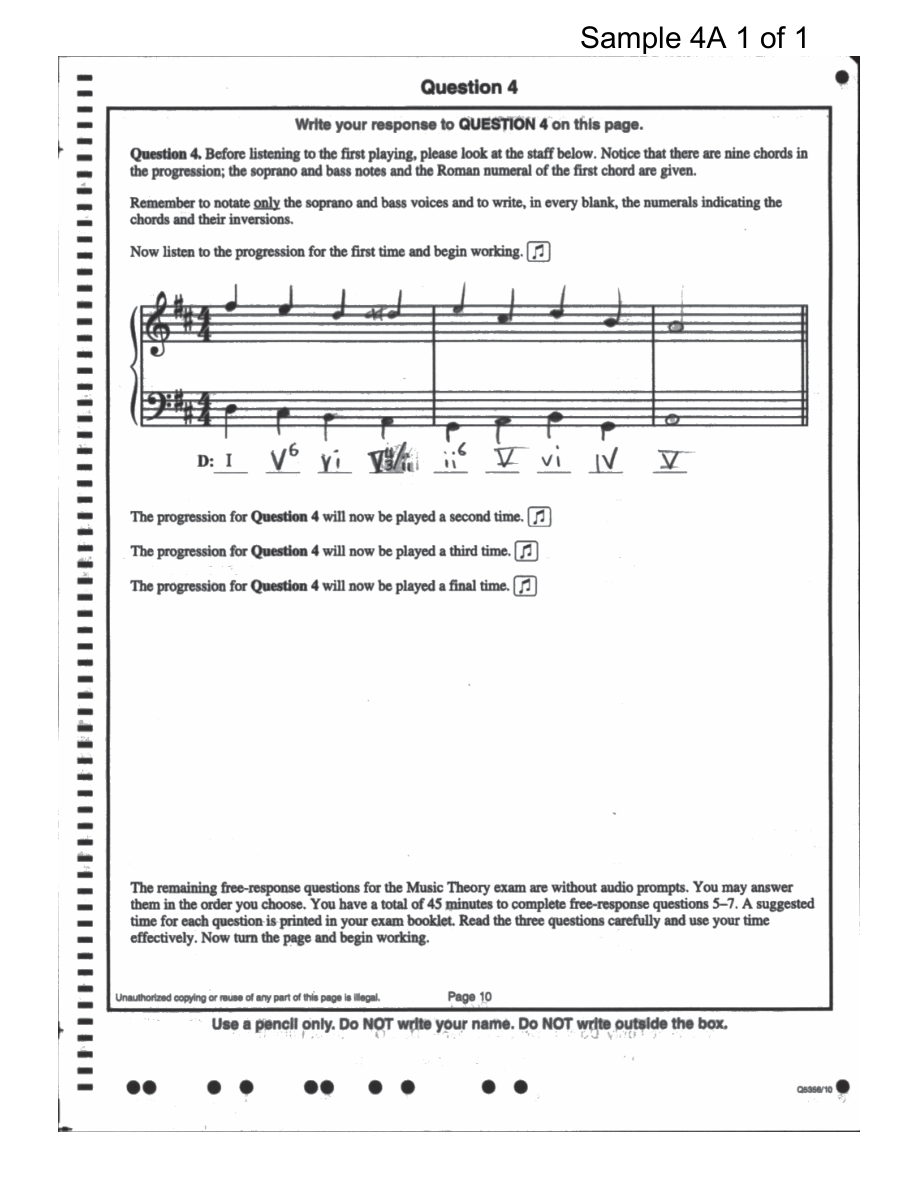
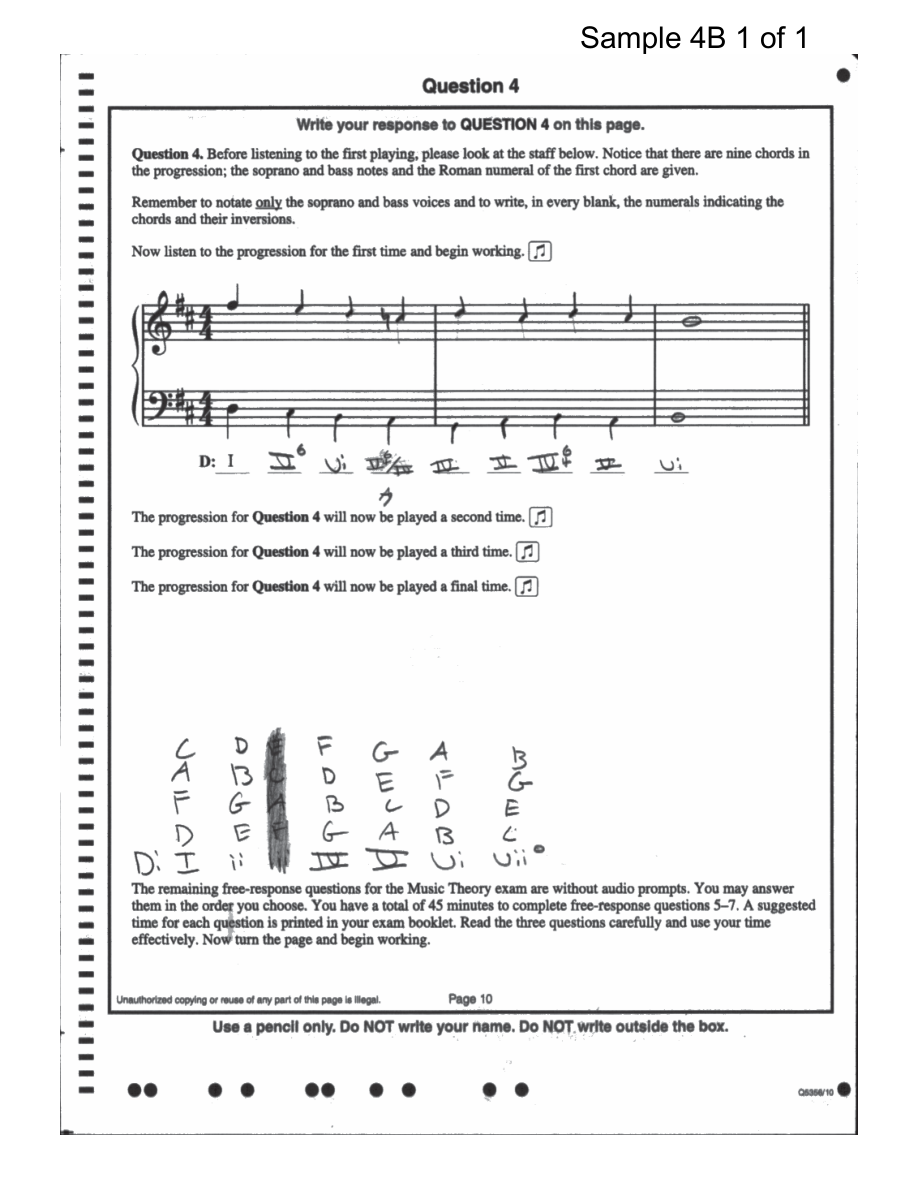
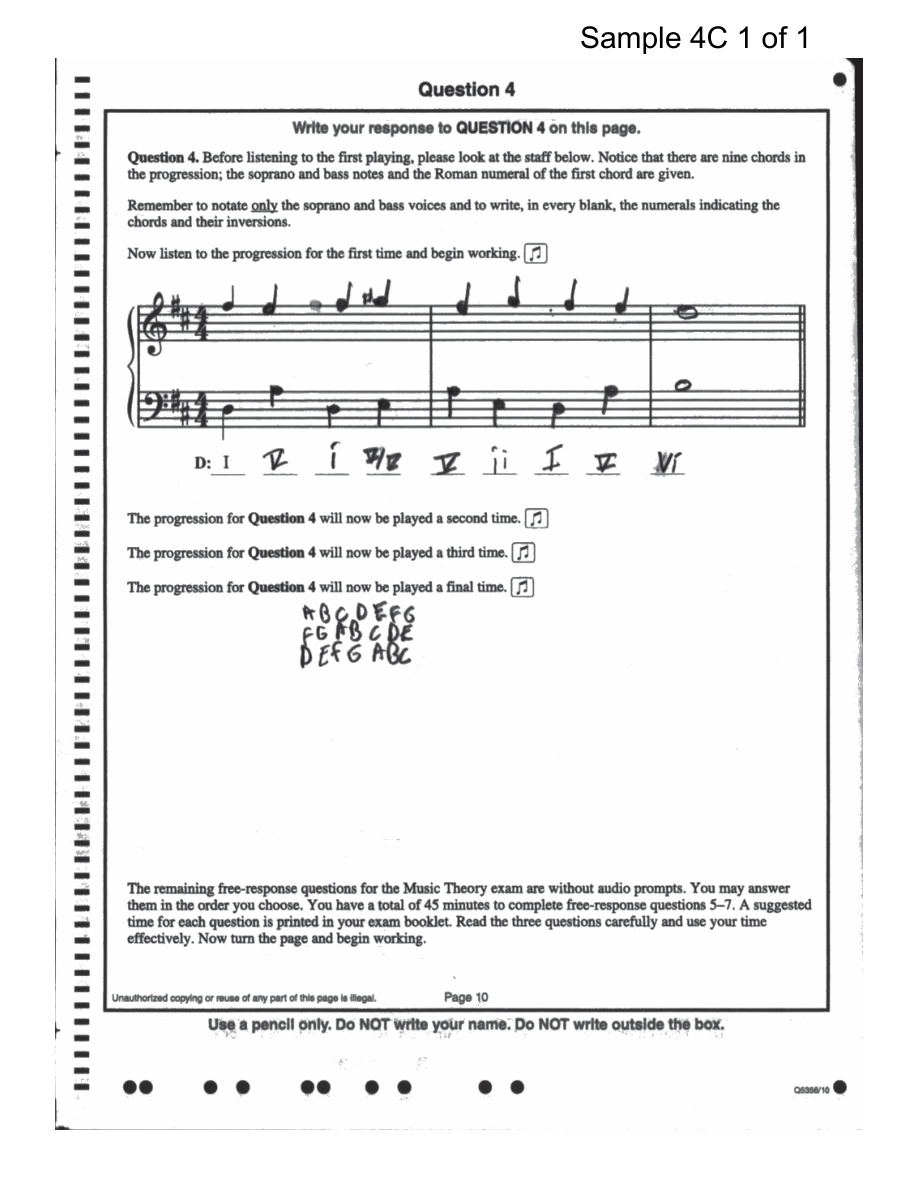
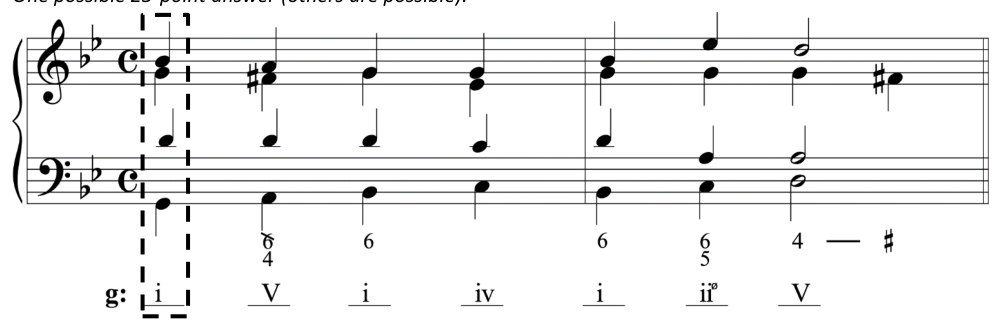
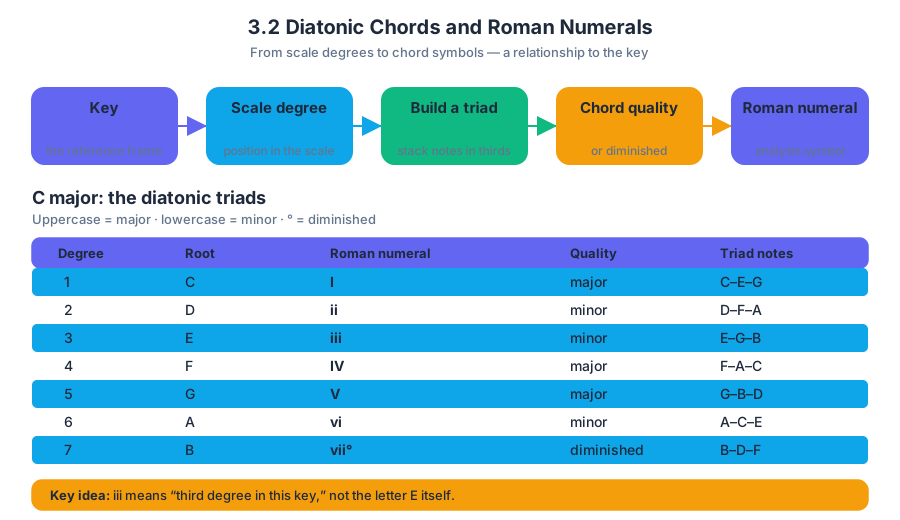
3.3 Chord inversions and figured bass
Key concepts: Chord inversions · Root position, first inversion, and second inversion · Figured-bass notation · Arabic numerals for chord inversions · Roman-numeral harmonic analysis · Distinguishing chord changes from bass changes · Four-voice realization from figured bass · Chord members appearing in the bass · Major and minor triad notation · Harmonic function in performed and notated progressions
A chord’s identity and its lowest note are related but not identical: when the bass changes, the harmony may change—or the same harmony may simply appear in a different inversion.
3.3 Chord inversions and figured bass
A chord’s identity and its lowest note are related but not identical: when the bass changes, the harmony may change—or the same harmony may simply appear in a different inversion. That distinction is the key to reading figured bass and analyzing a progression accurately.
The bass determines the inversion
The bass is the lowest sounding part of a chord. A triad is in root position when its root appears in the bass. When another chord member appears in the bass, the chord is inverted: the third in the bass creates first inversion, while the fifth in the bass creates second inversion.
For a C-major triad, the pitch collection is always C–E–G, but its position changes:
| Bass note | Chord position | Roman-numeral figure |
|---|---|---|
| C, the root | Root position | $I$ |
| E, the third | First inversion | $I^6$ |
| G, the fifth | Second inversion | $I^{6/4}$ |
The superscript figures are not arbitrary labels. They describe the intervals formed above the bass. With E in the bass, C is a sixth above E and G is a third above E, producing the conventional first-inversion label $I^6$. With G in the bass, C is a fourth above G and E is a sixth above G, producing $I^{6/4}$.
Essential Knowledge PIT-2.A.2: When a chord member other than the root appears in the bass, chord inversions result. The third in the bass indicates first inversion; the fifth in the bass indicates second inversion.
Figured bass as interval shorthand
Figured bass is an eighteenth-century shorthand system in which Arabic numerals indicate intervals to be supplied above a given bass note. The bass line provides the bottom voice; the figures identify the remaining pitches or, more broadly, imply the harmony to be realized above it.
In a four-voice realization, the task is therefore not to stack a chord mechanically above every bass note. First identify the implied harmony, determine its inversion, and then supply soprano, alto, and tenor parts with correct chord spelling, spacing, doubling, and voice leading.
For example, in a major key, a bass note belonging to scale degree $3$ with the figure $6$ may imply a first-inversion tonic triad, $I^6$. The bass is the tonic triad’s third; the other voices must provide the root and fifth, with one chord member doubled when appropriate.
Roman numerals plus inversion figures
Use the Roman-numeral conventions established earlier, then add the inversion figure to show which chord member is in the bass. Uppercase and lowercase still communicate triad quality, while the Arabic figure communicates arrangement above the bass. Thus $V^6$ means a major dominant triad in first inversion, not a new scale-degree chord.
The same distinction applies in minor keys. A minor tonic triad in first inversion is written $i^6$; a diminished supertonic triad in first inversion is written $ii^{\circ6}$ or, in some analytical conventions, $ii^{\circ6}$ with the figure placed beside the Roman numeral. The essential question remains: Which chord member is in the bass?
Worked progression: chord change or bass change?
Consider the progression:
$$I ;-; I^6 ;-; IV ;-; V ;-; V^6 ;-; I$$
Read it in C major:
- $I$: C–E–G, with C in the bass.
- $I^6$: C–E–G, but E is now in the bass.
- $IV$: F–A–C, with F in the bass.
- $V$: G–B–D, with G in the bass.
- $V^6$: G–B–D, but B is now in the bass.
- $I$: C–E–G, with C in the bass.
The changes from $I$ to $I^6$ and from $V$ to $V^6$ are bass changes without chord changes: the pitch collection and harmonic identity remain constant while the lowest chord member changes. The move from $I^6$ to $IV$, however, is an actual chord change because the harmony changes from C–E–G to F–A–C.
Misconception check
Misconception: “Every new bass note creates a new Roman numeral.” Not necessarily. If the upper voices and pitch collection still belong to the same triad, label the same harmony with a new inversion figure. Conversely, a bass note can remain unchanged while the upper voices change enough to create a new chord.
Retrieval check
A triad contains the pitches A–C–E, and C is in the bass. Is the chord in root position, first inversion, or second inversion? What figure should accompany its Roman numeral?
Answer: C is the third of the A-minor triad, so the chord is in first inversion: $i^6$ if it functions as tonic in A minor.
Learning Objective PIT-2.A: Identify chords in performed and notated music by combining the Roman numeral for scale-degree root and quality with the Arabic inversion figure for the bass arrangement. Learning Objective PIT-2.B: Use Roman numerals to indicate the harmonic progression implied by figured bass. Essential Knowledge PIT-2.B.1: Figures denote intervals above the bass and therefore imply harmonies that can receive Roman-numeral labels. Essential Knowledge PIT-2.B.2: An accidental or altered figure changes the indicated pitch above the bass; interpret it before assigning the harmonic label.
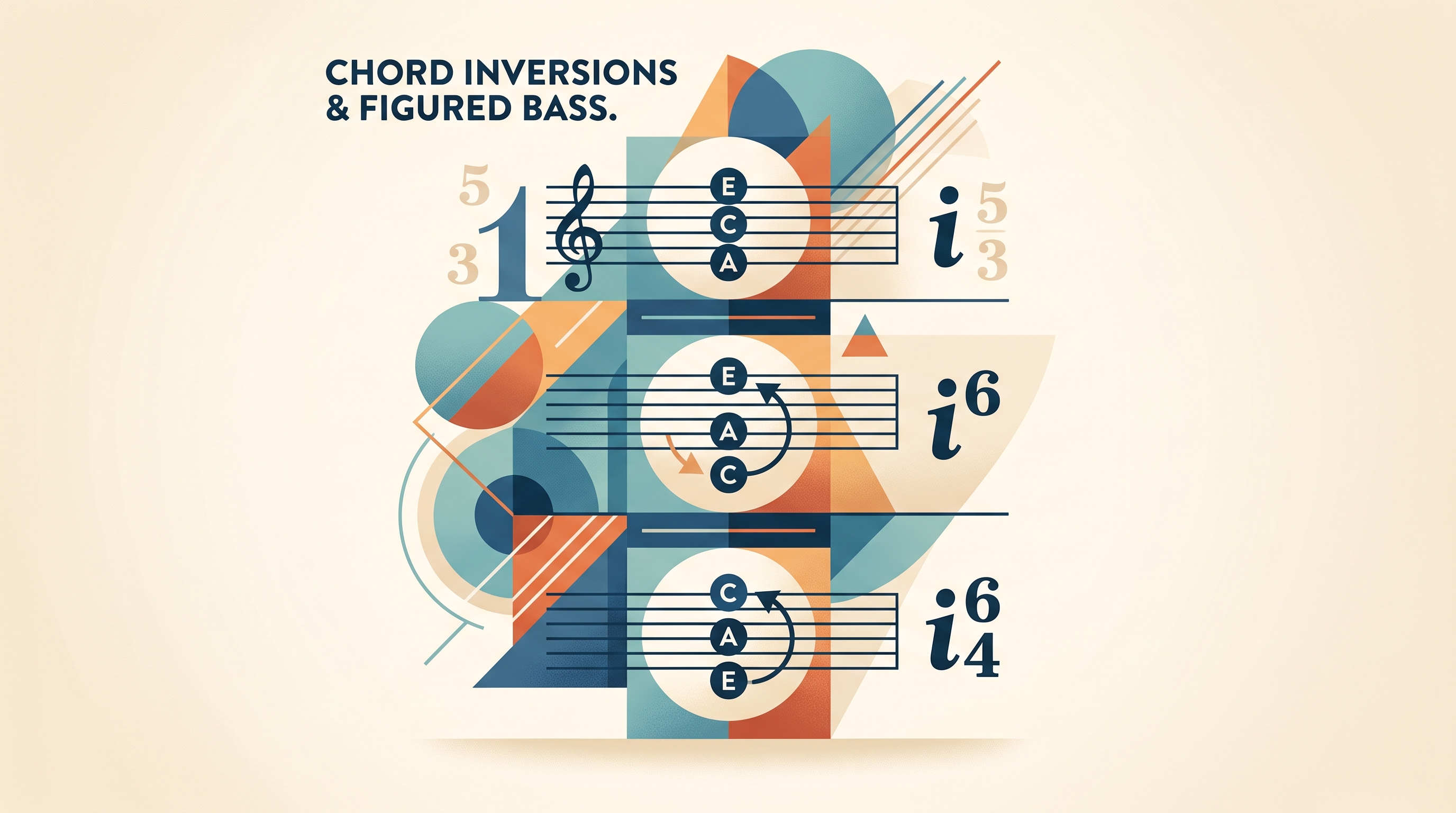
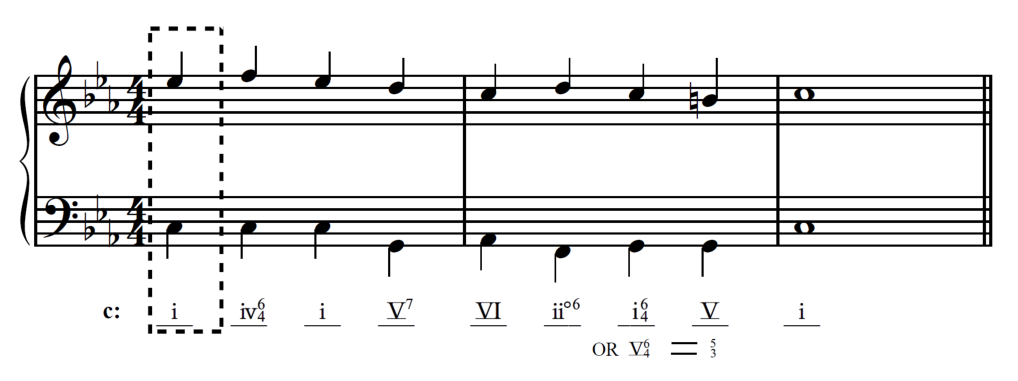
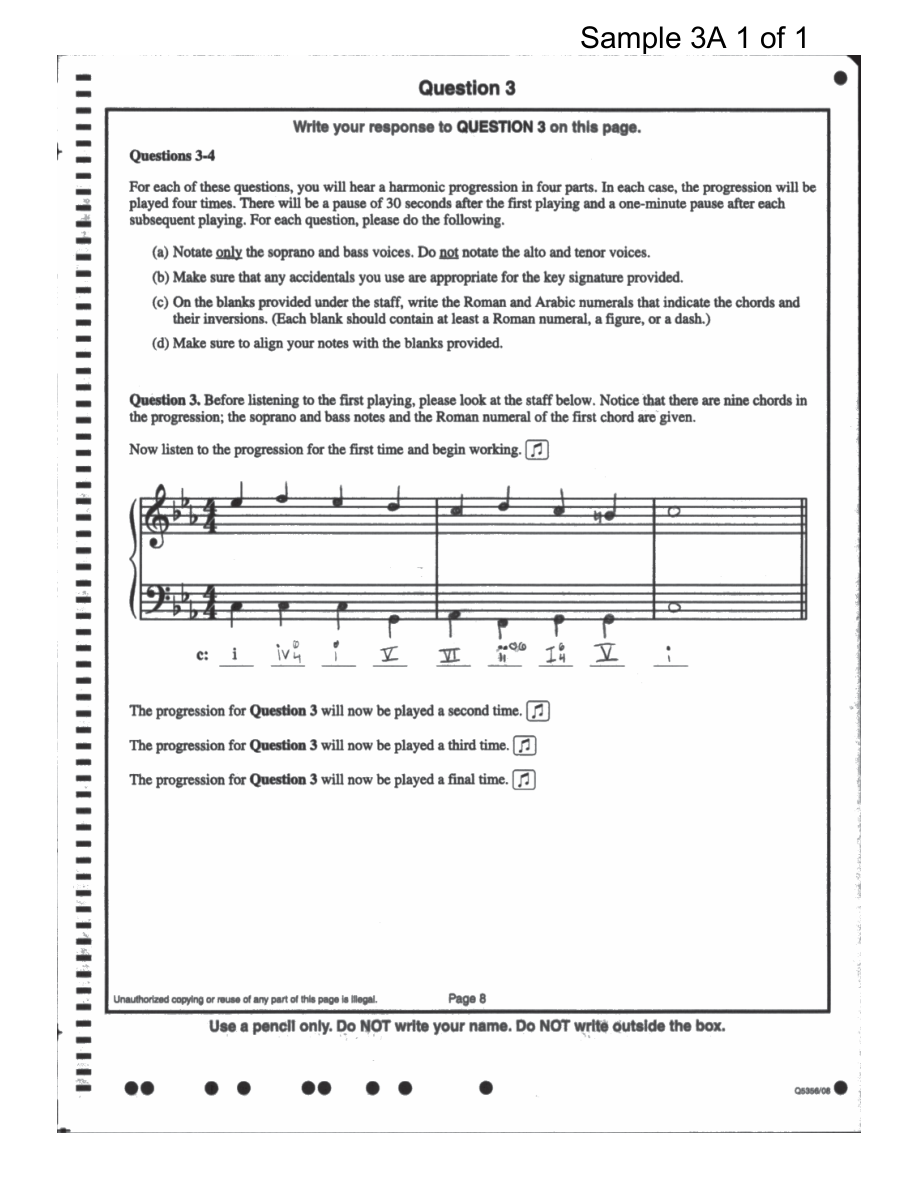
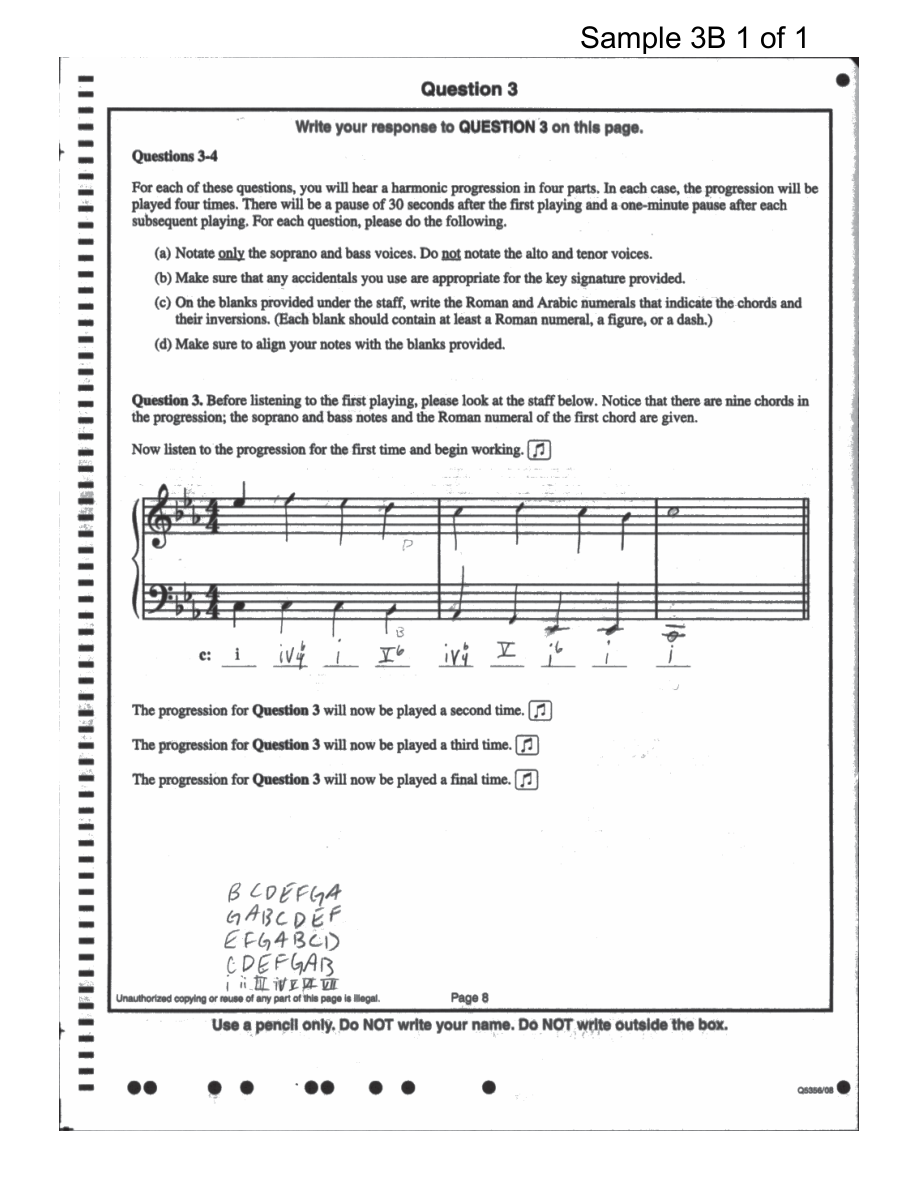
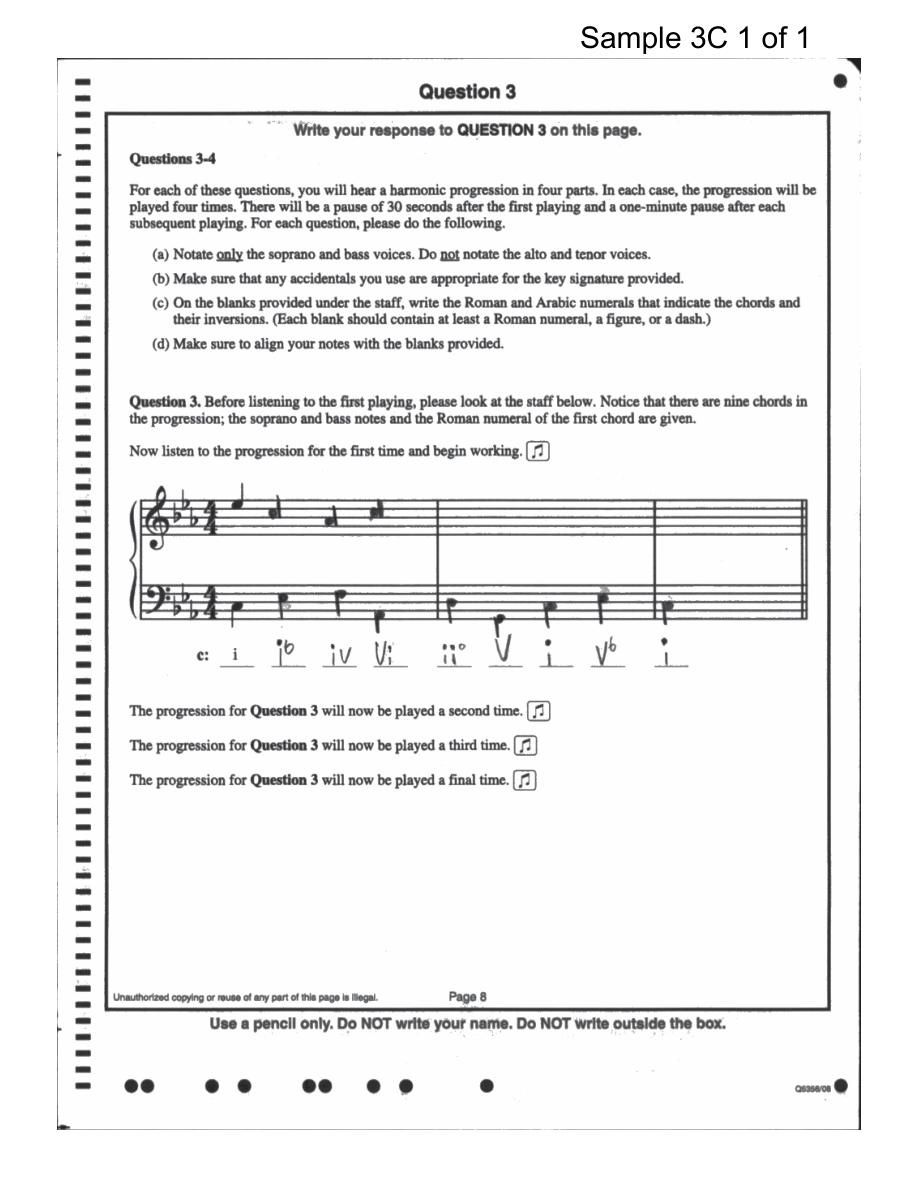
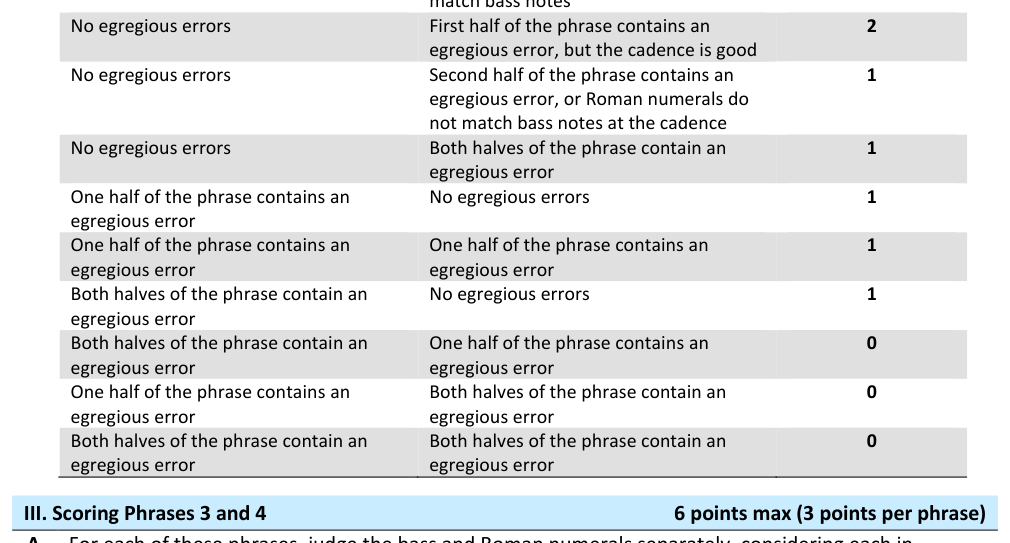
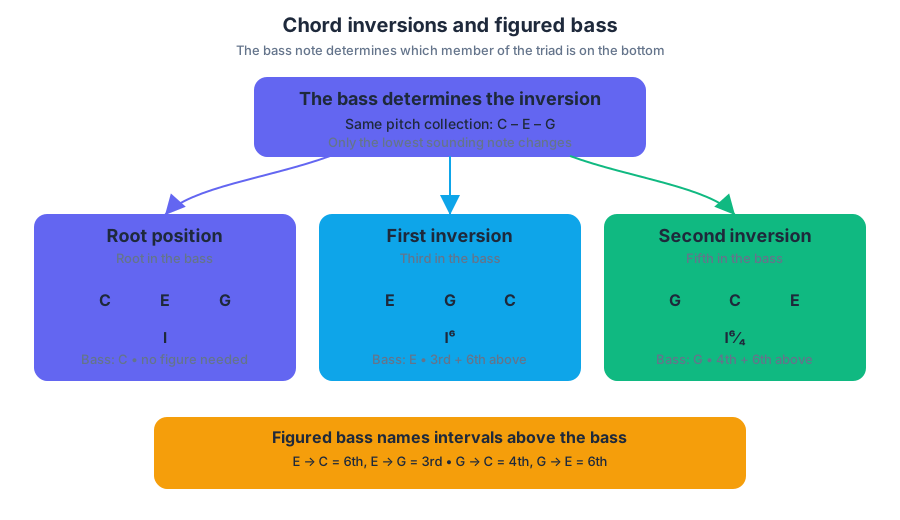
3.4 Seventh-chord qualities
Key concepts: Seventh-chord qualities · Chord definitions · Triads and seventh chords as structures built in thirds · Fully diminished seventh chord (viid7) · Minor seventh chord (ii7 or vi7) · Dominant seventh chord (V7) · Cadential 6/4 chord · Voice-leading before resolution · Contextual listening · Harmony as relationships among chords within a musical style
A seventh chord contains four distinct pitches arranged as a triad plus an added seventh, so its sound depends not only on the chord’s root but also on the precise sizes of its third, fifth, and seventh.
3.4 Seventh-chord qualities
A seventh chord contains four distinct pitches arranged as a triad plus an added seventh, so its sound depends not only on the chord’s root but also on the precise sizes of its third, fifth, and seventh.
A chord is three or more pitches sounding simultaneously. The term can also describe successive pitches that the ear groups as one harmony, as in an arpeggio. A seventh chord therefore remains identifiable even when its notes are heard one at a time rather than as a single vertical sonority.
PIT-1.O.1 — Chord Definitions: A triad contains three distinct pitches stacked in thirds; a seventh chord contains four distinct pitches stacked in thirds.
Imagine stacking objects in alternating layers: each new layer is a third above the one beneath it. In a seventh chord, the layers are the root, third, fifth, and seventh. These names describe each chord member’s intervallic relationship to the root, not necessarily the order in which the notes appear in a performance.
The structural recipe
To identify a seventh-chord quality, first reorganize the pitches conceptually into a stack of thirds. Then inspect the triad quality and the interval from the root to the seventh.
| Chord quality | Triad below | Seventh above root | Example |
|---|---|---|---|
| Fully diminished seventh | Diminished triad | Diminished seventh | $F\sharp$–A–C–$E\flat$ |
| Minor seventh | Minor triad | Minor seventh | $F\sharp$–A–$C\sharp$–E |
| Dominant seventh | Major triad | Minor seventh | $F\sharp$–$A\sharp$–$C\sharp$–E |
| Major seventh | Major triad | Major seventh | F–A–C–E |
The quality label is not a Roman numeral. Fully diminished seventh, minor seventh, and dominant seventh describe the chord’s internal interval structure. Roman numerals such as $\mathrm{vii}^{\circ 7}$, $\mathrm{ii^7}$, $\mathrm{vi^7}$, and $\mathrm{V^7}$ describe the chord’s scale-degree location and harmonic context.
Worked identification: three chords built from $F\sharp$
Start with the notes $F\sharp_4$–$A_4$–$C_5$–$E\flat_5$. Reading upward gives a diminished third structure: $F\sharp$ to A is a minor third, A to C is a minor third, and C to $E\flat$ is a minor third. The result is a fully diminished seventh chord, written here as $\mathrm{vii}^{\circ 7}$.
Now change only two pitches: $F\sharp_4$–$A_4$–$C\sharp_5$–$E_5$. The bottom three notes form a minor triad, $F\sharp$–A–$C\sharp$, and the outer interval from $F\sharp$ to E is a minor seventh. This is a minor seventh chord, which may function as $\mathrm{ii^7}$ in E major or $\mathrm{vi^7}$ in A major.
Finally, use $F\sharp_4$–$A\sharp_4$–$C\sharp_5$–$E_5$. The lower three notes form a major triad, while $F\sharp$ to E remains a minor seventh. This combination is a dominant seventh chord, $\mathrm{V^7}$, in the key of B major.
Hearing quality in context
Vertical inspection is essential, but seventh-chord qualities should also be identified through contextual listening. An arpeggiated chord may present its root, third, fifth, and seventh successively; your task is to hear the four-note grouping and infer its quality rather than treating each note as an isolated event.
A seventh often creates a tendency toward downward motion. For example, in a dominant seventh chord, the chordal seventh may move down by step as the harmony resolves. The voice carrying that seventh may move before the chord resolves fully, so do not assume that every chord member must remain in place until the next vertical sonority.
Harmonic context: $\mathrm{ii^7}$ and the cadential $6/4$
A minor seventh such as $\mathrm{ii^7}$ can participate in a progression toward a cadential $6/4$ chord. The cadential $6/4$ is not being identified here as a seventh-chord quality; it is part of the surrounding harmonic context that helps explain why a seventh chord sounds directed toward resolution.
For example, in C major, a progression may move from $\mathrm{ii^7}$, D–F–A–C, toward a cadential $6/4$ built over G, C–E–G, and then to $\mathrm{V^7}$, G–B–D–F. The important analytical question is twofold: What is the chord’s internal quality? and How does that quality behave in the progression?
Misconception check
Misconception: “A chord’s Roman numeral tells me its quality automatically.” Roman numerals provide a strong clue, but the pitches must confirm the quality. In particular, $\mathrm{ii^7}$ and $\mathrm{vi^7}$ are both minor seventh chords, while $\mathrm{V^7}$ is a dominant seventh because its triad is major.
Retrieval check
Identify each quality without changing the order of the notes: $B$–D–F–$A$, $C$–E–G–B$, and D–F–A–C. Which one is fully diminished, which one is major seventh, and which ones are minor seventh? Then explain why a listener hearing the notes as an arpeggio can still perceive each as a chord.
This work develops PIT-2.C — “Describe the quality of a seventh chord in— a. performed music, b. notated music.” It draws on Skill 1: Analyze performed music, Skill 2: Analyze notated music, and Skill 3: Convert between performed and notated music: hear the sonority, inspect its pitch content, and connect both forms of evidence to the correct chord-quality label.
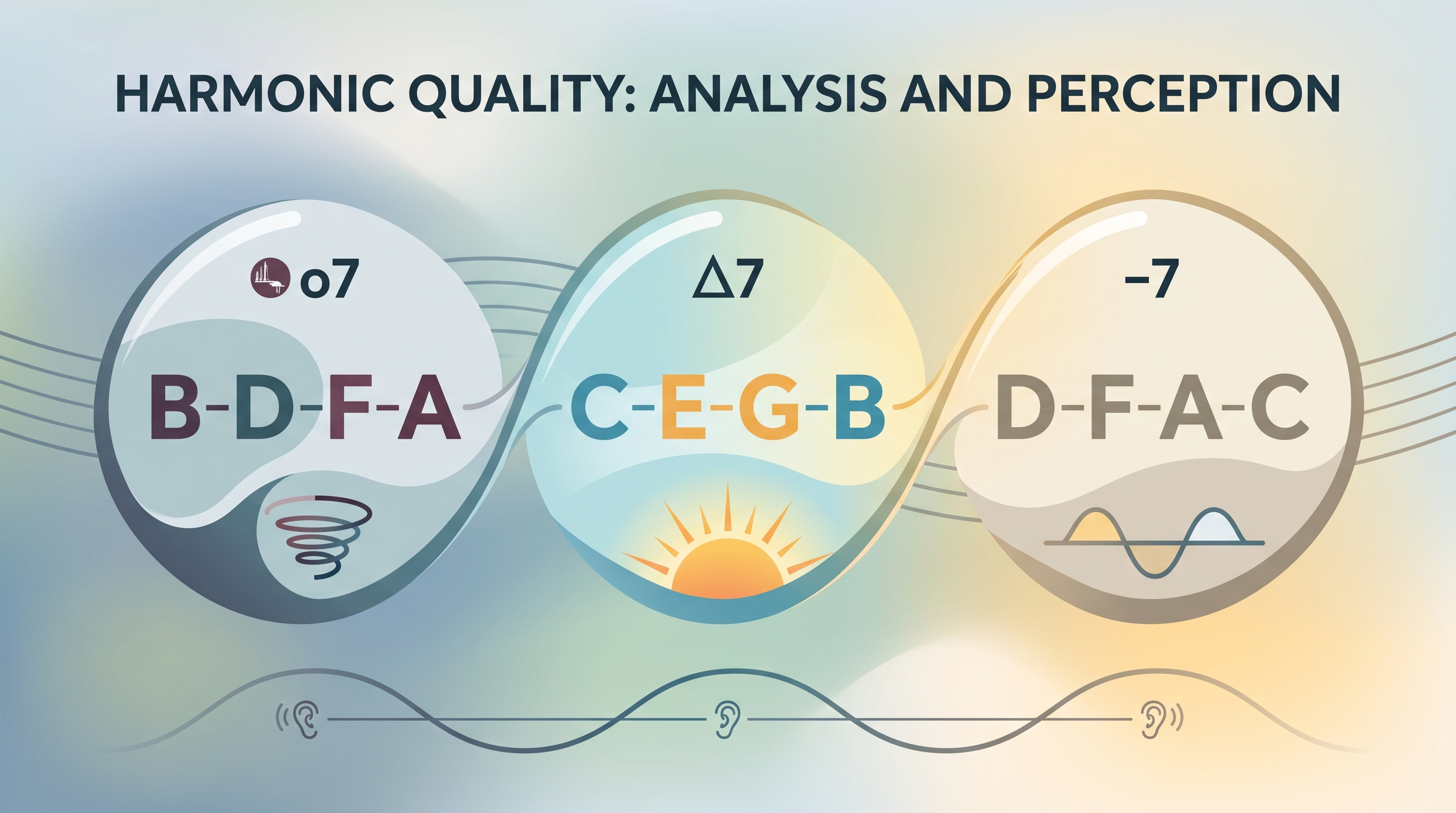
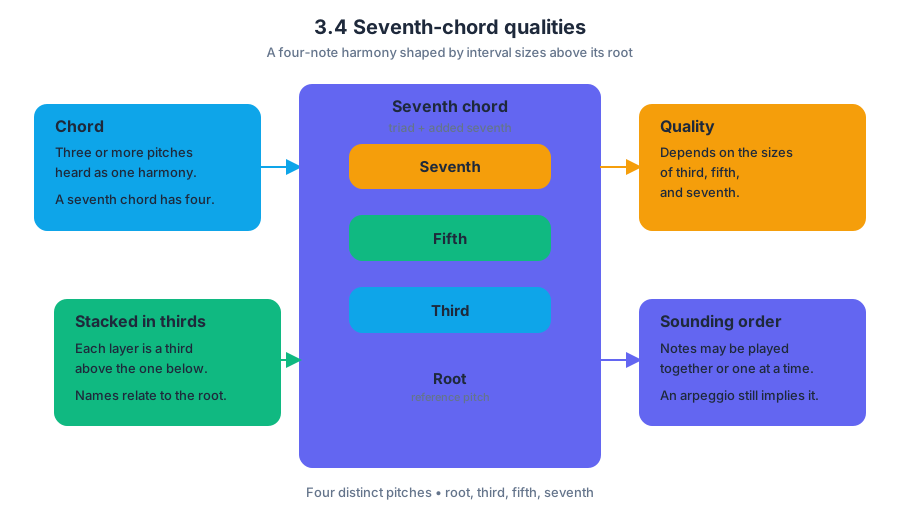
3.5 Seventh-chord inversions and figures
Key concepts: Seventh-chord inversions · Figured-bass notation for seventh chords · Dominant seventh arpeggios in all inversions · Identifying seventh-chord inversions from the bass note · Roman-numeral analysis of seventh chords · Third-related dissonance in seventh chords · Melodic dictation with tonic and dominant triad arpeggios · Compound meter in melodic dictation
A seventh chord can keep exactly the same four pitches while its bass changes, so the ear may hear a new bass line without hearing a new harmony.
3.5 Seventh-chord inversions and figures
A seventh chord can keep exactly the same four pitches while its bass changes, so the ear may hear a new bass line without hearing a new harmony. Seventh-chord inversion identifies which chord member is in the bass; figured bass records the intervals above that bass note.
PIT-2.D.1: Seventh chords have the potential for a third inversion in which the chordal seventh appears in the bass.
The inversion map
For a seventh chord, the figure names the intervals above the bass. The Roman numeral identifies the chord’s root and scale-degree function; the Arabic figures identify its inversion.
| Bass position | Chord member in bass | Standard figure | Example using $G^7 = G$–$B$–$D$–$F$ |
|---|---|---|---|
| Root position | Root | $7$ or omitted in some contexts | Bass $G$: $V^7$ |
| First inversion | Third | $6/5$ | Bass $B$: $V^{6/5}$ |
| Second inversion | Fifth | $4/3$ | Bass $D$: $V^{4/3}$ |
| Third inversion | Seventh | $4/2$ or $2$ | Bass $F$: $V^{4/2}$ |
Read the bass before reading the figure
The fastest reliable procedure is: identify the bass pitch, read the figure, build the chord above that bass, then determine the chord root and Roman numeral. Do not assume that the lowest note is the root.
Suppose the bass note is $F$ with the figure $4/2$ in the key of $C$ major. The intervals above $F$ must be a fourth, sixth, and second: $B$, $D$, and $G$. The complete sonority is $F$–$G$–$B$–$D$, which rearranges to $G$–$B$–$D$–$F$. Therefore the analysis is $V^{4/2}$: a dominant seventh chord in third inversion.
A bass note with figure $6$ is different. In the ordinary diatonic context, $6$ indicates a first-inversion triad, not a seventh chord. Thus, in a minor key, a bass $B\flat$ with figure $6$ can represent $i^6$: the tonic triad with its third in the bass. The missing $3$ is conventionally understood in a simple triadic figure.
Why $6/5$ means first inversion
For a seventh chord in first inversion, the bass is the chordal third. From that bass, the remaining chord members normally form the intervals $3$, $5$, and $6$, producing the compact figure $6/5$.
For example, if the chord is $A$–$C$–$E\flat$–$G$, then $A$ is the root. With $A$ in the bass, the chord is root position and should be represented by $7$. To create first inversion, place $C$ in the bass: $C$–$E\flat$–$G$–$A$. The resulting analysis is $A^{6/5}$, because $C$ is the third of the A seventh chord.
Misconception check: A figure $6/5$ does not mean “the bass note is the root.” It means the bass is the third of a seventh chord.
A complete Roman-numeral example
Consider this progression in $A$ minor:
$$I - I^6 - ii^7 - ii^{6/5} - V^7 - V^{4/2} - i$$
The first two sonorities may contain related tonic pitches but differ in bass placement. Likewise, $ii^7$ and $ii^{6/5}$ can contain the same four chord members while the bass changes from the root to the third. In harmonic dictation, listen for whether the harmony changes or whether only its inversion changes.
A useful listening question is: “Can I rearrange the notes of the second sonority into the same chord as the first?” If yes, the chord may be unchanged in a new inversion. If the pitch collection or function changes, the Roman numeral changes as well.
Sing the dominant seventh in every inversion
In $C$ major, the dominant seventh is $G$–$B$–$D$–$F$. Practice its arpeggio by rote in four bass arrangements:
$$G-B-D-F \quad (V^7)$$
$$B-D-F-G \quad (V^{6/5})$$
$$D-F-G-B \quad (V^{4/3})$$
$$F-G-B-D \quad (V^{4/2})$$
Singing these patterns makes inversion an audible event rather than a memorized symbol. It also supports melodic dictation: melodies may outline tonic and dominant triads, while compound meter changes how those arpeggiated pitches are grouped rhythmically.
Third-related dissonance
A seventh chord can contain a third-related dissonance: two chord members separated by a third may sound unstable when heard within the complete seventh-chord sonority. The added seventh changes the chord’s color and often creates a need for resolution, especially in dominant-function harmony.
This is why a seventh chord should not be treated as “just a triad with one extra note.” Its inversion changes the bass support, its figure changes, and its dissonant tendency may become more or less prominent depending on register and context.
Retrieval check
A bass note $D$ with figure $4/3$ appears in a $G$-dominant seventh chord. Name the inversion and the Roman numeral. Then answer: if the next sonority contains the same four pitches but puts $B$ in the bass, has the chord necessarily changed?
Answer: $D$ is the fifth of $G$–$B$–$D$–$F$, so the chord is $V^{4/3}$, a second-inversion dominant seventh. Moving the bass to $B$ produces $V^{6/5}$; the inversion changes, but the chord may remain the same.
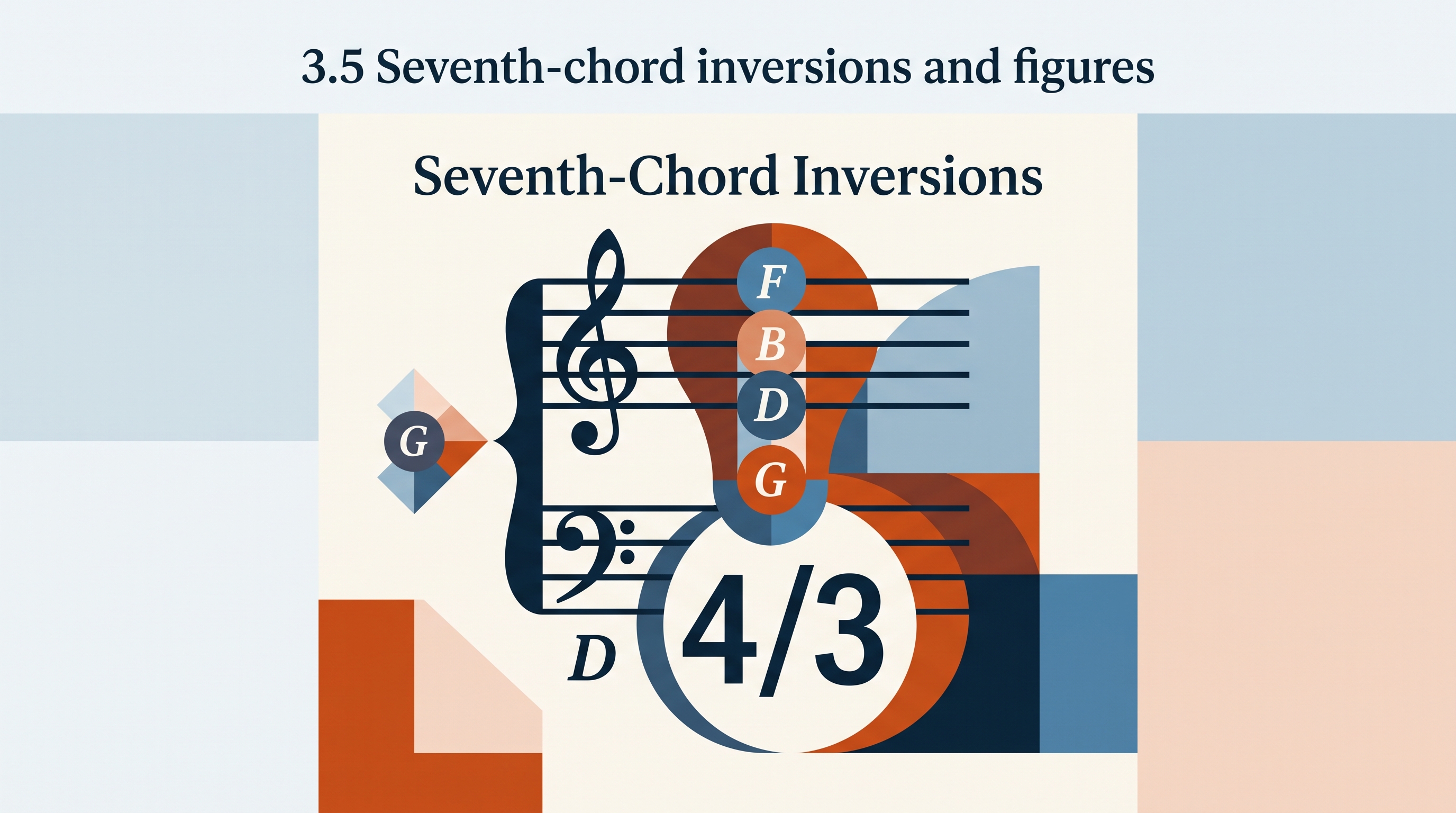
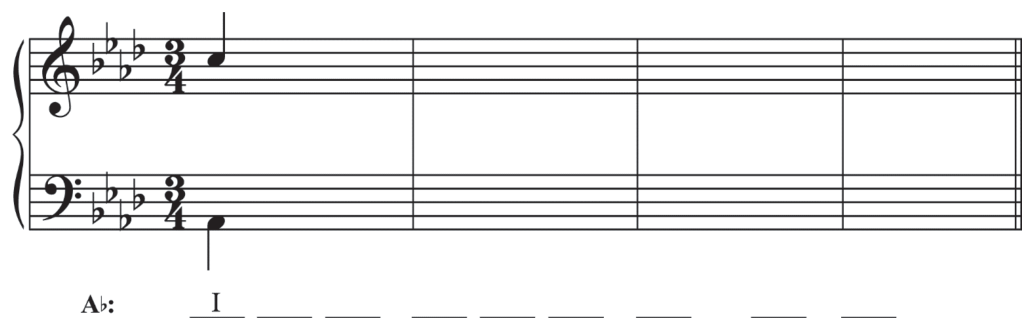
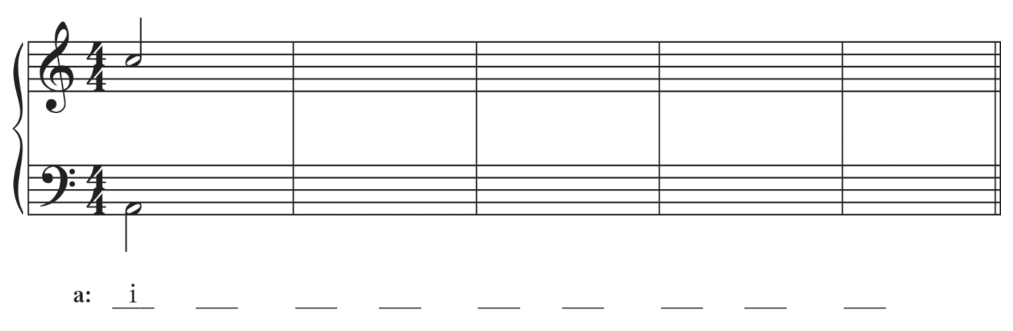
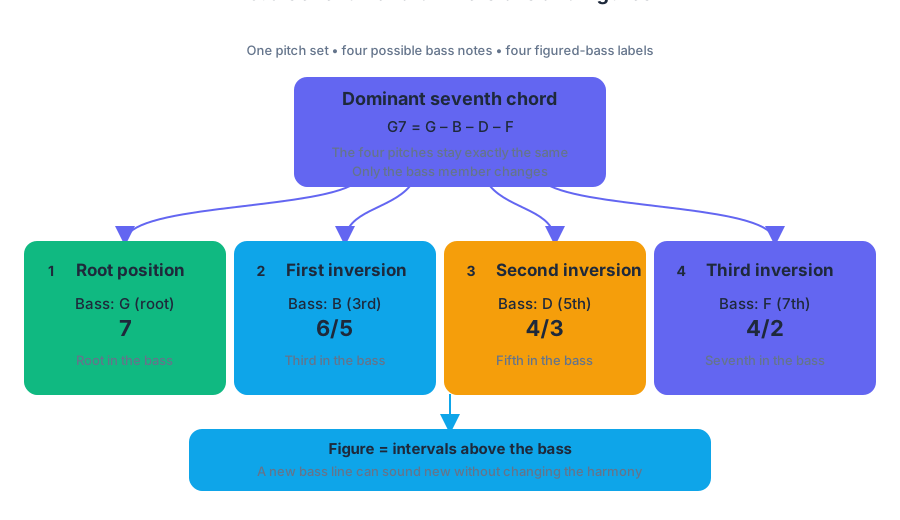
4.1 Soprano-bass counterpoint
Key concepts: Soprano-bass counterpoint · SATB voice leading · Parallel perfect intervals · Beat-to-beat parallels · Hidden (covered) perfect intervals · Direct perfect intervals · Overlapping voices · Phrase structure and phrase relationships · Roman-numeral harmonic analysis · Common-practice period part-writing
A convincing bass line does more than supply low notes: it forms a second melody that must cooperate with the soprano at every moment. Soprano-bass counterpoint is the practice of completing a bass beneath a given soprano while controlling harmonic function, melodic direction, phrase shape, and the intervals formed…
4.1 Soprano-bass counterpoint
A convincing bass line does more than supply low notes: it forms a second melody that must cooperate with the soprano at every moment. Soprano-bass counterpoint is the practice of completing a bass beneath a given soprano while controlling harmonic function, melodic direction, phrase shape, and the intervals formed between the outer voices.
Voice leading describes how individual voices or parts move as a harmonic progression advances from one chord to the next.
In a two-voice exercise, inspect the soprano and bass as simultaneous melodies. At each chord, check chord spelling, spacing, doubling, and harmonic progression; from one chord to the next, check how each line moves and what interval the two voices create.
The outer voices as a musical conversation
The soprano often supplies a given melodic contour, while the bass must create a complementary line beneath it. A useful first pass is to identify likely harmonic goals from the soprano’s notes, then use Roman-numeral analysis to choose a bass that supports those goals without producing forbidden motion.
For example, suppose a phrase in C major begins with a soprano moving $E_4$–$F_4$–$G_4$ and ends with a soprano $D_4$–$C_4$. A plausible bass might move $C_3$–$F_3$–$G_3$–$C_3$, supporting a progression such as
$$ I \rightarrow IV \rightarrow V \rightarrow I. $$
The bass rises toward the dominant, then returns to tonic at the cadence. The exact notes depend on the complete harmony, but the underlying reasoning is consistent: identify the phrase’s destination, plan the harmonic progression, and make the bass line singable rather than merely functional.
Perfect intervals: the motion test
A perfect interval is a perfect fifth or perfect octave in this context. The central error is not simply “two perfect intervals”; it is parallel motion into consecutive perfect intervals: the same two voices move in the same direction and preserve a perfect fifth or octave.
| Motion between the same two voices | Example pattern | Parallel-perfect-interval error? |
|---|---|---|
| Same direction, $P8 \rightarrow P8$ | Bass $G_2 \rightarrow A_2$; soprano $G_4 \rightarrow A_4$ | Yes |
| Same direction, $P5 \rightarrow P5$ | Tenor $C_4 \rightarrow D_4$; alto $G_4 \rightarrow A_4$ | Yes |
| Same direction on successive beats | Perfect interval on beat $1$, another on beat $2$ | Yes |
| Opposite directions into a perfect interval | One voice rises while the other falls | No, not by the parallel rule |
| Similar motion into a perfect interval | Both voices move toward a new $P5$ or $P8$ | Possible hidden/direct error |
Beat-to-beat parallels require special attention. Compare the interval between the same two voices on successive beats, even when notes intervene between the attacks. If the first strong beat forms a perfect octave and the next strong beat forms another perfect octave, the result is treated as a parallel error.
Contrary motion is different: if the bass moves up while the soprano moves down, the voices are not moving in parallel. Thus, a $P5$ or $P8$ approached by contrary motion is not a parallel-perfect-interval error. Do not confuse “successive perfect intervals” with “parallel perfect intervals”; direction determines the classification.
Hidden and direct perfect intervals
A hidden, or covered, perfect interval occurs when two voices move in the same direction into a perfect fifth or octave. In outer-voice writing, the soprano’s motion matters especially: a soprano skip into the perfect interval makes the arrival sound more exposed.
The source examples distinguish two cases. A bass moving by step from $F$ to $G$ while the soprano skips from $D$ to $G$ may be acceptable because only the soprano leaps. By contrast, if both voices leap in the same direction into the perfect interval, the result is unacceptable.
A direct perfect interval is the especially conspicuous case in which both voices move in the same direction—often by skip—into a perfect fifth or octave. For example:
$$ \text{Bass: } C_3 \rightarrow G_3 \qquad \text{Soprano: } G_3 \rightarrow D_4 $$
The voices move upward by leap and arrive at a perfect fifth. This is not a parallel interval, because the starting interval is not another perfect fifth; it is a direct-perfect-interval problem caused by similar motion and simultaneous leaps.
Spacing, overlap, and independence
Voices must remain distinct in register. Voice overlap occurs when a lower voice moves above the previous pitch of a higher voice, or when a higher voice moves below the previous pitch of a lower voice. If the bass moves from $G_3$ to $D_4$ while the soprano moves from $C_4$ to $B_3$, the new bass note $D_4$ is higher than the soprano’s previous $C_4$—an overlap error.
Do not confuse overlap with ordinary spacing. A bass and soprano may be separated by a wide interval, but neither should cross the prior position of the other. The voices should sound like independent lines, not like two parts exchanging registers.
Phrase structure determines the solution
A soprano-bass solution must also follow the phrase. Phrases are often marked by cadences and fermatas, and a phrase may function as an antecedent—a question-like opening that ends with a half cadence—or a consequent—a reply that more strongly closes with an authentic cadence.
This distinction guides bass contour and harmonic choice:
- An antecedent phrase may move toward $V$ and finish with a half cadence, leaving the music open.
- A consequent phrase may repeat or vary the opening, then direct the bass toward $V \rightarrow I$ for an authentic cadence.
- Parallel phrases begin with similar or identical melodic material; their bass openings may echo the same contour while changing the cadence.
- Contrasting phrases begin differently, so the bass may answer with a new register, direction, or harmonic route while still supporting the larger period.
For instance, two phrases might share the same soprano opening, but the first ends on $V$ and the second ends on $I$. Reusing a related bass opening preserves the parallel relationship; changing the final bass motion from a dominant arrival to a tonic arrival creates the phrase-level contrast between an open antecedent and a closed consequent.
AP skill connection and retrieval check
This topic develops 2.E: Use symbols and terms to describe and apply harmonic, melodic, and rhythmic procedures of 18th-century voice leading (up to 4 voices) in notated music. It also uses 2.F: Use terms and symbols to describe formal features and relationships in notated music, including motives, phrases, and phrase relationships. In performed music, the corresponding interpretive work connects with 1.E and 1.F: recognizing voice-leading procedures and phrase relationships by ear.
Retrieval check: If the bass and soprano move in opposite directions into a perfect octave, is that automatically parallel motion? If both move upward by leap into a perfect fifth, what problem should you investigate? Finally, which cadence better completes a consequent phrase: a half cadence or an authentic cadence?
Answers: opposite-direction motion is not parallel motion; both voices leaping into the perfect fifth suggests a direct perfect interval; and an authentic cadence normally provides the stronger consequent ending.
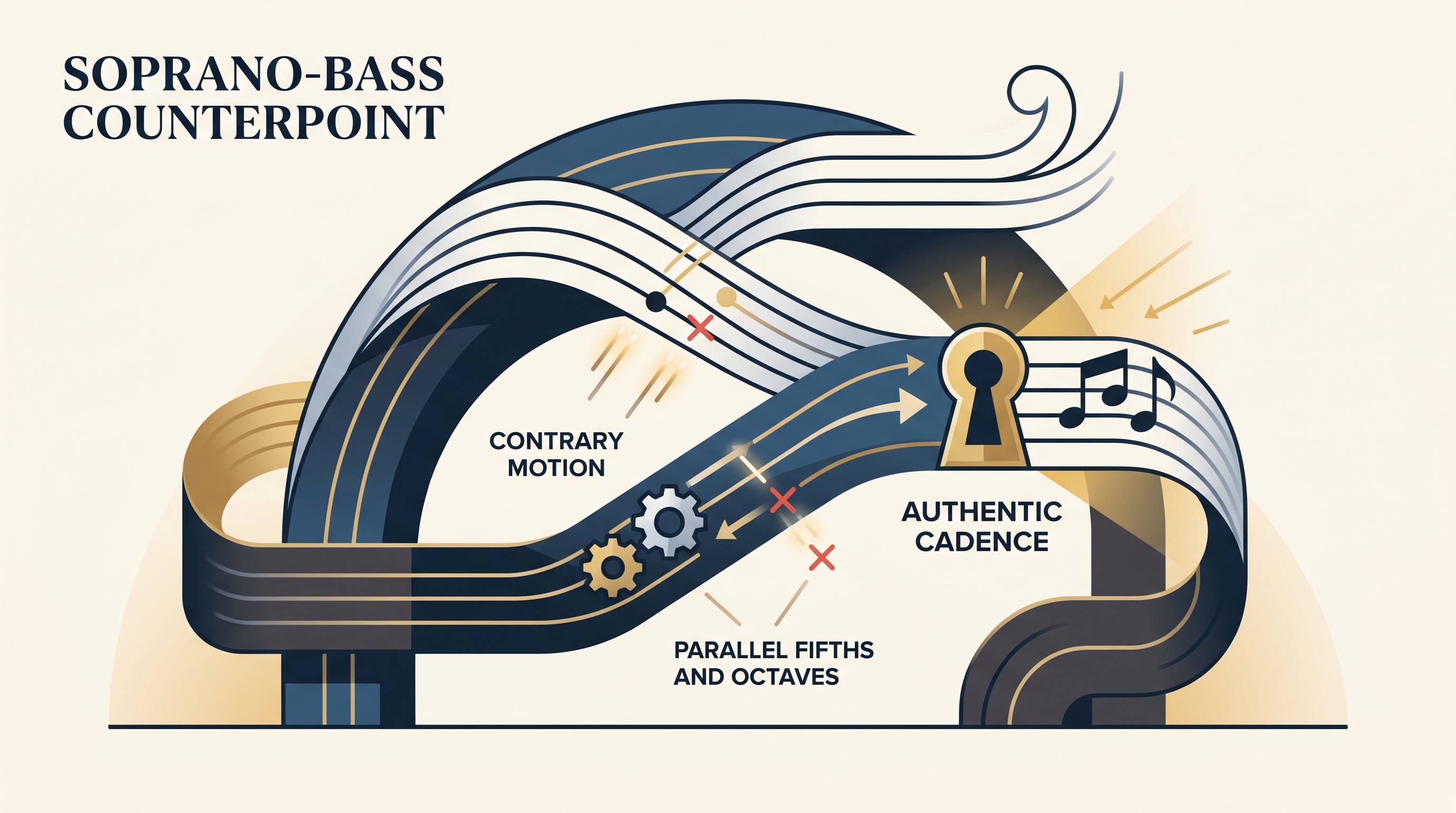
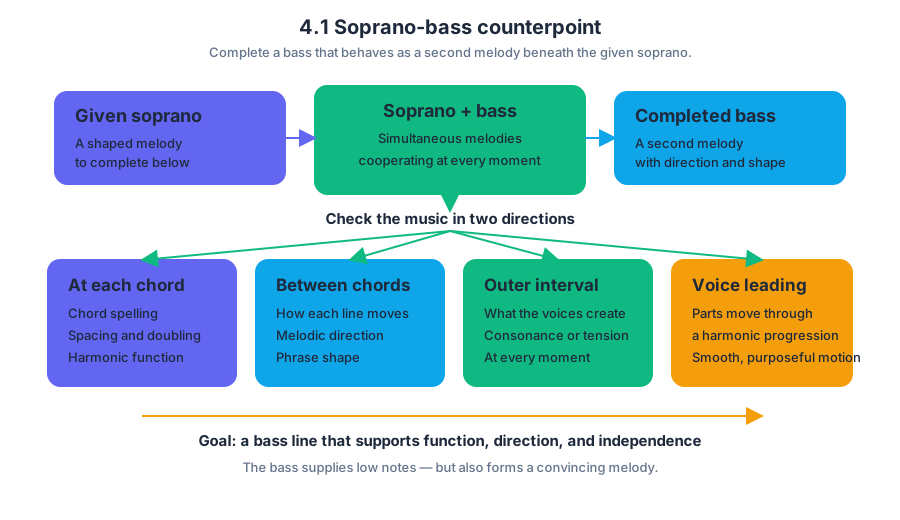
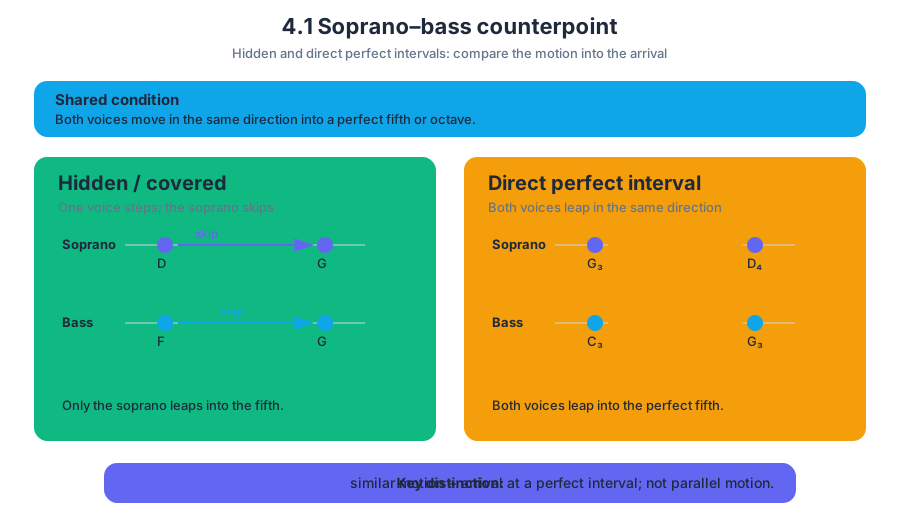
4.2 SATB voice leading
Key concepts: SATB four-voice writing and spacing · Eighteenth-century voice-leading procedures · Harmonic intervals between voices · Similar and contrary motion · Direct (hidden) fifths and octaves · Stepwise motion in the upper voice · Leading-tone resolution · Note-against-note dissonance · Roman-numeral harmonic progressions · Score analysis and contextual listening
SATB writing arranges four voices from highest to lowest as soprano, alto, tenor, bass. The challenge is not merely to spell each chord correctly: every voice must form a singable line while the vertical intervals between voices remain clear and stylistically controlled.
4.2 SATB voice leading
SATB writing arranges four voices from highest to lowest as soprano, alto, tenor, bass. The challenge is not merely to spell each chord correctly: every voice must form a singable line while the vertical intervals between voices remain clear and stylistically controlled.
The SATB “grid”: horizontal lines, vertical chords
Read a four-part passage in two directions at once:
- Horizontally: Does each voice move logically from one note to the next?
- Vertically: Do the voices form the required chord, with acceptable spacing and intervals?
- Across time: Do successive chords create forbidden parallels, direct intervals, unresolved dissonances, or awkward overlaps?
Write the voices in this order:
$$ \text{soprano} ;>; \text{alto} ;>; \text{tenor} ;>; \text{bass} $$
The soprano and alto, and the alto and tenor, should normally remain within an octave. The tenor and bass may be farther apart. Preserve the basic spacing established by the first chord unless the musical texture gives you a clear reason to change it.
Worked example: a compact I–V$^6$–I progression
In C major, consider this original realization:
| Chord | Soprano | Alto | Tenor | Bass |
|---|---|---|---|---|
| I | E | C | G | C |
| V$^6$ | D | B | G | G |
| I | E | C | G | C |
The vertical check confirms that the notes belong to I, V$^6$, and I. The horizontal check is equally important: the alto moves $C$–$B$–$C$, so the leading tone $B$ resolves upward by step to tonic $C$. The soprano moves by step from $E$ to $D$ and back to $E$, while the tenor remains on $G$ and the bass outlines the harmonic motion $C$–$G$–$C$.
Now inspect the intervals between voices. The upper voices are comfortably spaced, no voice crosses another, and the soprano does not leap into a perfect fifth or octave by similar motion. This is the central SATB habit: check the chord and the path into it.
Motion and perfect intervals
Similar motion occurs when two voices move in the same direction. Contrary motion occurs when one rises while the other falls. Oblique motion occurs when one voice moves and the other remains stationary. Contrary motion into a perfect fifth or octave is not automatically an error; the direction of motion alone does not make the interval forbidden.
The major danger is a succession of perfect intervals:
- Parallel fifths or octaves: the same two voices move in the same direction from one perfect interval to another. These are prohibited.
- Beat-to-beat fifths or octaves: equal perfect intervals recur between the same voices on successive beats, even if the passage is notated as separate chord changes.
- Direct, or hidden, fifths and octaves: two voices move by similar motion into a perfect interval. In the stricter outer-voice case, the error is especially serious when the soprano leaps.
- Contrary motion: do not classify every contrary-motion arrival at a perfect interval as forbidden. Instead, test whether the passage creates a prohibited succession or another voice-leading problem.
A practical distinction is:
$$ \text{similar motion} + \text{perfect interval} = \text{check for direct/hidden interval} $$
whereas
$$ \text{contrary motion} + \text{perfect interval} \neq \text{automatic error} $$
When similar motion brings the outer voices to a perfect fifth or octave, prefer stepwise motion in the upper voice. If the upper voice leaps into that perfect interval, revise the line if possible.
Other interval hazards
Avoid excessive consecutive thirds between the same pair of voices. A single third is normal, but a long chain of parallel or repeatedly similar thirds can make two voices behave like a locked pair rather than independent melodic lines. Vary the interval or redirect one voice while preserving the chord.
Watch for unequal fifths, especially a diminished fifth changing to a perfect fifth. An ascending diminished-fifth-to-perfect-fifth motion can be acceptable between upper voices in the specific motion from I to I$^6$ through V$^{4}_{3}$ or vii$^\circ_6$; other cases require caution, and the same motion between bass and an upper voice is unacceptable under the stated scoring conventions. A perfect fifth changing to a diminished fifth by step between upper voices is generally acceptable.
Voice overlap occurs when a voice moves into the former range of a neighboring voice—for example, the tenor rises above the alto’s previous note. Keep each part in a coherent register. Also identify note-against-note dissonances: a dissonant vertical interval must be justified by the surrounding motion and should not sound like an accidental clash.
Leading tones, dissonance, and final checking
A leading tone normally resolves upward by step to the tonic. Do not leave it stranded merely because the next chord offers a convenient note; first determine whether the leading tone can resolve without creating a larger error. Likewise, a dissonance between voices is not judged in isolation: examine whether it is approached and left smoothly.
Use Roman numerals to label the harmonic progression, then perform two passes:
- Vertical pass: chord spelling, inversion, spacing, doubling, harmonic intervals, and dissonance.
- Horizontal pass: voice ranges, overlap, leaps, leading-tone resolution, similar motion, and perfect-interval successions.
Misconception check: “Any two voices moving in contrary motion to a fifth or octave is forbidden.” Correction: contrary motion is not itself the prohibition. The essential tests are whether perfect intervals occur consecutively, whether similar motion creates a direct or hidden fifth or octave, and whether the individual voices remain stylistically controlled.
Retrieval check: In the example I–V$^6$–I above, which voice contains the leading tone, and why is its motion preferred? Then identify whether the soprano’s motion into the final chord is stepwise or leaping, and explain why that matters when checking the outer voices.
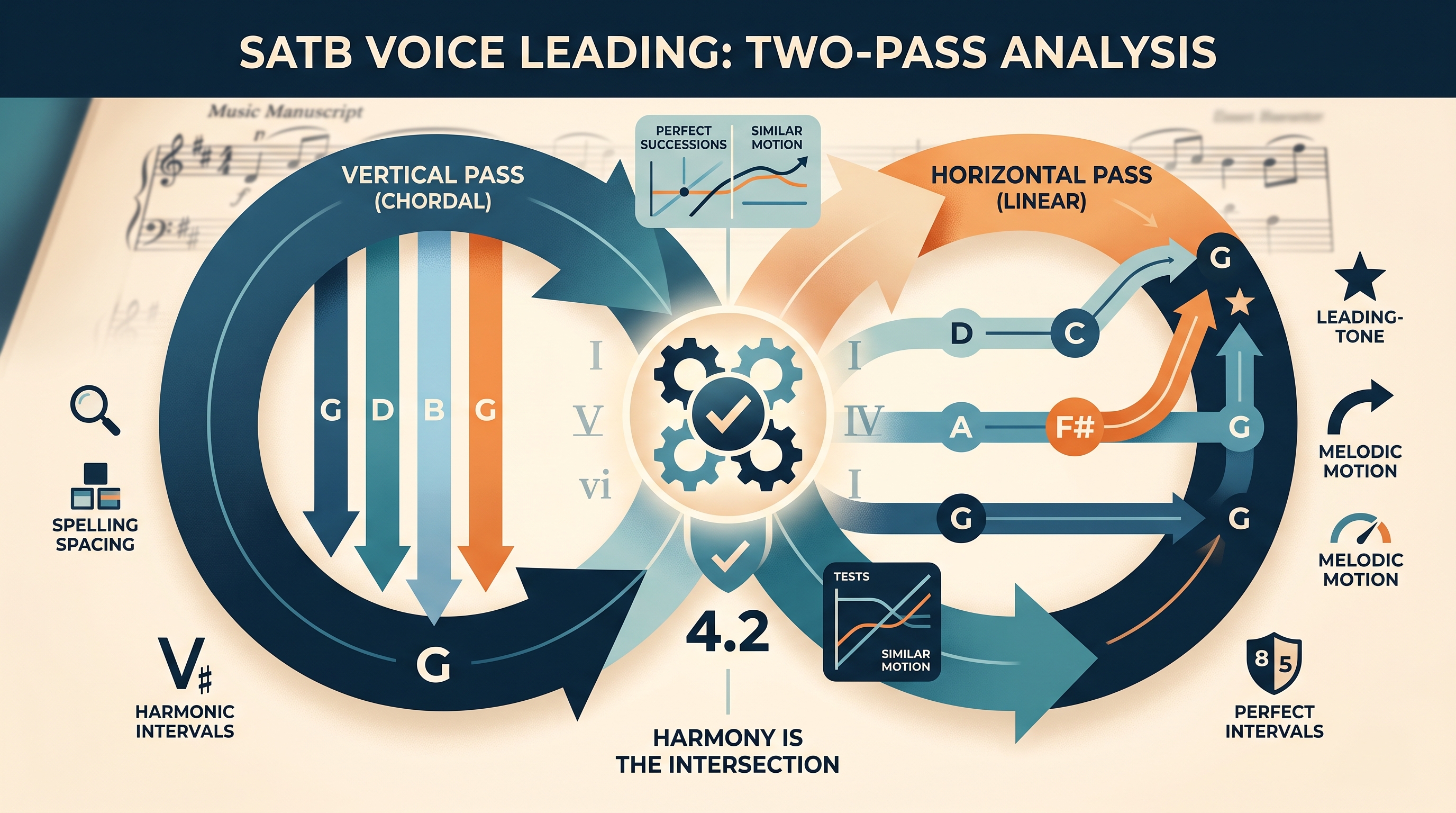
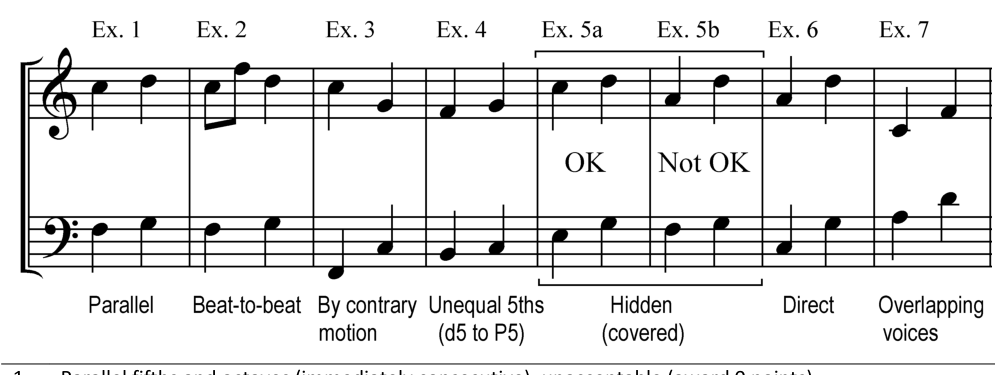
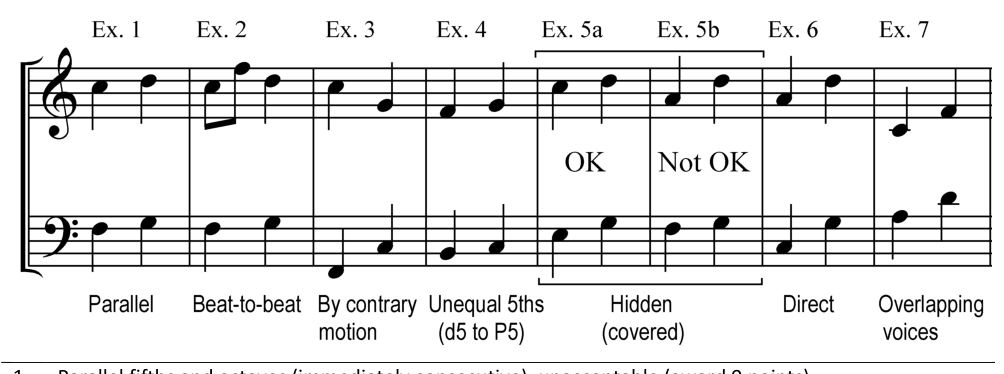
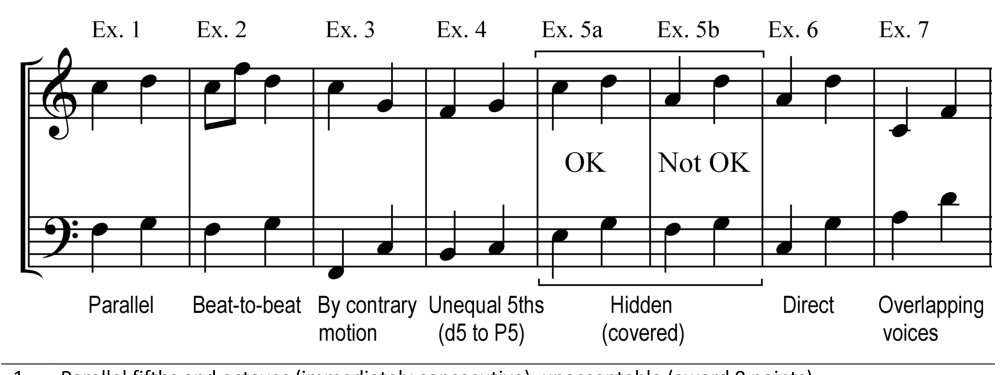
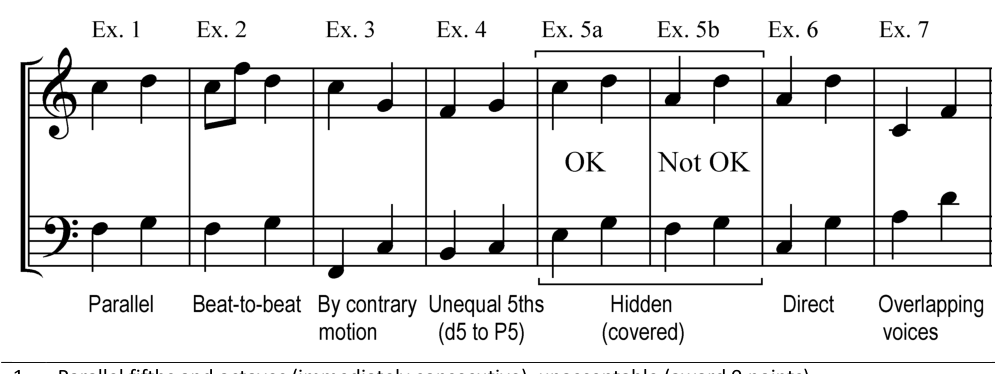
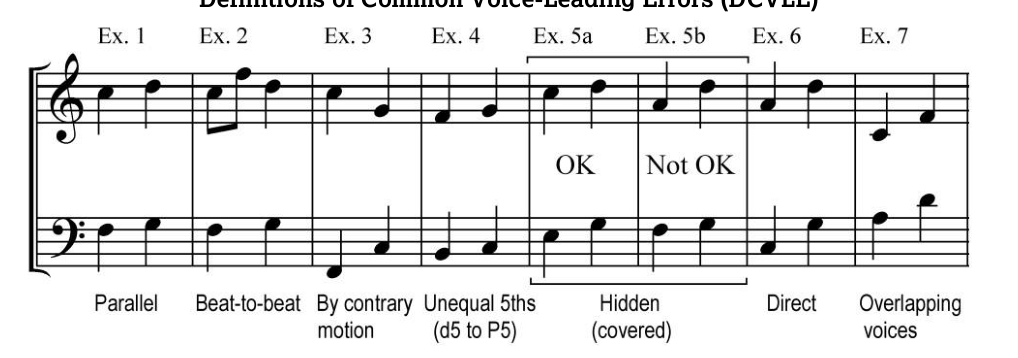
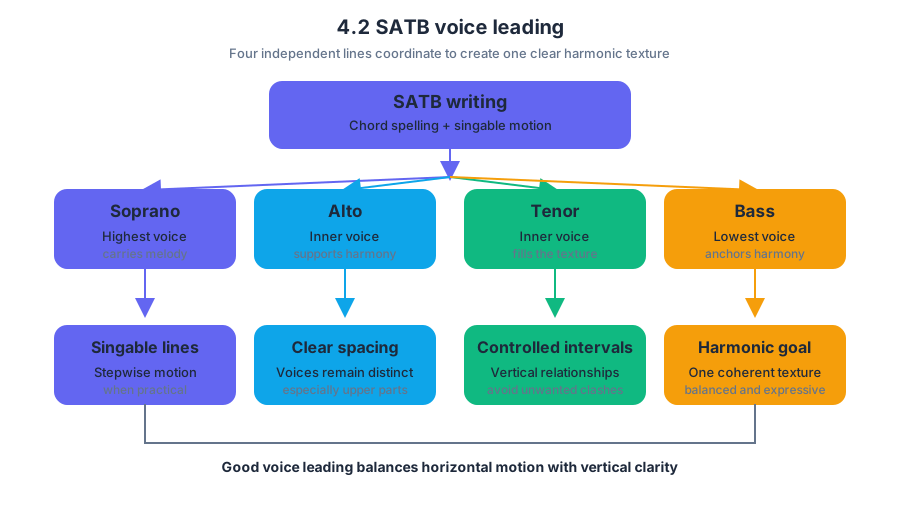
4.3 Harmonic progression and function
Key concepts: Harmonic function and progression in performed and notated music · Harmony as successively and simultaneously produced pitches forming chords that relate within a musical style · Harmonic rhythm: the rate at which chords change and its effect on musical pace · Chord roles and functional areas: tonic, predominant, dominant, and tonic · The tonic–predominant–dominant–tonic functional progression · Predominant harmonies, especially subdominant IV or iv and supertonic ii or ii° · Inconclusive and conclusive cadences · Perfect authentic cadence (PAC) and imperfect authentic cadence (IAC) · Second-inversion triads (6/4 chords) and their permitted contexts · Cadential, neighboring or pedal, passing, and arpeggiated 6/4 patterns
A chord progression is not merely a chain of sonorities: each chord creates an expectation about what may come next. In tonal music, a tonic chord can feel like home, a dominant chord can create pressure to return home, and a predominant chord can prepare that pressure.
4.3 Harmonic progression and function
A chord progression is not merely a chain of sonorities: each chord creates an expectation about what may come next. In tonal music, a tonic chord can feel like home, a dominant chord can create pressure to return home, and a predominant chord can prepare that pressure.
Enduring Understanding PIT-2: Harmony consists of pitches produced successively and/or simultaneously that form perceivable chords. Within an established musical style, those chords relate to one another through harmonic context.
Hearing harmony as a system
Harmonic function means the contextual role a chord plays within a key. The same chord may behave differently depending on what surrounds it, so analysis should treat chords as related functional units rather than isolated labels. Harmonic progression is the movement from one functional area to another in performed or notated music.
The core tonal pattern is:
$$ \text{tonic} \rightarrow \text{dominant} \rightarrow \text{tonic} $$
Tonic establishes stability, dominant creates directed tension, and tonic provides resolution. Composers frequently expand this pattern by inserting a predominant area:
$$ \boxed{\text{Tonic} \rightarrow \text{Predominant} \rightarrow \text{Dominant} \rightarrow \text{Tonic}} $$
This is the standard progression identified by PIT-2.H.5 and PIT-2.H.7. In C major, one possible realization is:
$$ I \rightarrow ii^6 \rightarrow V^7 \rightarrow I $$
The $I$ chord establishes C major. The $ii^6$ chord belongs to the predominant functional area and directs attention toward $V^7$. The dominant seventh chord intensifies the expectation of $I$, which restores tonal stability.
Predominant and dominant areas
Predominant harmonies commonly include the subdominant chord, $IV$ or $iv$, and the supertonic chord, $ii$ or $ii^\circ$. They often precede the dominant functional area because their scale-degree content and voice-leading tendencies prepare dominant harmony.
For example, in C major:
$$ I \rightarrow IV \rightarrow V \rightarrow I $$
or
$$ I \rightarrow ii \rightarrow V \rightarrow I $$
In C minor, the corresponding predominant choices may include $iv$ and $ii^\circ$. The lowercase Roman numeral identifies minor quality; the diminished symbol identifies the diminished supertonic triad.
Misconception check: A chord’s Roman numeral does not automatically determine its function in every context. Functional analysis depends on the chord’s relationship to surrounding harmonies, melodic motion, and tonal emphasis.
Common-practice progressions establish expectations, but composers can deliberately depart from them. A motion such as $V \rightarrow IV$ is called a retrogression under PIT-2.H.6 because it reverses the expected dominant-to-predominant direction. It may sound unusual in a strict tonal progression, yet it can be meaningful as a stylistic or expressive choice.
Harmonic rhythm: the pace of change
Harmonic rhythm is the rate at which chords change. It is independent of the notated meter: a piece in $4/4$ may change harmony once per measure, twice per measure, or on every quarter-note beat.
| Chord-change pattern | Perceived effect |
|---|---|
| One chord per measure | Broad, stable harmonic pace |
| Two chords per measure | Increased motion |
| One chord per half note | Noticeable acceleration |
| One chord per quarter note | Rapid harmonic activity |
Imagine four measures that begin with one chord per measure. If the composer changes to two chords per measure, then to quarter-note changes near a climax, the harmonic rhythm accelerates even if the tempo marking remains unchanged. The music can feel as though it is moving faster because the harmonic landscape changes more frequently.
Worked analysis: performed and notated music
Suppose a notated bass line and Roman-numeral analysis show the following progression in G major:
$$ I ;|; ii^6 ;|; V^7 ;|; I $$
Read it functionally: tonic establishes G major, $ii^6$ supplies predominant motion, $V^7$ creates dominant tension, and $I$ resolves it. Now listen to the same progression performed: even without seeing the notation, the first chord should sound stable, the third chord active and urgent, and the final chord settled.
This directly develops Learning Objective PIT-2.H: “Identify and describe harmonic function within a chord progression in performed music and notated music.” It also applies Skill 1: Analyze performed music by hearing stability, preparation, tension, and release; Skill 2: Analyze notated music by reading Roman numerals, inversions, and bass motion; and Skill 3: Convert between performed and notated music by connecting what is heard to the written progression.
The cadential six-four as dominant preparation
Second-inversion triads, written as $^6_4$ chords, should not be treated as freely interchangeable with root-position triads. Under PIT-2.K.1, they occur in four standard contexts: cadential, neighboring or pedal, passing, and arpeggiated $^6_4$ patterns.
A cadential $^6_4$ precedes the dominant. In C major, the notes of $I^6_4$ are G, C, and E, but the bass G and the surrounding motion make the sonority function as a preparation of $V$:
$$ I^6_4 \rightarrow V \rightarrow I $$
Under PIT-2.K.2, its tonic-triad contents do not make it an ordinary tonic arrival; in this context, it intensifies the dominant area.
Key insight: Analyze the role a chord performs, not only the notes it contains.
Cadence labels describe degrees of closure. Inconclusive types include half and imperfect authentic cadences; conclusive types include perfect authentic and plagal cadences under PIT-2.I.1. A perfect authentic cadence is $V \rightarrow I$ with both chords in root position and scale degree $1$ in the soprano. An imperfect authentic cadence is also $V \rightarrow I$, but an inversion or a soprano note other than scale degree $1$ prevents the strongest closure.
Retrieval check
In a major key, classify the functional areas in $I \rightarrow ii^6 \rightarrow V^7 \rightarrow I$, identify the likely harmonic-rhythm change if the chords shift from one per measure to one per quarter note, and explain why a cadential $I^6_4$ before $V$ functions as dominant preparation rather than an ordinary tonic chord.
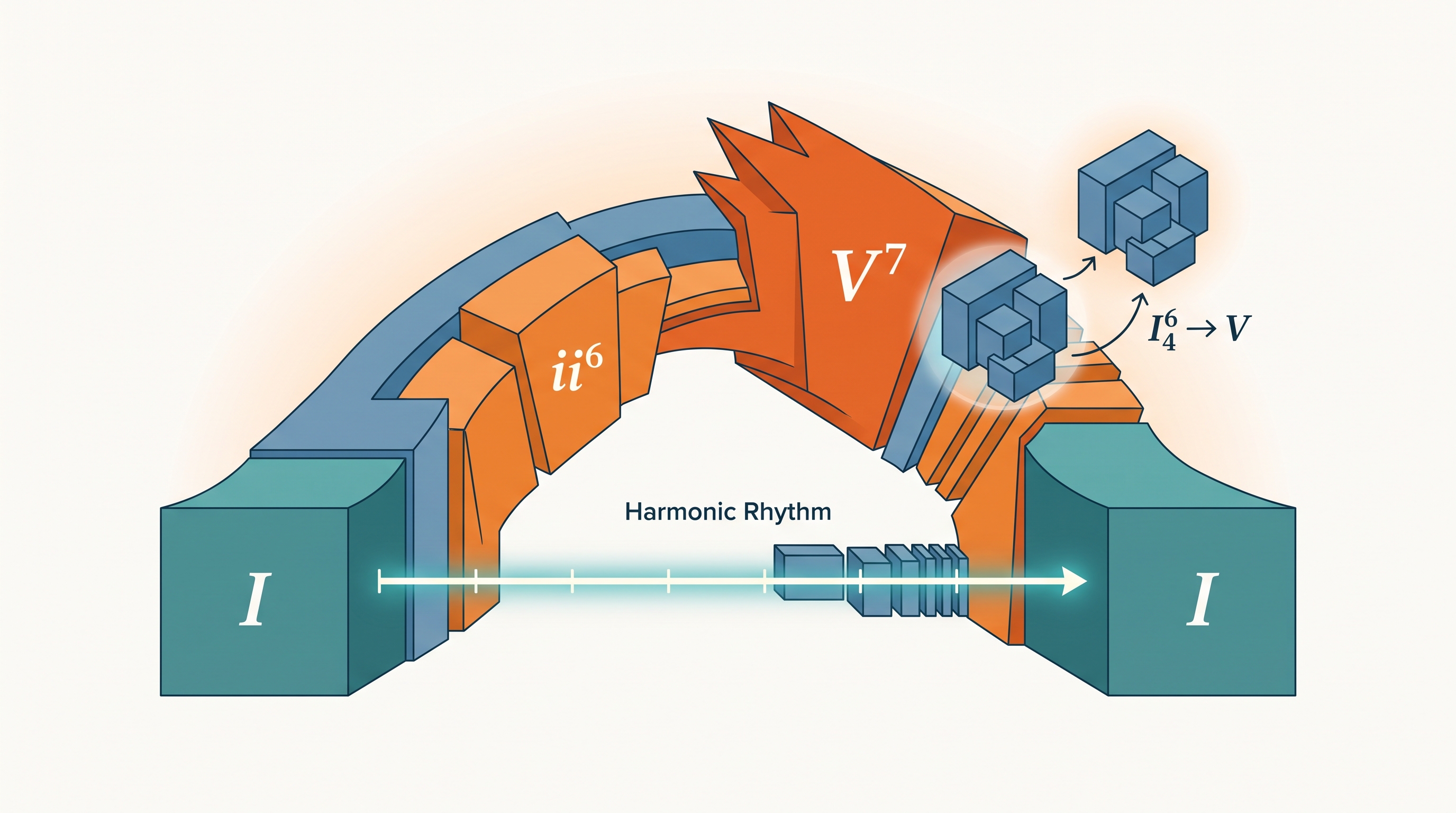
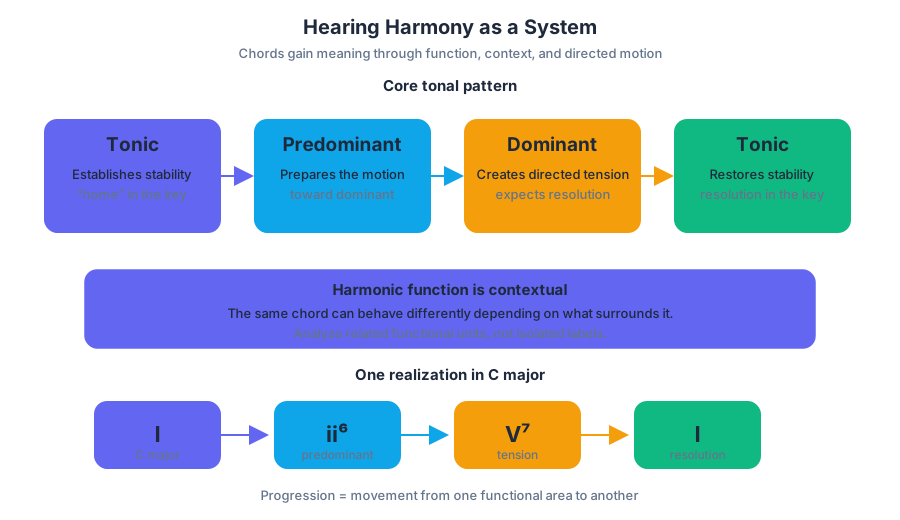
4.4 Cadences and phrases
A cadence is a musical punctuation point: a pattern of harmony and melody that creates closure, continuation, or surprise. A phrase is a complete musical thought, often ending at a cadence.
4.4 Cadences and phrases
A cadence is a musical punctuation point: a pattern of harmony and melody that creates closure, continuation, or surprise. A phrase is a complete musical thought, often ending at a cadence. Just as spoken language uses commas and periods, tonal music uses cadences to shape the listener’s sense of arrival.
Official topic identifier: 4.4 Cadences and phrases
Associated big idea: PIT—Pitch
Associated skill emphasis: PIT +, especially identifying harmonic and melodic evidence in performed or notated music.
Four broad cadence types
There are four broad cadence types: authentic, half, plagal, and deceptive. Perfect authentic and imperfect authentic cadences are not separate broad categories; they are two subtypes of the authentic cadence.
| Broad type | Typical harmonic motion | Effect |
|---|---|---|
| Authentic | Dominant to tonic, $V$–$I$ or $V^7$–$I$ | Strong arrival or finality |
| Half | Any progression ending on dominant, often $I$–$V$ or $ii$–$V$ | Pause or expectation |
| Plagal | Subdominant to tonic, $IV$–$I$ or $iv$–$i$ | Gentle, often “Amen-like” closure |
| Deceptive | Dominant to a chord other than tonic, commonly $V$–$vi$ | Delayed or redirected arrival |
An authentic cadence moves from dominant function to tonic function. In C major, the basic pattern is
$$ V \rightarrow I = G \rightarrow C. $$
A perfect authentic cadence requires especially strong confirmation: both chords are in root position, the final tonic is in the soprano, and the soprano moves from scale degree $\hat{2}$ to $\hat{1}$ or from $\hat{7}$ to $\hat{1}$. Thus, a soprano motion $D \rightarrow C$ over $G \rightarrow C$ produces a perfect authentic cadence.
An imperfect authentic cadence still uses dominant-to-tonic motion, but one or more conditions for perfection is absent. The dominant or tonic may be inverted, or the soprano may end on scale degree $\hat{3}$ rather than $\hat{1}$. For example, $V^6 \rightarrow I$ or $V \rightarrow I$ with soprano motion $G \rightarrow E$ is authentic but imperfect.
Hearing the difference
A half cadence ends on the dominant. In C major, $I \rightarrow V$ produces a clear stopping point without tonal completion:
$$ C \rightarrow G. $$
The music may pause on $G$, but the listener expects continuation toward $C$. A half cadence can therefore occur at the end of a phrase even when the entire composition continues immediately afterward.
A plagal cadence moves from subdominant to tonic, such as $IV \rightarrow I$ in a major key or $iv \rightarrow i$ in a minor key. It sounds less urgent than an authentic cadence because it lacks the leading-tone-to-tonic attraction of $V \rightarrow I$.
A deceptive cadence begins like an authentic cadence but avoids tonic. The common pattern is $V \rightarrow vi$ in major or $V \rightarrow VI$ in minor:
$$ G \rightarrow A\text{-minor} $$
in C major. The dominant creates an expectation of $I$, while the following chord redirects the phrase. The cadence is “deceptive” because the harmonic goal is withheld, not because the progression is random.
Phrases and phrase boundaries
A phrase is identified by several kinds of evidence working together:
- a cadential harmonic pattern;
- a sustained or repeated final note;
- a rest or breath;
- a change in melodic direction or rhythmic activity;
- a sense that one musical idea has ended before another begins.
A phrase does not have to end with a perfect authentic cadence. A question-like opening phrase may end with a half cadence, while its answering phrase may end with an authentic cadence. This creates a common antecedent–consequent relationship: the first phrase sounds incomplete, and the second responds with greater closure.
Worked example: Imagine an eight-measure melody in C major. Measures $1$–$4$ contain the progression $I$–$ii$–$V$ and stop on a sustained $G$. The phrase boundary occurs after measure $4$, and the cadence is a half cadence because the phrase ends on $V$. Measures $5$–$8$ repeat part of the opening idea, then move $ii$–$V^7$–$I$ with soprano $D$ resolving to $C$. The final boundary is a perfect authentic cadence.
When analyzing a score or recording, first locate likely phrase endings by listening for breath, length, or silence. Then inspect the final bass and soprano pitches, identify the final chord with Roman numerals, and classify the harmonic motion. This prevents a common mistake: labeling a cadence from the final chord alone. A phrase ending on $I$ is not automatically authentic; the preceding harmony must establish whether the arrival came from $V$, $IV$, or another chord.
Misconception check: “Every $V$–$I$ ending is a perfect authentic cadence.”
Correction: $V$–$I$ is authentic, but perfection also depends on root position and the soprano’s final pitch and motion.
Retrieval check: In G major, classify each ending: $I$–$V$, $IV$–$I$, $V$–$I$ with soprano $B$–$G$, and $V$–$vi$. The answers are, respectively, half, plagal, perfect authentic, and deceptive cadences.
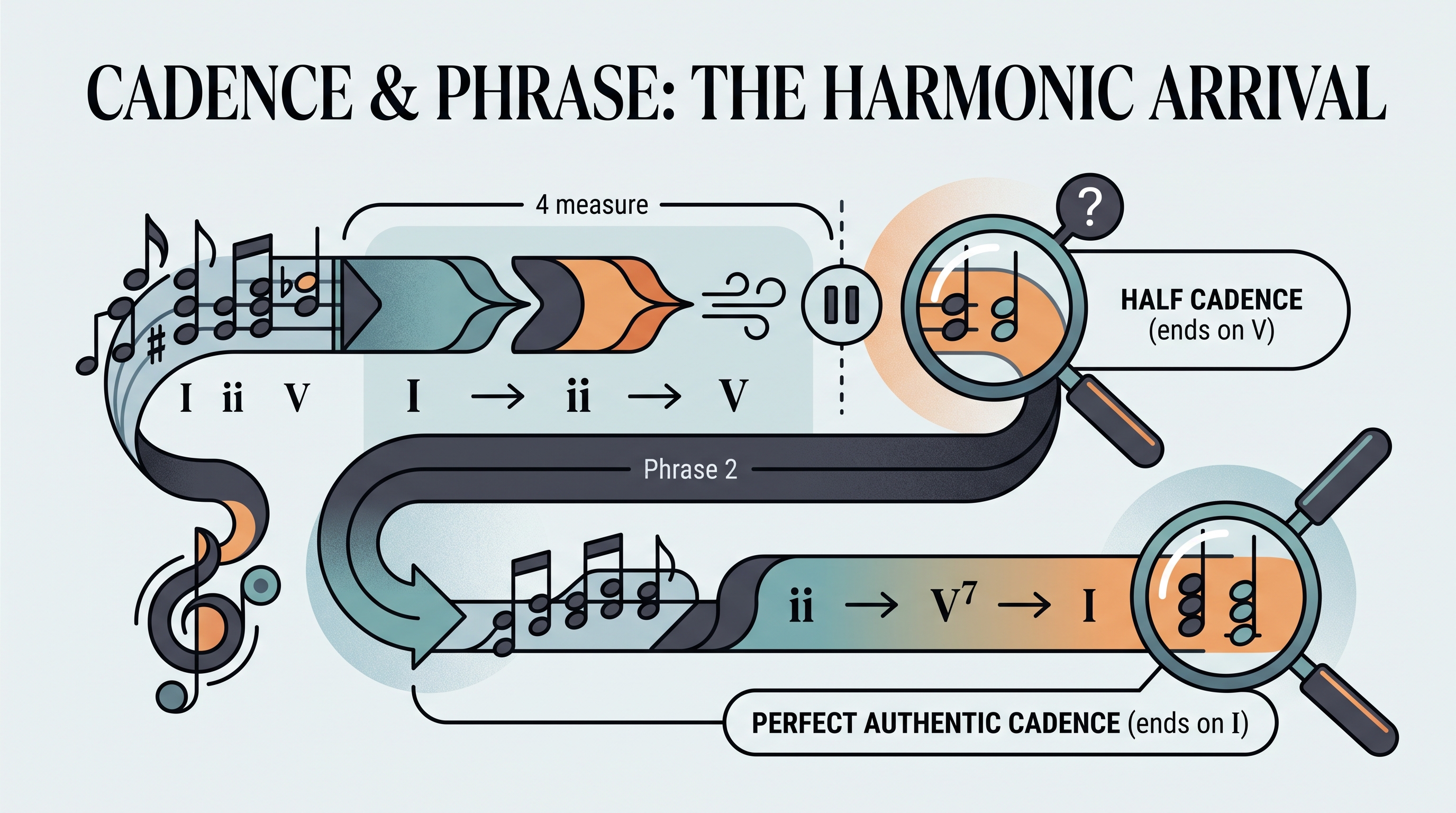
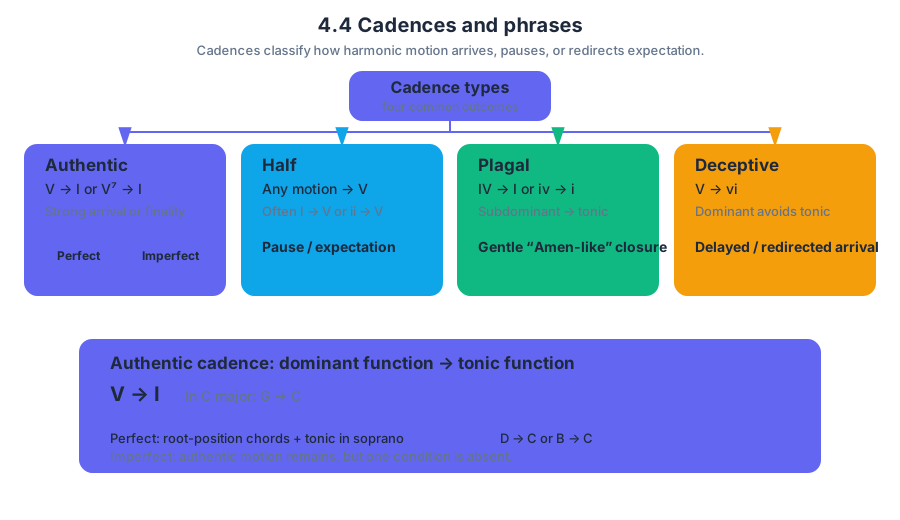
4.5 Voice leading with seventh chords
Key concepts: Voice leading as the coordinated motion and interaction of individual voices · 18th-century Western European voice-leading practices · Linear smoothness in voice leading · Independence of individual voices · Four types of voice motion: parallel, oblique, similar, and contrary · Voice leading in four voices · Voice leading with seventh chords · Seventh-chord inversions and figured-bass figures · Leading-tone resolution in voice leading · Avoidance of repeated perfect octaves or perfect unisons
A seventh chord is not four unrelated notes stacked vertically: it is four individual voices moving through time. Voice leading is the coordinated movement of those voices as a harmonic progression advances, and good voice leading makes the progression sound both connected and intelligible.
4.5 Voice leading with seventh chords
A seventh chord is not four unrelated notes stacked vertically: it is four individual voices moving through time. Voice leading is the coordinated movement of those voices as a harmonic progression advances, and good voice leading makes the progression sound both connected and intelligible.
In the 18th-century Western European common-practice tradition, a four-voice texture aims for two simultaneous qualities: linear smoothness, meaning each part moves naturally with economical intervals, and independence of voices, meaning each part remains perceptibly separate rather than collapsing into one doubled melody.
The four types of voice motion
Compare the two voices in one chord with the same two voices in the next chord. Their relationship is classified by direction and interval size:
| Motion | What the two voices do | Example |
|---|---|---|
| Parallel motion | Move in the same direction by the same melodic interval | soprano rises by a step; alto rises by a step |
| Similar motion | Move in the same direction by different melodic intervals | soprano rises by a third; alto rises by a step |
| Oblique motion | One voice stays fixed while the other moves | soprano remains; alto descends |
| Contrary motion | Move in opposite directions | soprano rises while alto descends |
These categories describe motion, not whether the voices sound smooth. Parallel motion can be useful, especially when it preserves a common pattern, but it becomes dangerous when it produces forbidden perfect-interval repetitions or weakens independence.
Perfect intervals: state the restriction precisely
The central prohibition is parallel perfect unisons and parallel perfect octaves. If the same two voices begin with a unison or octave and both move in the same direction by the same interval, they must not arrive at another unison or octave.
For example, if the tenor and soprano move from $C$–$G$ to $D$–$A$, the voices move upward together by whole step and preserve a perfect fifth; that is not the specific repeated-unison-or-octave error. But if they move from $C$–$C$ to $D$–$D$, or from $C$–$C'$ to $D$–$D'$, they have created parallel perfect unisons or octaves and have lost vocal independence.
The same restriction must be checked across successive chord changes even when an intervening chord appears elsewhere in the progression. Conversely, contrary motion and oblique motion are not parallel motion: a perfect interval reached through either of those motions is not automatically the prohibited pattern. A separate related warning applies when the outer voices move by similar motion into a perfect fifth or octave: normally, the upper voice should move by step. These are often called direct or hidden fifths and octaves.
Key distinction: “A perfect interval occurs” is not enough to diagnose an error. Ask whether the same two voices moved in parallel into a repeated perfect unison or octave.
Realizing a seventh-chord progression
A reliable realization begins vertically and ends horizontally. First spell every chord correctly; then assign its four chord tones to soprano, alto, tenor, and bass; finally inspect how each individual part moves.
Worked example: $V^7$ resolving to $I$ in C major
Suppose the dominant seventh chord is $G$–$B$–$D$–$F$, followed by $C$–$E$–$G$.
- Place the bass: let the bass move from $G$ to $C$.
- Resolve the leading tone: $B$, scale degree $\hat{7}$, normally rises to $C$, scale degree $\hat{1}$.
- Resolve the chordal seventh: $F$ normally descends by step to $E$.
- Complete the tonic: the remaining voice can move from $D$ to $G$, producing the tonic chord with a doubled root if the spacing permits.
- Check the texture: keep adjacent upper voices no farther than an octave apart; the bass may be more than an octave below the tenor. Confirm that no voice crosses over or overlaps an adjacent voice.
The seventh of a seventh chord is a tendency tone with a particularly strong conventional resolution: it generally moves downward by step. The leading tone generally resolves upward, but neither rule is an automatic visual reflex. A leading tone may be retained or redirected when the musical context requires it—for example, to avoid a prohibited interval, accommodate a chordal resolution, or maintain a complete and singable texture. The exception must be identifiable and musically explained.
A four-voice checking routine
Use this sequence whenever a seventh chord appears in root position or when any chord tone appears in the soprano:
- Chord spelling: Are all four pitches members of the intended seventh chord, with every accidental correct?
- Spacing: Are adjacent upper parts within an octave? Is the bass-to-tenor distance allowed to exceed an octave?
- Doubling and completeness: Is the chord complete when possible, and is any doubling justified by the voice leading?
- Tendency tones: Does the leading tone generally rise? Does the chordal seventh generally descend by step?
- Voice independence: Are voices free of crossing and overlap? Does each line remain singable?
- Motion audit: Between each pair of voices, label parallel, similar, oblique, or contrary motion.
- Perfect-interval audit: Are parallel perfect unisons or octaves absent? If outer voices approach a perfect fifth or octave by similar motion, does the upper voice move by step?
- Seventh-chord resolution: Does the seventh resolve appropriately, and is any exception supported by the surrounding progression?
Misconception check: A seventh chord is not “correct” merely because its four pitches are spelled correctly. A vertically accurate chord can still fail through voice crossing, excessive upper spacing, unresolved tendency tones, parallel perfect intervals, or lines that do not behave independently.
Retrieval check: In a $V^7$–$I$ progression, identify the usual destinations of the leading tone and the chordal seventh. Then ask: if two voices move in opposite directions into an octave, is that automatically parallel octaves? Explain why or why not.
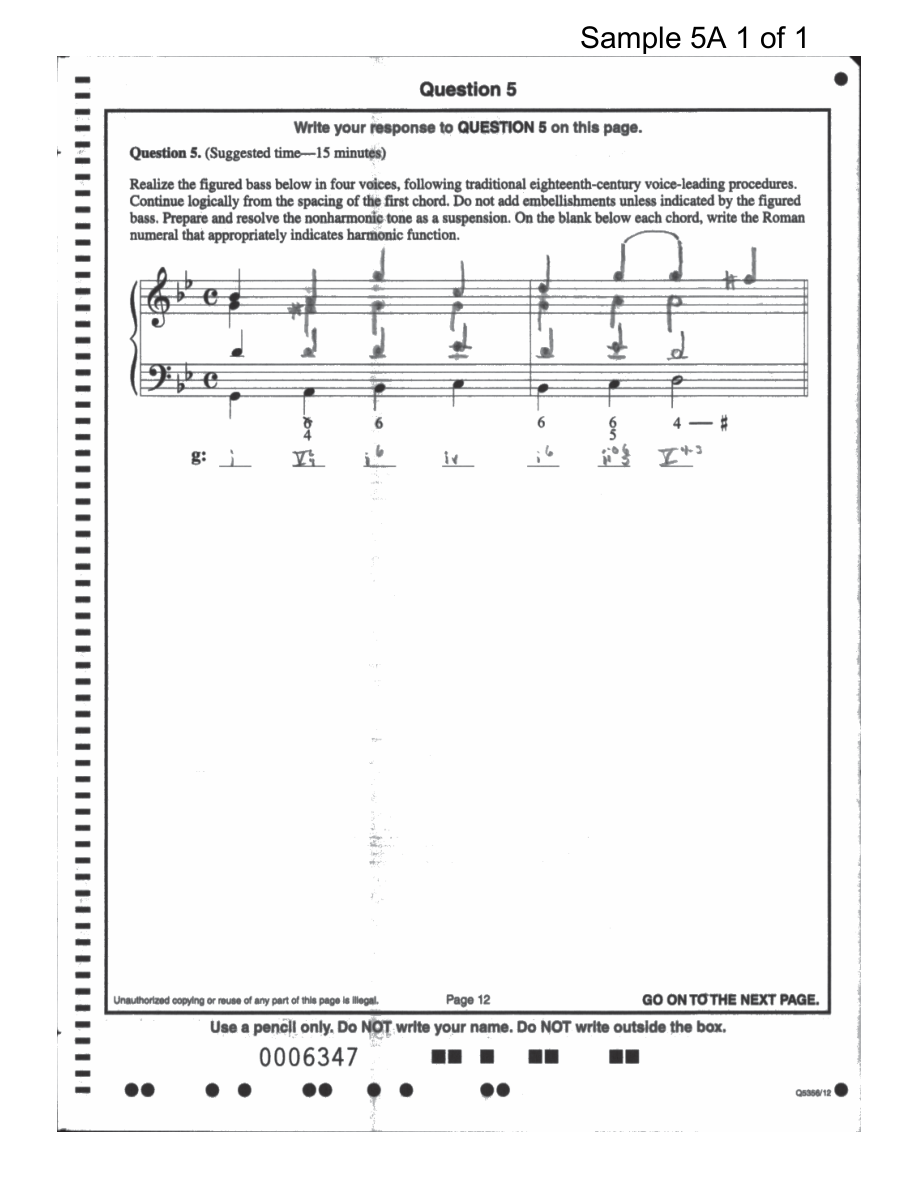

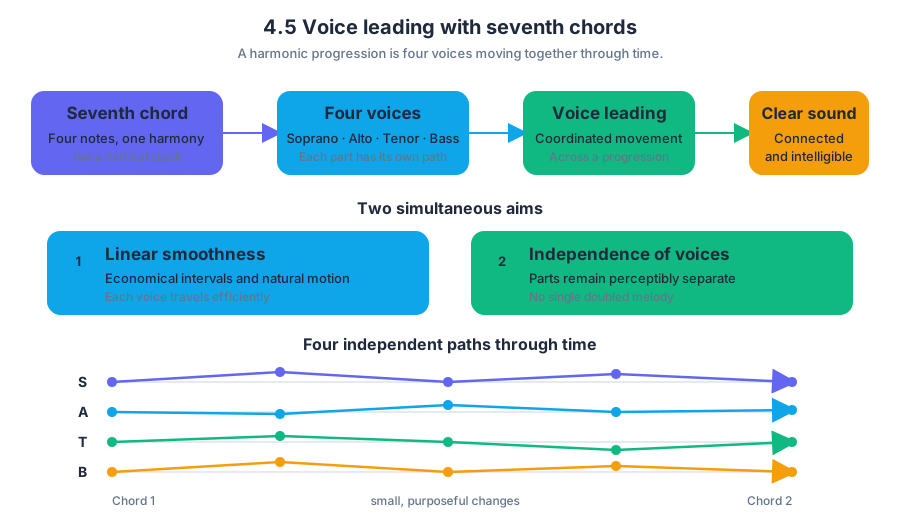
4.6 Voice leading with inverted seventh chords
Key concepts: Voice leading with inverted seventh chords · Stepwise bass motion in extended progressions · Smooth voice leading with minimal leaps · Spacing between the bass and its nearest upper voice · Complete spelling of inverted seventh chords · Approach and resolution of chordal sevenths · Descending-step resolution of chordal sevenths · Approaching chordal sevenths by step or leap · Inverted diminished seventh chords in tonicization · Secondary dominant and leading-tone seventh-chord voice leading
An inverted seventh chord can make a bass line sound like a melody rather than a sequence of harmonic leaps. In an extended progression, its bass note often moves by step while the upper voices shift as little as possible—a compact musical “hinge” between larger harmonic goals.
4.6 Voice leading with inverted seventh chords
An inverted seventh chord can make a bass line sound like a melody rather than a sequence of harmonic leaps. In an extended progression, its bass note often moves by step while the upper voices shift as little as possible—a compact musical “hinge” between larger harmonic goals.
Learning Objective: Identify and apply the procedures of eighteenth-century voice leading.
Essential Knowledge: PIT-4.A.10, PIT-4.A.11, PIT-4.A.12, and PIT-4.A.13.
Suggested Skill: Skill 1.E: Analyze Performed Music—use symbols and terms to describe and apply harmonic, melodic, and rhythmic procedures of eighteenth-century voice leading in performed music.
The inverted-seventh-chord principle
A seventh chord in inversion contains the same four chord tones as its root-position form, but a chord tone other than the root occupies the bass. In writing, inversion does not license omission: every inverted seventh chord must be spelled completely.
For example, in C major:
- $V^7$ is $G$–$B$–$D$–$F$.
- $V^6_5$ places $B$ in the bass: $B$–$D$–$F$–$G$.
- $V^4_3$ places $D$ in the bass: $D$–$F$–$G$–$B$.
- $V^4_2$ places $F$ in the bass: $F$–$G$–$B$–$D$.
The bass can therefore move stepwise through an extended progression even while the harmony remains directed toward tonic. PIT-4.A.10 states that voice leading into and out of inverted seventh chords is typically smooth, with no leaps or only minimal leaps. The distance between the bass and its nearest upper voice should be no more than an octave; wider spacing creates an unnecessarily empty lower register.
Worked example: a stepwise bass and $V^4_3$
Consider the progression $I-V^4_3-I^6$ in C major:
$$ \begin{array}{c|c|c} I & V^4_3 & I^6 \ \hline C\text{–}E\text{–}G & D\text{–}F\text{–}G\text{–}B & E\text{–}G\text{–}C \end{array} $$
The bass moves $C\rightarrow D\rightarrow E$, creating a clear ascending stepwise line. In the middle chord, $D$ is the bass of $V^4_3$, while the chordal seventh $F$ normally resolves downward to $E$ in the final $I^6$ chord. The upper voices can retain common tones or move by step, so the chord feels like a smooth connection rather than a sudden harmonic block.
The seventh has one important exception. In a $V^4_3$ chord within $I-V^4_3-I^6$, the chordal seventh may move up by step instead of down. In other contexts, however, the default remains firm: a chordal seventh should resolve downward by step whenever possible. It may remain temporarily in the same voice—for example, when $ii^7$ moves to a cadential $^6_4$—before descending.
Approaching and resolving chordal sevenths
A chordal seventh should normally be approached by common tone or by step. If the musical context makes those approaches impossible, an ascending leap may be used; a descending leap of a third is rare but possible. Once present, the seventh should descend by step to prevent an unresolved dissonance.
| Situation | Preferred treatment |
|---|---|
| Approach to the chordal seventh | Common tone or step |
| Approach when those are impossible | Ascending leap |
| Rare alternative | Descending leap of a third |
| Resolution of the chordal seventh | Descending step |
| Special exception | $V^4_3$ in $I-V^4_3-I^6$ may resolve upward by step |
| Temporary retention | Possible before later downward resolution |
Leading-tone seventh chords in inversion
The leading-tone seventh chords used for tonicization are $vii^{\circ 7}$, the fully diminished seventh chord, and $vii^{\varnothing 7}$, the half-diminished seventh chord. A secondary leading-tone seventh chord is labeled according to the chord it tonicizes: for example, $vii^{\circ 7}/V$ means “the leading-tone seventh chord of the dominant.”
These chords have two related functions under PIT-4.A.11. They can substitute for $V$ or $V^7$ as part of the dominant function, or they can appear between tonic chords to prolong tonic through stepwise voice leading. Their tendency tones must appear individually—not doubled—and resolve according to their tendencies, as required by PIT-4.A.12.
Misconception check
Misconception: “Because the chord is inverted, I can leave out the root or seventh.” Inversion changes the bass position, not the chord’s identity. A written inverted seventh chord must contain all four chord tones. The exception concerning omission applies to the fifth of a root-position dominant seventh chord, not to inverted seventh chords.
Retrieval check: In C major, identify the chord and the expected resolution of the bass and chordal seventh in $F$–$G$–$B$–$D$. Answer: it is $V^4_2$; the bass $F$, which is the chordal seventh, normally moves down by step to $E$, while the remaining voices resolve smoothly toward $I$ or its appropriate inversion.
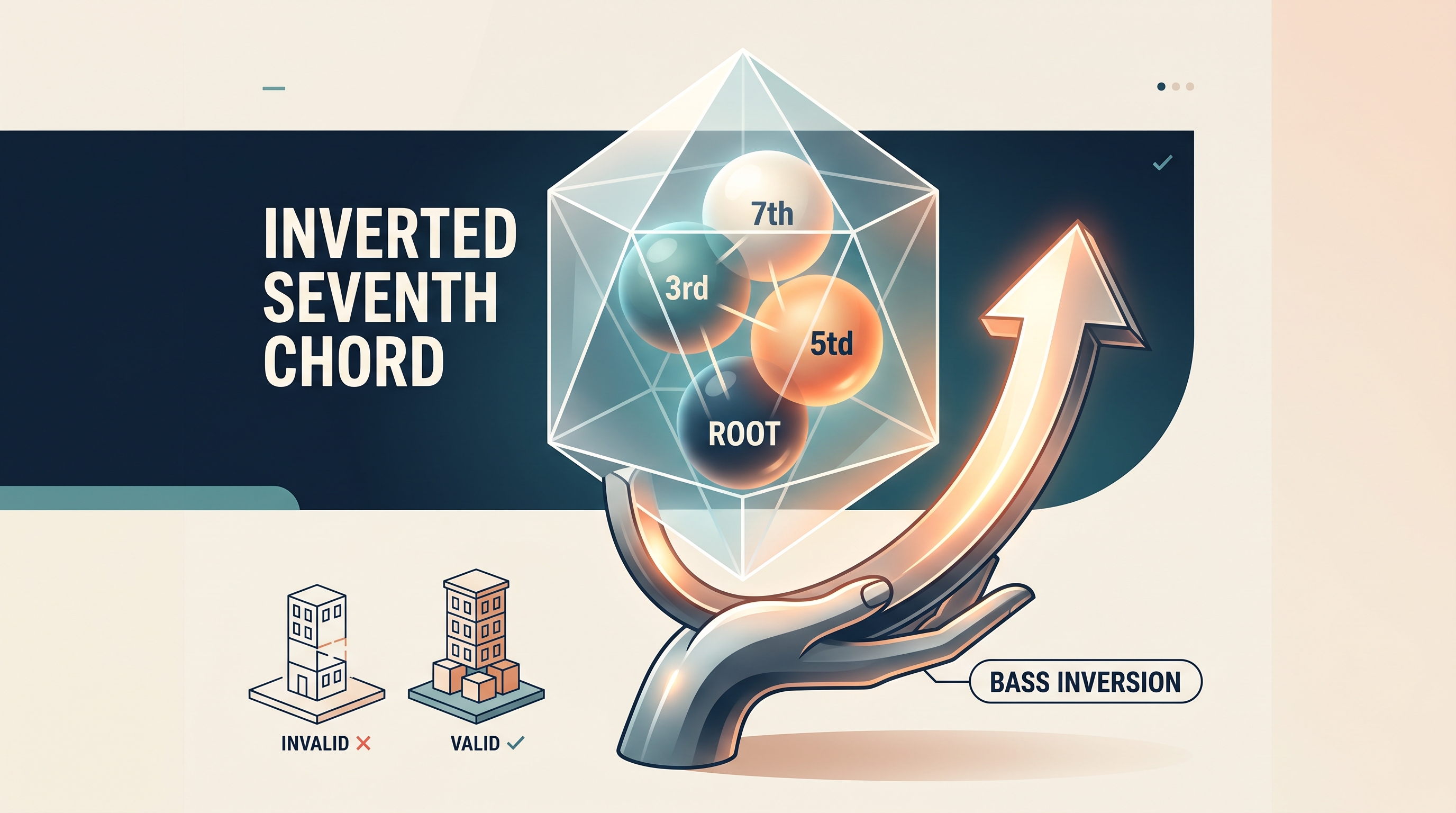
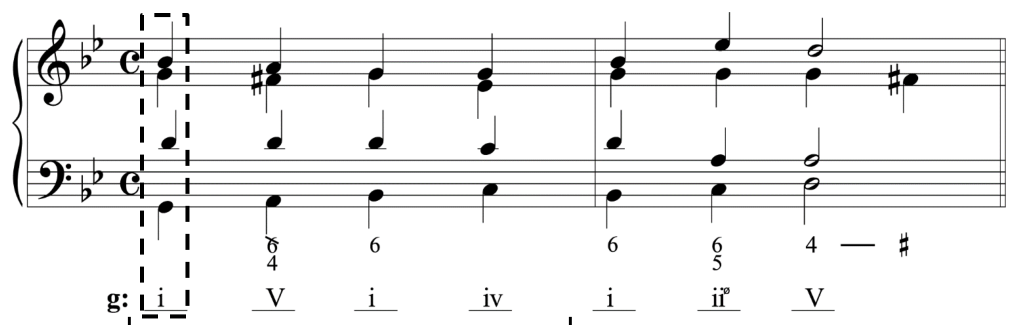
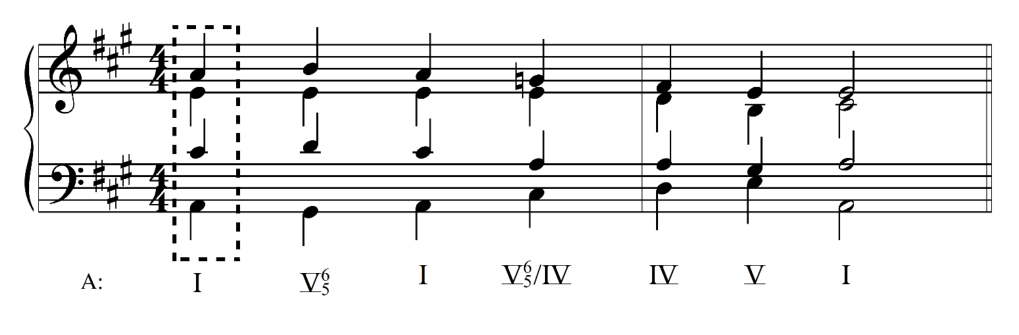
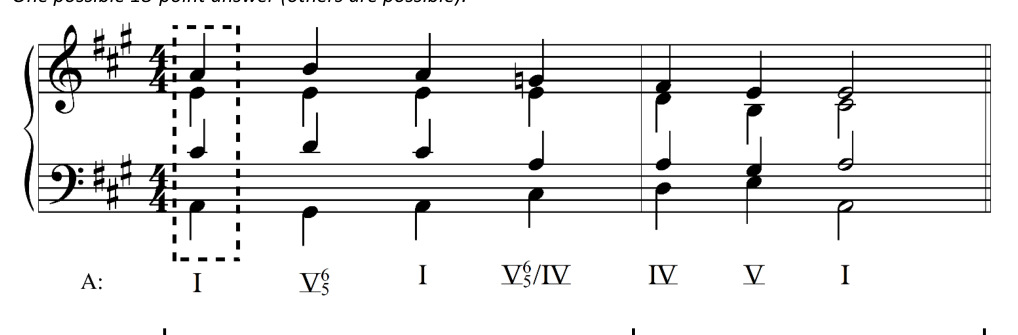
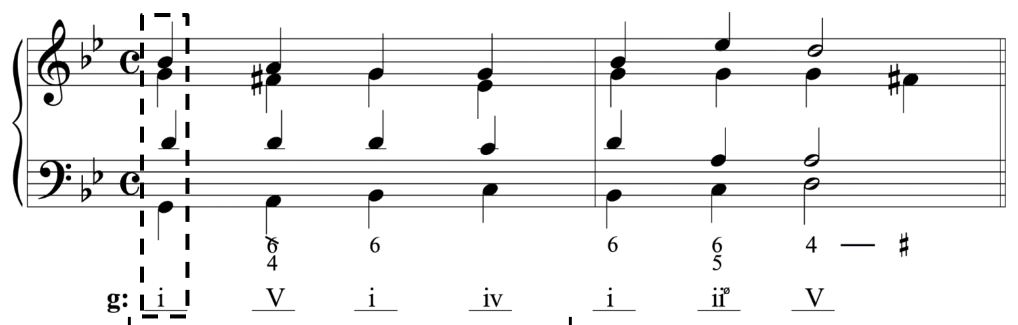
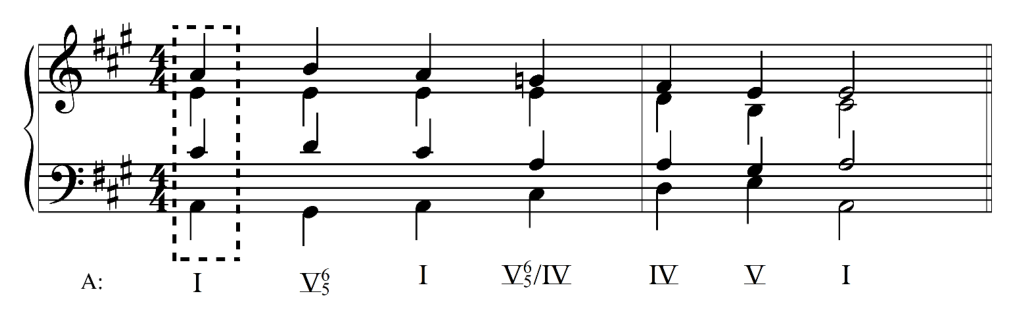
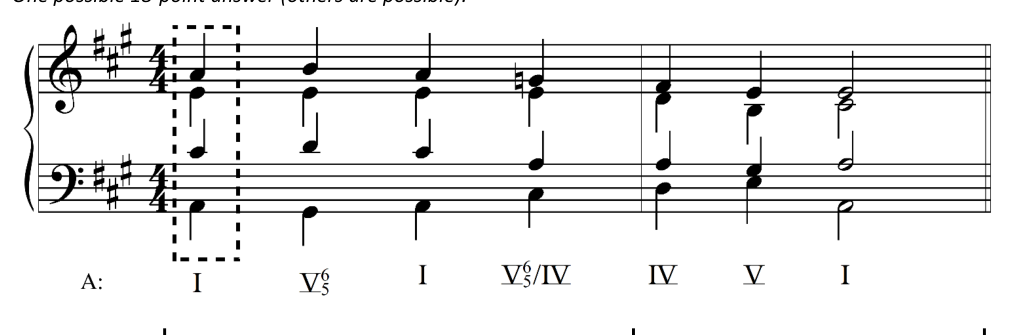
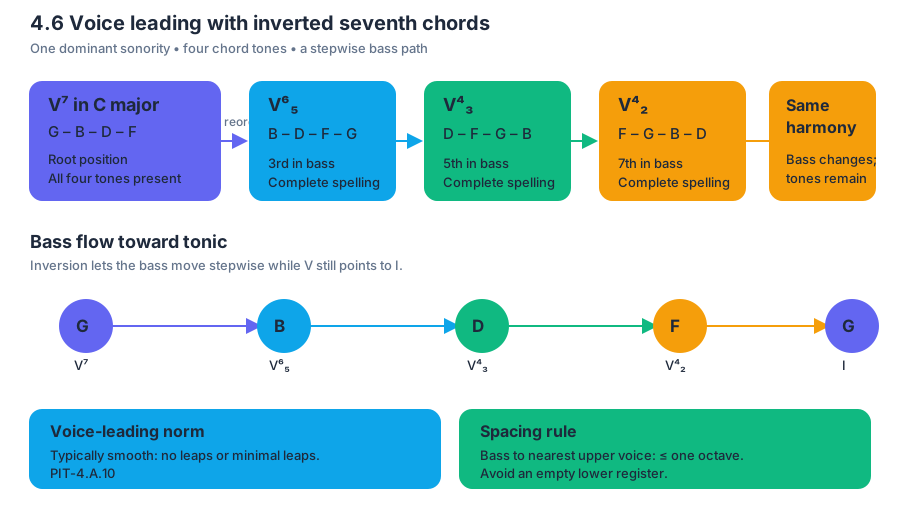
5.1 Adding predominant-function IV (iv) and ii (ii°) to a melodic phrase
Key concepts: Predominant function · IV chord · iv chord · ii° chord · Tonic–predominant–dominant–tonic functional order · Harmonic progression · Melodic phrase · Normative chord successions · Harmonic function · Roman-numeral chord notation
A melody can sound as though it is heading somewhere before the dominant chord arrives. That sense of direction often comes from a predominant-function chord: a harmony whose contextual role is to move away from tonic and prepare the dominant.
5.1 Adding predominant-function IV (iv) and ii (ii°) to a melodic phrase
A melody can sound as though it is heading somewhere before the dominant chord arrives. That sense of direction often comes from a predominant-function chord: a harmony whose contextual role is to move away from tonic and prepare the dominant.
Core pattern: tonic $\rightarrow$ predominant $\rightarrow$ dominant $\rightarrow$ tonic
The Roman numerals identify the chords, while the functional labels explain their behavior. In a major-key context, the principal predominant chord is usually $IV$; in a minor-key context, common predominant choices include $iv$ and $ii^\circ$. These chords do not merely “fill space.” They intensify the establishment of the key by creating a directed path toward the dominant.
The functional order: T–PD–D–T
The functional order tonic–predominant–dominant–tonic describes a common harmonic progression. Tonic establishes stability and key; predominant creates motion away from that stability; dominant produces tension that seeks resolution; and the returning tonic supplies closure.
This is a normative succession: a historically common and usable pattern, not an unbreakable rule. Composers expand this background in many ways, creating a harmonic foreground in which chords may be repeated, prolonged, or combined in varied sequences. The functional relationship remains the important idea: a chord’s role depends on its context within the progression.
| Function | Typical role | Major-key example | Minor-key example |
|---|---|---|---|
| Tonic | Establishes or confirms the key | $I$ | $i$ |
| Predominant | Prepares the dominant area | $IV$ | $iv$ or $ii^\circ$ |
| Dominant | Creates directed tension | $V$ or $V^7$ | $V$ or $V^7$ |
| Tonic | Resolves the progression | $I$ | $i$ |
Misconception check — “predominant” means any chord before the dominant. Position alone is not enough. A chord may occur before $V$ without functioning as a predominant; the label describes a contextual harmonic relationship, not simply a location in time. In the standard pattern, $IV$, $iv$, and $ii^\circ$ are identified as predominant harmonies because their usual role is to precede the dominant functional area.
Adding $IV$ to a major-key melody
Suppose a melody in C major ends with the notes $D$–$G$–$C$. A simple harmonic reading is:
$$ I \rightarrow IV \rightarrow V \rightarrow I $$
Spell the chords first: $I$ is C–E–G, $IV$ is F–A–C, $V$ is G–B–D, and the final $I$ is C–E–G. The melody supports the progression because $D$ belongs to $V$, while the final $C$ strongly supports the return to tonic. The $IV$ chord introduces $F$ and $A$, broadening the harmonic surface before the dominant arrives.
A useful procedure is to let the melody suggest likely harmonies, then test those harmonies by function:
- Locate a stable opening or ending that may support $I$.
- Find a melodic or rhythmic point where the harmony should begin moving.
- Insert $IV$ to create predominant motion.
- Use $V$ or $V^7$ where the melody and phrase direction produce dominant tension.
- Confirm the final tonic as the point of resolution.
Adding $iv$ and $ii^\circ$ in minor
In a minor-key phrase, the predominant color often comes from the minor subdominant $iv$. In A minor, for example:
The chords are A–C–E, D–F–A, E–G-sharp–B, and A–C–E. Notice the raised $G$ in $V$: the leading tone strengthens the dominant’s pull toward A. The $iv$ chord, by contrast, supplies the predominant motion through D and F without requiring the raised leading tone.
The diminished supertonic chord $ii^\circ$ also has predominant function in a minor-key context. In A minor:
$$ i \rightarrow ii^\circ \rightarrow V \rightarrow i $$
Here $ii^\circ$ contains B–D–F. Its diminished quality gives it instability, but its contextual role is still predominant because it leads toward the dominant. A common mistake is to identify a chord only by its quality—“diminished means dominant.” Function must be determined from the chord’s scale-degree content and its relationship to neighboring harmonies.
Worked interpretation: If a minor-key phrase presents the bass notes A–B–E–A and the surrounding melody confirms A minor, a plausible Roman-numeral analysis is $i$–$ii^\circ$–$V$–$i$. The bass movement alone does not prove the analysis, but the complete pattern supports it: tonic stability, predominant departure, dominant tension, and tonic resolution.
AP skills in action
This topic develops 1.C — Use symbols and terms to describe melodic, harmonic, and rhythmic relationships in performed music. When listening, hear the phrase’s functional trajectory and describe it with Roman numerals such as $I$–$IV$–$V$–$I$ or $i$–$iv$–$V$–$i$.
It also develops 2.C — Use symbols and terms to describe melodic, harmonic, and rhythmic relationships in notated music. In a score, connect the melodic notes, bass movement, and chord spelling before assigning the Roman numeral. The strongest analysis explains not only what chord is present, but why that chord functions as predominant in that phrase.
Retrieval check: In G major, which progression best represents the standard functional order: $I$–$ii^\circ$–$V$–$I$, $I$–$IV$–$V$–$I$, or $I$–$V$–$IV$–$I$? In a minor key, name two predominant-function chords discussed here.
Answer: $I$–$IV$–$V$–$I$ is the standard major-key example. In minor, $iv$ and $ii^\circ$ can serve predominant function.
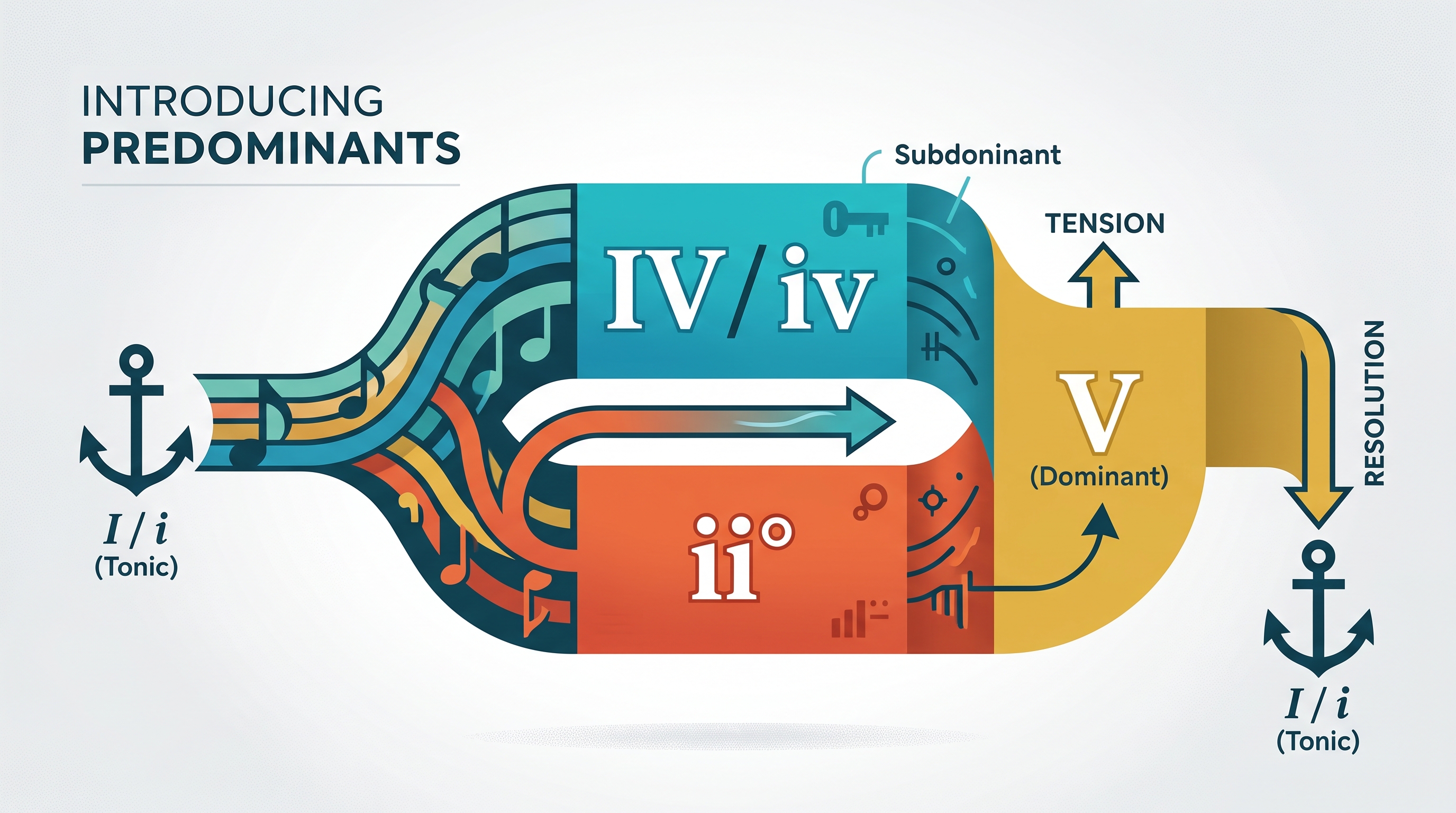
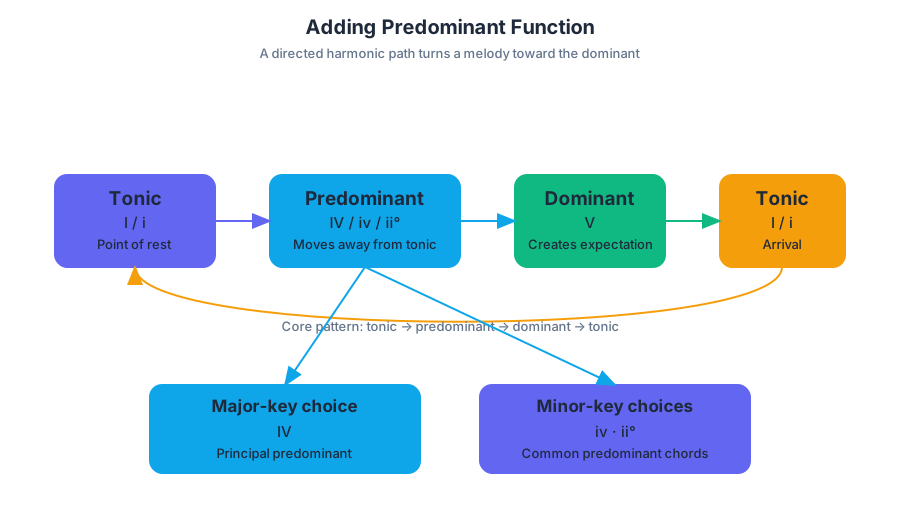
5.2 The vi (VI) chord
Key concepts: The vi (VI) chord · Chord progressions · Notated melodies · AP Music Theory harmony questions · Melody playback and listening responses · Exam question timing and pauses
A melody can sound as if it is moving away from home without actually leaving the key: in a major key, the vi chord provides that change of color by beginning on scale degree $6$ while remaining entirely diatonic.
5.2 The vi (VI) chord
A melody can sound as if it is moving away from home without actually leaving the key: in a major key, the vi chord provides that change of color by beginning on scale degree $6$ while remaining entirely diatonic. In Roman-numeral analysis, it is written lowercase vi because its triad is minor; in a minor key, the parallel chord is written uppercase VI because the triad built on scale degree $6$ is major.
vi in a major key = a minor triad built on scale degree $6$.
VI in a minor key = a major triad built on lowered scale degree $6$.
The chord belongs to the harmonic language of PIT-2: Harmony—Groupings of pitches that are successively and/or simultaneously produced form perceivable units known as chords. The related identifiers PIT-2.A.1, PIT-2.A.2, PIT-2.B.1, and PIT-2.B.2 emphasize that chords are not isolated labels: they participate in recognizable progressions and support musical motion.
Building vi from the scale
In C major, scale degree $6$ is A. Stack the other diatonic notes above it by thirds:
$$A-C-E$$
The intervals above A are a minor third, $A$ to $C$, and a perfect fifth, $A$ to $E$. Therefore, the chord is an A-minor triad, labeled vi.
| Key | Scale degree $6$ | Triad | Roman numeral |
|---|---|---|---|
| C major | A | A–C–E | vi |
| G major | E | E–G–B | vi |
| A minor | F | F–A–C | VI |
| E minor | C | C–E–G | VI |
What vi does in a progression
The vi chord often acts as a tonic-function substitute: it shares two pitches with the tonic triad. In C major, C major is $C$–$E$–$G$, while A minor is $A$–$C$–$E$; the common tones $C$ and $E$ make vi sound related to tonic, but its bass note A prevents it from feeling like a complete return home.
A common progression is:
$$ I \rightarrow vi \rightarrow ii \rightarrow V \rightarrow I $$
In C major, that becomes:
$$ C\text{ major} \rightarrow A\text{ minor} \rightarrow D\text{ minor} \rightarrow G\text{ major} \rightarrow C\text{ major} $$
The progression first moves from tonic to a darker, softer substitute, then through predominant-function $ii$ and dominant $V$ toward tonic. The vi chord can also follow $V$: $V \rightarrow vi$ creates a deceptive motion, because the dominant appears to promise tonic but resolves to vi instead.
Worked contextual example: reading labels above a melody
Imagine a notated melody in C major with Roman-numeral labels placed above successive measures:
$$I \qquad vi \qquad ii \qquad V \qquad I$$
Read the labels as a harmonic map rather than as isolated vocabulary. The melody’s notes should be interpreted against each underlying chord: notes such as $A$, $C$, and $E$ are especially stable during vi, while $G$ and $B$ may function as nonchord tones or as preparation for the following harmony.
If the melody ends on E over the vi label, do not automatically call the harmony $I$. E is also a chord member of vi, and the Roman numeral above the melody supplies the intended harmonic context. The labels indicate specific chord progressions, appearing above the notated melody; they tell you which harmonic path the passage takes.
The major–minor distinction
The capitalization is structural, not decorative:
- vi: scale degree $6$ in a major key produces a minor triad.
- VI: scale degree $6$ in a minor key produces a major triad, using the lowered sixth scale degree of the minor collection.
A frequent misconception is that “the sixth chord” always means a major chord because the symbol contains a capital-looking Roman numeral in some contexts. Correct the mistake by identifying the key first, locating scale degree $6$, and stacking the notes diatonically. Chord quality determines capitalization.
Misconception check: In G major, is vi D major or D minor?
G major is $G$–$A$–$B$–$C$–$D$–$E$–$F^\sharp$; scale degree $6$ is E, so vi is $E$–$G$–$B$, an E-minor triad—not D major.
Listening and AP response timing
In AP Music Theory harmony and aural questions, a labeled melody links notated music to performed music. The notation may show Roman-numeral chord labels above the melody, while playback lets you hear how the progression shapes the phrase.
For the referenced listening format, Question 1’s melody is played three times. A 30-second pause follows the first playing. Question 2’s melody is played four times, with a one-minute pause following each subsequent playing. Responses to Questions 2 and 6 are written on the designated response page. The exam clarifications and corrections associated with these instructions appear on pages $225$–$230$; use the current official directions when practicing because timing and page-location instructions control where answers belong.
The four AP skill categories provide the clearest way to describe the work:
- Skill 1: Analyze performed music — hear the melody’s contour, cadence, and harmonic color.
- Skill 2: Analyze notated music — read the key, melody, chord labels, and progression.
- Skill 3: Convert between performed and notated music — connect what you hear with the written Roman numerals and pitches.
- Skill 4: Complete based on cues — use the given key, labels, measures, and playback repetitions to produce the required response.
During the first hearing, establish the key and phrase direction. During the pauses, verify the vi label against the melody’s pitches; do not spend the entire pause replaying a single uncertain note mentally. On later hearings, check rhythm, cadential motion, and whether the written response is on the designated page.
Retrieval check
In E-flat major, identify vi, then explain why it may sound like a tonic substitute. Finally, if a melody is labeled $I$–$vi$–$ii$–$V$–$I$, name the chord-quality pattern.
Answer: E-flat major’s scale degree $6$ is C, so vi is $C$–$E\flat$–$G$, a C-minor triad. It shares two pitches with E-flat major, allowing it to resemble tonic while its bass changes. The quality pattern is major, minor, minor, major, major.
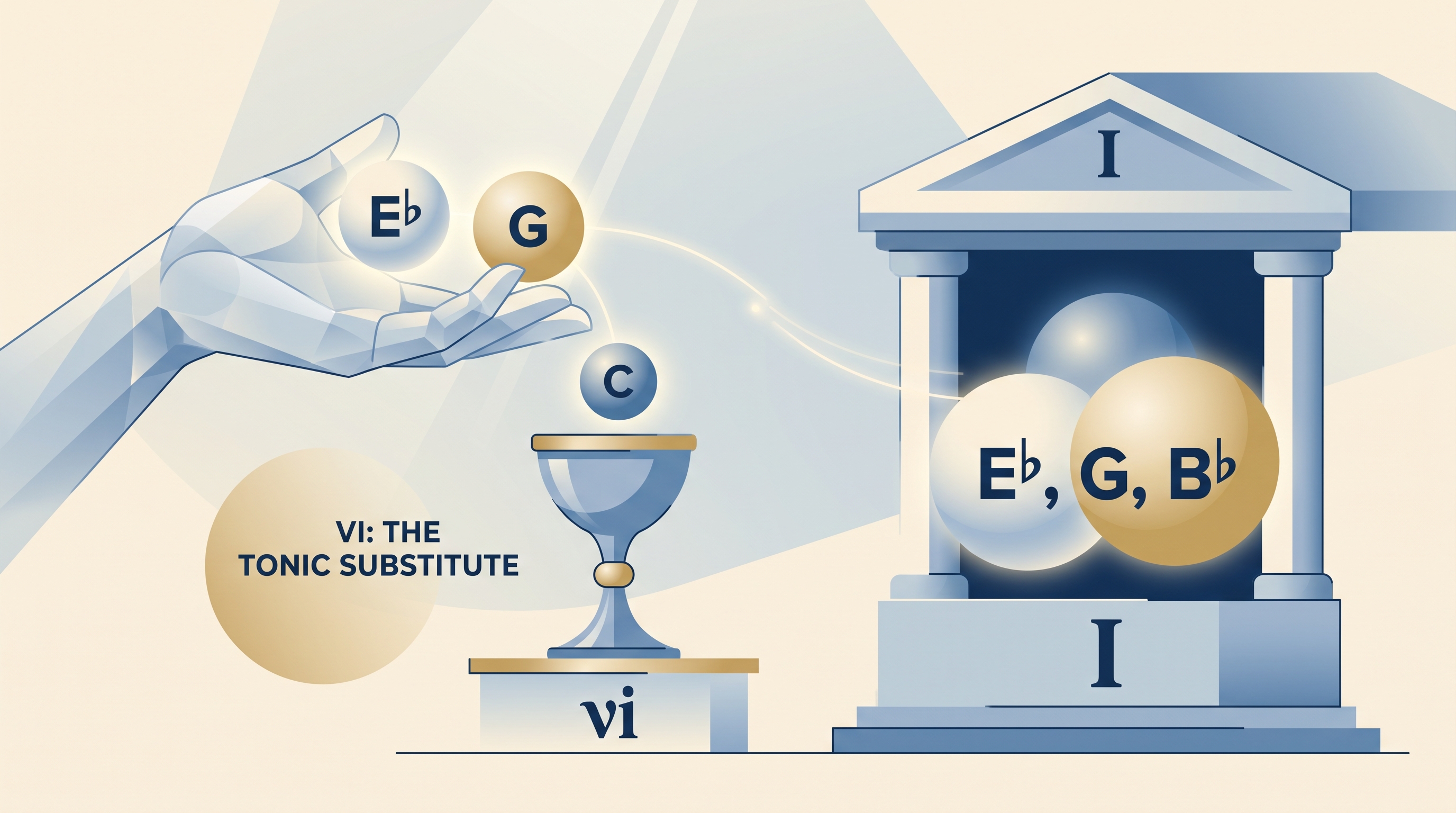
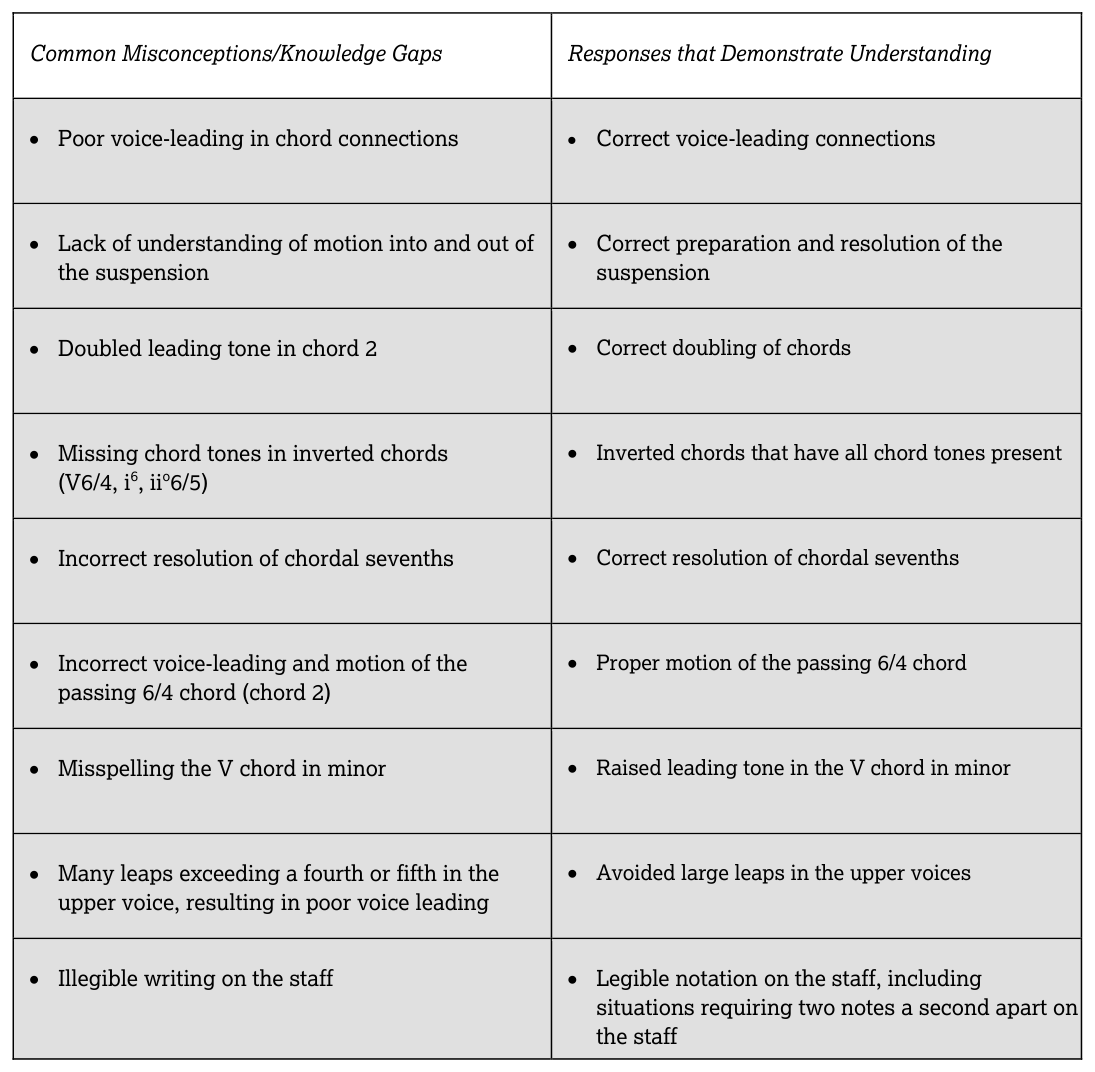
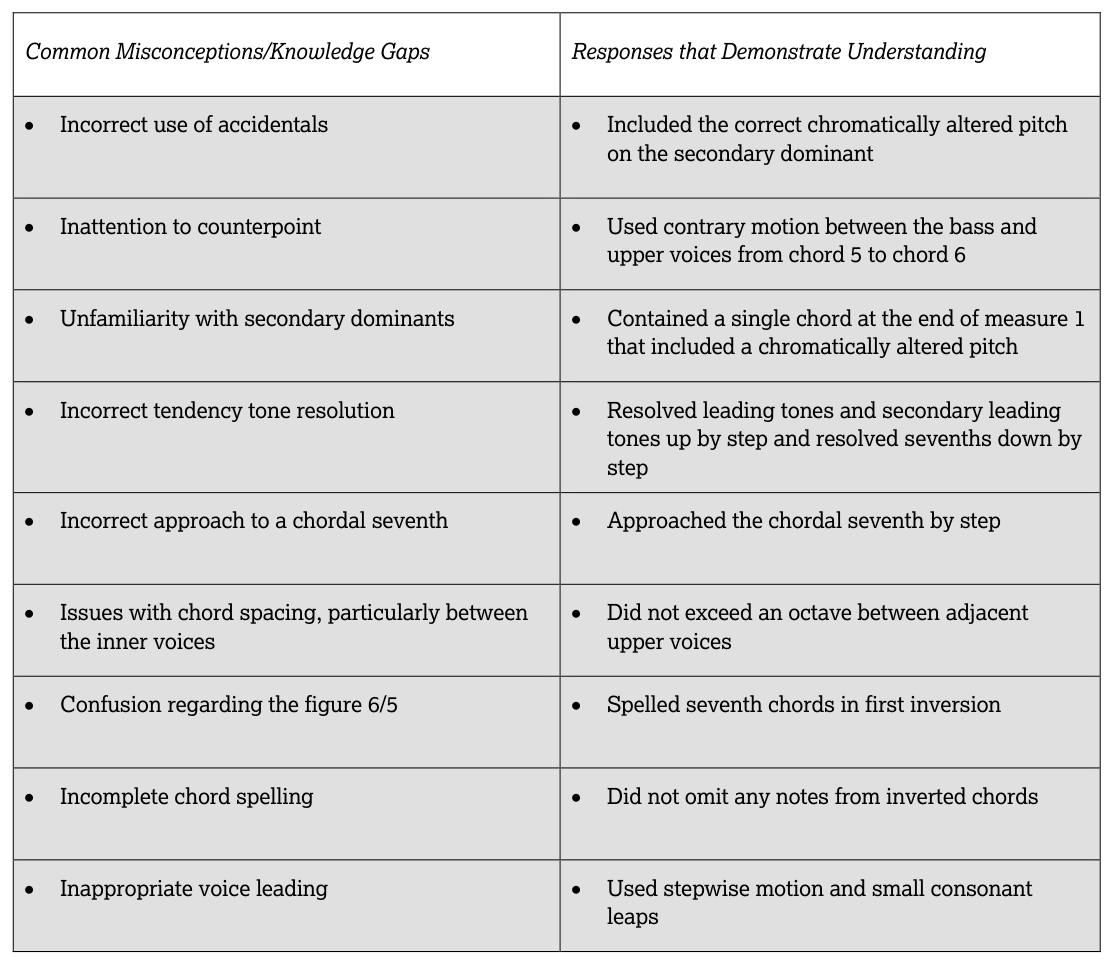
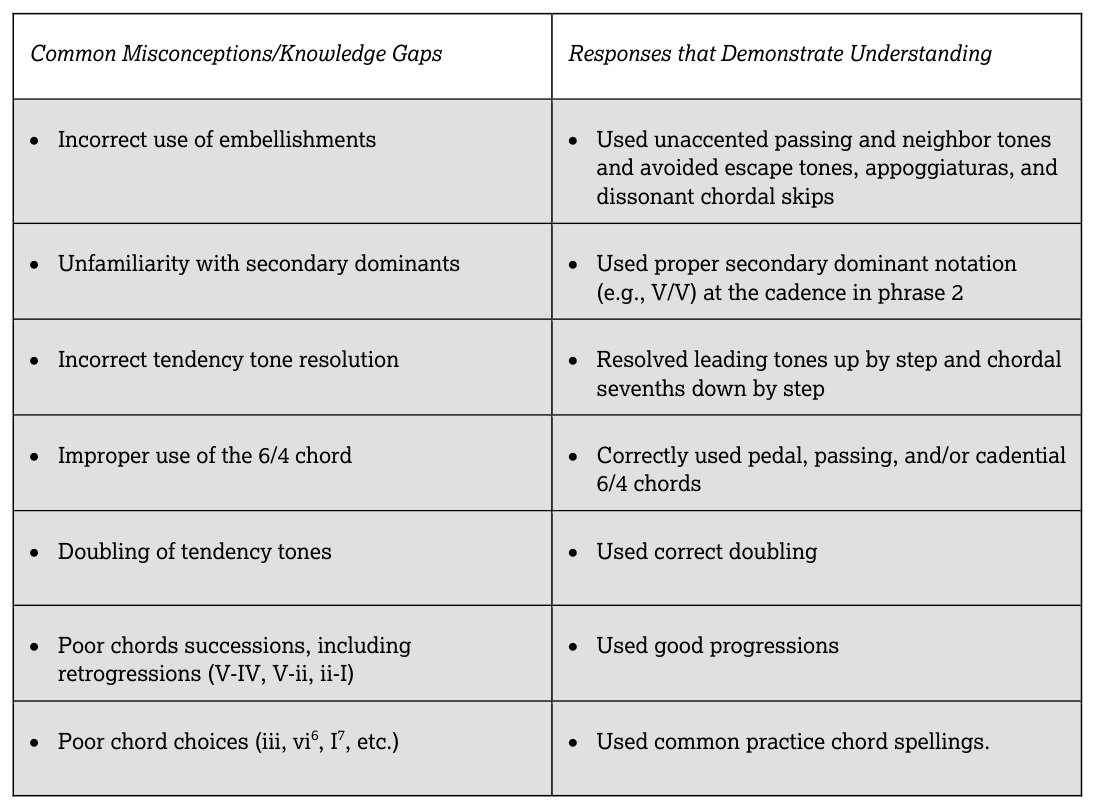
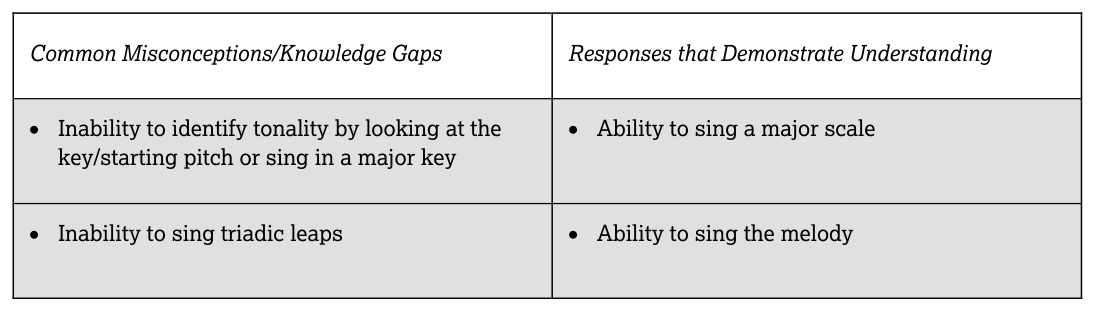
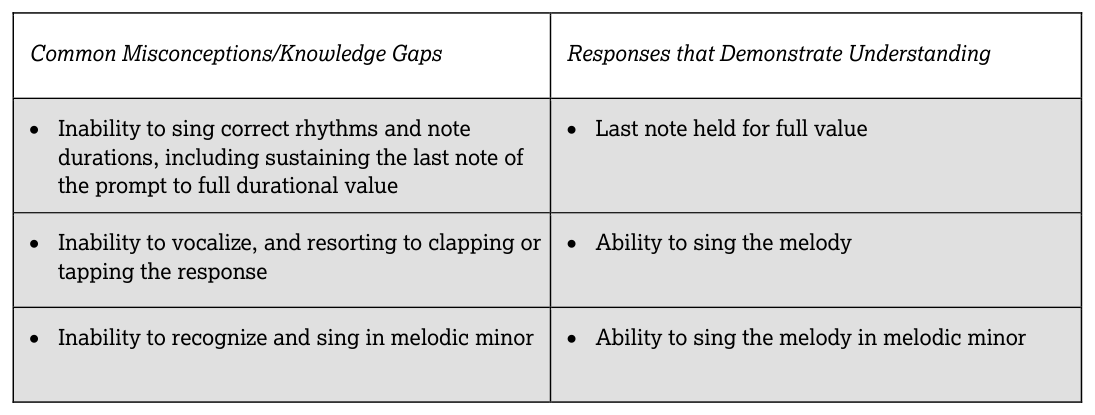
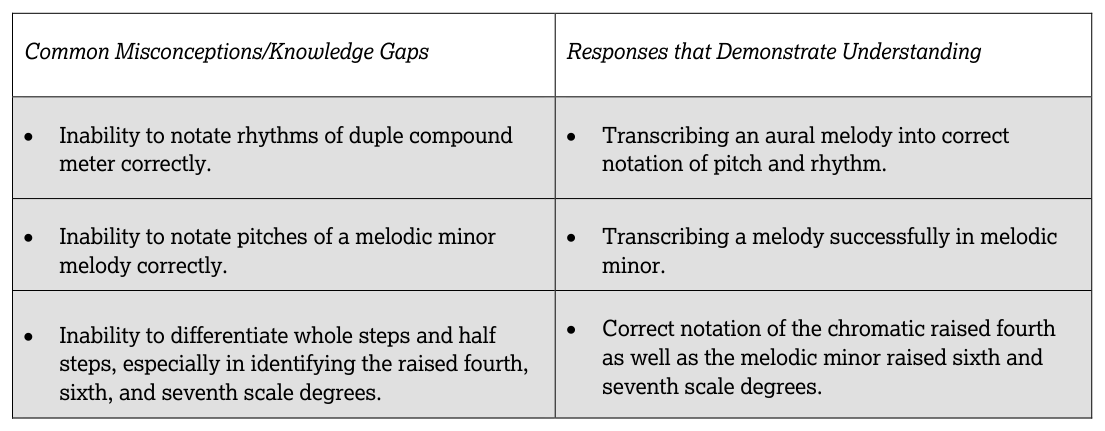
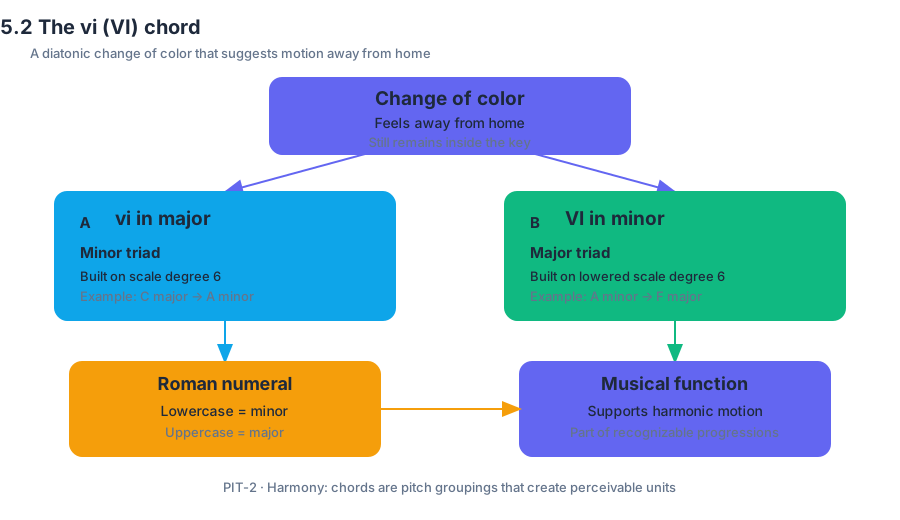
5.3 Predominant seventh chords
Key concepts: common-practice techniques · converting between performed and another representation
A predominant seventh chord prepares the dominant by adding a fourth chord member to a predominant triad, creating a stronger directed motion toward $V$ or $V^7$.
5.3 Predominant Seventh Chords
A predominant seventh chord prepares the dominant by adding a fourth chord member to a predominant triad, creating a stronger directed motion toward $V$ or $V^7$. In the familiar harmonic route
$$ \text{tonic} \rightarrow \text{predominant} \rightarrow \text{dominant} \rightarrow \text{tonic}, $$
the predominant seventh chord is the “launch platform” that gives the dominant arrival extra momentum.
Key idea: Predominant seventh chords usually move toward dominant-function chords, not directly to tonic.
The principal predominant seventh chords
In common-practice harmony, the most important predominant seventh chords are built on scale degree $2$ and scale degree $4$.
| Chord | Major-key form | Minor-key form | Typical function |
|---|---|---|---|
| Supertonic seventh | $ii^7$ | $ii^{ø7}$ | Predominant |
| Subdominant seventh | $IV^7$ | $iv^7$ | Predominant |
The $ii^7$ chord in a major key contains the notes of the minor triad on scale degree $2$ plus a minor seventh above its root. In C major:
$$ ii^7 = D-F-A-C. $$
The $ii^{ø7}$ chord in a minor key is a diminished triad with a minor seventh. In C minor:
$$ ii^{ø7} = D-F-A\flat-C. $$
The subdominant seventh has a major-minor seventh quality in major:
$$ IV^7 \text{ in C major} = F-A-C-E\flat, $$
and a minor seventh quality in minor:
$$ iv^7 \text{ in C minor} = F-A\flat-C-E\flat. $$
The symbol tells you both what the chord is and how it functions: lowercase Roman numerals indicate minor or diminished quality, while the superscript identifies the seventh-chord structure.
Why the seventh matters
A seventh added above a predominant chord creates a dissonant interval that normally resolves downward by step. In $ii^7 \rightarrow V$, the chordal seventh is scale degree $1$, and it commonly descends to scale degree $7$, which is the third of the $V$ chord.
In C major:
$$ ii^7 = D-F-A-C \quad \longrightarrow \quad V = G-B-D. $$
The note $C$, the seventh of $ii^7$, moves down to $B$, the third of $V$. This motion is especially important because it both resolves the dissonance and helps define the dominant harmony.
Other voices move to available tones of $V$ according to the voicing. Scale degree $4$ often moves to a chord tone such as scale degree $5$ rather than being described as rising to the leading tone. The leading tone, scale degree $7$, generally rises to scale degree $1$ when the progression continues from $V$ to $I$.
Worked example: hearing and notating $ii^7 \rightarrow V^7 \rightarrow I$
Suppose a performed passage in C major sounds like four sustained harmonic events:
$$ D-F-A-C \rightarrow G-B-D-F \rightarrow C-E-G. $$
Identify it in three stages:
- The first chord has root $D$ and the pitch collection of $ii^7$: label it $ii^7$.
- The second chord is built on scale degree $5$ and contains $G$, $B$, $D$, and $F$: label it $V^7$.
- The final chord is the tonic triad: label it $I$.
The complete progression is therefore
$$ ii^7 \rightarrow V^7 \rightarrow I. $$
If the music is heard rather than seen, listen for the characteristic pull of the seventh downward and the leading tone upward. If the music is notated, inspect the key, identify the chord root, stack the chord members by thirds, and determine the Roman numeral. This is the conversion between performed and notated music required by Skill 3: Convert between performed and notated music, especially 3.E: Apply knowledge of musical symbols and terms to detect discrepancies in pitch and rhythm when comparing notated and performed music in one or more parts.
Common-practice voice leading
When writing a predominant seventh chord, preserve the chordal seventh’s tendency to descend by step whenever possible. For $ii^7 \rightarrow V$, scale degree $1$ descends to scale degree $7$; the leading tone in the arriving $V$ chord then normally resolves upward to tonic in the following $I$ chord.
A common mistake is to treat every chord member as if it must move by the same interval or in the same direction. Voice leading is controlled by several interacting principles: resolve tendency tones, avoid forbidden parallels, keep individual parts singable, and complete the destination chord. The correct motion depends on the inversion and the specific voice that contains each chord member.
Misconception check: Scale degree $4$ is not the chordal seventh of $ii^7$ in a major key. The seventh of $ii^7$ is scale degree $1$; scale degree $4$ is the root of $IV$ and the third of $ii^7$.
Retrieval check
In G major, identify the chord $A-C-E-G$, explain its function, and name the most characteristic resolution for its seventh. The answer is $ii^7$, a predominant seventh chord; it normally moves toward $V$ or $V^7$, and its seventh, $G$, commonly descends by step to $F\sharp$, the third of $V$.
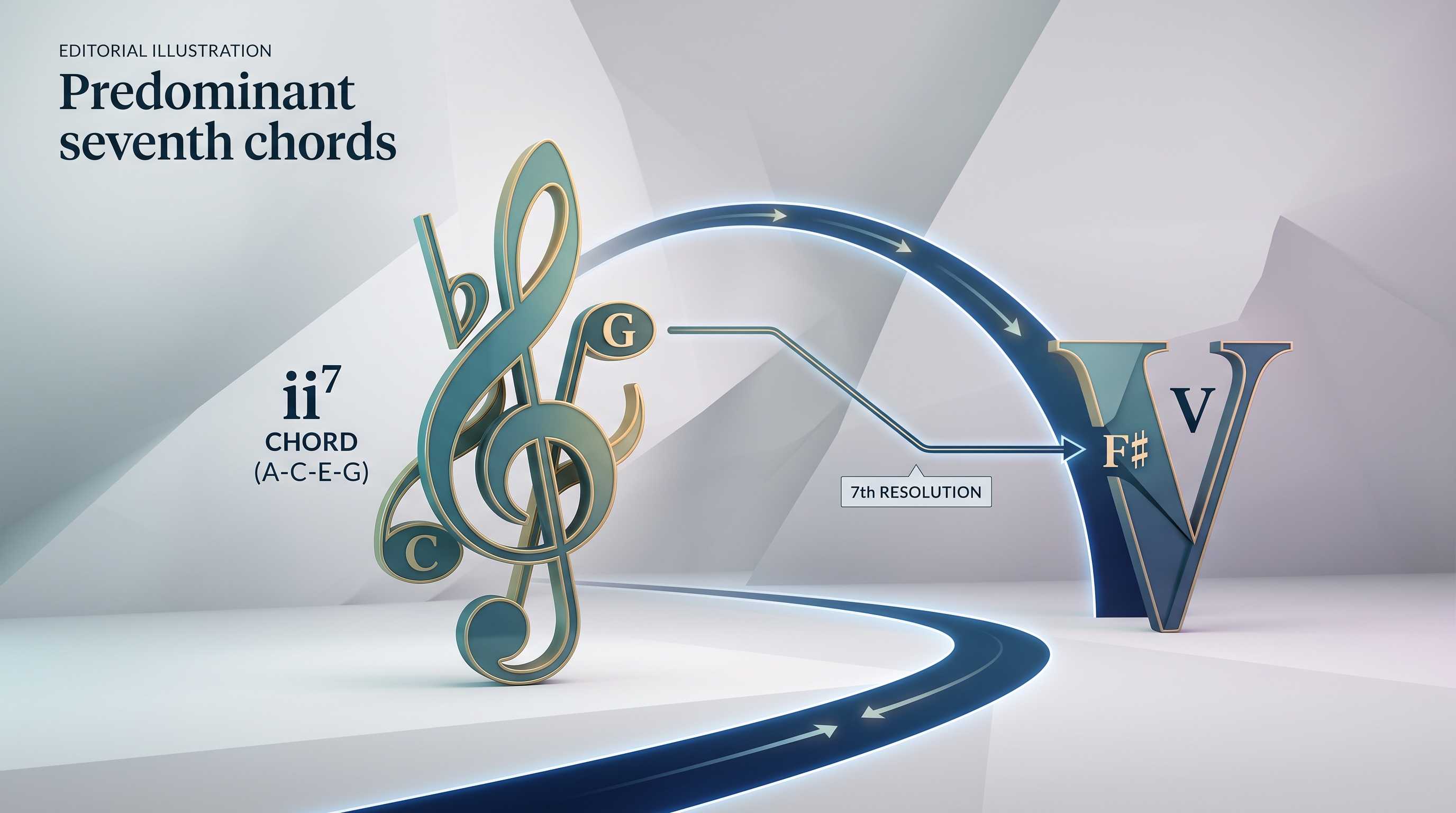
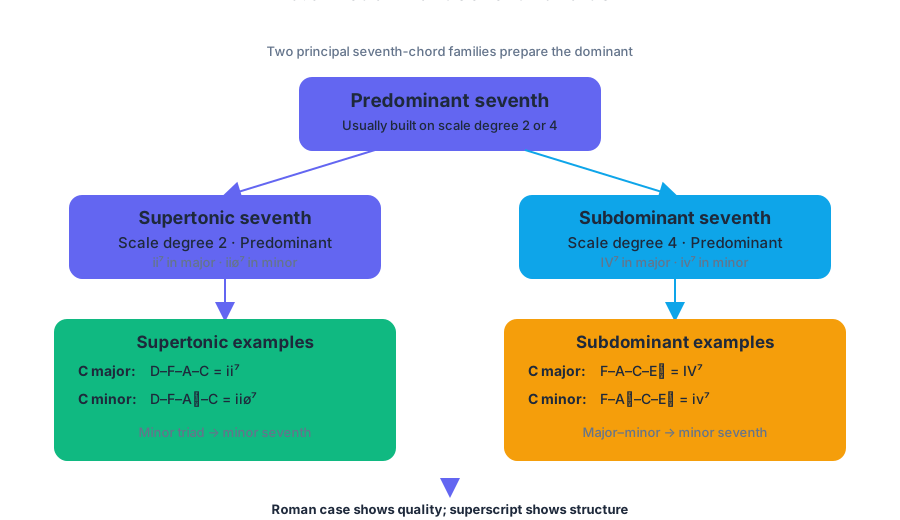
5.4 The iii (III) chord
Key concepts: The iii (III) chord · Chord-quality abbreviations in chord symbols · Minor triad notation such as Cm · Lead-sheet chord symbols · Roman-numeral chord labels · Neighboring or pedal six-four chords · Plagal cadences · Passing six-four chords · Cadential six-four chords · Avoiding poor chord successions
The iii chord is the diatonic triad built on scale degree $\hat{3}$: in a major key it is a minor triad, while in a minor key its quality is typically represented as a major triad, written $\mathrm{III}$.
5.4 The iii (III) chord
The iii chord is the diatonic triad built on scale degree $\hat{3}$: in a major key it is a minor triad, while in a minor key its quality is typically represented as a major triad, written $\mathrm{III}$. Its sound often connects tonic-oriented harmony with predominant or tonic-area motion, but its label depends on both scale degree and chord quality.
Finding and labeling the iii chord
In C major, the scale is
$$ \mathrm{C-D-E-F-G-A-B-C}. $$
The triad beginning on scale degree $\hat{3}$ uses $E$, $G$, and $B$:
$$ E-G-B. $$
The interval from $E$ to $G$ is a minor third, and the interval from $G$ to $B$ is a major third. Together they form a minor triad, so the Roman-numeral label is lowercase:
$$ \mathrm{iii}. $$
In A minor, the diatonic triad on scale degree $\hat{3}$ is built on $C$:
$$ C-E-G. $$
That triad is major, so it receives the uppercase label
$$ \mathrm{III}. $$
The uppercase/lowercase distinction is not cosmetic: it communicates chord quality.
Roman numerals versus lead-sheet symbols
Two labeling systems answer different questions. A Roman-numeral chord label identifies a chord’s scale-degree position within a key and uses case to show quality. A lead-sheet chord symbol gives performers the chord’s root and quality directly, usually without requiring them to infer the key.
Chord quality may be abbreviated with symbols such as $m$ for minor, $d$ for diminished, and $A$ for augmented. Thus, the C-minor triad may be labeled
$$ \mathrm{Cm}. $$
Lead-sheet chord symbols appear above the notated melody and indicate the specific chord progression expected for accompaniment. In C major, the iii chord can therefore be represented in two complementary ways:
| System | Label | Information emphasized |
|---|---|---|
| Roman numeral | $\mathrm{iii}$ | Scale-degree position and minor quality in the current key |
| Lead-sheet symbol | $\mathrm{Em}$ | Root $E$ and minor quality |
Misconception check — “iii” means the same thing as “Em.” The labels can refer to the same sounding chord in C major, but they are not interchangeable in every context. $\mathrm{iii}$ depends on the key; $\mathrm{Em}$ names the chord itself. If the key changes, the Roman numeral may change even when the sounding chord remains $E$ minor.
The iii chord in harmonic context
A chord’s identity is not enough; its neighbors matter. The iii chord can participate in a smooth bass motion, such as
$$ \mathrm{I-iii-IV}, $$
where the roots move upward by step:
$$ C \rightarrow E \rightarrow F. $$
It may also appear as part of a tonic-area prolongation, especially when the surrounding melody or bass makes its function clear. Do not automatically treat every chord containing scale degree $\hat{3}$ as $\mathrm{iii}$: determine the chord root, spell the triad, and then compare the root with the key.
Six-four chords near the iii chord
A six-four chord is a triad in second inversion, so its bass is the chord’s fifth. Not all six-four chords have the same function. The cadential six-four is especially important because it precedes the dominant:
$$ \mathrm{I^{6/4}-V-I}. $$
It commonly harmonizes the second note of a three-note ascending or descending figure. For example, a bass pattern
$$ G-A-G $$
may place the cadential six-four over $G$, the dominant over $A$, and the final tonic over $G$ in a suitable tonal context. The six-four sonority sounds like tonic, but its motion and placement make it a dominant embellishment rather than an independent tonic arrival.
By contrast, a neighboring or pedal six-four decorates a sustained or repeated bass note. The bass remains stable while the upper voices move away and return, so the six-four is heard as an embellishment of the surrounding harmony rather than as a cadential dominant preparation.
Writing and analysis warnings
Plagal cadences use the progression
$$ \mathrm{IV-I} $$
in major keys or
$$ \mathrm{iv-i} $$
in minor keys. They should not be confused with the cadential six-four, which leads into $\mathrm{V}$ before resolving to tonic.
In part-writing exercises, avoid poor successions such as
$$ \mathrm{V-IV} \qquad \text{and} \qquad \mathrm{V-vi}. $$
The latter may represent deceptive motion in an appropriate context, but it should not be inserted casually. Likewise, do not choose $\mathrm{iii}$ merely because its notes fit the melody: the progression must support a convincing harmonic function and acceptable voice leading.
Retrieval check: In G major, identify the notes and Roman numeral of the triad built on scale degree $\hat{3}$. Then give its lead-sheet symbol.
Answer: G major is $G-A-B-C-D-E-F^\sharp$; scale degree $\hat{3}$ is $B$, producing $B-D-F^\sharp$, a minor triad:
$$ \mathrm{iii}=\mathrm{Bm}. $$
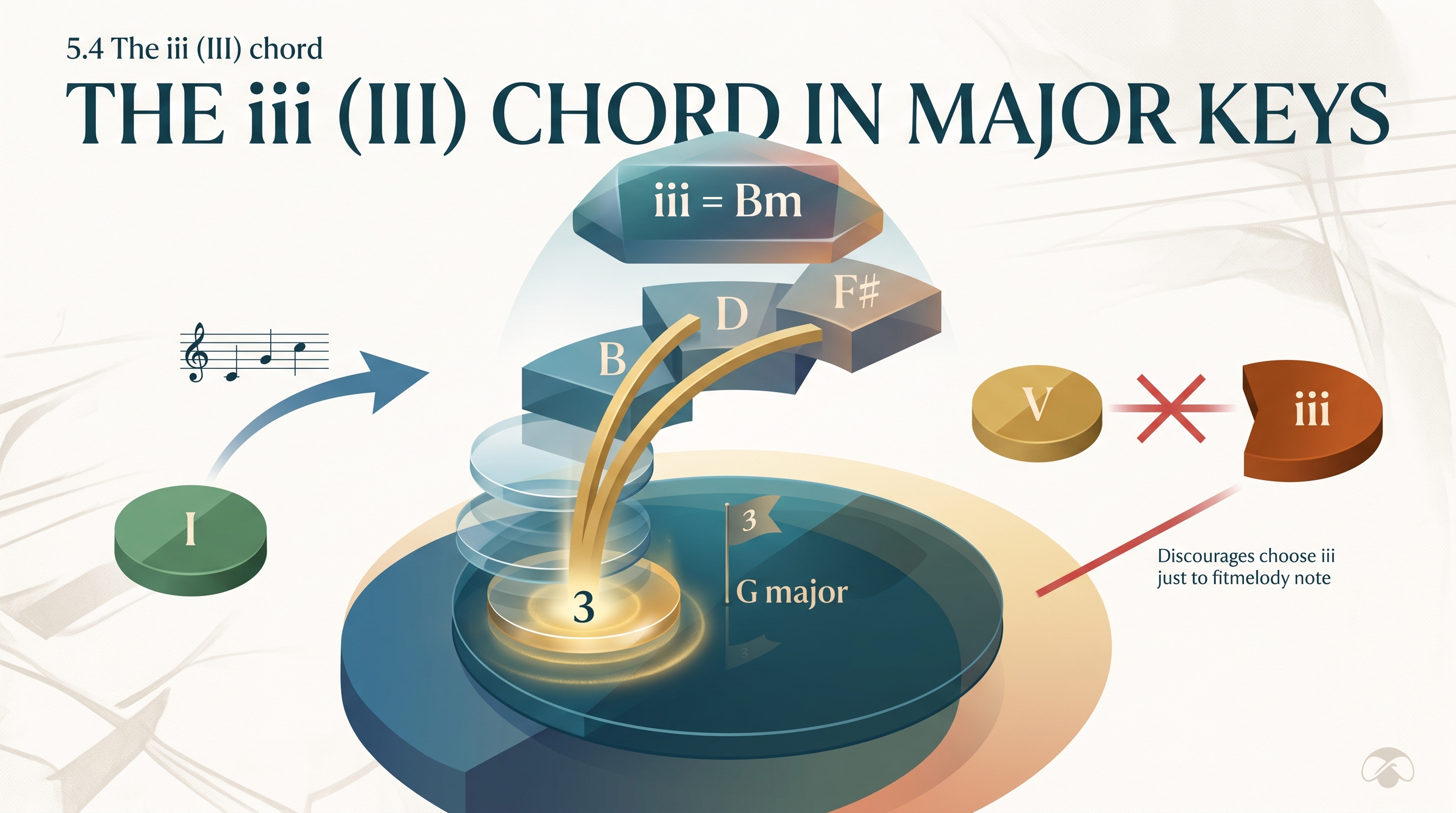
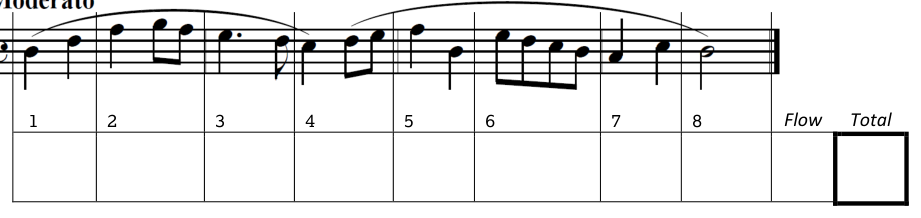
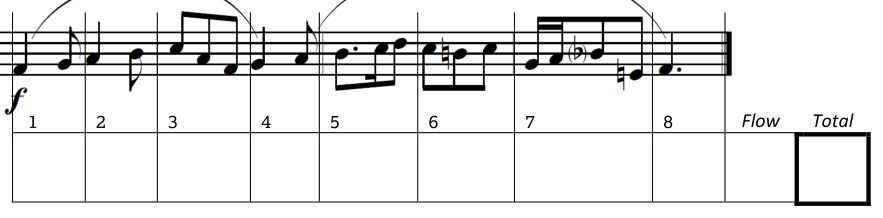
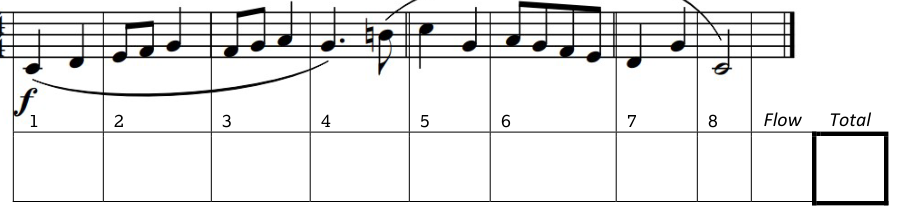
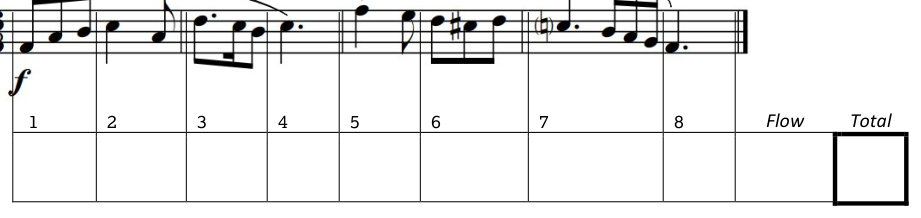
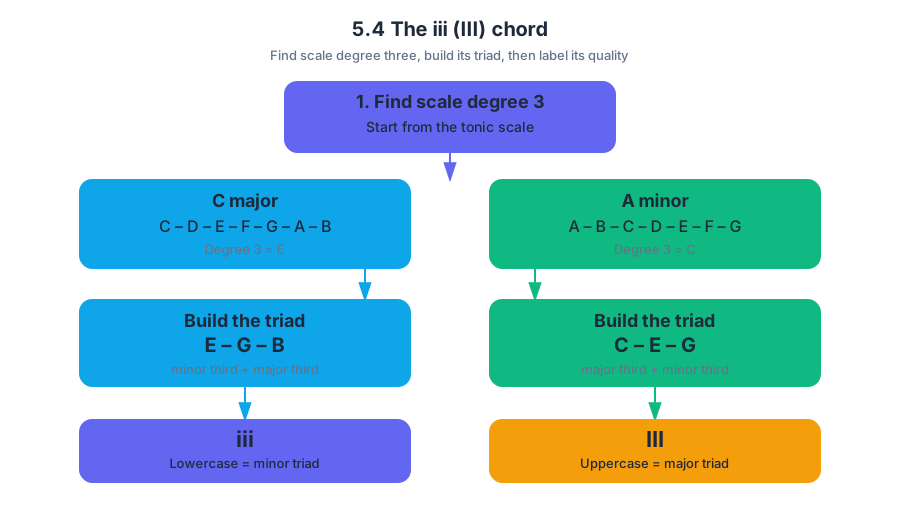
5.5 Cadences and predominant function
A cadence is a point of musical punctuation: the harmony and melody create enough closure—or enough interruption—to make a phrase sound finished, paused, or redirected.
5.5 Cadences and predominant function
A cadence is a point of musical punctuation: the harmony and melody create enough closure—or enough interruption—to make a phrase sound finished, paused, or redirected. A predominant function is the harmonic role that prepares a dominant chord, usually by moving from tonic toward $V$.
The central question is: How does a phrase move from stability toward a cadence, and what makes that cadence sound final or unfinished?
The harmonic route to a cadence
In common-practice tonal harmony, a complete phrase often follows this broad trajectory:
$$ \text{Tonic} \rightarrow \text{Predominant} \rightarrow \text{Dominant} \rightarrow \text{Tonic} $$
In C major, the progression might be:
$$ I \rightarrow ii^6 \rightarrow V^7 \rightarrow I $$
Here, $I$ establishes C major. The predominant chord $ii^6$ creates forward motion, the dominant $V^7$ intensifies that motion through its leading tone and seventh, and the final $I$ supplies tonal arrival.
The most common predominant chords are $ii$ and $IV$ in major, and $ii^\circ$ and $iv$ in minor. Their shared job matters more than their chord labels: they generally lead toward dominant-function harmony.
| Function | Common major-key chords | Common minor-key chords | Typical destination |
|---|---|---|---|
| Tonic | $I$, sometimes $vi$ | $i$, sometimes $VI$ | Stability or departure |
| Predominant | $ii$, $IV$ | $ii^\circ$, $iv$ | $V$ or $V^7$ |
| Dominant | $V$, $V^7$, $vii^\circ$ | $V$, $V^7$, $vii^\circ$ | $I$ or $i$ |
This functional reading explains why $ii^6$ is especially useful before $V$: its bass note is scale degree $\hat{4}$, which moves smoothly to scale degree $\hat{5}$, while the upper voices can proceed by step.
Cadence types
A cadence is identified by the harmonic goal and by the melodic and bass behavior at the phrase ending—not by the final chord alone.
- Authentic cadence: dominant-function harmony moves to tonic, usually $V$ or $V^7$ to $I$ in major or $i$ in minor.
- Half cadence: the phrase ends on dominant harmony. It sounds like a comma rather than a period.
- Deceptive cadence: dominant-function harmony moves somewhere other than tonic, most commonly $V$ to $vi$ in major or $VI$ in minor.
- Plagal cadence: predominant-function harmony moves directly to tonic, commonly $IV$ to $I$ or $iv$ to $i$.
An authentic cadence can be further described as perfect authentic when the final harmony is $V$ to $I$, both chords are in root position, and the soprano ends on tonic. If one or more of those conditions is absent, the cadence is generally imperfect authentic. The phrase may still sound conclusive, but its closure is less emphatic.
Worked example: hearing the function
Suppose a phrase in G major ends with the progression:
$$ | I \quad | IV \quad | ii^6 \quad V^7 \quad | I | $$
First, identify the tonal center: the opening and closing $I$ chords establish G major. Next, classify the middle chords: $IV$ and $ii^6$ are predominant-function chords, and $V^7$ is dominant-function harmony.
The final $V^7 \rightarrow I$ creates an authentic cadence. If the bass ends on G and the soprano also ends on G, with both chords in root position, the cadence qualifies as perfect authentic. If the soprano instead ends on B, the cadence remains authentic but is imperfect.
Now change only the final tonic chord:
$$ | ii^6 \quad V^7 \quad | vi | $$
The $V^7$ still sounds as though it wants to resolve to $I$, but $vi$ replaces the expected tonic. This is a deceptive cadence: the dominant function is present, yet the arrival avoids the expected goal.
What exam analysis rewards
For PIT 1: Analyze Performed Music, listen for the sensation of arrival, interruption, or suspension at the phrase ending. A dominant chord followed by a minor submediant often produces the characteristic “expected ending that did not happen” of a deceptive cadence.
For PIT 2: Analyze Notated Music, inspect the final two or three harmonies, determine the key, and check both the Roman numerals and the bass. For PIT +, several observations may be needed together: harmonic function, cadence type, phrase placement, and melodic closure.
Key insight: The last chord does not identify a cadence by itself. The cadence is the relationship between the harmonies immediately before the ending and the chord that actually arrives.
Misconception check
Misconception: “Any phrase ending on $I$ is an authentic cadence.” Not necessarily. A tonic chord may follow a plagal progression such as $IV \rightarrow I$, or it may appear after a weak or non-dominant progression. To call a cadence authentic, verify that dominant-function harmony—typically $V$, $V^7$, or $vii^\circ$—precedes the tonic.
Retrieval check: In the key of D minor, classify $iv \rightarrow i$, $V^7 \rightarrow i$, and $V \rightarrow VI$. Which one is plagal, which is authentic, and which is deceptive?
Answer: $iv \rightarrow i$ is plagal; $V^7 \rightarrow i$ is authentic; $V \rightarrow VI$ is deceptive.
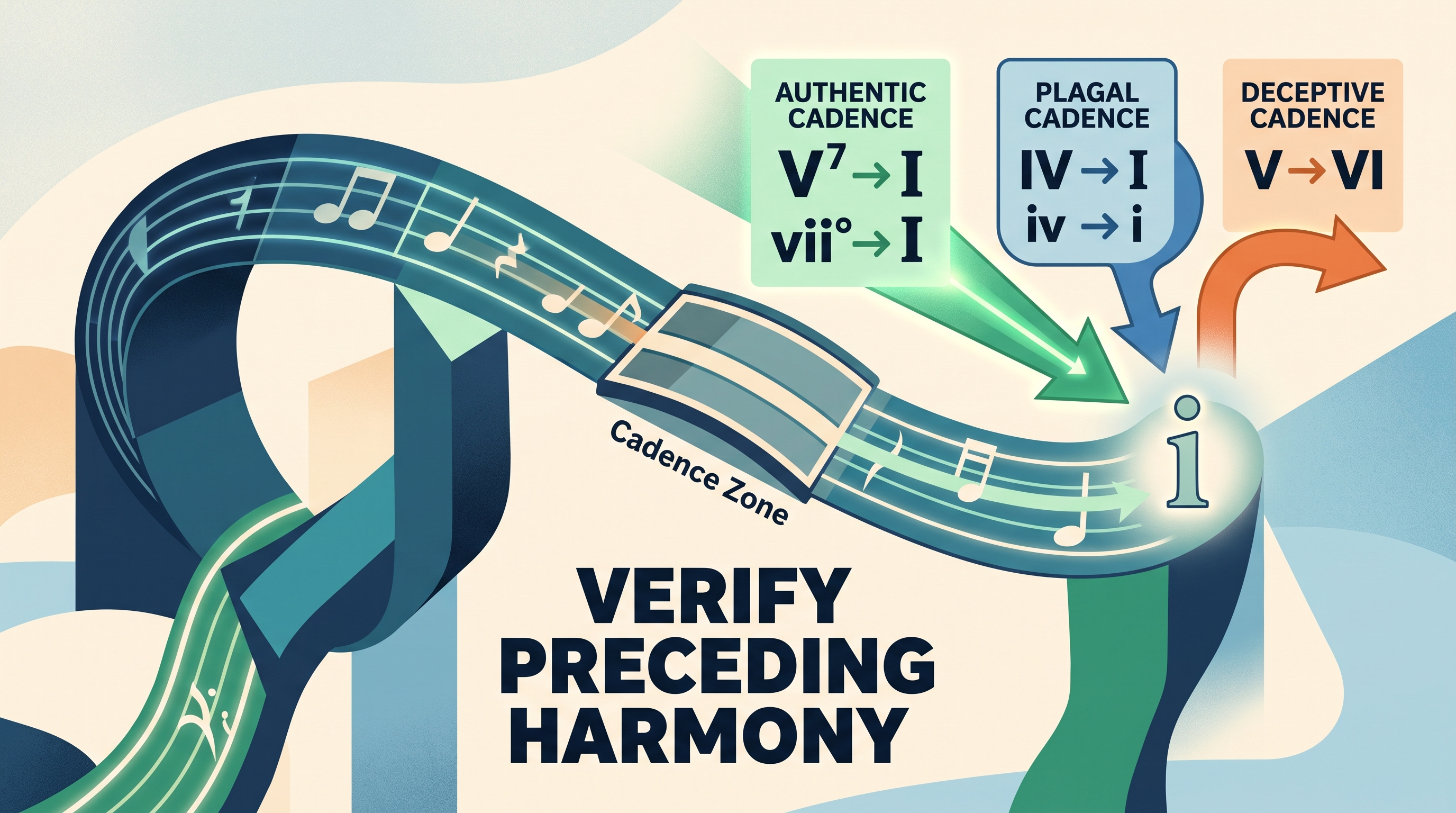
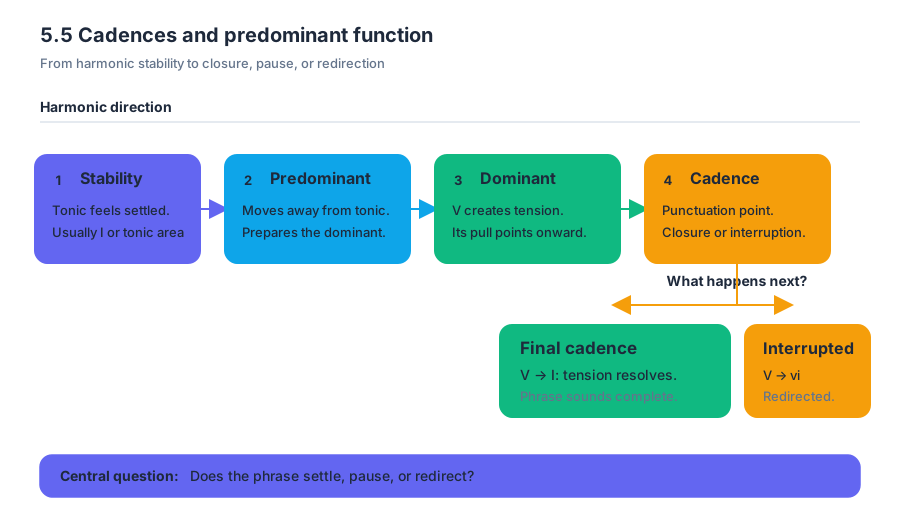
5.6 Cadential six-four chords
Key concepts: Cadential six-four chord as a second-inversion tonic triad · Dominant function of the cadential 6/4 despite its tonic-triad pitches · Resolution of the cadential 6/4 to V · Strong-beat placement and phrase-final cadential context · Voice-leading retardations: 6–5 and 4–3 above the bass · Distinction between cadential, passing, pedal, neighboring, and arpeggiated 6/4 chords · Bass motion and stability in identifying six-four chord types · Alternative analysis of a cadential 6/4 as a decorated dominant chord
A cadential six-four chord contains the pitches of the tonic triad but functions as a dominant embellishment immediately before $V$.
5.6 Cadential six-four chords
A cadential six-four chord contains the pitches of the tonic triad but functions as a dominant embellishment immediately before $V$.
Learning Objective PIT-2.K: Identify the type of $^6_4$ chord used in notated music.
Essential Knowledge PIT-2.K.1–PIT-2.K.2: Second-inversion triads occur in four specific contexts—cadential, neighboring or pedal, passing, and arpeggiated—and their identity depends on context, metric placement, bass motion, and resolution.
The sound and function of the cadential $^6_4$
In a $^6_4$ chord, the fifth of the triad is in the bass. A tonic triad in C major, for example, contains C, E, and G. Its second inversion places G in the bass:
$$ I^{6/4} = G\text{–}C\text{–}E $$
Although these are tonic-triad pitches, the chord does not behave like $I$. On a strong beat near the end of a phrase, the upper voices create two accented dissonances above the bass. They then resolve downward into the dominant:
$$ I^{6/4} \longrightarrow V $$
In C major:
$$ G\text{–}C\text{–}E \longrightarrow G\text{–}B\text{–}D $$
The C above the bass G descends to B, creating the characteristic $6-5$ motion. The E descends to D, creating $4-3$ motion.
Core idea: the cadential $^6_4$ is not an independent tonic-function chord. It is a dominant-function sonority whose upper voices temporarily delay the arrival of $V$.
Worked example: locating the cadential $^6_4$
Suppose the final harmony of a phrase in G major is written as follows:
$$ \text{Bass: } D \qquad \text{Upper voices: } G,\ B $$
The notes are D–G–B, the pitches of $I^{6/4}$ in G major. To determine whether this is cadential, inspect three clues:
- Bass position: D is the fifth scale degree, so the tonic triad is in second inversion.
- Metric placement: the sonority occurs on a strong beat, giving the upper voices accented emphasis.
- Resolution: G moves down to F-sharp and B moves down to A, producing $6-5$ and $4-3$ above the bass D.
The analysis is therefore:
$$ I^{6/4} \longrightarrow V \longrightarrow I $$
or, in an alternative dominant-centered analysis:
$$ V^{6/4-5/3} \longrightarrow I $$
The second analysis emphasizes that the entire event belongs to dominant function, with the $^6_4$ pitches acting like moving figures over the dominant bass.
Misconception check: “It contains the tonic triad, so it must be tonic harmony.”
Correction: harmonic function comes from context, not from pitch collection alone. Strong-beat placement, phrase-final location, and resolution to $V$ identify this sonority as cadential dominant embellishment.
Four kinds of $^6_4$ chords
The bass and the surrounding voices distinguish the cadential type from other second-inversion triads.
| Type | Typical context | Identifying motion |
|---|---|---|
| Cadential $^6_4$ | Strong beat near a phrase ending | Resolves to $V$; upper voices show $6-5$ and $4-3$ |
| Passing $^6_4$ | Bass moves by step through a scale fragment | Bass continues upward or downward between harmonies |
| Neighboring or pedal $^6_4$ | Upper voices move while the bass remains stationary | Bass acts as a sustained pedal point |
| Arpeggiated $^6_4$ | Bass outlines a triad | Bass arpeggiates between root and fifth or through the complete triad |
A passing $^6_4$ is noncadential because its bass participates in stepwise motion. A pedal $^6_4$ is noncadential because the upper voices move against a stationary bass. An arpeggiated $^6_4$ results from bass arpeggiation, often producing the flowing bass patterns associated with waltzes or marches.
Analysis workflow
Three-question test:
Where is the bass? Is it the fifth of a tonic triad?
When does it occur? Is it on a strong beat in a phrase-ending context?
Where does it go? Does it resolve to $V$ with $6-5$ and $4-3$ motions?
If all three answers point toward the dominant arrival, label the chord $I^{6/4}-V$ or use the dominant-centered reading $V^{6/4-5/3}$. Do not label every second-inversion tonic triad as cadential.
Retrieval check: A second-inversion tonic triad appears on a weak beat while the bass moves stepwise from scale degree $4$ to $5$. Is it cadential, passing, pedal, or arpeggiated? Answer: passing, because the bass is part of a stepwise connecting motion rather than a phrase-final $I^{6/4}-V$ resolution.
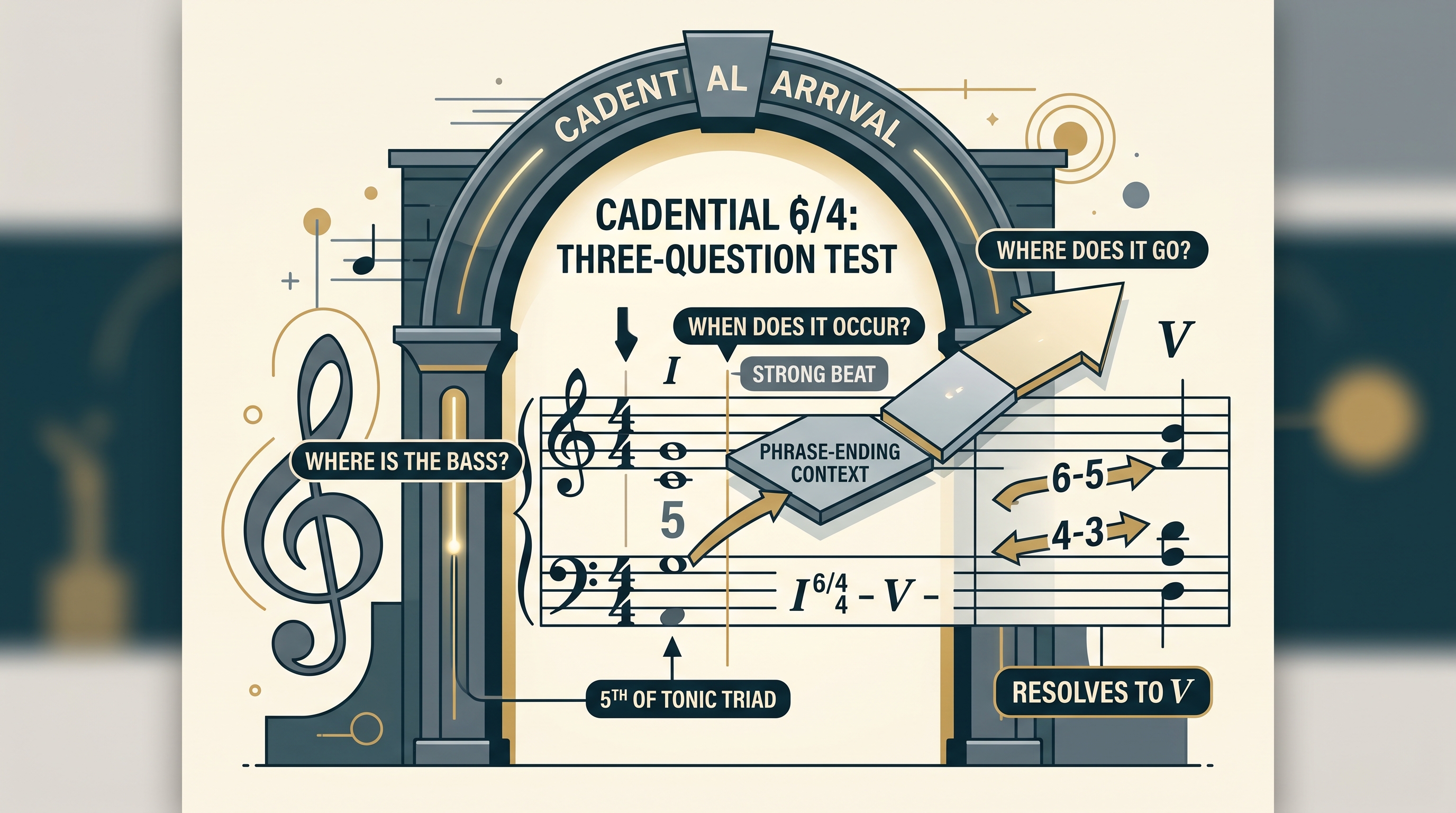

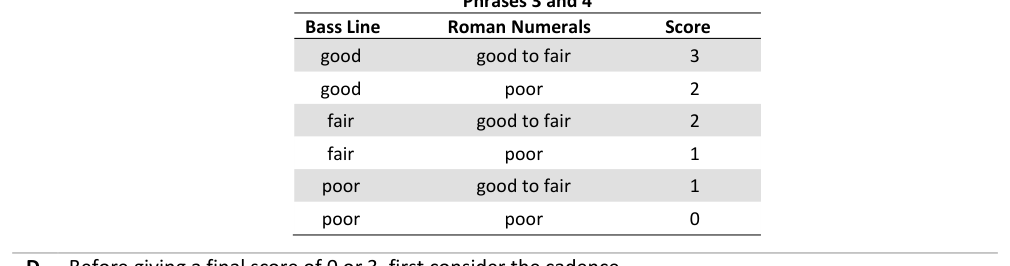
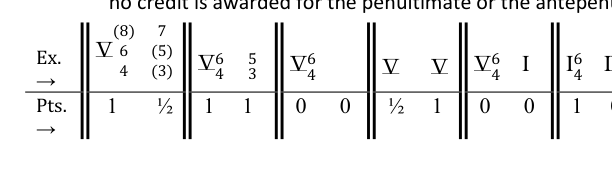
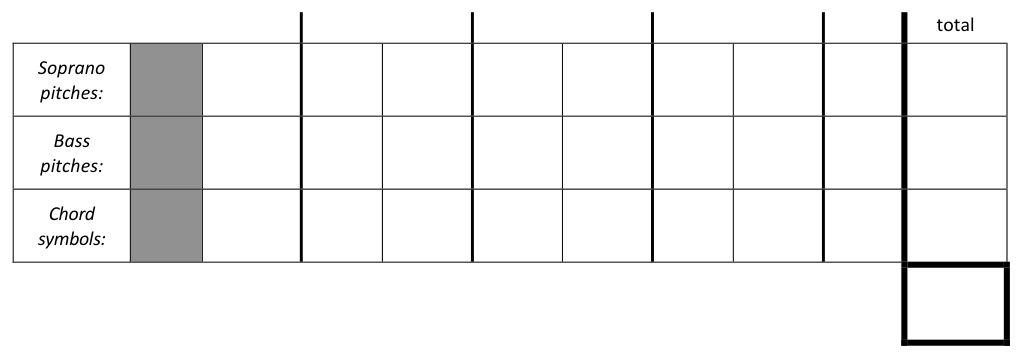
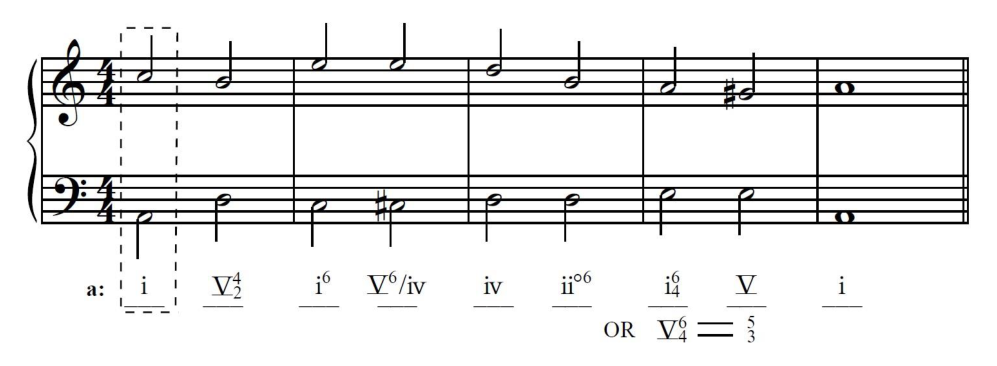
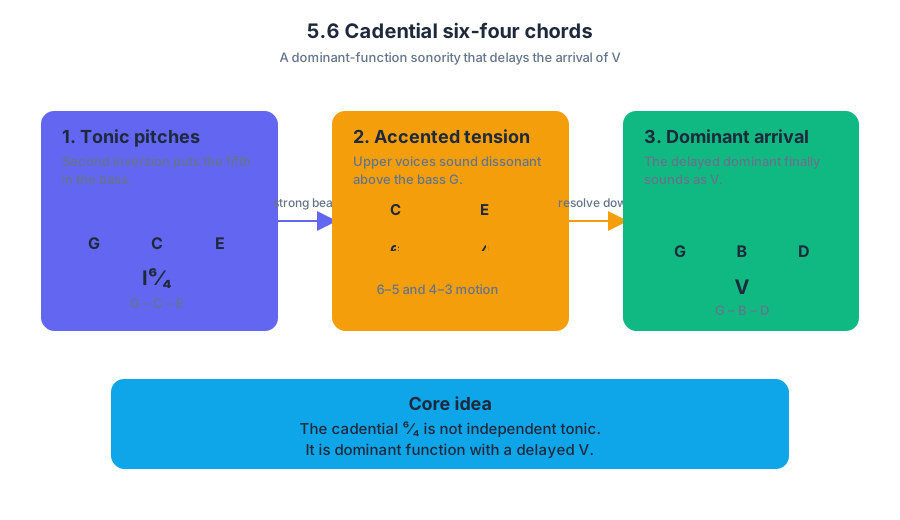
5.7 Additional six-four chords
Key concepts: Additional six-four chords · Roman numeral analysis · Second-inversion dominant seventh chords · Tonic and scale-degree notation · Harmonic progression notation · Regular scoring by segments · Holistic alternate scoring · Pitch and rhythm accuracy · Flow-point scoring · Scoring rules for restarts and transposition
An additional six-four chord is a second-inversion triad whose meaning comes from its harmonic surroundings rather than from a single fixed function. Roman-numeral analysis therefore reads a progression such as
5.7 Additional six-four chords
An additional six-four chord is a second-inversion triad whose meaning comes from its harmonic surroundings rather than from a single fixed function. Roman-numeral analysis therefore reads a progression such as
$$i - V^4_3 - i^6$$
as a connected motion: tonic, dominant seventh in second inversion, then tonic in first inversion.
Reading the harmonic shorthand
Roman numerals identify the chord’s scale-degree root and quality; superscript and subscript figures identify its inversion. In the example above, lowercase $i$ means a minor tonic triad, while $i^6$ means that same tonic triad in first inversion.
Key distinction: $V^4_3$ is a dominant seventh chord in second inversion—not a triad in second inversion.
A seventh chord contains four chord members. In a second inversion, the chord’s fifth is in the bass, so the intervals above the bass are a fourth and a third; that produces the figure $4/3$. By contrast, a triad in second inversion is labeled $6/4$, because its intervals above the bass are a sixth and a fourth.
| Symbol | Chord type | Inversion indicated |
|---|---|---|
| $V^6$ | Dominant triad | First inversion |
| $V^4_3$ | Dominant seventh chord | Second inversion |
| $i^6$ | Tonic triad | First inversion |
| $i^6_4$ | Tonic triad | Second inversion |
The notation $\hat{1}$ means scale degree one, or the tonic. This symbol refers to a pitch position within the established scale; it is not itself a chord label. Thus, if a melody establishes $\hat{1}$ as its tonal center, later transposition or pitch analysis should be judged relative to that tonic.
Worked analysis
Suppose a minor-key passage contains the progression below:
$$i - V^4_3 - i^6$$
Read it in three stages:
- $i$ establishes the tonic harmony.
- $V^4_3$ introduces the dominant seventh chord with its fifth in the bass.
- $i^6$ returns to tonic harmony, but with the third of the tonic chord in the bass.
The dashes are meaningful: they show harmonic progression, not subtraction. A common error is to read $V^4_3$ as “a four-three triad” or to treat $i^6$ as a new key. The Roman numeral remains the harmonic identity; the figures describe only the chord’s vertical arrangement.
Misconception check: The number $6$ in $i^6$ does not mean “scale degree six.” It describes the intervals above the bass and signals first inversion.
Regular scoring by segments
In performance tasks, regular scoring evaluates the response in separate musical segments. For each segment, pitch and rhythm are checked together: a segment earns its point only when both are accurate. The segment scores are then added for a preliminary total, and a separate flow point may be awarded for a continuous response without hesitations or restarts.
For example:
$$1101+1111+1=8$$
Here the eight segment positions contain seven correct segments, followed by one flow point.
If a student restarts, evaluators score the last complete response and do not award the flow point. If no complete response exists, they score the last response available. Evaluators also listen beyond the apparent ending in case the student gives an additional response.
Holistic alternate scoring
Holistic alternate scoring judges the overall response rather than adding one point per segment. It is used when the regular segment score is low enough that a response’s broader consistency may be represented more fairly by a pitch-focused or rhythm-focused guide.
Under an alternate guide, evaluators consider how accurately the student maintains pitch or rhythm across the performance as a whole. The result is not combined with individual segment points or the regular flow point; the regular and alternate guides are separate scoring systems. When applicable, evaluators record the higher complete score, never a mixture of points from different guides.
Edge cases that change the score
For transposition, scoring begins from the tonic established by the student. A response can therefore receive credit for accurately transposed segments when the intervals above that student-established tonic are correct.
An additional point may be awarded for an exceptionally good response or for a response that would otherwise receive zero. This is distinct from the regular flow point. The evaluator should apply the relevant scoring guide completely, record the higher applicable result, and avoid combining guides.
Retrieval check
Identify each item in $i - V^4_3 - i^6$: Which symbol names the dominant seventh chord, what inversion does $V^4_3$ show, and what does $\hat{1}$ name? Then state the regular-scoring rule: must a segment have correct pitch, correct rhythm, or both to earn its segment point?




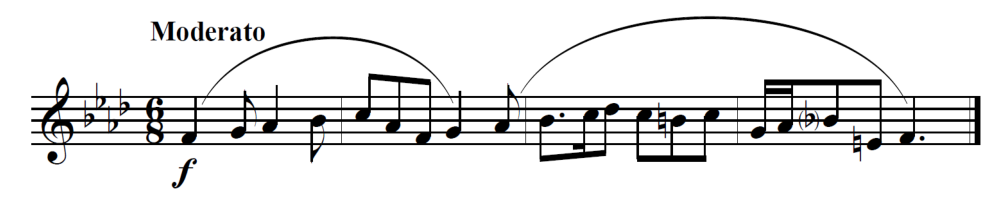
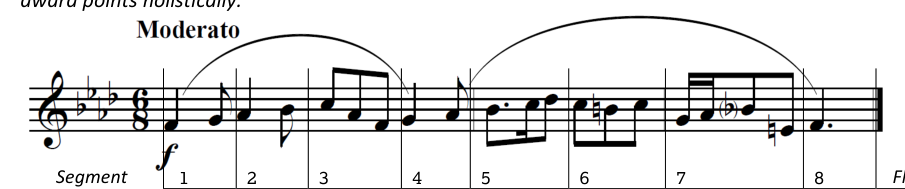
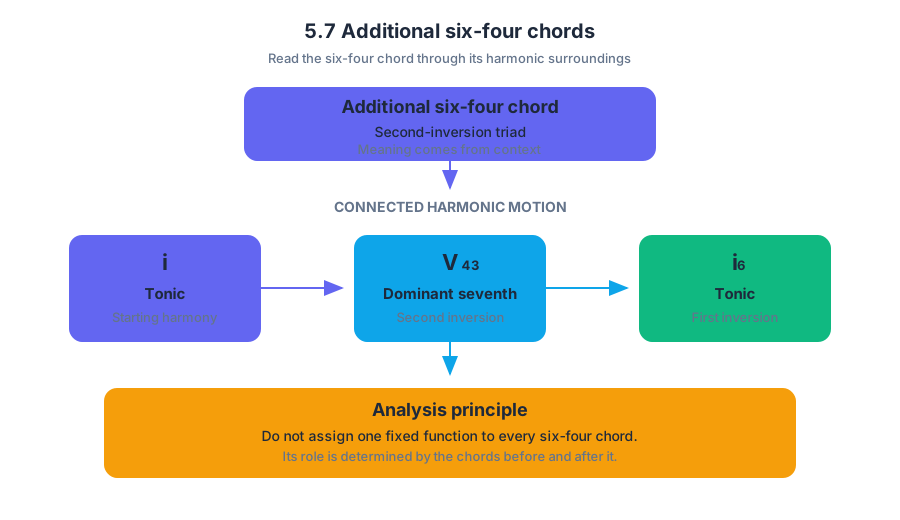
6.1 Passing tones and neighbor tones
Key concepts: Embellishing tones · Nonharmonic tones · Passing tones · Accented passing tones · Unaccented passing tones · Neighbor tones · Upper neighbor tones · Lower neighbor tones · Identifying passing and neighbor tones · Writing passing and neighbor tones
A melody can become expressive without changing its underlying harmony: a note may briefly step away from a chord tone, create motion, and return or continue smoothly.
6.1 Passing tones and neighbor tones
A melody can become expressive without changing its underlying harmony: a note may briefly step away from a chord tone, create motion, and return or continue smoothly. These temporary notes are nonharmonic tones, also called embellishing tones, because they decorate an essential melodic or bass framework rather than functioning as stable members of the chord.
Essential Knowledge — PIT-2.M.3: Common classifications of nonharmonic tones include passing tones, both accented and unaccented, and neighbor tones, including lower and upper neighbor tones.
The two motion patterns
The most useful first question is: Does the embellishing note connect two different chord tones, or does it leave one chord tone and return to it?
| Type | Motion pattern | Musical effect |
|---|---|---|
| Passing tone | Stepwise motion in the same direction between two different chord tones | Fills in a gap |
| Upper neighbor tone | Step up, then step back to the original pitch | Decorates from above |
| Lower neighbor tone | Step down, then step back to the original pitch | Decorates from below |
A passing tone connects two chord tones by stepwise motion in the same direction. In a C-major context, the line C–D–E contains D as a passing tone if C and E belong to the surrounding harmony while D does not. The melody moves through D toward a new goal.
A neighbor tone moves away from a chord tone by step and then returns to that same chord tone. In the pattern E–F–E, F is an upper neighbor tone. In E–D–E, D is a lower neighbor tone. The middle note temporarily ornaments a single pitch rather than connecting two different structural pitches.
Worked identification example
Suppose a bass line over a sustained harmony contains the following patterns:
$$ \text{C–D–E} \qquad \text{G–F–G} \qquad \text{E–F–G} $$
Analyze each middle note by tracing its approach and departure:
- In C–D–E, D is approached by step from C and leaves by step toward E. Because the line continues in the same direction toward a different chord tone, D is a passing tone.
- In G–F–G, F is approached by step and returns to G. Because the original pitch is restored, F is a lower neighbor tone.
- In E–F–G, F is again a passing tone, provided E and G are the surrounding chord tones.
The decisive evidence is not simply whether a note is dissonant. Follow the melodic contour: same direction toward a new pitch indicates passing; away and back to the starting pitch indicates neighbor.
Accented and unaccented passing tones
Passing tones may be accented or unaccented. An unaccented passing tone occurs on a metrically weaker position, such as an offbeat or the second part of a beat. An accented passing tone occurs on a metrically stronger position, often receiving emphasis through its placement, duration, or attack.
Consider a quarter-note framework in which the essential tones are C and E. If D appears as a shorter note between them on a weak subdivision, it is an unaccented passing tone. If D receives the stronger beat before the line continues to E, it remains a passing tone by its melodic motion, but it is now an accented passing tone.
Important distinction: “Accented” does not mean “harmonic,” and “unaccented” does not mean “unimportant.” These labels describe rhythmic or metric position, not whether the note belongs to the chord.
Chorale-style application
In an 18th-century chorale-style bass line, the essential framework may consist of quarter notes outlining the harmony. When the task specifically permits nonharmonic tones, that framework can be enlivened by carefully placed eighth-note motion, especially unaccented passing tones and unaccented neighbor tones.
For example, a bass might move from C to E while using the eighth-note pattern C–D–E, or it might decorate G with G–F–G. Such motion can create a desirable relationship with the soprano: two bass eighth notes may complement a stationary soprano quarter note, the voices may move in parallel thirds or sixths, or they may exchange registral material.
Common misconception — “Any chromatic or dissonant note is a passing tone.” A passing tone is identified by its specific approach-and-resolution pattern: step in, step out, and continue in the same direction between two different structural tones. A note that returns to its starting pitch is a neighbor tone; other patterns belong to other nonharmonic-tone classifications.
Listening and score-reading connection
The same analysis works in a written score, a sung melody, or a pop recording. A pop vocal line may briefly rise from a stable chord tone and return as an upper neighbor, or move stepwise through an intervening pitch as a passing tone. Listen for the underlying sustained or repeated pitch framework, then label the decorative motion rather than judging the note in isolation.
AP skills: This topic most directly engages Skill 1: Analyze performed music, Skill 2: Analyze notated music, and Skill 3: Convert between performed and notated music. On an exam-style task, you may need to hear or see the line, determine the approach and resolution, and identify the embellishing tone accurately.
Retrieval check
Classify the middle note in each pattern:
- C–D–E
- A–B–A
- E–D–C
Answers: D is a passing tone; B is an upper neighbor tone; D is a passing tone. Then ask one final question: if the middle note in C–D–E falls on a strong beat, what changes? Its classification remains passing tone, but its metric label changes from unaccented to accented.
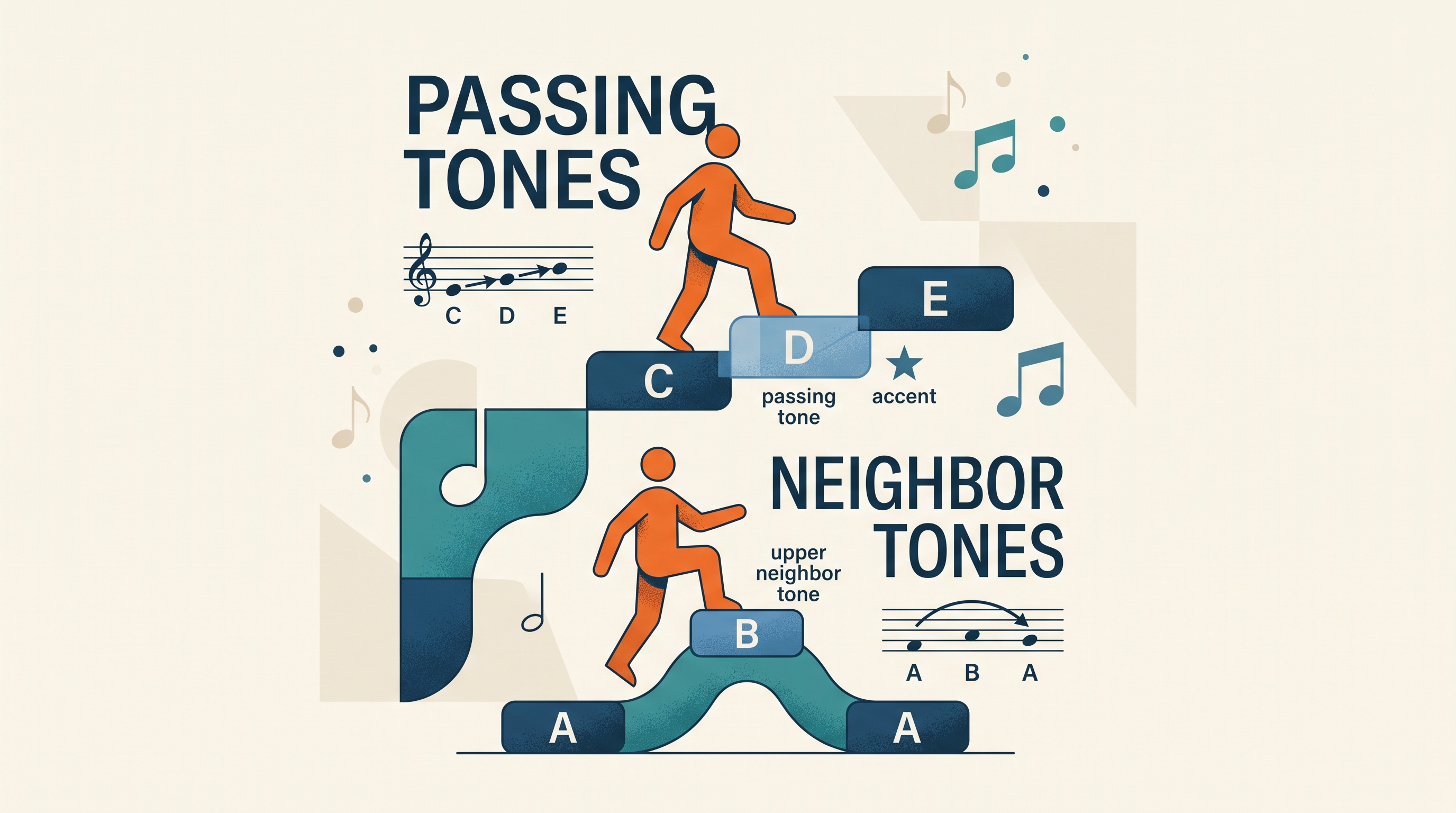
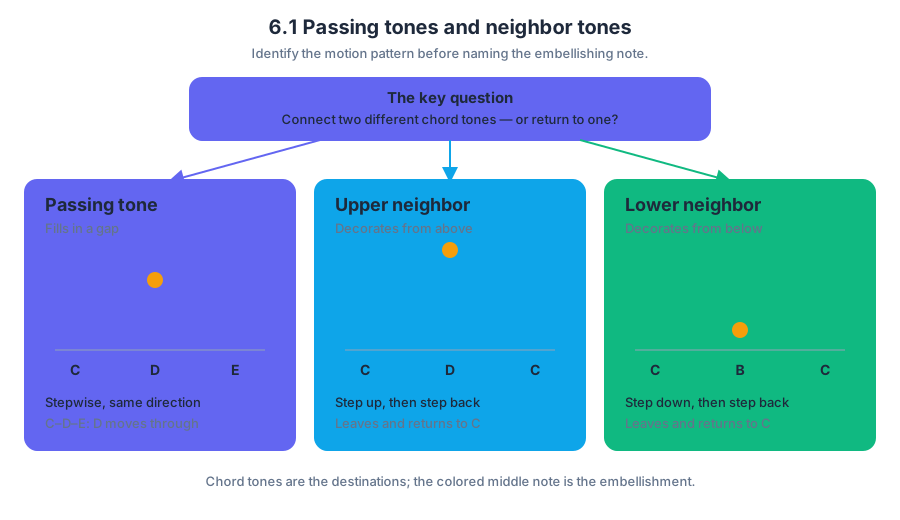
6.2 Writing passing and neighbor tones
Key concepts: Writing unaccented passing tones · Writing unaccented neighbor tones · Stepwise melodic motion · Harmonic-context analysis of melodies · Part-writing passing 6/4 chords · Part-writing pedal (neighboring) 6/4 chords · Doubling the fifth in a passing 6/4 chord · Stationary bass in a pedal or neighboring 6/4 chord
A passing or neighbor tone earns its label not merely from its pitch, but from where it occurs in the meter, how it moves, and what harmony surrounds it.
6.2 Writing passing and neighbor tones
A passing or neighbor tone earns its label not merely from its pitch, but from where it occurs in the meter, how it moves, and what harmony surrounds it. In prescribed writing exercises, both types should normally be unaccented, meaning they occur on a weak beat or weak part of a beat.
Write the melody before naming the tone
Use the surrounding chord tones as the stable points of the melody. A passing tone fills the step between two different chord tones; a neighbor tone leaves a chord tone and returns to that same tone. The writing pattern is therefore:
$$ \text{passing: } X \rightarrow Y \rightarrow Z $$
where $Y$ lies between $X$ and $Z$ by step, while
$$ \text{neighbor: } X \rightarrow Y \rightarrow X $$
returns to the starting pitch.
For example, in a melody whose stable notes are $C$ and $E$, the sequence $C-D-E$ may use $D$ as an unaccented passing tone. If the melody instead moves $E-F-E$, the $F$ is an unaccented upper neighbor. The distinction becomes reliable only after the rhythm and harmony are inspected together.
A writing checklist
- Locate the likely chord tones before and after the embellishing tone.
- Check whether the middle tone moves by step.
- Check the meter: the passing or neighbor tone should be unaccented.
- Decide whether the tone connects two different pitches or returns to its point of departure.
- Test the result against the implied harmonic progression.
Worked example: harmonic-context analysis
Suppose a soprano line in $C$ major moves as follows:
$$ \text{beat 1: } C \qquad \text{weak part of beat 2: } D \qquad \text{beat 3: } E $$
If the surrounding harmony supports $C$ before the motion and $E$ afterward, then $D$ is a passing tone: it connects $C$ and $E$ by step and is placed weakly. If the line instead reads
$$ E ;-; F ;-; E, $$
with $E$ supported before and after the motion, $F$ is a neighbor tone.
The same pitch can receive a different interpretation in another harmonic setting. A note that looks like a passing tone in isolation may be a chord member of the current harmony, or it may create an implausible chord succession. Always analyze the melody within its harmonic context rather than labeling notes from contour alone.
Diagnostic questions: Is the tone unaccented? Does it move by step? Does it connect two different chord tones or return to the same one? Does the implied harmony make musical sense?
Part-writing a passing ${}^{6}_{4}$ chord
A passing ${}^{6}{4}$ chord is a harmonic event created by stepwise motion in all four voices. The bass moves through the second-inversion chord while the upper voices also travel by step toward their next positions. Under PIT-4.F.1, the fifth of the ${}^{6}{4}$ chord should be doubled.
| Feature | Passing ${}^{6}_{4}$ requirement |
|---|---|
| Melodic motion | All voices move by step |
| Chord position | Second inversion |
| Doubling | Double the fifth of the ${}^{6}_{4}$ chord |
| Metric placement | Normally weak or unaccented |
| Function | Connects neighboring harmonic areas |
The doubling rule is not optional decoration. It helps the passing sonority arise naturally from the surrounding lines and prevents the chord from behaving like an isolated, incorrectly emphasized harmony.
Part-writing a pedal or neighboring ${}^{6}_{4}$ chord
A pedal, or neighboring, ${}^{6}_{4}$ chord is recognized by a different motion pattern: the bass remains stationary while upper voices move away from and return toward tones belonging to the root-position triad. Under PIT-4.F.2, the third and fifth of that root-position triad are embellished by their respective upper neighbor tones.
Imagine a sustained bass supporting a root-position triad. One upper voice rises by step and returns, while another upper voice performs the same kind of neighboring motion. The temporary upper-voice sonority forms the neighboring ${}^{6}_{4}$; because the bass does not move, it is pedal rather than passing.
| Chord type | Bass | Upper voices | Main motion |
|---|---|---|---|
| Passing ${}^{6}_{4}$ | Moves by step | Move by step | All voices move |
| Pedal or neighboring ${}^{6}_{4}$ | Remains stationary | Embellish by upper neighbors | Upper voices move around a fixed bass |
Metric and harmonic control
PIT-4.F.4 requires the six-four chord to fit both its tonal and rhythmic setting. Passing and neighboring ${}^{6}{4}$ chords normally occur on weak beats, whereas a cadential ${}^{6}{4}$ belongs on a strong beat. A plausible bass line must also avoid poor successions such as $V-IV$, $V-ii$, $ii-iii$, $IV-iii$, $ii-I$, $V-vi^{6}$, and $iii-vii^\circ$.
Misconception check: “Any stepwise note is automatically passing.” Not necessarily. A passing tone must connect two different tones by step, be unaccented in these exercises, and work with the implied harmony. A stationary bass also does not prove that every upper motion is a neighbor tone; the upper voices must embellish the third and fifth of the root-position triad as specified by PIT-4.F.2.
Retrieval check: In one sentence each, explain why the middle note in $C-D-E$ can be passing, why the middle note in $E-F-E$ can be a neighbor, what must be doubled in a passing ${}^{6}{4}$ chord, and what must remain stationary in a pedal ${}^{6}{4}$ chord.
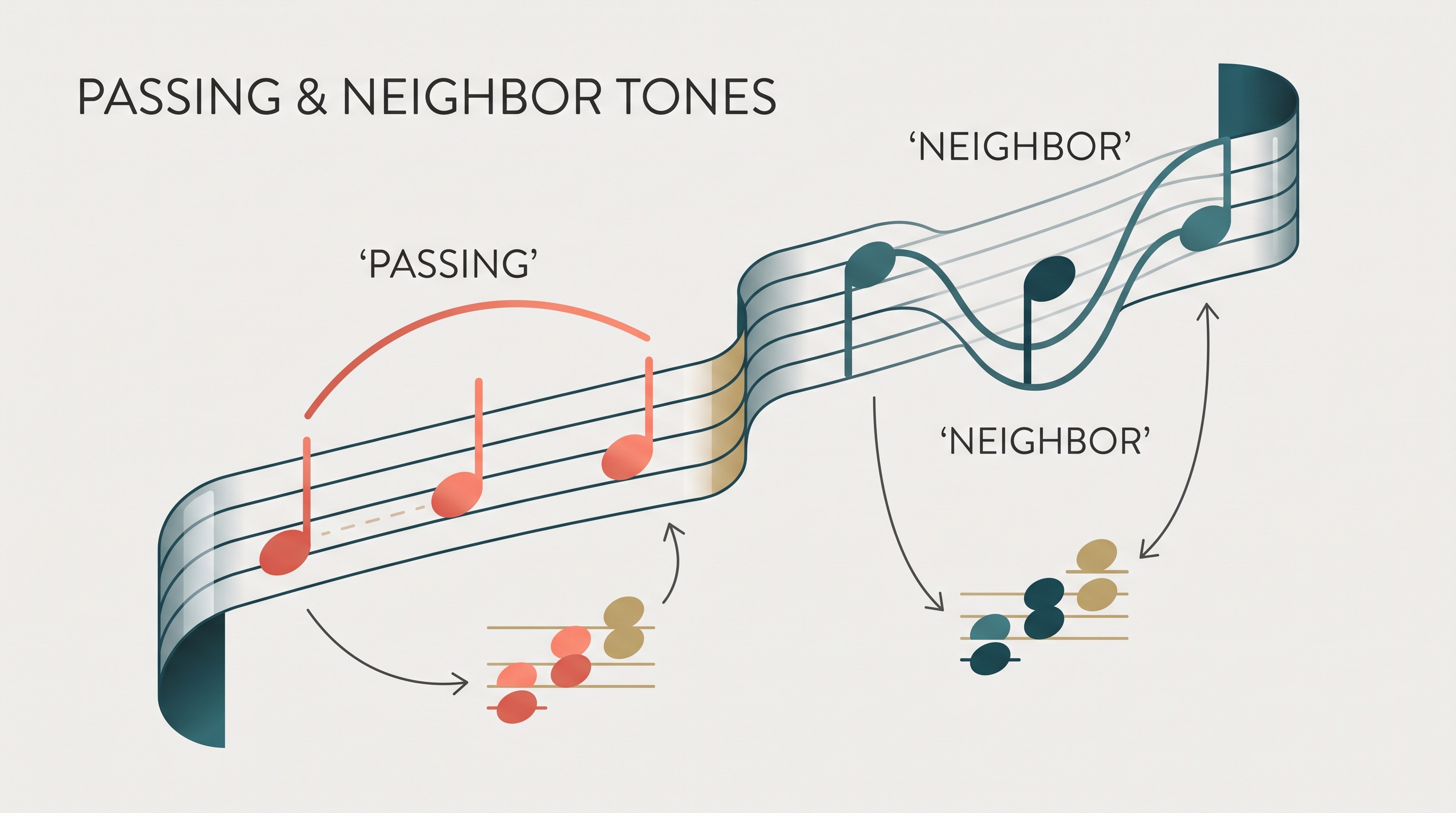
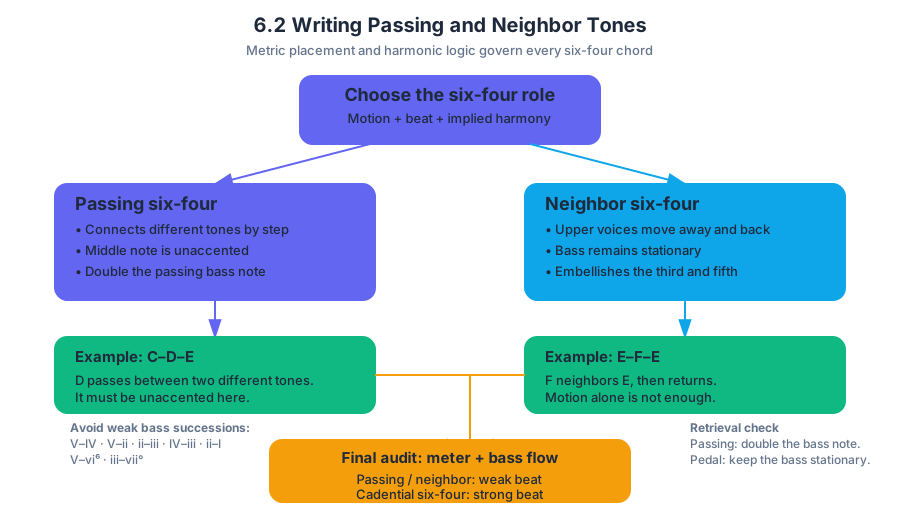
6.3 Other embellishing tones
Key concepts: Embellishing tones · Upper-neighbor tones · Passing tones · Identifying embellishing tones in a musical score · Marking the score with color coding
An embellishing tone is easiest to recognize when you stop asking only, “What chord is sounding?” and ask instead, “How does this note behave between the surrounding stable notes?” In a score, the answer is often visible as a small melodic detour: a note leaves a stable pitch and returns, or it fills the space…
6.3 Other embellishing tones
An embellishing tone is easiest to recognize when you stop asking only, “What chord is sounding?” and ask instead, “How does this note behave between the surrounding stable notes?” In a score, the answer is often visible as a small melodic detour: a note leaves a stable pitch and returns, or it fills the space between two stable pitches.
PIT-2.M: Identify types of embellishing tones, including nonharmonic tones, in performed and notated music.
For this topic, treat the previously learned patterns as a compact working reference rather than a new writing exercise. An upper neighbor leaves a stable note by step upward and returns to that same note; a passing tone moves by step in one direction between two stable notes.
| Melodic pattern | Motion | Return pattern | Quick visual clue |
|---|---|---|---|
| Upper neighbor | Stable note–step up–step down | Returns to the starting pitch | A “peak” above one pitch |
| Passing tone | Step–step in the same direction | Connects two different stable pitches | A “bridge” between endpoints |
The distinction is not determined by whether the embellishing tone is above or below its neighbors. It depends on the pattern of motion: a lower neighbor makes the same return shape below the starting note, while a descending passing tone fills the space between two different pitches.
Hear the pattern, then verify it in the notation
Listen to the opening phrases of Mozart’s Piano Sonata in C major, K. 545, while following the score. Do not circle every note that sounds dissonant or every note that moves quickly. First locate the notes that seem structurally stable—often notes belonging to the prevailing chord—then inspect the notes between them.
A reliable score-reading sequence is:
- Trace the melodic line. Follow one voice at a time, especially the soprano or the most prominent upper line.
- Mark candidate notes. Look for stepwise motion that either returns to its starting pitch or continues toward a different pitch.
- Check the surrounding harmony. Ask whether the candidate belongs to the chord sounding at that moment. If it does not, it may be a nonharmonic embellishing tone.
- Classify the motion. A return to the original pitch suggests a neighbor; continued stepwise motion toward another pitch suggests a passing tone.
- Confirm by listening. The ear should hear either a brief departure and return or a smooth connection between two anchors.
Use two consistent colors while marking the score: circle upper neighbors in one color, such as blue, and circle passing tones in a different color, such as red. The colors are not the analysis; they are an external memory aid that makes the melodic pattern visible across several measures.
Worked score-marking example
Imagine a soprano line with the pitch sequence
$$ G ;-; A ;-; G ;-; F ;-; E $$
The $A$ is an upper neighbor because it rises by step from $G$ and returns to $G$. Circle $A$ in blue. The $F$ is a passing tone because it continues downward by step from $G$ toward $E$; circle $F$ in red.
Now compare
$$ E ;-; F ;-; G $$
Here $F$ is not a neighbor, even though it is stepwise and may be dissonant against the harmony. It connects two different boundary pitches, $E$ and $G$, so its melodic role is passing. This is the central identification test: does the line return, or does it continue?
Melodic pattern versus harmonic function
A note’s classification requires both its melodic surroundings and its harmonic context. A stepwise note can resemble a passing tone melodically, but if the phrase contains a change of harmony, the note may instead be a chord tone in the new harmony. Do not classify a note from its pitch interval alone.
For example, in the line
$$ C ;-; D ;-; E $$
$D$ may be a passing tone if the same harmony spans all three notes and $D$ does not belong to that chord. But if the harmony changes so that $D$ becomes a chord member, the note is no longer nonharmonic merely because the melody moves by step.
Misconception check: “Every dissonant-sounding step is a passing tone.”
Correction: First determine the melodic pattern, then test the note against the harmony. A passing tone connects two different stable notes by step while functioning as a nonharmonic tone within the prevailing harmony.
The broader classification under PIT-2.M.4 also includes anticipation, escape tone, appoggiatura, and pedal point. The color-coding exercise concentrates on upper neighbors and passing tones because their similar stepwise surfaces make them especially easy to confuse in real scores.
Retrieval check
A melody contains $B$ between $A$ and $C$, all in one sustained harmony. Which color should mark $B$, and why? A later phrase contains $D$ between $C$ and $D$ with a return to $C$—classify that note using the same two-part test: motion pattern first, harmonic context second.
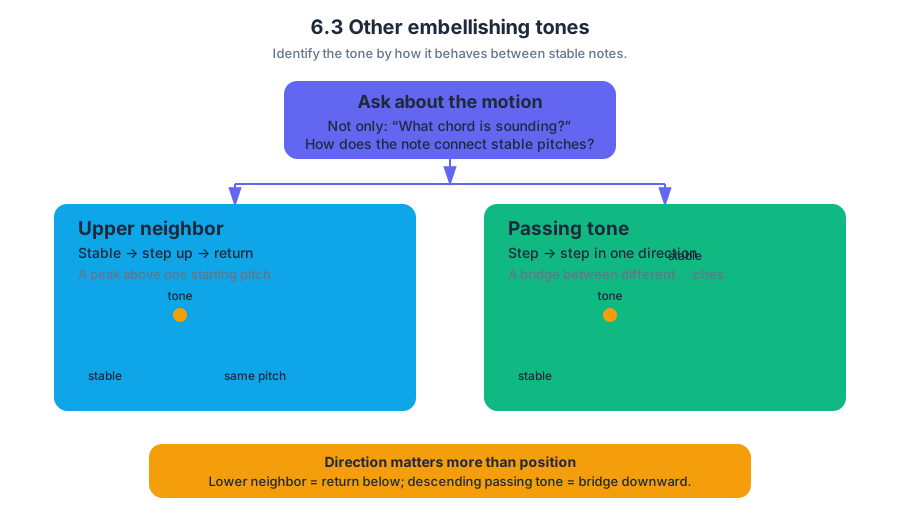
6.4 Suspensions
Key concepts: Suspensions
A suspension is a nonharmonic tone that is prepared as a consonance, held while the harmony changes, becomes dissonant against the new harmony, and then resolves by step—normally downward—to a consonant chord tone.
6.4 Suspensions
A suspension is a nonharmonic tone that is prepared as a consonance, held while the harmony changes, becomes dissonant against the new harmony, and then resolves by step—normally downward—to a consonant chord tone. Its expressive power comes from a tiny delay: the voice arrives at the “wrong” note for a moment before yielding to the note the harmony expects.
Preparation → Suspension → Resolution
consonant note → same note over new harmony, now dissonant → stepwise motion to a consonant note
The three stages
Consider a soprano moving through a cadence in C major. The soprano begins on C while the harmony is tonic, changes to dominant while the soprano remains on C, and finally moves down to B.
| Stage | Bass and harmony | Soprano | Interval above bass | Function |
|---|---|---|---|---|
| Preparation | Bass C, I: C–E–G | C | Unison with bass, or octave depending on register | Consonant chord tone |
| Suspension | Bass G, V: G–B–D | C | Perfect fourth | Dissonant suspended tone |
| Resolution | Bass G, V: G–B–D | B | Major third | Consonant chord tone |
The soprano C is consonant during the preparation because it belongs to the tonic triad, C–E–G. When the bass changes to G and the harmony becomes V, the soprano remains C. C is not part of the dominant triad G–B–D, and the interval between soprano C and bass G is a fourth, which functions as a dissonance in this contrapuntal context. The C then resolves downward by step to B, a chord tone of V, producing the familiar 4–3 suspension.
Suspension patterns
Suspensions are often identified by the interval above the bass during the dissonant stage and the interval formed after resolution. Common patterns include:
| Pattern | Dissonant interval | Resolution interval | Typical motion |
|---|---|---|---|
| 4–3 | Fourth | Third | Upper voice moves down by step |
| 7–6 | Seventh | Sixth | Upper voice moves down by step |
| 9–8 | Ninth | Octave | Upper voice moves down by step |
| 2–3 | Second | Third | Lower voice moves down by step |
The numbers describe intervals above the bass, not scale-degree numbers and not chord labels. In a 7–6 suspension, for example, the suspended voice forms a seventh above the bass and then descends to form a sixth. In a 2–3 suspension, the dissonance is usually created by a lower voice that moves downward while the upper voice remains stable.
Direction and special classifications
The standard suspension resolves downward by step. An upward-resolving suspension, also called a retardation, holds the same prepared-and-suspended pattern but resolves upward by step instead. The crucial distinction is not simply the direction of motion: the tone must still be prepared as a consonance, become dissonant when the harmony changes, and resolve into a consonant chord tone.
A rearticulated suspension repeats or reattacks the suspended pitch at the moment the harmony changes rather than sustaining it continuously. The pitch still functions as a suspension if its preparation, dissonance, and stepwise resolution are clear. A chain suspension occurs when the resolution of one suspension becomes the preparation for another, allowing a descending line such as $4$–$3$, followed by another delayed dissonance, to unfold across several harmonies.
Worked analysis
Suppose the bass sounds the following harmonic roots:
$$ \text{I} \longrightarrow \text{V} \longrightarrow \text{I} $$
The soprano sounds:
$$ C \longrightarrow C \longrightarrow B \longrightarrow C $$
Analyze the first three soprano notes rather than labeling the repeated C automatically. Over I, C is a consonant chord member and therefore supplies the preparation. Over V, the harmony changes to G–B–D, but C is retained; C is now a fourth above the bass G and is dissonant. The motion C down to B is stepwise and resolves the suspension. The later B-to-C motion belongs to the return to tonic and is not part of the suspension itself.
What exam readers commonly catch
Misconception: “Any repeated note over changing chords is a suspension.” Repetition alone is insufficient. The retained note must be consonant before the harmony changes and dissonant afterward.
Misconception: “A fourth is always consonant.” In common-practice contrapuntal analysis, a fourth above the bass is treated as dissonant when it functions against the bass, as in the C-over-G example.
Misconception: “Every stepwise resolution is a suspension.” A suspension requires the complete three-stage pattern: preparation, suspension, and resolution. A passing motion or neighbor motion may be stepwise but does not necessarily involve a prepared tone held across a harmonic change.
CED skills and identifiers
Topic 6.4: Suspensions is assessed primarily through the Big Idea DES (Musical Design) and the official skill categories Skill 1: Analyze performed music, Skill 2: Analyze notated music, Skill 3: Convert between performed and notated music, and Skill 4: Complete based on cues. In analysis, identify the three stages and classify the interval pattern; in aural work, hear the delayed resolution; in notation, label or write the suspension accurately; and in completion tasks, preserve the preparation, dissonance, and resolution.
Retrieval check: In C major, a soprano C is consonant over tonic I. The bass then changes to G for V while the soprano remains C, and the soprano resolves to B. What is the suspension pattern, and why? The answer is 4–3: C is prepared as a consonance over I, becomes a fourth above G and dissonant over V, then descends by step to B, a consonant chord tone of V.
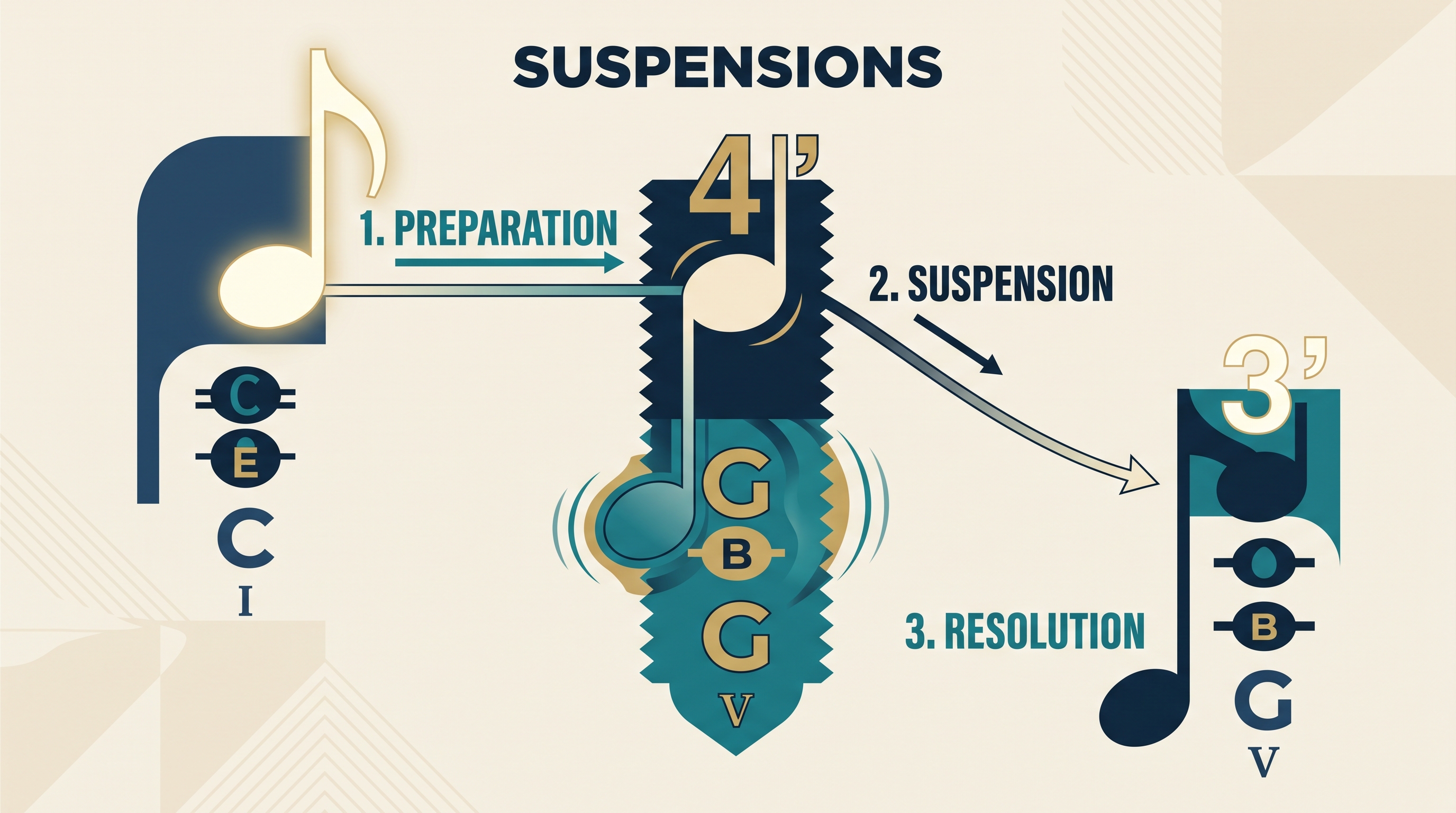
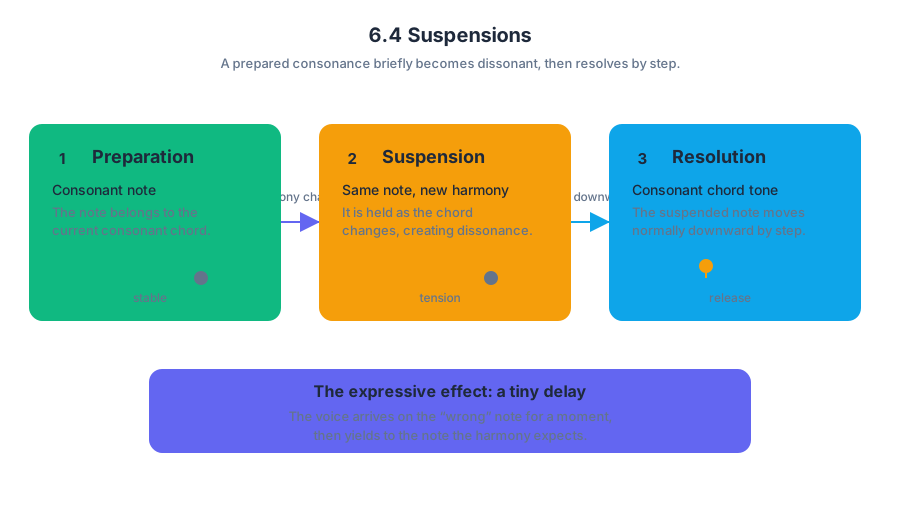
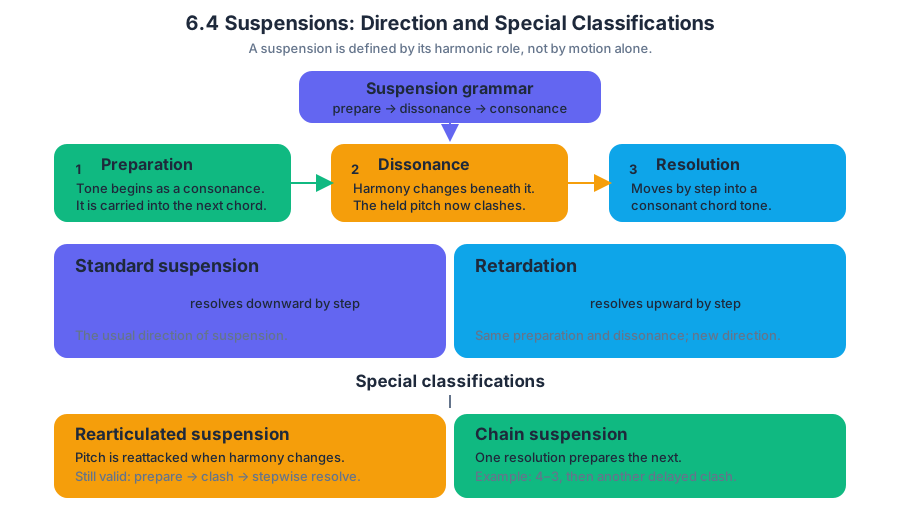
7.1 Tonicization through secondary dominant chords
Key concepts: Tonicization · Secondary dominant (applied dominant) chords · Roman-numeral slash notation · Temporary tonicization of non-tonic major or minor triads · V/V (the dominant of the dominant) · V/ii and V/IV · Resolution of secondary dominants · Chromatic accidentals in secondary dominants · Dominant seventh (major-minor seventh) chords · Identifying tonicization in performed and notated music
A tonicization makes a chord other than the home-key tonic sound temporarily like a tonic, usually by placing that chord after its own dominant. The effect is a brief musical spotlight: the overall key remains stable, but one local chord suddenly feels like “home.”
7.1 Tonicization through secondary dominant chords
A tonicization makes a chord other than the home-key tonic sound temporarily like a tonic, usually by placing that chord after its own dominant. The effect is a brief musical spotlight: the overall key remains stable, but one local chord suddenly feels like “home.”
Learning Objective PIT-2.Q: Identify and describe tonicization in performed music and notated music.
Essential Knowledge PIT-2.Q.1: Tonicization is a fleeting local event in which a scale degree or chord other than the primary tonic is made to sound like a temporary tonic. It does not necessarily change the composition’s overall key.
The dominant-of-the-target mechanism
The most common way to create tonicization is with a secondary dominant, also called an applied dominant. A secondary dominant is the dominant chord of a major or minor triad other than the actual tonic.
Key idea: Find the chord being temporarily emphasized. Then imagine its own dominant arriving immediately before it.
In C major, the ordinary dominant is $\text{V}$, a G-major triad. The dominant of G is D major, so the progression
$$ \text{V}/\text{V} \rightarrow \text{V} $$
is spelled
$$ \text{D–F}\sharp\text{–A} \rightarrow \text{G–B–D}. $$
The D-major chord is labeled $\text{V}/\text{V}$, pronounced “five of five.” The first numeral identifies the function of the applied chord; the chord after the slash identifies the temporarily tonicized target:
- $\text{V}/\text{V}$ = the dominant of the dominant
- $\text{V}/\text{ii}$ = the dominant of the supertonic
- $\text{V}/\text{IV}$ = the dominant of the subdominant
The slash does not mean a fraction or an inversion. It describes a relationship between two chords. In $\text{V}/\text{ii}$, read from right to left: first identify $\text{ii}$ as the target, then construct its dominant.
Worked examples in C major
To construct $\text{V}/\text{ii}$ in C major, begin with the target: $\text{ii}$ is D minor, spelled D–F–A. Its dominant is A major, spelled A–C$\sharp$–E. Therefore,
$$ \text{V}/\text{ii} = \text{A–C}\sharp\text{–E} \rightarrow \text{D–F–A}. $$
The C$\sharp$ is not in the key signature of C major. That accidental is expected: the applied dominant borrows the leading tone of the temporarily tonicized chord. The arrival on D minor creates a brief sense that D is the local tonal center, even though the composition may continue in C major.
Similarly, $\text{V}/\text{IV}$ targets F major. The dominant of F is C major:
$$ \text{V}/\text{IV} = \text{C–E–G} \rightarrow \text{F–A–C}. $$
This example may require no new accidental in C major because C major is already the dominant of F. By contrast, $\text{V}/\text{V}$ requires F$\sharp$, and $\text{V}/\text{ii}$ requires C$\sharp$. Secondary dominants nearly always require accidentals, but the exact spelling depends on the target chord and the home key.
Triads, seventh chords, and inversions
A secondary dominant may appear as a triad or as a dominant seventh chord, also called a major-minor seventh ($\text{Mm7}$). In C major, the applied dominant of G can therefore be either
$$ \text{D–F}\sharp\text{–A} $$
or
$$ \text{D–F}\sharp\text{–A–C}. $$
It may also occur in any inversion appropriate to the harmonic context. The inversion changes the bass and the figured-bass description, but it does not change the secondary-function label: an inverted D-major chord still functions as $\text{V}/\text{V}$ if it resolves to G major.
How to identify tonicization by ear and by score
For notated music, look for three clues: a target triad that is not the home tonic, an applied dominant immediately before it, and an accidental that creates the target’s leading tone. Then label the applied chord with slash notation.
For performed music, listen for a short dominant-to-tonic-like gesture that does not establish a permanent new key. A sharpened note may sound like a sudden upward pull, followed by a chord that briefly feels settled. The strongest confirmation is the resolution: $\text{V}/\text{V}$ should resolve to $\text{V}$, $\text{V}/\text{ii}$ to $\text{ii}$, and $\text{V}/\text{IV}$ to $\text{IV}$.
Misconception check — “Every accidental means modulation.” An accidental can support tonicization without changing the overall key. Modulation requires a more sustained change of tonal center; tonicization is a temporary local emphasis.
Retrieval check: In G major, which chord is $\text{V}/\text{V}$, and what note must be altered to spell it? Answer: the target is D major, whose dominant is A major, A–C$\sharp$–E; C$\sharp$ is the accidental that creates the applied dominant.
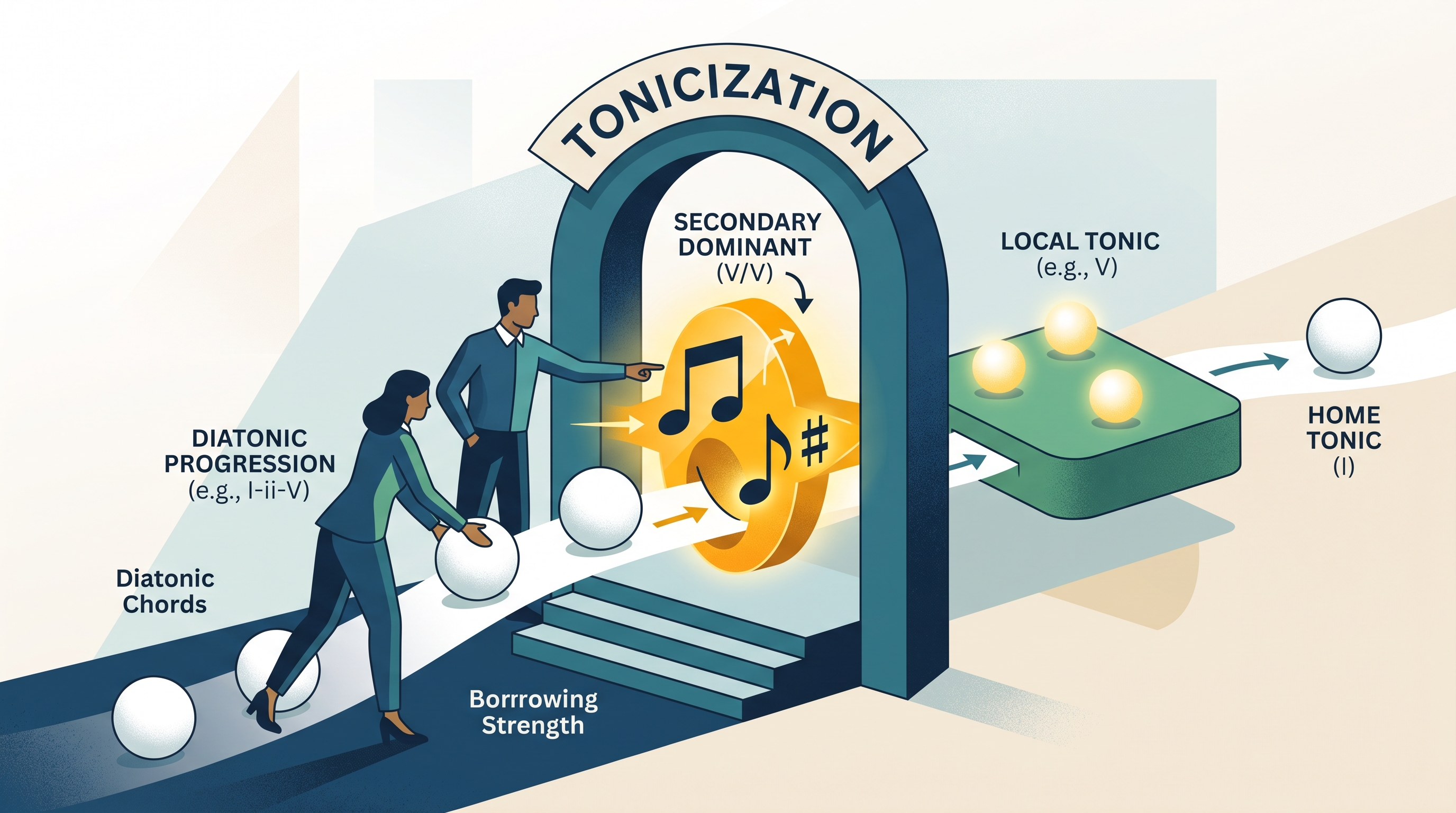
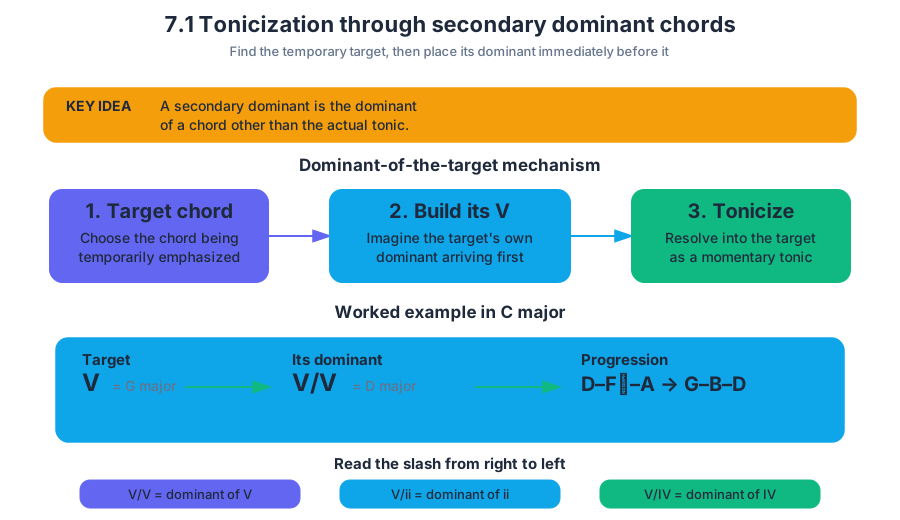
7.2 Part writing of secondary dominant chords
Key concepts: Tonicization · Secondary dominant chords · Secondary leading-tone chords · Part writing · Voice leading · Accidentals and chromatic pitches · Harmonic function and key relationships · Chord inversions and seventh chords · Normative harmonic procedures of 18th-century music · Analysis and composition of secondary-function chords
Apply the dominant-chord voice-leading rules from 7.1 to secondary dominants: preserve normal doubling, spacing, and resolution practices while accounting for their chromatic pitches. The challenge is not to invent a new set of rules, but to hear the temporary target, spell the applied chord correctly, and connect…
7.2 Part Writing of Secondary Dominant Chords
Apply the dominant-chord voice-leading rules from 7.1 to secondary dominants: preserve normal doubling, spacing, and resolution practices while accounting for their chromatic pitches. The challenge is not to invent a new set of rules, but to hear the temporary target, spell the applied chord correctly, and connect each voice smoothly.
PIT-2.E: Compose a bass line added to a given soprano line, following the normative harmonic procedures of 18th-century music.
The part-writing principle
A secondary dominant uses the voice-leading behavior of an ordinary dominant chord—but toward a temporary target. In the key of C major, $V/V$ is the dominant of $V$: the chord $D$ major, spelled $D-F\sharp-A$, moves toward $G$ major. The $F\sharp$ is chromatic in C major, but it functions as the leading tone of the temporary key of G.
Secondary-function chords may be triads or seventh chords, and they may appear in root position or inversion. Their Roman-numeral labels identify both the chord quality and its target:
- $V/V$: a major dominant triad tonicizing $V$.
- $V^7/V$: a dominant seventh chord tonicizing $V$.
- $V/ii$: a dominant chord tonicizing $ii$.
- $V/vi$: a dominant chord tonicizing $vi$.
The slash means “of,” not division: $V/V$ means “the dominant of the dominant.”
Worked example: writing $V^7/V$ in four parts
Suppose a passage in C major moves from $V/V$ to $V$. The secondary dominant is $D^7$, whose pitches are $D-F\sharp-A-C$. A workable four-part voicing is:
| Voice | $V^7/V$ | Resolution to $V$ | Function |
|---|---|---|---|
| Bass | $D$ | $G$ | Root of applied chord moves to target root |
| Tenor | $A$ | $B$ | Chord tone moves by step |
| Alto | $C$ | $B$ | Chordal seventh resolves downward |
| Soprano | $F\sharp$ | $G$ | Temporary leading tone resolves upward |
The crucial resolutions are $F\sharp \rightarrow G$ and $C \rightarrow B$. The first is the leading tone of the temporary target, while the second is the chordal seventh of $D^7$ and therefore follows the normal dominant-seventh rule: it resolves downward by step. The resulting $G$-major chord contains the target harmony, not a new permanent key.
PIT-2.E.2: When part-writing secondary dominants, all doubling and voice-leading considerations of normal dominant chords should be maintained, including the downward resolution of chordal sevenths.
Doubling, spacing, and inversion
For a secondary-dominant triad, treat the chord as you would a normal dominant triad. In most situations, double the root rather than the temporary leading tone. Avoid doubling a chromatic leading-tone pitch because that pitch has a strong tendency toward the temporary tonic and can create parallel or awkward resolutions.
For a secondary dominant seventh chord, include all four chord members when possible. Keep the voices within conventional SATB ranges, avoid voice crossing, and resolve the chordal seventh downward by step. In an inversion, identify the chord members—not merely the bass note—before deciding which pitch is the seventh or temporary leading tone.
Misconception check: “Because $V/V$ is chromatic, it follows different voice-leading rules.”
Correction: Its spelling changes because of the chromatic pitch, but its dominant behavior does not. Apply the same doubling, spacing, tendency-tone, and seventh-resolution principles used for $V$.
Reading chromatic clues in a melody
When a soprano melody is given and a bass line must be composed, a chromatic pitch can imply an applied harmony. In C major, the pattern $F\sharp \rightarrow G$ is especially informative: raised scale degree $\sharp\hat{4}$ resolves to $\hat{5}$, suggesting that $G$—the dominant of C—is being briefly tonicized by $V/V$.
The reasoning chain is:
$$ \sharp\hat{4}=F\sharp \longrightarrow \hat{5}=G $$
$$ F\sharp \text{ is the leading tone of } G \Longrightarrow D-F\sharp-A \text{ or } D-F\sharp-A-C \Longrightarrow V/V \text{ or } V^7/V $$
This is not automatic: a chromatic note may have another melodic or harmonic explanation. Confirm the interpretation by checking the surrounding bass, the following chord, and whether the chromatic pitch behaves like a tendency tone.
Boundary: secondary leading-tone chords
The related secondary leading-tone chord, such as $vii^\circ/V$, also tonicizes a temporary target but is diminished rather than dominant. For example, in C major, $vii^\circ/V$ is $F\sharp-A-C$, whose root is the leading tone of G. Its specific part-writing treatment follows separately; here, the essential distinction is functional: $V/V$ is a dominant-quality chord, while $vii^\circ/V$ is a diminished leading-tone chord.
AP skill connection and retrieval check
Skill 4.A: “Apply knowledge of common-practice tonality to spell chords and to follow procedures of 18th-century voice leading to connect chords in harmonic progressions.” This appears when you spell $V^7/V$, resolve $F\sharp$ to $G$, and send the chordal seventh $C$ downward.
Skill 4.D: “Compose a bass line to harmonize a given melody, implying appropriate harmony, and identify the implied harmony using Roman and Arabic numerals.” This appears when a melodic $\sharp\hat{4}$–$\hat{5}$ pattern leads you to test $V/V$ as the supporting harmony.
Retrieval check: In E-flat major, a soprano line contains $D\flat \rightarrow E\flat$ while the harmony moves toward $A\flat$. Which secondary dominant is suggested? Spell the chord and name the two tendency tones in its seventh-chord form.
Answer: The suggested chord is $V/V$, because $A\flat$ is $V$ in E-flat major. Its dominant is $E\flat$ major, so $V/V$ is $E\flat-G-B\flat$; the seventh-chord form is $E\flat-G-B\flat-D\flat$. The $D\flat$ resolves downward to $C$, while $G$ resolves upward to $A\flat$.
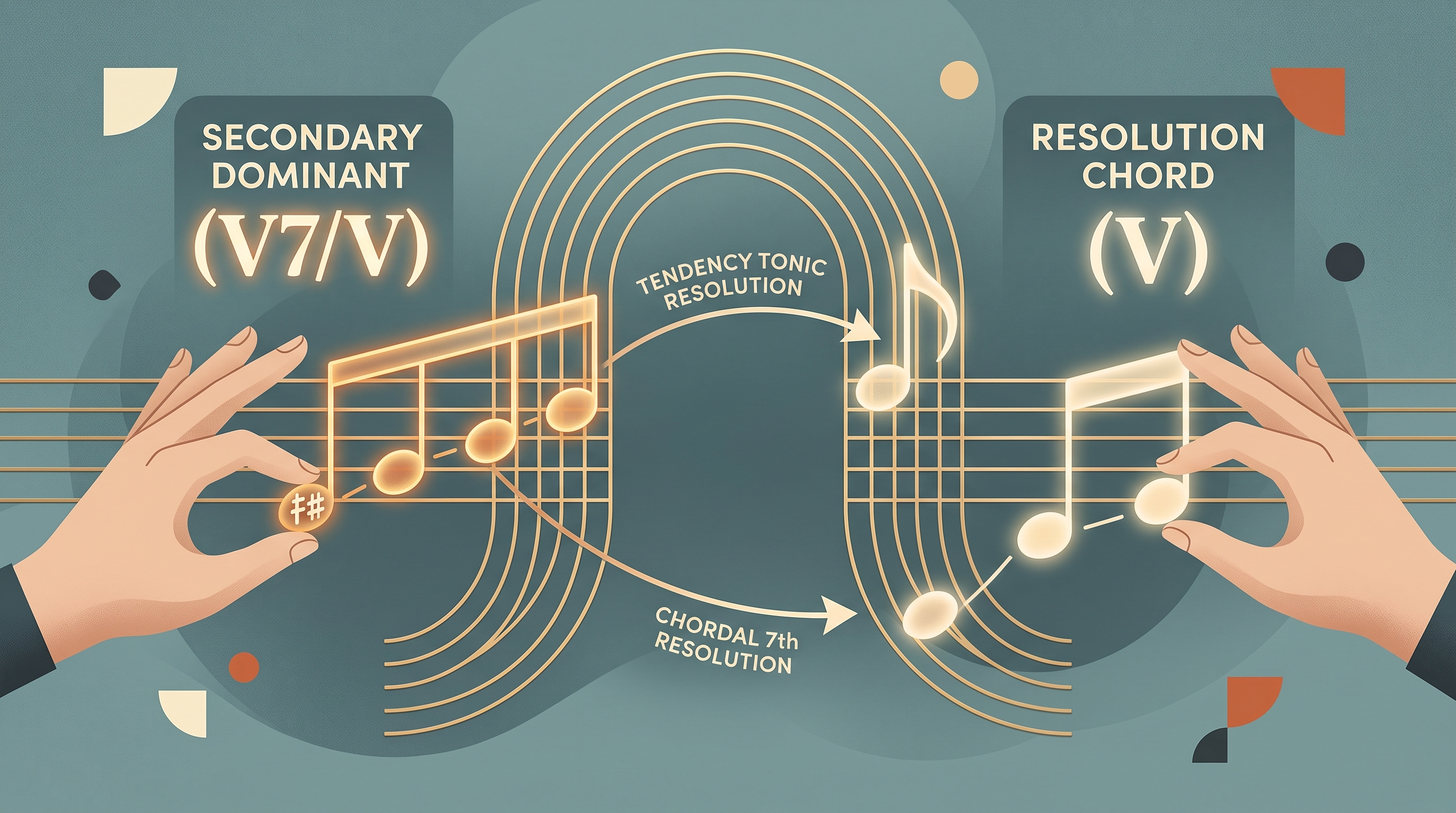
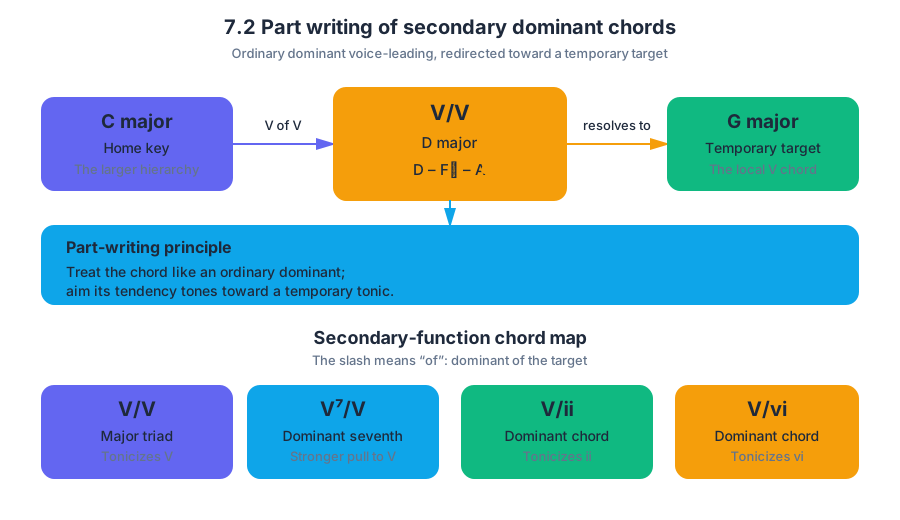
7.3 Tonicization through secondary leading-tone chords
Key concepts: Tonicization as a temporary local emphasis of a chord other than the primary tonic · Secondary dominant (applied dominant) chords · Secondary leading-tone chords, also called applied leading-tone or applied diminished seventh chords · Chromatic alteration and accidentals used to tonicize a target chord · Roman-numeral and Arabic-numeral analysis of applied chords · Inversion and notation of secondary leading-tone triads and seventh chords · Resolution of chromatically altered tones · Common-practice voice leading in secondary-function harmony
A chord can briefly behave like a destination without becoming the permanent home key: tonicization is the local emphasis of a diatonic chord other than the primary tonic, making that chord sound like a temporary tonic.
7.3 Tonicization through Secondary Leading-Tone Chords
A chord can briefly behave like a destination without becoming the permanent home key: tonicization is the local emphasis of a diatonic chord other than the primary tonic, making that chord sound like a temporary tonic. The primary key remains unchanged, but chromatically altered pitches usually signal the temporary harmonic spotlight.
PIT-2.Q.2: Tonicization is a fleeting local event, not a modulation.
Like the secondary dominants analyzed in 7.2, secondary leading-tone chords tonicize a non-tonic chord. They differ in the chord used to approach the target: a secondary dominant uses the target’s dominant, while a secondary leading-tone chord uses the target’s leading-tone diminished triad or diminished-seventh chord.
The target-and-approach model
To analyze an applied chord, identify two things:
- Target: the non-tonic diatonic chord being temporarily emphasized.
- Approach chord: the diminished chord built on the leading tone of that target.
For example, in C major, the target $V$ chord is G major. Its temporary leading tone is $\sharp\hat{4}$, or F-sharp, because F-sharp lies a half step below G. Building a diminished seventh chord above F-sharp produces F-sharp–A–C–E, which resolves naturally to G:
$$ \mathrm{vii}^{\circ 7}/V \longrightarrow V $$
The slash means “of.” Thus, $\mathrm{vii}^{\circ 7}/V$ means “the diminished-seventh chord built on the leading tone of V,” not “the ordinary vii chord in the main key.” In C major, the spelling is:
$$ \mathrm{F\sharp-A-C-E} \longrightarrow \mathrm{G-B-D} $$
The F-sharp rises to G, while the other chord members resolve according to the surrounding harmonic context.
Building and identifying applied leading-tone chords
PIT-2.Q.3 defines secondary leading-tone chords as diminished triads or diminished seventh chords—fully diminished or half diminished—whose root is the leading tone of the chord being tonicized. They may tonicize any accurately notated diatonic major or minor triad other than the primary tonic.
Consider the target $ii$ in C major: D minor. Its leading tone is C-sharp, so the applied diminished-seventh chord is:
$$ \mathrm{vii}^{\circ 7}/ii
\mathrm{C\sharp-E-G-B\flat} \longrightarrow \mathrm{D-F-A} $$
The accidental is not optional decoration. C-sharp is required because it is the leading tone of D, the temporary target. A spelling such as D-sharp–F-sharp–A–C would point toward E, not D, and therefore describes a different harmonic function.
The diminished-triad version normally appears only in first inversion. In C major, the applied leading-tone triad of V is F-sharp–A–C, but its standard notation is:
$$ \mathrm{vii}^{\circ 6}/V $$
The Arabic $6$ indicates first inversion: A, the chord’s third, appears in the bass. Applied diminished-seventh chords may appear in any inversion appropriate to the harmonic context, using figures such as $7$, $6/5$, $4/3$, or $4/2$.
A half-diminished secondary leading-tone chord has an important restriction: it is used only when the target is a major triad. Therefore, a half-diminished applied leading-tone chord can tonicize $V$ or $IV$ in a major key, but it does not normally tonicize a minor target such as $ii$.
Roman-numeral analysis in context
When a passage contains a chromatic pitch, do not immediately rename the entire key. First ask whether the altered pitch creates a leading tone aimed at a nearby non-tonic chord. A sequence such as
$$ \mathrm{I - vii}^{\circ 7}/V - V - I $$
remains in C major: the applied chord intensifies G major locally, and the final C-major chord confirms the primary tonic.
Misconception check — “Every chromatic diminished chord is vii° of the main key.” Not so. The slash notation identifies the temporary target. In C major, F-sharp–A–C–E is not simply the diatonic vii°7 of C; it is $\mathrm{vii}^{\circ 7}/V$ because F-sharp leads to G.
Skill connection: this topic most directly uses Skill 1: Analyze performed music, Skill 2: Analyze notated music, and Skill 3: Convert between performed and notated music. In listening, hear the sudden emphasis of a non-tonic chord and its chromatic leading tone. In notation, identify the target, spell the applied chord, label its Roman numeral and Arabic figure, and account for the accidental. Skill 4: Complete based on cues applies when a required target or bass line determines the correct inversion and spelling.
Voice-leading guardrail
Analysis and notation are inseparable from eighteenth-century voice-leading conventions. Chromatically altered tones must resolve appropriately, voices should remain within practical ranges, and part writing should avoid forbidden parallels—especially parallel fifths. A correct Roman numeral attached to an incorrectly spelled or poorly connected chord is not a complete solution.
Retrieval check: In E-flat major, which applied leading-tone seventh chord tonicizes the diatonic $vi$ chord, C minor? Identify its root, spell the chord, and write its analysis. The target is C, so its leading tone is B natural; the chord is B–D–F–A-flat, analyzed as $\mathrm{vii}^{\circ 7}/vi$.
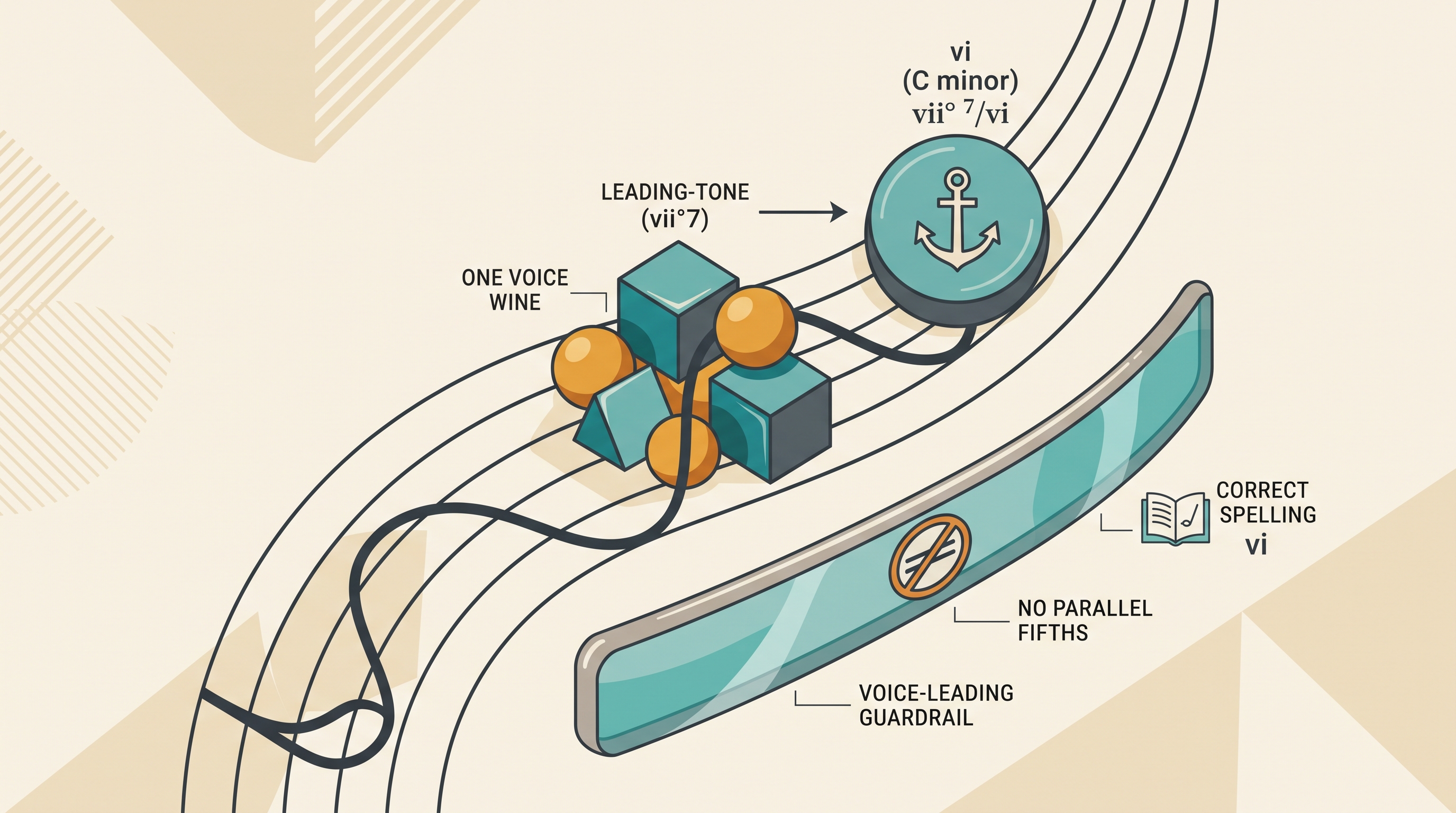
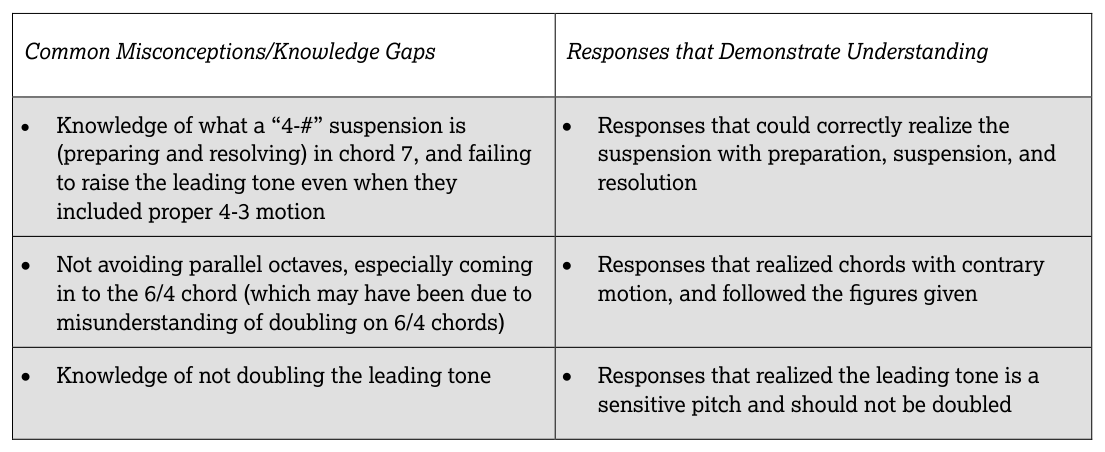
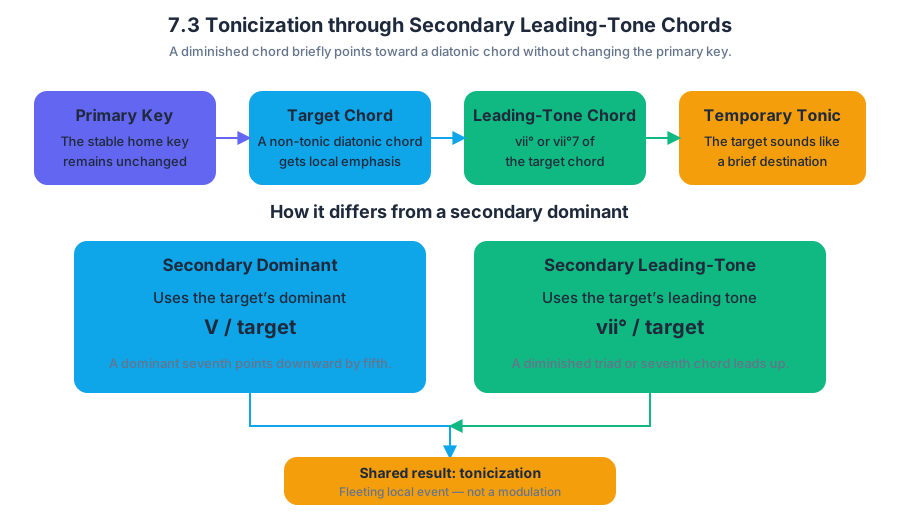
7.4 Part writing of secondary leading-tone chords
Key concepts: Part writing of secondary leading-tone chords · Secondary functions in harmony · Spelling secondary leading-tone chords · 18th-century common-practice voice-leading procedures · Voice leading in up to four voices · Chordal seventh resolution · Score analysis of voice leading · Error detection in part writing · Harmonic dictation of secondary leading-tone chords · Converting between performed and notated music
A secondary leading-tone chord must be written as if it were a normal leading-tone chord aimed at a temporary target: its leading tone rises by step to the target chord’s root, while any chordal seventh falls by step.
7.4 Part writing of secondary leading-tone chords
A secondary leading-tone chord must be written as if it were a normal leading-tone chord aimed at a temporary target: its leading tone rises by step to the target chord’s root, while any chordal seventh falls by step. The essential question is not merely “What chord is this?” but “How can every voice move convincingly into the chord it tonicizes?”
PIT-4.A.14: When part-writing secondary leading-tone chords, all doubling and voice-leading considerations of normal leading-tone chords should be maintained, including the rule that chordal sevenths resolve down by step.
The spelling follows the target, not the home key
To spell a secondary leading-tone chord, first identify its target chord. Then build the leading-tone chord immediately below that target’s root, using the target key’s pitch collection. In C major, the target $V$ chord is G major. Its leading tone is $F\sharp$, so the conventional secondary leading-tone seventh chord is:
$$ \mathrm{viiø7/V} = F\sharp-A-C-E $$
This is half-diminished seventh: a diminished triad plus a minor seventh. The $F\sharp$ leads upward to G, and the chordal seventh E falls to D, a member of the G-major target chord.
A fully diminished alternative may appear in chromatic writing:
$$ F\sharp-A-C-E\flat $$
This is fully diminished seventh because the seventh above $F\sharp$ is diminished. It is not the mandatory spelling of $\mathrm{viiø7/V}$ in C major; it is a chromatic variant. In that version, $E\flat$ still resolves downward by step to D. The spelling changes, but the voice-leading principle does not.
The same procedure works in another key. In D major, the target $V$ is A major, whose leading tone is G-sharp. The conventional secondary leading-tone seventh chord is:
$$ \mathrm{viiø7/V} = G\sharp-B-D-F\sharp $$
Here $G\sharp\rightarrow A$ and $F\sharp\rightarrow E$. A fully diminished chromatic form, $G\sharp-B-D-F$, is possible, with $F\rightarrow E$, but it should be labeled accurately rather than treated as the default spelling.
Worked four-voice realization
Suppose a progression in C major moves from $I$ to $\mathrm{viiø7/V}$ to $V$. A practical four-voice plan is:
| Voice | $I$ chord | $\mathrm{viiø7/V}$ | $V$ |
|---|---|---|---|
| Soprano | G | F-sharp | G |
| Alto | E | E | D |
| Tenor | C | C | B |
| Bass | C | A | G |
The middle chord is spelled $F\sharp-A-C-E$, although the bass has A. Its Roman-numeral identity is still $\mathrm{viiø7/V}$ because the chord’s function depends on its relation to G, not on the bass alone. The soprano’s $F\sharp\rightarrow G$ supplies normal leading-tone resolution; the alto’s E remains temporarily, then resolves down to D as the chordal seventh. The other voices move by small intervals into the dominant.
This example also illustrates a crucial writing decision: do not double a tendency tone merely to fill four voices. In a leading-tone chord, the leading tone and chordal seventh have directed resolutions, so doubling either can create parallel or unresolved tendencies. If a chord has fewer members than voices, double a stable, nontendency chord member when the voice leading permits it.
The four assessment lenses
PIT-4.A requires applying 18th-century voice-leading procedures through score analysis, error detection, writing exercises, and contextual listening. The same progression may therefore appear as notation to inspect, an error to diagnose, a partially completed texture to finish, or a performed fragment to identify and notate.
The topic draws on four named skills:
- Skill 1: Analyze Performed Music (1.E): Use harmonic, melodic, and rhythmic symbols and terms to describe 18th-century voice leading in performed music, including textures of up to four voices.
- Skill 2: Analyze Notated Music (2.C, 2.E): Use notation to describe relationships and evaluate voice-leading procedures in a score.
- Skill 3: Convert Between Performed and Notated Music (3.E): Compare heard and written pitch or rhythm and detect discrepancies in a one- or two-voice representation.
- Skill 4: Complete Based on Cues (4.A): Use common-practice tonality to spell chords and connect them through appropriate voice-leading procedures.
In harmonic dictation, a performed $F\sharp-A-C-E$ resolving to G-major may sound like a brief $vii°7-I$ motion in G, even though the larger piece remains in C major. Your notation must show the local function: $\mathrm{viiø7/V}\rightarrow V$, not a falsely tonicized change of global key.
Misconception check
Misconception: “Every secondary leading-tone seventh chord is fully diminished.” Not so. In a major-key context, the conventional chord is often half-diminished, such as $F\sharp-A-C-E$ for $\mathrm{viiø7/V}$ in C major. A fully diminished form such as $F\sharp-A-C-E\flat$ is a possible chromatic variant, not a spelling rule.
Misconception: “Because the chord is secondary, its seventh may resolve freely.” The opposite is true: secondary function does not suspend ordinary voice-leading practice. The chordal seventh resolves down by step, and the leading tone resolves up by step whenever the target chord permits.
Retrieval check
In C major, spell $\mathrm{viiø7/V}$ and state the two principal tendency-tone resolutions. Answer: $F\sharp-A-C-E$; $F\sharp\rightarrow G$ and $E\rightarrow D$. If the optional fully diminished form $F\sharp-A-C-E\flat$ is used, the seventh resolves $E\flat\rightarrow D$. Topic 7.3 emphasizes identifying such chords; Topic 7.4 emphasizes writing them correctly in context.
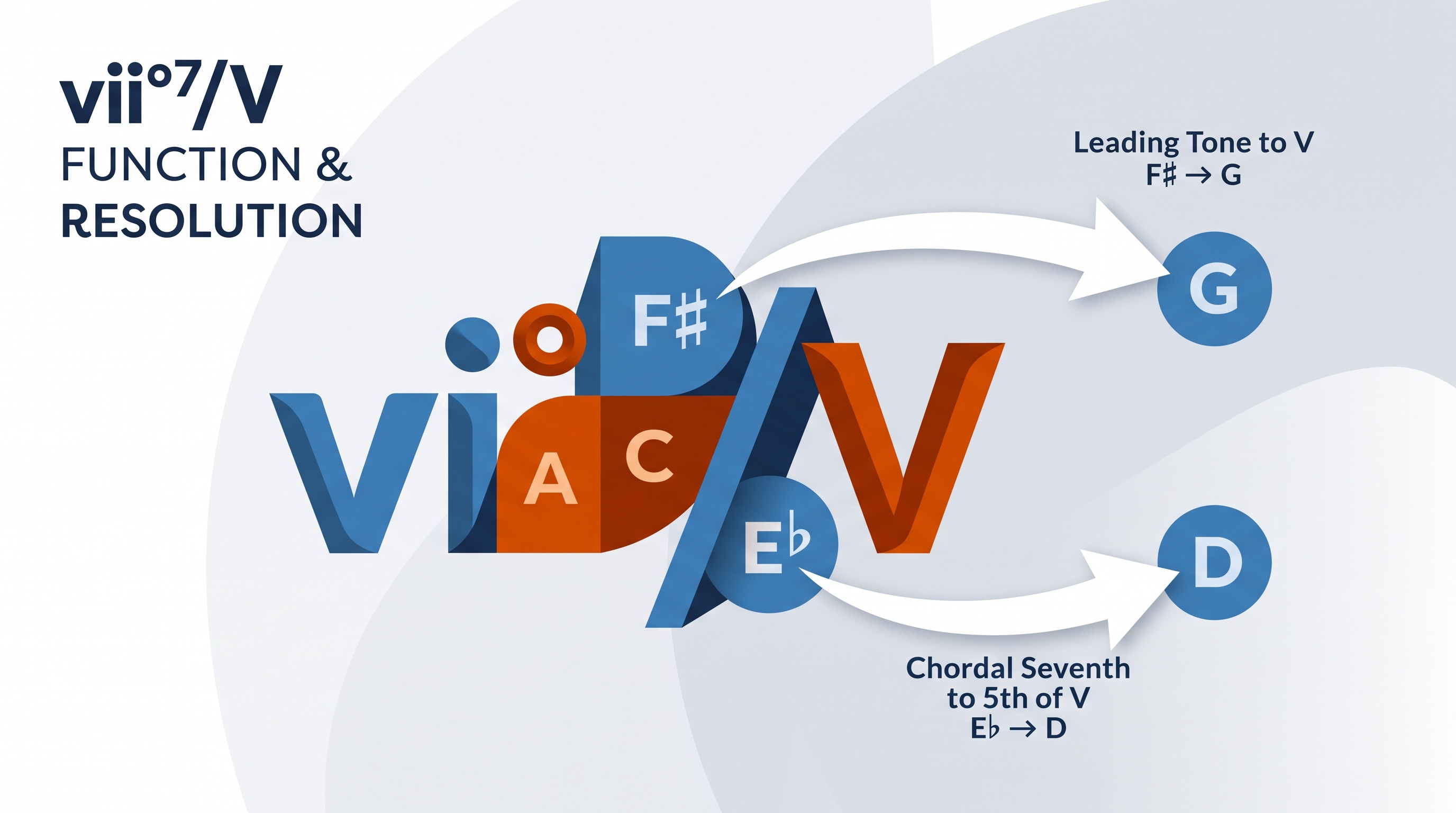
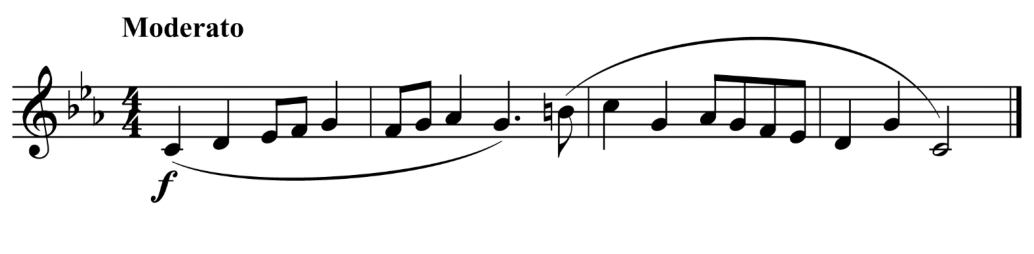
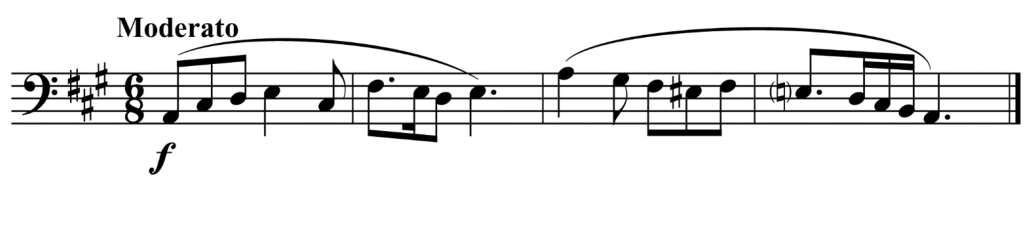
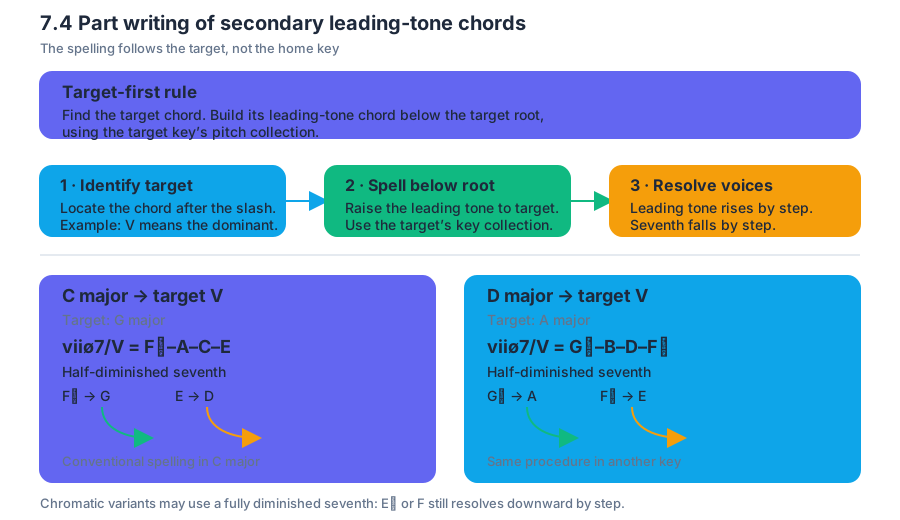
8.1 Modes
A mode is a seven-note pitch collection organized around a particular tonic, or tonal center. The same white-key collection can sound completely different depending on which note feels like “home”: C–D–E–F–G–A–B centered on C is Ionian, but the same pitches centered on D produce Dorian.
8.1 Modes
A mode is a seven-note pitch collection organized around a particular tonic, or tonal center. The same white-key collection can sound completely different depending on which note feels like “home”: C–D–E–F–G–A–B centered on C is Ionian, but the same pitches centered on D produce Dorian.
Modes matter because a melody’s identity depends on more than its individual notes. Changing the tonal center changes the pattern of whole steps and half steps around that center, which changes the location of characteristic scale degrees and therefore the melody’s color.
The seven diatonic modes
The seven common diatonic modes can be understood as rotations of the major scale. Each mode begins on a different scale degree of the same parent collection, but each must be heard and analyzed relative to its own tonic.
| Mode | Scale-degree pattern above its tonic | Characteristic relationship to major or minor |
|---|---|---|
| Ionian | $1\ 2\ 3\ 4\ 5\ 6\ 7$ | Major scale |
| Dorian | $1\ 2\ \flat 3\ 4\ 5\ 6\ \flat 7$ | Minor with raised $6$ |
| Phrygian | $1\ \flat 2\ \flat 3\ 4\ 5\ \flat 6\ \flat 7$ | Minor with lowered $2$ |
| Lydian | $1\ 2\ 3\ \sharp 4\ 5\ 6\ 7$ | Major with raised $4$ |
| Mixolydian | $1\ 2\ 3\ 4\ 5\ 6\ \flat 7$ | Major with lowered $7$ |
| Aeolian | $1\ 2\ \flat 3\ 4\ 5\ \flat 6\ \flat 7$ | Natural minor |
| Locrian | $1\ \flat 2\ \flat 3\ 4\ \flat 5\ \flat 6\ \flat 7$ | Minor with lowered $2$ and lowered $5$ |
A useful memory sequence is I–D–P–L–M–A–L: Ionian, Dorian, Phrygian, Lydian, Mixolydian, Aeolian, Locrian. The sequence follows the major scale’s degrees from $1$ through $7$.
Relative and parallel modes
Relative modes share the same pitch collection but have different tonics. C Ionian and D Dorian are relative: both use the notes C, D, E, F, G, A, and B. Parallel modes share the same tonic but use different pitch collections. C Ionian and C Dorian are parallel: both begin on C, but C Dorian contains $E\flat$ and $B\flat$ instead of E and B.
This distinction prevents a frequent analytical error: identifying a mode solely by its key signature. A key signature tells you the available pitch collection, not automatically which pitch functions as the tonic. To establish the mode, listen for or inspect the note that receives emphasis, begins or ends important phrases, and functions as the point of repose.
Worked example: identifying D Dorian
Suppose a melody uses only the notes D, E, F, G, A, B, and C. The key signature is therefore the same as C major, but the melody repeatedly returns to D, and D sounds like the point of rest.
- Treat D as scale degree $1$, not C.
- Spell the collection above D: D–E–F–G–A–B–C–D.
- Compare it with D natural minor: D–E–F–G–A–B-flat–C–D.
- The raised sixth degree, B natural, identifies D Dorian.
The crucial sound is the contrast between the minor third, F, and the raised sixth, B natural. Dorian often sounds minor without the darker quality created by the lowered sixth of natural minor.
Key insight: A mode is identified by the interaction between its tonic and its interval pattern, not by a key signature alone.
AP skills and reasoning processes
Modes are assessed through the official skill categories Analyze Performed Music, Analyze Notated Music, Convert Between Performed and Notated Music, and Complete Based on Cues. In practice, Analyze Performed Music asks you to hear a tonal center and recognize modal color; Analyze Notated Music asks you to determine the tonic and pitch collection from a score; Convert Between Performed and Notated Music connects a heard modal melody with its notation; and Complete Based on Cues may require continuing or supplying notes consistent with a given mode.
The topic is especially connected with PIT, the course big idea for Pitch, and with the skill of using symbols and terms to describe pitch patterns and relationships. Your evidence should be specific: identify the tonic, name the mode, and cite the note or scale-degree relationship that proves the identification.
Misconception check
Misconception: “A melody with no sharps or flats is in C major.”
Correction: Its notes may belong to the C-major collection, but its mode could be C Ionian, D Dorian, E Phrygian, F Lydian, G Mixolydian, A Aeolian, or B Locrian. The tonal center determines the mode.
Retrieval check
A melody uses the notes G, A, B, C, D, E, and F, but G is the clear tonal center. Identify the mode and its characteristic scale-degree alteration compared with G major.
Answer: G Mixolydian. It has a lowered seventh, F natural, instead of F-sharp.
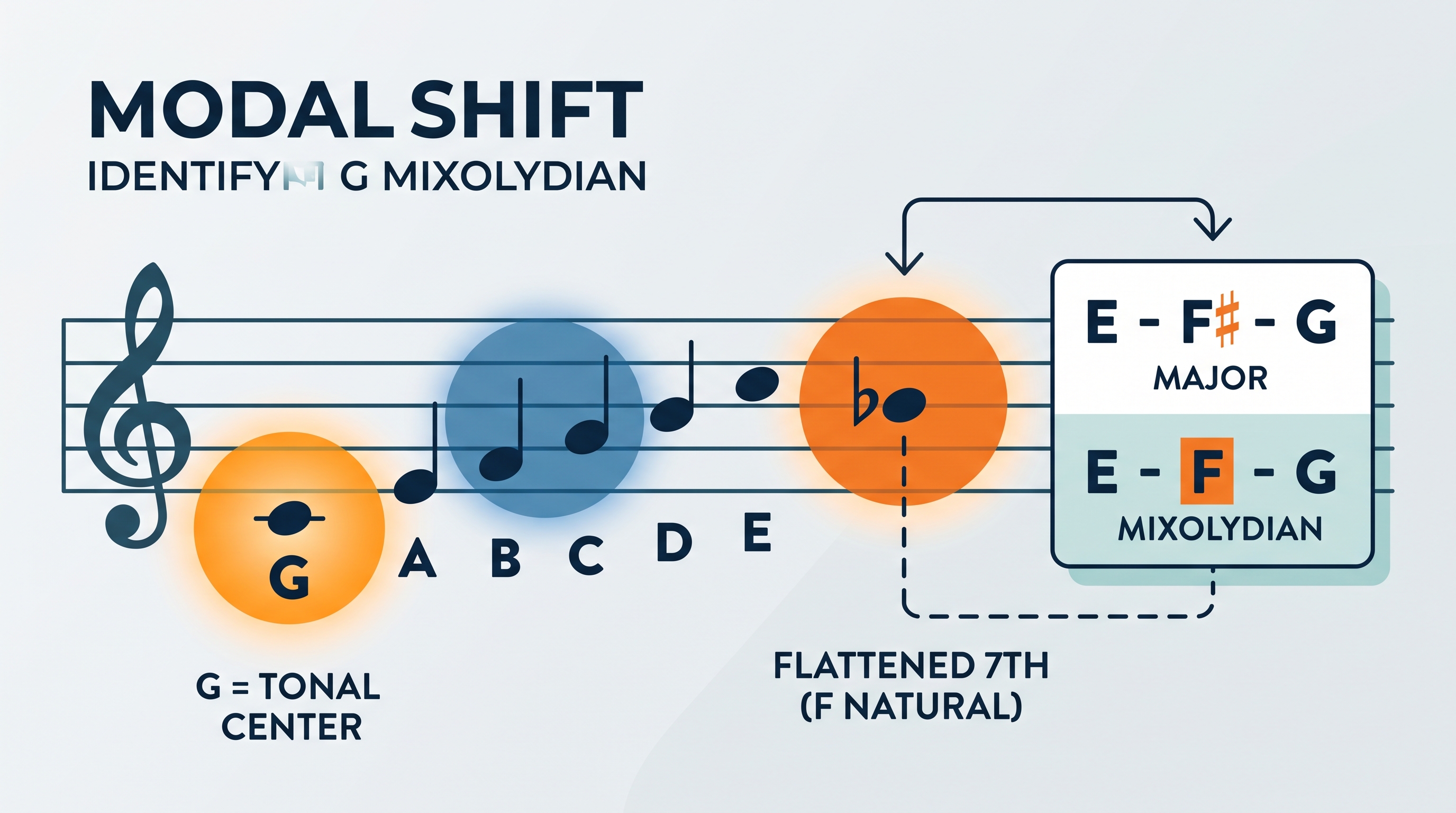
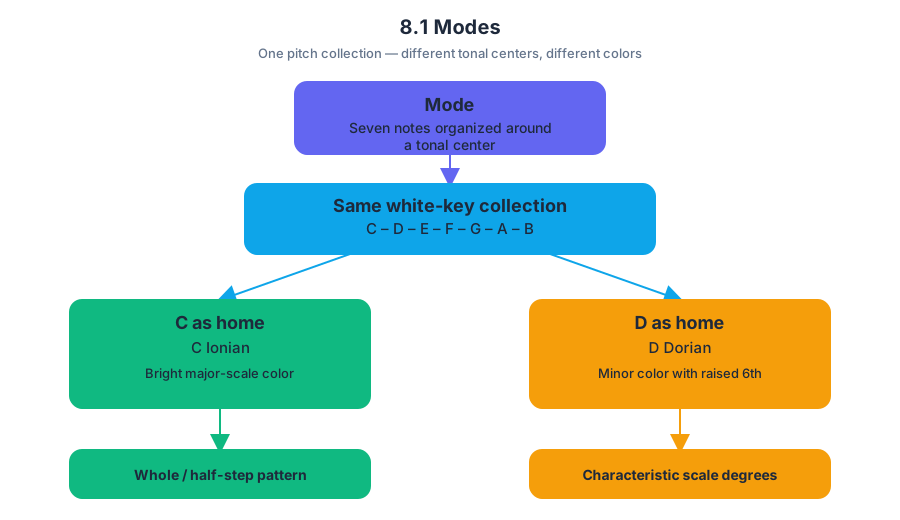
8.2 Phrase relationships
A phrase is a coherent musical idea that usually ends with a cadence, and a phrase relationship describes how one phrase answers, repeats, contrasts with, or develops another.
8.2 Phrase relationships
A phrase is a coherent musical idea that usually ends with a cadence, and a phrase relationship describes how one phrase answers, repeats, contrasts with, or develops another. Like a spoken exchange—“Are we leaving?” followed by “Yes, after dinner”—phrases gain meaning from what comes before and after them.
CED alignment: Topic 8.2 Phrase Relationships; AP Skills 1.F, Analyze Performed Music, and 2.F, Analyze Notated Music. The topic belongs to the Musical Design and Form ideas emphasized in Unit 8. In performance, you listen for phrase boundaries and relationships; in notation, you locate cadences, compare motives, and diagram the design.
Hearing the phrase as a musical sentence
A phrase often has a beginning, a continuation, and a point of temporary or final arrival. Its boundary may be marked by a cadence, a rest, a long note, a change of texture, or a change in melodic and rhythmic activity. No single clue is always decisive: a breath mark can help, but the harmony and melodic shape must also support the interpretation.
Two phrases may be related in several ways:
| Relationship | What changes? | Typical musical effect |
|---|---|---|
| Parallel | The phrases begin similarly but continue differently. | Recognition followed by variation |
| Contrasting | Their melodies, rhythms, or contours differ substantially. | Question-and-answer contrast |
| Antecedent–consequent | The first phrase sounds incomplete; the second answers it more conclusively. | Musical question followed by answer |
| Repeated | The musical idea returns with little or no change. | Emphasis, stability, or formal clarity |
The antecedent–consequent pair
An antecedent phrase is the opening “question” of a phrase pair. It commonly ends with a cadence that sounds unfinished, such as a half cadence, while the consequent phrase responds and more often ends with an authentic cadence. The relationship is functional rather than merely visual: the second phrase must sound like a response to the first.
Imagine a melody in $C$ major. Phrase $1$ begins with the motive $C-D-E$ and ends on the dominant harmony, $V$, producing a half cadence. Phrase $2$ begins again with $C-D-E$, but then changes direction, reaches the tonic harmony, $I$, and closes with an authentic cadence. Because the opening is shared but the endings differ, the pair is parallel antecedent–consequent.
The same opening does not automatically create an antecedent–consequent relationship. If both phrases end with equally conclusive cadences, the first may function as a repeated or parallel phrase rather than an antecedent. Always listen for the larger question-and-answer arc.
Parallel and contrasting phrases
A parallel phrase relationship is recognized by shared material at the beginning of two phrases. The later material may be transposed, rhythmically altered, or redirected toward a different cadence. For example, a phrase beginning with an ascending third followed by stepwise motion might return with the same contour but end on a different pitch and harmony.
A contrasting phrase relationship begins with substantially different musical material. Contrast can involve melodic contour, rhythmic density, register, articulation, or harmonic direction. A quiet, stepwise first phrase followed by a more active phrase with larger leaps is contrasting even if both phrases occupy the same number of measures.
Worked analysis: identifying the relationship
Suppose a notated melody contains two four-measure units:
- Phrase $1$: begins with $G-A-B$, repeats the opening rhythm, and ends on $D$ with dominant harmony.
- Phrase $2$: begins with $G-A-B$, changes the final two measures, and ends on $C$ with tonic harmony.
Reasoning:
- The two phrases share their opening motive, so they are parallel.
- Phrase $1$ ends on dominant harmony, so it behaves like an antecedent.
- Phrase $2$ ends on tonic harmony, so it behaves like a consequent.
- The complete description is therefore a parallel antecedent–consequent relationship.
Misconception check
Misconception: “A phrase is always four measures long.” Four measures is common, but phrase length depends on musical syntax, not a fixed measurement. A phrase may last two, four, eight, or an irregular number of measures if its melodic and harmonic motion creates a convincing unit.
Misconception: “A repeated rhythm means the phrases are identical.” Phrase identity depends on the whole musical idea. A phrase can repeat its rhythm while changing pitch contour, harmony, register, or cadence; those changes may create a parallel or contrasting relationship.
Skill application and retrieval check
For 1.F, Analyze Performed Music, listen for where a phrase seems to breathe, where its harmony pauses, and whether the next phrase confirms or challenges the first. For 2.F, Analyze Notated Music, mark phrase boundaries, label cadence types, compare opening motives, and describe the relationship using precise terms such as parallel, contrasting, antecedent, and consequent.
Retrieval check: Two phrases share their first two measures. The first ends with a half cadence, and the second ends with an authentic cadence. What phrase relationship is most precise? Answer: a parallel antecedent–consequent relationship. The shared opening makes it parallel; the incomplete-to-complete cadence pattern makes it antecedent–consequent.
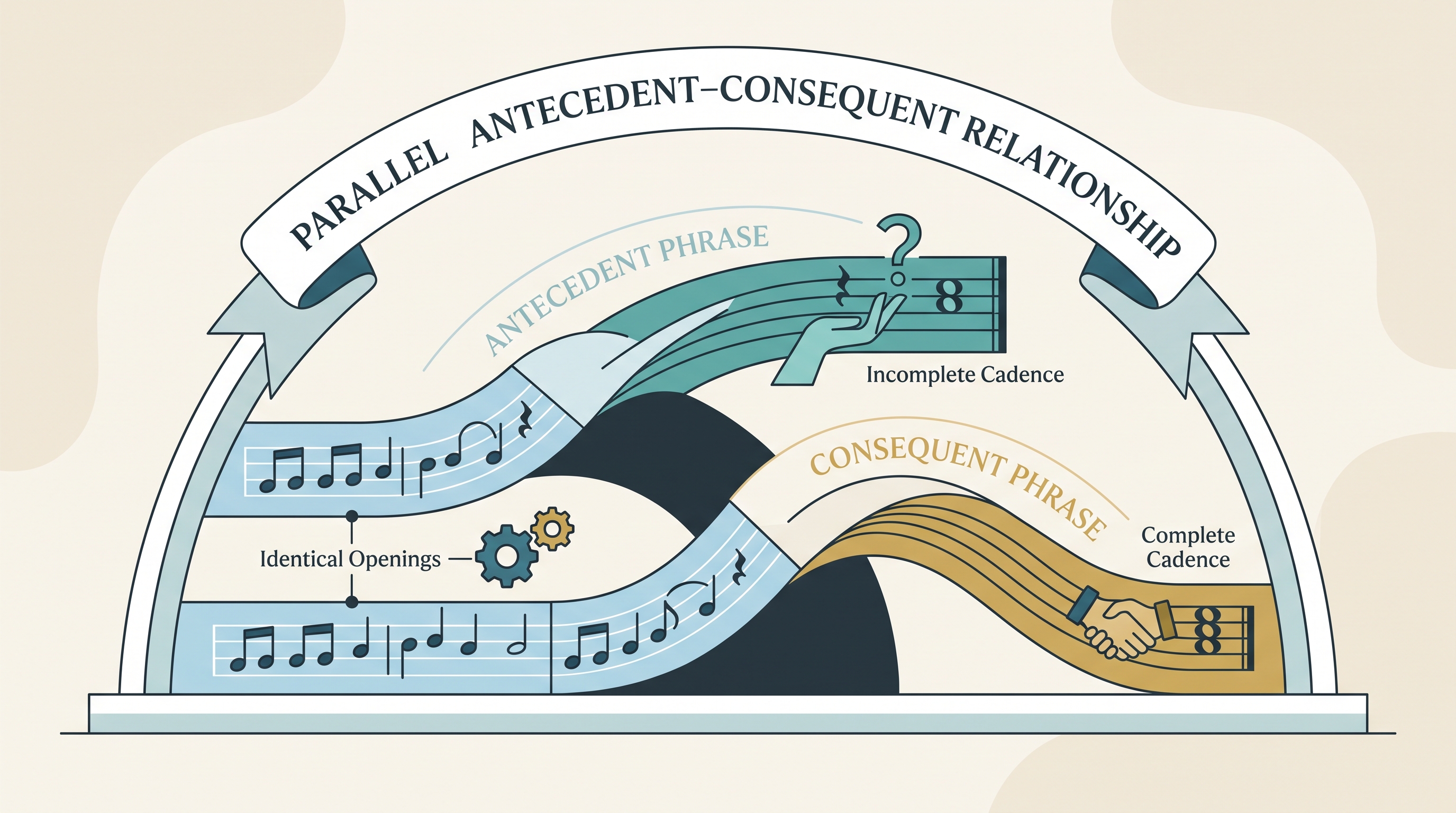
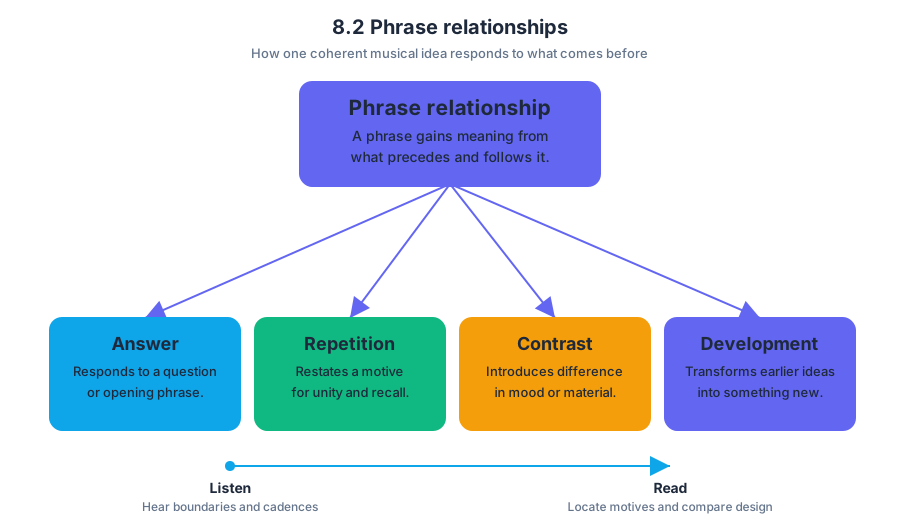
8.3 Common formal sections
Key concepts: Musical form · Hierarchy of constituent parts in composition · Relationships among musical parts · Contrast and development as formal processes · Formal types and functions · Established melodic-harmonic patterns · Phrase relationships · Modes · Common formal sections · Form as the structural aspect of music
Form is the structural organization of a musical composition: the way its parts are arranged, related, contrasted, and developed. Like language, music has hierarchy—small units combine into larger units, and those larger units create the composition’s recognizable shape.
8.3 Common Formal Sections
Form is the structural organization of a musical composition: the way its parts are arranged, related, contrasted, and developed. Like language, music has hierarchy—small units combine into larger units, and those larger units create the composition’s recognizable shape.
A listener may hear a return, a contrast, or a new section before knowing its name. A score analyst makes that intuition precise by tracking recurring melody, harmony, texture, rhythm, and cadence.
Formal hierarchy: music as structure
A composition can be understood as nested levels:
- Motives combine into phrases.
- Phrases combine into larger sections.
- Sections form a complete composition.
- Larger works may organize several complete movements or parts into an even broader structure.
The individual profile of a piece comes from the relationships among these parts. A section may be repeated, contrasted, or developed. Repetition creates stability and recognition; contrast creates variety; development transforms earlier material so that it produces motion or new meaning.
FOR-1: Form is a hierarchy of constituent parts whose relationships, contrasts, development, and established roles create the unique profile of a composition.
Formal types can be recognized in two complementary ways. Some depend on established melodic-harmonic patterns—for example, a return to opening material after a contrasting passage. Others depend on formal function, meaning the role a part performs in the larger structure: beginning, transition, continuation, climax, return, or closure.
Modes: identity through pitch organization
A mode is a scale pattern with a characteristic arrangement of whole steps, half steps, and altered scale degrees. Modes can give a passage a distinctive sound, and that sound can help distinguish one formal section from another.
Using a common tonic as a reference, the seven diatonic modes are:
| Mode | Scale-degree pattern above its tonic | Characteristic difference |
|---|---|---|
| Ionian | $1\ 2\ 3\ 4\ 5\ 6\ 7$ | Major-scale collection |
| Dorian | $1\ 2\ \flat3\ 4\ 5\ 6\ \flat7$ | Minor third with raised sixth |
| Phrygian | $1\ \flat2\ \flat3\ 4\ 5\ \flat6\ \flat7$ | Minor quality with lowered second |
| Lydian | $1\ 2\ 3\ \sharp4\ 5\ 6\ 7$ | Major quality with raised fourth |
| Mixolydian | $1\ 2\ 3\ 4\ 5\ 6\ \flat7$ | Major quality with lowered seventh |
| Aeolian | $1\ 2\ \flat3\ 4\ 5\ \flat6\ \flat7$ | Natural minor collection |
| Locrian | $1\ \flat2\ \flat3\ 4\ \flat5\ \flat6\ \flat7$ | Minor quality with lowered second and fifth |
For example, a melody centered on $D$ using the notes of $D$ Dorian—$D$, $E$, $F$, $G$, $A$, $B$, and $C$—sounds different from one centered on $D$ Aeolian, which uses $B\flat$ instead of $B$. If a composition moves from a Dorian opening to a contrasting Aeolian section, the change in scale-degree $6$ can help mark the formal boundary even when the instrumentation remains unchanged.
Misconception check: a mode is not merely “starting a major scale on a different note.” A mode has its own tonal center, and its characteristic scale-degree pattern must be heard or analyzed in relation to that center.
Common formal sections and their functions
The CED identifies common sections in both performed and notated music through FOR-1.E, “Identify common sections in—performed music [and] notated music.” Essential Knowledge FOR-1.E.1 names the following terms:
| Section | Typical function |
|---|---|
| Introduction | Establishes a work’s sound, mood, meter, key, or thematic material before the principal section |
| Verse | Presents successive stanzas, often with changing text and recurring musical design |
| Refrain | Returns with the same or similar text and music after contrasting material |
| Chorus | A recurring, often especially prominent section, frequently carrying the central text or hook |
| Bridge | Connects or contrasts larger sections, often supplying new melodic or harmonic material |
| Interlude | Provides instrumental or transitional material between principal sections |
| Coda | A closing passage that extends or confirms the ending |
| Codetta | A smaller closing unit, often completing a phrase or subsection |
These labels describe what a passage does within a structure, not just what it sounds like in isolation. A bridge, for instance, is identified by its connective or contrasting role; a coda follows the main structural close and reinforces finality.
Exam boundary: The terms in FOR-1.E.1 may identify sections within a musical excerpt and orient a response to a multiple-choice question. Students are not asked to invent section labels independently as the sole task.
Representative formal types
A formal type is a recurring large-scale arrangement of sections. The letters show relationships: identical letters indicate related or repeated material, while different letters indicate contrast.
- Binary form: $AB$ — one section is followed by a contrasting or complementary section. The first part often moves away from the opening tonal area, while the second provides continuation and eventual closure.
- Ternary form: $ABA$ — an opening section returns after a contrasting middle section. The return creates formal balance and makes the middle section function as contrast.
- Rondo form: $ABACA$ or a longer pattern such as $ABACADA$ — a recurring principal section alternates with contrasting episodes. The recurring $A$ material provides continuity while the episodes provide variety and development.
- Strophic form: $AAA\ldots$ — successive stanzas use the same or nearly the same music. Changing text supplies variation while musical repetition creates unity.
A short instrumental example might begin with an $A$ theme in a stable tonic, move to a contrasting $B$ passage with new melodic and harmonic material, and then return to $A$. That pattern is ternary only if the returning material functions as a recognizable restatement; merely ending in the opening key does not prove that the opening section has returned.
Worked analysis: from sound to formal diagram
Imagine a performed piece with the following events: an eight-measure instrumental opening, a vocal verse, a recurring chorus, a contrasting bridge, a return of the chorus, and a short closing extension.
- The instrumental opening is the introduction.
- The verse establishes the first principal section.
- The chorus returns with the central musical idea, functioning as a refrain or chorus.
- The bridge introduces contrast and connects toward the return.
- The final extension is a coda.
A useful diagram is:
$$ \text{Introduction} - A - B - C - B - \text{Coda} $$
The exact label depends on evidence from the music. If $B$ is the same chorus each time, the design resembles a refrain-based or rondo-like structure; if the verse and chorus alternate repeatedly, the large-scale pattern may be described as verse–chorus form. The analyst should identify audible or notated relationships first, then choose the most defensible formal description.
Retrieval check
A passage begins in Dorian, introduces a contrasting section in Aeolian, returns to the original melody, and ends with a short confirming extension. Name the most likely large-scale type and two formal functions.
Answer: The design is most consistent with ternary form, $ABA$: the opening and return provide repetition and structural balance, the Aeolian middle provides contrast, and the final extension functions as a coda if it follows the actual structural return.
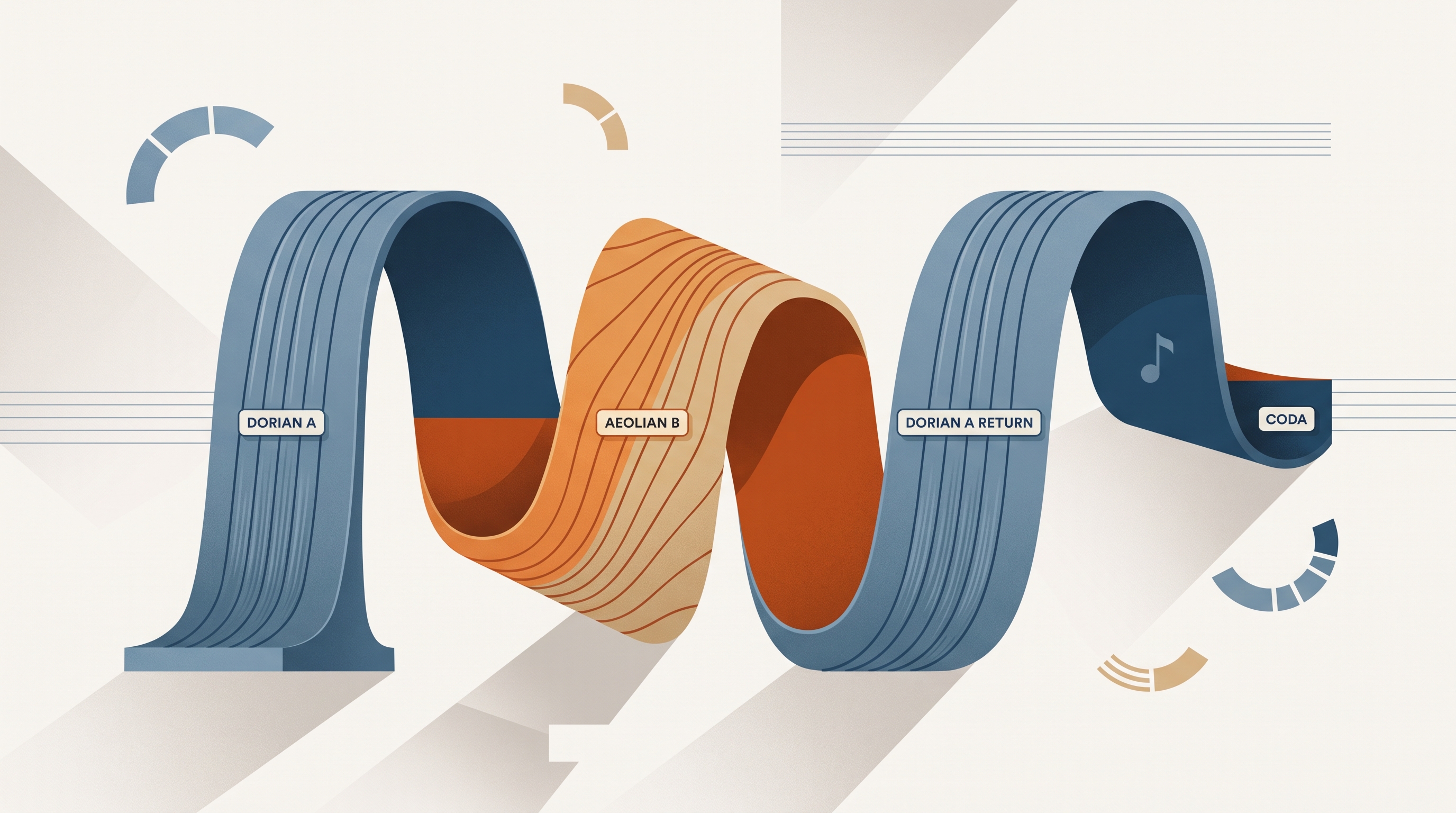
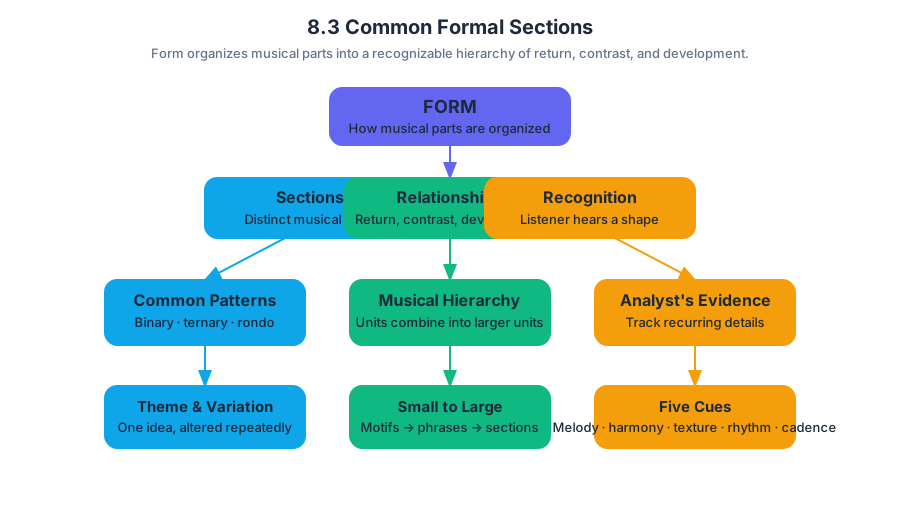
AP Practice 1
Key concepts: AP Music Theory Course and Exam Description updates effective Fall 2026 · Retardation and upward-resolving suspension as the same musical concept · Texture terminology clarification: removal of “technical” and “casual” descriptors · AP Exams, qualifying scores, college credit, and course placement · AP’s emphasis on evidence, scientific reasoning, and independent thinking · AP’s opposition to censorship and support for respectful debate · Access, opportunity, and readiness for students enrolling in AP courses · My AP activation and access to AP resources · Aural skills, listening, harmony, and sight-singing in AP Music Theory · Diverse musical repertoire in AP Music Theory
A strong AP Music Theory answer begins with evidence: what is heard, what is notated, and which musical process best explains it. This original practice set uses multiple-choice reasoning to rehearse the exam’s terminology updates, course purpose, and academic expectations while keeping the central habit of mind…
AP Practice 1
A strong AP Music Theory answer begins with evidence: what is heard, what is notated, and which musical process best explains it. This original practice set uses multiple-choice reasoning to rehearse the exam’s terminology updates, course purpose, and academic expectations while keeping the central habit of mind clear: identify the evidence before choosing a conclusion.
Timing guidance: Allow approximately $10$–$12$ minutes for the questions below, including a brief review. On the actual AP Exam, multiple-choice questions may test performed music, notated music, terminology, harmony, form, aural recognition, and analysis. AP Exams are administered each year in May; a qualifying score is typically used by colleges for credit, placement into advanced courses, or both, although policies vary by institution.
Question 1: Nonharmonic-tone terminology
A voice sustains a consonant note into a new harmony. That note becomes dissonant against the new chord and then resolves upward by step to a consonant note. Which statement best identifies the terminology required by the AP Music Theory materials effective beginning Fall 2026?
A. The note is an accented passing tone only.
B. The note is a retardation, also called an upward-resolving suspension.
C. The note is a lower neighbor tone because it resolves upward.
D. The note is a rearticulated suspension because every suspension must be repeated.
Answer: B. The decisive evidence is the delayed resolution of a note that was sustained into a new harmony, followed by upward stepwise resolution. Under PIT-2.M.5, “upward-resolving suspension” is recognized as a formal synonym for retardation. A rearticulated suspension and a chain of suspensions are also recognized classifications, but neither is required by the description in the question.
Key distinction: “Retardation” and “upward-resolving suspension” name the same musical concept; they are not two different nonharmonic tones.
Misconception check: Do not classify a tone solely by the direction of resolution. A neighbor tone moves away from and back to a single structural pitch, whereas a suspension or retardation is understood through its relationship to the harmony and its preparation, dissonance, and resolution.
Question 2: Texture terminology
A student describes a passage by identifying one prominent melody, supporting chords, and a bass line. Which response uses the updated texture terminology most appropriately?
A. “The passage is technically homophonic.”
B. “The passage is casually homophonic.”
C. “The passage is homophonic because one melody is supported by accompanying material.”
D. “The passage cannot be classified because the updated terminology removes all texture labels.”
Answer: C. DES-1.A.2 removes the descriptors “technical” and “casual” from the classification of texture terminology. The update does not remove the fundamental category homophonic and does not replace the deleted adjectives with new required terms.
Question 3: What AP Music Theory measures
Which activity most directly represents the primary emphasis of AP Music Theory?
A. Memorizing composers’ biographies without listening to their music
B. Recognizing, understanding, and describing tonal materials through performed and notated music
C. Reproducing one cultural or political interpretation of every musical work
D. Studying only Western art music through silent score reading
Answer: B. AP Music Theory develops recognition, understanding, and description of the basic materials and processes of tonal music as they are heard or presented in a score. Aural skills are a primary objective, and the course also includes sight-singing, notation, harmony, and performance-based work. Musical examples may come from Western tonal repertoire, contemporary art music, jazz, popular music, and non-Western cultures.
The course does not require students to adopt a particular cultural or political viewpoint. AP’s stated approach begins with evidence and scientific reasoning: students examine what can be heard or observed, evaluate interpretations, and draw their own conclusions. Respectful debate is encouraged; personal attacks, censorship, and indoctrination are not substitutes for analysis.
Question 4: Administration and preparation
Which statement is most accurate about preparation for the updated AP Music Theory assessment?
A. Students begin accessing AP support only after submitting the exam.
B. The audio portion remains dependent on CDs, and course timing changes with the terminology updates.
C. Teachers and students activate My AP at the beginning of the school year, and updated materials are implemented beginning Fall 2026.
D. Because colleges use the same placement policy, every qualifying score guarantees identical credit.
Answer: C. My AP is activated at the beginning of the school year so students can access AP resources and prepare for exam-day procedures. The Fall 2026 clarifications revise selected terminology, including PIT-2.M.5 and DES-1.A.2; the audio-delivery clarification moves listening portions from CDs to the Bluebook application while the exam’s content and timing remain unchanged. College credit and placement decisions remain institution-specific.
Examiner-rewarded reasoning
For a multiple-choice task, the rewarded performance is not a written rubric point but a defensible selection based on precise evidence. Review each missed item using this routine:
- Name the evidence: What musical event, wording, or policy detail controlled the answer?
- Name the distractor trap: Did you confuse resolution direction with tone classification, or assume a deleted adjective was replaced?
- State the rule: For example, “A retardation is an upward-resolving suspension under PIT-2.M.5.”
- Re-answer without looking: Explain why each incorrect option fails.
Retrieval check: In one sentence, explain why a retardation and an upward-resolving suspension receive the same classification, and in a second sentence identify the two texture descriptors removed by DES-1.A.2.
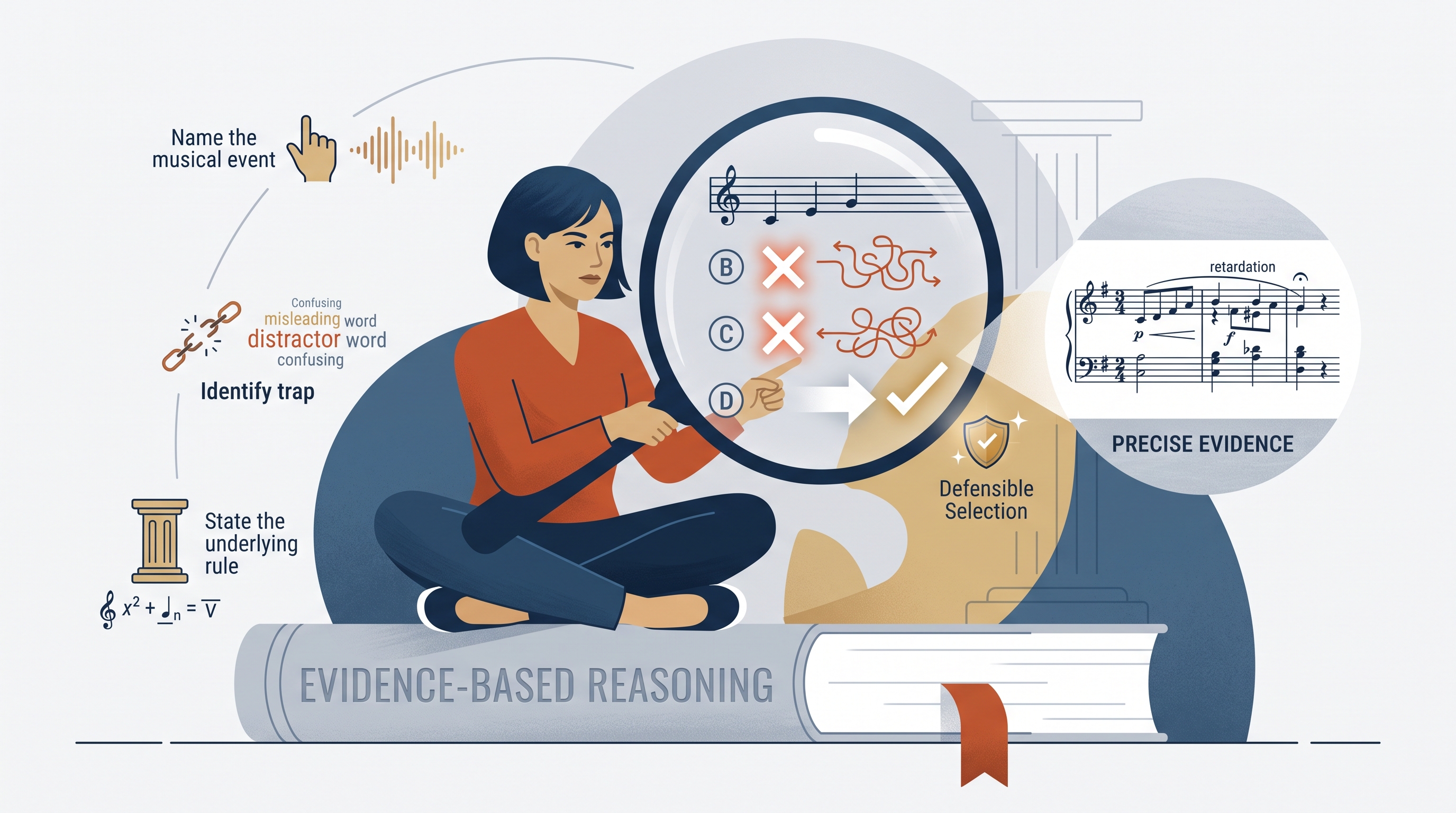
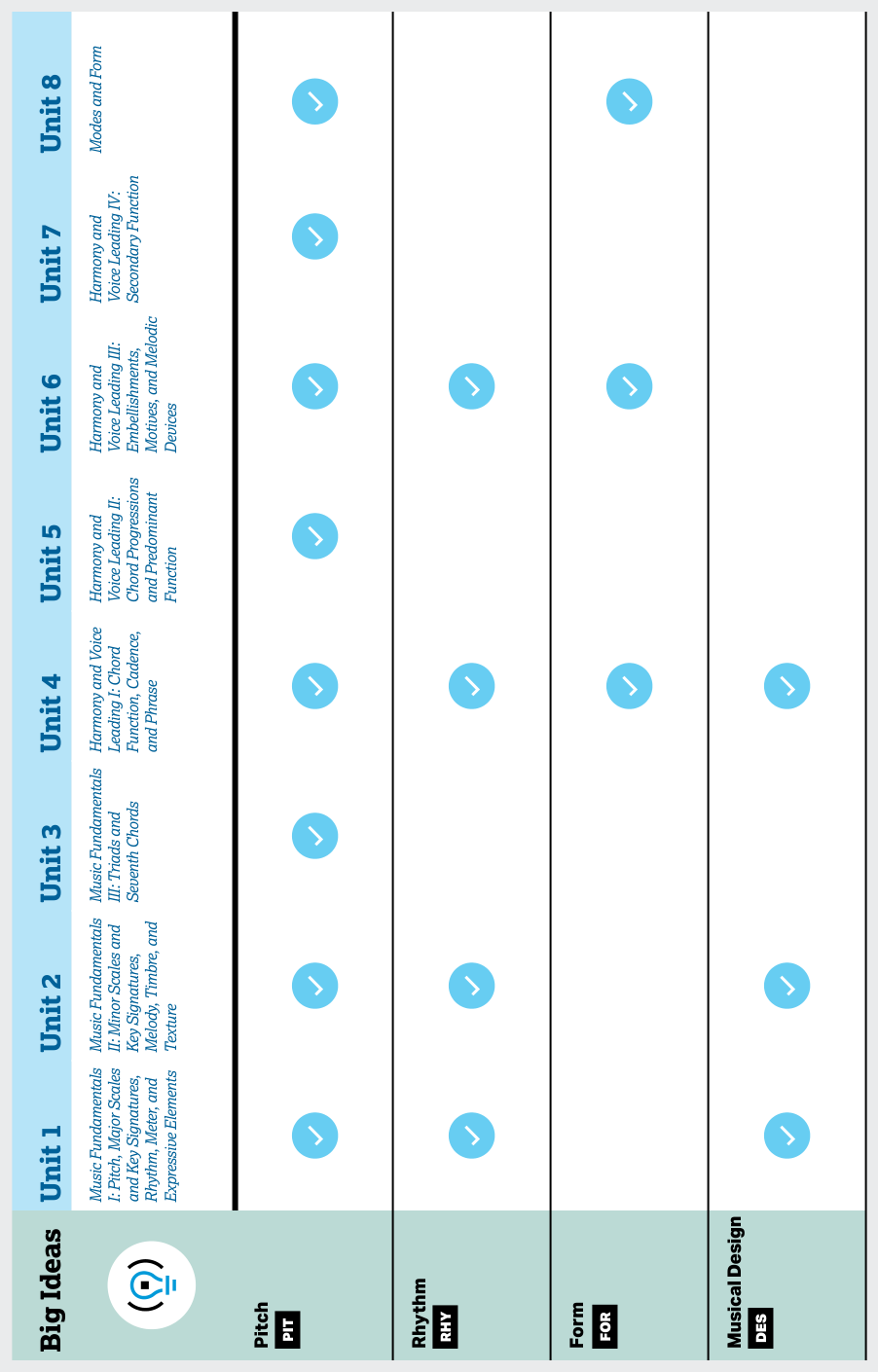
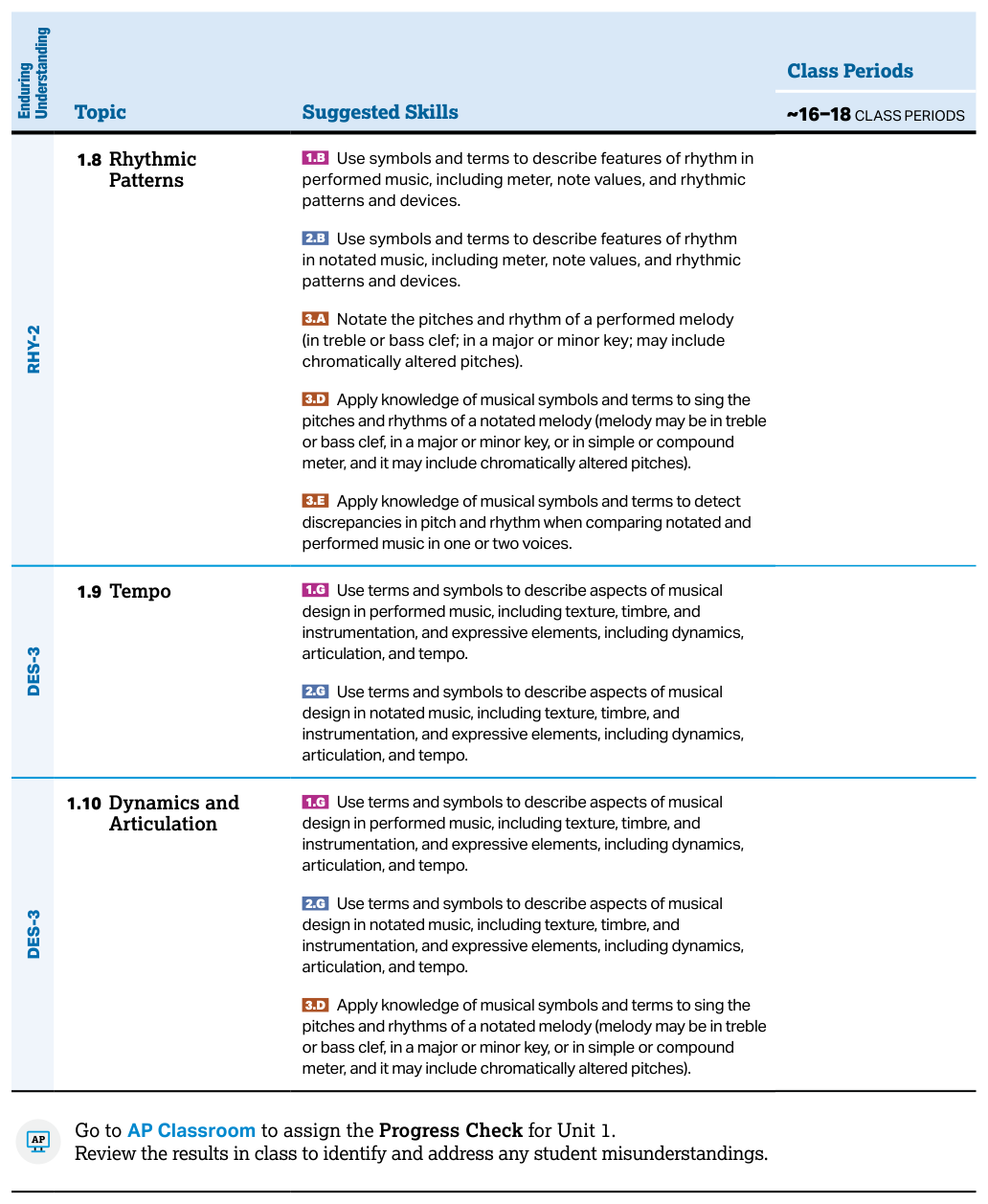
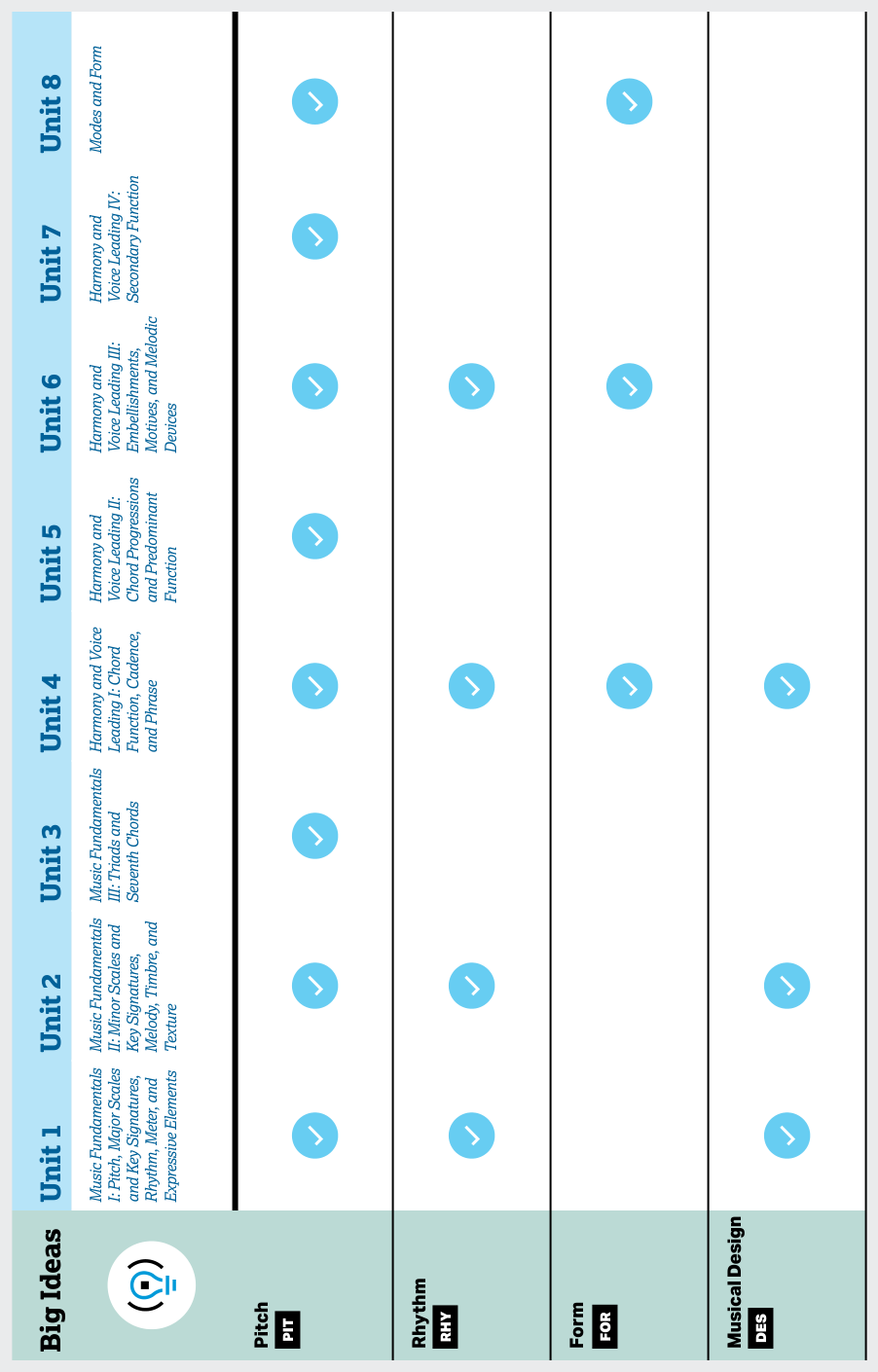
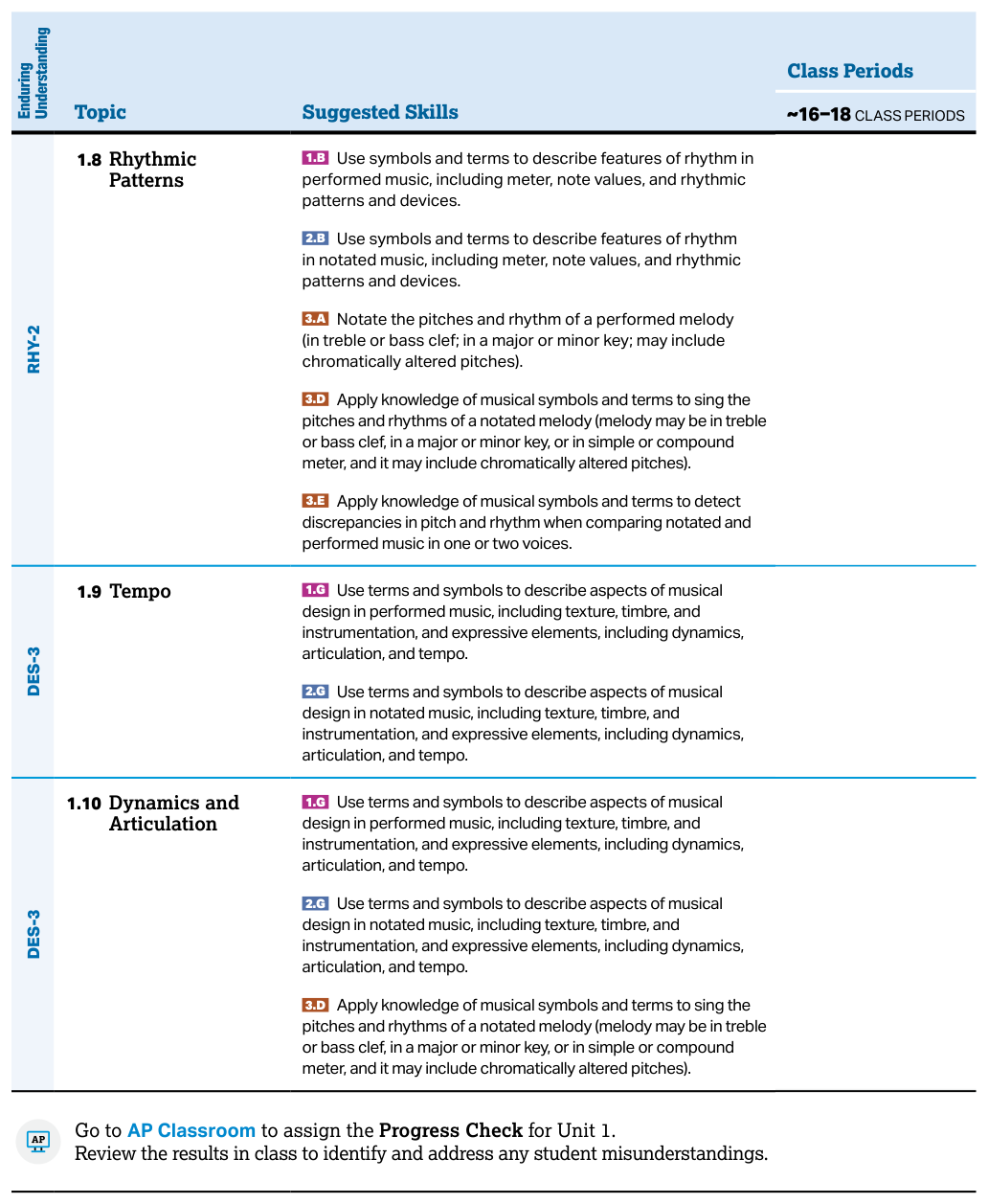
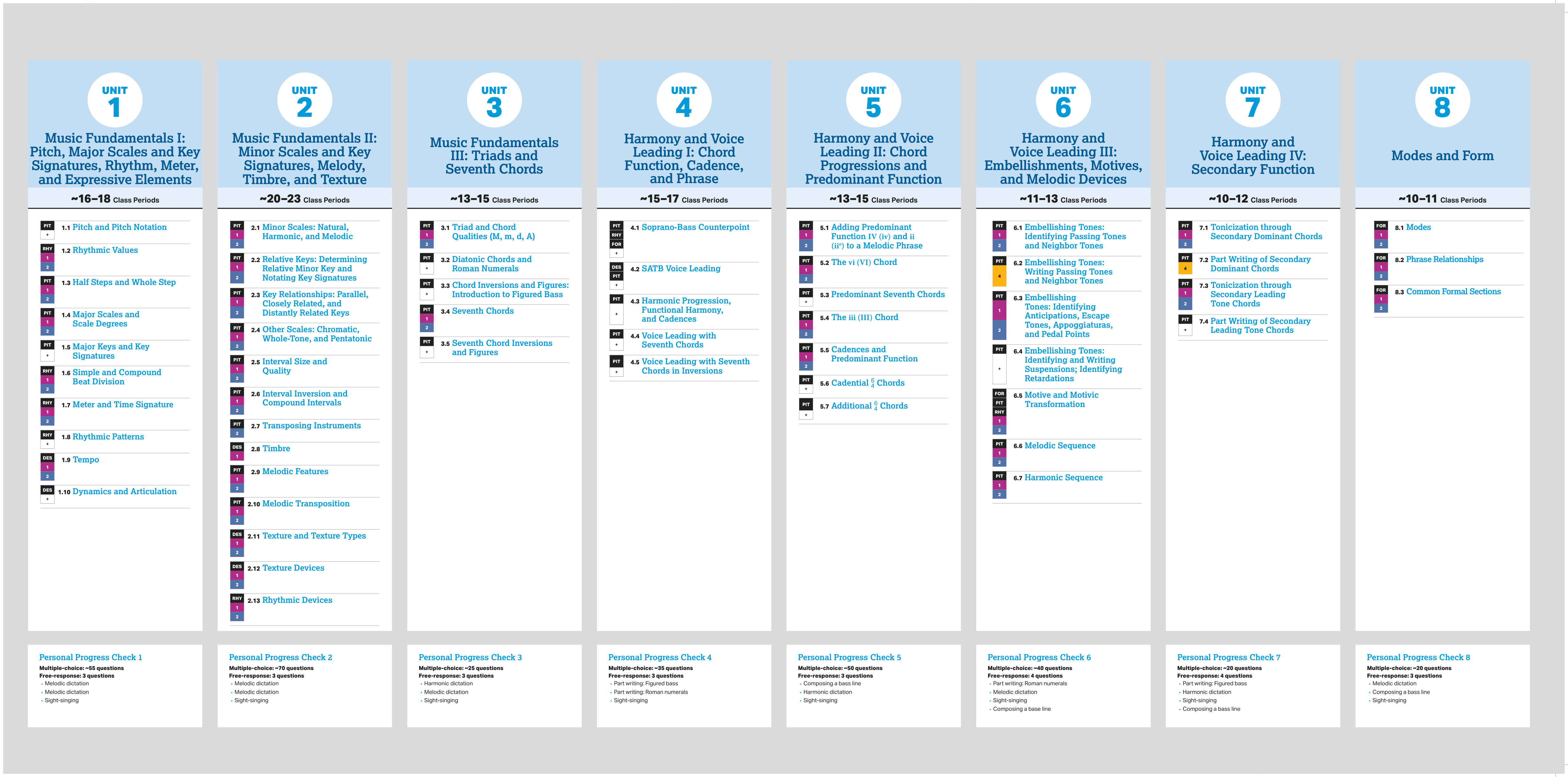
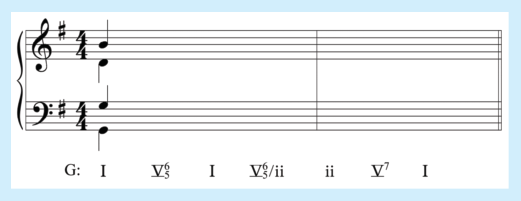
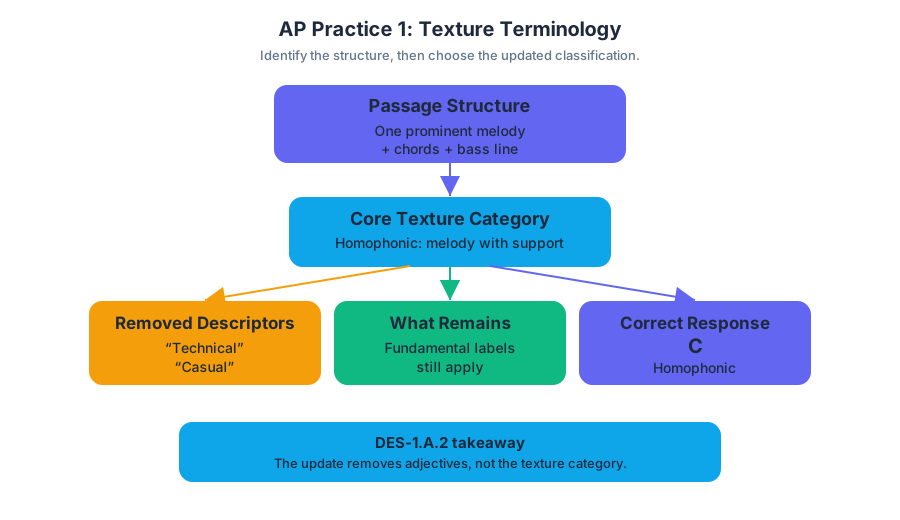
AP Practice 2
Key concepts: Upward-resolving suspension (retardation) · Suspension, including rearticulated suspension and chain of suspensions · Texture terminology · Pitch and pitch notation · Rhythm, meter, and beat division · Syncopation and rhythmic patterns · Dynamics, articulation, and tempo · Instrument families and standard instruments · Tonic, dominant, and predominant harmonic functions · Recomposing a well-known tonal melody
A harmonic dictation task asks you to turn a heard musical event into a precise notated and analytical account: What pitches and rhythms occurred, what harmonies changed, and how did those harmonies function?
AP Practice 2
A harmonic dictation task asks you to turn a heard musical event into a precise notated and analytical account: What pitches and rhythms occurred, what harmonies changed, and how did those harmonies function? The challenge is not merely naming chords. You must connect pitch, bass motion, rhythm, meter, nonharmonic tones, and harmonic function into one coherent explanation.
Task type: original, unofficial harmonic-analysis and notation practice
Suggested timing: $8$ minutes total
Primary skills: Skill 1: Analyze performed music, Skill 2: Analyze notated music, Skill 3: Convert between performed and notated music, and Skill 4: Complete based on cues. The task also activates 1.B/2.B: Rhythmic Features, 1.D/2.D: Transformation, 1.E/2.E: 18th-Century Voice Leading, and 1.G/2.G: Musical Design.
The musical situation
Imagine a four-measure phrase in $C$ major performed by a keyboard instrument. The excerpt uses a steady simple meter. The bass changes harmony at the beginning of each beat-group, while an upper voice sustains and then resolves by step. Your job is to reconstruct the bass, label the harmonic functions, and identify the sustained tone accurately.
The keyboard family includes piano, harpsichord, and organ. In another performance, the same harmonic plan might be colored by drums, cymbals, or marimba; those instruments change the timbre, or tone color, without necessarily changing the harmonic function.
Practice prompt
The performer plays the following harmonic outline in $C$ major. Each harmony occupies one measure unless otherwise indicated:
- Measure $1$: $C$ major
- Measure $2$: $F$ major
- Measure $3$: $G$ major, with an upper voice holding $A$ from the previous harmony and moving upward to $B$
- Measure $4$: $C$ major
On your response, complete these three tasks:
- Notate a bass line representing the changing harmonies.
- Label each harmony with its Roman numeral and function.
- Identify the nonharmonic tone in measure $3$ and describe its resolution.
Worked solution
A practical reconstruction begins with the bass. Because the harmonies are $C$ major, $F$ major, $G$ major, and $C$ major, a convincing root-position bass is:
$$ C \rightarrow F \rightarrow G \rightarrow C $$
In $C$ major, these roots produce the following Roman numerals:
| Measure | Chord tones | Roman numeral | Function |
|---|---|---|---|
| $1$ | $C$–$E$–$G$ | $I$ | Tonic |
| $2$ | $F$–$A$–$C$ | $IV$ | Predominant |
| $3$ | $G$–$B$–$D$ | $V$ | Dominant |
| $4$ | $C$–$E$–$G$ | $I$ | Tonic |
The progression is therefore:
$$ I \rightarrow IV \rightarrow V \rightarrow I $$
The first and last harmonies establish and confirm tonic. The $IV$ chord moves away from tonic and prepares the dominant, while $V$ creates the strongest tension before resolving to $I$.
The suspension—and the important update
The upper voice holds $A$ into the $G$-major harmony. Since $A$ is not a chord tone of $G$ major, it is temporarily dissonant. It then moves upward by step to $B$, which belongs to the dominant chord:
$$ A \rightarrow B $$
This is an upward-resolving suspension, officially recognized in PIT-2.M.5 as a synonym for retardation. The broader classification of nonharmonic tones includes suspension, rearticulated suspension, chain of suspensions, and upward-resolving suspension (retardation).
A suspension is heard as a tone carried from one harmony into the next, where it creates dissonance before resolving by step.
A common misconception is that every suspension must resolve downward. Many suspensions do resolve downward, but an upward-resolving suspension is specifically a retardation. Do not label the $A$ a chord tone merely because it was consonant in the preceding measure; classify it according to its relationship with the harmony sounding at the moment of dissonance.
Rhythm, meter, and texture checks
Rhythm exists in time: it concerns the durations and placement of sounds and silences. Meter organizes beats into recurring hierarchies, and beat division determines whether each beat divides simply or compoundly. If the upper voice enters after the expected beat or sustains across a strong beat, listen for syncopation—a rhythmic emphasis that challenges the regularity of the established meter.
Do not confuse a sustained suspension with syncopation. A suspension is primarily a harmonic and melodic event; syncopation is primarily a rhythmic event. They can occur together, but one does not automatically prove the other.
Texture terminology also matters when describing the excerpt. No new texture vocabulary has been added, and the terms “technical” and “casual” are not required texture descriptors under DES-1.A.2. Use established terms such as homophonic when one prominent melody is supported by accompanying harmonies.
What earns credit
An examiner rewards an answer that is musically complete and internally consistent:
- The bass line changes at the correct harmonic points.
- The pitches are written with accurate notation and appropriate accidentals.
- The Roman numerals match the key of $C$ major.
- Tonic, predominant, and dominant functions are identified correctly.
- The $A$ is recognized as an upward-resolving suspension, or retardation.
- Rhythm, meter, and any syncopation are represented rather than guessed.
- The response distinguishes chord tones from nonharmonic tones.
For error review, circle the first incorrect decision rather than only correcting the final label. Ask: Did I lose the beat, mishear the bass, misidentify the key, or classify the nonharmonic tone by its previous harmony? That diagnosis tells you whether to practice rhythm and meter, pitch notation, harmonic function, or suspensions.
The clarifications labeled “To be Implemented for Fall 2026” apply to the $2026$–$2027$ academic year and beyond. Beginning with the later digital implementation, formal questions move to a digital platform, while the exam’s overall timing and content remain unchanged. Practice the musical reasoning—not a particular delivery device.
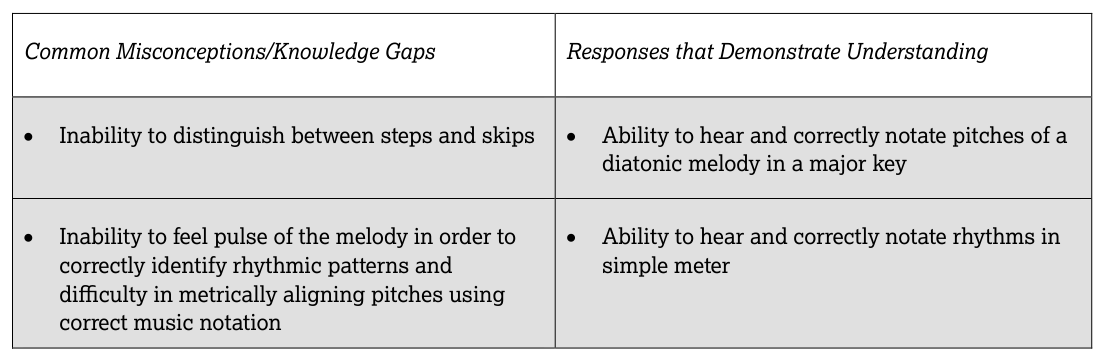
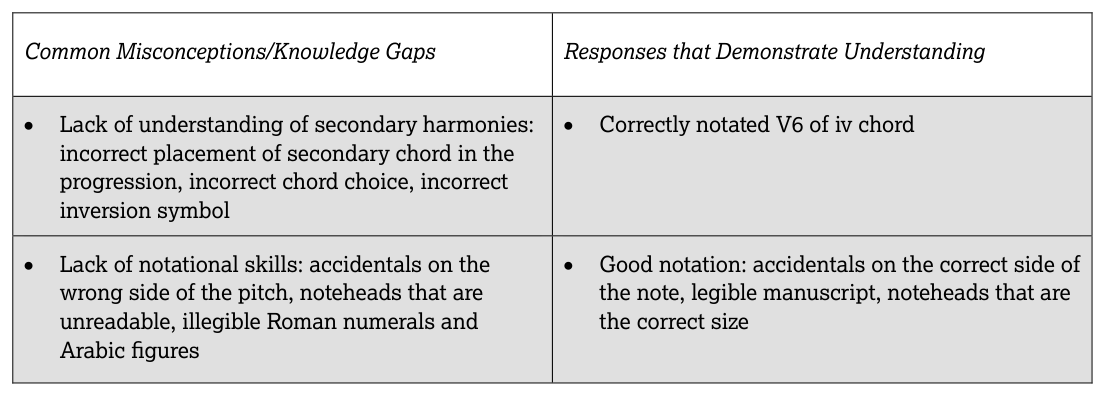
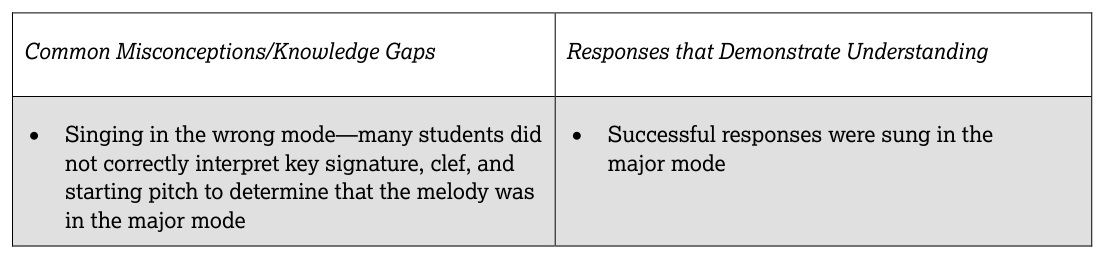
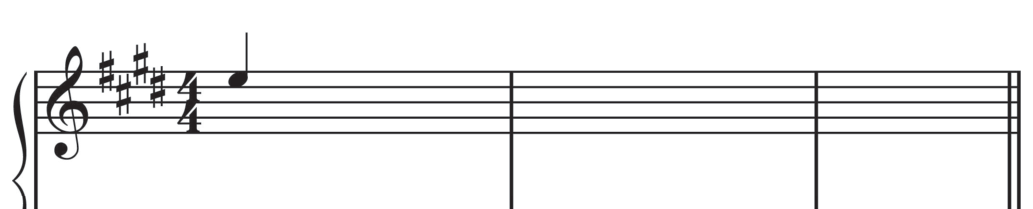
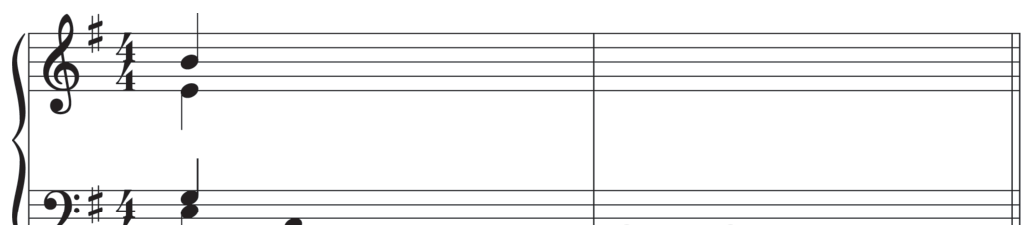
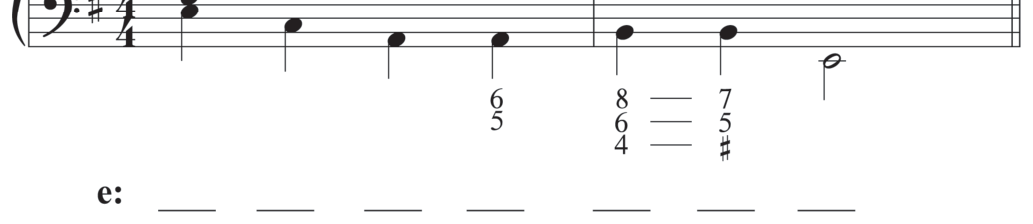
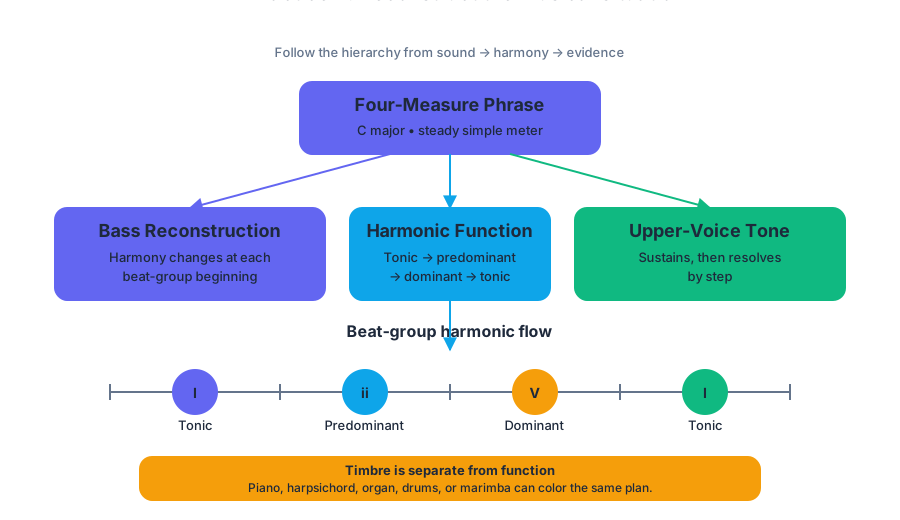
AP Practice 3
A sight-singing response is judged by what remains audible when the melody becomes difficult: rhythmic accuracy, relative pitch accuracy, and continuity. The task is not to sing with a beautiful operatic tone; it is to keep the musical line moving accurately and steadily while reading unfamiliar notation.
AP Practice 3
A sight-singing response is judged by what remains audible when the melody becomes difficult: rhythmic accuracy, relative pitch accuracy, and continuity. The task is not to sing with a beautiful operatic tone; it is to keep the musical line moving accurately and steadily while reading unfamiliar notation.
For each melody, the current procedure allows approximately $1$ minute and $15$ seconds of preparation followed by a performance of no more than $30$ seconds. A starting pitch is provided, but you may sing with note names, solfège, scale-degree numbers, or a neutral syllable, and you may transpose the melody to a comfortable key.
Original practice task: a compound-meter melody
Preparation time: $1$ minute and $15$ seconds.
Performance time: $30$ seconds.
Suggested setting: $6/8$ meter, key signature of $G$ major, beginning on scale degree $1$.
Because plain text cannot display the complete staff notation, use the following equivalent reading model for an original melody. Each bar contains two beats, and each beat divides into three eighth-note pulses:
| Measure | Beat 1 | Beat 2 |
|---|---|---|
| $1$ | $G$ quarter note, $A$ eighth note | $B$ dotted quarter note |
| $2$ | $A$ quarter note, $G$ eighth note | $E$ dotted quarter note |
| $3$ | $F^\sharp$ quarter note, $G$ eighth note | $A$ dotted quarter note |
| $4$ | $B$ quarter note, $A$ eighth note | $G$ dotted quarter note |
The melody therefore has the solfège pattern:
$$ \text{do–re–mi};|;\text{re–do–la};|;\text{ti–do–re};|;\text{mi–re–do} $$
Before singing, identify three anchors: the tonic $G$ as do, the dominant $D$ as a likely destination, and the final $G$ as do. Notice also that every measure contains the same rhythmic shape: a quarter note followed by an eighth note, then a dotted quarter note. Recognizing that repeated pattern prevents the rhythm from becoming a separate problem in every measure.
Worked reasoning under exam conditions
First pass: scan the structure. Confirm the key signature, meter, starting pitch, phrase length, and final pitch. In $6/8$, do not count six equal strong beats; hear two larger beats, each divided into three eighth-note pulses:
$$ \text{ONE-la-li TWO-la-li} $$
Second pass: speak the rhythm. Before adding pitch, say a neutral syllable through the four measures. The first beat of measure $1$ occupies three eighth-note pulses: the quarter note uses pulses $1$ and $2$, while the eighth note arrives on pulse $3$. The dotted quarter note fills the entire second beat.
Third pass: locate the scale degrees. In $G$ major, the notes are:
$$ G=\text{do},\quad A=\text{re},\quad B=\text{mi},\quad E=\text{la},\quad F^\sharp=\text{ti}. $$
The most important interval is the step from $F^\sharp$ to $G$: ti resolves upward by a half step to do. Do not treat $F^\sharp$ as an isolated chromatic note; it is the leading tone of the key and points strongly toward $G$.
Fourth pass: perform without stopping. If one pitch is missed, preserve the pulse and re-enter at the next recognizable anchor. For this melody, those anchors are the beginning of each measure and the final $G$. A brief imperfect note with continuous rhythm is generally less damaging than stopping, restarting, and losing the phrase.
What earns the available credit
A strong response demonstrates the three assessed dimensions:
| Criterion | What the examiner can hear | Practical decision |
|---|---|---|
| Rhythmic accuracy | Notes enter and sustain for their intended durations | Feel $6/8$ as two beats per measure |
| Relative pitch accuracy | Melodic distances and scale-degree relationships are correct | Hear $F^\sharp$ as ti resolving to do |
| Continuity | The performance continues at a steady tempo | Recover at the next anchor instead of stopping |
The response does not require an ornate vocal style. A clear, steady neutral syllable can be safer than solfège if syllable changes disrupt the rhythm. Conversely, solfège can strengthen pitch memory when scale-degree relationships are secure.
Misconception check: “The provided starting pitch fixes my key”
It does not. The starting pitch establishes the reference for the printed melody, but the procedure permits transposition to a comfortable key. If the written range is uncomfortable, preserve the interval relationships and rhythm while singing in another key. Transposition is a performance choice, not permission to alter the melody’s contour or meter.
Retrieval check
Without looking back, answer aloud: In the original melody, what scale degree is $F^\sharp$ in $G$ major, what pitch does it tend toward, and what should you do if you miss it during performance?
Answer: $F^\sharp$ is scale degree $7$, or ti; it tends upward to $G$, or do; keep the pulse and re-enter at the next reliable anchor rather than stopping.
Error-review routine
After performing, label each error as R for rhythm, P for relative pitch, or C for continuity. Perform the melody again while correcting only the most frequent category. Then perform it once more without speaking the analysis aloud. This separates a temporary reading mistake from a recurring skill weakness and mirrors the task’s actual scoring priorities.

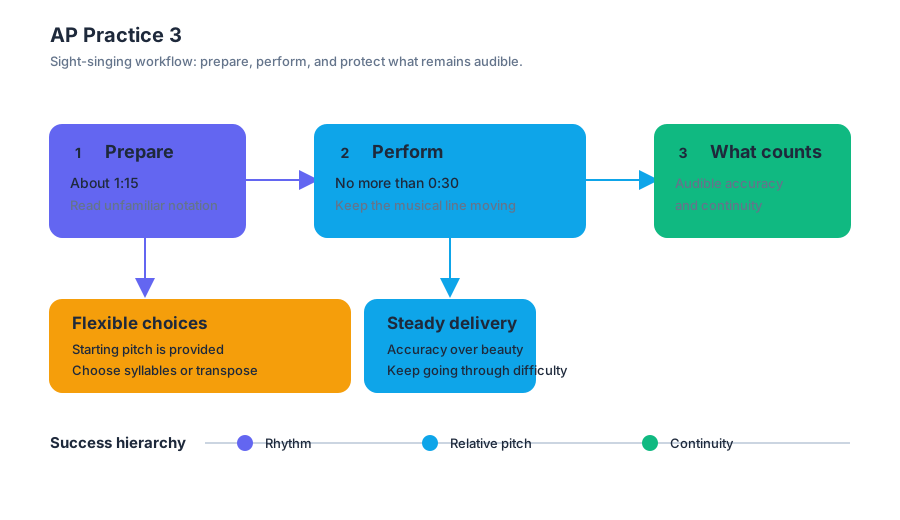
AP Practice 4
A sight-singing response turns silent notation into a continuous musical performance: the score gives pitch and rhythm, but the singer must supply accurate execution under severe time pressure.
AP Practice 4
A sight-singing response turns silent notation into a continuous musical performance: the score gives pitch and rhythm, but the singer must supply accurate execution under severe time pressure. On the current AP Music Theory sight-singing task, each melody receives $1$ minute and $15$ seconds of preparation and must be performed within $30$ seconds.
Task snapshot
| Feature | What to expect |
|---|---|
| Section | Section II, Part B |
| Number of melodies | $2$ |
| Preparation | $1$ minute and $15$ seconds per melody |
| Performance | Up to $30$ seconds per melody |
| Starting pitch | Provided at the beginning of preparation |
| Allowed approach | Note names, solfège, scale-degree numbers, or a neutral syllable |
| Optional choice | You may transpose to a comfortable key |
| Main scoring priorities | Rhythmic accuracy, relative pitch accuracy, and continuity |
The central exam decision is not “Can I sing every note perfectly?” but “What plan lets me preserve the pulse and musical direction when one note becomes uncertain?” A missed pitch followed by immediate recovery can preserve continuity; stopping to search for the lost note usually damages both the musical line and the time limit.
Original practice melody
Unofficial practice prompt. Prepare and sing the following melody. Use a steady quarter-note pulse. The melody is in common meter, begins on scale degree $\hat{1}$, and uses a major tonal center.
| Measure | Beats 1–4 |
|---|---|
| $1$ | $C$ quarter, $D$ quarter, $E$ half |
| $2$ | $G$ quarter, $F$ quarter, $E$ quarter, $D$ quarter |
| $3$ | $C$ half, $E$ quarter, $F$ quarter |
| $4$ | $G$ half, $E$ quarter, $C$ quarter |
In scale-degree form, the same melody is:
$$ \hat{1}\ \hat{2}\ |\ \hat{3}!-\ |\ \hat{5}\ \hat{4}\ \hat{3}\ \hat{2}\ |\ \hat{1}!-\ \hat{3}\ \hat{4}\ |\ \hat{5}!-\ \hat{3}\ \hat{1} $$
Here, the dash indicates that the preceding pitch is sustained. The important musical shape is an opening ascent toward $\hat{3}$, a descent through $\hat{5}$–$\hat{2}$, and a final expansion toward $\hat{5}$ before returning to tonic.
The $75$-second preparation algorithm
First $15$ seconds: establish the tonal map. Locate the key signature, identify the tonic, and sing or internally hear the tonic and dominant. For this melody, anchor $C$ as $\hat{1}$ and $G$ as $\hat{5}$. Do not spend preparation time naming every interval before you know where the melody belongs tonally.
Next $20$ seconds: secure the rhythm. Tap or silently conduct four beats per measure. Notice that measure $1$ contains two attacks followed by a two-beat sustain, while measure $2$ contains four equal quarter-note attacks. Rhythm is not decoration: if the pulse collapses, even correct pitches become difficult to evaluate.
Next $20$ seconds: rehearse the danger points. The largest leap is the upward perfect fifth from $C$ to $G$ at the start of measure $2$. Hear it as $\hat{1}$ to $\hat{5}$, then use the stepwise descent $G$–$F$–$E$–$D$ to reestablish the tonal center.
Final $20 seconds: perform once without stopping. Sing aloud if possible, using solfège, numbers, or a neutral syllable. If a pitch slips, continue the pulse and reconnect at the next secure landmark rather than restarting.
Worked performance reasoning
Start with a clear internal $C$ and maintain a four-beat pattern. The first measure should feel stable: $C$–$D$–$E$, with $E$ held through beats $3$ and $4$. In measure $2$, aim directly for $G$ rather than climbing step by step; the following $F$–$E$–$D$ gives you a reliable descending route.
At the beginning of measure $3$, return to $C$ and sustain it for two beats. The final two measures create a controlled rise to $G$, followed by a stepwise return through $E$ to tonic. Keep the tempo moving even if the final $C$ is not perfectly centered.
Examiner-rewarded reasoning: preserve the written rhythm, maintain relative pitch relationships, and perform continuously with a steady tempo. A response is not strengthened by stopping after an error; it is strengthened by recovering musically.
Common misconception check
Misconception: “The starting pitch locks me into that key.” The provided starting pitch is a reference, not a command to use an uncomfortable register. The sight-singing procedure permits transposition to a comfortable key, provided the melodic relationships remain intact.
Misconception: “I should silently analyze until every note is certain.” Analysis helps only when it leads to performance. Use the $75$ seconds to secure tonal center, meter, major leaps, and phrase shape; then sing.
Error-review routine
After recording, listen once without looking at the notation. Mark only three items: the first rhythmic disruption, the first pitch error, and the point where continuity was either preserved or lost. Then repeat the melody with one specific correction, such as “hold measure $1$ longer” or “hear $\hat{1}$ before leaping to $\hat{5}$.”
Quick check: If you lose the pitch at the beginning of measure $2$, which two landmarks can restore you—its arrival on $\hat{5}$ or the later return to $\hat{1}$? A strong response uses either landmark without stopping the beat.
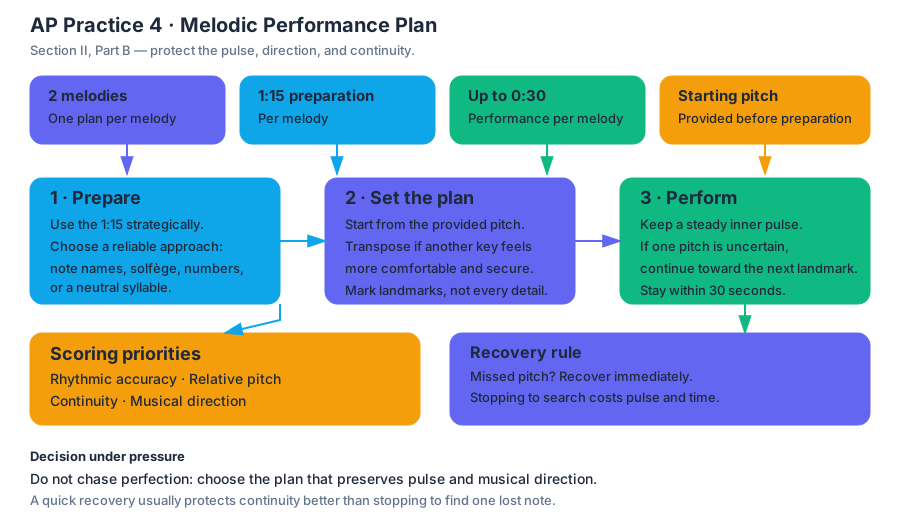
AP Practice 5
A harmonization task asks you to turn a single melody into a convincing musical conversation: the melody supplies the visible clues, while your chords must explain its motion, support cadences, and follow eighteenth-century stylistic norms.
AP Practice 5
A harmonization task asks you to turn a single melody into a convincing musical conversation: the melody supplies the visible clues, while your chords must explain its motion, support cadences, and follow eighteenth-century stylistic norms. The strongest solution is not the one with the most chords; it is the one whose bass, harmonic function, and voice leading make the melody sound inevitable.
The task: harmonize a melody from cues
In this original, unofficial practice task, write a four-part harmonization for the melody below. The melody is in G major, common meter, and ends on the tonic. Use soprano, alto, tenor, and bass. Supply Roman numerals beneath the measures.
Key: G major        Meter: 4/4

Soprano:
| G  A  B  D | C  B  A  G | A  B  C  A | B  A  G  — |
  1  2  3  5   4  3  2  1   2  3  4  2   3  2  1
A practical time target is approximately $8$–$10$ minutes. First identify the likely cadence and phrase shape; then sketch the bass and Roman numerals; finally complete the inner voices and check for forbidden parallels, unresolved tendency tones, awkward leaps, and spacing errors.
Step 1: Read the melody as evidence
The opening notes $G$–$A$–$B$–$D$ fit several diatonic chords, including $I$, $ii$, and $V$. Do not assign a chord merely because it contains the melody note. Instead, ask what each chord does: tonic prolongs stability, predominant prepares departure, and dominant creates pressure toward tonic.
The final soprano notes $B$–$A$–$G$ strongly suggest a dominant-to-tonic close. In G major, $B$ is scale degree $3$ and also the leading tone’s resolution target; a final progression such as $V^7$–$I$ gives the phrase a clear authentic cadence.
Worked solution
One coherent harmonic plan is:
| Measure | Soprano evidence | Roman numerals | Function |
|---|---|---|---|
| $1$ | $G$–$A$–$B$–$D$ | $I \rightarrow ii$ | tonic to predominant |
| $2$ | $C$–$B$–$A$–$G$ | $IV \rightarrow I$ | predominant to tonic |
| $3$ | $A$–$B$–$C$–$A$ | $ii^6 \rightarrow V^7$ | predominant to dominant |
| $4$ | $B$–$A$–$G$ | $V^7 \rightarrow I$ | dominant to tonic |
A possible bass line is $G$–$A$–$C$–$G$–$A$–$D$–$G$. It supports the progression without becoming a distracting second melody. The first inversion of $ii$, written $ii^6$, places $F\sharp$ in the bass and can produce smoother stepwise motion into $V$.
For the final $V^7$–$I$, the chord tones are $D$–$F\sharp$–$A$–$C$ moving to $G$–$B$–$D$. The chordal seventh $C$ should normally resolve downward to $B$, while the leading tone $F\sharp$ resolves upward to $G$. These two directed resolutions are the harmonic “arrows” that make the cadence audible.
What earns credit
This task primarily activates Skill 4: Complete Based on Cues, because you must complete music while following eighteenth-century stylistic norms. It also draws on Skill 2: Analyze Notated Music, as you interpret the melody’s pitch and rhythmic information, and Skill 3: Convert Between Performed and Notated Music, because the intended harmonic result must be represented accurately in notation.
An examiner rewards the musical result through criteria such as correct chord identification, a functional harmonic progression, accurate notation, and appropriate voice leading. In practical terms, a response should make the intended chords recognizable, preserve the given soprano, maintain proper voice ranges and spacing, and avoid errors that undermine tonal syntax.
Misconception check: “Any chord containing the melody note works”
Misconception: If the soprano note belongs to a chord, that chord is automatically acceptable. Correction: Chord choice depends on context. The note $A$ in measure $3$ could belong to $ii$, $IV$, or $V^7$, but only $ii^6 \rightarrow V^7$ explains the predominant-to-dominant motion and prepares the closing cadence convincingly.
Another common error is treating the bass as leftover material. The bass determines inversion, supports harmonic function, and can create direct parallels with the soprano. Write the bass as an independent, singable line before filling in alto and tenor.
Error-review routine
After completing the harmonization, inspect it in four passes:
- Harmony: Does every Roman numeral match the notes?
- Function: Does the progression move convincingly toward a cadence?
- Voice leading: Do leading tones and chordal sevenths resolve appropriately?
- Notation: Are clefs, stems, accidentals, spacing, and Roman numerals clear?
For each error, label its cause rather than merely correcting the note: misread melody cue, wrong function, unresolved tendency tone, parallel perfect interval, or notation error. That diagnosis tells you which musical skill—not just which answer—you need to strengthen.
Retrieval check
In G major, what harmonic function most naturally follows $ii^6$, and where should the chordal seventh of $V^7$ resolve? Answer: $ii^6$ normally moves to dominant-function harmony, especially $V$ or $V^7$; the seventh of $V^7$ resolves downward by step to the third of $I$.
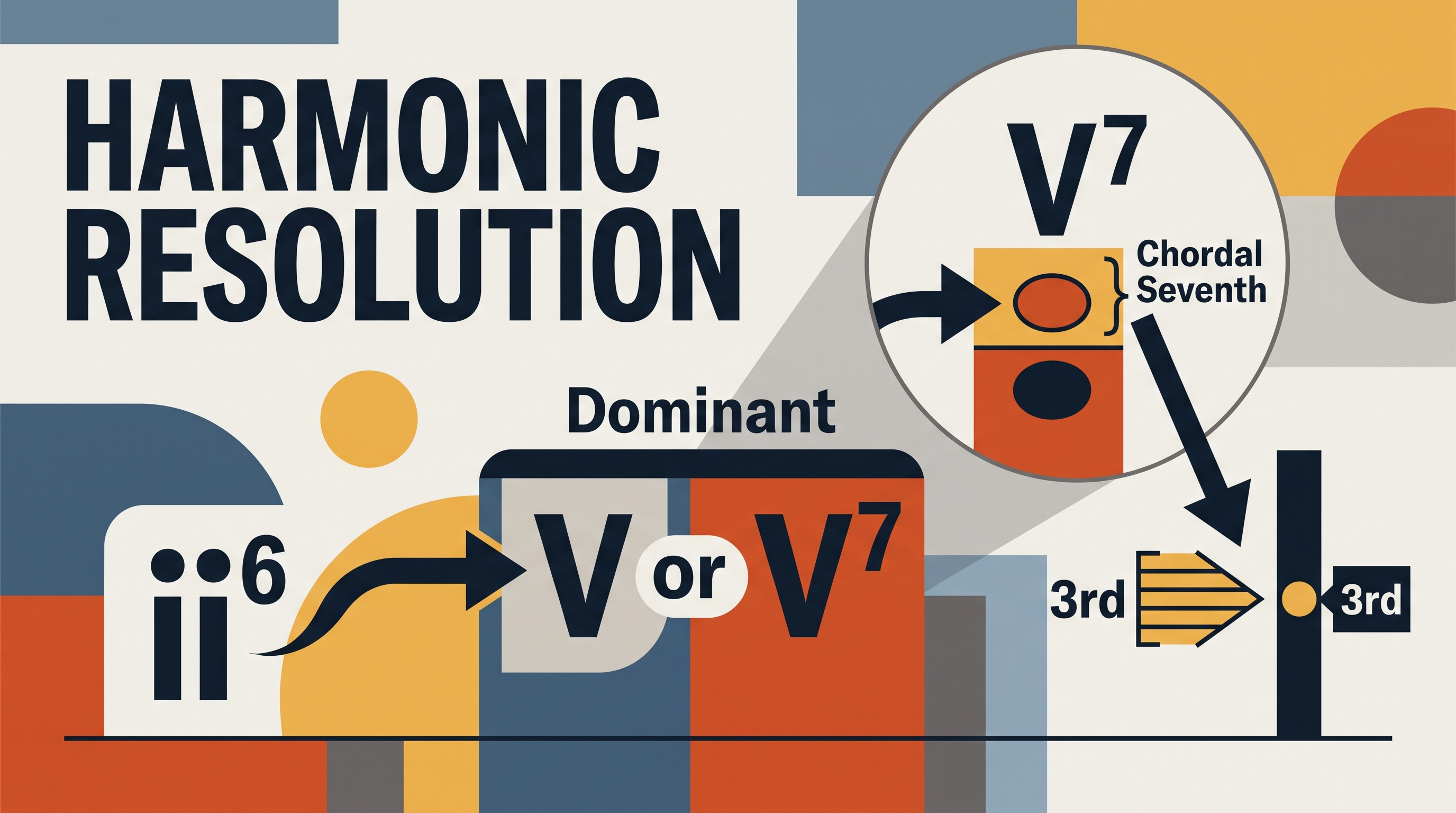
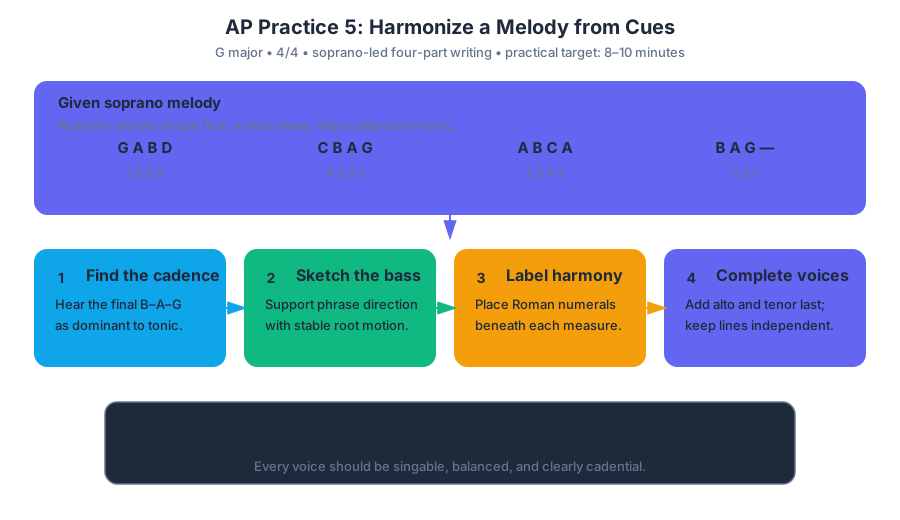
AP Practice 6
Sight-singing rewards a performer who keeps the musical line moving while controlling two separate problems: rhythmic accuracy and relative pitch accuracy. In the AP Music Theory sight-singing task, each melody receives a short preparation period of approximately $1$ minute and $15$ seconds, followed by a…
AP Practice 6
Sight-singing rewards a performer who keeps the musical line moving while controlling two separate problems: rhythmic accuracy and relative pitch accuracy. In the AP Music Theory sight-singing task, each melody receives a short preparation period of approximately $1$ minute and $15$ seconds, followed by a performance period of $30$ seconds; continuity matters because a correct recovery is musically stronger than stopping after one mistake.
The task: turn notation into a continuous performance
The most reliable strategy is to read the melody in layers rather than trying to name every note independently. First identify the meter and beat grouping, then locate the tonic and major structural notes, and finally fill in the passing motion between those anchors.
For this original, unofficial practice melody, use D minor, $6/8$ meter, and a starting pitch of $D_4$. Sing with solfège, scale-degree numbers, note names, or a neutral syllable. The melody contains mostly stepwise motion, one chromatic tendency tone, and a final tonic resolution.
| Measure | Rhythmic outline | Pitch sequence | Structural purpose |
|---|---|---|---|
| $1$ | dotted quarter, eighth, quarter | $D_4$–$F_4$–$A_4$ | Establishes tonic and the minor triad |
| $2$ | three quarter-note beats | $G_4$–$F_4$–$E_4$ | Descending stepwise motion |
| $3$ | dotted quarter, three eighths | $D_4$–$E_4$–$F_4$–$G_4$ | Returns to and departs from tonic |
| $4$ | quarter, quarter, dotted quarter | $A_4$–$B\flat_4$–$A_4$ | Dominant-region emphasis |
| $5$ | three quarter-note beats | $C^\sharp_5$–$D_5$–$E_5$ | Raised leading tone points toward $D$ |
| $6$ | dotted quarter, three eighths | $F_5$–$E_5$–$D_5$–$C^\sharp_5$ | Descending line with renewed tension |
| $7$ | quarter, quarter, dotted quarter | $D_5$–$C^\sharp_5$–$B\flat_4$ | Prepares the final cadence |
| $8$ | dotted half | $D_4$ | Complete tonic resolution |
Worked preparation: three passes, one minute
Pass 1: scan the rhythm. In $6/8$, the basic beat is the dotted quarter note, and each measure contains two large beats. Count $1$–$la$–$li$, $2$–$la$–$li$ or conduct two broad pulses. Do not let the eighth-note groups turn into three independent beats.
Pass 2: locate the pitch anchors. The opening $D$ establishes tonic. The $A$ in measure $4$ functions as a dominant-area goal, while $C^\sharp$ in measures $5$ and $6$ acts as a leading tone that strongly pulls upward to $D$. The repeated $D$ notes divide the melody into recognizable gestures.
Pass 3: connect the anchors. Sing the skeleton $D \rightarrow A \rightarrow D \rightarrow D$ first. Then insert the interior notes: $D$–$F$–$A$, $G$–$F$–$E$, and so on. This prevents a single difficult interval from destroying the entire performance.
A strong internal counting plan is:
$$ \text{Measure 1: } D\text{--}F\text{--}A \qquad \text{Measure 2: } G\text{--}F\text{--}E $$
The first measure moves upward through the tonic triad; the second descends by step. Hearing those shapes is more dependable than treating $D$–$F$ as an unrelated minor third and $F$–$A$ as another isolated interval.
What earns credit
The performance should be judged through three observable criteria: rhythmic accuracy, relative pitch accuracy, and continuity. A useful self-check is to ask whether the listener can identify the meter, recognize the intended tonal center, and hear a stable phrase even if one pitch is imperfect.
| Criterion | Evidence of control | Common failure |
|---|---|---|
| Rhythmic accuracy | The $6/8$ pulse remains steady; dotted-quarter and eighth-note values retain their proportions | Replacing compound beat division with a flat stream of equal notes |
| Relative pitch accuracy | Scale steps, minor-third shapes, and the raised leading tone move to their intended targets | Singing every note as though it were unrelated to the key |
| Continuity | The performer continues after a slip and reenters at the next stable pitch | Stopping, restarting, or abandoning the meter |
Misconception check: “One wrong note means I should stop”
Stopping usually creates a second error: lost rhythm and broken continuity. If measure $5$ begins incorrectly, keep the $6/8$ pulse, aim for the next structural $D_5$, and resume from that anchor. The scoring evidence is stronger when the musical line remains intelligible.
Another misconception is that the provided starting pitch forces the melody to remain in its printed register. Preparation may include transposing the melody to a comfortable key, but the interval relationships and rhythmic values must remain intact. A comfortable range is useful only if it preserves accurate relative pitch and steady tempo.
Error-review routine
After performing, replay the attempt—or have a partner listen—and classify each problem before correcting it:
- Mark the first place where the pulse changed.
- Circle the first uncertain pitch and identify its scale-degree relationship to the preceding note.
- Label each recovery point, such as the next tonic, dominant, or repeated pitch.
- Rehearse only the damaged measure plus the measure before it.
- Perform the complete melody again without restarting.
If the error occurs at $C^\sharp_5$, do not merely repeat the note mechanically. Sing $C^\sharp_5 \rightarrow D_5$ several times, because the important musical fact is its leading-tone pull. If the error occurs in the eighth-note group of measure $3$, practice the group against the two large compound-meter beats rather than speeding up each syllable.
Final retrieval check
Before performing, answer mentally: In this melody, what establishes the tonic, what note creates the strongest upward pull, and what must remain steady even after a pitch mistake? The essential answers are $D$, $C^\sharp$, and the $6/8$ pulse—together, they form the map that makes continuous sight-singing possible.
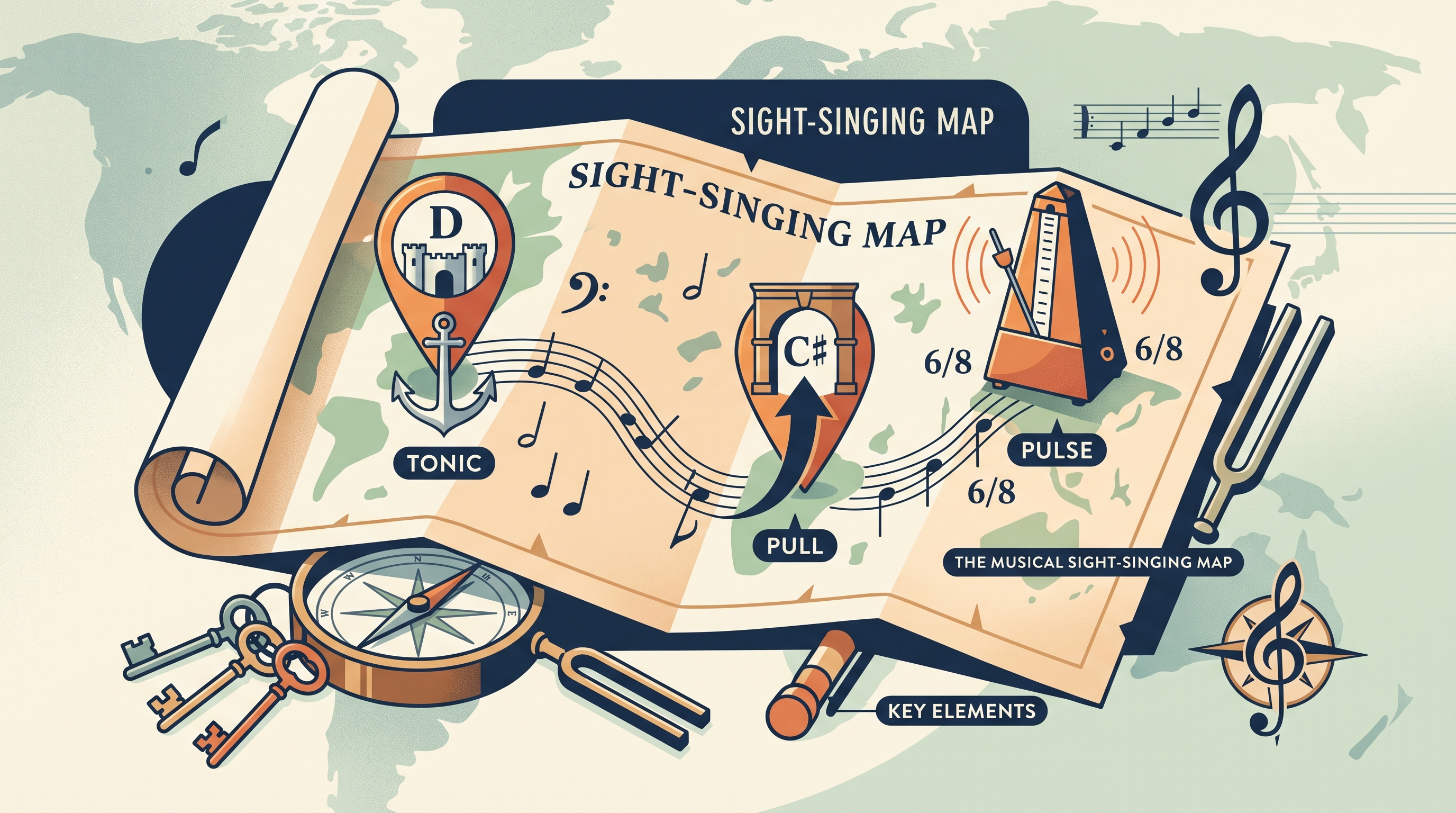
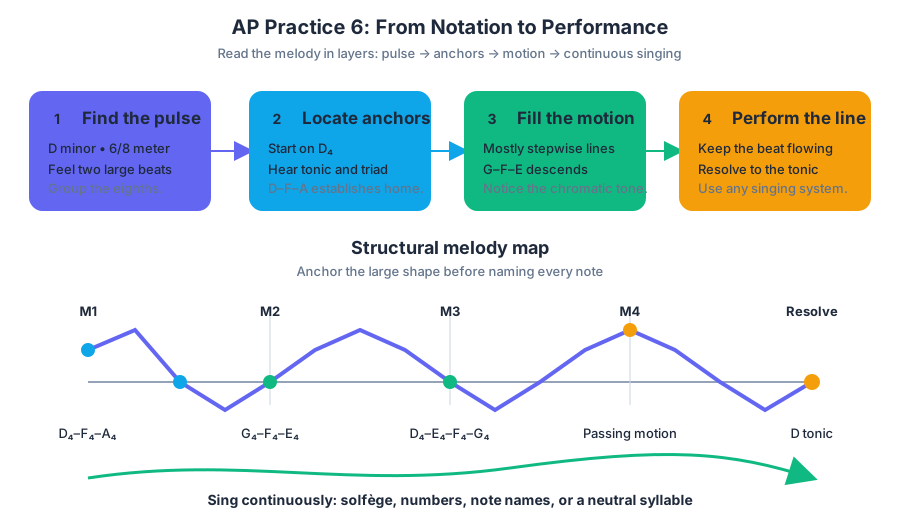
Source Materials
- Learn More (.pdf)
- AP Music Theory Course and Exam Description
- AP Music Theory Course Overview
- AP Music Theory Course at a Glance
- AP Music Theory Course at a Glance Poster
- Adopt AP Music Theory
- AP Music Theory
- AP Music Theory
- Figure — AP Music Theory Course and Exam Description (p. 1)
- Figure — AP Music Theory Course and Exam Description (p. 17)
- Pacing recommendations for each unit are suggestions for how to allocate teaching time and administer the Personal Progress Checks. Class periods are based on a 45-minute class period, meeting five da
- Figure — AP Music Theory Course and Exam Description (p. 29)
Study AP Music Theory with AI — Free on Lykke
Sign up for free to generate personalized flashcards, quizzes, and study guides from this course. Chat with an AI tutor that knows the material.
Get Started FreeView this course wiki on Lykke · Browse all public course wikis