Interactive Demo
The Trap Door Effect Simulator
The Trap Door Effect Simulator is a free, interactive learning demo from the Think Python, 2nd edition course on Lykke. It helps you build intuition for Trap door effect, Pedagogical goals, Python 3 transition, Open-source collaboration. Play with it directly in your browser — it features 3 sliders, 1 button and a live visual canvas. This demo lives in the “Introduction and Pedagogical Goals” section of the course.
How to use this demo
- Drag the “Scaffolding Strength: 50”, “Curriculum Pace: 5” sliders to change the inputs and watch the result update live.
- Use the “Restart Simulation” button to trigger actions or reset the demo.
- Experiment freely — there's nothing to break, and every change is reversible.
What you'll explore
- Trap door effect
- Pedagogical goals
- Python 3 transition
- Open-source collaboration
- Debugging techniques
Frequently asked questions
What does the The Trap Door Effect Simulator demo do?
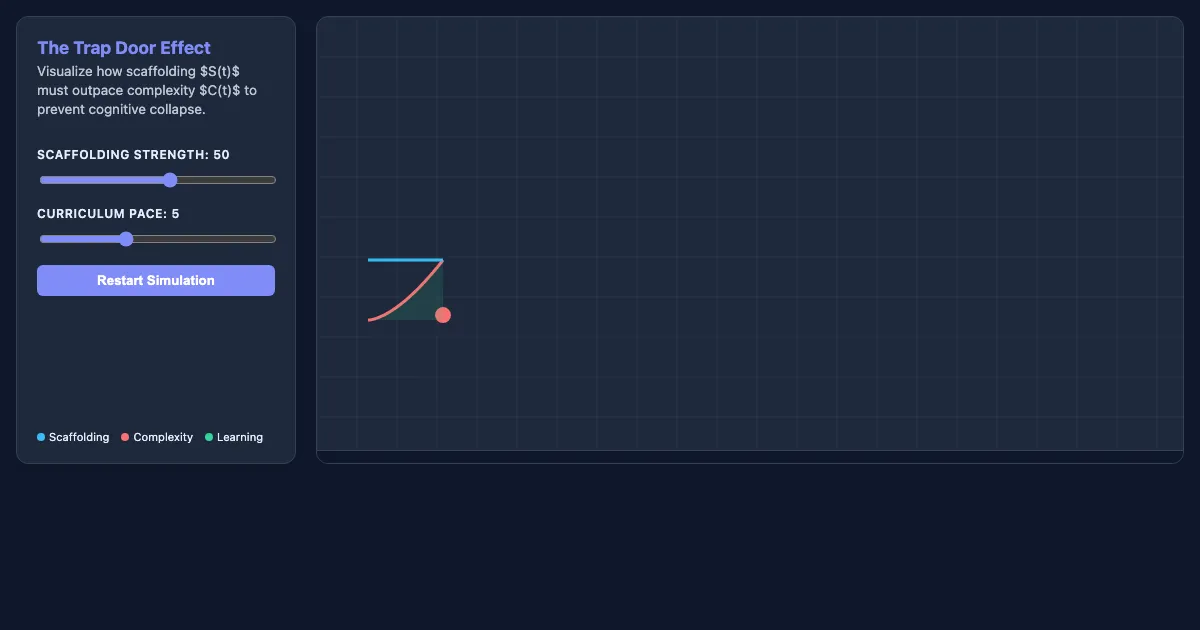
The Trap Door Effect Simulator The Trap Door Effect Visualize how scaffolding must outpace complexity to prevent cognitive collapse. Scaffolding Strength: 50 Curriculum Pace: 5 Restart Simulation Scaffolding Complexity Learning Adjust the sliders and press Restart to see if the student survives the curriculum. The Trap Door Effect Simulator lets you explore this hands-on instead of only reading about it.
What Think Python, 2nd edition concept does The Trap Door Effect Simulator teach?
This section outlines the history and philosophy of the course, emphasizing a concise approach to teaching computer science and the transition to Python 3. It focuses on Trap door effect, Pedagogical goals, Python 3 transition, Open-source collaboration, Debugging techniques from the “Introduction and Pedagogical Goals” section.
What can I control in The Trap Door Effect Simulator?
The “Scaffolding Strength: 50”, “Curriculum Pace: 5” sliders change the key inputs; the “Restart Simulation” button run actions or reset the demo. Every change updates the visualization in real time, so you can see exactly how each variable affects the outcome.
How does The Trap Door Effect Simulator fit into the Think Python, 2nd edition course?
Think Python, 2nd Edition, is an introductory computer science course designed to teach programming through the Python language. It emphasizes a concise, jargon-free approach, focusing on fundamental concepts like debug… This demo is the interactive piece for the “Introduction and Pedagogical Goals” section. Open the full Think Python, 2nd edition course wiki at https://www.getlykke.com/explore/public/think-python-2nd-edition-ff823fa0-9e72-490d-bf5f-19c0512d9bf1 for notes, flashcards, quizzes and the other demos.
What will I understand better after using The Trap Door Effect Simulator?
You'll build intuition for Trap door effect, Pedagogical goals, Python 3 transition, Open-source collaboration, Debugging techniques — and, crucially, see how they behave when you change the inputs, which is hard to get from a textbook or lecture on Think Python, 2nd edition alone.
From the Think Python, 2nd edition course
This interactive demo is part of the Introduction and Pedagogical Goals section. Explore the full Think Python, 2nd edition course wiki on Lykke — with notes, flashcards, quizzes and more interactive demos.
Open the Think Python, 2nd edition course →