Interactive Demo
The Seat Allocation Engine
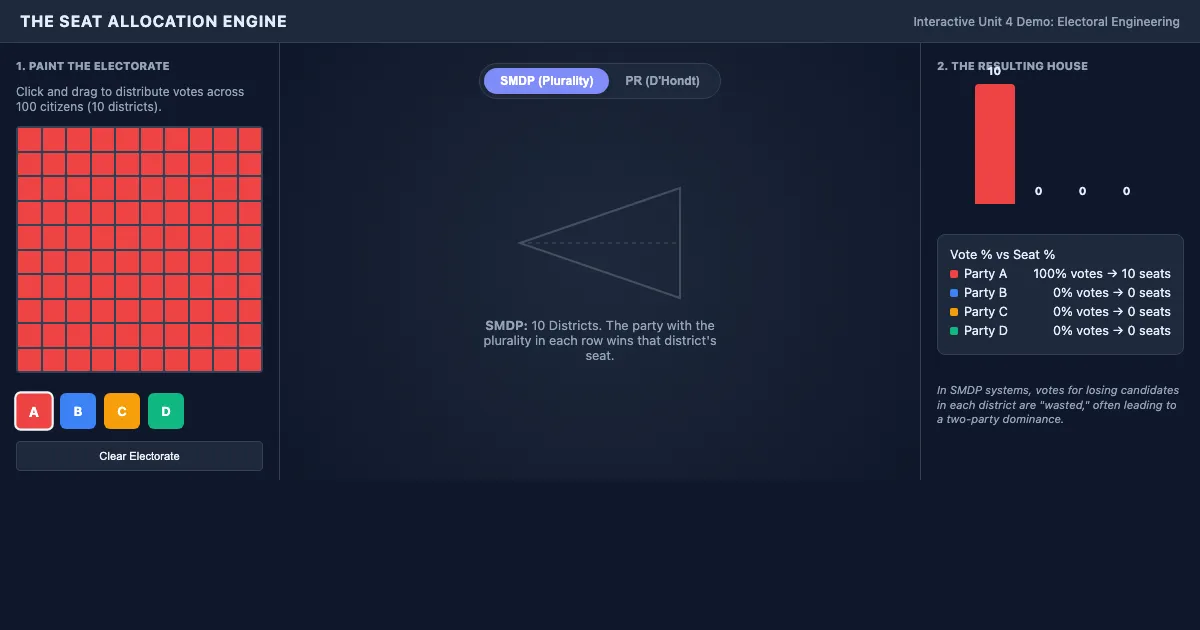
The Seat Allocation Engine is a free, interactive learning demo from the AP Comparative Government and Politics course on Lykke. It helps you build intuition for Proportional Representation, Single-Member District Plurality, Multi-party Systems, Two-party Systems. Play with it directly in your browser — it features 3 buttons and direct drag interaction. This demo lives in the “Unit 4: Party and Electoral Systems and Citizen Organizations” section of the course.
How to use this demo
- Click and drag directly on the canvas to manipulate the scene.
- Use the “Clear Electorate”, “SMDP (Plurality)”, “PR (D'Hondt)” buttons to trigger actions or reset the demo.
- Experiment freely — there's nothing to break, and every change is reversible.
What you'll explore
- Proportional Representation
- Single-Member District Plurality
- Multi-party Systems
- Two-party Systems
- Social Movements
- Interest Groups
- Electoral Rules
Frequently asked questions
What does the The Seat Allocation Engine demo do?
Paint the Electorate Click and drag to distribute votes across 100 citizens (10 districts). The party with the plurality in each row wins that district's seat. The Seat Allocation Engine lets you explore this hands-on instead of only reading about it.
What AP Comparative Government and Politics concept does The Seat Allocation Engine teach?
This unit focuses on the mechanisms through which citizens choose their leaders and the organizations, such as political parties and social movements, that represent their interests. It focuses on Proportional Representation, Single-Member District Plurality, Multi-party Systems, Two-party Systems, Social Movements, Interest Groups from the “Unit 4: Party and Electoral Systems and Citizen Organizations” section.
What can I control in The Seat Allocation Engine?
You can drag elements directly on the canvas; the “Clear Electorate”, “SMDP (Plurality)”, “PR (D'Hondt)” buttons run actions or reset the demo. Every change updates the visualization in real time, so you can see exactly how each variable affects the outcome.
How does The Seat Allocation Engine fit into the AP Comparative Government and Politics course?
AP Comparative Government and Politics introduces students to the complex world of global politics by analyzing the structures and challenges of six core countries: China, Iran, Mexico, Nigeria, Russia, and the United K… This demo is the interactive piece for the “Unit 4: Party and Electoral Systems and Citizen Organizations” section. Open the full AP Comparative Government and Politics course wiki at https://www.getlykke.com/explore/public/ap-comparative-government-and-politics-8324ab45-8a6b-4519-be08-73c29c1090f8 for notes, flashcards, quizzes and the other demos.
What will I understand better after using The Seat Allocation Engine?
You'll build intuition for Proportional Representation, Single-Member District Plurality, Multi-party Systems, Two-party Systems, Social Movements, Interest Groups — and, crucially, see how they behave when you change the inputs, which is hard to get from a textbook or lecture on AP Comparative Government and Politics alone.
From the AP Comparative Government and Politics course
This interactive demo is part of the Unit 4: Party and Electoral Systems and Citizen Organizations section. Explore the full AP Comparative Government and Politics course wiki on Lykke — with notes, flashcards, quizzes and more interactive demos.
Open the AP Comparative Government and Politics course →