Interactive Demo
The Modal Prism
The Modal Prism is a free, interactive learning demo from the AP Music Theory course on Lykke. It helps you build intuition for Church Modes (Dorian, Phrygian, Lydian, etc.), Pentatonic and Whole-Tone Scales, Binary and Ternary Form, Sonata-Allegro Form. Play with it directly in your browser — it features 7 buttons and a live visual canvas. This demo lives in the “Unit 8: Modes and Form” section of the course.
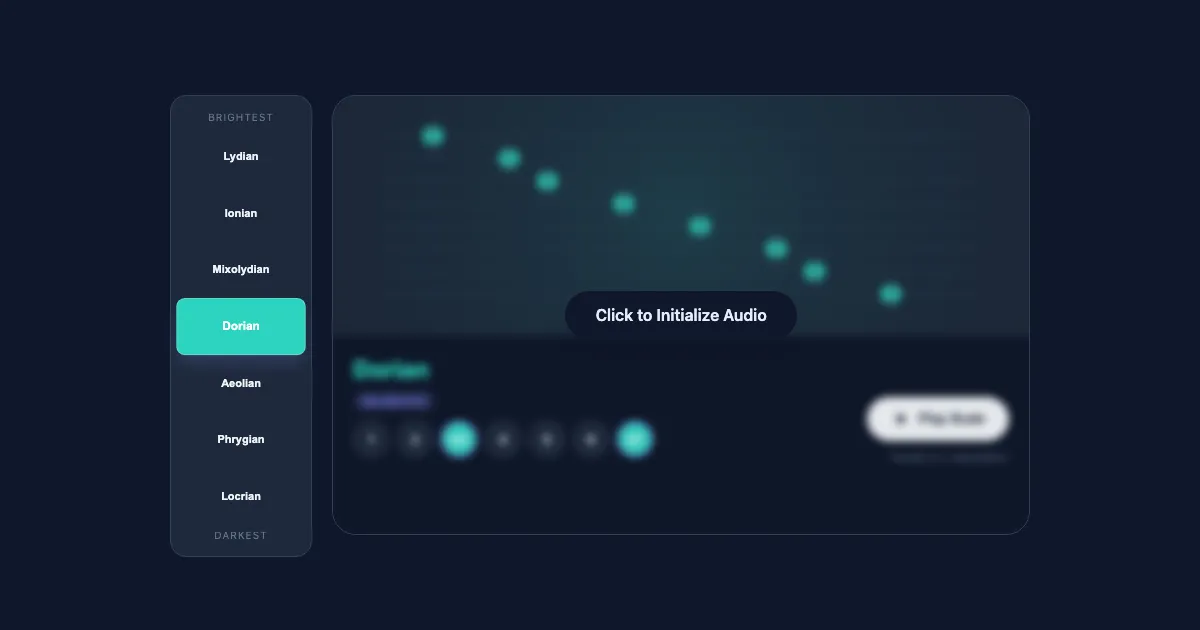
How to use this demo
- Use the “Lydian”, “Ionian”, “Mixolydian”, “Dorian” buttons to trigger actions or reset the demo.
- Experiment freely — there's nothing to break, and every change is reversible.
What you'll explore
- Church Modes (Dorian, Phrygian, Lydian, etc.)
- Pentatonic and Whole-Tone Scales
- Binary and Ternary Form
- Sonata-Allegro Form
- Theme and Variations
Frequently asked questions
What does the The Modal Prism demo do?
The final unit explores musical structures beyond the major/minor system, including church modes and large-scale formal designs like sonata and rondo form. The Modal Prism turns that idea into something you can manipulate directly and watch respond.
What AP Music Theory concept does The Modal Prism teach?
The final unit explores musical structures beyond the major/minor system, including church modes and large-scale formal designs like sonata and rondo form. It focuses on Church Modes (Dorian, Phrygian, Lydian, etc.), Pentatonic and Whole-Tone Scales, Binary and Ternary Form, Sonata-Allegro Form, Theme and Variations from the “Unit 8: Modes and Form” section.
What can I control in The Modal Prism?
The “Lydian”, “Ionian”, “Mixolydian”, “Dorian” buttons run actions or reset the demo. Every change updates the visualization in real time, so you can see exactly how each variable affects the outcome.
How does The Modal Prism fit into the AP Music Theory course?
AP Music Theory is an introductory college-level course that develops students' understanding of music through the analysis of performed and notated works. The curriculum integrates written theory with aural skills, cov… This demo is the interactive piece for the “Unit 8: Modes and Form” section. Open the full AP Music Theory course wiki at https://www.getlykke.com/explore/public/ap-music-theory-64526a5a-2b9d-4c74-956a-c2957679aa84 for notes, flashcards, quizzes and the other demos.
What will I understand better after using The Modal Prism?
You'll build intuition for Church Modes (Dorian, Phrygian, Lydian, etc.), Pentatonic and Whole-Tone Scales, Binary and Ternary Form, Sonata-Allegro Form, Theme and Variations — and, crucially, see how they behave when you change the inputs, which is hard to get from a textbook or lecture on AP Music Theory alone.
From the AP Music Theory course
This interactive demo is part of the Unit 8: Modes and Form section. Explore the full AP Music Theory course wiki on Lykke — with notes, flashcards, quizzes and more interactive demos.
Open the AP Music Theory course →