Interactive Demo
The Distortion Engine: S.A.D.D. Analysis
The Distortion Engine: S.A.D.D. Analysis is a free, interactive learning demo from the AP Human Geography course on Lykke. It helps you build intuition for Absolute vs. Relative Location, Geographic Information Systems (GIS), Remote Sensing, Map Projection and Distortion. Play with it directly in your browser — it features 3 buttons, direct drag interaction and a live visual canvas. This demo lives in the “Unit 1: Thinking Geographically” section of the course.
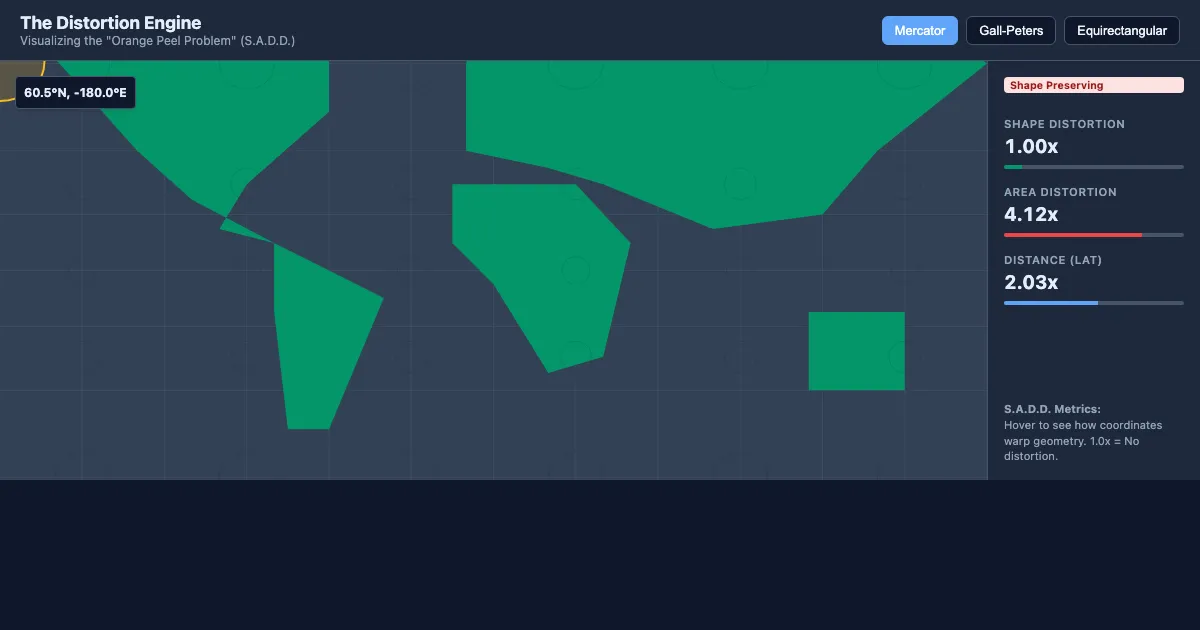
How to use this demo
- Click and drag directly on the canvas to manipulate the scene.
- Use the “Mercator”, “Gall-Peters”, “Equirectangular” buttons to trigger actions or reset the demo.
- Experiment freely — there's nothing to break, and every change is reversible.
What you'll explore
- Absolute vs. Relative Location
- Geographic Information Systems (GIS)
- Remote Sensing
- Map Projection and Distortion
- Formal, Functional, and Perceptual Regions
- Distance Decay
- Time-Space Compression
Frequently asked questions
What does the The Distortion Engine: S.A.D.D. Analysis demo do?
Metrics: Hover to see how coordinates warp geometry. The Distortion Engine: S.A.D.D. Analysis lets you explore this hands-on instead of only reading about it.
What AP Human Geography concept does The Distortion Engine: S.A.D.D. Analysis teach?
Unit 1 provides the toolkit for geographic inquiry, focusing on how geographers collect, analyze, and display data. Students learn to distinguish between different types of maps, understand the implications of scale, an… It focuses on Absolute vs. Relative Location, Geographic Information Systems (GIS), Remote Sensing, Map Projection and Distortion, Formal, Functional, and Perceptual Regions, Distance Decay from the “Unit 1: Thinking Geographically” section.
What can I control in The Distortion Engine: S.A.D.D. Analysis?
You can drag elements directly on the canvas; the “Mercator”, “Gall-Peters”, “Equirectangular” buttons run actions or reset the demo. Every change updates the visualization in real time, so you can see exactly how each variable affects the outcome.
How does The Distortion Engine: S.A.D.D. Analysis fit into the AP Human Geography course?
AP Human Geography introduces students to the systematic study of patterns and processes that have shaped human understanding, use, and alteration of Earth's surface. Students employ spatial concepts and landscape analy… This demo is the interactive piece for the “Unit 1: Thinking Geographically” section. Open the full AP Human Geography course wiki at https://www.getlykke.com/explore/public/ap-human-geography-689b4df1-0d85-4ac5-a723-f52936dce101 for notes, flashcards, quizzes and the other demos.
What will I understand better after using The Distortion Engine: S.A.D.D. Analysis?
You'll build intuition for Absolute vs. Relative Location, Geographic Information Systems (GIS), Remote Sensing, Map Projection and Distortion, Formal, Functional, and Perceptual Regions, Distance Decay — and, crucially, see how they behave when you change the inputs, which is hard to get from a textbook or lecture on AP Human Geography alone.
From the AP Human Geography course
This interactive demo is part of the Unit 1: Thinking Geographically section. Explore the full AP Human Geography course wiki on Lykke — with notes, flashcards, quizzes and more interactive demos.
Open the AP Human Geography course →