Interactive Demo
The Berlin Arbitrator: Scramble for Africa
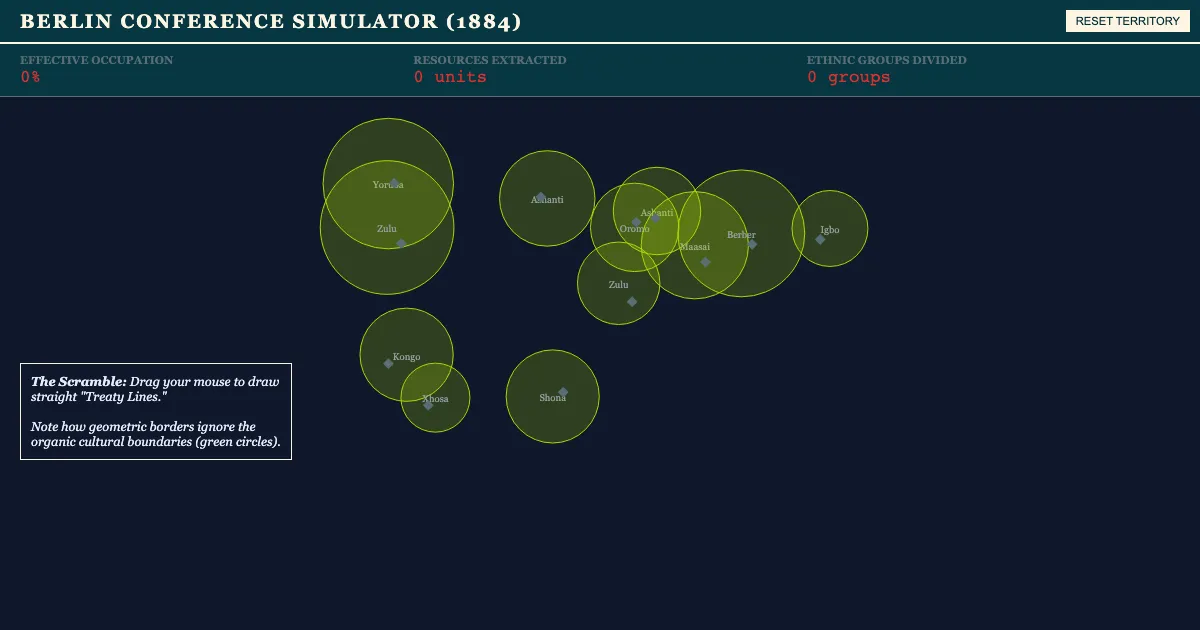
The Berlin Arbitrator: Scramble for Africa is a free, interactive learning demo from the AP World History: Modern course on Lykke. It helps you build intuition for Social Darwinism, The Scramble for Africa (Berlin Conference), Imperialism in East Asia and India, Indigenous Responses to State Expansion. Play with it directly in your browser — it features 1 button and direct drag interaction. This demo lives in the “Unit 6: Consequences of Industrialization” section of the course.
How to use this demo
- Click and drag directly on the canvas to manipulate the scene.
- Use the “Reset Territory” button to trigger actions or reset the demo.
- Experiment freely — there's nothing to break, and every change is reversible.
What you'll explore
- Social Darwinism
- The Scramble for Africa (Berlin Conference)
- Imperialism in East Asia and India
- Indigenous Responses to State Expansion
- Global Migration Patterns
- Economic Imperialism
Frequently asked questions
What does the The Berlin Arbitrator: Scramble for Africa demo do?
Industrialized nations used their technological and economic advantages to expand their empires between 1750 and 1900. This unit examines the motives for imperialism, the methods of state expansion in Africa and Asia, a… The Berlin Arbitrator: Scramble for Africa turns that idea into something you can manipulate directly and watch respond.
What AP World History: Modern concept does The Berlin Arbitrator: Scramble for Africa teach?
Industrialized nations used their technological and economic advantages to expand their empires between 1750 and 1900. This unit examines the motives for imperialism, the methods of state expansion in Africa and Asia, a… It focuses on Social Darwinism, The Scramble for Africa (Berlin Conference), Imperialism in East Asia and India, Indigenous Responses to State Expansion, Global Migration Patterns, Economic Imperialism from the “Unit 6: Consequences of Industrialization” section.
What can I control in The Berlin Arbitrator: Scramble for Africa?
You can drag elements directly on the canvas; the “Reset Territory” button run actions or reset the demo. Every change updates the visualization in real time, so you can see exactly how each variable affects the outcome.
How does The Berlin Arbitrator: Scramble for Africa fit into the AP World History: Modern course?
AP World History: Modern is a college-level course that explores the global story from c. 1200 CE to the present. Students investigate the evolution of human societies through six analytical themes: environment, culture… This demo is the interactive piece for the “Unit 6: Consequences of Industrialization” section. Open the full AP World History: Modern course wiki at https://www.getlykke.com/explore/public/ap-world-history-modern-fbf3fc6c-f39b-4da7-bd1c-09b2c21fa289 for notes, flashcards, quizzes and the other demos.
What will I understand better after using The Berlin Arbitrator: Scramble for Africa?
You'll build intuition for Social Darwinism, The Scramble for Africa (Berlin Conference), Imperialism in East Asia and India, Indigenous Responses to State Expansion, Global Migration Patterns, Economic Imperialism — and, crucially, see how they behave when you change the inputs, which is hard to get from a textbook or lecture on AP World History: Modern alone.
From the AP World History: Modern course
This interactive demo is part of the Unit 6: Consequences of Industrialization section. Explore the full AP World History: Modern course wiki on Lykke — with notes, flashcards, quizzes and more interactive demos.
Open the AP World History: Modern course →