Interactive Demo
Schlieffen Plan: The Failed Algorithm
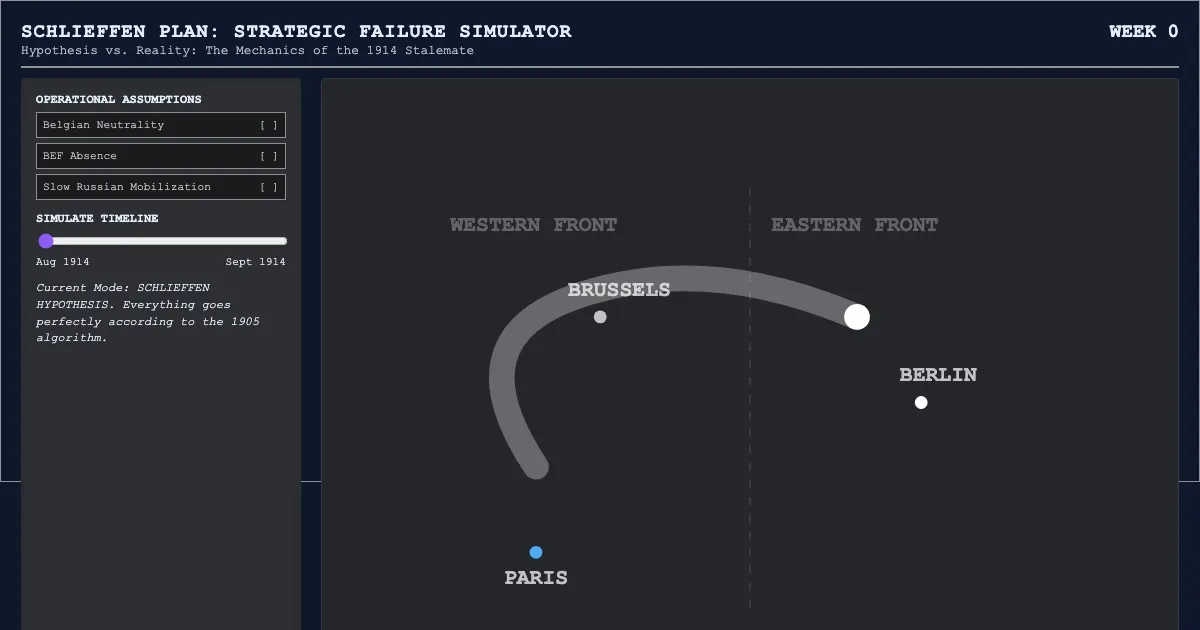
Schlieffen Plan: The Failed Algorithm is a free, interactive learning demo from the AP European History course on Lykke. It helps you build intuition for Total War, The Treaty of Versailles, The Russian Revolution (1917), The Great Depression. Play with it directly in your browser — it features 1 slider and 3 buttons. Move slider to advance the "Right Wing" pivot. This demo lives in the “Unit 8: 20th-Century Global Conflicts” section of the course.
How to use this demo
- Move slider to advance the "Right Wing" pivot.
- Drag the “Operational Assumptions”, “Simulate Timeline” sliders to change the inputs and watch the result update live.
- Use the “Belgian Neutrality”, “BEF Absence”, “Slow Russian Mobilization” buttons to trigger actions or reset the demo.
- Experiment freely — there's nothing to break, and every change is reversible.
What you'll explore
- Total War
- The Treaty of Versailles
- The Russian Revolution (1917)
- The Great Depression
- Fascism and Nazism
- The Holocaust
- World War II
Frequently asked questions
What does the Schlieffen Plan: The Failed Algorithm demo do?
Analyzes the causes and consequences of the two World Wars and the rise of totalitarianism. Schlieffen Plan: The Failed Algorithm turns that idea into something you can manipulate directly and watch respond.
What AP European History concept does Schlieffen Plan: The Failed Algorithm teach?
Analyzes the causes and consequences of the two World Wars and the rise of totalitarianism. It focuses on Total War, The Treaty of Versailles, The Russian Revolution (1917), The Great Depression, Fascism and Nazism, The Holocaust from the “Unit 8: 20th-Century Global Conflicts” section.
What can I control in Schlieffen Plan: The Failed Algorithm?
The “Operational Assumptions”, “Simulate Timeline” sliders change the key inputs; the “Belgian Neutrality”, “BEF Absence”, “Slow Russian Mobilization” buttons run actions or reset the demo. Every change updates the visualization in real time, so you can see exactly how each variable affects the outcome.
How does Schlieffen Plan: The Failed Algorithm fit into the AP European History course?
AP European History is a college-level course that explores the cultural, economic, political, and social developments that have shaped Europe from 1450 to the present. Students analyze primary and secondary sources to… This demo is the interactive piece for the “Unit 8: 20th-Century Global Conflicts” section. Open the full AP European History course wiki at https://www.getlykke.com/explore/public/ap-european-history-71b79c1b-e1c4-4e70-a76d-9bbaf0a79898 for notes, flashcards, quizzes and the other demos.
What will I understand better after using Schlieffen Plan: The Failed Algorithm?
You'll build intuition for Total War, The Treaty of Versailles, The Russian Revolution (1917), The Great Depression, Fascism and Nazism, The Holocaust — and, crucially, see how they behave when you change the inputs, which is hard to get from a textbook or lecture on AP European History alone.
From the AP European History course
This interactive demo is part of the Unit 8: 20th-Century Global Conflicts section. Explore the full AP European History course wiki on Lykke — with notes, flashcards, quizzes and more interactive demos.
Open the AP European History course →