Interactive Demo
Logic & Soundness Visualizer
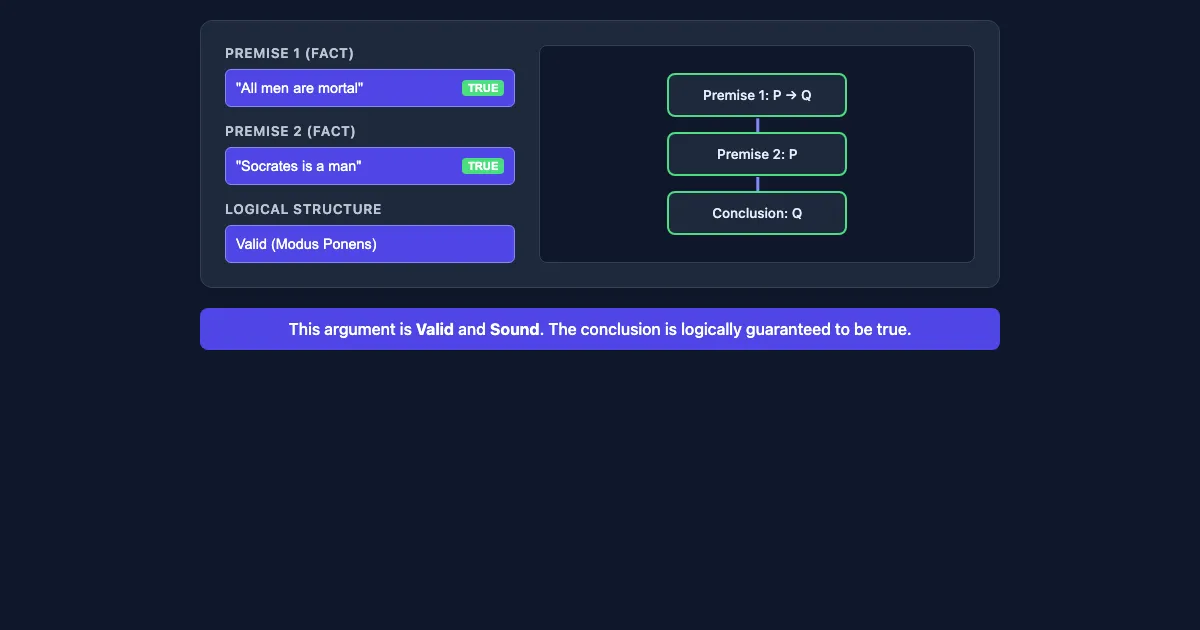
Logic & Soundness Visualizer is a free, interactive learning demo from the Introduction Philosophy course on Lykke. It helps you build intuition for Deductive Reasoning, Inductive Reasoning, Logical Fallacies, Syllogisms. Play with it directly in your browser — it features interactive elements you can explore. This demo lives in the “Logic and Critical Thinking” section of the course.
How to use this demo
- Experiment freely — there's nothing to break, and every change is reversible.
What you'll explore
- Deductive Reasoning
- Inductive Reasoning
- Logical Fallacies
- Syllogisms
Frequently asked questions
What does the Logic & Soundness Visualizer demo do?
An introduction to the formal and informal tools of philosophical inquiry, focusing on the structure of arguments and the methods of reasoning. Logic & Soundness Visualizer turns that idea into something you can manipulate directly and watch respond.
What Introduction Philosophy concept does Logic & Soundness Visualizer teach?
An introduction to the formal and informal tools of philosophical inquiry, focusing on the structure of arguments and the methods of reasoning. It focuses on Deductive Reasoning, Inductive Reasoning, Logical Fallacies, Syllogisms from the “Logic and Critical Thinking” section.
How does Logic & Soundness Visualizer fit into the Introduction Philosophy course?
OpenStax's Introduction to Philosophy provides a comprehensive, thematic exploration of the fundamental branches of philosophical thought. The course is designed to build critical thinking and analytical skills by engag… This demo is the interactive piece for the “Logic and Critical Thinking” section. Open the full Introduction Philosophy course wiki at https://www.getlykke.com/explore/public/introduction-philosophy-1a18dc12-b581-475b-ab67-809c8bfd2d13 for notes, flashcards, quizzes and the other demos.
What will I understand better after using Logic & Soundness Visualizer?
You'll build intuition for Deductive Reasoning, Inductive Reasoning, Logical Fallacies, Syllogisms — and, crucially, see how they behave when you change the inputs, which is hard to get from a textbook or lecture on Introduction Philosophy alone.
From the Introduction Philosophy course
This interactive demo is part of the Logic and Critical Thinking section. Explore the full Introduction Philosophy course wiki on Lykke — with notes, flashcards, quizzes and more interactive demos.
Open the Introduction Philosophy course →