Interactive Demo
Interactive Root-Finding Demo
Interactive Root-Finding Demo is a free, interactive learning demo from the CS323: Numerical Analysis and Computing course on Lykke. It helps you build intuition for Root-Finding Methods (Newton's, Secant, Bisection), Convergence Analysis, Polynomial Interpolation (Lagrange, Vandermonde, Newton), Interpolation Error Analysis. Play with it directly in your browser — it features 3 buttons, direct drag interaction and a live visual canvas. This demo lives in the “Midterm 2: Review and Assessment” section of the course.
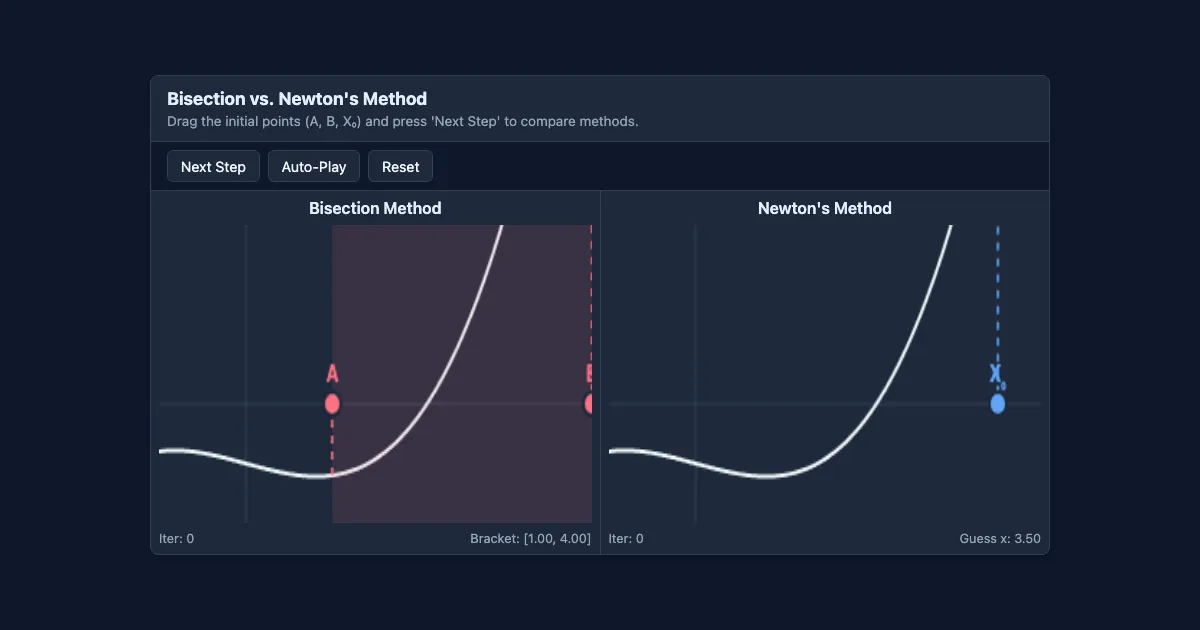
How to use this demo
- Click and drag directly on the canvas to manipulate the scene.
- Use the “Next Step”, “Auto-Play”, “Reset” buttons to trigger actions or reset the demo.
- Experiment freely — there's nothing to break, and every change is reversible.
What you'll explore
- Root-Finding Methods (Newton's, Secant, Bisection)
- Convergence Analysis
- Polynomial Interpolation (Lagrange, Vandermonde, Newton)
- Interpolation Error Analysis
- Piecewise vs. Global Interpolation
Frequently asked questions
What does the Interactive Root-Finding Demo demo do?
Newton's Method Drag the initial points (A, B, X₀) and press 'Next Step' to compare methods. Interactive Root-Finding Demo lets you explore this hands-on instead of only reading about it.
What CS323: Numerical Analysis and Computing concept does Interactive Root-Finding Demo teach?
This module provides a comprehensive review for the second midterm, focusing on root-finding and polynomial interpolation. It includes a practice exam and solutions that test the theoretical understanding and practical… It focuses on Root-Finding Methods (Newton's, Secant, Bisection), Convergence Analysis, Polynomial Interpolation (Lagrange, Vandermonde, Newton), Interpolation Error Analysis, Piecewise vs. Global Interpolation from the “Midterm 2: Review and Assessment” section.
What can I control in Interactive Root-Finding Demo?
You can drag elements directly on the canvas; the “Next Step”, “Auto-Play”, “Reset” buttons run actions or reset the demo. Every change updates the visualization in real time, so you can see exactly how each variable affects the outcome.
How does Interactive Root-Finding Demo fit into the CS323: Numerical Analysis and Computing course?
CS323 provides a comprehensive introduction to numerical algorithms, focusing on practical implementation and real-world applications. The course begins with the fundamentals of computational error and floating-point ar… This demo is the interactive piece for the “Midterm 2: Review and Assessment” section. Open the full CS323: Numerical Analysis and Computing course wiki at https://www.getlykke.com/explore/public/cs323-numerical-analysis-and-computing-7146330a-2792-4961-9bd5-0e42fb092c87 for notes, flashcards, quizzes and the other demos.
What will I understand better after using Interactive Root-Finding Demo?
You'll build intuition for Root-Finding Methods (Newton's, Secant, Bisection), Convergence Analysis, Polynomial Interpolation (Lagrange, Vandermonde, Newton), Interpolation Error Analysis, Piecewise vs. Global Interpolation — and, crucially, see how they behave when you change the inputs, which is hard to get from a textbook or lecture on CS323: Numerical Analysis and Computing alone.
From the CS323: Numerical Analysis and Computing course
This interactive demo is part of the Midterm 2: Review and Assessment section. Explore the full CS323: Numerical Analysis and Computing course wiki on Lykke — with notes, flashcards, quizzes and more interactive demos.
Open the CS323: Numerical Analysis and Computing course →