Interactive Demo
Gothic Structural Logic Demo
Gothic Structural Logic Demo is a free, interactive learning demo from the AP Art History course on Lykke. It helps you build intuition for Byzantine Iconography, Gothic Verticality and Light, Renaissance Humanism, Baroque Drama and Tenebrism. Play with it directly in your browser — it features 1 slider and 2 buttons. This demo lives in the “Unit 3: Early Europe and Colonial Americas, 200–1750 CE” section of the course.
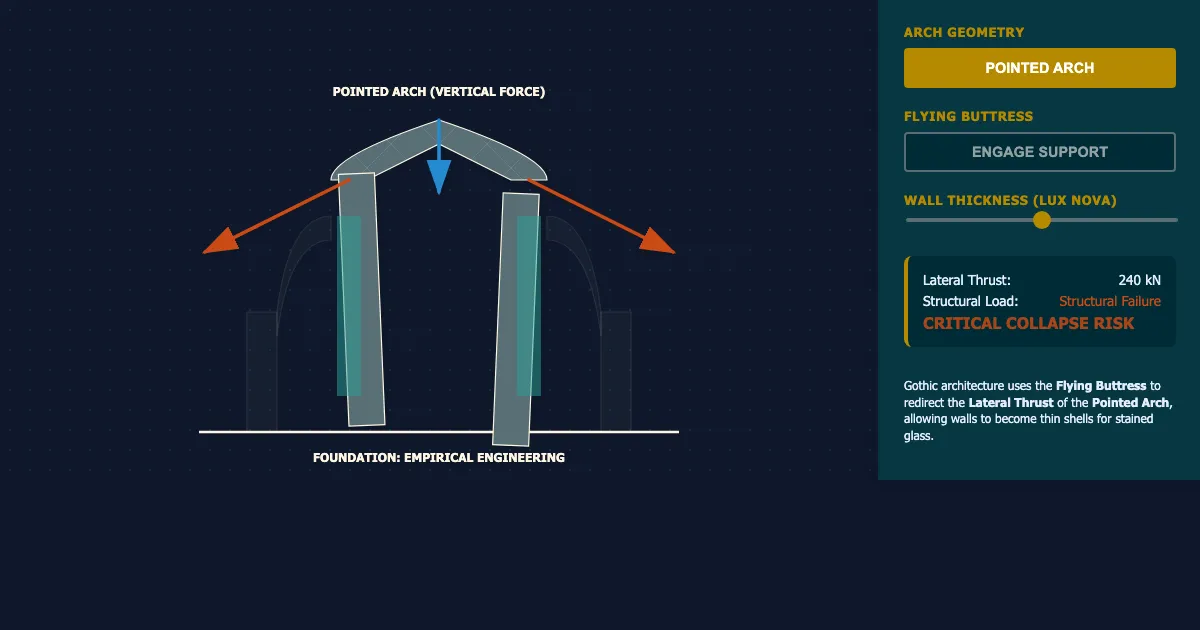
How to use this demo
- Drag the sliders to change the inputs and watch the visualization update in real time.
- Use the “POINTED ARCH”, “ENGAGE SUPPORT” buttons to trigger actions or reset the demo.
- Experiment freely — there's nothing to break, and every change is reversible.
What you'll explore
- Byzantine Iconography
- Gothic Verticality and Light
- Renaissance Humanism
- Baroque Drama and Tenebrism
- Syncretism in Colonial Art
- The Protestant Reformation's Impact
Frequently asked questions
What does the Gothic Structural Logic Demo demo do?
This unit covers the rise of Christian, Islamic, and Medieval art in Europe, leading into the Renaissance, Baroque, and the artistic exchanges resulting from European colonization in the Americas. Gothic Structural Logic Demo turns that idea into something you can manipulate directly and watch respond.
What AP Art History concept does Gothic Structural Logic Demo teach?
This unit covers the rise of Christian, Islamic, and Medieval art in Europe, leading into the Renaissance, Baroque, and the artistic exchanges resulting from European colonization in the Americas. It focuses on Byzantine Iconography, Gothic Verticality and Light, Renaissance Humanism, Baroque Drama and Tenebrism, Syncretism in Colonial Art, The Protestant Reformation's Impact from the “Unit 3: Early Europe and Colonial Americas, 200–1750 CE” section.
What can I control in Gothic Structural Logic Demo?
The sliders change the key inputs; the “POINTED ARCH”, “ENGAGE SUPPORT” buttons run actions or reset the demo. Every change updates the visualization in real time, so you can see exactly how each variable affects the outcome.
How does Gothic Structural Logic Demo fit into the AP Art History course?
AP Art History is a college-level survey course that explores the nature of art, its uses, and its meanings through the investigation of 250 prescribed works of art spanning from prehistory to the present. Students deve… This demo is the interactive piece for the “Unit 3: Early Europe and Colonial Americas, 200–1750 CE” section. Open the full AP Art History course wiki at https://www.getlykke.com/explore/public/ap-art-history-f51173a9-1720-4a4e-ae2a-947e74f02bf7 for notes, flashcards, quizzes and the other demos.
What will I understand better after using Gothic Structural Logic Demo?
You'll build intuition for Byzantine Iconography, Gothic Verticality and Light, Renaissance Humanism, Baroque Drama and Tenebrism, Syncretism in Colonial Art, The Protestant Reformation's Impact — and, crucially, see how they behave when you change the inputs, which is hard to get from a textbook or lecture on AP Art History alone.
From the AP Art History course
This interactive demo is part of the Unit 3: Early Europe and Colonial Americas, 200–1750 CE section. Explore the full AP Art History course wiki on Lykke — with notes, flashcards, quizzes and more interactive demos.
Open the AP Art History course →