Interactive Demo
The Oxygen Sag Simulator
The Oxygen Sag Simulator is a free, interactive learning demo from the AP Environmental Science course on Lykke. It helps you build intuition for Point vs. Nonpoint Source Pollution, Eutrophication and Dead Zones, Endocrine Disruptors, Bioaccumulation and Biomagnification. Play with it directly in your browser — it features 4 sliders, direct drag interaction and a live visual canvas. This demo lives in the “Unit 8: Aquatic and Terrestrial Pollution” section of the course.
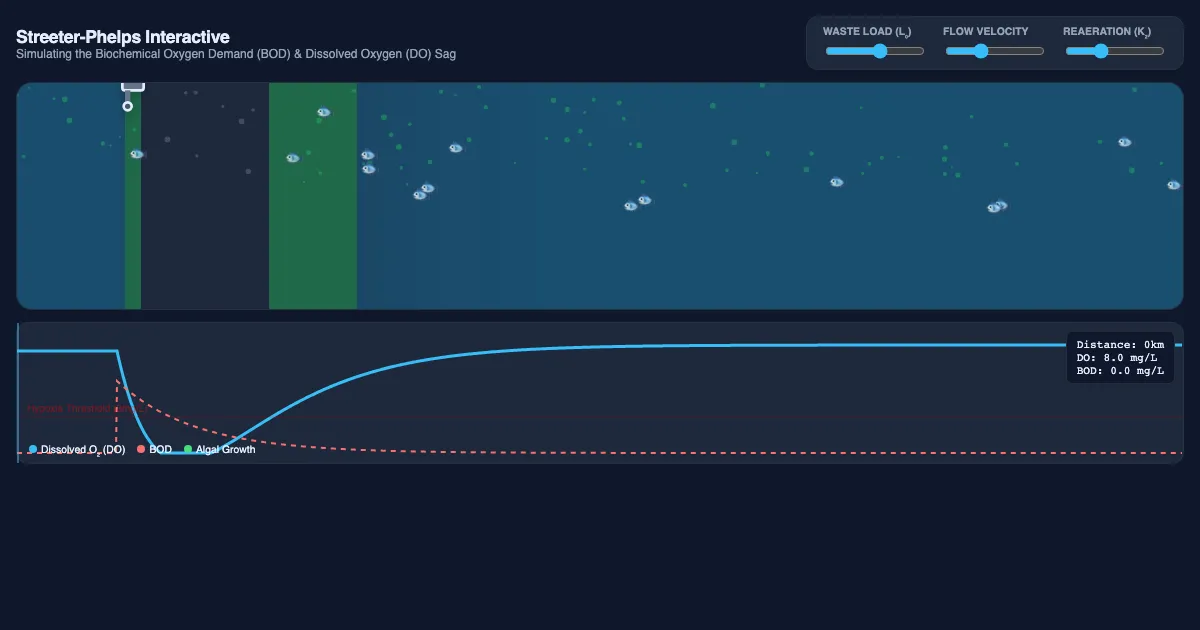
How to use this demo
- Drag the “Waste Load (L₀)”, “Flow Velocity”, “Reaeration (k₂)” sliders to change the inputs and watch the result update live.
- Click and drag directly on the canvas to manipulate the scene.
- Experiment freely — there's nothing to break, and every change is reversible.
What you'll explore
- Point vs. Nonpoint Source Pollution
- Eutrophication and Dead Zones
- Endocrine Disruptors
- Bioaccumulation and Biomagnification
- Solid Waste Management and Landfills
- Sewage Treatment Processes
- Lethal Dose 50% (LD50)
Frequently asked questions
What does the The Oxygen Sag Simulator demo do?
Students examine the impact of pollution on water and land ecosystems. The unit covers point and nonpoint source pollution, waste management, and the biological effects of toxins like endocrine disruptors. The Oxygen Sag Simulator turns that idea into something you can manipulate directly and watch respond.
What AP Environmental Science concept does The Oxygen Sag Simulator teach?
Students examine the impact of pollution on water and land ecosystems. The unit covers point and nonpoint source pollution, waste management, and the biological effects of toxins like endocrine disruptors. It focuses on Point vs. Nonpoint Source Pollution, Eutrophication and Dead Zones, Endocrine Disruptors, Bioaccumulation and Biomagnification, Solid Waste Management and Landfills, Sewage Treatment Processes from the “Unit 8: Aquatic and Terrestrial Pollution” section.
What can I control in The Oxygen Sag Simulator?
The “Waste Load (L₀)”, “Flow Velocity”, “Reaeration (k₂)” sliders change the key inputs; you can drag elements directly on the canvas. Every change updates the visualization in real time, so you can see exactly how each variable affects the outcome.
How does The Oxygen Sag Simulator fit into the AP Environmental Science course?
AP Environmental Science is a college-level, interdisciplinary course that explores the scientific principles, concepts, and methodologies required to understand the interrelationships of the natural world. Students ana… This demo is the interactive piece for the “Unit 8: Aquatic and Terrestrial Pollution” section. Open the full AP Environmental Science course wiki at https://www.getlykke.com/explore/public/ap-environmental-science-124e55a4-e4f5-4ce3-89ab-e0beebe215fe for notes, flashcards, quizzes and the other demos.
What will I understand better after using The Oxygen Sag Simulator?
You'll build intuition for Point vs. Nonpoint Source Pollution, Eutrophication and Dead Zones, Endocrine Disruptors, Bioaccumulation and Biomagnification, Solid Waste Management and Landfills, Sewage Treatment Processes — and, crucially, see how they behave when you change the inputs, which is hard to get from a textbook or lecture on AP Environmental Science alone.
From the AP Environmental Science course
This interactive demo is part of the Unit 8: Aquatic and Terrestrial Pollution section. Explore the full AP Environmental Science course wiki on Lykke — with notes, flashcards, quizzes and more interactive demos.
Open the AP Environmental Science course →