Interactive Demo
The Historical Prism
The Historical Prism is a free, interactive learning demo from the AP European History course on Lykke. It helps you build intuition for Historical Thinking Skills, Reasoning Processes (Comparison, Causation, Continuity/Change), Thematic Lenses (INT, ECD, CID, SOP, SCD, NEI, TSI), Sourcing and Situation. Play with it directly in your browser — it features 2 buttons. Click a lens on the left to refract the event. This demo lives in the “Course Framework, Themes, and Historical Thinking” section of the course.
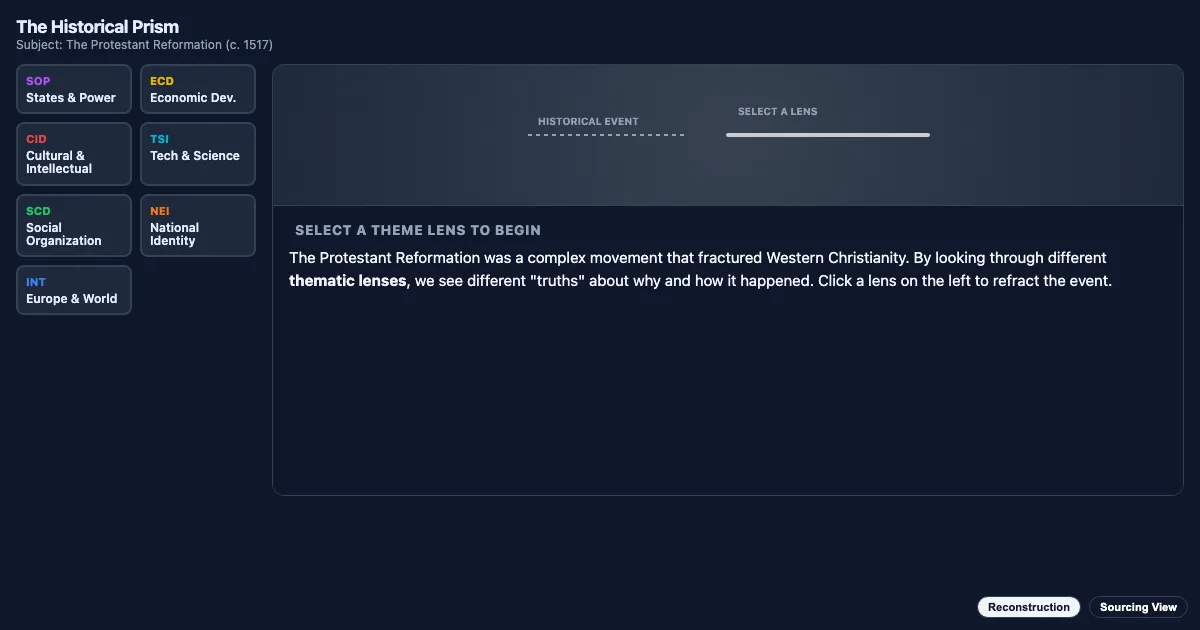
How to use this demo
- Click a lens on the left to refract the event.
- Use the “Reconstruction”, “Sourcing View” buttons to trigger actions or reset the demo.
- Experiment freely — there's nothing to break, and every change is reversible.
What you'll explore
- Historical Thinking Skills
- Reasoning Processes (Comparison, Causation, Continuity/Change)
- Thematic Lenses (INT, ECD, CID, SOP, SCD, NEI, TSI)
- Sourcing and Situation
- Claims and Evidence in Sources
- Contextualization
- Making Historical Connections
- Argumentation
Frequently asked questions
What does the The Historical Prism demo do?
1517) Reconstruction Sourcing View HISTORICAL EVENT SELECT A LENS Select a theme lens to begin The Protestant Reformation was a complex movement that fractured Western Christianity. By looking through different thematic lenses, we see different "truths" about why and how it happened. The Historical Prism lets you explore this hands-on instead of only reading about it.
What AP European History concept does The Historical Prism teach?
This section introduces the structural foundation of the AP European History course, focusing on the seven thematic lenses and six historical thinking skills required for mastery. It focuses on Historical Thinking Skills, Reasoning Processes (Comparison, Causation, Continuity/Change), Thematic Lenses (INT, ECD, CID, SOP, SCD, NEI, TSI), Sourcing and Situation, Claims and Evidence in Sources, Contextualization from the “Course Framework, Themes, and Historical Thinking” section.
What can I control in The Historical Prism?
The “Reconstruction”, “Sourcing View” buttons run actions or reset the demo. Every change updates the visualization in real time, so you can see exactly how each variable affects the outcome.
How does The Historical Prism fit into the AP European History course?
AP European History is a college-level course that explores the cultural, economic, political, and social developments that have shaped Europe from 1450 to the present. Students analyze primary and secondary sources to… This demo is the interactive piece for the “Course Framework, Themes, and Historical Thinking” section. Open the full AP European History course wiki at https://www.getlykke.com/explore/public/ap-european-history-71b79c1b-e1c4-4e70-a76d-9bbaf0a79898 for notes, flashcards, quizzes and the other demos.
What will I understand better after using The Historical Prism?
You'll build intuition for Historical Thinking Skills, Reasoning Processes (Comparison, Causation, Continuity/Change), Thematic Lenses (INT, ECD, CID, SOP, SCD, NEI, TSI), Sourcing and Situation, Claims and Evidence in Sources, Contextualization — and, crucially, see how they behave when you change the inputs, which is hard to get from a textbook or lecture on AP European History alone.
From the AP European History course
This interactive demo is part of the Course Framework, Themes, and Historical Thinking section. Explore the full AP European History course wiki on Lykke — with notes, flashcards, quizzes and more interactive demos.
Open the AP European History course →