Interactive Demo
The 1848 Pipeline: Mechanics of Revolution
The 1848 Pipeline: Mechanics of Revolution is a free, interactive learning demo from the AP European History course on Lykke. It helps you build intuition for Nationalism, The Revolutions of 1848, Unification of Italy (Cavour/Garibaldi), Unification of Germany (Bismarck). Play with it directly in your browser — it features 1 button. This demo lives in the “Unit 7: 19th-Century Perspectives and Political Developments” section of the course.
How to use this demo
- Use the “Reset Demo” button to trigger actions or reset the demo.
- Experiment freely — there's nothing to break, and every change is reversible.
What you'll explore
- Nationalism
- The Revolutions of 1848
- Unification of Italy (Cavour/Garibaldi)
- Unification of Germany (Bismarck)
- Realpolitik
- New Imperialism
- Social Darwinism
Frequently asked questions
What does the The 1848 Pipeline: Mechanics of Revolution demo do?
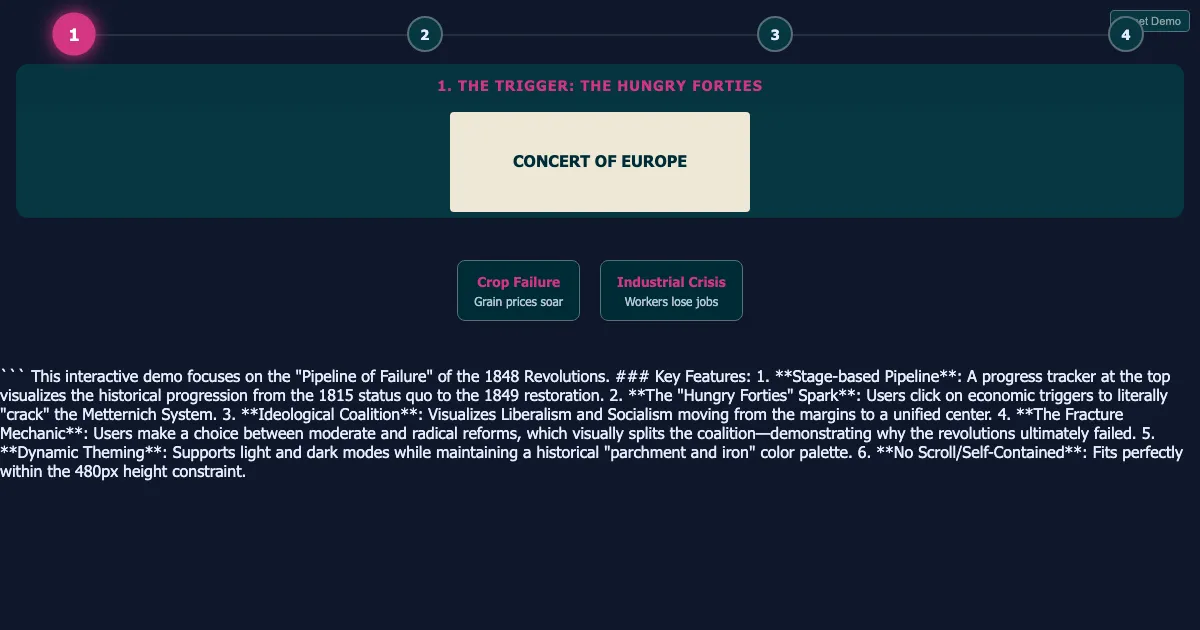
**Stage-based Pipeline**: A progress tracker at the top visualizes the historical progression from the 1815 status quo to the 1849 restoration. **The "Hungry Forties" Spark**: Users click on economic triggers to literally "crack" the Metternich System. The 1848 Pipeline: Mechanics of Revolution lets you explore this hands-on instead of only reading about it.
What AP European History concept does The 1848 Pipeline: Mechanics of Revolution teach?
Examines the rise of nationalism, the unification of new nation-states, and the era of New Imperialism. It focuses on Nationalism, The Revolutions of 1848, Unification of Italy (Cavour/Garibaldi), Unification of Germany (Bismarck), Realpolitik, New Imperialism from the “Unit 7: 19th-Century Perspectives and Political Developments” section.
What can I control in The 1848 Pipeline: Mechanics of Revolution?
The “Reset Demo” button run actions or reset the demo. Every change updates the visualization in real time, so you can see exactly how each variable affects the outcome.
How does The 1848 Pipeline: Mechanics of Revolution fit into the AP European History course?
AP European History is a college-level course that explores the cultural, economic, political, and social developments that have shaped Europe from 1450 to the present. Students analyze primary and secondary sources to… This demo is the interactive piece for the “Unit 7: 19th-Century Perspectives and Political Developments” section. Open the full AP European History course wiki at https://www.getlykke.com/explore/public/ap-european-history-71b79c1b-e1c4-4e70-a76d-9bbaf0a79898 for notes, flashcards, quizzes and the other demos.
What will I understand better after using The 1848 Pipeline: Mechanics of Revolution?
You'll build intuition for Nationalism, The Revolutions of 1848, Unification of Italy (Cavour/Garibaldi), Unification of Germany (Bismarck), Realpolitik, New Imperialism — and, crucially, see how they behave when you change the inputs, which is hard to get from a textbook or lecture on AP European History alone.
From the AP European History course
This interactive demo is part of the Unit 7: 19th-Century Perspectives and Political Developments section. Explore the full AP European History course wiki on Lykke — with notes, flashcards, quizzes and more interactive demos.
Open the AP European History course →